

Chem. J. Chinese Universities ›› 2026, Vol. 47 ›› Issue (10): 20260245.doi: 10.7503/cjcu20260245
• Physical Chemistry • Previous Articles Next Articles
GAO Fen’e1( ), WANG Ruiying1, GUO Junlan1, ZHANG Xi1, CHENG Shangyuan2, YUAN Zhiguo2(), LIU Jingyao3()
Received:2026-06-23
Online:2026-10-10
Published:2026-09-03
Contact:
GAO Fen’e, YUAN Zhiguo, LIU Jingyao
E-mail:gaofene@sxct.edu.cn;ncustyzg@nuc.edu.cn;ljy121@jlu.edu.cn
Supported by:CLC Number:
TrendMD:
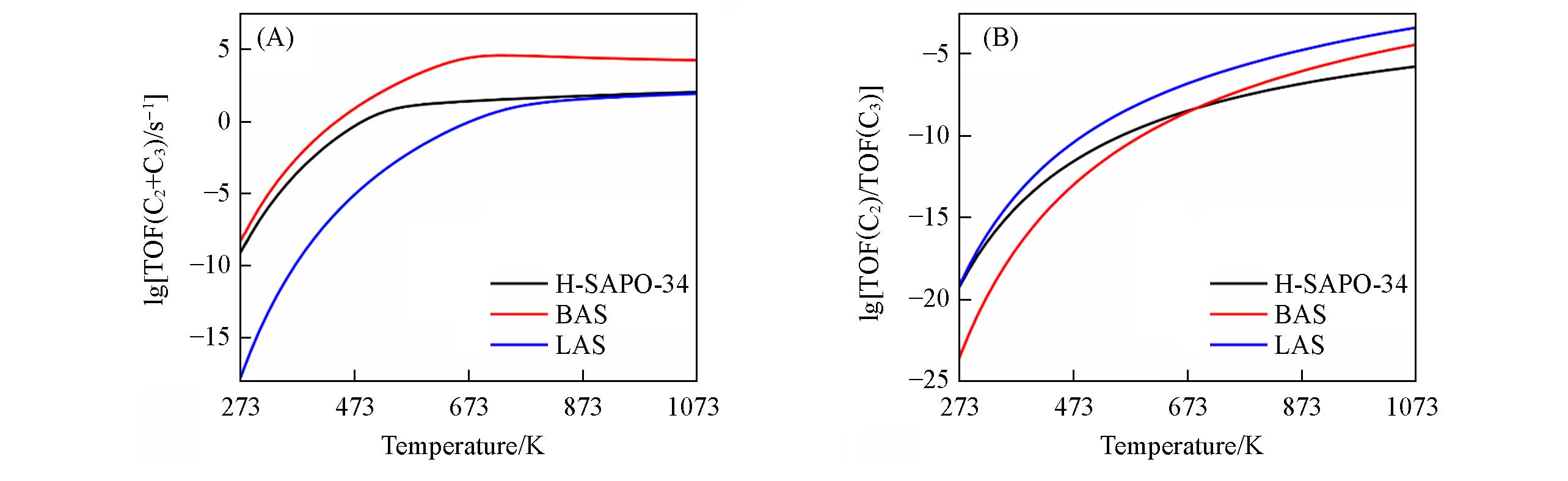
GAO Fen’e, WANG Ruiying, GUO Junlan, ZHANG Xi, CHENG Shangyuan, YUAN Zhiguo, LIU Jingyao. Theoretical Study of the Influence of H-SAPO-34 Modified with Zn2+ on Olefin-based Cycles During Methanol-to-olefins Reaction[J]. Chem. J. Chinese Universities, 2026, 47(10): 20260245.
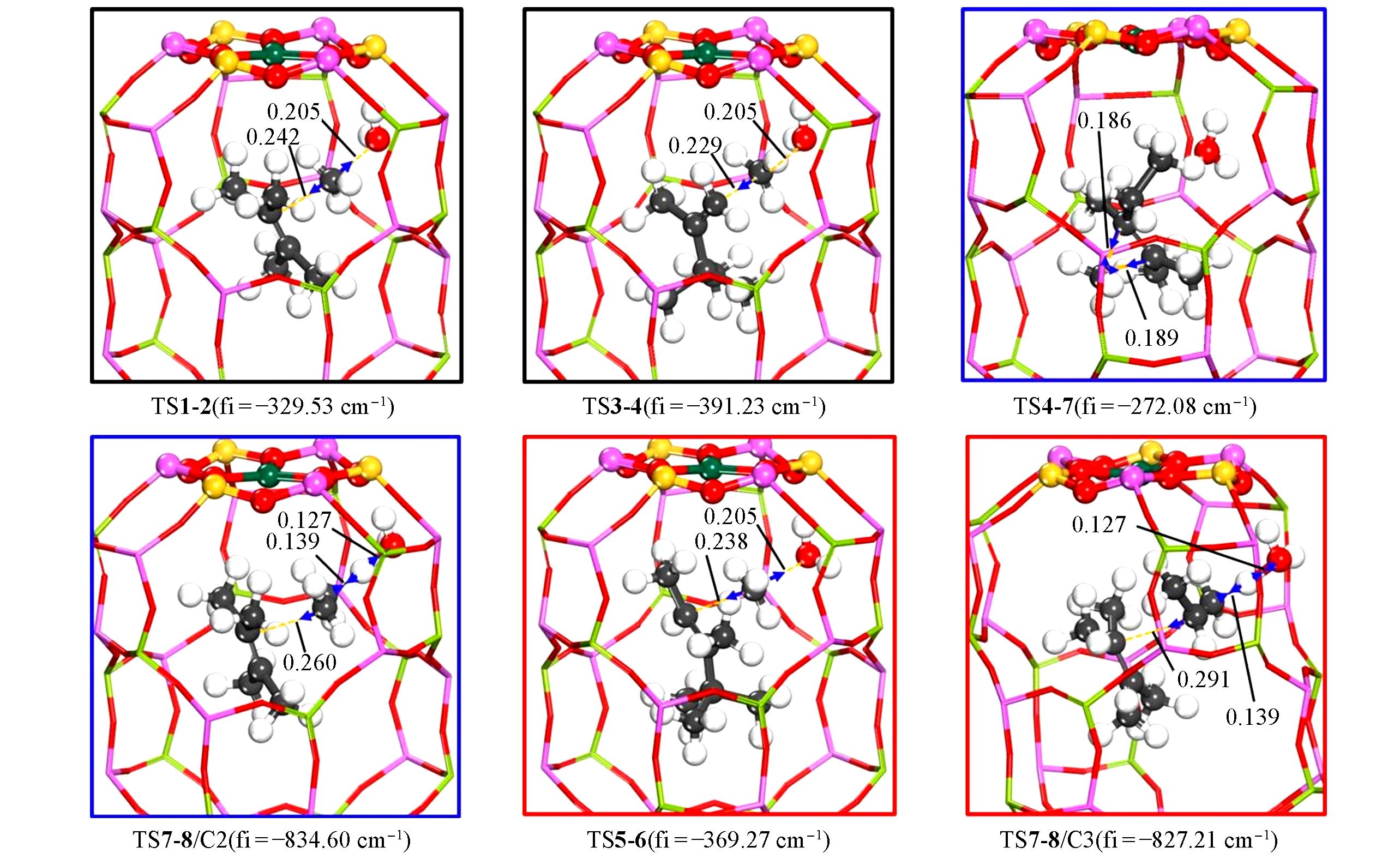
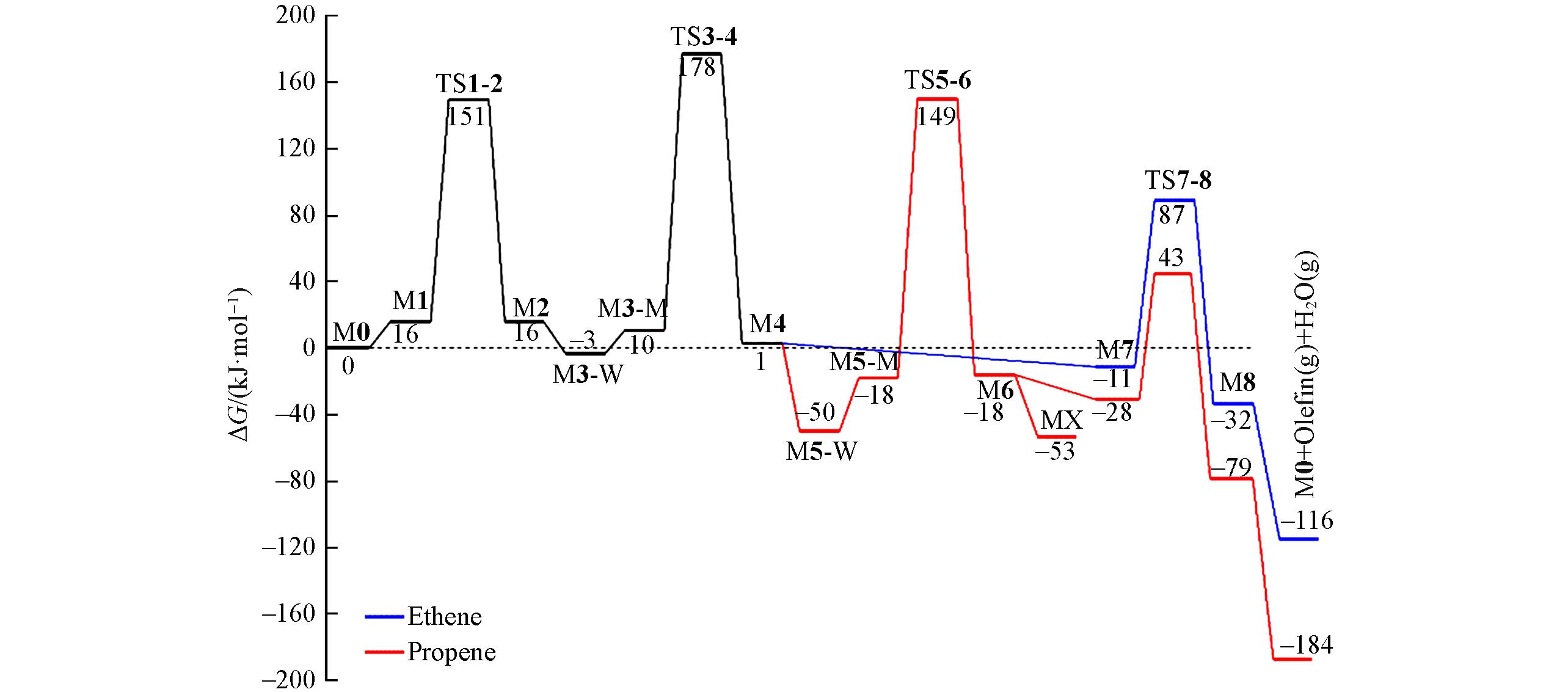
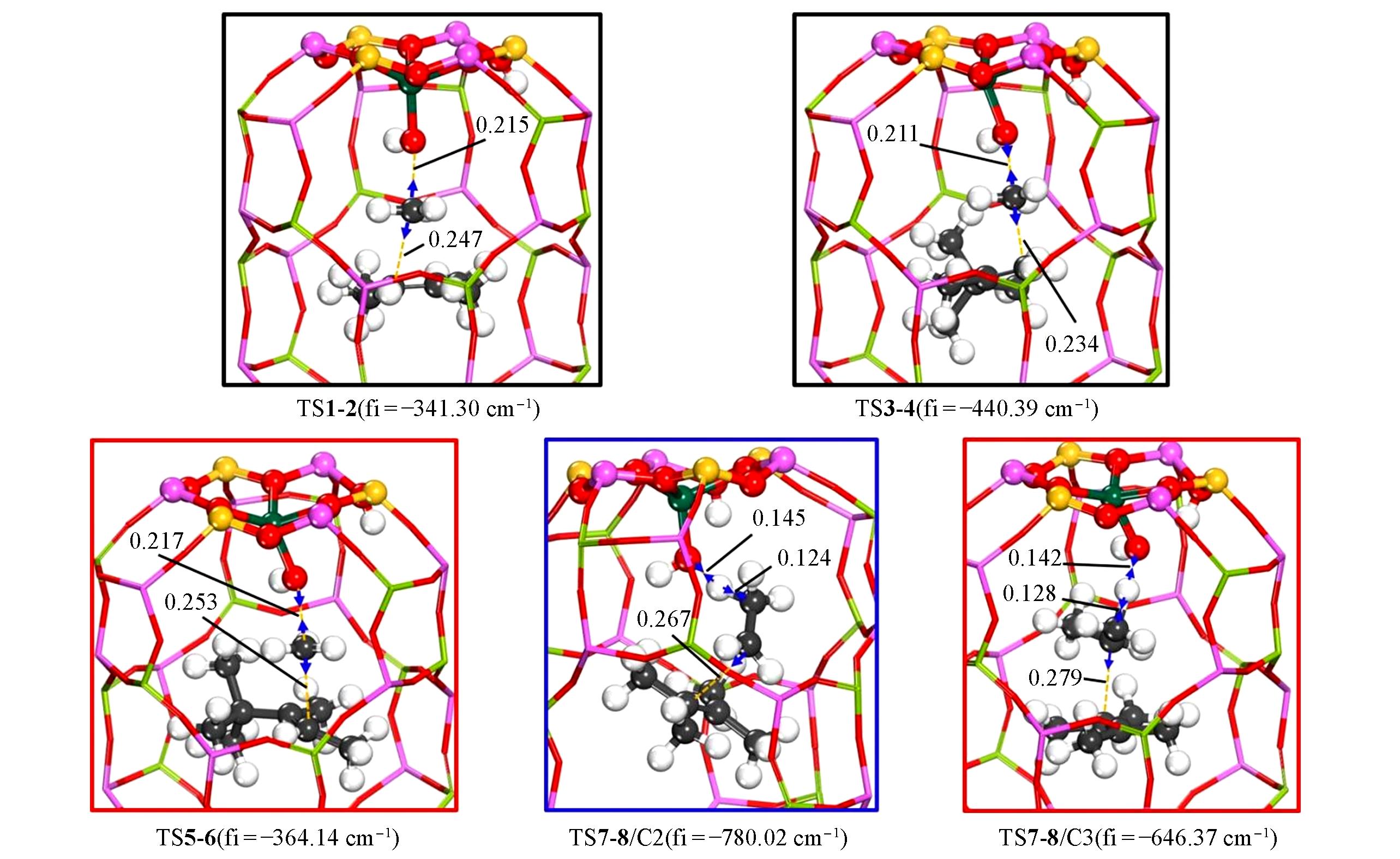
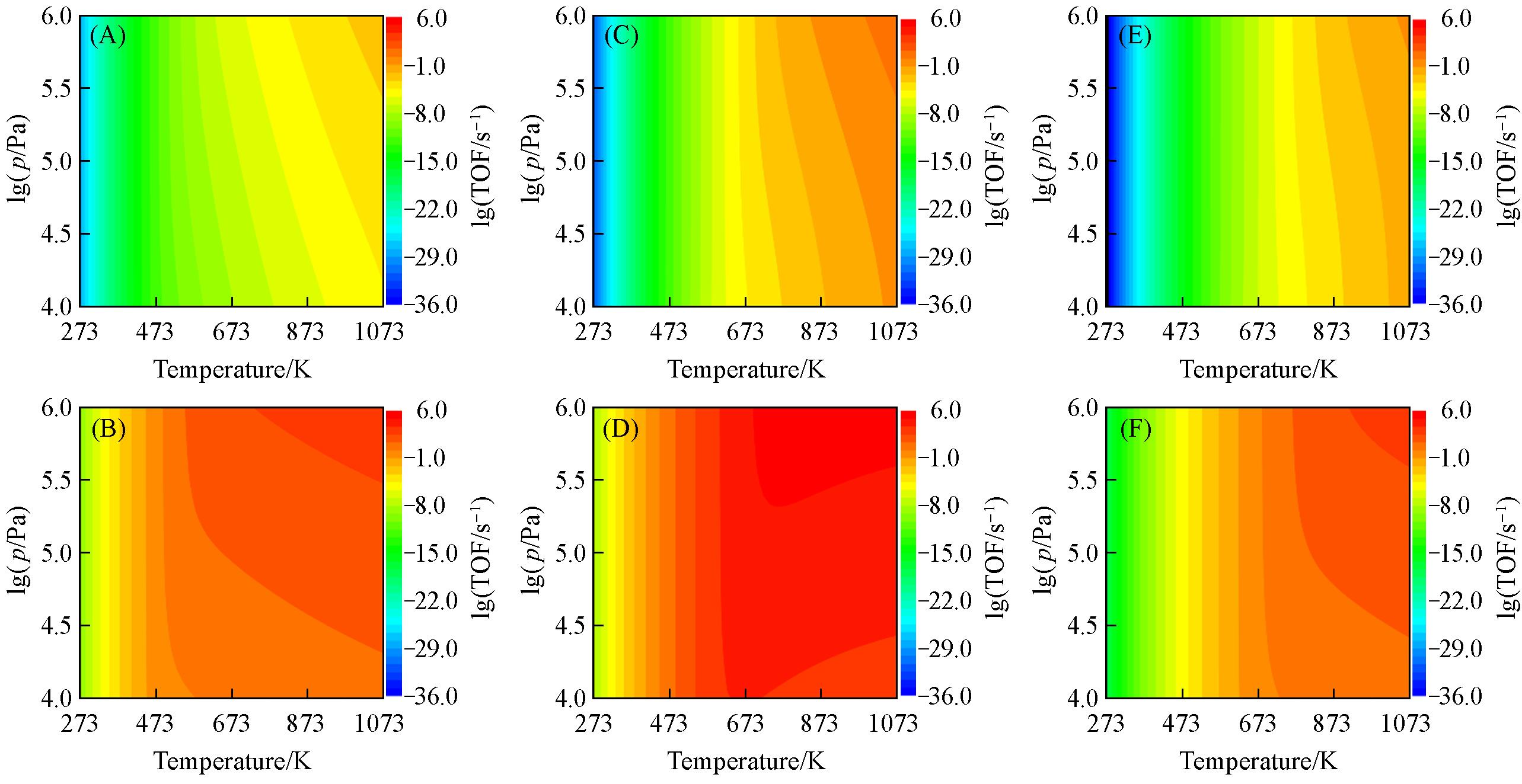
| Site | ΔGmeth/(kJ∙mol-1) | ΔGcrack/(kJ∙mol-1) | ΔGpara/(kJ∙mol-1) | ΔGover/(kJ∙mol-1) | TOF/s-1 |
|---|---|---|---|---|---|
| 1st/2nd/3rd | C2H4/C3H6 | C2H4/C3H6 | C2H4/C3H6 | C2H4/C3H6 | |
| H⁃SAPO⁃34(BAS) | 109/125/119 | 95/61 | 174/135 | 174/149 | 8.2×10⁻⁸/2.5×101 |
| Zn@H⁃SAPO⁃34(BAS) | 79/85/92 | 97/73 | 131/112 | 131/112 | 6.9×10⁻⁵/2.5×104 |
| Zn@H⁃SAPO⁃34(LAS) | 135/168/167 | 98/71 | 137/199 | 181/199 | 1.4×10⁻⁷/9.2×10-1 |
Table 1 Gibbs free energy barriers(ΔG) and turnover frequencies(TOF) for the olefin cycle at different active sites in H-SAPO-34 and Zn@H-SAPO-34 at 673 K*
| Site | ΔGmeth/(kJ∙mol-1) | ΔGcrack/(kJ∙mol-1) | ΔGpara/(kJ∙mol-1) | ΔGover/(kJ∙mol-1) | TOF/s-1 |
|---|---|---|---|---|---|
| 1st/2nd/3rd | C2H4/C3H6 | C2H4/C3H6 | C2H4/C3H6 | C2H4/C3H6 | |
| H⁃SAPO⁃34(BAS) | 109/125/119 | 95/61 | 174/135 | 174/149 | 8.2×10⁻⁸/2.5×101 |
| Zn@H⁃SAPO⁃34(BAS) | 79/85/92 | 97/73 | 131/112 | 131/112 | 6.9×10⁻⁵/2.5×104 |
| Zn@H⁃SAPO⁃34(LAS) | 135/168/167 | 98/71 | 137/199 | 181/199 | 1.4×10⁻⁷/9.2×10-1 |
| [1] | Hannula I., Arpiainen V., Biomass Convers. Bior., 2015, 5(1), 63—74 |
| [2] | Olsbye U., Svelle S., Bjorgen M., Beato P., Janssens T. V., Joensen F., Bordiga S., Lillerud K. P., Angew. Chem. Int. Ed., 2012, 51(24), 5810—5831 |
| [3] | Tian P., Wei Y., Ye M., Liu Z., ACS Catal., 2015, 5(3), 1922—1938 |
| [4] | Al Hussami R., Ghavipour M., Nasser G., Duah C., Yousef S., Kopyscinski J., J. Mater. Chem. A, 2026, 14(1), 90—179 |
| [5] | Li J. F., Fan W. B., Dong M., He Y., Qin Z. F., Wang J. G., Chem. J. Chinese Universities, 2011, 32(3), 765—771 |
| 李俊汾, 樊卫斌, 董梅, 何月, 秦张峰, 王建国. 高等学校化学学报, 2011, 32(3), 765—771 | |
| [6] | Guo S. J., Wang S., Zhang L., Qin Z. F., Wang P. F., Dong M., Wang J. G., Fan W. B., Chem. J. Chinese Universities, 2021, 42(1), 227—238 |
| 郭淑佳, 王森, 张莉, 秦张峰, 王鹏飞, 董梅, 王建国, 樊卫斌. 高等学校化学学报, 2021, 42(1), 227—238 | |
| [7] | Ilias S., Bhan A., ACS Catal., 2012, 3(1), 18—31 |
| [8] | Lin S., Li H., Tian P., Wei Y., Ye M., Liu Z., J. Am. Chem. Soc., 2025, 147(14), 11585—11607 |
| [9] | Haw J. F., Song W., Marcus D. M., Nicholas J. B., Acc. Chem. Res., 2003, 36(5), 317—326 |
| [10] | Yarulina I., Chowdhury A. D., Meirer F., Weckhuysen B. M., Gascon J., Nat. Catal., 2018, 1(6), 398—411 |
| [11] | Stöcker M., Micropor. Mesopor. Mat., 1999, 29(1/2), 3—48 |
| [12] | Zang K., Zhang W., Huang J., Feng P., Ding J., Chem. Phys. Lett., 2019, 737, 136844 |
| [13] | Dahl I. M., Kolboe S., J. Catal., 1994, 149(2), 458—464 |
| [14] | Dahl I. M., Kolboe S., J. Catal., 1996, 161(1), 304—309 |
| [15] | Dahl I. M., Kolboe S., Catal. Lett., 1993, 20(3), 329—336 |
| [16] | Svelle S., Joensen F., Nerlov J., Olsbye U., Lillerud K. P., Kolboe S., Bjørgen M., J. Am. Chem. Soc., 2006, 128(46), 14770— 14771 |
| [17] | Bjørgen M., Svelle S., Joensen F., Nerlov J., Kolboe S., Bonino F., Palumbo L., Bordiga S., Olsbye U., J. Catal., 2007, 249(2), 195—207 |
| [18] | Svelle S., Olsbye U., Joensen F., Bjørgen M., J. Phys. Chem. C, 2007, 111(49), 17981—17984 |
| [19] | McCann D. M., Lesthaeghe D., Kletnieks P. W., Guenther D. R., Hayman M. J., van Speybroeck V., Waroquier M., Haw J. F., Angew. Chem. Int. Ed., 2008, 47(28), 5179—5182 |
| [20] | de Wispelaere K., Hemelsoet K., Waroquier M., van Speybroeck V., J. Catal., 2013, 305, 76—80 |
| [21] | Wang C. M., Wang Y. D., Xie Z. K., Catal. Sci. Technol., 2014, 4(8), 2631—2638 |
| [22] | Wang C. M., Wang Y. D., Du Y. J., Yang G., Xie Z. K., Catal. Sci. Technol., 2015, 5(9), 4354—4364 |
| [23] | Plessow P. N., Studt F., Catal. Sci. Technol., 2018, 8(17), 4420—4429 |
| [24] | Wang C. M., Wang Y. D., Xie Z. K., Chin. J. Catal., 2018, 39(7), 1272—1279 |
| [25] | Fečík M., Plessow P. N., Studt F., Catal. Sci. Technol., 2021, 11(11), 3826—3833 |
| [26] | Chen Y. Y., Wei Z., Wang S., Li J., Dong M., Qin Z., Wang J., Jiao H., Fan W., Catal. Sci. Technol., 2016, 6(14), 5326—5335 |
| [27] | Keil F. J., Micropor. Mesopor. Mat., 1999, 29(1/2), 49—66 |
| [28] | Ding J. J., Shen X. F., Zhou J., Ye Y. C., Liu H. X., Xie Z. K., Chemcatchem, 2020, 12(24), 6420—6425 |
| [29] | Shi Z., Bhan A., J. Catal., 2021, 395, 266—272 |
| [30] | Alshafei F. H., Park Y., Zones S. I., Davis M. E., J. Catal., 2021, 404, 620—633 |
| [31] | Hasnain Bakhtiar S., Ismail A., Ali S., Raziq F., Abbas Hussain S., Zada A., Dong W., Zahid M., Fu Q., Inorg. Chem. Commun., 2024, 159, 111835 |
| [32] | Ghavipour M., Al Hussami R., Nasser G., Kopyscinski J., ChemPhysChem, 2024, 25(24), e202400357 |
| [33] | Zhu Z., Fan M., He M., An B., Chen Y., Xu S., Zhou T., Sheveleva A. M., Kippax⁃Jones M., Shan L., Cheng Y., Cavaye H., Armstrong J., Rudić S., Parker S. F., Thornley W., Tillotson E., Lindley M., Tian S., Lee D., Fu S., Frogley M. D., Tuna F., McInnes E. J. L., Haigh S. J., Yang S., Sci. Bull., 2025, 70(5), 694—703 |
| [34] | van Vreeswijk S. H., Ferwerda S., Flick A. P., Yarulina I., Meirer F., Hutter E. M., Weckhuysen B. M., ChemCatChem, 2026, 18(1), e01159 |
| [35] | Bailleul S., Yarulina I., Hoffman A. E. J., Dokania A., Abou⁃Hamad E., Chowdhury A. D., Pieters G., Hajek J., de Wispelaere K., Waroquier M., Gascon J., Van Speybroeck V., J. Am. Chem. Soc., 2019, 141(37), 14823—14842 |
| [36] | Chu Y., Yi X., Li C., Sun X., Zheng A., Chem. Sci., 2018, 9(31), 6470—6479 |
| [37] | Han M., Xue Z., Ling L., Zhang R., Fan M., Wang B., Mol. Catal., 2021, 509, 111622 |
| [38] | Gao P., Wang Q., Xu J., Qi G., Wang C., Zhou X., Zhao X., Feng N., Liu X., Deng F., ACS Catal., 2017, 8(1), 69—74 |
| [39] | Gao P., Xu J., Qi G., Wang C., Wang Q., Zhao Y., Zhang Y., Feng N., Zhao X., Li J., Deng F., ACS Catal., 2018, 8(10), 9809—9820 |
| [40] | Wang C., Zhang L., Yang J., Yu J., Shao X., Zhang L., Liu R., Zhu W., Dai W., Micropor. Mesopor. Mat., 2025, 392, 113632 |
| [41] | Zhong J., Han J., Wei Y., Xu S., Sun T., Guo X., Song C., Liu Z., Chin. J. Catal., 2018, 39(11), 1821—1831 |
| [42] | Zhong J., Han J., Wei Y., Xu S., Sun T., Guo X., Song C., Liu Z., J. Energ. Chem, 2019, 32, 174—181 |
| [43] | Zhong J., Han J., Wei Y., Xu S., He Y., Zheng Y., Ye M., Guo X., Song C., Liu Z., Chem. Commun., 2018, 54(25), 3146—3149 |
| [44] | Huang H. W., Wang H. R., Zhu H., Zhang S. H., Zhang Q., Li C. Y., Catal. Sci. Technol., 2019, 9(9), 2203—2210 |
| [45] | Gao F. E, Liu J. Y., Chem. Eng. Sci., 2023, 273, 118652 |
| [46] | Gao F. E, Liu J. Y., Mol. Catal., 2022, 533, 112755 |
| [47] | Gao F. E, Theoretical Study on the Reaction Mechanism of Methanol⁃to⁃olefin Catalyzed by H⁃RUB⁃50 and Zn⁃modified H⁃SAPO⁃34 Zeolite, Jilin University, Changchun, 2023 |
| 高奋娥. H⁃RUB⁃50和Zn改性的H⁃SAPO⁃34分子筛催化甲醇制烯烃反应机理的理论研究, 长春: 吉林大学, 2023 | |
| [48] | Wang C. M., Wang Y. D., Xie Z. K., J. Catal., 2013, 301, 8—19 |
| [49] | Kresse G., Furthmüller J., Phys. Rev. B, 1996, 54(16), 11169 |
| [50] | Blöchl P. E., Phys. Rev. B, 1994, 50(24), 17953—17979 |
| [51] | Kresse G., Joubert D., Phys. Rev. B, 1999, 59(3), 1758 |
| [52] | Wellendorff J., Lundgaard K. T., Møgelhøj A., Petzold V., Landis D. D., Nørskov J. K., Bligaard T., Jacobsen K. W., Phys. Rev. B, 2012, 85(23), 235149 |
| [53] | Brogaard R. Y., Weckhuysen B. M., Nørskov J. K., J. Catal., 2013, 300, 235—241 |
| [54] | Brogaard R. Y., Wang C. M., Studt F., ACS Catal., 2014, 4(12), 4504—4509 |
| [55] | Medford A. J., Shi C., Hoffmann M. J., Lausche A. C., Fitzgibbon S. R., Bligaard T., Nørskov J. K., Catal. Lett., 2015, 145(3), 794—807 |
| [56] | Kozuch S., Shaik S., Acc. Chem. Res., 2010, 44(2), 101—110 |
| [1] | HUANG Shiyu, JIANG Hongbin, LIU Heran, DAI Wenchen, XU Xiaochen, CHEN Jie, YANG Guang, YANG Fenglin. Study on Co(x)/ γ⁃Al2O3 Heterogeneous Catalyst Activation of Peracetic Acid for Treating Methylene Blue Wastewater [J]. Chem. J. Chinese Universities, 2026, 47(8): 20250377. |
| [2] | ZHAO Hao, DAI Bowen, CHENG Chongbo, BIAN Fengjie, SHEN Dekui, JIANG Xiaoxiang. Density Functional Theory Studies of Guaiacol Hydrodeoxygenation on Ni-Fe Cluster/Al2O3 Surface [J]. Chem. J. Chinese Universities, 2026, 47(7): 20250409. |
| [3] | XU Yiming, SHI Yiwei, WANG Xin, ZHU Zhihui, SONG Zhiguo, WANG Min. Green Synthesis of Mono- and Disubstituted Quinazolinones by Multi-site Synergistic Catalysis of Novel Three-dimensional Single-nuclear Zn(II) Complexes [J]. Chem. J. Chinese Universities, 2026, 47(2): 20250225. |
| [4] | LI Haojing, GE Changwei, ZHONG Qidi, YAN Hong, SUN Guohui. Theoritical Studies on the Photophysical Properties of 1,4-Dihydropyridine Derivatives [J]. Chem. J. Chinese Universities, 2026, 47(2): 20250250. |
| [5] | XU Xingyu, XIE Xiaoming, QIU Ping. Ring-opening Mechanism of 2-Phenyl-3-amineazetidine to Form Thiazole or Oxazole [J]. Chem. J. Chinese Universities, 2025, 46(5): 20240547. |
| [6] | HU Yuteng, SANG Lixia, DU Chunxu. Interfacial Performances of MoS2-H2O Depended on Plasmonic Metal and Its Localized Thermal Effect [J]. Chem. J. Chinese Universities, 2025, 46(5): 20240569. |
| [7] | YANG Siwei, HUANG Xuri. Theoretical Study of B, N Co-doped Fullerene C70 as Non-metal Electrocatalysts for Oxygen Reduction and Evolution [J]. Chem. J. Chinese Universities, 2025, 46(4): 20240490. |
| [8] | HUANG Zhiyao, LI Li, XU Huaqing, YANG Yifan, WEI Yaoyao, LIU Guokui, XIA Qiying. First-principles Study on the Catalysis of OER/ORR by N-doped Graphene with Defects [J]. Chem. J. Chinese Universities, 2025, 46(2): 20240430. |
| [9] | TIAN Yang, GUO Qijing, YANG Huachun, LIU Haixia, XUE Fengfeng, YI Hao, SONG Shaoxian. Complexation Mechanism of Manganese Impurities in Hydrofluoric Acid System: DFT-based Ligand Structure and Reaction Pathway Analysis [J]. Chem. J. Chinese Universities, 2025, 46(12): 20250189. |
| [10] | HE Jun, ZHU Aoyang, WEI Yuchen, ZHU Yiquan, JIANG Li, HE Xiaojun. Preparation and Zinc Storage Properties of Three-dimensional Nitrogen-doped Hierarchical Porous Carbon Nanosheets [J]. Chem. J. Chinese Universities, 2024, 45(7): 20240099. |
| [11] | CHEN Junjie, ZHANG Ruidan, CHEN Yue. First-principles Study of Potential Applications of Monolayer GeTe in Lithium/sodium/potassium Ion Batteries [J]. Chem. J. Chinese Universities, 2024, 45(7): 20240148. |
| [12] | ZHANG Shuo, ZHAO Liuyang, HUANG Hao, WU Aimin, LI Aikui. Oxygen Framework Mechanism of Layered Lithium-rich Manganese-based Materials Stabilized by High-valent Element Mo Based on First-principles Calculations [J]. Chem. J. Chinese Universities, 2024, 45(5): 20240035. |
| [13] | CHEN Rong, WEN Liangying, YUE Dong, YANG Zhongqing. Density Functional Theory Analysis of Coadsorption Behavior of Cl2 and O2 on TiC(100) Surface [J]. Chem. J. Chinese Universities, 2024, 45(4): 20230497. |
| [14] | CHEN Qingqing, LI Jiangtao, HUANG Xinrong, GU Fang, WANG Haijun. Excess Entropy of Janus Particles Immersed in Hydrogen Bonding Fluids [J]. Chem. J. Chinese Universities, 2024, 45(2): 20230443. |
| [15] | WANG Xin, QI Jinyang, YANG Ruijie, SONG Zhiguo, WANG Min. Synthesis, Characterization and Catalytic Property of the Cu(II) Complex Based on Benzene Sulfonic Acid Ligand [J]. Chem. J. Chinese Universities, 2024, 45(10): 20240297. |
| Viewed | ||||||
|
Full text |
|
|||||
|
Abstract |
|
|||||
