

高等学校化学学报 ›› 2026, Vol. 47 ›› Issue (8): 20260062.doi: 10.7503/cjcu20260062
宋志国, 王鑫, 朱志慧, 徐一铭, 王敏( )
)
收稿日期:2026-02-02
出版日期:2026-08-10
发布日期:2026-05-25
通讯作者:
王敏
E-mail:wangmin@qymail.bhu.edu.cn
基金资助:
SONG Zhiguo, WANG Xin, ZHU Zhihui, XU Yiminmg, WANG Min()
Received:2026-02-02
Online:2026-08-10
Published:2026-05-25
Contact:
WANG Min
E-mail:wangmin@qymail.bhu.edu.cn
Supported by:摘要:
在溶剂热条件下, 以四水合硝酸镉为金属源, 1,5-萘二磺酸根(1,5-NDA2-)和咪唑(Im)为主、 辅配体, 合 成了一个具有稳定荧光性质的新型镉配合物Cd(C3H4N2)4(C10H6O6S2)2[简写为Cd(Im)4(1,5-NDA)2]. 采用X射线 单晶衍射和热重分析对其进行了表征. X射线单晶衍射结果表明, 配合物晶体属于单斜晶系的C1c1空间群, 中心离子Cd(II)位于六配位畸变的八面体结构中; 热重分析结果表明, 配合物具有良好的热稳定性. 对 Cd(Im)4(1,5-NDA)2的荧光性能进行了考察, 固态荧光光谱显示配合物具有较好的荧光性, 其荧光发射主要 来自配体的π-π*跃迁. 采用含时密度泛函理论(TD-DFT)对配合物激发态下的轨道贡献进行了计算. 荧光猝灭实验结果表明, Fe3+对配合物的荧光强度具有明显的猝灭作用, 配合物对Fe3+的检出限为0.46 μmol/L. 采用 多技术联用的方式推测了Fe3+对Cd(Im)4(1,5-NDA)2可能的荧光猝灭机理. 紫外-可见吸收测试结果表明, Fe3+与Cd(Im)4(1,5-NDA)2之间发生能量共振转移(FRET); 粉末X射线衍射、 红外光谱、 电感耦合等离子体质谱、 能量色散光谱和X射线光电子能谱表征结果表明, Fe3+与Cd(Im)4(1,5-NDA)2上的N原子之间存在相互作用. 综上所述, Fe3+对Cd(Im)4(1,5-NDA)2的荧光猝灭机理为Fe3+与配合物之间的FRET及Fe3+与配合物上N原子发生相互作用的双路径协同猝灭.
中图分类号:
TrendMD:
宋志国, 王鑫, 朱志慧, 徐一铭, 王敏. 含萘二磺酸类配体单核Cd(II)配合物传感器对Fe3+的高选择性检测. 高等学校化学学报, 2026, 47(8): 20260062.
SONG Zhiguo, WANG Xin, ZHU Zhihui, XU Yiminmg, WANG Min. Highly Selective Detection of Fe3+ by Mononuclear Cd(II) Complex Sensor Containing Naphthalene Disulfonic Acid Ligands. Chem. J. Chinese Universities, 2026, 47(8): 20260062.
| Formula | C22H20CdN8O6S2 | μ/mm-1 | 1.050 |
|---|---|---|---|
| Formula weight | 668.98 | F(000) | 1344 |
| Temperature/K | 296.15 | Crystal size | 0.24 mm×0.22 mm×0.20 mm |
| λ/nm | 0.071073 | Theta range/(°) | 2.383—25.096 |
| Crystal system | Monoclinic | Index ranges | -11 ≤ h ≤ 11 |
| Space group | C1c1 | -20 ≤ k ≤ 20 | |
| a/nm | 0.98439(9) | -18 ≤ l ≤ 18 | |
| b/nm | 1.70932(15) | Dc/(Mg·m-3) | 1.701 |
| c/nm | 1.57981(13) | Total reflections | 27807 |
| α/(°) | 90 | Unique reflections | 4633 |
| β/(°) | 100.627(2) | Goodness⁃of⁃fit F2 | 1.089 |
| γ/(°) | 90 | R1, ωR2* | 0.0212, 0.0521 |
| V/nm3 | 2.6127(4) | R1, ωR2(all data)* | 0.0216, 0.0522 |
| Z | 4 | CCDC No. | 2348654 |
Table 1 Crystallographic data for Cd(Im)4(1,5-NDA)2
| Formula | C22H20CdN8O6S2 | μ/mm-1 | 1.050 |
|---|---|---|---|
| Formula weight | 668.98 | F(000) | 1344 |
| Temperature/K | 296.15 | Crystal size | 0.24 mm×0.22 mm×0.20 mm |
| λ/nm | 0.071073 | Theta range/(°) | 2.383—25.096 |
| Crystal system | Monoclinic | Index ranges | -11 ≤ h ≤ 11 |
| Space group | C1c1 | -20 ≤ k ≤ 20 | |
| a/nm | 0.98439(9) | -18 ≤ l ≤ 18 | |
| b/nm | 1.70932(15) | Dc/(Mg·m-3) | 1.701 |
| c/nm | 1.57981(13) | Total reflections | 27807 |
| α/(°) | 90 | Unique reflections | 4633 |
| β/(°) | 100.627(2) | Goodness⁃of⁃fit F2 | 1.089 |
| γ/(°) | 90 | R1, ωR2* | 0.0212, 0.0521 |
| V/nm3 | 2.6127(4) | R1, ωR2(all data)* | 0.0216, 0.0522 |
| Z | 4 | CCDC No. | 2348654 |
| Bond | Experimental | Simulated b | Bond | Experimental | Simulated b |
|---|---|---|---|---|---|
| Cd1—O7 | 0.2456(3) | 0.2462 | O9—Cd1—O7 | 81.10(11) | 82.46 |
| Cd1—O9 | 0.2333(3) | 0.2339 | O9—Cd1—N4 | 162.45(12) | 161.22 |
| Cd1—N1 | 0.2265(3) | 0.2312 | N1—Cd1—N3 | 168.76(13) | 167.07 |
| Cd1—N3 | 0.2295(3) | 0.2358 | N1—Cd1—O9 | 85.14(12) | 84.80 |
| Cd1—N4 | 0.2345(4) | 0.2398 | N2—Cd1—O7 | 177.09(12) | 176.53 |
| Cd1—N2 | 0.2324(3) | 0.2381 | N2—Cd1—O9 | 100.23(13) | 99.23 |
Table 2 Partial bond length(nm) and bond angle(°) of Cd(Im)4(1,5-NDA)2a
| Bond | Experimental | Simulated b | Bond | Experimental | Simulated b |
|---|---|---|---|---|---|
| Cd1—O7 | 0.2456(3) | 0.2462 | O9—Cd1—O7 | 81.10(11) | 82.46 |
| Cd1—O9 | 0.2333(3) | 0.2339 | O9—Cd1—N4 | 162.45(12) | 161.22 |
| Cd1—N1 | 0.2265(3) | 0.2312 | N1—Cd1—N3 | 168.76(13) | 167.07 |
| Cd1—N3 | 0.2295(3) | 0.2358 | N1—Cd1—O9 | 85.14(12) | 84.80 |
| Cd1—N4 | 0.2345(4) | 0.2398 | N2—Cd1—O7 | 177.09(12) | 176.53 |
| Cd1—N2 | 0.2324(3) | 0.2381 | N2—Cd1—O9 | 100.23(13) | 99.23 |
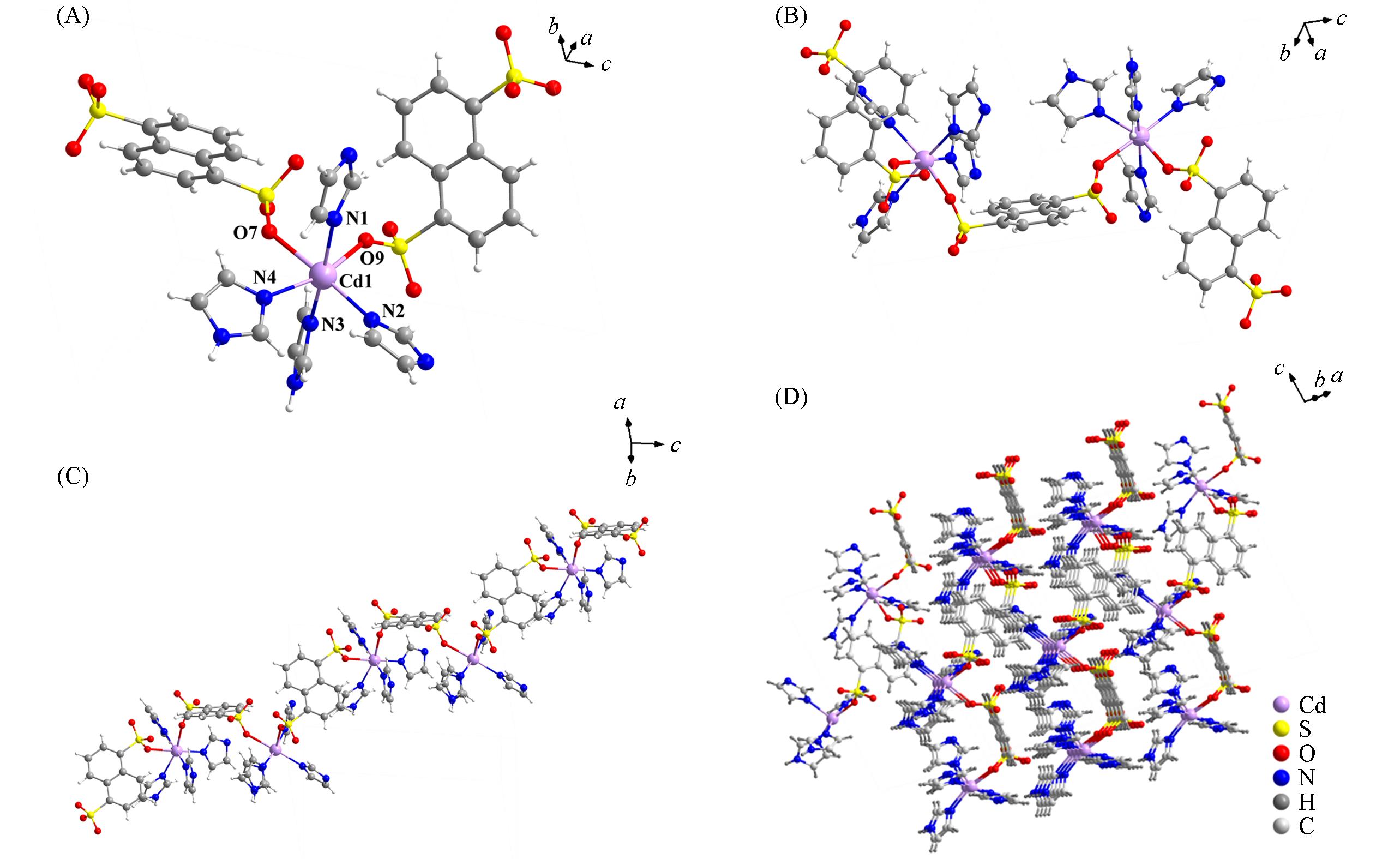
Fig.1 Asymmetric structural unit(A), adjacent molecule coordination mode(B), one⁃dimensional chain⁃like structure(C) and three⁃dimensional network structure(D) of Cd(Im)4(1,5⁃NDA)2
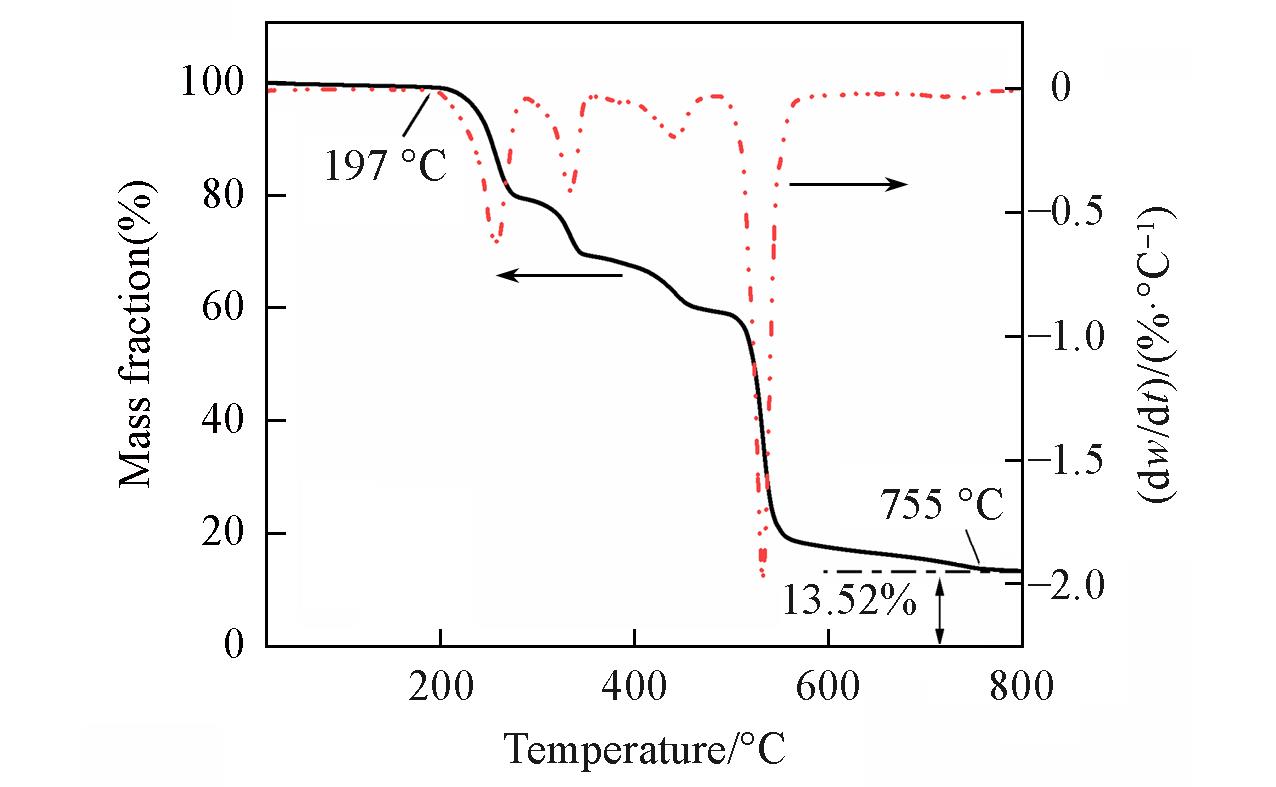
Fig.2 TG⁃DTG curves of Cd(Im)4(1,5⁃NDA)2
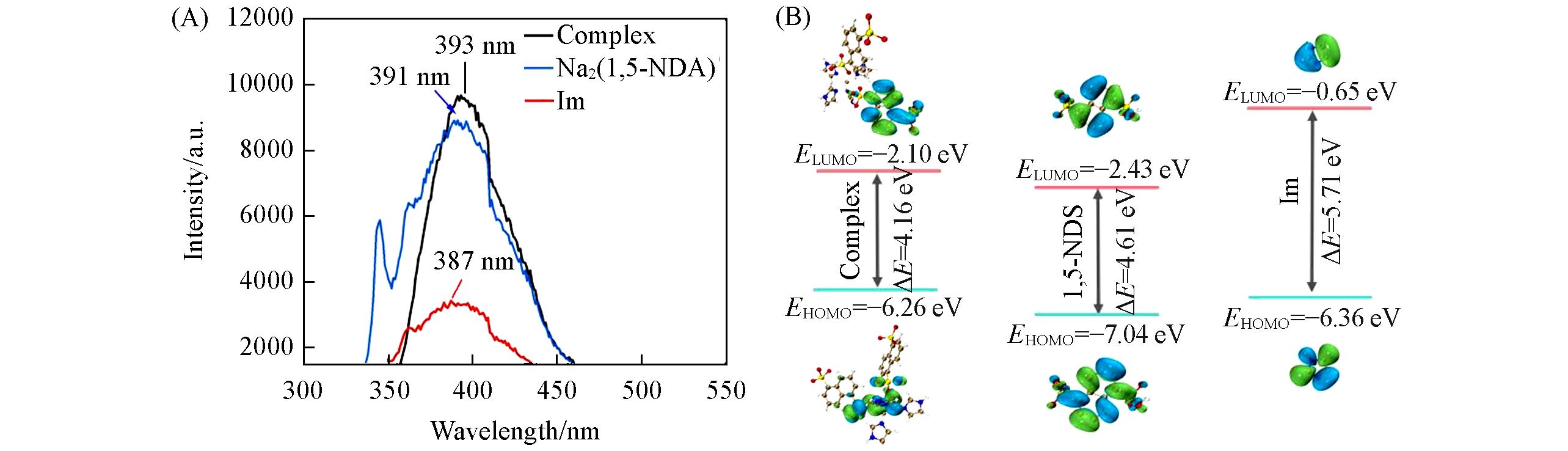
Fig.3 Solid⁃state fluorescence spectra(A) and frontier molecular orbitals(B) of Cd(Im)4(1,5⁃NDA)2 and its ligands
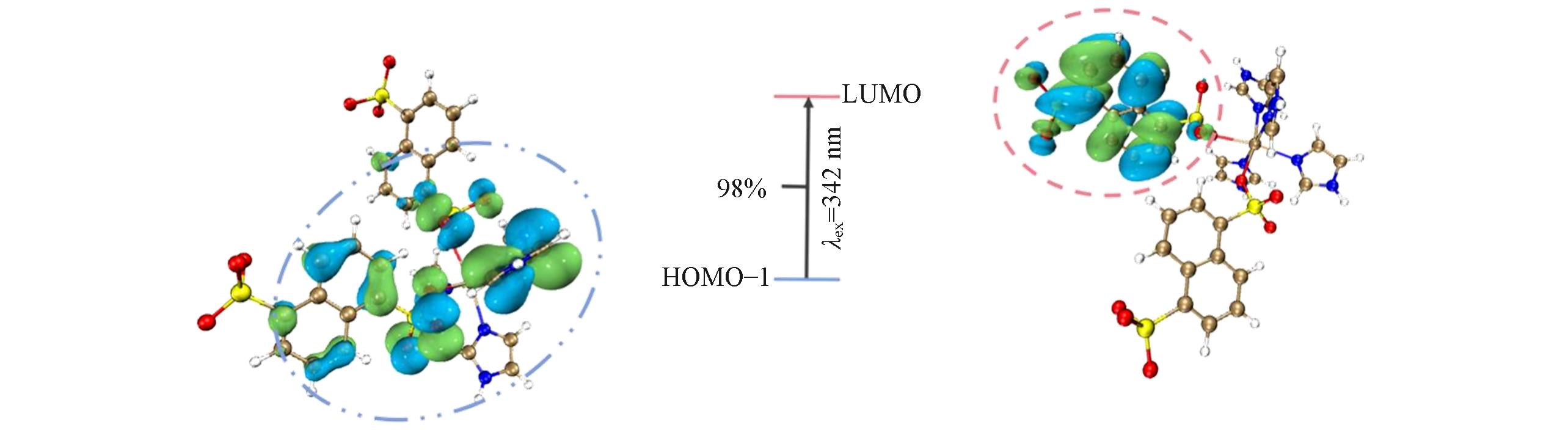
Fig.4 Main electronic transition of Cd(Im)4(1,5⁃NDA)2 corresponding to the molecular orbitals(λex=342 nm)
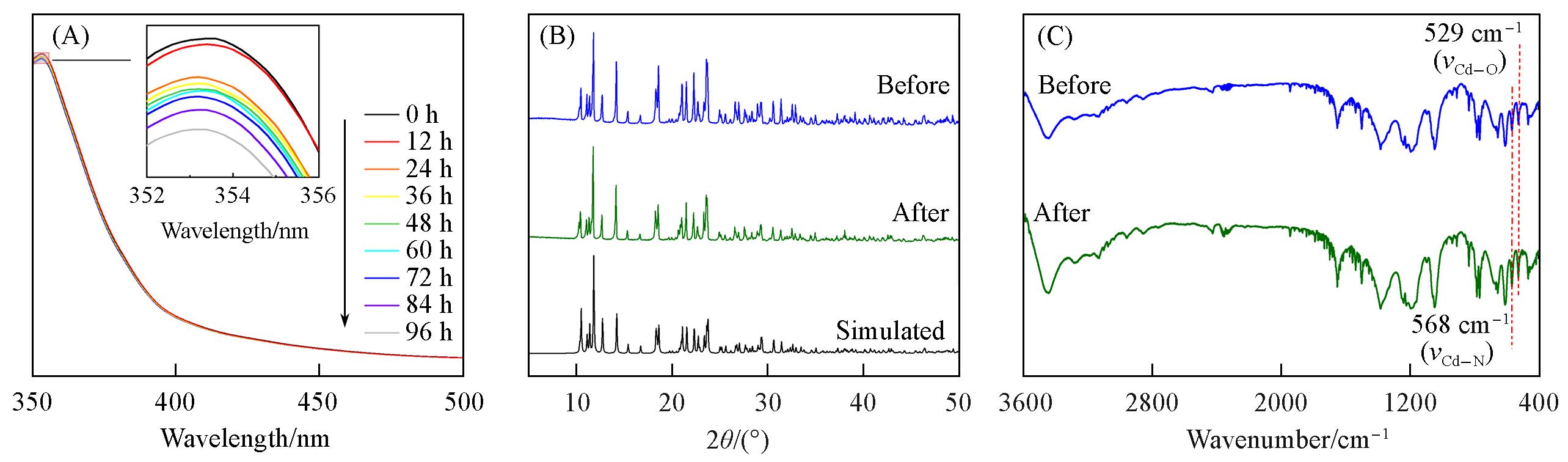
Fig.5 Fluorescence spectra of Cd(Im)4(1,5⁃NDA)2 in water(A) at different soaking times, powder X⁃ray diffraction patterns(B) and infrared spectra(C) before and after soaking for 96 h
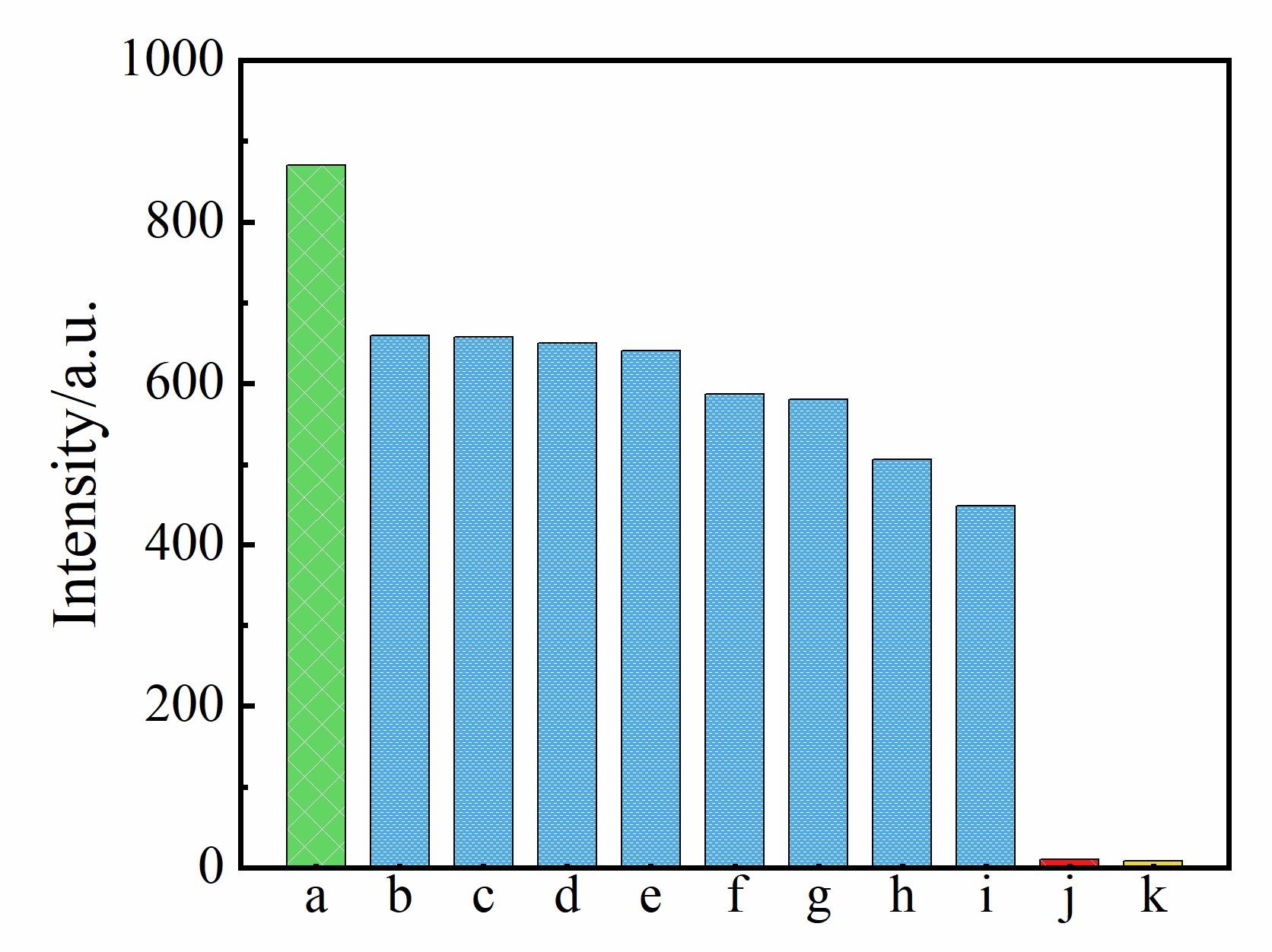
Fig.6 Recognition and interference⁃resistant experiment of Cd(Im)4(1,5⁃NDA)2 towards Fe3+a. Blank; b. blank+Na+; c. blank+Cd2+; d. blank+K+; e. blank+ Ba2+; f. blank+Co2+; g. blank+Ni2+; h. blank+Cu2+; i. blank+Fe2+; j. blank+Fe3+; k. mixed.
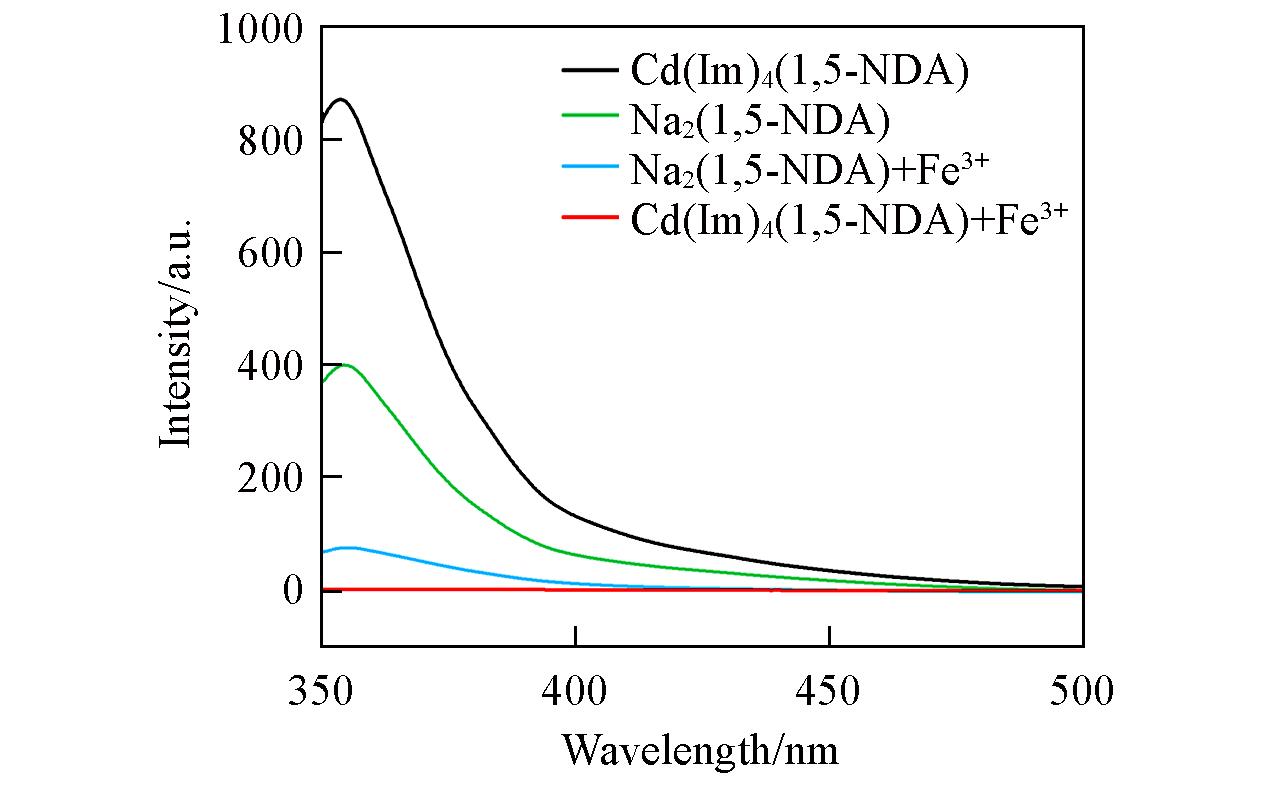
Fig.7 Fluorescence spectra of Cd(Im)4(1,5⁃NDA)2 andNa2(1,5⁃NDA) before and after the addition of Fe3+
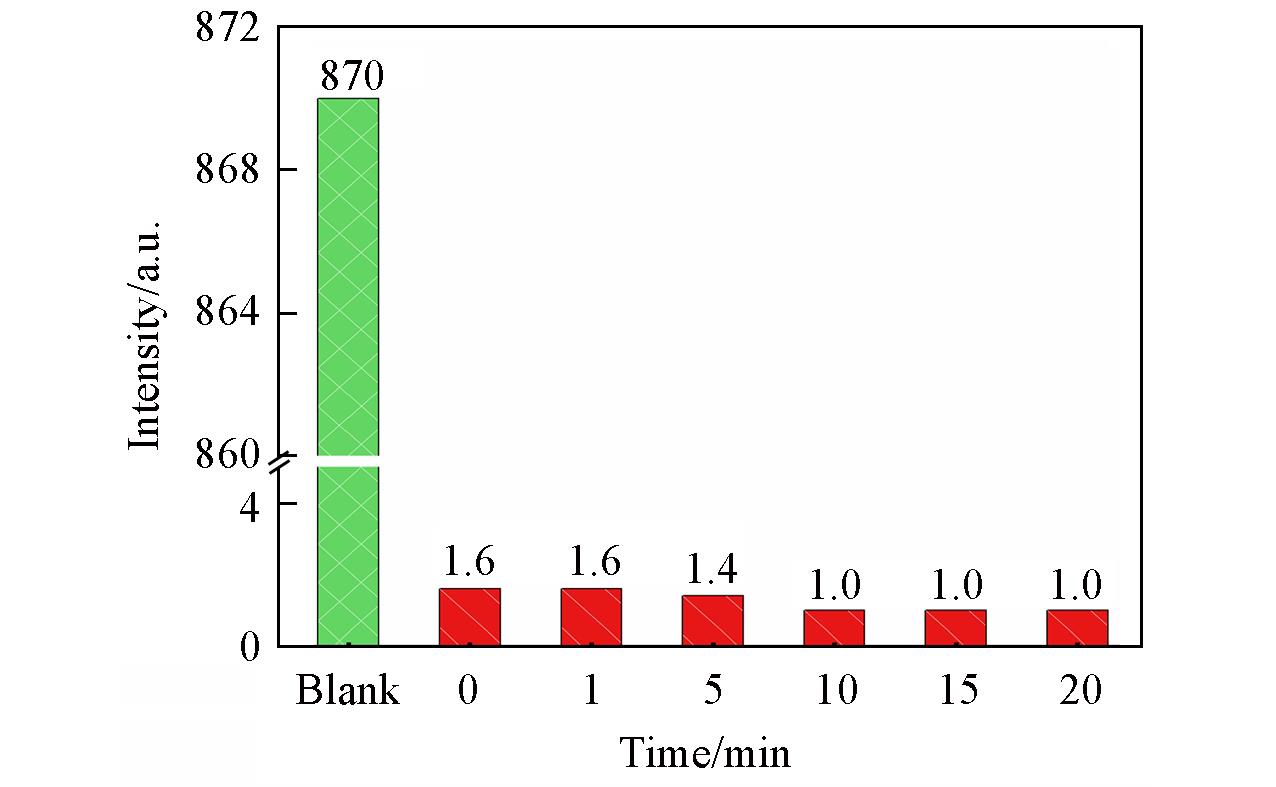
Fig.8 Fluorescence intensity of Cd(Im)4(1,5⁃NDA)2 at different contact times with Fe3+
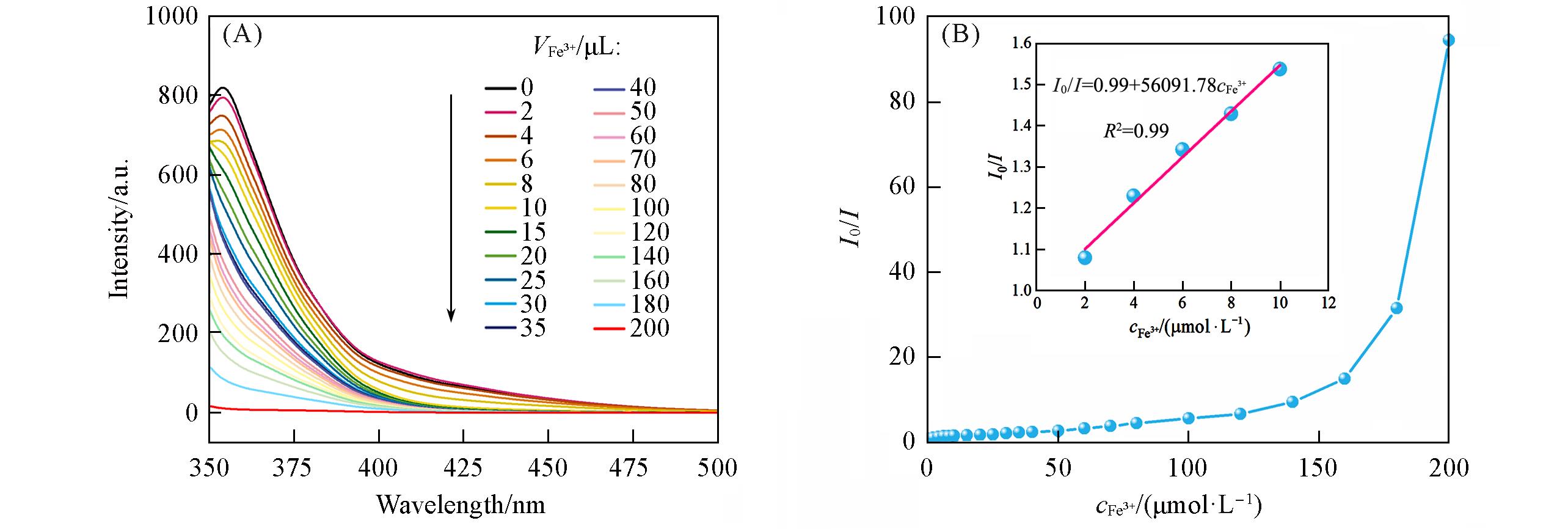
Fig.9 Fluorescence spectra of Cd(Im)4(1,5⁃NDA)2 with different volumes of 0.001 mol/L Fe3+ solution(A) andStem⁃Volmer curve(I0/I⁃cFe3+ plot) in the Cd(Im)4(1,5⁃NDA)2 suspension(B)The inset in (B) is the magnified view of the linear part of the Stem-Volmer curve at lower Fe3+ concentration.
| Fluorescent sensing material | LOD/(μmol·L-1) | Ref. | Fluorescent sensing material | LOD/(μmol·L-1) | Ref. |
|---|---|---|---|---|---|
| [CdL(H2O)(NO3)·H2O] n | 253 | [ | [Cd(LBIX)(HEA)] n | 1.14 | [ |
| [Cd(HDCPN)(1,4⁃bib)0.5(H2O)2] n | 132 | [ | [Cd4(L)4(1,4⁃bib)4]·2DMA | 0.65 | [ |
| [Zn3Eu2(TTHA)2(H2O)6]·6HO | 16.8 | [ | [Mn(na)2(Dmbpy)(H2O)]·Hna | 0.52 | [ |
| [Zn2(cptpy)(btc)(H2O)] n | 9.73 | [ | Cd(Im)4(1,5⁃NDA)2 | 0.46 | This work |
Table 3 Comparison of LOD for Fe3+ detection using different fluorescent sensing materials
| Fluorescent sensing material | LOD/(μmol·L-1) | Ref. | Fluorescent sensing material | LOD/(μmol·L-1) | Ref. |
|---|---|---|---|---|---|
| [CdL(H2O)(NO3)·H2O] n | 253 | [ | [Cd(LBIX)(HEA)] n | 1.14 | [ |
| [Cd(HDCPN)(1,4⁃bib)0.5(H2O)2] n | 132 | [ | [Cd4(L)4(1,4⁃bib)4]·2DMA | 0.65 | [ |
| [Zn3Eu2(TTHA)2(H2O)6]·6HO | 16.8 | [ | [Mn(na)2(Dmbpy)(H2O)]·Hna | 0.52 | [ |
| [Zn2(cptpy)(btc)(H2O)] n | 9.73 | [ | Cd(Im)4(1,5⁃NDA)2 | 0.46 | This work |
| Water sample | Recovery(%) | ||
|---|---|---|---|
| Sea Water | 2.00 | 2.07 | 103.50 |
| 4.00 | 4.12 | 103.00 | |
| 8.00 | 8.15 | 101.88 | |
| Lake Water | 2.00 | 2.04 | 102.00 |
| 4.00 | 4.06 | 101.50 | |
| 8.00 | 8.11 | 101.38 |
Table 4 Determination of Fe3+ in water samples
| Water sample | Recovery(%) | ||
|---|---|---|---|
| Sea Water | 2.00 | 2.07 | 103.50 |
| 4.00 | 4.12 | 103.00 | |
| 8.00 | 8.15 | 101.88 | |
| Lake Water | 2.00 | 2.04 | 102.00 |
| 4.00 | 4.06 | 101.50 | |
| 8.00 | 8.11 | 101.38 |
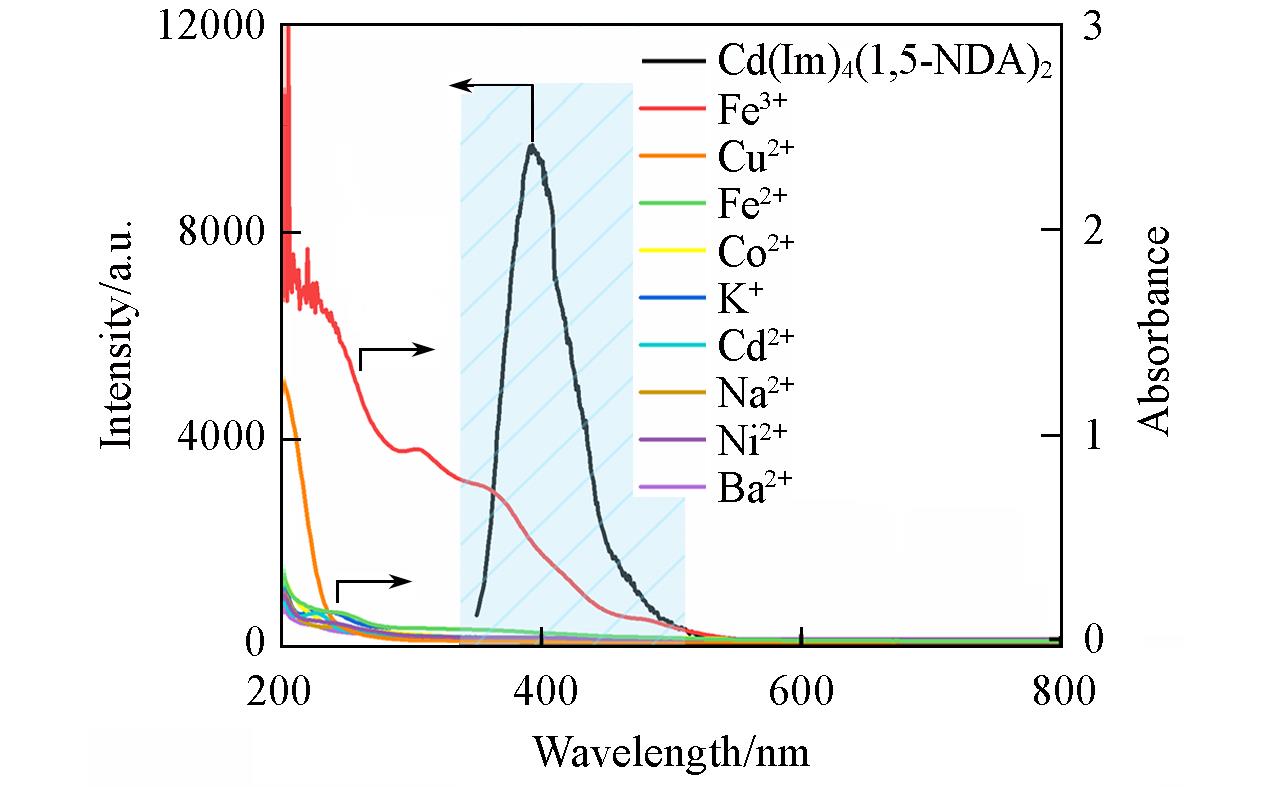
Fig.10 UV⁃Vis spectra of different metal ions and fluorescence excitation spectra of Cd(Im)4(1,5⁃NDA)2
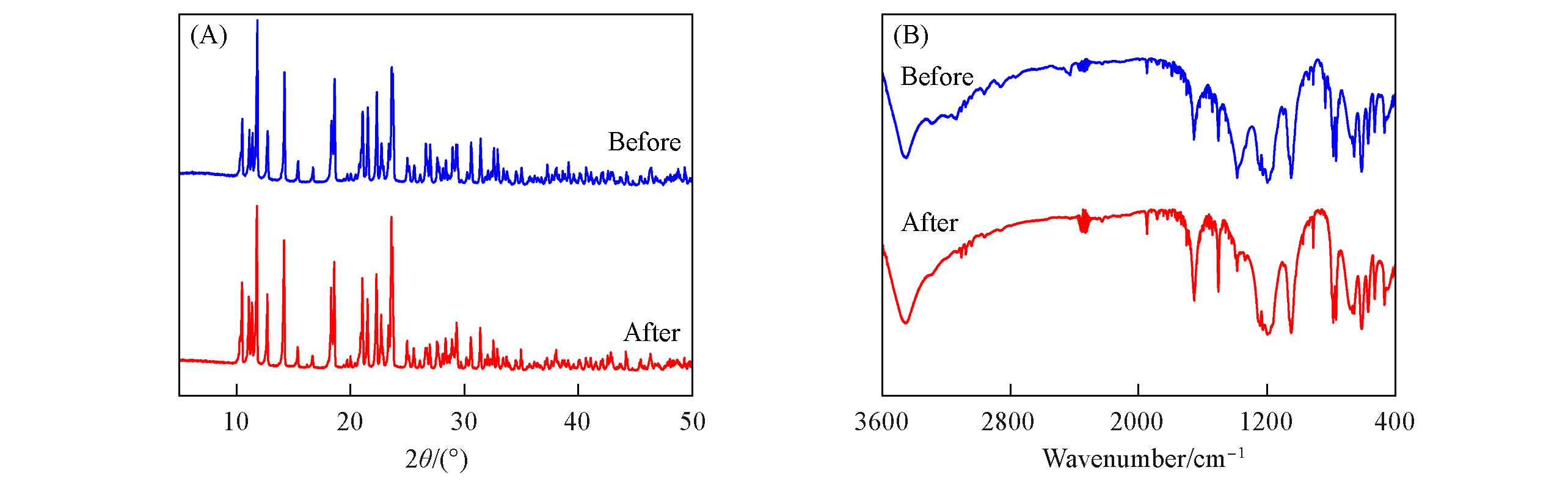
Fig.11 Powder X⁃ray diffraction patterns(A) and infrared spectra(B) of Cd(Im)4(1,5⁃NDA)2 before and after the fluorescence quenching experiment
| Sample | Entry | ICP test value of c(Cd2+)/(mg·L-1) | Fe3+ added amount/(g·L-1) | ICP test value of c(Fe3+)/(g·L-1) |
|---|---|---|---|---|
| I | 1 | 3.92 | — | 0 |
| 2 | 3.94 | — | 0 | |
| 3 | 3.93 | — | 0 | |
| II | 1 | 3.96 | 0.201 | 0.128 |
| 2 | 4.05 | 0.201 | 0.137 | |
| 3 | 4.01 | 0.201 | 0.132 |
Table 5 Concentrations of Cd2+ and Fe3+ in Sample I and Sample II
| Sample | Entry | ICP test value of c(Cd2+)/(mg·L-1) | Fe3+ added amount/(g·L-1) | ICP test value of c(Fe3+)/(g·L-1) |
|---|---|---|---|---|
| I | 1 | 3.92 | — | 0 |
| 2 | 3.94 | — | 0 | |
| 3 | 3.93 | — | 0 | |
| II | 1 | 3.96 | 0.201 | 0.128 |
| 2 | 4.05 | 0.201 | 0.137 | |
| 3 | 4.01 | 0.201 | 0.132 |
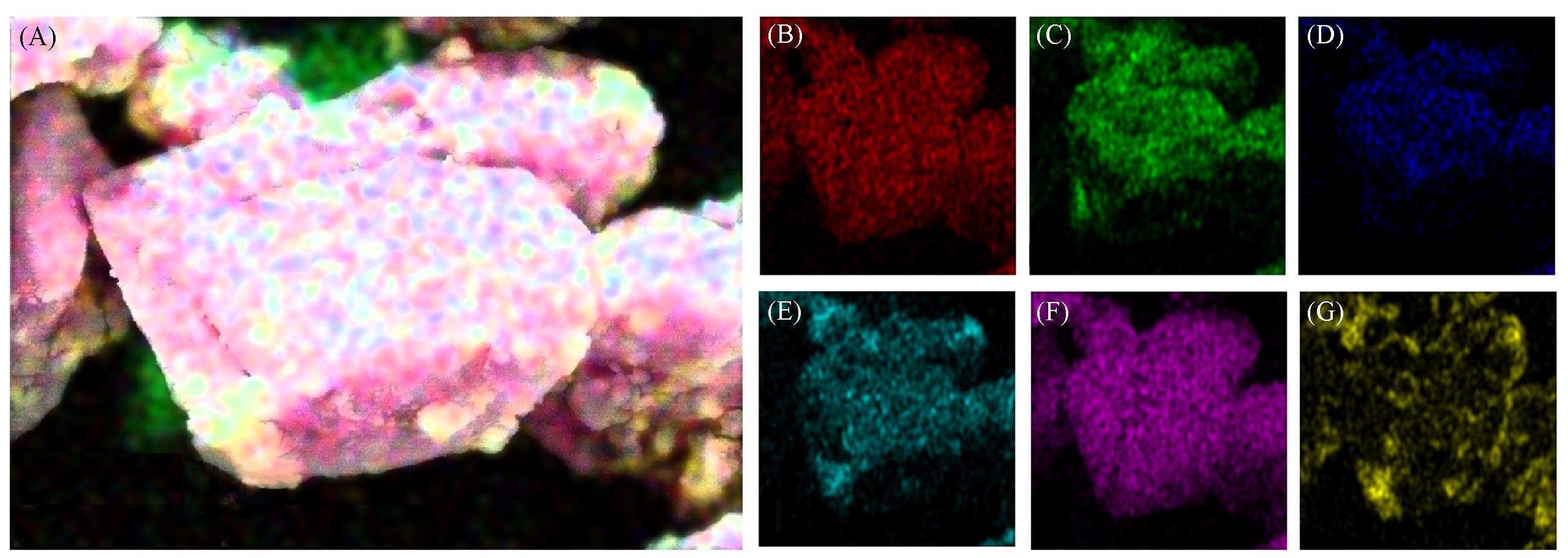
Fig.12 Energy dispersive spectra of Cd(Im)4(1,5⁃NDA)2 after the fluorescence quenching experiment(A) and the element mappings of Cd(B), C(C), N(D), O(E), S(F), and Fe(G) in Cd(Im)4(1,5⁃NDA)2
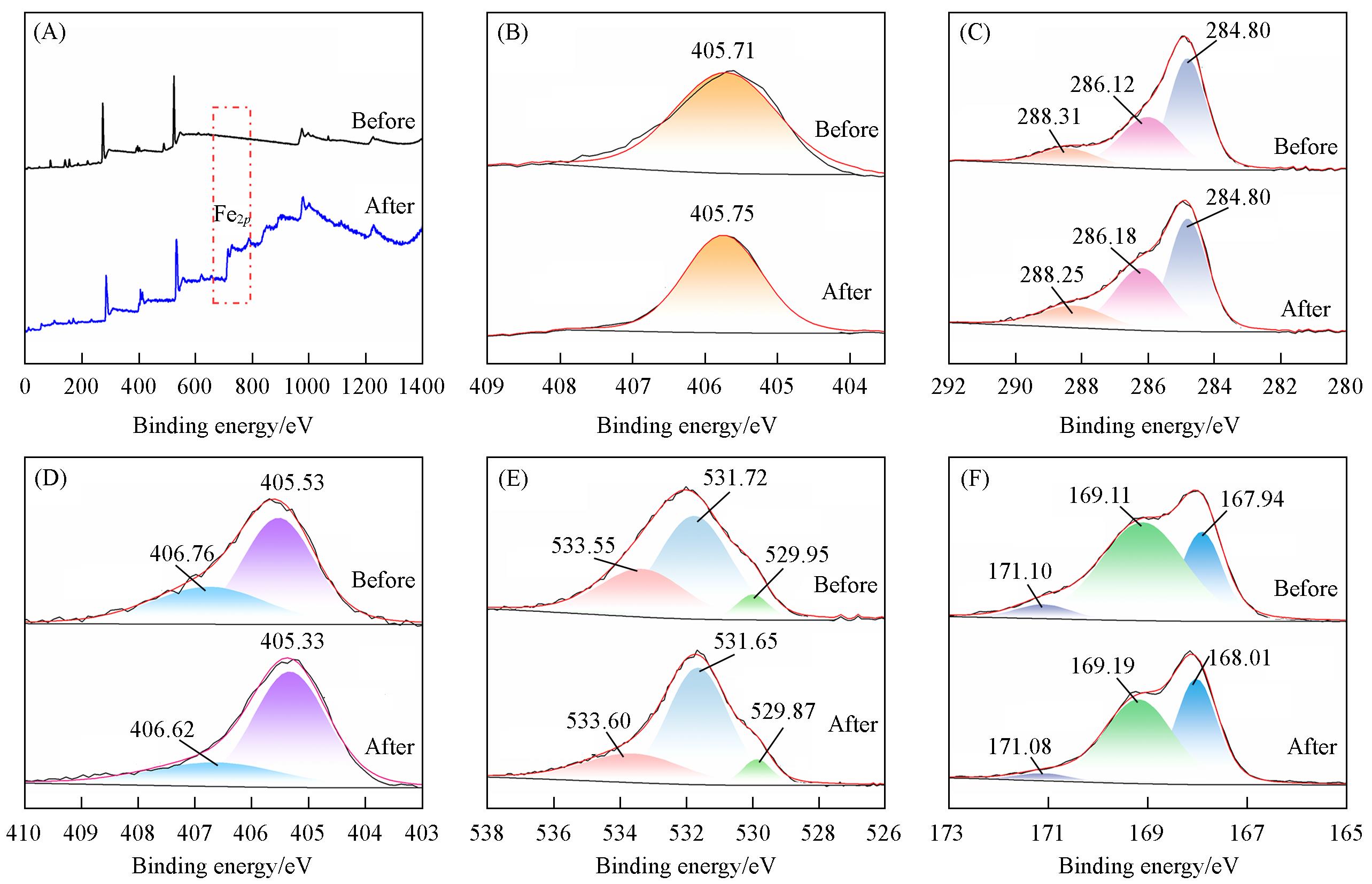
Fig.13 Total XPS spectra(A) and Cd3/2d (B), C1s (C), N1s (D), O1s (E) and S2p (F) XPS high resolution spectra of Cd(Im)4(1,5⁃NDA)2 before and after the fluorescence quenching experiment
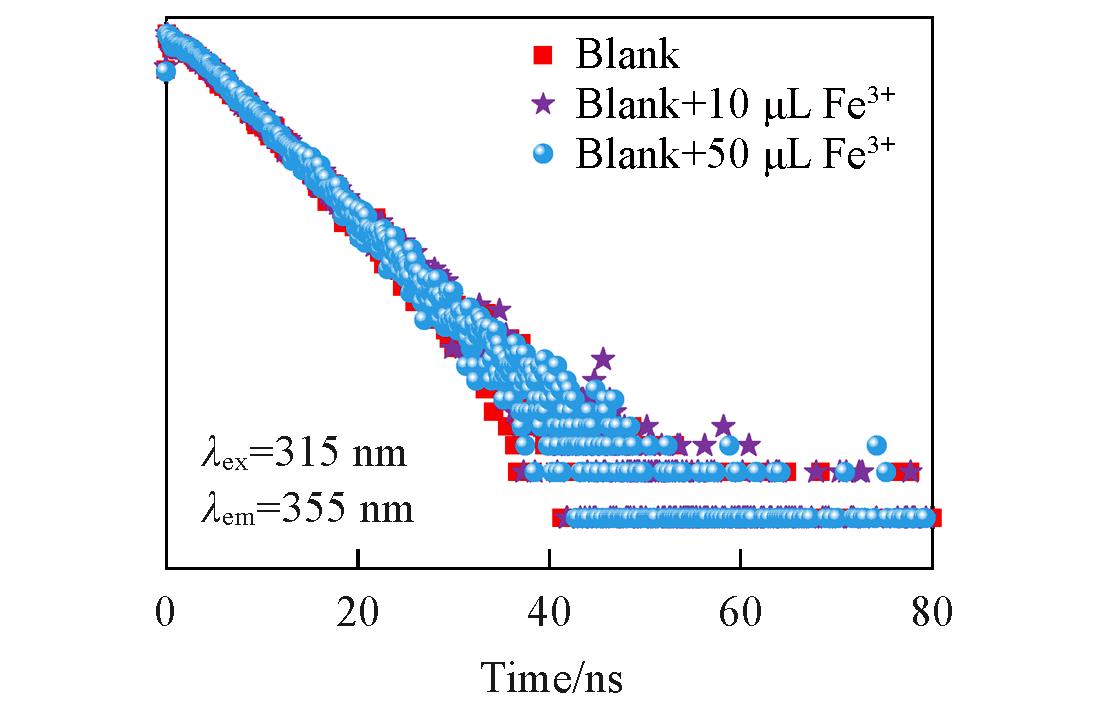
Fig.14 Fluorescence lifetime curves of Cd(Im)4(1,5⁃NDA)2 suspensions with different volumes of Fe3+ solution
| [1] | Carter K. P., Alexandra M. Y., Amy E. P., Chem. Rev., 2014, 114(8), 4564—4601 |
| [2] | Wang K., Geng T. M., Guo C., Zhou X. H., Zhu F., Anal. Chim. Acta., 2023, 1279, 341747 |
| [3] | Gao Z. H., Fu L., Dong G. Y., Polyhedron, 2024, 256, 117006 |
| [4] | Liu R., Zhang Y., Piao Y., Meng L. Y., Carbon Lett., 2021, 31, 821—829 |
| [5] | Zhang Y., Qi H., Huang Y., Zhang F., Liu H., Wang Z. J., Li R., J. Mater. Chem. B, 2021, 9, 4654—4662 |
| [6] | Zeki O. C., Eylem C. C., Reçber T., Kır S., Nemutlu E. J., Pharm. Biomed. Anal., 2020, 190, 113509 |
| [7] | Chen D. M., Zhang N. N., Liu C. S., Du M., J. Mater. Chem. C, 2017, 5(9), 2311—2317 |
| [8] | Li Y., Shi X., Min H., Li T., Yan B., Talanta, 2024, 280, 126719 |
| [9] | Li L., Gao S., Yang L., Liu Y. L., Li P., Ye F., Fu Y., J. Hazard. Mater., 2021, 404, 124015 |
| [10] | Gao N. N., Ling Y. T., Wang Y., J. Mol. Struct., 2024, 1311, 138427 |
| [11] | George N., Singh G., Singh R., Singh G., Singh H., Kaur G., Singh J., Polyhedron, 2023, 242, 116496 |
| [12] | Shen Z., Li Q. Y., Qin L. X., Fan M. T., Zhao Q., Inorg. Chim. Acta, 2025, 588, 122871 |
| [13] | Shakya S. ,Khan I. M., Ahmad M., J. Photochem. Photobiol. A, 2020, 392, 112402 |
| [14] | Chen J. L., Song J. F., Hao H. M., Zhou S. Y., Zhu H. Y., Zhang X. Q., J. Mol. Struct., 2025, 1340, 142485 |
| [15] | Pei Y. Y., Gao J., Liu X., Xue H. Y., J. Fluoresc., 2020, 30(5), 1241—1250 |
| [16] | Samanta P., Desai A. V., Sharma S., Chandra P., Ghosh S. K., Inorg. Chem., 2018, 57, 2360—2364 |
| [17] | Senthilkumar S., Goswami R., Smith V. J., Bajaj H. C., Neogi S., ACS Sustain. Chem. Eng., 2018, 6, 10295—10306 |
| [18] | Shahabadi N., Ghaffari L., Mardani Z., Shiri F., Nucleosides, Nucleotides Nucleic Acids, 2024, 43(6), 493—516 |
| [19] | Wang J. ,Zhao Y., Fan L., Zhang J., Sun C., Li W., Chang Z., Inorg. Chim. Acta, 2025, 574, 122415 |
| [20] | Zhao B., Liu H., Gu Y., Sun Q., Inorg. Nano⁃Met. Chem., 2023, 53(8), 769—775 |
| [21] | Wen Q., Chen J. L., Song J. F., Zhou S. Y., Zhu H. Y., Zhang X. Q., J. Mol. Struct., 2024, 1300, 137235 |
| [22] | An H. L., Duan Y., Chen T. T., Chai L. Q., J. Mol. Struct., 2024, 1310, 138320 |
| [23] | Wang X., Shi Y. W., Yang R. J., Song Z. G., Wang M., Acta Chim. Sinica, 2025, 83(7), 674—684 |
| 王鑫, 史燚威, 杨瑞杰, 宋志国, 王敏. 化学学报, 2025, 83(7), 674—684 | |
| [24] | Huang Y., Gao R. H., Liu M., Chen L. X., Ni X. L., Xiao X., Tao Z., Angew. Chem., 2021, 133(28), 15294—15319 |
| [25] | Chen K., Zhu Z. Q., Zhang M. H., Yang X., Li J., Chen C., Redshaw C., CrystEngComm, 2023, 25(6), 961—970 |
| [26] | Song W., Wang L. Q., Zeng S. L., Wang L., Fan Y., Xu J. N., Chem. J. Chinese Universities, 2018, 39(7), 1406—1411 |
| 宋伟, 王力群, 曾双利, 王莉, 范勇, 徐家宁. 高等学校化学学报, 2018, 39(7), 1406—1411 | |
| [27] | Yi M. J., Xiao X., Zhang Y. Q., Xue S. F., Tao Z., Zhang J. X., Acta Chim. Sinica, 2014, 72(8), 949—955 |
| 易君明, 肖欣, 张云黔, 薛赛凤, 陶朱, 张建新. 化学学报, 2014, 72(8), 949—955 | |
| [28] | Bruker S., SMART(version 5.628) SAINT(version 6.45), SADABS, Bruker AXS Inc., Madison, Wisconsin, USA. 2001 |
| [29] | Dolomanov O. V., Bourhis L. J., Gildea R. J., Howard J. A. K., Puschmann H. J., Appl. Crystallogr., 2009, 42, 339—341 |
| [30] | Sheldrick G. M., SHELXL⁃97, Program for Crystal Structure Solution, University of Göttingen, Göttingen, 1997 |
| [31] | Becke A. D., J. Chem. Phys., 1993, 981, 448799 |
| [32] | Lee C., Yang W., Parr R. G., Phys. Rev. B, 1988, 37, 785—789 |
| [33] | Lu T., Chen F. W., J. Comput. Chem., 2012, 33, 580—592 |
| [34] | Humphrey W., Dalke A., Schulten K., J. Mol. Graphics 1996, 14, 33—38 |
| [35] | Hema M. K., Karthik C. S., Pampa K. J., Mallu P., Lokanath N. K., J. Mol. Struct., 2021, 1243, 130774 |
| [36] | Liang R., Wang Y. T., Guo Y. K., Xuan X. P., Chin. J. Inorg. Chem., 2017, 33(8), 1465—1473 |
| 梁蕊, 王玉停, 郭永康, 轩小朋. 无机化学学报, 2017, 33(8), 1465—1473 | |
| [37] | Wu G. Z., Wang P. F., Li S. Q., Fang X. L., Chin. J. Inorg. Chem., 2020, 36(2), 226—232 |
| 吴国志, 汪鹏飞, 李善青, 方霄龙. 无机化学学报, 2020, 36(2), 226—232 | |
| [38] | Shu Q. D., Kong S. N., Wei Y. Z., Shu M. H., Polyhedron, 2019, 118, 96—102 |
| [39] | Zhang D. C., Jia J. H., Liang D., Cai X. B., Zhao Y. Q., Hu X. L., Jiang Y. B., Lu C. Z., Acta Chim. Sinica, 2024, 82(8), 887—893 |
| 张登朝, 贾吉慧, 梁栋, 蔡显宝, 赵雨晴, 胡祥龙, 江钰冰, 卢灿忠. 化学学报, 2024, 82(8), 887—893 | |
| [40] | Li Z., Li R., Li X., Chem. J. Chinese Universities, 2018, 39(11), 2363—2374 |
| 李铮, 李睿, 李夏. 高等学校化学学报, 2018, 39(11), 2363—2374 | |
| [41] | Zhang Y., Su Y. X., Cai Z., Tong L., Dong W. K., J. Mol. Struct., 2024, 1309, 138164 |
| [42] | Ren Y. Y., Li X., Han Y. F., Acta Chim. Sinica, 2023, 81(7), 735—740 |
| 任妍妍, 李欣, 韩英锋. 化学学报, 2023, 81(7), 735—740 | |
| [43] | Tang L., Chen L. Y., Hou X. Y., Wang X., Wang J. J., Chin. J. Inorg. Chem., 2023, 39(1), 168—180 |
| 唐龙, 陈鲁园, 侯向阳, 王潇, 王记江. 无机化学学报, 2023, 39(1), 168—180 | |
| [44] | Zheng L. N., Liu S., Xue N., Du Y., Ding T., Xu L. Y., Sun Y. Z., J. Mol. Struct., 2024, 1305, 137794 |
| [45] | Gao L. L., Li M. X., Du Y. E., Chen Y. Q., Chin. J. Inorg. Chem., 2020, 36(12), 2359—2366 |
| 高玲玲, 李梦雪, 杜意恩, 陈勇强. 无机化学学报, 2020, 36(12), 2359—2366 | |
| [46] | Li J. L., Xiao Y., Wang L. Y., Xing Y. H., Bai F. Y., Shi Z., Polyhedron, 2022, 214, 115648 |
| [47] | Chen H., Fan P., Tu X., Min H., Yu X., Li X., Cheng P., Chem. Asian J., 2019, 14(20), 3611—3619 |
| [48] | Dong L. L., Liu J., Ynag H., Fu Y. P., Liu H. L., Chen X. L., Cui H. L., Liu L., Wang J. J., Chin. J. Inorg. Chem., 2025, 41(4), 809—820 |
| 董璐璐, 刘洁, 杨华, 符钰培, 刘红丽, 陈小莉, 崔华莉, 刘琳, 王记江. 无机化学学报, 2025, 41(4), 809—820 | |
| [49] | Wang C., Ji Z. Y., Spectrosc. Spectral Anal., 2025, 45(3), 658—664 |
| 王策, 姬占有. 光谱学与光谱分析, 2025, 45(3), 658—664 | |
| [50] | Chen C.C., Cai Y., Wang L. F., Wu Y. D., Yin H. J., Zhou J. R., Ni C. L., Liu W., Inorg. Chem., 2021, 60, 5463—5473 |
| [51] | Wen L., Zheng X., Lv K., Wang C., Xu X., Inorg. Chem., 2015, 54, 7133—7135 |
| [52] | Zhang X. Q., Chen F. M., Wen Q., Zhou C. C., He X., Li Y., Liu H. F., J. Mol. Struct., 2022, 1252, 132183 |
| [53] | Zhong L. N., Chen J. L., Zhao Q. H., Chin. J. Inorg. Chem., 2025, 414), 709—718(钟丽娜, 陈晶玲, 赵青华. 无机化学学报, 2025, 41(4), 709—718 |
| [54] | Zhu X., Yan X., Kang E., Han Y., Yin C., Ye S. Angew. Chem. Int. Ed., 2025, 64(5), e202417218 |
| [55] | Ge K. M., Wang D., Xu Z. J., Chu R. Q., J. Mol. Struct., 2020, 217, 127862 |
| [56] | Li J., Zhu Y., Xu H., Zheng T. F., Liu S. J., Wu Y., Chen J. L., Chen Y. Q., Wen H. R., Inorg. Chem., 2022, 61, 3607—3615 |
| [57] | Mukherjee D., Pal A., Pal S. C., Saha A., Das M. C., Inorg. Chem., 2022, 61, 16852—16962 |
| [58] | Liu J. J., Yu L. M., Han F. X., Chen F. Y., Cheng F. X., J. Solid State Chem., 2018, 270, 45—50 |
| [59] | Zeng Y. N., Zheng H. Q., Gu J. F., Cao G. J., Zhuang W. E., Lin J. D., Cao R., Lin Z., J. Inorg. Chem., 2019, 58, 13360—13369 |
| [1] | 温哥华, 薛静漪. 一维铀酰羧酸膦酸配位聚合物对水溶液中Fe3+的高灵敏选择性检测[J]. 高等学校化学学报, 2025, 46(12): 20250165. |
| [2] | 朱宣祺, 崔丽影, 赵欣宇, 姜玲, 张雪. Fe3+掺杂的聚氨基吡咯纳米粒子用于原位乳腺癌的磁共振成像和光热治疗[J]. 高等学校化学学报, 2025, 46(1): 20240156. |
| [3] | 徐小花, 王莉, 林鹏程, 马天锋, 石琳, 王欢, 芦永昌. NPCl -CDs/Fe 3+荧光探针的制备及对 L-Cys的传感检测[J]. 高等学校化学学报, 2024, 45(9): 20240251. |
| [4] | 冀超, 李文, 张丽荣, 华佳, 刘云凌. 一例Eu-MOF材料的构筑及对Fe3+与硝基芳香族爆炸物的荧光检测性能[J]. 高等学校化学学报, 2024, 45(2): 20230455. |
| [5] | 马鉴新, 刘晓东, 徐娜, 刘国成, 王秀丽. 一种具有发光传感、 安培传感和染料吸附性能的多功能Zn(II)配位聚合物[J]. 高等学校化学学报, 2022, 43(1): 20210585. |
| [6] | 吴季, 张浩, 骆昱晖, 耿吴越, 兰亚乾. 一种具有荧光性质的阳离子Ga⁃MOF用于Fe3+和硝基化合物识别[J]. 高等学校化学学报, 2022, 43(1): 20210617. |
| [7] | 李然, 张旭东, 穆丽丹, 孙童, 艾刚刚, 沙夜龙, 张玉琦, 王记江. 三联噻吩衍生物功能化SiO2反蛋白石光子晶体荧光薄膜的制备及应用[J]. 高等学校化学学报, 2021, 42(9): 2989. |
| [8] | 阿丽, 王勇. 多肽荧光传感器检测铜离子[J]. 高等学校化学学报, 2020, 41(12): 2736. |
| [9] | 咸国轩, 于玉娥, 陈玉倩, 万小雨, 王素娜, 卢静. 辅助配体调控的荧光Cd-MOFs: 乙酰丙酮的荧光增强和Cr(Ⅵ)的荧光猝灭[J]. 高等学校化学学报, 2020, 41(12): 2725. |
| [10] | 黄贺, 李春光, 施展, 冯守华. 酪氨酸微波水热法制备碳点及其在Fe3+检测和荧光标记方面的应用[J]. 高等学校化学学报, 2019, 40(8): 1579. |
| [11] | 周思慧, 李琼, 张婷, 庞代文, 唐宏武. 基于碳点的荧光纳米开关灵敏检测Cu(Ⅱ)离子和焦磷酸盐[J]. 高等学校化学学报, 2019, 40(8): 1593. |
| [12] | 马玉坤, 王海君, 郭梦岩. 狼毒乙素分子印迹膜荧光传感器的制备及在中药材检测中的应用[J]. 高等学校化学学报, 2019, 40(7): 1381. |
| [13] | 梁足培, 苏飞飞, 国荣, 唐昱垚, 金烁, 于梓洹, 李建, 马淑兰. 荧光素-层状双金属氢氧化物复合体的发光性能及对Fe3+的荧光识别[J]. 高等学校化学学报, 2019, 40(7): 1352. |
| [14] | 宫明慧, 杨珊珊, 李树生, 匡芮, 孔祥正. 沉淀聚合制备荧光聚脲微球及Fe3+检测[J]. 高等学校化学学报, 2019, 40(6): 1317. |
| [15] | 张春燕, 罗建新, 李文军, 欧丽娟, 喻桂朋, 潘春跃. 单分散键合型含铕聚苯乙烯微球的制备与荧光传感性能[J]. 高等学校化学学报, 2019, 40(1): 153. |
| 阅读次数 | ||||||
|
全文 |
|
|||||
|
摘要 |
|
|||||
