

Chem. J. Chinese Universities ›› 2026, Vol. 47 ›› Issue (7): 20260039.doi: 10.7503/cjcu20260039
• Articles: Inorganic Chemistry • Previous Articles Next Articles
LI Xin, LV Ze, ZHONG Yi, XU Hong, MAO Zhiping, ZHANG Linping( )
)
Received:2026-01-20
Online:2026-07-10
Published:2026-03-25
Contact:
ZHANG Linping
E-mail:zhang_lp@dhu.edu.cn
Supported by:CLC Number:
TrendMD:
LI Xin, LV Ze, ZHONG Yi, XU Hong, MAO Zhiping, ZHANG Linping. Preparation of Ligand-functionalized MIL-101(Fe) MOFs and Their Photocatalytic Performance for CO2 Reduction[J]. Chem. J. Chinese Universities, 2026, 47(7): 20260039.
| Photocatalyst | Measured value(%) | Theoretical value(%) | Structural formula | ||||
|---|---|---|---|---|---|---|---|
| C | H | N | C | H | N | ||
| NH2⁃MIL⁃101(Fe) | 33.20 | 3.91 | 5.69 | 32.90 | 3.48 | 5.68 | C24H19ClO18N3Fe3 |
| CH3O⁃MIL⁃101(Fe) | 36.81 | 3.95 | 2.10 | 36.51 | 3.90 | 2.58 | C27H22ClO21Fe3 |
| MIL⁃101(Fe) | 38.66 | 4.29 | 4.08 | 38.48 | 4.31 | 4.99 | C24H16ClO18Fe3 |
| Br⁃MIL⁃101(Fe) | 30.00 | 2.54 | 1.29 | 30.12 | 2.44 | 1.34 | C24H13ClO18Br3Fe3 |
| NO2⁃MIL⁃101(Fe) | 29.01 | 3.69 | 4.99 | 29.09 | 3.66 | 5.65 | C24H13ClO24N3Fe3 |
Table 1 Elemental analysis(mass fraction) for MIL-101(Fe) and ligand-modified X-MIL-101(Fe)(X=NH2, CH3O, Br, NO2)
| Photocatalyst | Measured value(%) | Theoretical value(%) | Structural formula | ||||
|---|---|---|---|---|---|---|---|
| C | H | N | C | H | N | ||
| NH2⁃MIL⁃101(Fe) | 33.20 | 3.91 | 5.69 | 32.90 | 3.48 | 5.68 | C24H19ClO18N3Fe3 |
| CH3O⁃MIL⁃101(Fe) | 36.81 | 3.95 | 2.10 | 36.51 | 3.90 | 2.58 | C27H22ClO21Fe3 |
| MIL⁃101(Fe) | 38.66 | 4.29 | 4.08 | 38.48 | 4.31 | 4.99 | C24H16ClO18Fe3 |
| Br⁃MIL⁃101(Fe) | 30.00 | 2.54 | 1.29 | 30.12 | 2.44 | 1.34 | C24H13ClO18Br3Fe3 |
| NO2⁃MIL⁃101(Fe) | 29.01 | 3.69 | 4.99 | 29.09 | 3.66 | 5.65 | C24H13ClO24N3Fe3 |
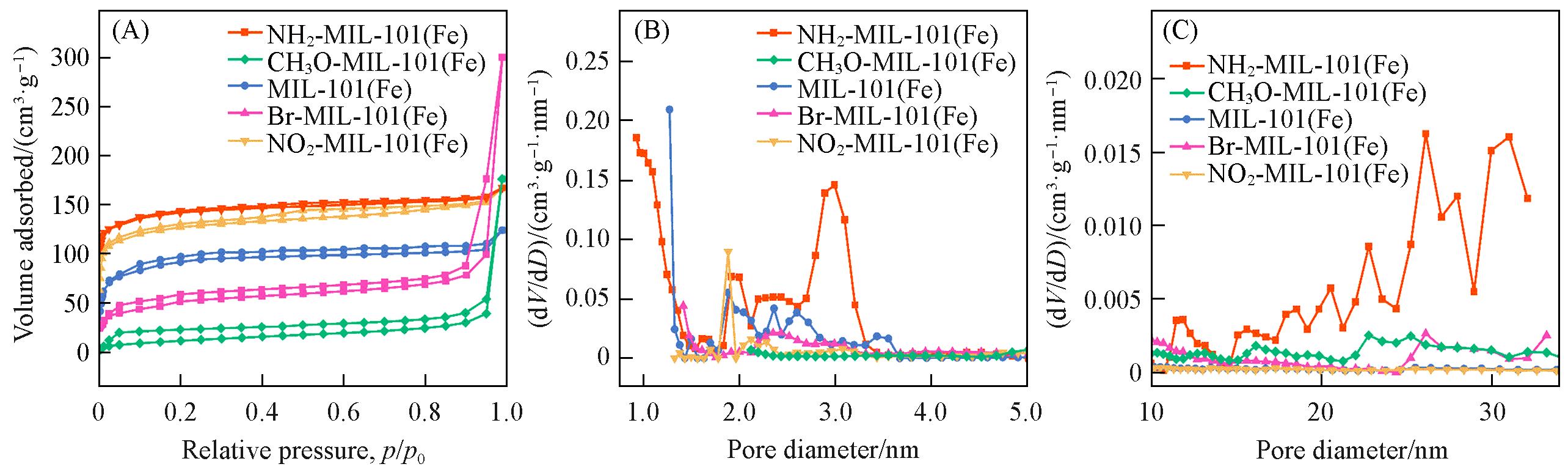
| Photocatalyst | SBET/(m2·g-1) | Pore volume/(cm3·g-1) | Pore diameter/nm |
|---|---|---|---|
| NH2⁃MIL⁃101(Fe) | 595 | 0.63 | 0.93 |
| CH3O⁃MIL⁃101(Fe) | 443 | 0.14 | 1.15 |
| MIL⁃101(Fe) | 275 | 0.12 | 1.26 |
| Br⁃MIL⁃101(Fe) | 373 | 0.18 | 1.42 |
| NO2⁃MIL⁃101(Fe) | 411 | 0.20 | 1.27 |
Table 2 Specific surface area, pore volume and pore diameter of MIL-101(Fe) and X-MIL-101(Fe)(X=NH2, CH3O, Br, NO2)
| Photocatalyst | SBET/(m2·g-1) | Pore volume/(cm3·g-1) | Pore diameter/nm |
|---|---|---|---|
| NH2⁃MIL⁃101(Fe) | 595 | 0.63 | 0.93 |
| CH3O⁃MIL⁃101(Fe) | 443 | 0.14 | 1.15 |
| MIL⁃101(Fe) | 275 | 0.12 | 1.26 |
| Br⁃MIL⁃101(Fe) | 373 | 0.18 | 1.42 |
| NO2⁃MIL⁃101(Fe) | 411 | 0.20 | 1.27 |
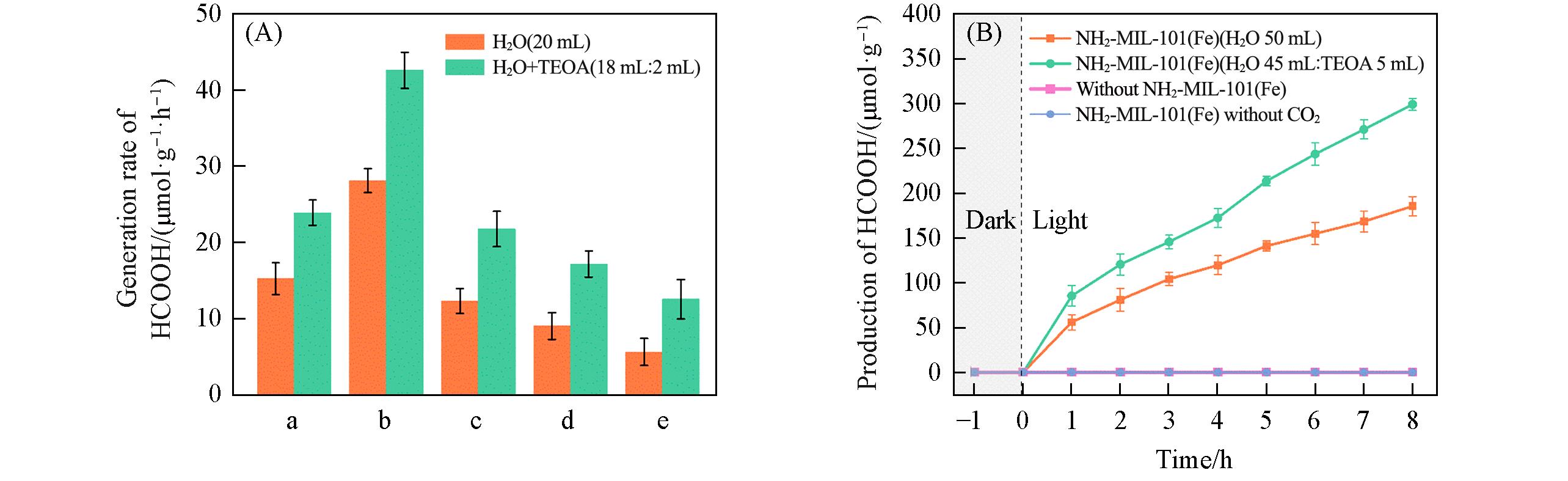
| Photocatalyst | Light source | Solvent | Sacrificial | Generation rate of HCOOH/ (μmol·g-1·h-1)(selectivity, %) | Ref. |
|---|---|---|---|---|---|
| NH2⁃MIL⁃101(Fe) | 300 W Xe lamp | H2O | TEOA | 42.61(100) | This work |
| NH2⁃MIL⁃125(Ti) | 300 W Xe lamp(420—800 nm) | MeCN | TEOA | 16.28(100) | [ |
| PCN⁃222 | 300 W Xe lamp(420—800 nm) | MeCN | TEOA | 60(100) | [ |
| Eu⁃Ru(phen)3⁃MOF | 300 W Xe lamp(420—800 nm) | MeCN | TEOA | 94(100) | [ |
| PFC⁃58⁃30 | 300 W Xe lamp(λ>400 nm) | H2O | No | 29.8(80) | [ |
| NNU⁃31⁃Ni | 300 W Xe lamp(λ ≥ 420nm) | H2O | No | 26.3(100) | [ |
| FeTCP⁃OH⁃Co | 300 W Xe lamp(λ ≥ 420nm) | H2O | No | 17.72(>97) | [ |
Table 3 Comparison of photocatalytic performance of NH2‑MIL‑101(Fe) with the reported work
| Photocatalyst | Light source | Solvent | Sacrificial | Generation rate of HCOOH/ (μmol·g-1·h-1)(selectivity, %) | Ref. |
|---|---|---|---|---|---|
| NH2⁃MIL⁃101(Fe) | 300 W Xe lamp | H2O | TEOA | 42.61(100) | This work |
| NH2⁃MIL⁃125(Ti) | 300 W Xe lamp(420—800 nm) | MeCN | TEOA | 16.28(100) | [ |
| PCN⁃222 | 300 W Xe lamp(420—800 nm) | MeCN | TEOA | 60(100) | [ |
| Eu⁃Ru(phen)3⁃MOF | 300 W Xe lamp(420—800 nm) | MeCN | TEOA | 94(100) | [ |
| PFC⁃58⁃30 | 300 W Xe lamp(λ>400 nm) | H2O | No | 29.8(80) | [ |
| NNU⁃31⁃Ni | 300 W Xe lamp(λ ≥ 420nm) | H2O | No | 26.3(100) | [ |
| FeTCP⁃OH⁃Co | 300 W Xe lamp(λ ≥ 420nm) | H2O | No | 17.72(>97) | [ |
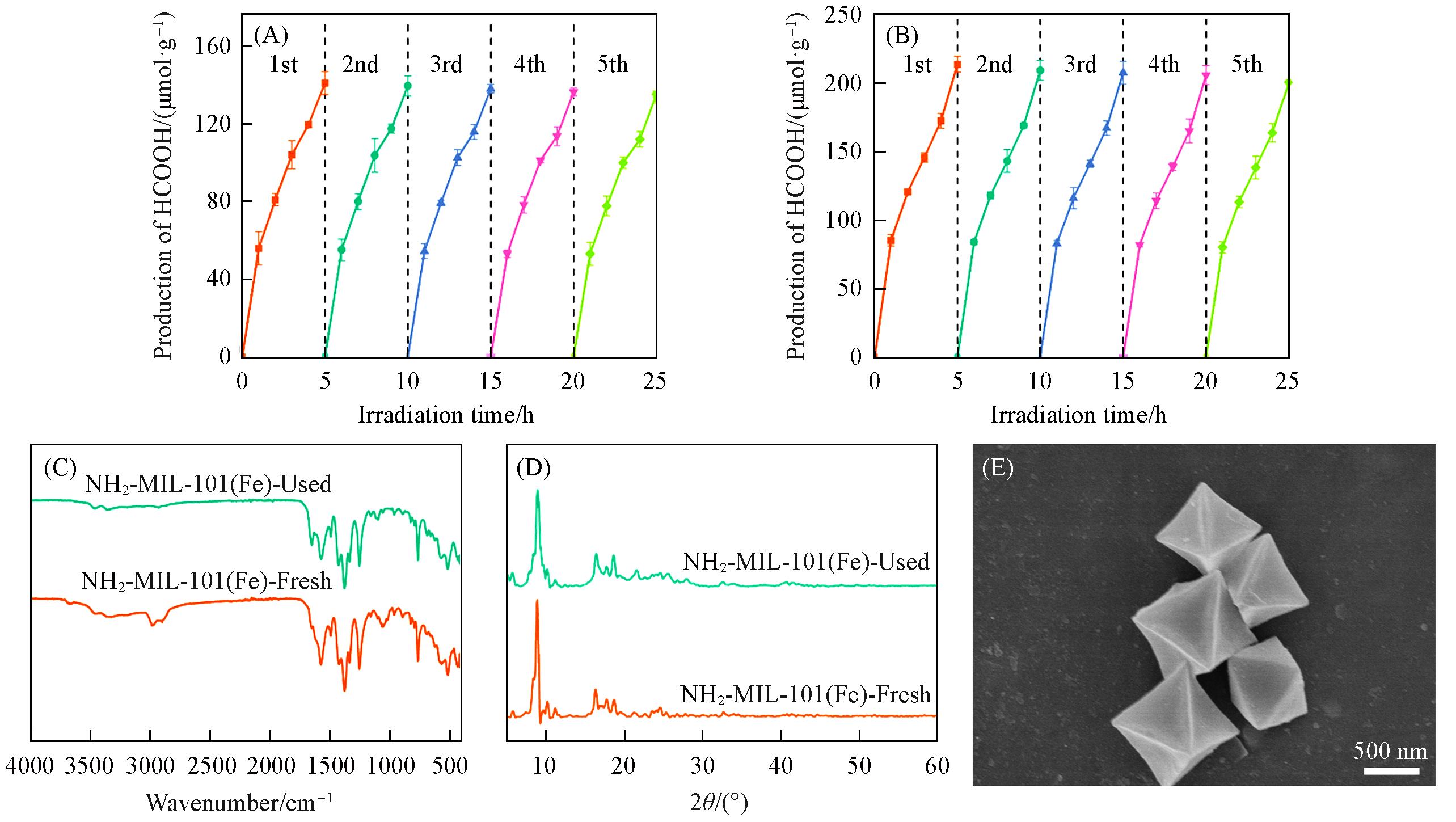
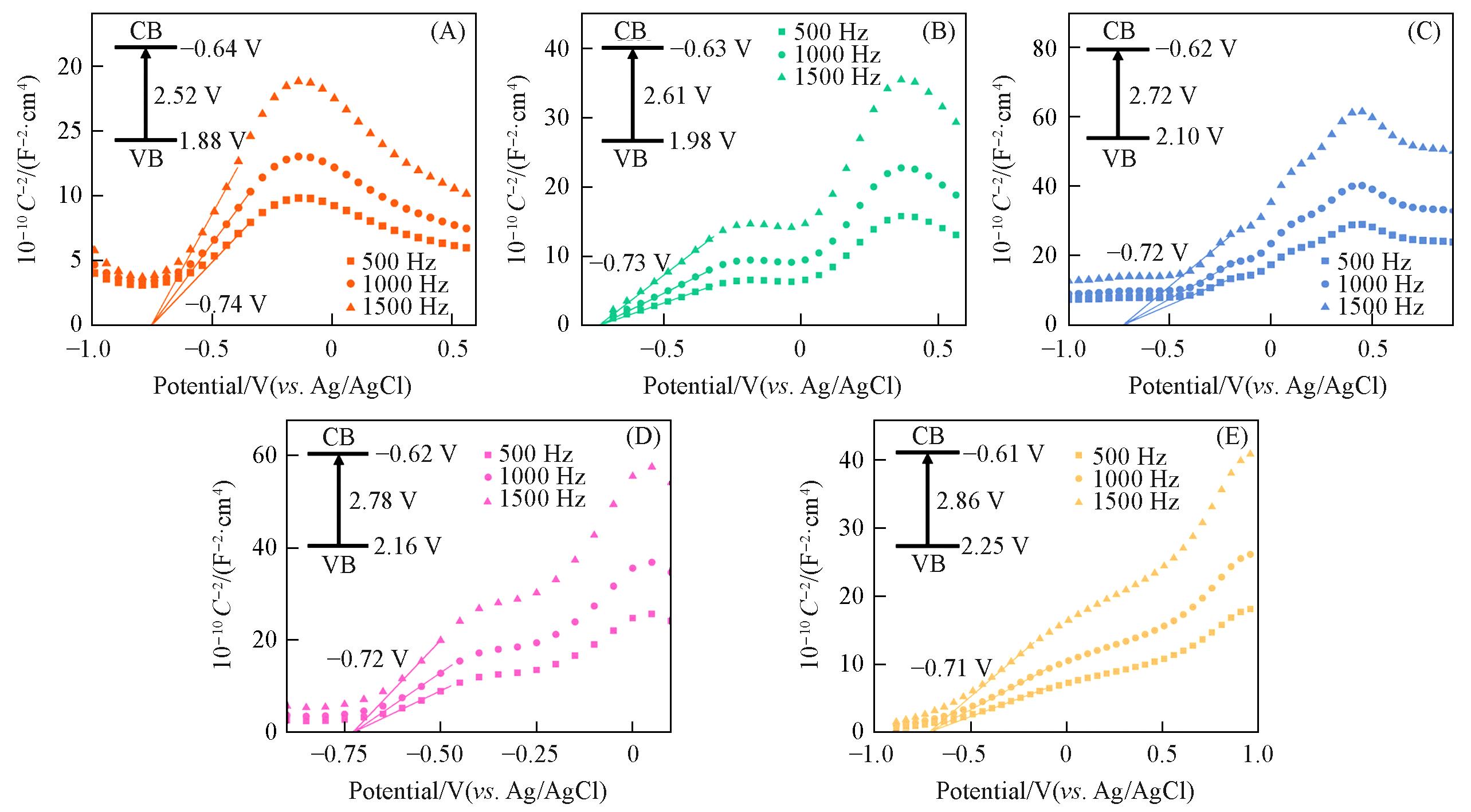
| [1] | Bonchio M., Bonin J., Ishitani O., Lu T. B., Morikawa T., Morris A. J., Reisner E., Sarkar D., Toma F. M., Robert M., Nat. Catal., 2023, 6, 657 |
| [2] | Helveston Davidson M. R., Nature, 2022, 612, 83—100 |
| [3] | Fang Z., Ren R., Wang Y. Q., Hu Y., Dong M. Y., Ye Z., He Q., Peng X., Appl. Catal. B: Environ., 2022, 318, 121878 |
| [4] | Kong T. T., Jiang Y. W., Xiong Y. J., Chem. Soc. Rev., 2020, 49, 6579—6592 |
| [5] | Zheng H. L., Huang S. L., Luo M. Wei B., Chen Q., He E., Lin L. Q., Angew. Chem. Int. Ed., 2020, 59, 23588—23592 |
| [6] | Zhong D. C., Gong Y. N., Zhang C., Lu T. B., Chem. Soc. Rev., 2023, 52, 3170—3215 |
| [7] | Tang L. G., Xu H., Xu Y. R., Cheng Y., Chu Y. S., Feng S., Liu H. X., Liu X. L., Song M. S., Lu Z. Y., Chem. Res. Chinese Universities, 2025, 41(4), 812—821 |
| [8] | Pi Y. H., Feng X. Y., Song Y., Xu Z. W., Li Z., Lin W. B., J. Am. Chem. Soc., 2020, 142, 10302—10308 |
| [9] | Mu Q. Q., Zhu W., Li X., Zhang C. F., Su Y. H., Lian Y., Qi P., Deng Z., Zhang D., Wang S., Zhu X., Peng Y., Appl. Catal. B: Environ., 2020, 262, 118144 |
| [10] | Hu K. Q., Huang Z. W., Zeng L. W., Zhang Z. H., Mei L., Chai Z. F., Shi W. Q., Eur. J. Inorg. Chem., 2022, 2022, e202100748 |
| [11] | Li R., Zhang W., Zhou K., Adv. Mater., 2018, 30, 1705512 |
| [12] | Ahmad I., Alshimaysawee S., Romero⁃Parra R. M., Al⁃Hamdani M. M., Rahimpoor R., Mengelizadeh N., Balarak D., Environ. Sci. Pollut. Res., 2023, 30, 100018 |
| [13] | Hu T. D., Jia Q. M., He S. C., Shan S. Y., Su H. Y., Zhi Y. F., He L., J. Alloys Compd., 2017, 727, 114—123 |
| [14] | He L., Dong Y. N., Zheng Y. N., Jia Q. M., Shan S. Y., Zhang Y. Q., J. Hazard. Mater., 2019, 361, 85—95 |
| [15] | Dao X. Y., Xie X. F., Guo J. H., Zhang X. Y., Kang Y. S., Sun W. Y., ACS Appl. Energy Mater., 2020, 3, 3946—3955 |
| [16] | Zhang Q. Y., Wu Y. P., Hong X. Y., Li Z. Y., Lei Y. T., Yu R., Deng T., Zhang Y., Ma P., Sustain. Chem. Pharm., 2024, 37, 101344 |
| [17] | Chen H. L., Liu C., Guo W., Wang Z. W., Shi Y. Z., Yu Y., Wu L., Catal. Sci. Technol., 2022, 12, 1812—1824 |
| [18] | Xue Y. W., Gao R., Lin S. J., Zhong Q., Zhang Q., Hong J. M., J. Colloid Interface Sci., 2024, 663, 358—369 |
| [19] | Huo Q., Liu G. Q., Sun H. H., Fu Y. F., Ning Y., Zhang B., Zhang X., Gao J., Miao J., Zhang X., Liu S., Chem. Eng. J., 2021, 422, 130036 |
| [20] | Liu N., Tang M. Q., Wu J. X., Tang L., Huang W. Y., Li Q., Lei J., Zhang X., Wang L., Adv. Mater. Interfaces, 2020, 7, 2000468 |
| [21] | Su S. Y., Xing Z. P., Zhang S. Y., Du M., Wang Y., Li Z., Chen P., Zhu Q., Zhou W., Appl. Surf. Sci., 2021, 537, 147890 |
| [22] | Wu T., Zhong Y., Zhao W. M., Xu H., Mao Z. P., Zhang L. P., Chinese J. Inor. Chem., 2025, 41(9), 1765—1775 |
| 吴桐, 钟毅, 赵伟民, 徐红, 毛志平, 张琳萍. 无机化学学报, 2025, 41(9), 1765—1775 | |
| [23] | Bauer S., Serre C., Devic T., Horcajada P., Marrot J., Férey G., Stock N., Inorg. Chem., 2008, 47, 7568—7577 |
| [24] | Islam D. A., Chakraborty A., Acharya H., New J. Chem., 2016, 40, 6745—6752 |
| [25] | Wu C. Y., Zuo H. R., Zhao S. J., Cheng Y. N., Guo Z. Y., Yan Q. S., Chem. Eng. J., 2023, 454, 140157 |
| [26] | Li S., Sun S., Wu H., Wei C., Hu Y., Catal. Sci. Technol., 2018, 8, 1696—1704 |
| [27] | Li S. J., Cai M. J., Liu Y. P., Wang C. C., Yan R. Y., Chen X. B., Adv. Powder Mater., 2023, 2, 100073 |
| [28] | Qin Y. F., Peng X. Y., Wu T., Zhong Y., Xu H., Mao Z. P., Zhang L. P., Catalysts, 2025, 15, 15—29 |
| [29] | Shi L., Li P., Zhou W., Wang T., Chang K., Zhang H., Kako T., Liu G., Ye J., Nano Energy, 2016, 28, 158—164 |
| [30] | Li B. F., Wei F., Su B., Guo Z., Ding Z. X., Yang M. Q., Wang S. B., Mater. Today Energy, 2022, 24, 100943 |
| [31] | La Porta F. A., Nogueira A. E., Gracia L., Pereira W. S., Botelho G., Mulinari T. A., Andrés J., Longo E., J. Phys. Chem. Solids, 2017, 103, 179—190 |
| [32] | Dong Y. N., Hu T. D., Pudukudy M., Su H. Y., Jiang L. H., Shan S. Y., Jia Q. M., Mater. Chem. Phys., 2020, 251, 123060 |
| [33] | Fu Y., Sun D. R., Chen Y. J., Huang R. K., Ding Z. X., Fu X. Z., Li Z. H., Angew. Chem. Int. Ed., 2012, 51, 3364—3368 |
| [34] | Xu H. Q., Hu J. H., Wang D. K., Li Z. H., Zhang Q., Luo Y., Yu S. H., Jiang H. L., J. Am. Chem. Soc., 2015, 137, 13440—13443 |
| [35] | Yan Z. H., Du M. H., Liu J., Jin S., Wang C., Zhuang G. L., Kong X. J., Long L. S., Zheng L. S., Nat. Commun., 2018, 9, 3353—3362 |
| [36] | Zhang A., Si D., Huang H., Xie L., Fang Z., Liu T., Cao R., Angew. Chem. Int. Ed., 2022, 61, e202203955 |
| [37] | Dong L., Zhang L., Liu J., Huang Q., Lu M., Ji W., Lan Y., Angew. Chem. Int. Ed., 2020, 59, 2659—2663 |
| [38] | Chen E., Qiu M., Zhang Y., He L., Sun Y., Zheng H., Wu X., Zhang J., Lin Q., Angew. Chem. Int. Ed., 2022, 61, e202111622 |
| [39] | Cao T. P., Li Y. J., Sun D. W., Chem. J. Chinese Universities, 2024, 45(12), 20240298 |
| 曹铁平, 李跃军, 孙大伟. 高等学校化学学报, 2024, 45(12), 20240298 | |
| [40] | Wang D. K., Huang R. K., Liu W. J., Sun D. R., Li Z. H., ACS Catal., 2014, 4, 4254—4261 |
| [41] | Li X., Lv Z., Wu T., Ji B. L., Wu W., Zhong Y., Xu H., Mao Z. P., Zhang L. P., J. Colloid Interface Sci., 2026, 708, 139853 |
| [1] | SHI Kai, LIU Zijian, ZHANG Xiao, ZHAO Liyan, YAO Tongjie. Synthesis and Characterization of Y-MOF Constructed from Azobenzene Derivatives and Its Fluorescence Detection Performance for Nitro Compounds [J]. Chem. J. Chinese Universities, 2026, 47(7): 20250365. |
| [2] | ZHOU Haigang, CHENG Meng, ZHANG Yue, WEI Xubing, LI Xiaowei, HU Songqing. Construction and Performance of Fluorescent Thiophene-based MOFs for Pollutant Recognition [J]. Chem. J. Chinese Universities, 2026, 47(6): 20250274. |
| [3] | HE Yutong, LI Hanxi, FAN Xiaoyan, YU Meihui, ZHANG Jijie. Research Progress of MOF-SACs in Water Splitting for Hydrogen Evolution Reaction [J]. Chem. J. Chinese Universities, 2026, 47(3): 20250333. |
| [4] | ZHANG Yu, WU Yang, LI Jiaqi, XU Chao, WANG Shaozhen, LI Xinyu, WANG Cunmin, ZHANG Shenghui, XU Huan. Efficient Radiative Cooling Performance of MOF-functionalized Self-cleaning Polylactic Acid Fiber Membranes with Multi-scale Pores [J]. Chem. J. Chinese Universities, 2026, 47(3): 20250239. |
| [5] | XU Qianhui, XU Zhen, MA Ziao, QIAO Juan, LI Nan, MA Lei, JIN Haibo, ZHANG Rongyue. Preparation of Macroporous Polymer Anion Exchange Chromatography Media by Grafting Poly(N,N-dimethylaminopropyl acrylamide) and Their Adsorption Properties [J]. Chem. J. Chinese Universities, 2026, 47(3): 20250238. |
| [6] | YE Weiqing, LU Hui, CHEN Wanjing, LI Ningjing, ZHANG Yu, WANG Lihua, LI Jiang, ZHU Ying, LI Mingqiang, FAN Chunhai, JIA Sisi, CHEN Jing. Aggregation Induced Emission Enhancement of Ligand-Engineered Au Nanoclusters [J]. Chem. J. Chinese Universities, 2025, 46(8): 20250100. |
| [7] | ZHANG Xiaohui, ZHAO Dongdong, ZHANG Junjie, ZHUANG Jinliang. D-A Type Covalent Organic Framework Nanorods for Visible Light Catalyzed Benzylamine Coupling Reaction [J]. Chem. J. Chinese Universities, 2025, 46(7): 20250020. |
| [8] | LI Chengyu, SHANG Lu, ZHANG Tierui. Defect-modified Commercial Carbon Nanotubes for Poison-resistant Electrochemical Carbon Dioxide Reduction [J]. Chem. J. Chinese Universities, 2025, 46(5): 20250043. |
| [9] | LU Jingyu, LIU Zhiping, SHENG Xia, FENG Xinjian. Surface Wettability Regulation of Titanium Dioxide for Enhanced Photocatalytic Oxidation Reaction Performance [J]. Chem. J. Chinese Universities, 2025, 46(5): 20240571. |
| [10] | KANG Sha, ZHANG Ke, WEI Yajing, WANG Chuanyi. In⁃situ Construction of N-defective g-C3N5/CdS/Ti3C2 Schottky Junction for High-efficiency Photocatalytic NO Removal [J]. Chem. J. Chinese Universities, 2025, 46(4): 20240488. |
| [11] | WANG Longsheng, LI Zhaohui, HE Xuan, LI Weixin, CHEN Hui, WANG Daheng, FANG Wei, DU Xing, ZHAO Lei. Controllable Preparation and Carrier Mobility Regulation of Cu-THQ Thin Films [J]. Chem. J. Chinese Universities, 2025, 46(3): 20240470. |
| [12] | ZHANG Long, MA Liang, XU Chao, WU Yang, GAO Na, WANG Shaozhen, LI Xinyu, WANG Cunmin, XU Huan, ZHANG Shenghui. Highly Electroactive and Permeable Janus Filter Membranes by Direct MOF Functionalization of PLA Nanofibers [J]. Chem. J. Chinese Universities, 2025, 46(11): 20250215. |
| [13] | WANG Delong, XING Shilu, LI Chunli, ZHOU Nan, HAO Yaling, HUO Rong, LI Xiuhua, LIU Huifeng. Synthesis and Electrochemical Performance of Nanostructured Co-Nd-MOF/GO Electrode Materials [J]. Chem. J. Chinese Universities, 2025, 46(11): 20250191. |
| [14] | JI Baobao, WANG Zhixiang, LIU Yan, CAO Jia. Visible-light Photocatalytic Silylacylation of Alkenes [J]. Chem. J. Chinese Universities, 2025, 46(10): 20250202. |
| [15] | ZHANG Xiaofei, TIAN Pengcheng, CHANG Jingjing. [3+2] Cyclization Addition of N-cyclopropyl Aniline in a Non-metallic Photocatalytic System [J]. Chem. J. Chinese Universities, 2024, 45(9): 20240253. |
| Viewed | ||||||
|
Full text |
|
|||||
|
Abstract |
|
|||||
