

高等学校化学学报 ›› 2026, Vol. 47 ›› Issue (10): 20260245.doi: 10.7503/cjcu20260245
高奋娥1( ), 王锐英1, 郭俊兰1, 张茜1, 成尚元2, 袁志国2(), 刘靖尧3()
收稿日期:2026-06-23
出版日期:2026-10-10
发布日期:2026-09-03
通讯作者:
高奋娥,袁志国,刘靖尧
E-mail:gaofene@sxct.edu.cn;ncustyzg@nuc.edu.cn;ljy121@jlu.edu.cn
基金资助:
GAO Fen’e1(), WANG Ruiying1, GUO Junlan1, ZHANG Xi1, CHENG Shangyuan2, YUAN Zhiguo2(), LIU Jingyao3()
Received:2026-06-23
Online:2026-10-10
Published:2026-09-03
Contact:
GAO Fen’e, YUAN Zhiguo, LIU Jingyao
E-mail:gaofene@sxct.edu.cn;ncustyzg@nuc.edu.cn;ljy121@jlu.edu.cn
Supported by:摘要:
采用密度泛函理论(DFT)计算结合微观动力学模拟, 系统研究了H‑SAPO‑34中的Brønsted(B)酸位点与Zn@H‑SAPO‑34中B酸位点和Lewis(L)酸位点上烯烃循环生成乙烯和丙烯的反应机理, 以揭示Zn2+改性对甲醇制烯烃(MTO)催化性能的影响. 结果表明, 在H‑SAPO‑34催化的烯烃循环中, 丙烯选择性高于乙烯(与文献报道一致). Zn2+改性增强了邻近B酸位点的酸性强度, 显著降低了乙烯和丙烯生成路径的总自由能垒, 从而提升了反应活性, 同时缩小了两条路径之间能垒的差异. 在L酸位点上, 乙烯的总自由能垒略低于丙烯, 因而L酸对乙烯的相对选择性更高, 但两者的能垒均远高于B酸位点, 表明L酸位点并非主要活性中心. 微观动力学模拟进一步揭示, Zn2+改性后B酸位点仍为主要活性中心, 其总转化频率(TOF)较未改性H-SAPO-34提高2~3个数量级, 且丙烯的选择性优势保持不变, 而乙烯相对选择性随温度升高呈上升趋势. 综上, Zn2+改性通过增强B酸位点酸强度和引入L酸位点, 在保持丙烯选择性优势的同时提升了整体反应活性, 并缩小了乙烯与丙烯的选择性差异, 为高效MTO催化剂设计提供了理论依据.
中图分类号:
TrendMD:
高奋娥, 王锐英, 郭俊兰, 张茜, 成尚元, 袁志国, 刘靖尧. Zn2+改性H‑SAPO‑34对甲醇制烯烃反应中烯烃循环影响的理论研究. 高等学校化学学报, 2026, 47(10): 20260245.
GAO Fen’e, WANG Ruiying, GUO Junlan, ZHANG Xi, CHENG Shangyuan, YUAN Zhiguo, LIU Jingyao. Theoretical Study of the Influence of H-SAPO-34 Modified with Zn2+ on Olefin-based Cycles During Methanol-to-olefins Reaction. Chem. J. Chinese Universities, 2026, 47(10): 20260245.
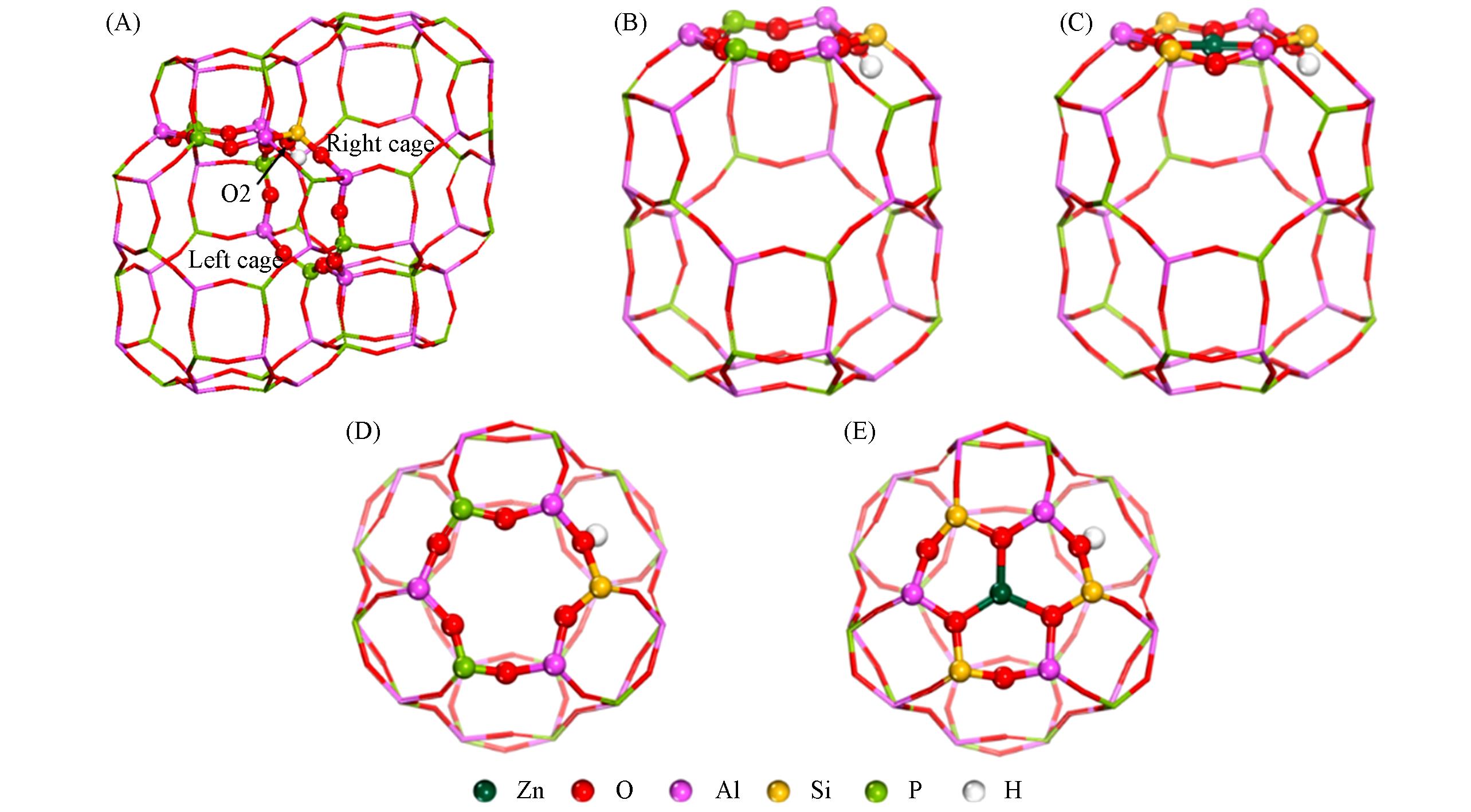
Fig.1 Structure of the H⁃SAPO⁃34 consisting of two CHA cages connected by eight⁃membered rings(A), the side views(B, C) and top views(D, E) of H⁃SAPO⁃34(B, D) and Zn@H⁃SAPO⁃34(C, E)
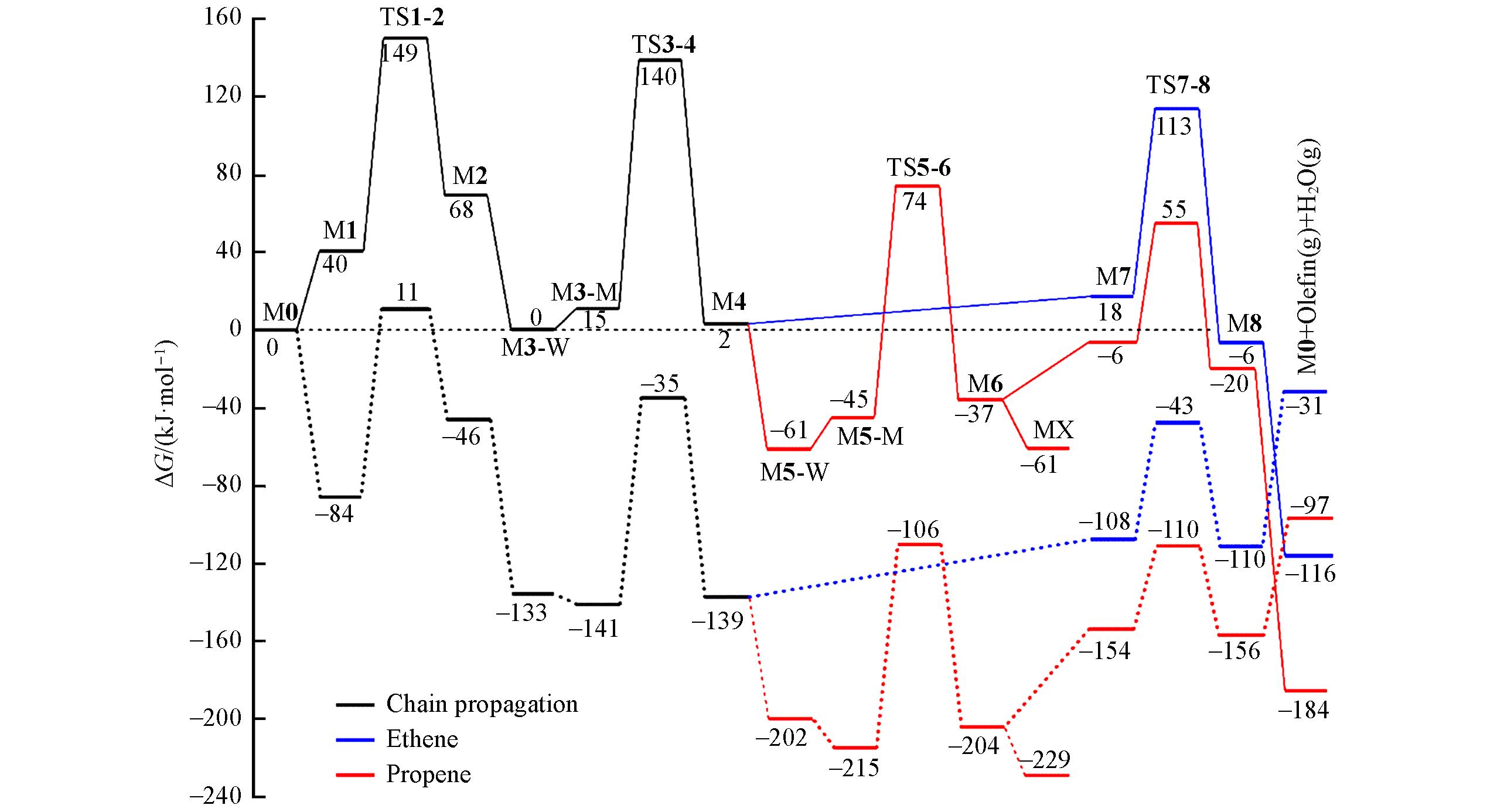
Fig.2 Gibbs free energy profile for olefin⁃based cycles over H⁃SAPO⁃34 at 0 K(dotted line) and 673 K(solid line)
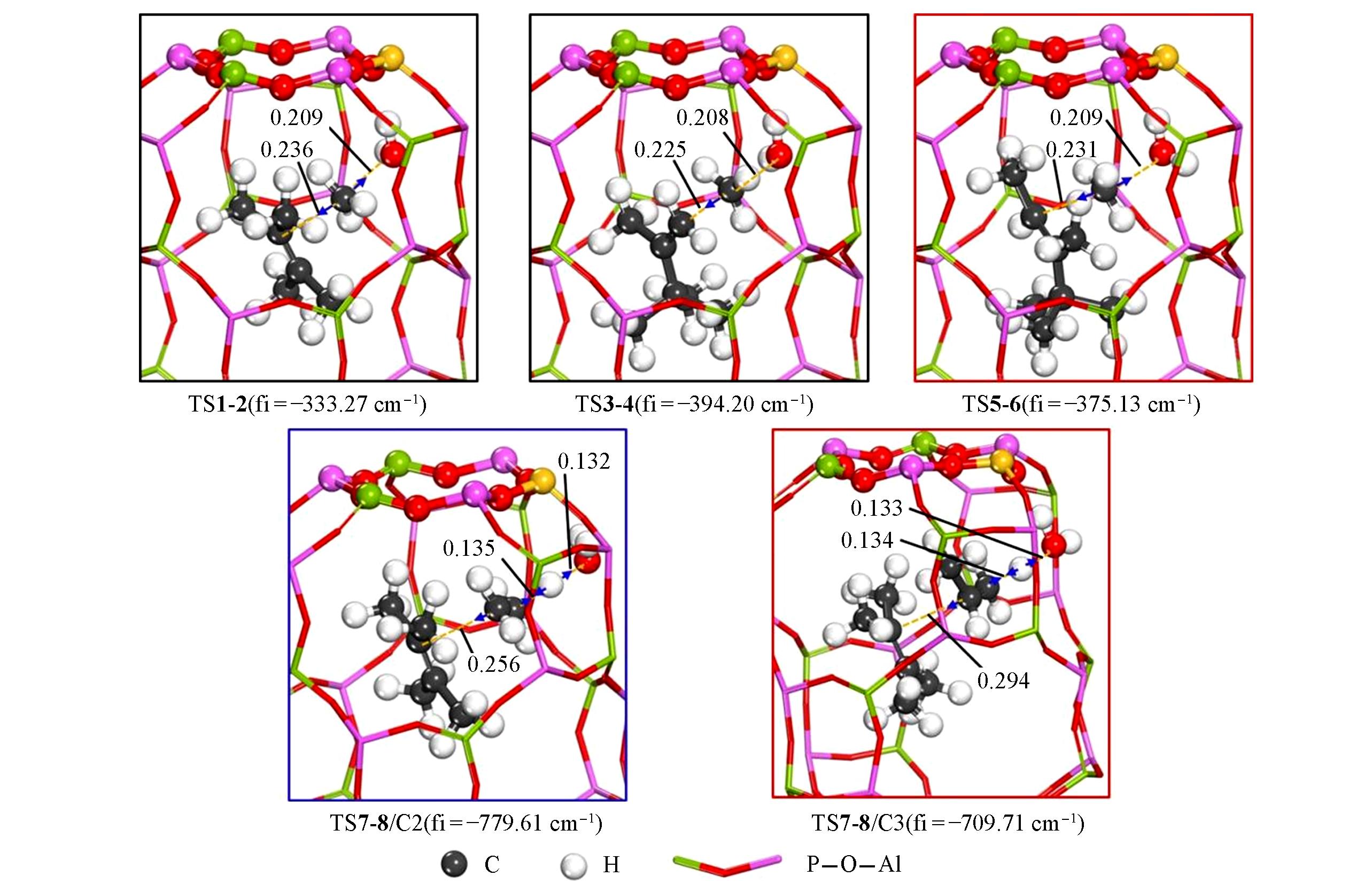
Fig.3 Transition state structures of key elementary steps at BAS in H⁃SAPO⁃34 zeoliteThe imaginary frequency(fi) and the associated vibrational mode are presented by the labeled values and blue arrows, respectively. All distances are in nm.
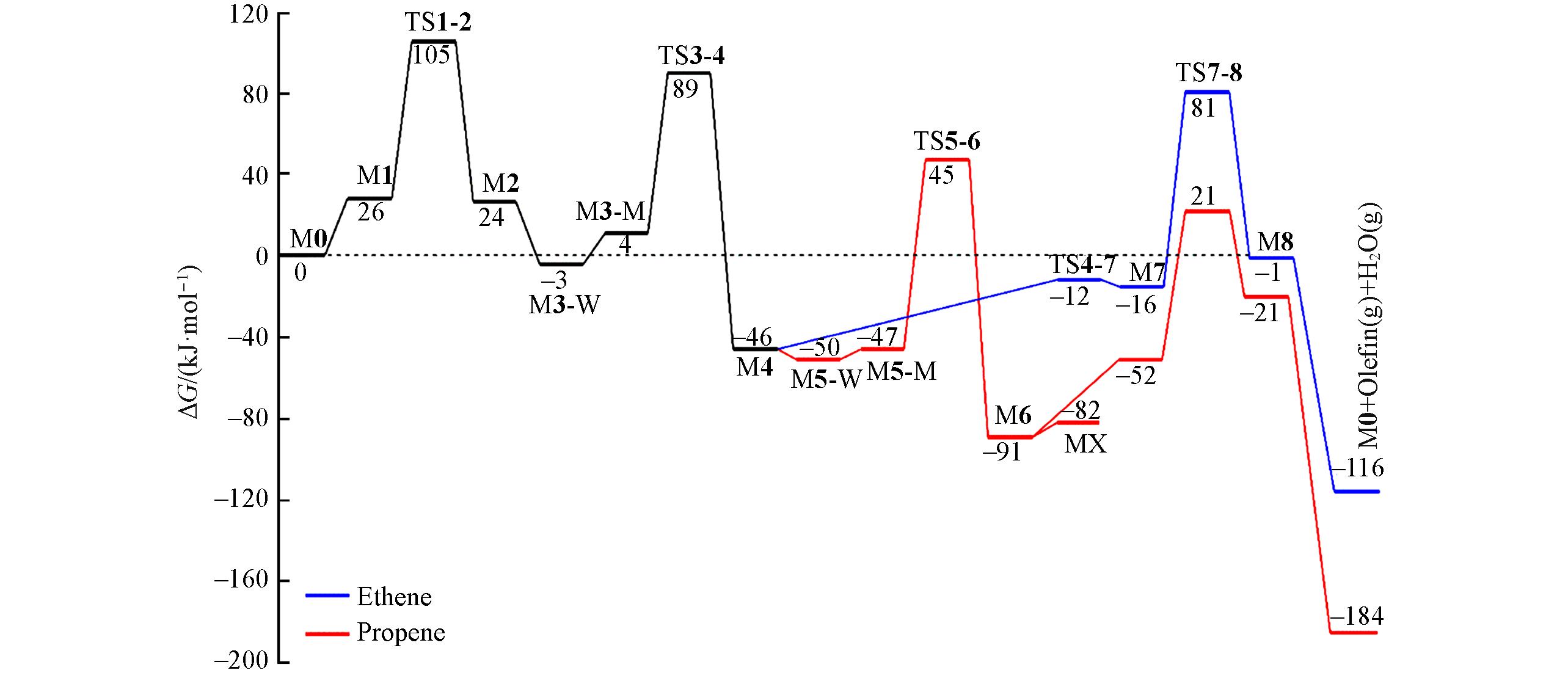
Fig.4 Gibbs free energy diagram for olefin⁃based cycles at BAS in Zn@H⁃SAPO⁃34
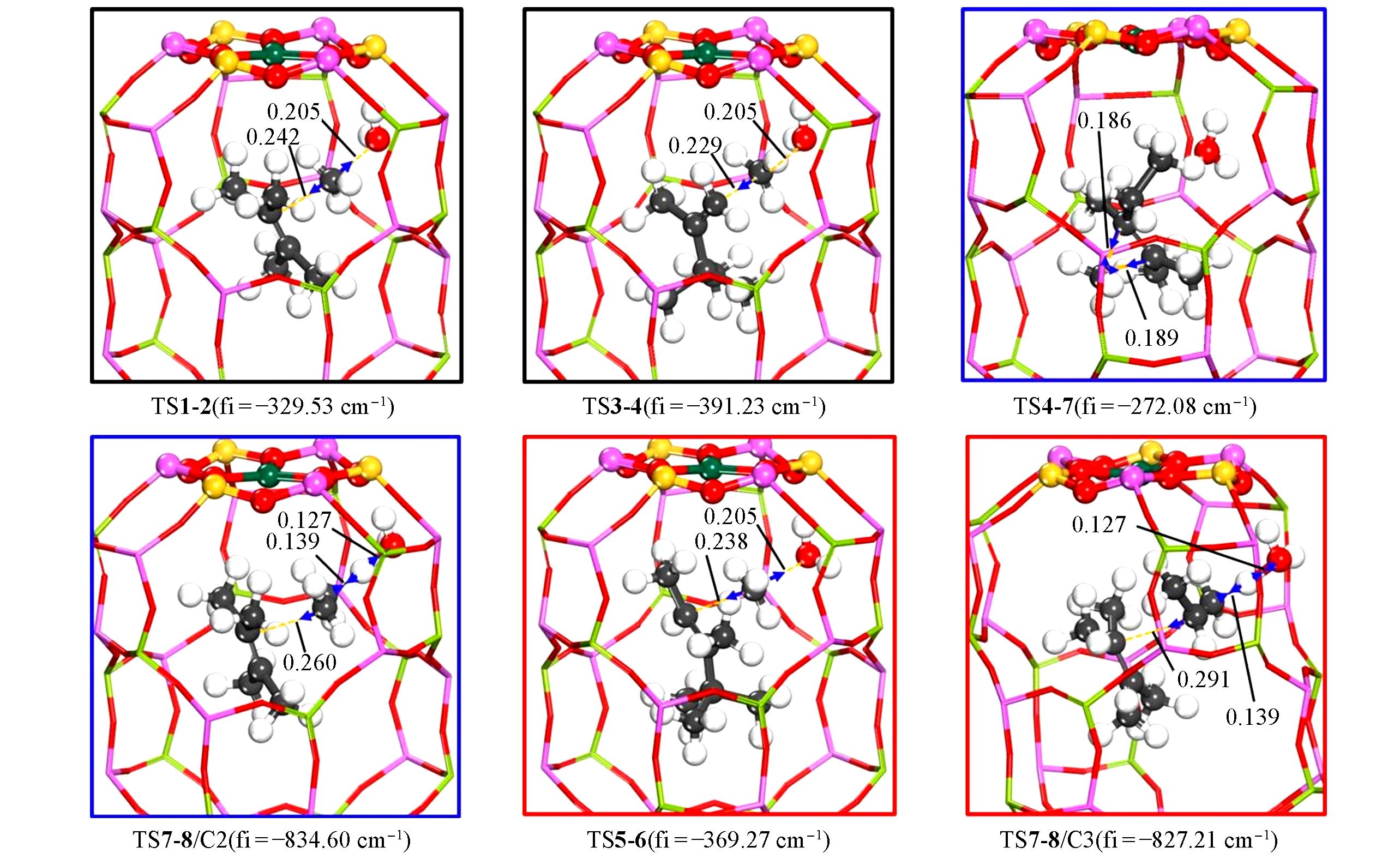
Fig.5 Geometric structures of key transition states for olefin⁃based cycles at BAS in Zn@H⁃SAPO⁃34The imaginary frequency and the associated vibrational mode are presented by the labeled values and blue arrows, respectively. The distances are in nm.
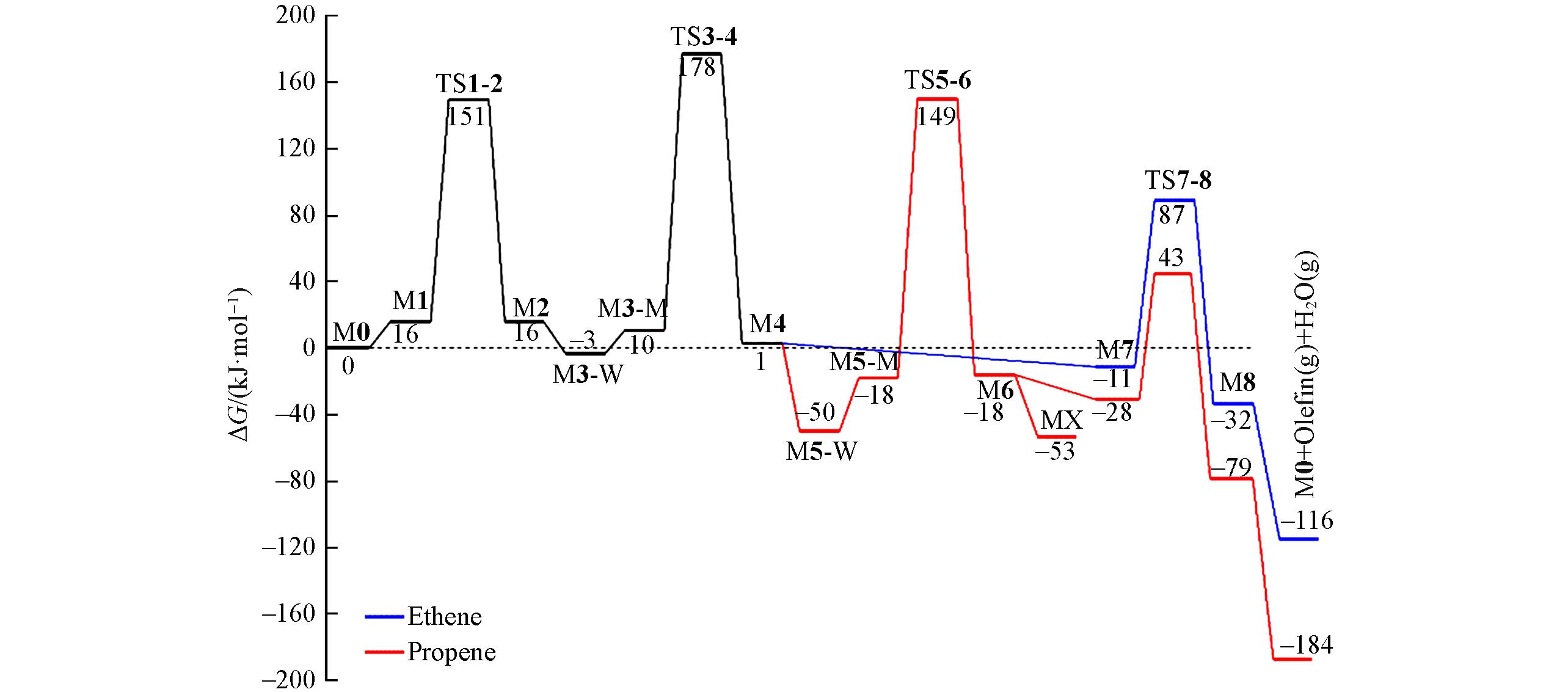
Fig.6 Gibbs free energy diagram for olefin⁃based cycles at LAS in Zn@H⁃SAPO⁃34
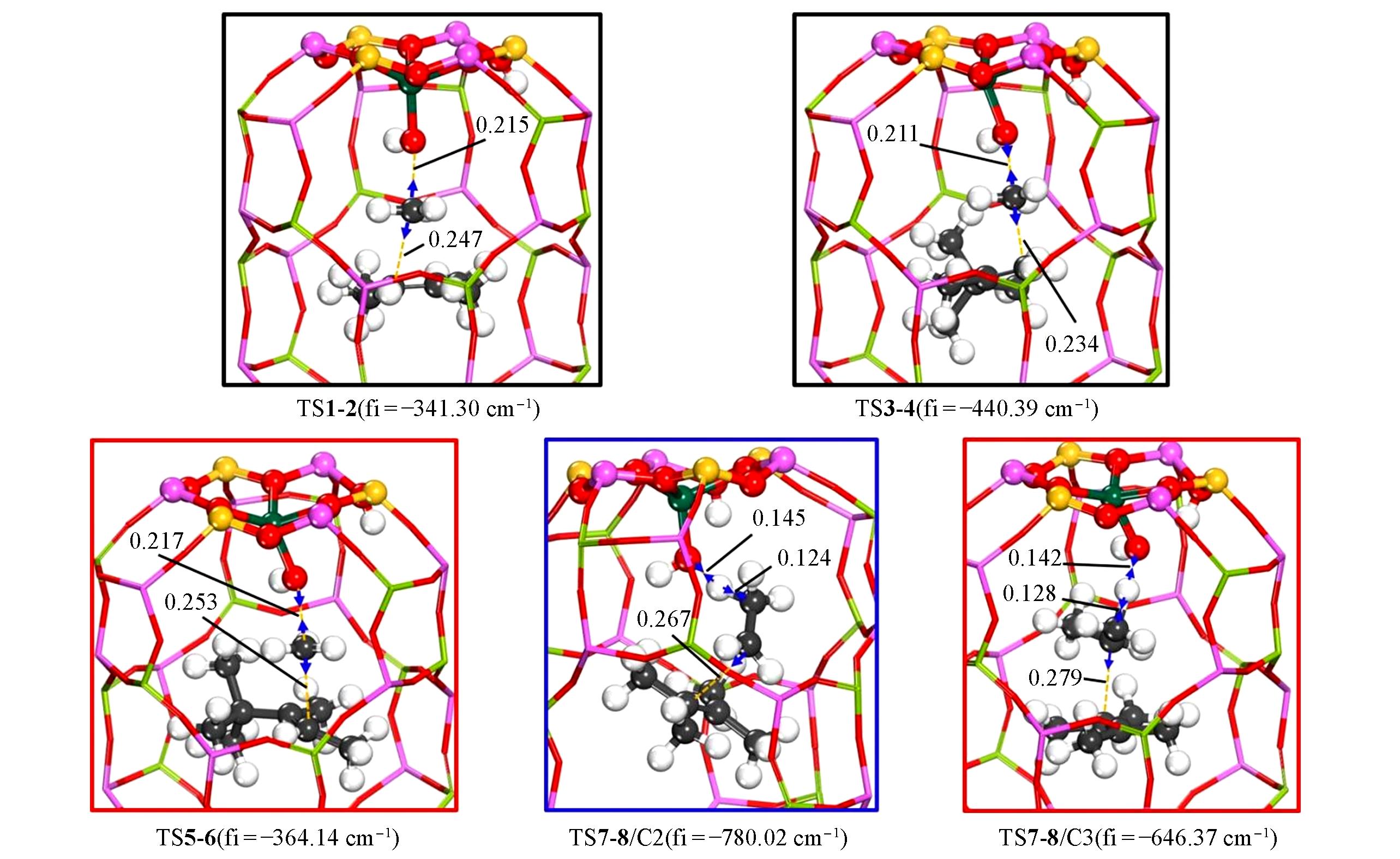
Fig.7 Geometric structures of key transition states for olefin⁃based cycles at LAS in Zn@H⁃SAPO⁃34The imaginary frequency and the associated vibrational mode are presented by the labeled values and blue arrows, respectively. The distances are in nm.
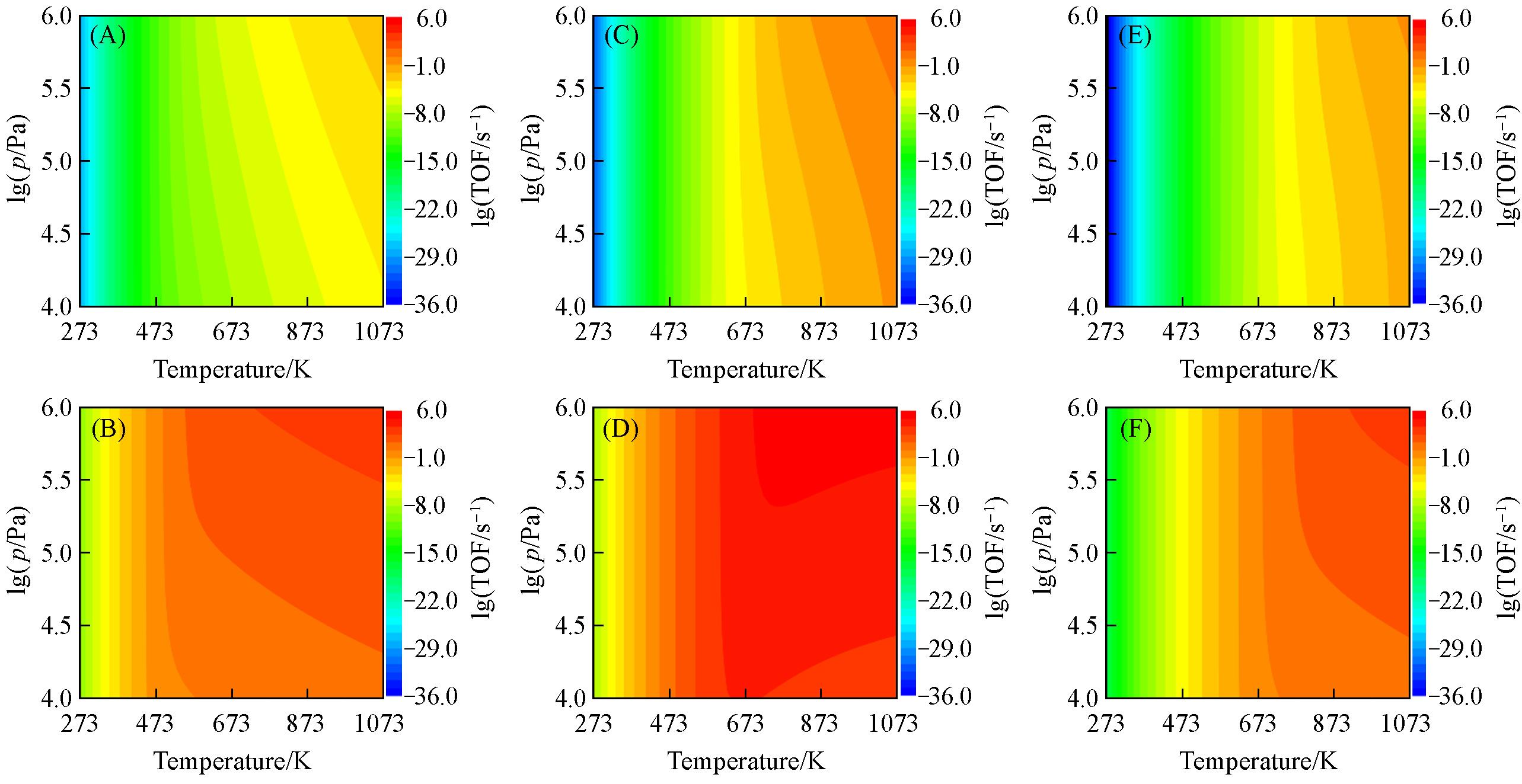
Fig.8 Resolved TOF plots of olefin⁃based cycles mechanism to ethene(A, C, E) and propene(B, D, F) at BAS in H⁃SAPO⁃34(A, B), BAS(C, D) and LAS(E, F) in Zn@H⁃SAPO⁃34 as a function of temperature and pressure
| Site | ΔGmeth/(kJ∙mol-1) | ΔGcrack/(kJ∙mol-1) | ΔGpara/(kJ∙mol-1) | ΔGover/(kJ∙mol-1) | TOF/s-1 |
|---|---|---|---|---|---|
| 1st/2nd/3rd | C2H4/C3H6 | C2H4/C3H6 | C2H4/C3H6 | C2H4/C3H6 | |
| H⁃SAPO⁃34(BAS) | 109/125/119 | 95/61 | 174/135 | 174/149 | 8.2×10⁻⁸/2.5×101 |
| Zn@H⁃SAPO⁃34(BAS) | 79/85/92 | 97/73 | 131/112 | 131/112 | 6.9×10⁻⁵/2.5×104 |
| Zn@H⁃SAPO⁃34(LAS) | 135/168/167 | 98/71 | 137/199 | 181/199 | 1.4×10⁻⁷/9.2×10-1 |
Table 1 Gibbs free energy barriers(ΔG) and turnover frequencies(TOF) for the olefin cycle at different active sites in H-SAPO-34 and Zn@H-SAPO-34 at 673 K*
| Site | ΔGmeth/(kJ∙mol-1) | ΔGcrack/(kJ∙mol-1) | ΔGpara/(kJ∙mol-1) | ΔGover/(kJ∙mol-1) | TOF/s-1 |
|---|---|---|---|---|---|
| 1st/2nd/3rd | C2H4/C3H6 | C2H4/C3H6 | C2H4/C3H6 | C2H4/C3H6 | |
| H⁃SAPO⁃34(BAS) | 109/125/119 | 95/61 | 174/135 | 174/149 | 8.2×10⁻⁸/2.5×101 |
| Zn@H⁃SAPO⁃34(BAS) | 79/85/92 | 97/73 | 131/112 | 131/112 | 6.9×10⁻⁵/2.5×104 |
| Zn@H⁃SAPO⁃34(LAS) | 135/168/167 | 98/71 | 137/199 | 181/199 | 1.4×10⁻⁷/9.2×10-1 |
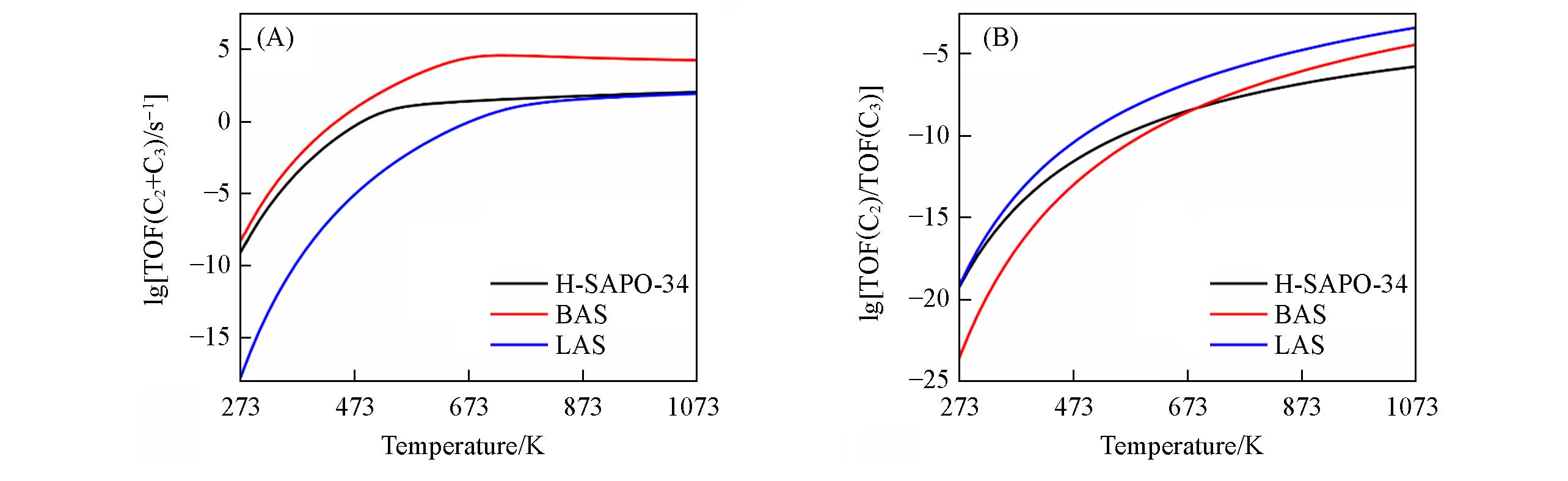
Fig.9 Total TOF(A) and TOF ratio(B) for ethene and propene as functions of temperature at 105 Pa
| [1] | Hannula I., Arpiainen V., Biomass Convers. Bior., 2015, 5(1), 63—74 |
| [2] | Olsbye U., Svelle S., Bjorgen M., Beato P., Janssens T. V., Joensen F., Bordiga S., Lillerud K. P., Angew. Chem. Int. Ed., 2012, 51(24), 5810—5831 |
| [3] | Tian P., Wei Y., Ye M., Liu Z., ACS Catal., 2015, 5(3), 1922—1938 |
| [4] | Al Hussami R., Ghavipour M., Nasser G., Duah C., Yousef S., Kopyscinski J., J. Mater. Chem. A, 2026, 14(1), 90—179 |
| [5] | Li J. F., Fan W. B., Dong M., He Y., Qin Z. F., Wang J. G., Chem. J. Chinese Universities, 2011, 32(3), 765—771 |
| 李俊汾, 樊卫斌, 董梅, 何月, 秦张峰, 王建国. 高等学校化学学报, 2011, 32(3), 765—771 | |
| [6] | Guo S. J., Wang S., Zhang L., Qin Z. F., Wang P. F., Dong M., Wang J. G., Fan W. B., Chem. J. Chinese Universities, 2021, 42(1), 227—238 |
| 郭淑佳, 王森, 张莉, 秦张峰, 王鹏飞, 董梅, 王建国, 樊卫斌. 高等学校化学学报, 2021, 42(1), 227—238 | |
| [7] | Ilias S., Bhan A., ACS Catal., 2012, 3(1), 18—31 |
| [8] | Lin S., Li H., Tian P., Wei Y., Ye M., Liu Z., J. Am. Chem. Soc., 2025, 147(14), 11585—11607 |
| [9] | Haw J. F., Song W., Marcus D. M., Nicholas J. B., Acc. Chem. Res., 2003, 36(5), 317—326 |
| [10] | Yarulina I., Chowdhury A. D., Meirer F., Weckhuysen B. M., Gascon J., Nat. Catal., 2018, 1(6), 398—411 |
| [11] | Stöcker M., Micropor. Mesopor. Mat., 1999, 29(1/2), 3—48 |
| [12] | Zang K., Zhang W., Huang J., Feng P., Ding J., Chem. Phys. Lett., 2019, 737, 136844 |
| [13] | Dahl I. M., Kolboe S., J. Catal., 1994, 149(2), 458—464 |
| [14] | Dahl I. M., Kolboe S., J. Catal., 1996, 161(1), 304—309 |
| [15] | Dahl I. M., Kolboe S., Catal. Lett., 1993, 20(3), 329—336 |
| [16] | Svelle S., Joensen F., Nerlov J., Olsbye U., Lillerud K. P., Kolboe S., Bjørgen M., J. Am. Chem. Soc., 2006, 128(46), 14770— 14771 |
| [17] | Bjørgen M., Svelle S., Joensen F., Nerlov J., Kolboe S., Bonino F., Palumbo L., Bordiga S., Olsbye U., J. Catal., 2007, 249(2), 195—207 |
| [18] | Svelle S., Olsbye U., Joensen F., Bjørgen M., J. Phys. Chem. C, 2007, 111(49), 17981—17984 |
| [19] | McCann D. M., Lesthaeghe D., Kletnieks P. W., Guenther D. R., Hayman M. J., van Speybroeck V., Waroquier M., Haw J. F., Angew. Chem. Int. Ed., 2008, 47(28), 5179—5182 |
| [20] | de Wispelaere K., Hemelsoet K., Waroquier M., van Speybroeck V., J. Catal., 2013, 305, 76—80 |
| [21] | Wang C. M., Wang Y. D., Xie Z. K., Catal. Sci. Technol., 2014, 4(8), 2631—2638 |
| [22] | Wang C. M., Wang Y. D., Du Y. J., Yang G., Xie Z. K., Catal. Sci. Technol., 2015, 5(9), 4354—4364 |
| [23] | Plessow P. N., Studt F., Catal. Sci. Technol., 2018, 8(17), 4420—4429 |
| [24] | Wang C. M., Wang Y. D., Xie Z. K., Chin. J. Catal., 2018, 39(7), 1272—1279 |
| [25] | Fečík M., Plessow P. N., Studt F., Catal. Sci. Technol., 2021, 11(11), 3826—3833 |
| [26] | Chen Y. Y., Wei Z., Wang S., Li J., Dong M., Qin Z., Wang J., Jiao H., Fan W., Catal. Sci. Technol., 2016, 6(14), 5326—5335 |
| [27] | Keil F. J., Micropor. Mesopor. Mat., 1999, 29(1/2), 49—66 |
| [28] | Ding J. J., Shen X. F., Zhou J., Ye Y. C., Liu H. X., Xie Z. K., Chemcatchem, 2020, 12(24), 6420—6425 |
| [29] | Shi Z., Bhan A., J. Catal., 2021, 395, 266—272 |
| [30] | Alshafei F. H., Park Y., Zones S. I., Davis M. E., J. Catal., 2021, 404, 620—633 |
| [31] | Hasnain Bakhtiar S., Ismail A., Ali S., Raziq F., Abbas Hussain S., Zada A., Dong W., Zahid M., Fu Q., Inorg. Chem. Commun., 2024, 159, 111835 |
| [32] | Ghavipour M., Al Hussami R., Nasser G., Kopyscinski J., ChemPhysChem, 2024, 25(24), e202400357 |
| [33] | Zhu Z., Fan M., He M., An B., Chen Y., Xu S., Zhou T., Sheveleva A. M., Kippax⁃Jones M., Shan L., Cheng Y., Cavaye H., Armstrong J., Rudić S., Parker S. F., Thornley W., Tillotson E., Lindley M., Tian S., Lee D., Fu S., Frogley M. D., Tuna F., McInnes E. J. L., Haigh S. J., Yang S., Sci. Bull., 2025, 70(5), 694—703 |
| [34] | van Vreeswijk S. H., Ferwerda S., Flick A. P., Yarulina I., Meirer F., Hutter E. M., Weckhuysen B. M., ChemCatChem, 2026, 18(1), e01159 |
| [35] | Bailleul S., Yarulina I., Hoffman A. E. J., Dokania A., Abou⁃Hamad E., Chowdhury A. D., Pieters G., Hajek J., de Wispelaere K., Waroquier M., Gascon J., Van Speybroeck V., J. Am. Chem. Soc., 2019, 141(37), 14823—14842 |
| [36] | Chu Y., Yi X., Li C., Sun X., Zheng A., Chem. Sci., 2018, 9(31), 6470—6479 |
| [37] | Han M., Xue Z., Ling L., Zhang R., Fan M., Wang B., Mol. Catal., 2021, 509, 111622 |
| [38] | Gao P., Wang Q., Xu J., Qi G., Wang C., Zhou X., Zhao X., Feng N., Liu X., Deng F., ACS Catal., 2017, 8(1), 69—74 |
| [39] | Gao P., Xu J., Qi G., Wang C., Wang Q., Zhao Y., Zhang Y., Feng N., Zhao X., Li J., Deng F., ACS Catal., 2018, 8(10), 9809—9820 |
| [40] | Wang C., Zhang L., Yang J., Yu J., Shao X., Zhang L., Liu R., Zhu W., Dai W., Micropor. Mesopor. Mat., 2025, 392, 113632 |
| [41] | Zhong J., Han J., Wei Y., Xu S., Sun T., Guo X., Song C., Liu Z., Chin. J. Catal., 2018, 39(11), 1821—1831 |
| [42] | Zhong J., Han J., Wei Y., Xu S., Sun T., Guo X., Song C., Liu Z., J. Energ. Chem, 2019, 32, 174—181 |
| [43] | Zhong J., Han J., Wei Y., Xu S., He Y., Zheng Y., Ye M., Guo X., Song C., Liu Z., Chem. Commun., 2018, 54(25), 3146—3149 |
| [44] | Huang H. W., Wang H. R., Zhu H., Zhang S. H., Zhang Q., Li C. Y., Catal. Sci. Technol., 2019, 9(9), 2203—2210 |
| [45] | Gao F. E, Liu J. Y., Chem. Eng. Sci., 2023, 273, 118652 |
| [46] | Gao F. E, Liu J. Y., Mol. Catal., 2022, 533, 112755 |
| [47] | Gao F. E, Theoretical Study on the Reaction Mechanism of Methanol⁃to⁃olefin Catalyzed by H⁃RUB⁃50 and Zn⁃modified H⁃SAPO⁃34 Zeolite, Jilin University, Changchun, 2023 |
| 高奋娥. H⁃RUB⁃50和Zn改性的H⁃SAPO⁃34分子筛催化甲醇制烯烃反应机理的理论研究, 长春: 吉林大学, 2023 | |
| [48] | Wang C. M., Wang Y. D., Xie Z. K., J. Catal., 2013, 301, 8—19 |
| [49] | Kresse G., Furthmüller J., Phys. Rev. B, 1996, 54(16), 11169 |
| [50] | Blöchl P. E., Phys. Rev. B, 1994, 50(24), 17953—17979 |
| [51] | Kresse G., Joubert D., Phys. Rev. B, 1999, 59(3), 1758 |
| [52] | Wellendorff J., Lundgaard K. T., Møgelhøj A., Petzold V., Landis D. D., Nørskov J. K., Bligaard T., Jacobsen K. W., Phys. Rev. B, 2012, 85(23), 235149 |
| [53] | Brogaard R. Y., Weckhuysen B. M., Nørskov J. K., J. Catal., 2013, 300, 235—241 |
| [54] | Brogaard R. Y., Wang C. M., Studt F., ACS Catal., 2014, 4(12), 4504—4509 |
| [55] | Medford A. J., Shi C., Hoffmann M. J., Lausche A. C., Fitzgibbon S. R., Bligaard T., Nørskov J. K., Catal. Lett., 2015, 145(3), 794—807 |
| [56] | Kozuch S., Shaik S., Acc. Chem. Res., 2010, 44(2), 101—110 |
| [1] | 黄诗雨, 姜宏斌, 刘贺然, 代文臣, 徐晓晨, 陈捷, 杨光, 杨凤林. Co(x)/γ-Al2O3非均相催化剂活化过氧乙酸处理亚甲基蓝废水的研究[J]. 高等学校化学学报, 2026, 47(8): 20250377. |
| [2] | 赵豪, 代博文, 程崇博, 卞凤杰, 沈德魁, 姜小祥. 愈创木酚在Ni-Fe团簇/Al2O3界面上加氢脱氧的密度泛函理论研究[J]. 高等学校化学学报, 2026, 47(7): 20250409. |
| [3] | 徐一铭, 史燚威, 王鑫, 朱志慧, 宋志国, 王敏. 新型三维单核Zn(II)配合物多位点协同催化单和双取代喹唑啉酮的绿色合成[J]. 高等学校化学学报, 2026, 47(2): 20250225. |
| [4] | 李浩静, 葛常威, 钟启迪, 闫红, 孙国辉. 1,4-二氢吡啶衍生物光物理性质的理论研究[J]. 高等学校化学学报, 2026, 47(2): 20250250. |
| [5] | 胡煜腾, 桑丽霞, 杜春旭. 等离激元金属及其温升作用下MoS2-H2O的界面性质[J]. 高等学校化学学报, 2025, 46(5): 20240569. |
| [6] | 顼兴宇, 解晓明, 邱萍. 2-苯基-3-氨基氮杂环丁烷开环形成噻唑或噁唑的机理研究[J]. 高等学校化学学报, 2025, 46(5): 20240547. |
| [7] | 杨思伟, 黄旭日. B, N共掺杂富勒烯C70作为氧还原和氧析出非金属电催化剂的理论研究[J]. 高等学校化学学报, 2025, 46(4): 20240490. |
| [8] | 黄智瑶, 李丽, 徐华卿, 杨一凡, 韦瑶瑶, 刘国魁, 夏其英. N掺杂石墨烯缺陷材料催化OER/ORR的第一性原理研究[J]. 高等学校化学学报, 2025, 46(2): 20240430. |
| [9] | 田阳, 郭其景, 杨华春, 刘海霞, 薛峰峰, 易浩, 宋少先. 氢氟酸体系锰杂质络合机制: 基于DFT的配位结构与反应路径解析[J]. 高等学校化学学报, 2025, 46(12): 20250189. |
| [10] | 何军, 朱傲阳, 魏雨晨, 朱怡全, 蒋莉, 何孝军. 三维氮掺杂分级多孔碳纳米片的制备及储锌性能[J]. 高等学校化学学报, 2024, 45(7): 20240099. |
| [11] | 陈俊杰, 张瑞丹, 陈越. 单层GeTe在锂/钠/钾离子电池中潜在应用的第一性原理研究[J]. 高等学校化学学报, 2024, 45(7): 20240148. |
| [12] | 张硕, 赵刘洋, 黄昊, 吴爱民, 李爱魁. 基于第一性原理高价元素Mo稳定层状富锂锰基材料的氧框架机制[J]. 高等学校化学学报, 2024, 45(5): 20240035. |
| [13] | 陈荣, 温良英, 岳东, 杨仲卿. Cl2和O2在TiC(100)表面共吸附行为的密度泛函理论分析[J]. 高等学校化学学报, 2024, 45(4): 20230497. |
| [14] | 陈晴晴, 李江涛, 黄欣蓉, 顾芳, 王海军. 氢键流体中Janus粒子的过量熵[J]. 高等学校化学学报, 2024, 45(2): 20230443. |
| [15] | 王鑫, 祁金阳, 杨瑞杰, 宋志国, 王敏. 基于苯磺酸配体构筑的Cu(II)配合物的合成、 表征及催化性能[J]. 高等学校化学学报, 2024, 45(10): 20240297. |
| 阅读次数 | ||||||
|
全文 |
|
|||||
|
摘要 |
|
|||||
