

高等学校化学学报 ›› 2026, Vol. 47 ›› Issue (7): 20250356.doi: 10.7503/cjcu20250356
安彦楠, 邵学广, 蔡文生( )
)
收稿日期:2025-11-24
出版日期:2026-07-10
发布日期:2026-01-24
通讯作者:
蔡文生
E-mail:wscai@nankai.edu.cn
基金资助:
AN Yannan, SHAO Xueguang, CAI Wensheng()
Received:2025-11-24
Online:2026-07-10
Published:2026-01-24
Contact:
CAI Wensheng
E-mail:wscai@nankai.edu.cn
Supported by:摘要:
采用分子动力学模拟对比研究了抗菌肽Magainin和Indolicidin分别与革兰氏阴性菌和阳性菌膜的相互作用机制. 统计分析了两种肽的结构变化、 吸附过程、 对膜结构的扰动及其与膜的相互作用. 结果表明, Magainin在水相中螺旋结构较不稳定, 但在膜环境中可重新形成稳定的螺旋结构, 且在革兰氏阴性菌膜上 表现出更强的结合能力和更显著的膜扰动效应, 说明其对革兰氏阴性菌膜具有更高的选择性. 相比之下, Indolicidin始终保持柔性的无规卷曲结构, 通过快速吸附与膜表面稳定结合, 其作用机制以静电吸引和疏水作用协同为主, 但对革兰氏阴性菌膜和阳性菌膜的扰动均较小. 对比研究结果为理解Magainin对革兰氏阴性菌的选择性和Indolicidin的广谱性提供了理论依据.
中图分类号:
TrendMD:
安彦楠, 邵学广, 蔡文生. 抗菌肽Magainin和Indolicidin对革兰氏阴性菌和阳性菌膜的作用机制. 高等学校化学学报, 2026, 47(7): 20250356.
AN Yannan, SHAO Xueguang, CAI Wensheng. Mechanism of Action of Antimicrobial Peptides Magainin and Indolicidin on Gram-negative and Gram-positive Bacterial Membranes. Chem. J. Chinese Universities, 2026, 47(7): 20250356.
| System | AMP | Molecular assembly | Box size/nm3 | Simulation time/μs |
|---|---|---|---|---|
| 1 | Magainin | Water | 5.5×5.5×5.5 | 1 |
| 2 | Indolicidin | Water | 5.5×5.5×5.5 | 1 |
| 3 | Magainin | POPC/POPG(3∶1)⁃water | 5.5×5.5×12 | 2 |
| 4 | Magainin | POPC/POPG(5∶1)⁃water | 5.5×5.5×12 | 2 |
| 5 | Indolicidin | POPC/POPG(3∶1)⁃water | 5.5×5.5×12 | 2 |
| 6 | Indolicidin | POPC/POPG(5∶1)⁃water | 5.5×5.5×12 | 2 |
Table 1 Details of molecular assemblies investigated in this study
| System | AMP | Molecular assembly | Box size/nm3 | Simulation time/μs |
|---|---|---|---|---|
| 1 | Magainin | Water | 5.5×5.5×5.5 | 1 |
| 2 | Indolicidin | Water | 5.5×5.5×5.5 | 1 |
| 3 | Magainin | POPC/POPG(3∶1)⁃water | 5.5×5.5×12 | 2 |
| 4 | Magainin | POPC/POPG(5∶1)⁃water | 5.5×5.5×12 | 2 |
| 5 | Indolicidin | POPC/POPG(3∶1)⁃water | 5.5×5.5×12 | 2 |
| 6 | Indolicidin | POPC/POPG(5∶1)⁃water | 5.5×5.5×12 | 2 |
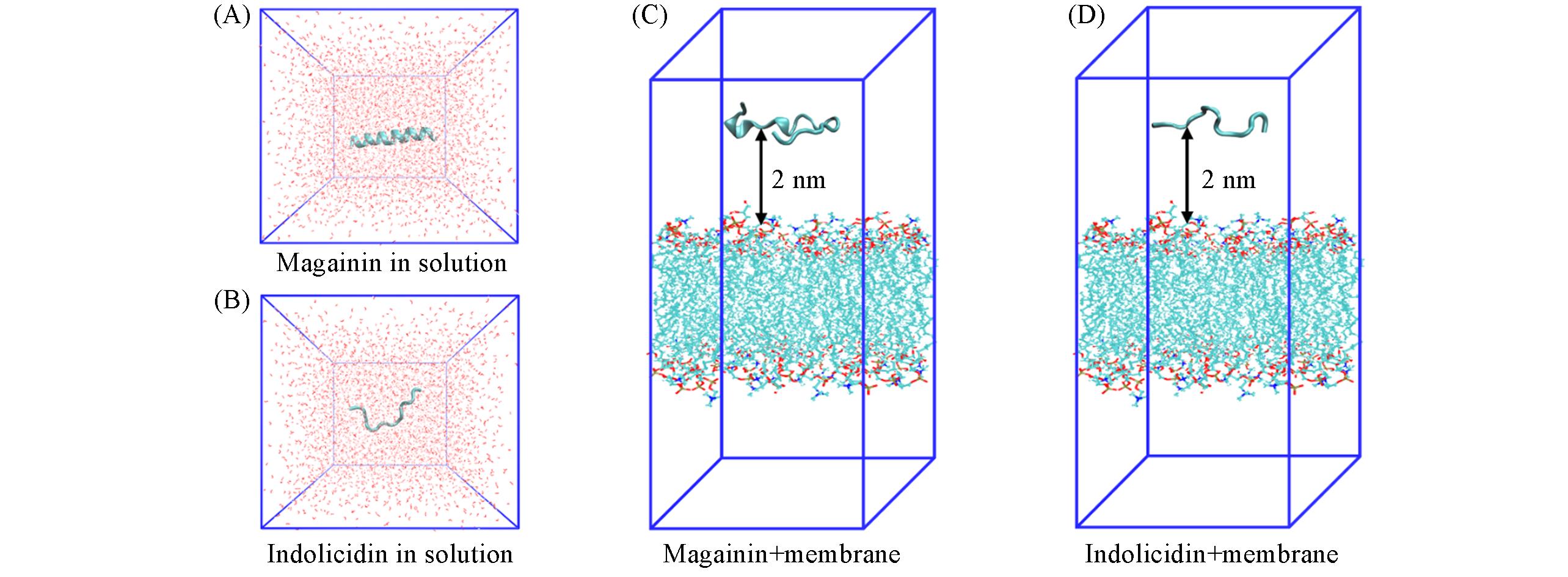
Fig.1 Models of Magainin(A) and Indolicidin(B) in pure water, Magainin(C) and Indolicidin(D) with membranes
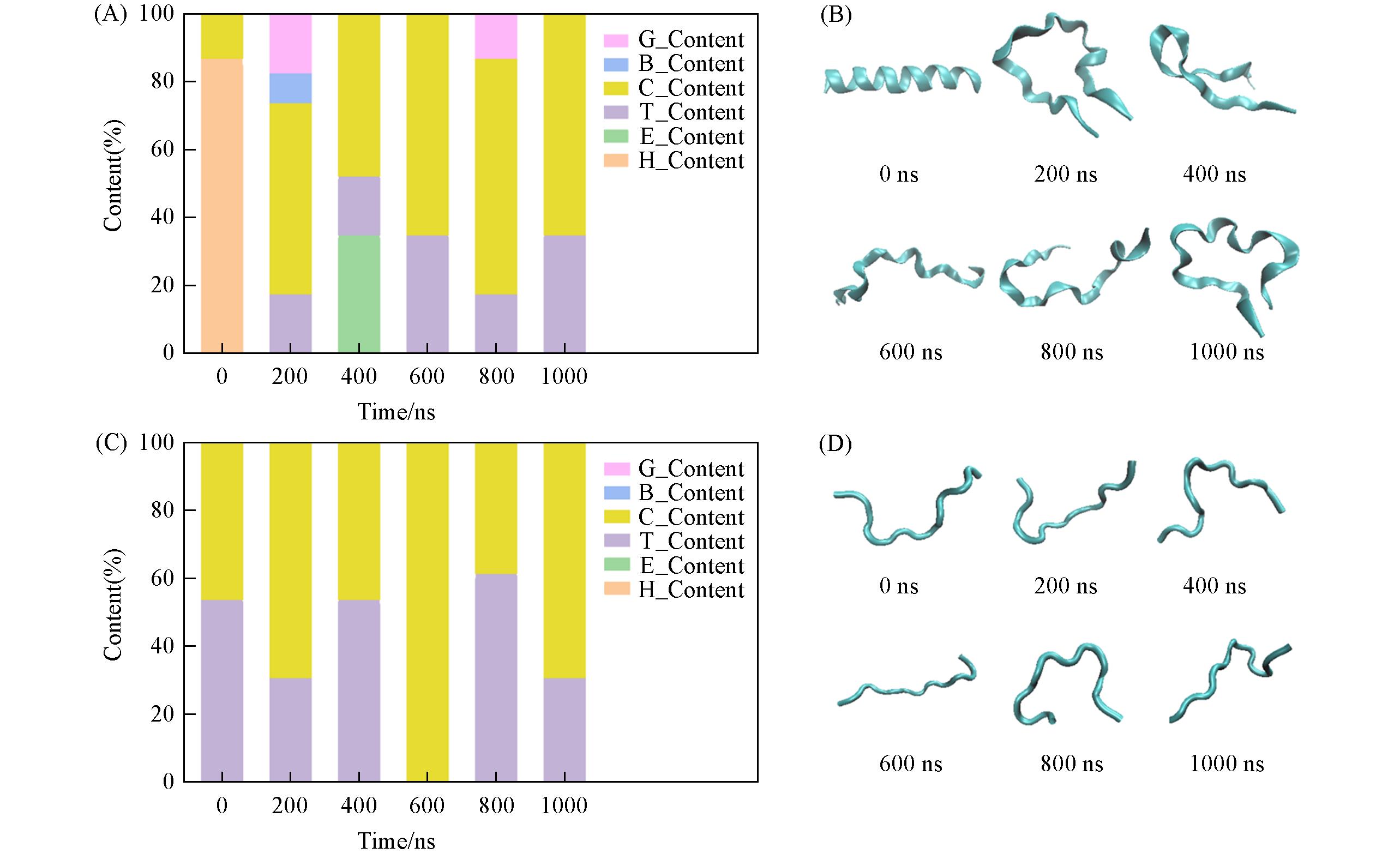
Fig.2 Contents of secondary structures at different moments(A, C) and secondary structures at key moments(B, D) of Magainin(A, B) and Indolicidin(C, D) in pure waterG: 3₁₀ helix, B: isolated β-bridge, C: coil, T: turn, E: extended strand, H: alpha helix.
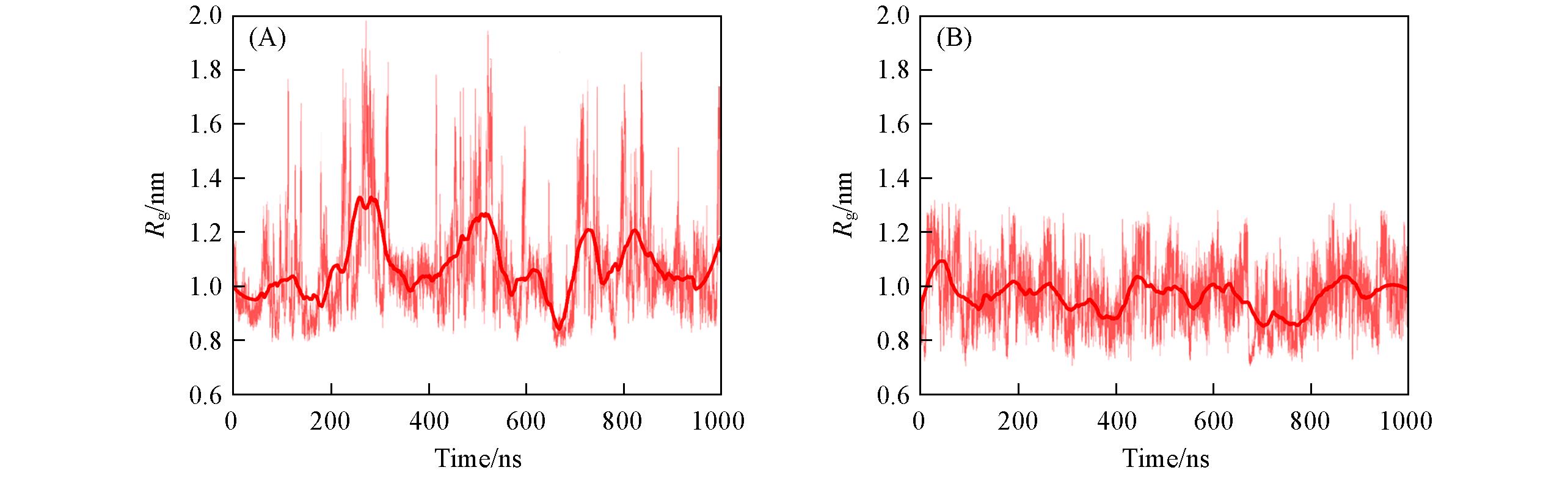
Fig.3 Radius of gyration(Rg) of Magainin(A) and Indolicidin(B) in pure water
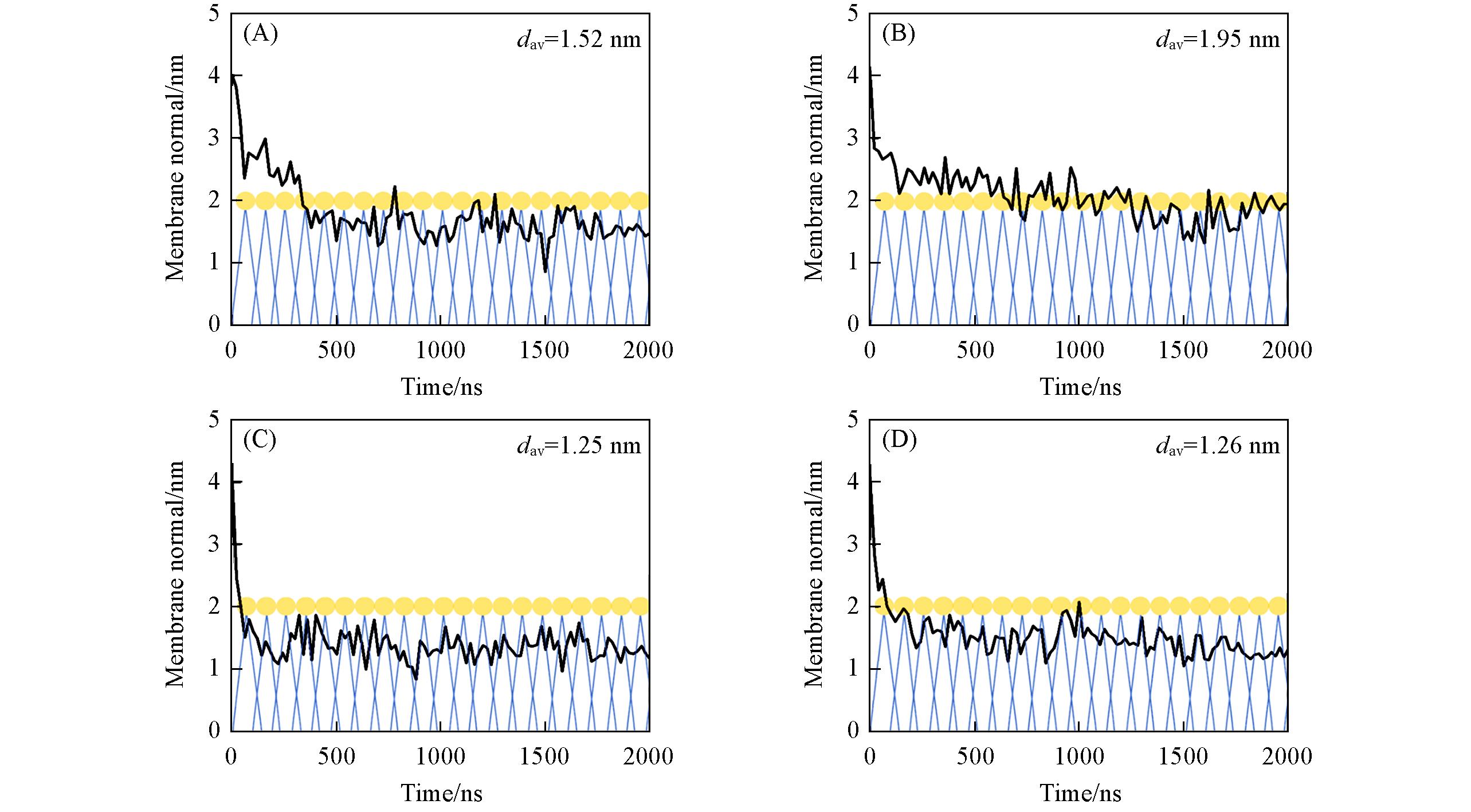
Fig.4 Distances of Magainin(A, B) and Indolicidin(C, D) from center of Gram⁃negative(A, C) and Gram⁃positive(B, D) bacterial membranesMembrane center is defined as 0 nm, blue lines indicate hydrophobic fatty acid tail region of membrane, yellow spheres represent lipid head groups(indicating membrane surface), and peptides were initially located 2 nm away from membrane surface to allow folding and spontaneous adsorption. dav is average distance of peptide relative to membrane center in direction perpendicular to membrane surface over last 100 ns, smaller values indicate deeper membrane embedding.
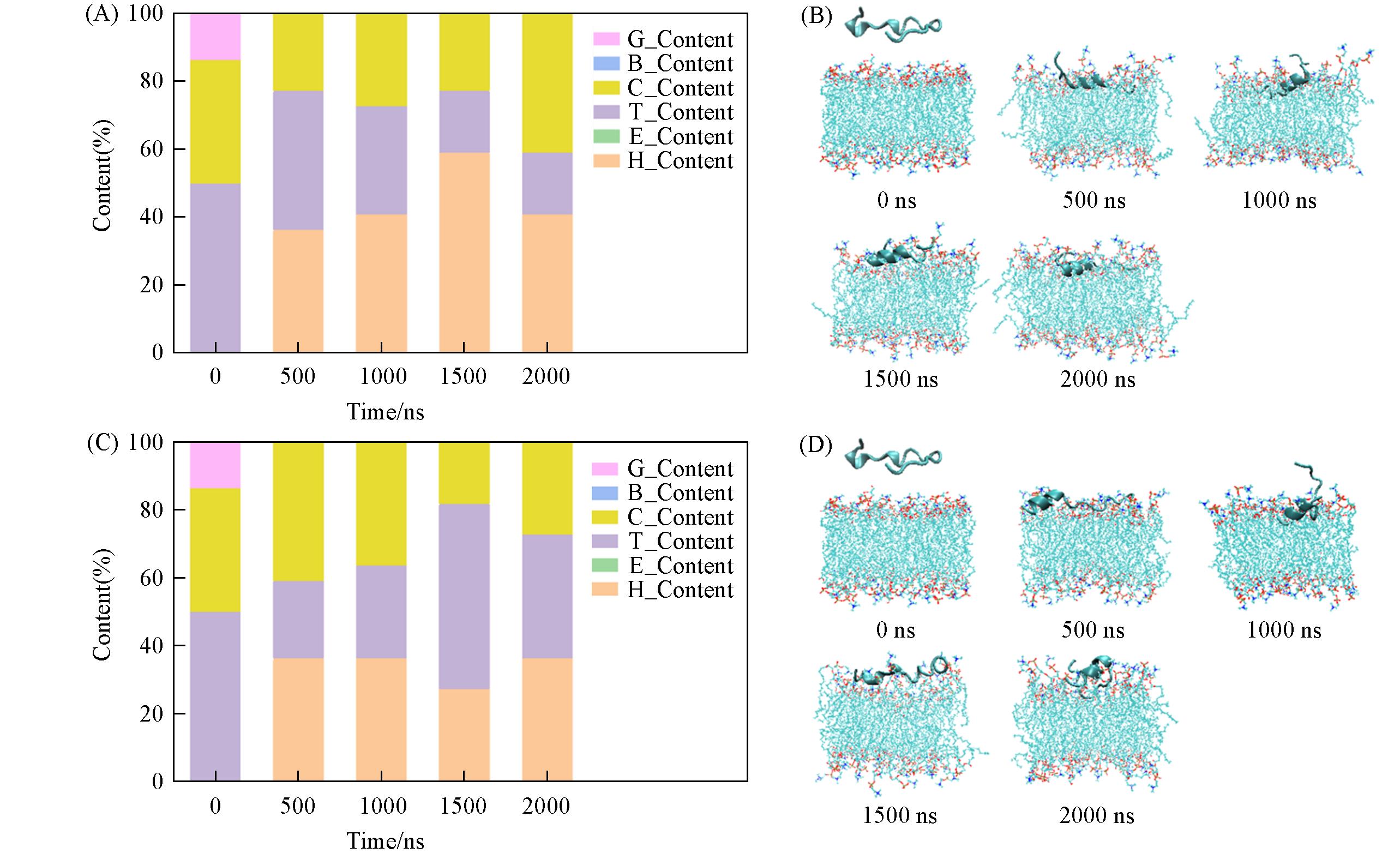
Fig.5 Contents of secondary structures at different moments(A, C) and secondary structures at key moments(B, D) of Magainin on Gram⁃negative(A, B) and Gram⁃positive(C, D) bacterial membranesInitial structure of Magainin in membrane-peptide complex was structure at 50 ns of equilibrium simulation in pure water. G: 3₁₀ helix, B: isolated β-bridge, C: coil, T: turn, E: extended strand, H: alpha helix.
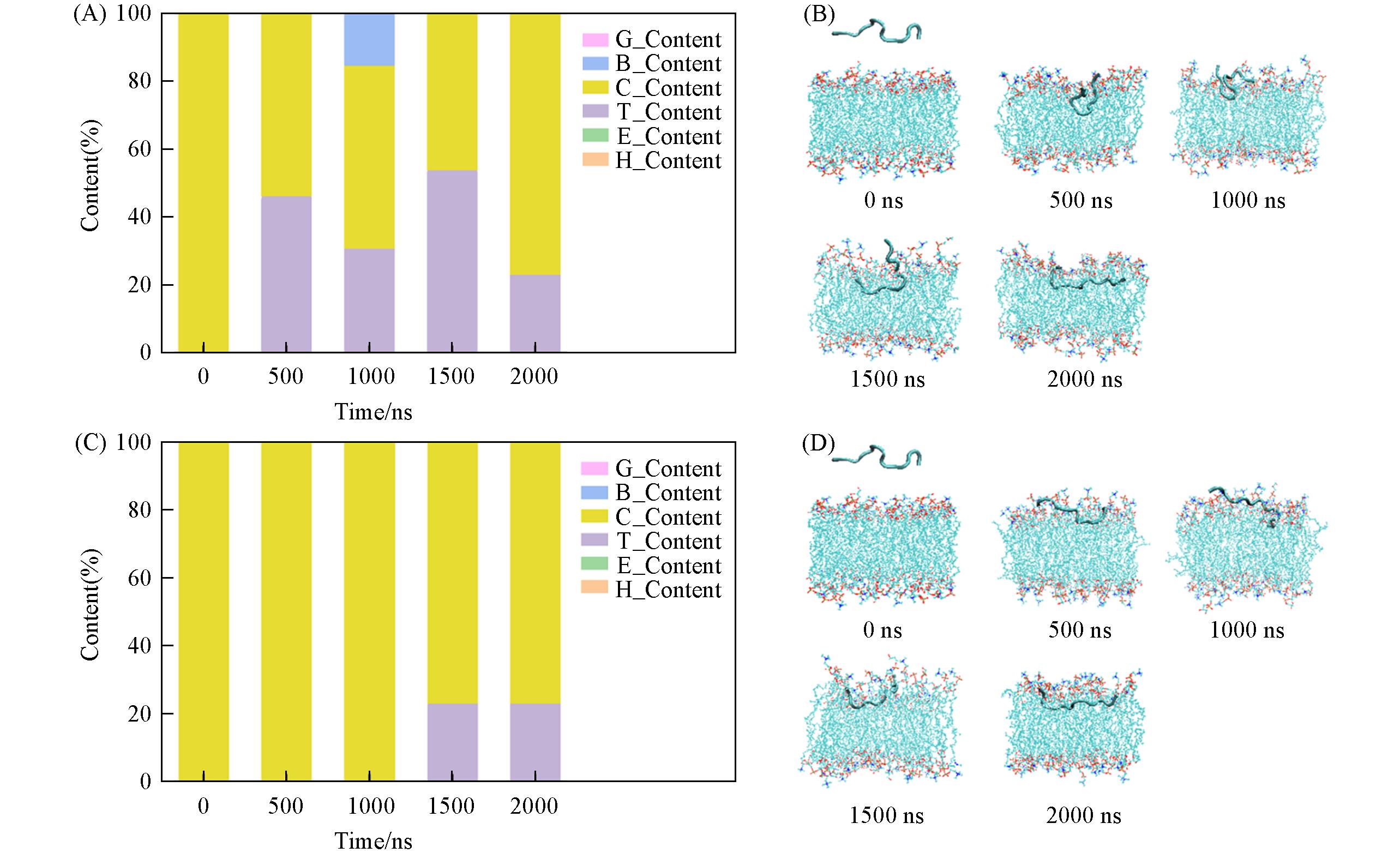
Fig.6 Contents of secondary structures at different moments(A, C) and secondary structures at key moments(B, D) of Indolicidin on Gram⁃negative(A, B) and Gram⁃positive(C, D) bacterial membranesInitial structure of Indolicidin in membrane-peptide complex was structure at 50 ns of equilibrium simulation in pure water. G: 3₁₀ helix, B: isolated β-bridge, C: coil, T: turn, E: extended strand, H: alpha helix.
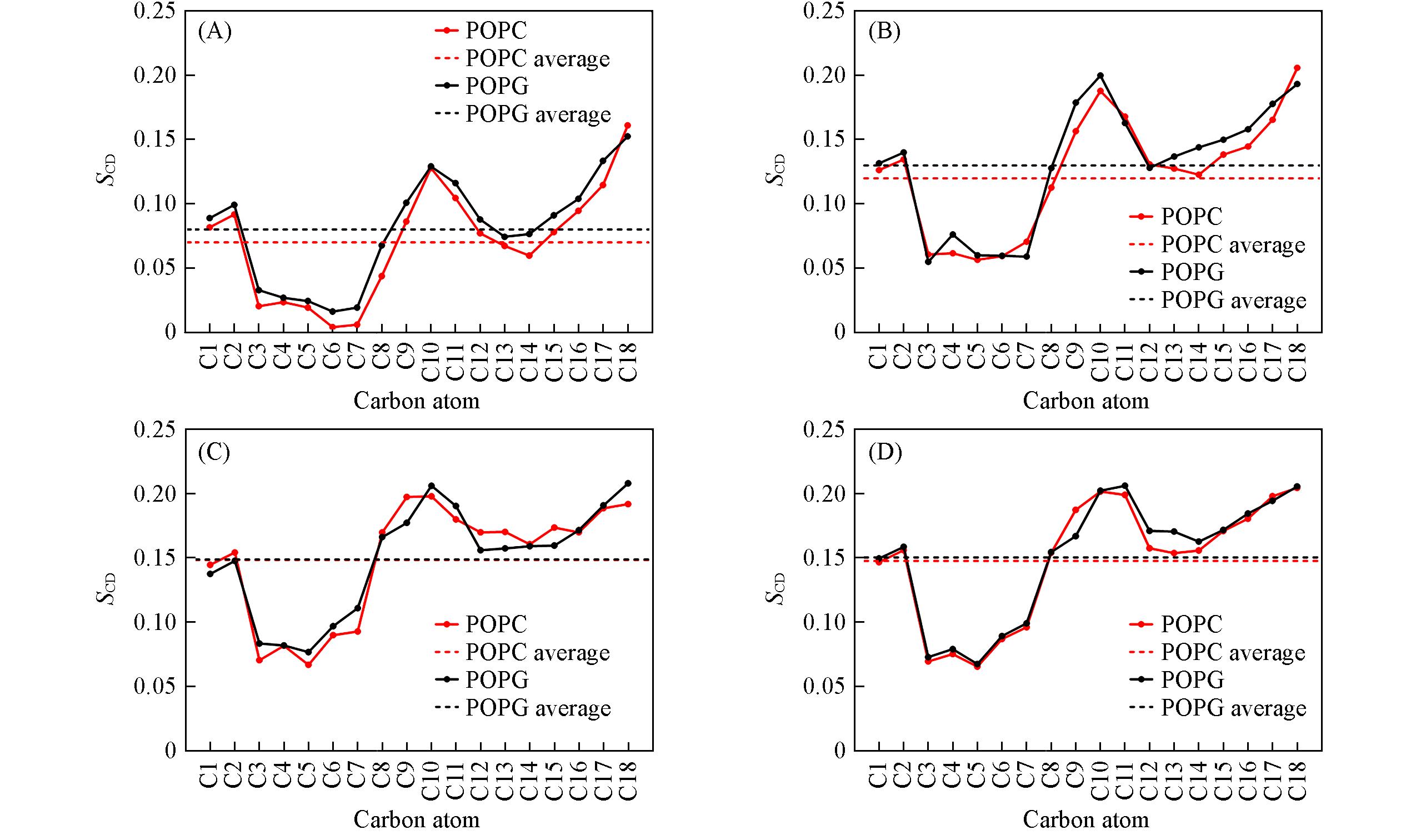
Fig.7 Order parameter SCD of alkyl chain of membrane lipid POPC and POPG molecules of Magainin(A, B) and Indolicidin(C, D) with Gram⁃negative(A, C) and Gram⁃positive(B, D) bacteria
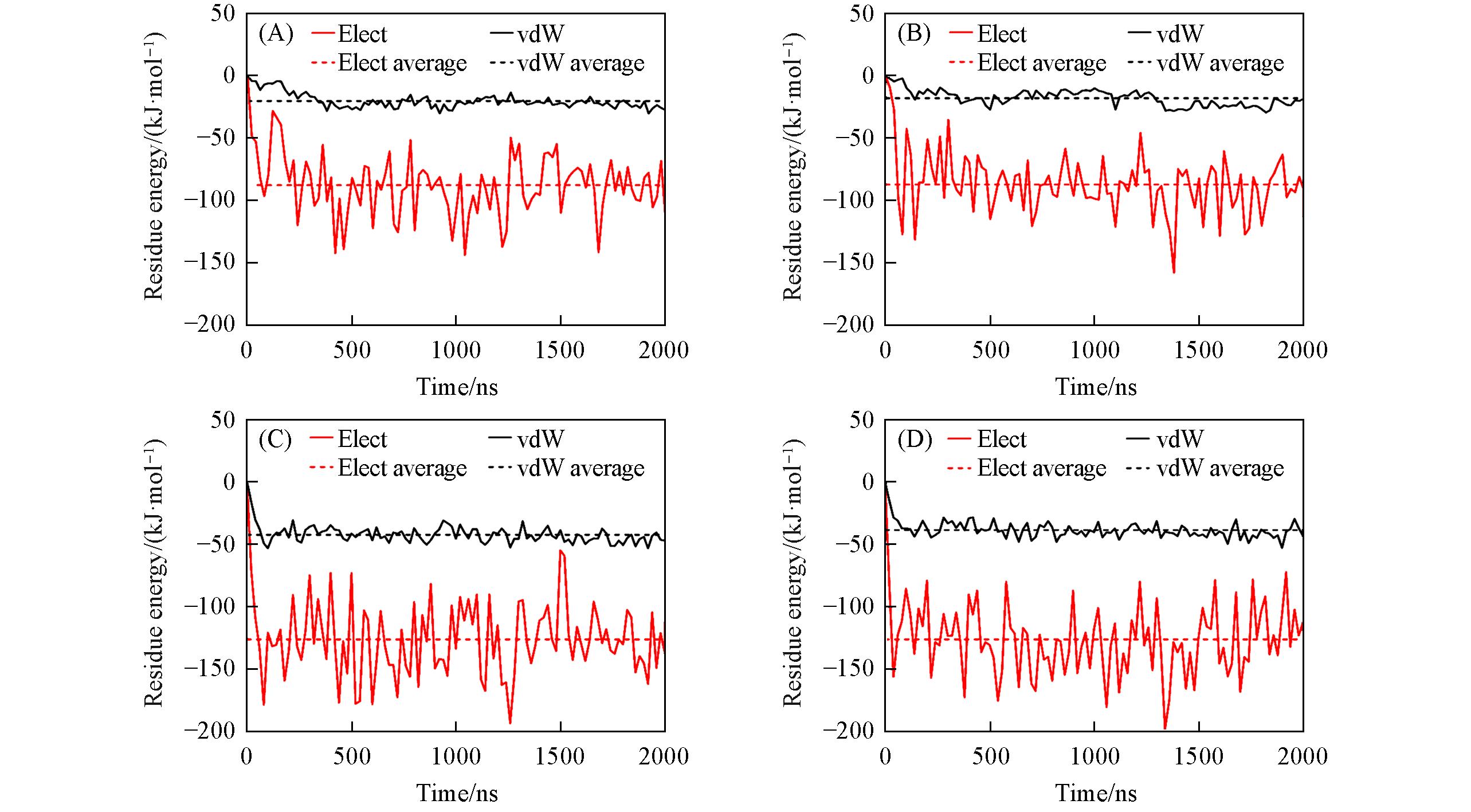
Fig.8 Interaction energy of Magainin(A, B) and Indolicidin(C, D) with Gram⁃negative(A, C) and Gram⁃positive(B, D) bacterial membranes
| [1] | Szymczak P., Zarzecki W., Wang J. J., Duan Y. Q., Wang J., Coelho L. P., Fuente⁃Nunez C., Szczurek E., Acc. Chem. Res., 2025, 58(12), 1831—1846 |
| [2] | He M. Y., Jiang Y. Q., Yang Y., Gong K. P., Jiang X. P., Tian Y., J. Phys. Chem. B, 2025, 129(7), 1956—1965 |
| [3] | Ahmad N. A., Ho J., J. Chem. Inf. Model., 2025, 65(1), 417—426 |
| [4] | Vega S. M., Booth V., Rowley C. N., J. Phys. Chem. B, 2022, 126(29), 5473—5480 |
| [5] | Fitz A. R., Klimov D. K., Lockhart C., J. Chem. Inf. Model., 2025, 65(17), 9251—9260 |
| [6] | Zasloff M., Nature, 2002, 415(6870), 389—395 |
| [7] | Subbalakshmi C., Sitaram N., FEMS Microbiol. Lett., 1998, 160(1), 91—96 |
| [8] | Jackel E., Lazzeri G., Covino R., J. Phys. Chem. B, 2025, 129(5), 1586—1596 |
| [9] | Benjamin A. B., Moule M. G., Didwania M. K., Hardy J., Saenkham⁃Huntsinger P., Sule P., Nielsen J. E., Lin J. S., Contag C. H., Barron A. E., Cirillo J. D., Microbiol. Spectr., 2022, 10(3), e0053422 |
| [10] | Wang H. P., Liu X. Y., Cai W. S., Shao X. G., Biomacromolecules, 2025, 26(11), 7838—7851 |
| [11] | Miao M. Y., Guo Y. C., Shao X. G., Cai W. S., Chem. J. Chinese Universities, 2021, 42(10), 3116—3124 |
| 妙孟姚, 郭一畅, 邵学广, 蔡文生. 高等学校化学学报, 2021, 42(10), 3116—3124 | |
| [12] | Cui S. L., Zhang W. J., Shao X. G., Cai W. S., Chem. J. Chinese Universities, 2022, 43(3), 20210838 |
| 崔韶丽, 张维佳, 邵学广, 蔡文生. 高等学校化学学报, 2022, 43(3), 20210838 | |
| [13] | Su L. L., Shao X. G., Cai W. S., Chem. J. Chinese Universities, 2023, 44(4), 20220745 |
| 粟李醴, 邵学广, 蔡文生. 高等学校化学学报, 2023, 44(4), 20220745 | |
| [14] | Tian C. S., Liu X. Y., Hao Y. L., Fu H. H., Shao X. G., Cai W. S., J. Phys. Chem. B, 2025, 129(5), 1453—1461 |
| [15] | Hao Y. L., Liu X. Y., Fu H. H., Shao X. G., Cai W. S., Bioinformatics, 2024, 40(8), btae497 |
| [16] | Tian C. S., Hao Y. L., Fu H. H., Shao X. G., Cai W. S., J. Chem. Inf. Model., 2025, 65(18), 9566—9575 |
| [17] | Rivel T., Biriukov D., Kabelka I., Vácha R., J. Chem. Inf. Model., 2025, 65(2), 908—920 |
| [18] | Andreev K., Martynowycz M. W., Ivankin A., Huang M. L., Kuzmenko I., Meron M., Lin B., Kirshenbaum K., Gidalevitz D., Langmuir, 2016, 32(48), 12905—12913 |
| [19] | Hayouka Z., Mortenson D. E., Kreitler D. F., Weisblum B., Forest K. T., Gellman S. H., J. Am. Chem. Soc., 2013, 135(42), 15738—15741 |
| [20] | Rozek A., Friedrich C. L., Hancock R. E., Biochemistry, 2000, 39(51), 15765—15774 |
| [21] | Jo S., Kim T., Iyer V. G., Im W., J. Comput. Chem., 2008, 29(11), 1859—1865 |
| [22] | Sharma P., Vaiwala R., Gopinath A. K., Chockalingam R., Ayappa K. G., Langmuir, 2024, 40(15), 7791—7811 |
| [23] | Yao H., Hong M., J. Am. Chem. Soc., 2014, 136(6), 2611—2624 |
| [24] | Phillips J. C., Hardy D. J., Maia J. D. C., Stone J. E., Ribeiro J. V., Bernardi R. C., Buch R., Fiorin G., Hénin J., Jiang W., McGreevy R., Melo M. C. R., Radak B. K., Skeel R. D., Singharoy A., Wang Y., Roux B., Aksimentiev A., Luthey⁃Schulten Z., Kalé L. V., Schulten K., Chipot C., Tajkhorshid E., J. Chem. Phys., 2020, 153(4), 044130 |
| [25] | Huang J., Rauscher S., Nawrocki G., Ran T., Feig M., de Groot B. L., Grubmüller H., MacKerell A. D., Nat. Methods, 2017, 14(1), 71—73 |
| [26] | Jorgensen W. L., Chandrasekhar J., Madura J. D., Impey R. W., Klein M. L., J. Chem. Phys., 1983, 79(2), 926—935 |
| [27] | Feller S. E., Zhang Y., Pastor R. W., Brooks B. R., J. Chem. Phys., 1995, 103(11), 4613—4621 |
| [28] | Ulmschneider J. P., Smith J. C., White S. H., Ulmschneider M. B., J. Am. Chem. Soc., 2011, 133(39), 15487—15495 |
| [29] | Ulmschneider M. B., Ulmschneider J. P., Schiller N., Wallace B. A., Von Heijne G., White S. H., Nat. Commun., 2014, 5, 4863 |
| [30] | Chen C. H., Starr C. G., Troendle E., Wiedman G., Wimley W. C., Ulmschneider J. P., Ulmschneider M. B., J. Am. Chem. Soc., 2019, 141(12), 4839—4848 |
| [31] | Hess B., Bekker H., Berendsen H. J. C., Fraaije J. G. E. M., J. Comput. Chem., 1997, 18(12), 1463—1472 |
| [32] | Essmann U., Perera L., Berkowitz M. L., Darden T., Lee H., Pedersen L. G., J. Chem. Phys., 1995, 103(19), 8577—8593 |
| [33] | Humphrey W., Dalke A., Schulten K., J. Mol. Graph., 1996, 14(1), 33—38 |
| [34] | Kumar A., Mishra B., Konar A. D., Mylonakis E., Basu A., J. Phys. Chem. B, 2024, 128(25), 6049—6058 |
| [35] | Volovik M. V., Batishchev O. V., Biomolecules, 2024, 14(9), 1118 |
| [36] | Fojan P., Gurevich L., Methods Mol. Biol., 2017, 1548, 201—215 |
| [37] | Liu L., Shi Z. H., Tong M. Q., Fang Y. Q., Yang D. Y., Yu J. F., Cao Z. X., J. Chem. Inf. Model., 2025, 65(5), 2623—2635 |
| [38] | Jaradat D. M. M., Saleh K. K. Y., Za'arir B. H. M., Arafat T., Alzoubi K. H., Al‑Taweel S. A., Mallah E., Haddad M. A., Haimur B. A. K., Int. J. Pept. Res. Ther., 2019, 25(3), 1095—1102 |
| [39] | Gupta S., Abhishek, Shrivastava S., Singh R. J., Gogoi P., Kumar B., Int. J. Pept. Res. Ther., 2021, 27(2), 1111—1119 |
| [40] | Vergis J., Malik S. S., Pathak R., Kumar M., Ramanjaneya S., Kurkure N. V., Barbuddhe S. B., Rawool D. B., Front. Microbiol., 2019, 10, 2723 |
| [41] | Nguyen L. T., Haney E. F., Vogel H. J., Trends Biotechnol., 2011, 29(9), 464—472 |
| [42] | Talandashti R., Mehrnejad F., Rostamipour K., Doustdar F., Lavasanifar A., J. Phys. Chem. B, 2021, 125(26), 7163—7176 |
| [43] | Ma W. D., Sun S. Q., Li W. W., Zhang Z. H., Lin Z., Xia Y., Yuan B., Yang K., Langmuir, 2020, 36(26), 7190—7199 |
| [1] | 郭莉莉, 户梦倩, 黄孟梅, 卢艳华, 李伟, 张庆友, 郭翔. 基于机器学习方法的含能材料分解温度预测[J]. 高等学校化学学报, 2026, 47(6): 20250297. |
| [2] | 范翔, 刘子建, 贾梦珂, 艾洪奇. 靶向猴痘A42R病毒的药物筛选和再利用: 结合机制的模拟研究[J]. 高等学校化学学报, 2026, 47(6): 20250317. |
| [3] | 焦海丽, 郑小燕. 限域环境诱导有机发光增强的理论研究进展[J]. 高等学校化学学报, 2026, 47(5): 20260060. |
| [4] | 李欣炘, 安国策, 宋小鸣, 倪爽, 白凤杨, 潘秀梅, 赵震. 大气中甲酸硫酸酐增强新粒子形成机制的理论研究[J]. 高等学校化学学报, 2026, 47(3): 20250313. |
| [5] | 冯靖淇 樊春海 陈静. 金纳米团簇的金属性演化[J]. 高等学校化学学报, 0, (): 20260067. |
| [6] | 赵迎, 杨海迪, 柴玉春, 高帅帅, 原鹏飞, 陈雪波. 催化电子捐赠的机器学习描述符: 预测氮固定中的吸附能和极限电位[J]. 高等学校化学学报, 2026, 47(2): 20250266. |
| [7] | 李浩静, 葛常威, 钟启迪, 闫红, 孙国辉. 1,4-二氢吡啶衍生物光物理性质的理论研究[J]. 高等学校化学学报, 2026, 47(2): 20250250. |
| [8] | 温哥华, 薛静漪. 一维铀酰羧酸膦酸配位聚合物对水溶液中Fe3+的高灵敏选择性检测[J]. 高等学校化学学报, 2025, 46(12): 20250165. |
| [9] | 田阳, 郭其景, 杨华春, 刘海霞, 薛峰峰, 易浩, 宋少先. 氢氟酸体系锰杂质络合机制: 基于DFT的配位结构与反应路径解析[J]. 高等学校化学学报, 2025, 46(12): 20250189. |
| [10] | 张莉, 黄可轩, 顾博嫒. 核受体FXR与天然产物激动剂Sarmentol H的作用机制[J]. 高等学校化学学报, 2025, 46(11): 20250182. |
| [11] | 郑笑函, 祝佳怡, 李晓蕾, 郝强, 王长生. 发展可极化键偶极模型快速预测环肽分子构象稳定性[J]. 高等学校化学学报, 2025, 46(10): 20250173. |
| [12] | 李永霞, 程雅璇, 郭谨昌. 冲突芳香性Ca3B8纳米团簇转子的理论研究[J]. 高等学校化学学报, 2025, 46(9): 20250149. |
| [13] | 卫诗倩, 李佳妮, 邱梅, 李纤, 陈茂霞, 范强, 唐凡, 范未峰, 胡育. 硅烯-二硫化锡复合材料表面锂/钠原子的吸附及迁移行为[J]. 高等学校化学学报, 2025, 46(8): 20250054. |
| [14] | 杨思伟, 黄旭日. B, N共掺杂富勒烯C70作为氧还原和氧析出非金属电催化剂的理论研究[J]. 高等学校化学学报, 2025, 46(4): 20240490. |
| [15] | 祝佳怡, 姜笑楠, 郑笑函, 郝强, 王长生. 基于键偶极模型的多肽-水体系多体极化作用强度高效计算新方法[J]. 高等学校化学学报, 2025, 46(4): 20240518. |
| 阅读次数 | ||||||
|
全文 |
|
|||||
|
摘要 |
|
|||||
