

高等学校化学学报 ›› 2026, Vol. 47 ›› Issue (4): 20260012.doi: 10.7503/cjcu20260012
• 综合评述 • 上一篇
杨湛, 邓皇俊( ), 池振国()
收稿日期:2026-01-04
出版日期:2026-04-10
发布日期:2026-02-01
通讯作者:
邓皇俊,池振国
E-mail:denghj23@mail.sysu.edu.cn;chizhg@mail.sysu.edu.cn
基金资助:
YANG Zhan, DENG Huangjun(), CHI Zhenguo()
Received:2026-01-04
Online:2026-04-10
Published:2026-02-01
Contact:
DENG Huangjun, CHI Zhenguo
E-mail:denghj23@mail.sysu.edu.cn;chizhg@mail.sysu.edu.cn
Supported by:摘要:
氢键有机框架(HOFs)是一类由分子间氢键自组装形成的新型多孔晶态材料, 具有高结晶度、 结构可调性、 动态可逆性以及可功能化等优点, 在气体吸附与分离、 化学传感及光电功能材料等领域展现出良好的应用前景. 然而, 传统有机发光材料在固态或高聚集状态下普遍存在聚集导致发光猝灭(ACQ)效应, 发光效率显著降低, 严重制约了其在固态发光与器件中的进一步应用. 近年来, 将聚集诱导发光(AIE)特性引入HOFs体系, 被证明是一种克服ACQ效应并提升固态发光性能的有效策略. 本文综合评述了近年来具有AIE特性的荧光型与磷光型HOFs的研究进展, 重点总结了其结构设计思路、 发光机理及相关应用探索, 并对该领域面临的挑战与发展方向进行了简要展望.
中图分类号:
TrendMD:
杨湛, 邓皇俊, 池振国. 具有聚集诱导发光性质的氢键有机框架的研究进展. 高等学校化学学报, 2026, 47(4): 20260012.
YANG Zhan, DENG Huangjun, CHI Zhenguo. Research Progress on Hydrogen-bonded Organic Frameworks with Aggregation-induced Emission. Chem. J. Chinese Universities, 2026, 47(4): 20260012.
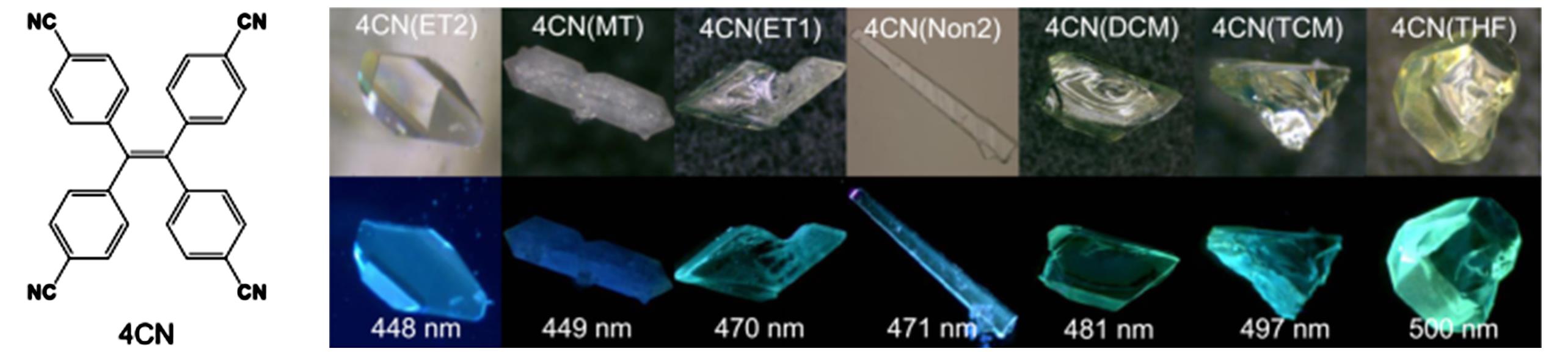
Fig.1 Molecular structure of 4CN and photographs of different crystals of 4CN under daylight(first row) and UV light(second row)[14]
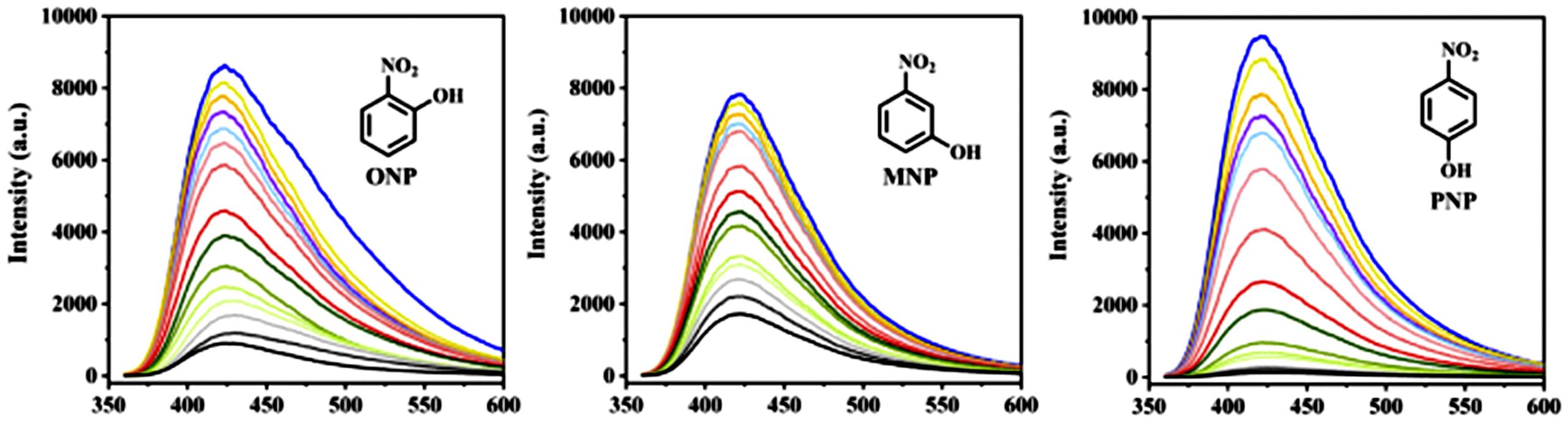
Fig.2 Fluorescence spectra of HOF⁃TPE⁃CN dispersed in water(1 mg/mL) with increasing concentrations(0—500 μmol/L) of ONP, MNP and PNP[15]Copyright 2024, the Royal Society of Chemistry.
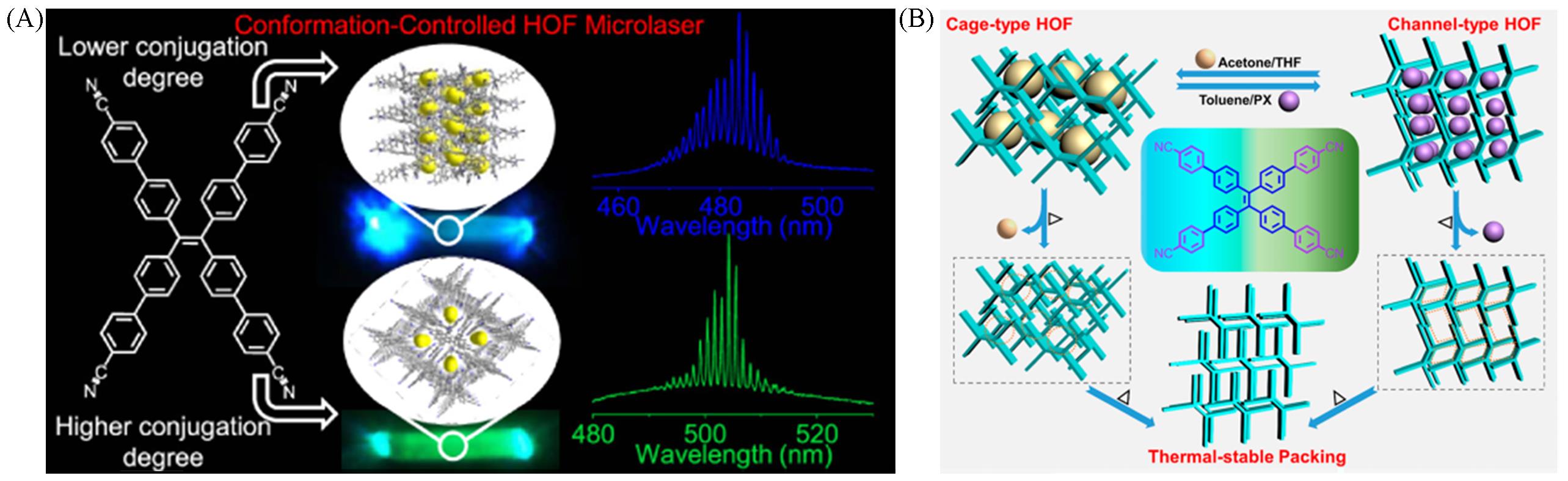
Fig.3 Molecular structure, HOF structure and pump spectra of HOF⁃FJU⁃4 and HOF⁃FJU⁃5(A)[16], schematic illustration of behavior of the 4Ph⁃4CN crystals(THF indicates tetrahydrofuran, and PX indicates p⁃xylene)(B)[17](A) Copyright 2021, American Chemical Society; (B) Copyright 2022, American Chemical Society.
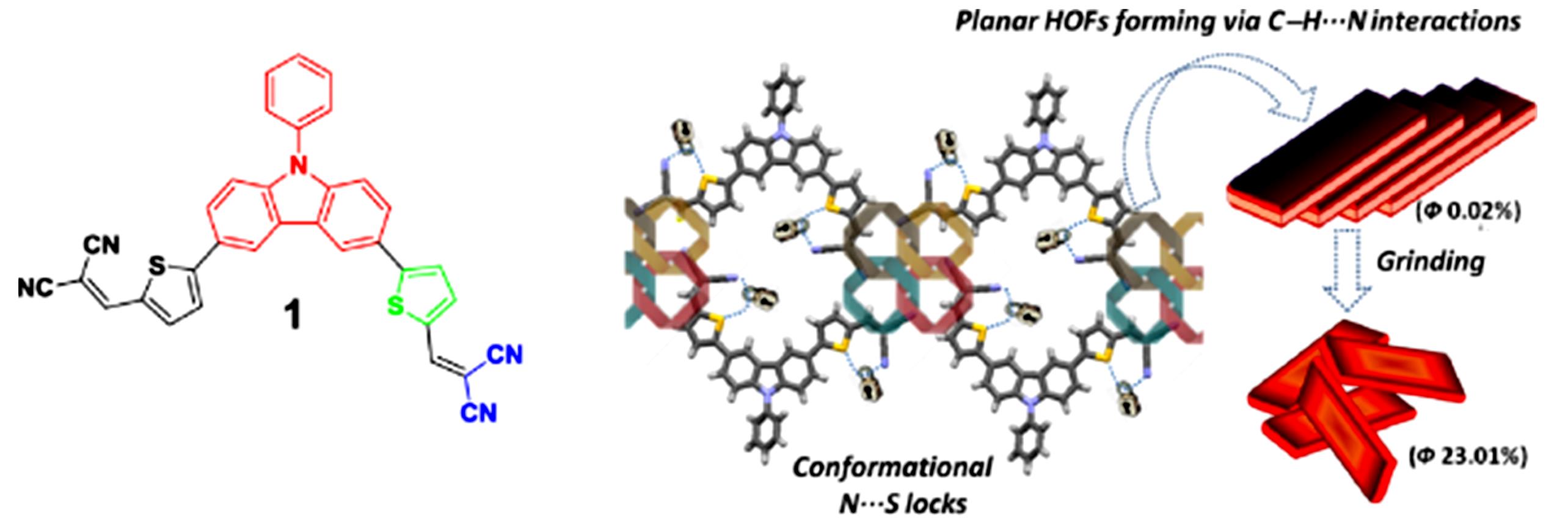
Fig.4 Molecular structure, HOF structure and mechanoresponsive luminescence behavior of compound 1[18]Copyright 2018, American Chemical Society.
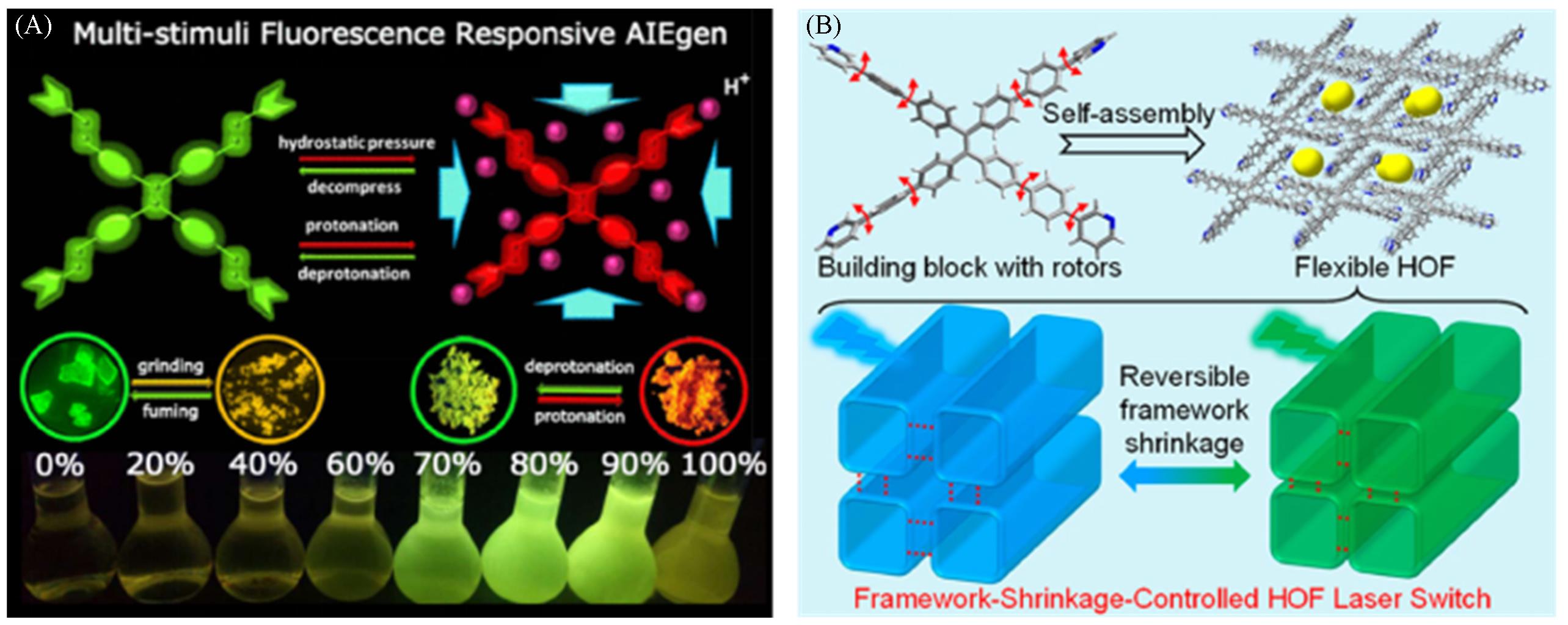
Fig.5 Multi⁃stimuli responsive fluorescence and AIE behaviors of TP2VPE(A)[19] and wavelength⁃switchable lasing induced by framework shrinkage in a single hydrogen⁃bonded organic framework microcrystal(B)[20](A) Copyright 2018, American Chemical Society; (B) Copyright 2022, American Chemical Society.
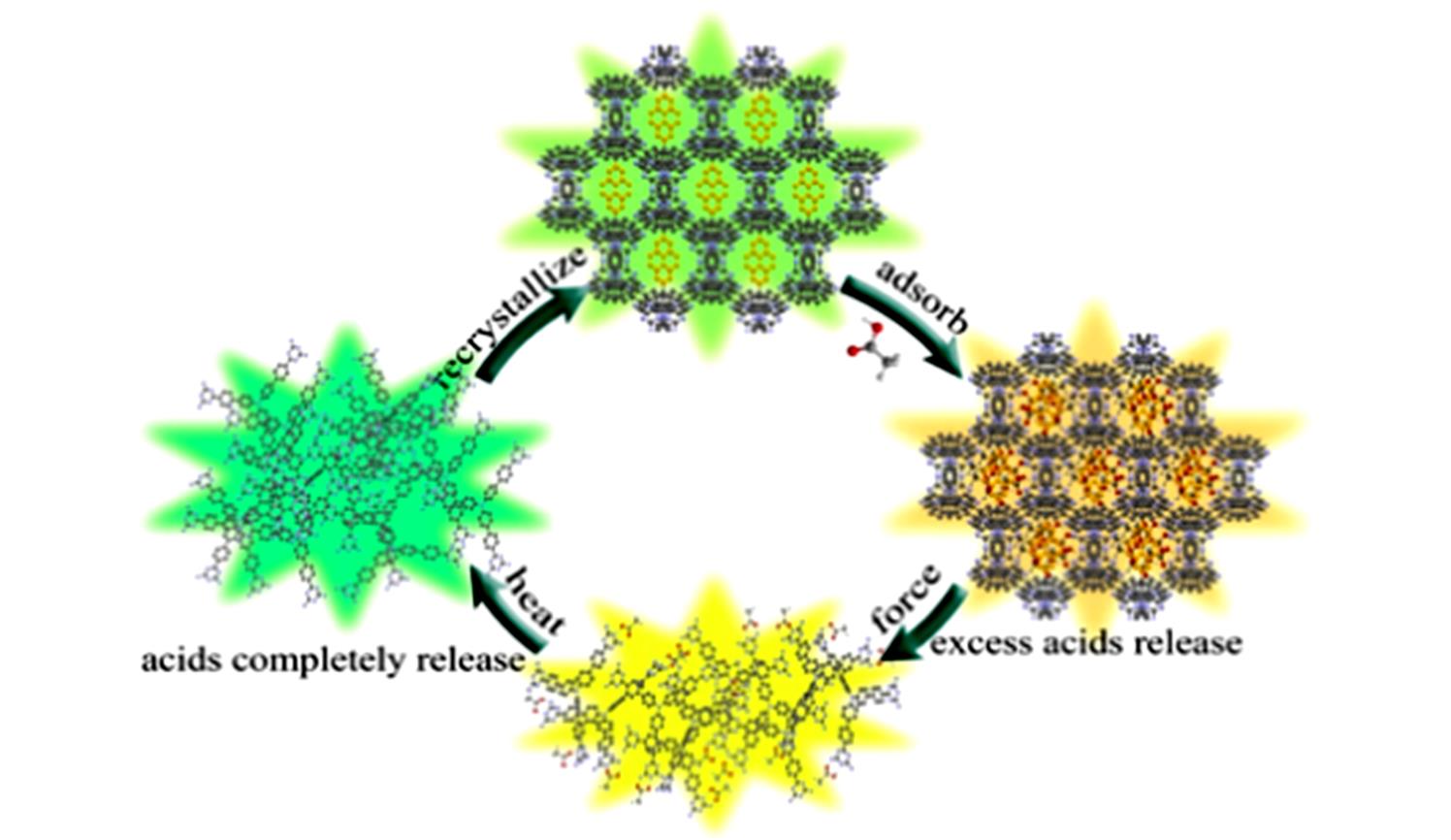
Fig.6 Fluorescence emission change of X⁃HOF⁃1 that was switched by fuming, grinding, heating and recrystallization[21]Copyright 2021, American Chemical Society.
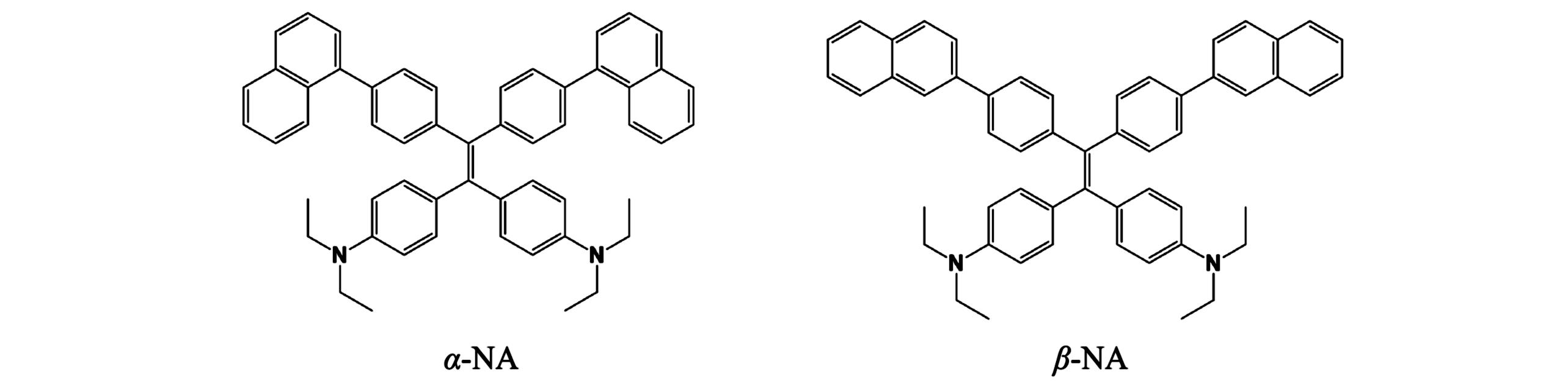
Fig.7 Molecular structures of α⁃NA and β⁃NA[22]
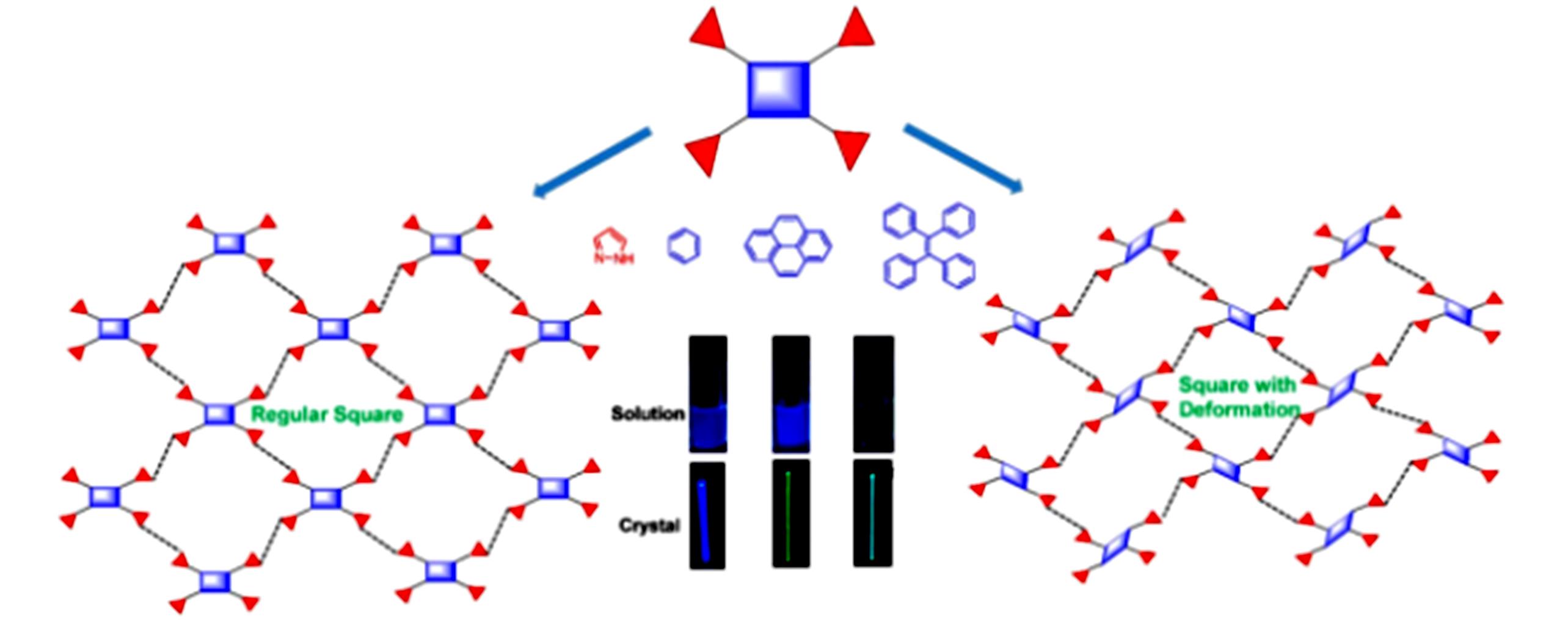
Fig.8 Hydrogen⁃bonded organic frameworks constructed from pyrazole linkers and diverse aromatic cores[23]Copyright 2022, MDPI AG.
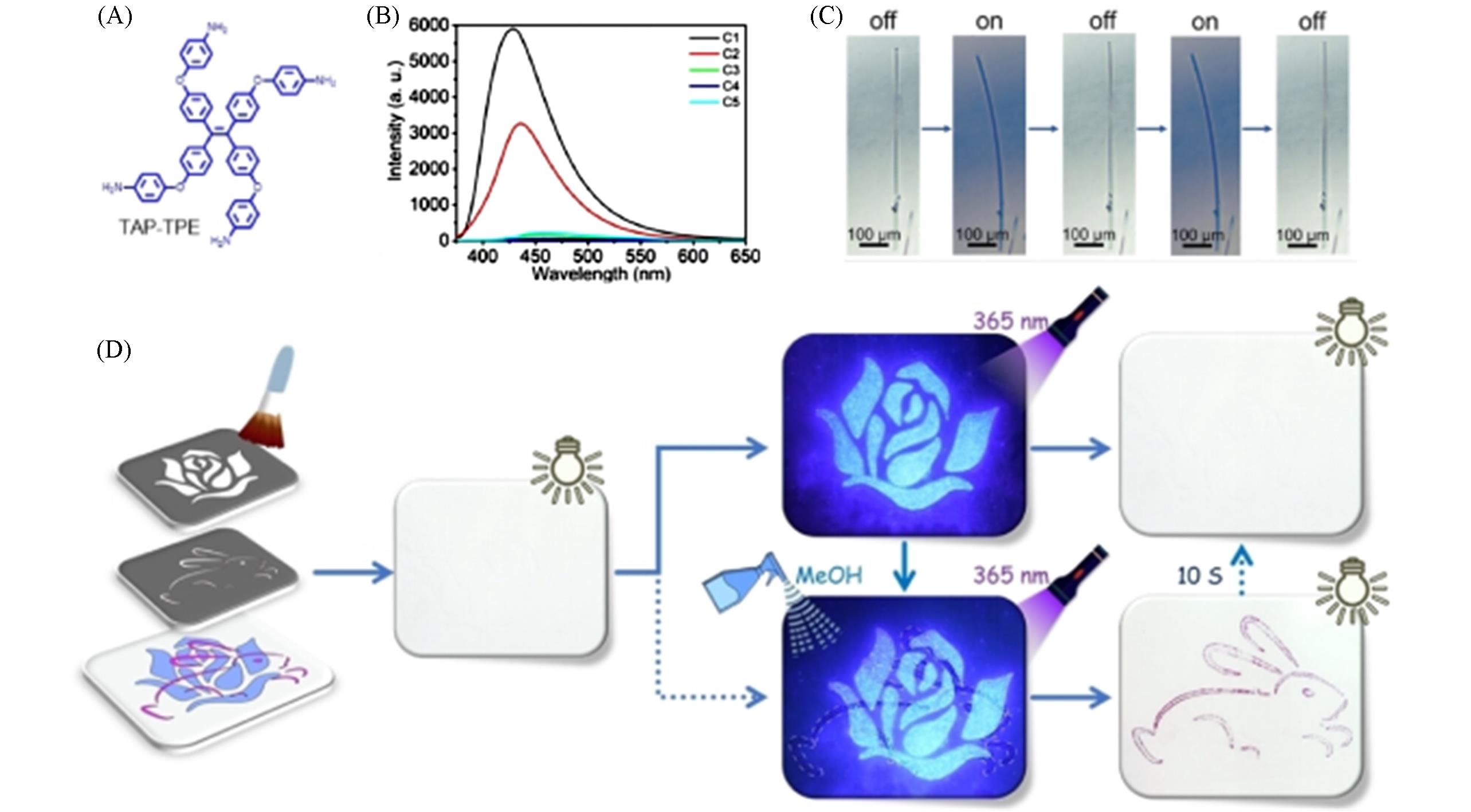
Fig.9 Molecular structure of TAP⁃TPE(A), fluorescent spectra of crystals C1, C2, C3, C4 and C5(B), reversible bent and straighten of one end of a rod⁃like C4 crystal(11.5 μm×15.3 μm×717.7 μm) that was sticking to other big crystals as on and off of 365 nm UV light in 1 s interval, the UV⁃light source is on the back of the crystal(C), picture for multimode anticounterfeiting using C1 and C4 crystal powder as printing dyes(D)[24]Copyright 2023, Wiley-VCH GmbH.
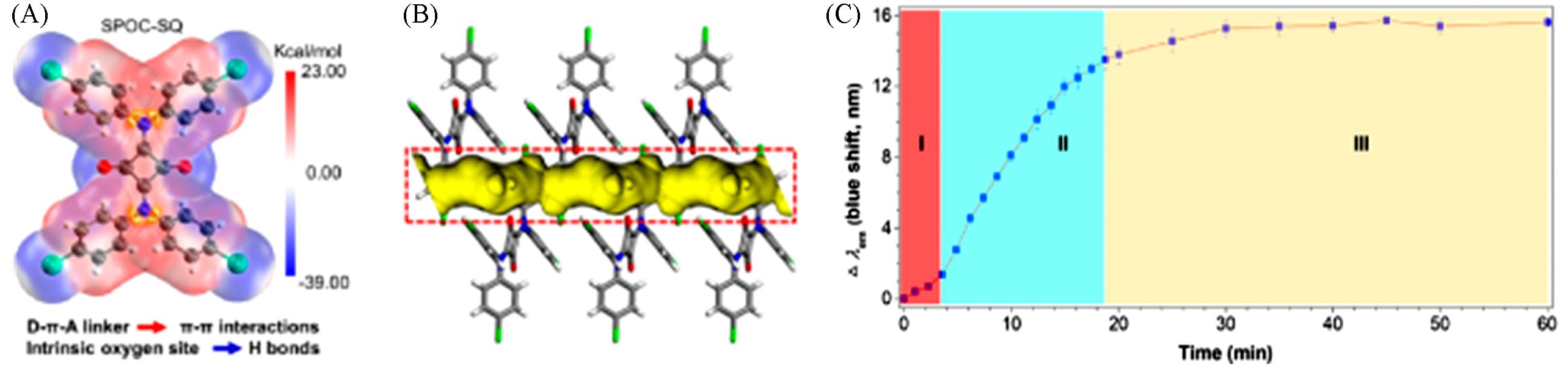
Fig.10 Chemical structure and electrostatic potential(ESP) diagram of SPOC⁃SQ(A)[25], packing diagram and 1D pore channel of SPOCSQ⁃C2H2 viewed along the lateral view, with the gas⁃accessible void space visualized by yellow/gray (inner/outer) curved planes generated with a probe of 0.14 nm, the C2H2 gas molecules in voids are omitted for clarity(B)[25], plot of the wavelength blue⁃shifted change(Δλem) against C2H2 adsorption time(C)[25]Copyright 2021, American Chemical Society.
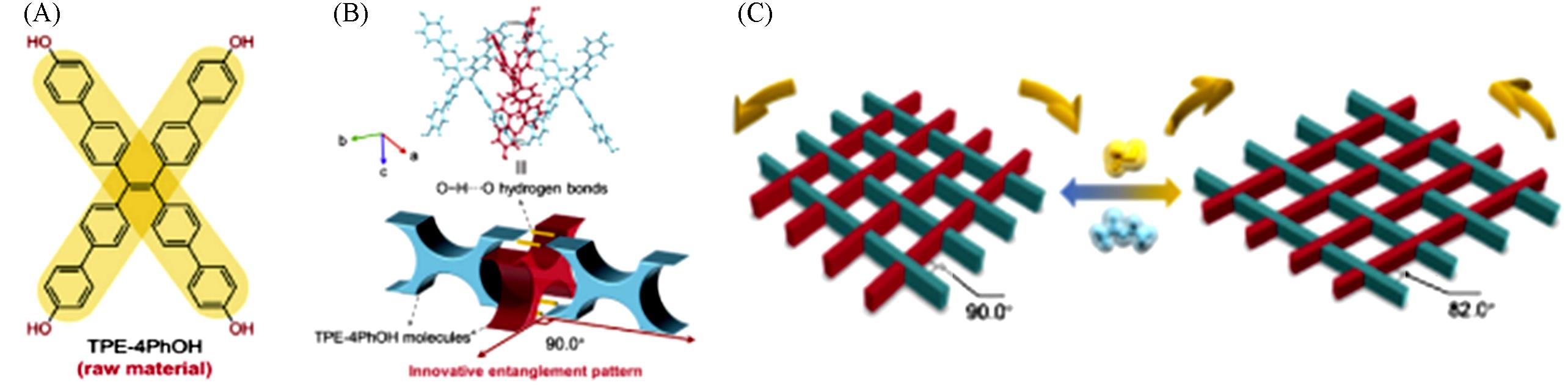
Fig.11 Chemical structure of the X⁃shaped small organic molecule TPE⁃4PhOH(A), the interlocking mode at the entanglement location in the SXRD structure of 2D⁃90(top) and the corresponding schematic diagram(bottom)(B), illustration of reversible structural transformations between 2D⁃90 and 2D⁃82, atoms of MeOH and EA molecules are colored yellow and light blue, respectively, for clarity(C)[27]Copyright 2021, Elsevier Inc.
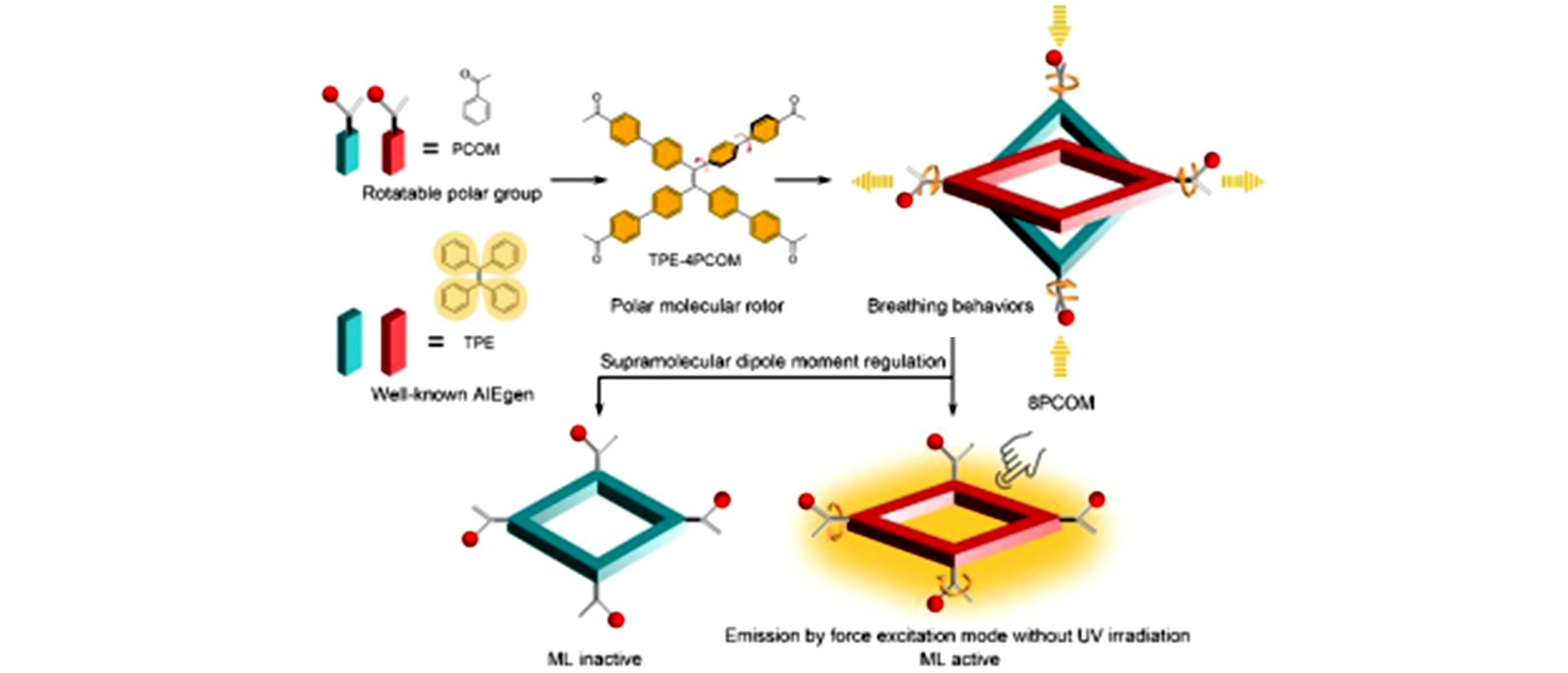
Fig.12 Design strategy for the ML⁃active flexible 8PCOM framework using a polar molecular rotor as the organic building block[29]Copyright 2021, Chinese Chemical Society.
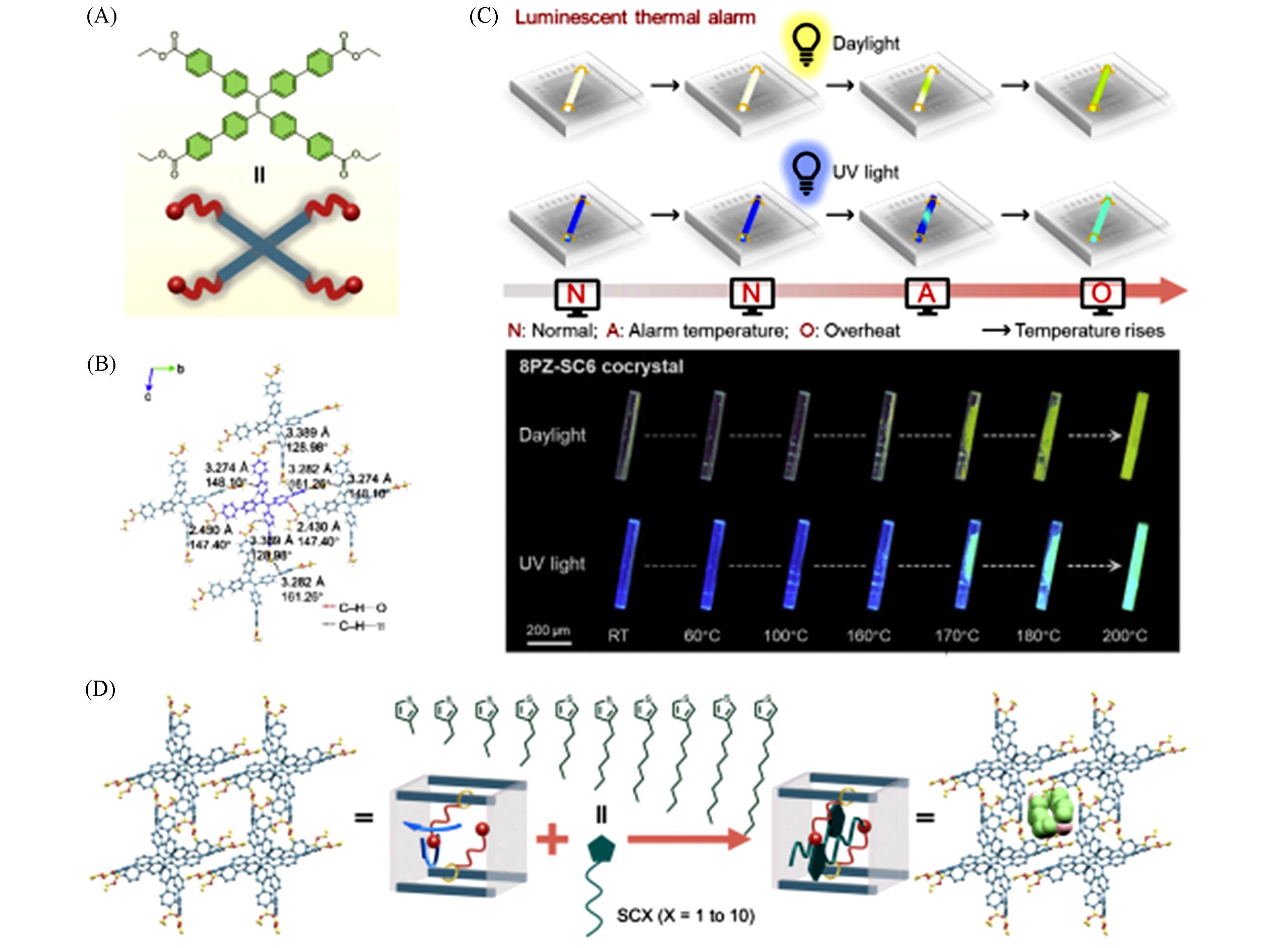
Fig.13 Molecular structure and schematic representation of TPE⁃4PZ(A), hydrogen bonds in single⁃crystal structure of DCM@8PZ at 150 K viewing along the a axis(B), schematic of 8PZ⁃SCX cocrystals used as luminescent temperature alarms and images of 8PZ⁃SC6 cocrystal under daylight(upper) and 350 nm UV light(lower) upon heat treatment(scale bar, 200 mm)(C), illustration of the adaptive accommodation of 3⁃alkylthiophenes in 8PZ through the local motions of ethyl⁃ester chains(D)[30]Copyright 2023, Elsevier Inc.
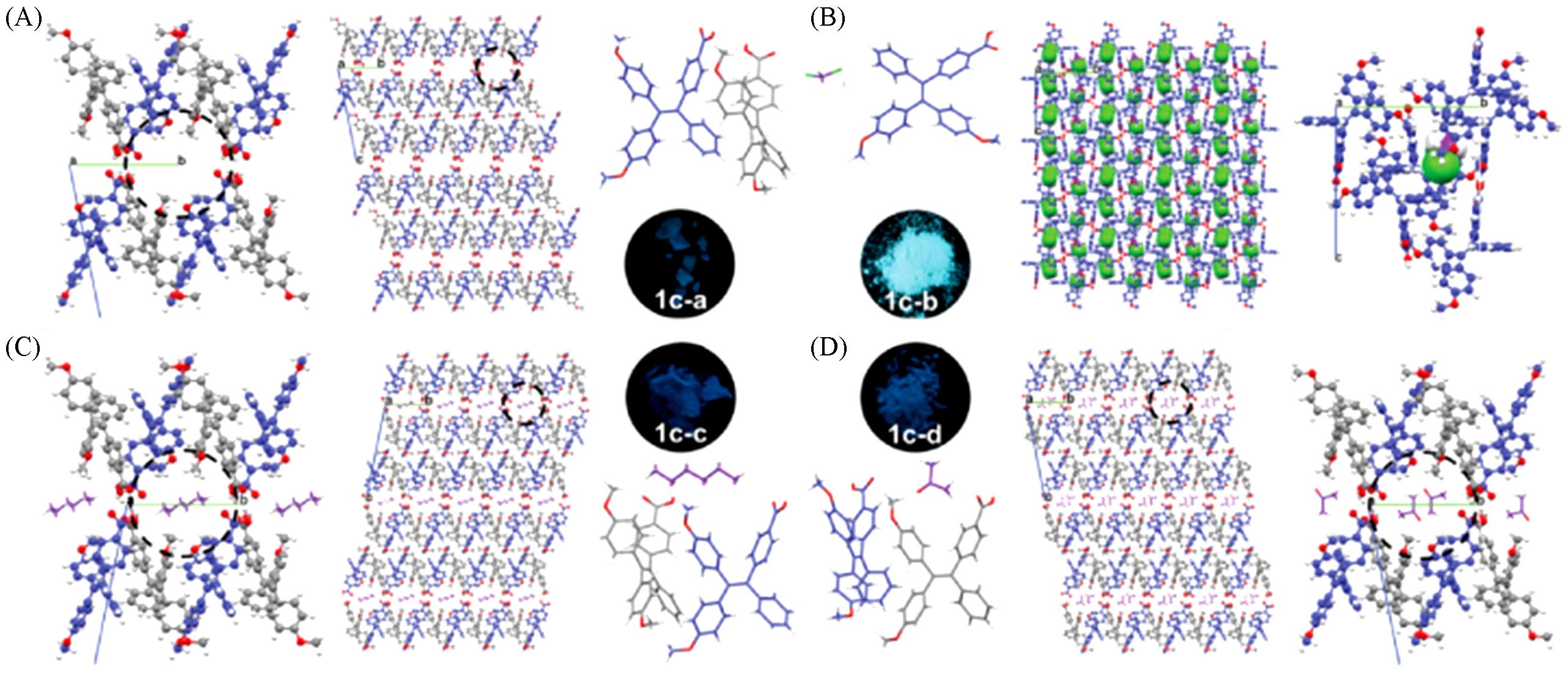
Fig.14 Molecular structure, molecular packing viewed along the a⁃axis of the unit cell and photos of four crystals taken under UV light: 1c⁃a (A), 1c⁃b (B), 1c⁃c (C) and 1c⁃d (D)
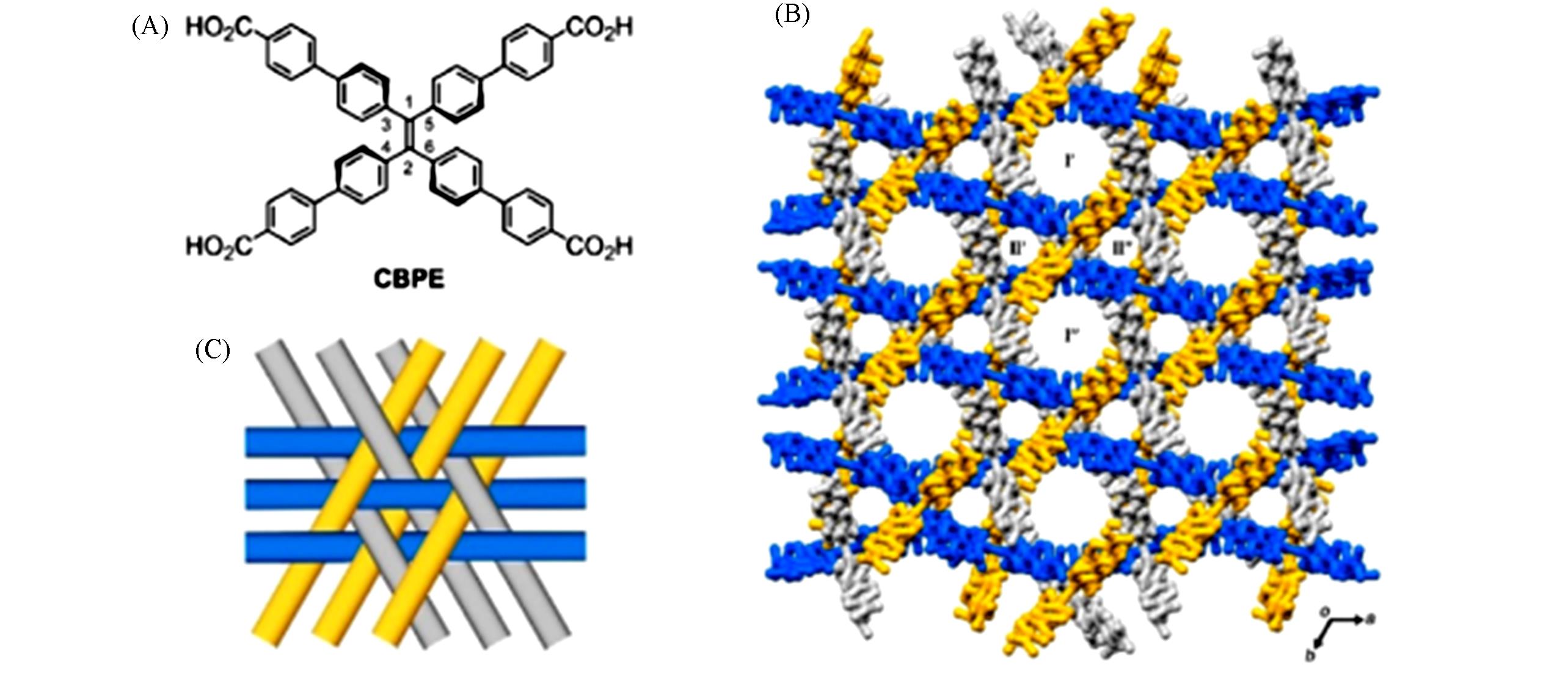
Fig.15 Molecular structure of CBPE(A), illustration of triaxially woven frameworks of CBPE⁃1(MeBz)(B), crystal structure of triaxially woven CBPE⁃1(MeBz)(C)[32]Copyright 2020, Wiley-VCH GmbH.
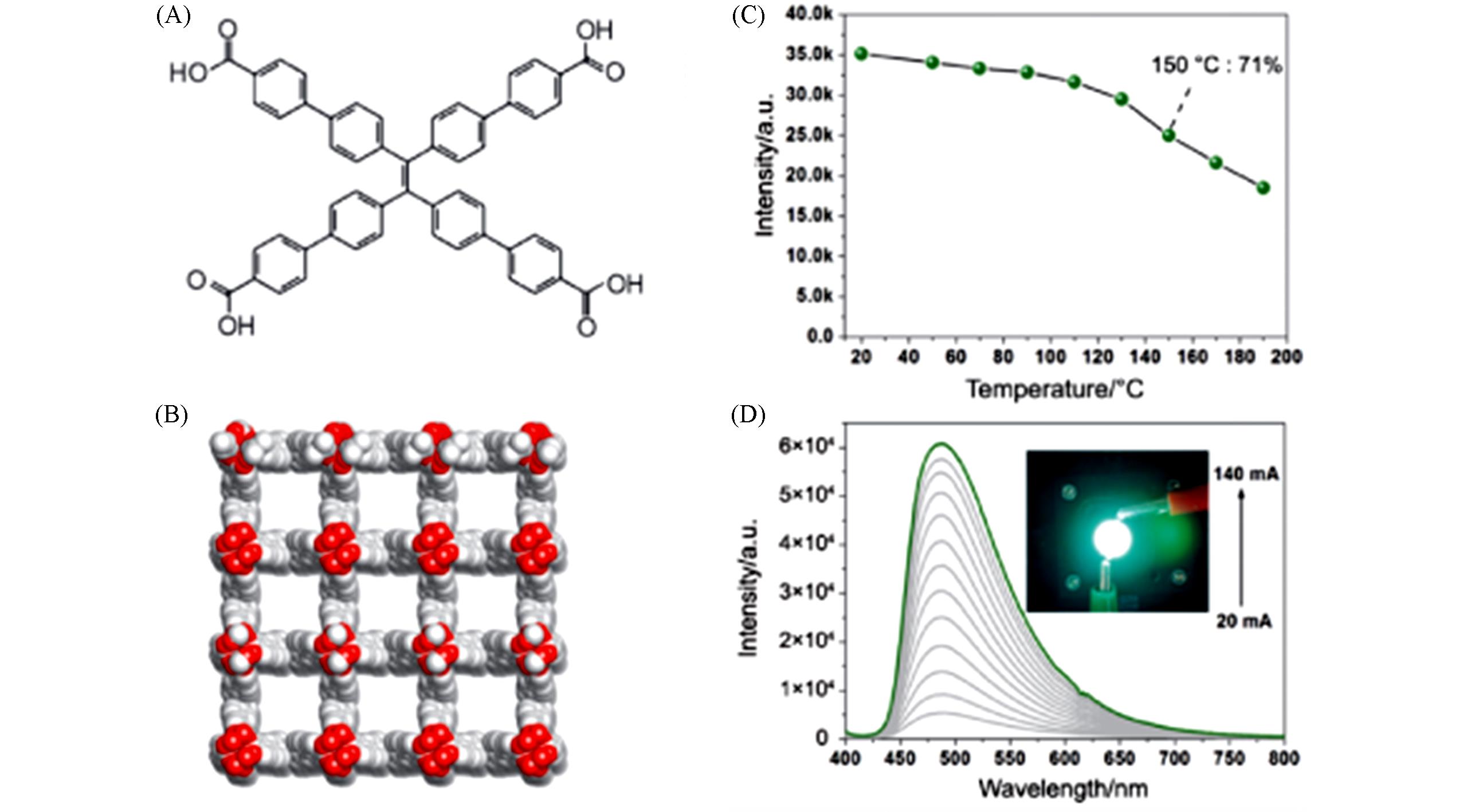
Fig.16 Molecular structure of TCBPE(A), HOF structure of TCBPE(B), temperature⁃dependent fluorescence intensities of TCBPE⁃HOF(C), PL spectra of TCBPE⁃HOF cyan LED device with a 365 nm chip under various drive currents(the inset shows the photo of the obtained LED)(D)[33]Copyright 2025, Jilin University, The Editorial Department of Chemical Research in Chinese Universities and Springer-Verlag GmbH.
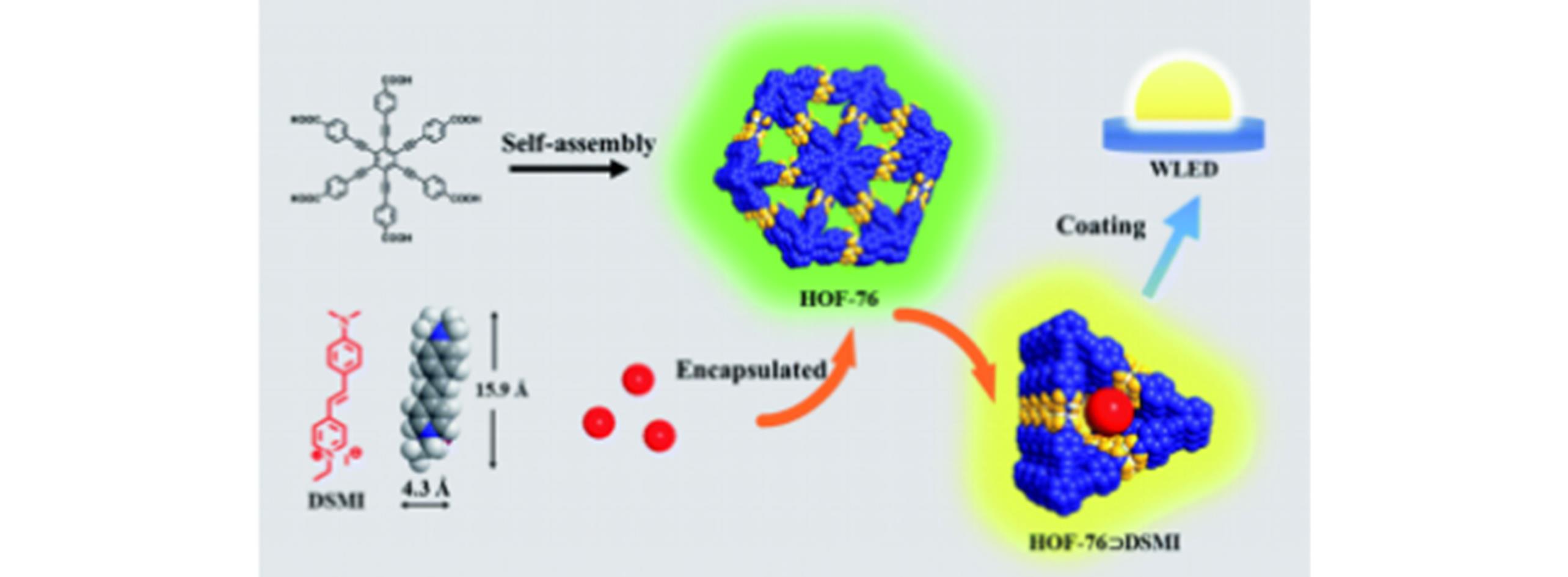
Fig.17 Schematic illustration of the design and synthesis of HOF⁃76⊃DSMI and the packaging of a WLED[34]Copyright 2022, the Royal Society of Chemistry.
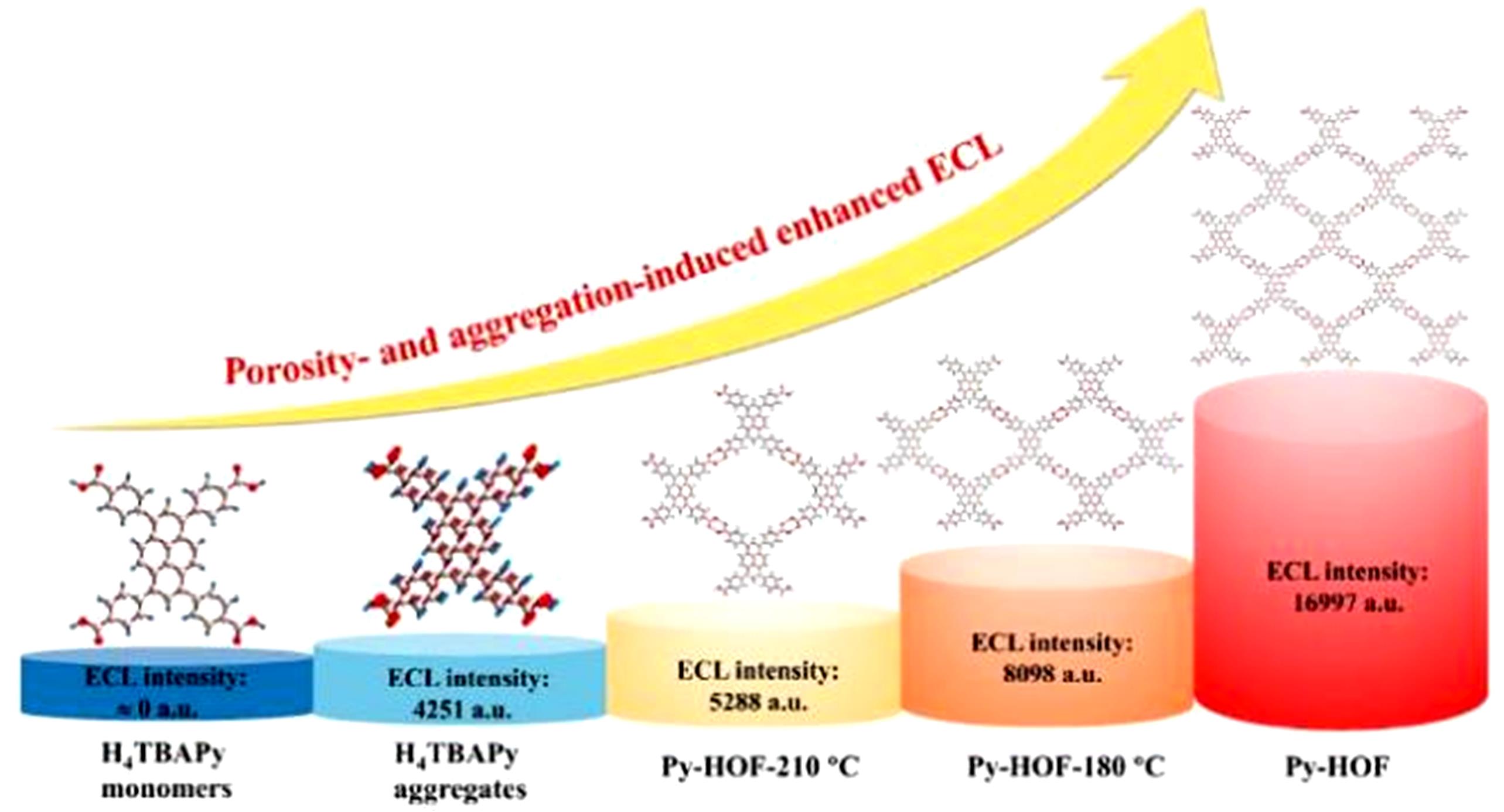
Fig.18 Schematic illustration of the porosity and aggregation⁃induced enhanced electrochemiluminescence and molecular packing of Py‑HOF[35]Copyright 2022, American Chemical Society.
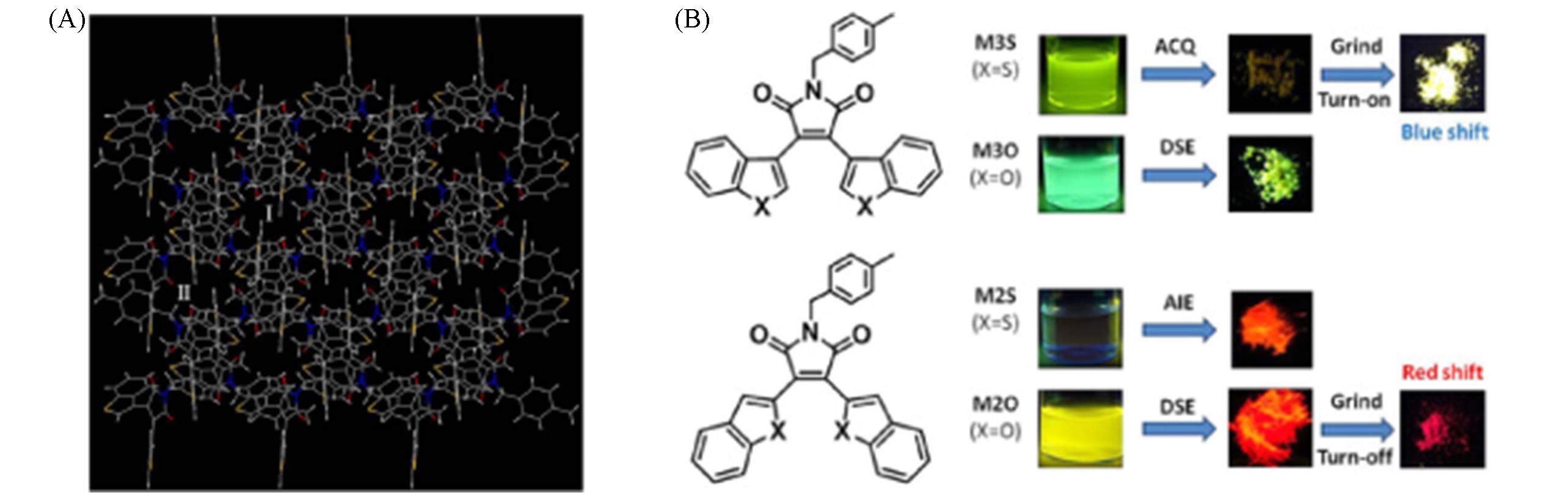
Fig.19 HOF structure of M3S(A), structure of arylmaleimides and their photographs in THF and in solid state taken under 365 nm UV light(B)[38]Copyright 2018, Wiley-VCH GmbH.
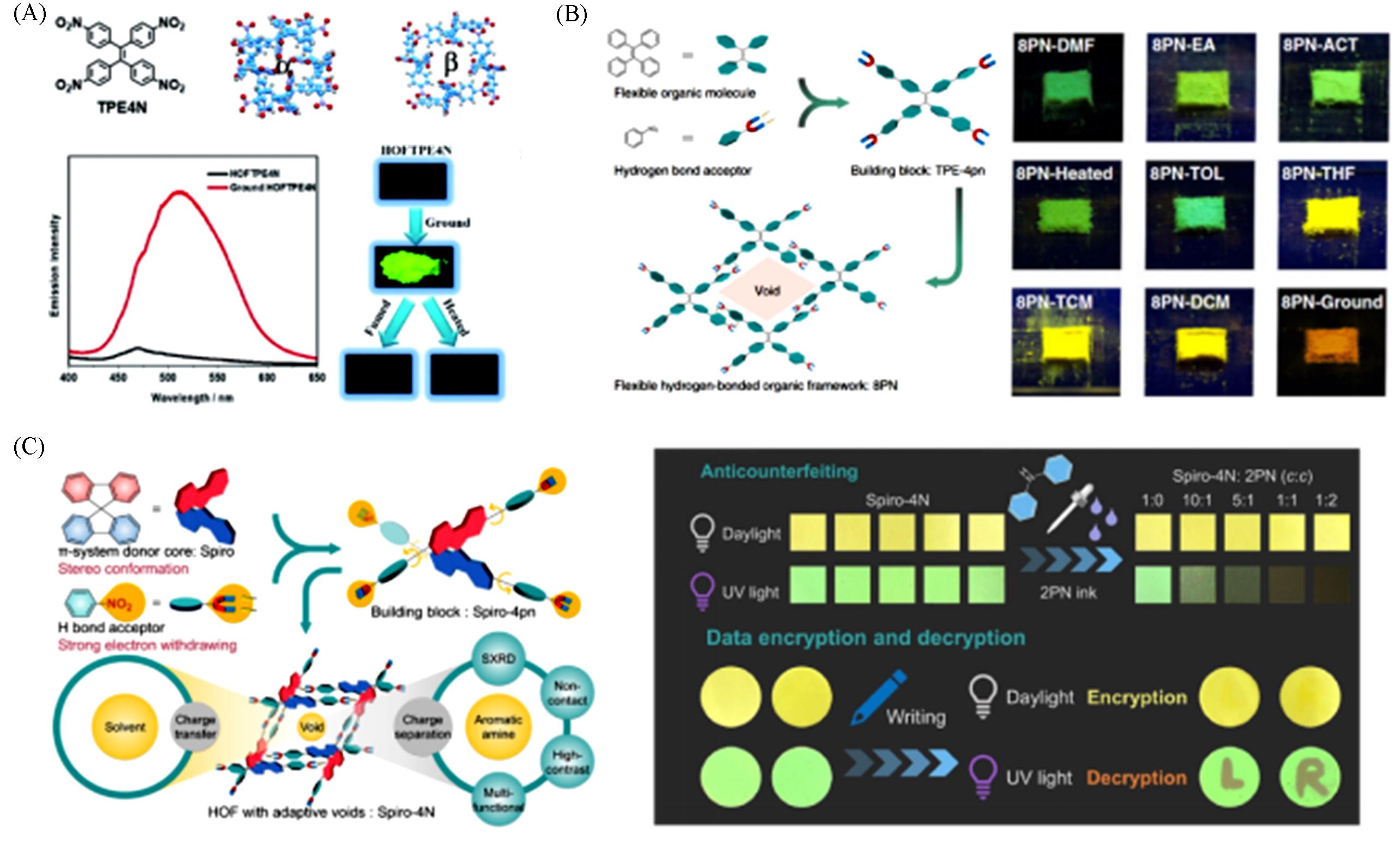
Fig.20 Chemical structure, single crystal structures and PL spectra of TPE4N(A)[39], construction of 8PN and photographs of 8PN taken under UV⁃light irradiation(365 nm)(B)[40], the design strategy for Spiro⁃4N and photographs of Spiro⁃4N test strips before and after addition of diphenylamine ink(C)[41](B) Copyright 2019, Springer Nature; (C) Copyright 2023, Wiley-VCH GmbH.
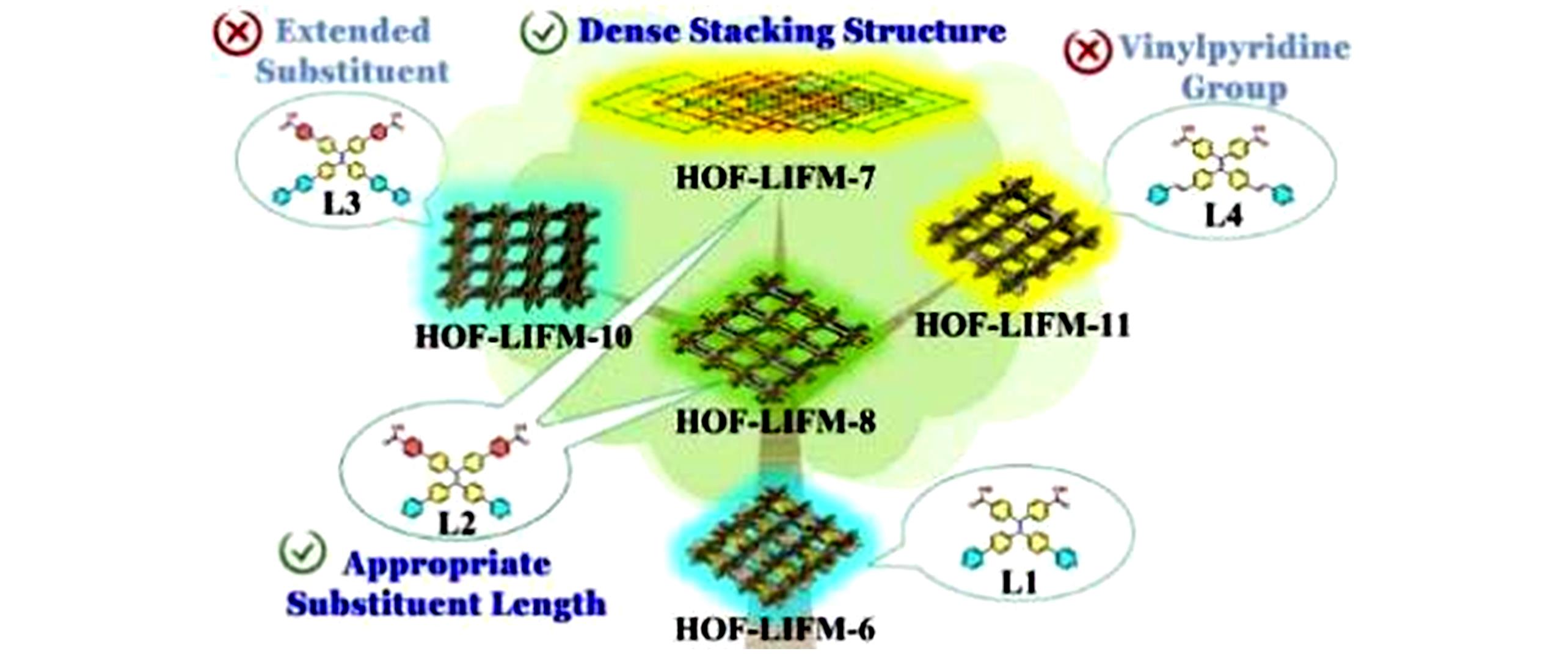
Fig.21 Tetraphenylethylene⁃based HOFs with optimized two⁃photon absorption(TPA) properties constructed through molecular building⁃block modification and crystal engineering, demonstrating promising performance in two⁃photon cellular imaging applications[42]Copyright 2023, Wiley-VCH GmbH.
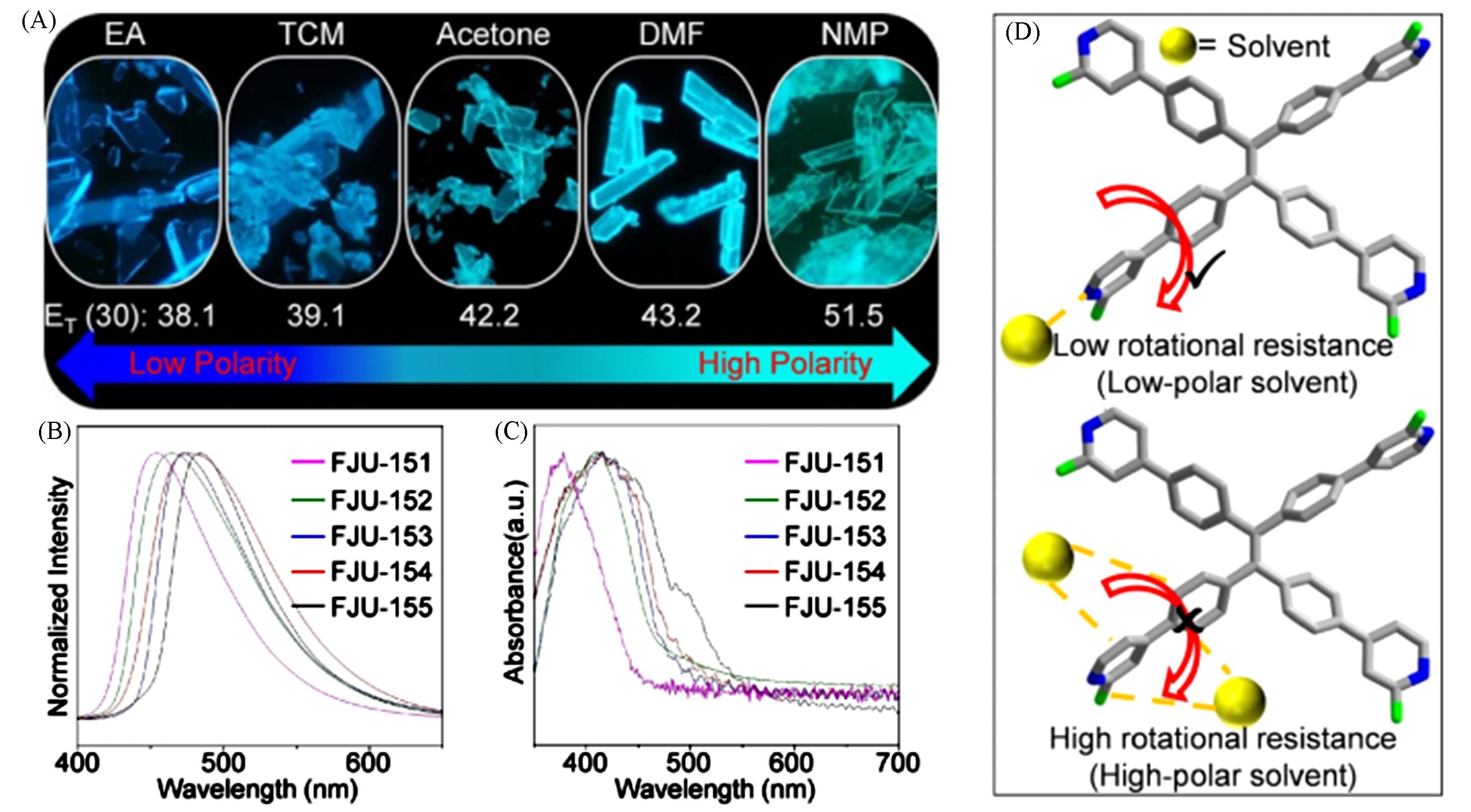
Fig.22 PL⁃microscopy images under UV excitation(cale bars are 20 μm)(A), PL emission spectra of (B) and UV⁃Vis spectra of FJU⁃151, FJU⁃152, FJU⁃153, FJU⁃154 and FJU⁃155(C) and different rotation restrictions caused by the connection modes between F⁃TPPE and solvents(D)[43]Copyright 2023, Wiley-VCH GmbH.
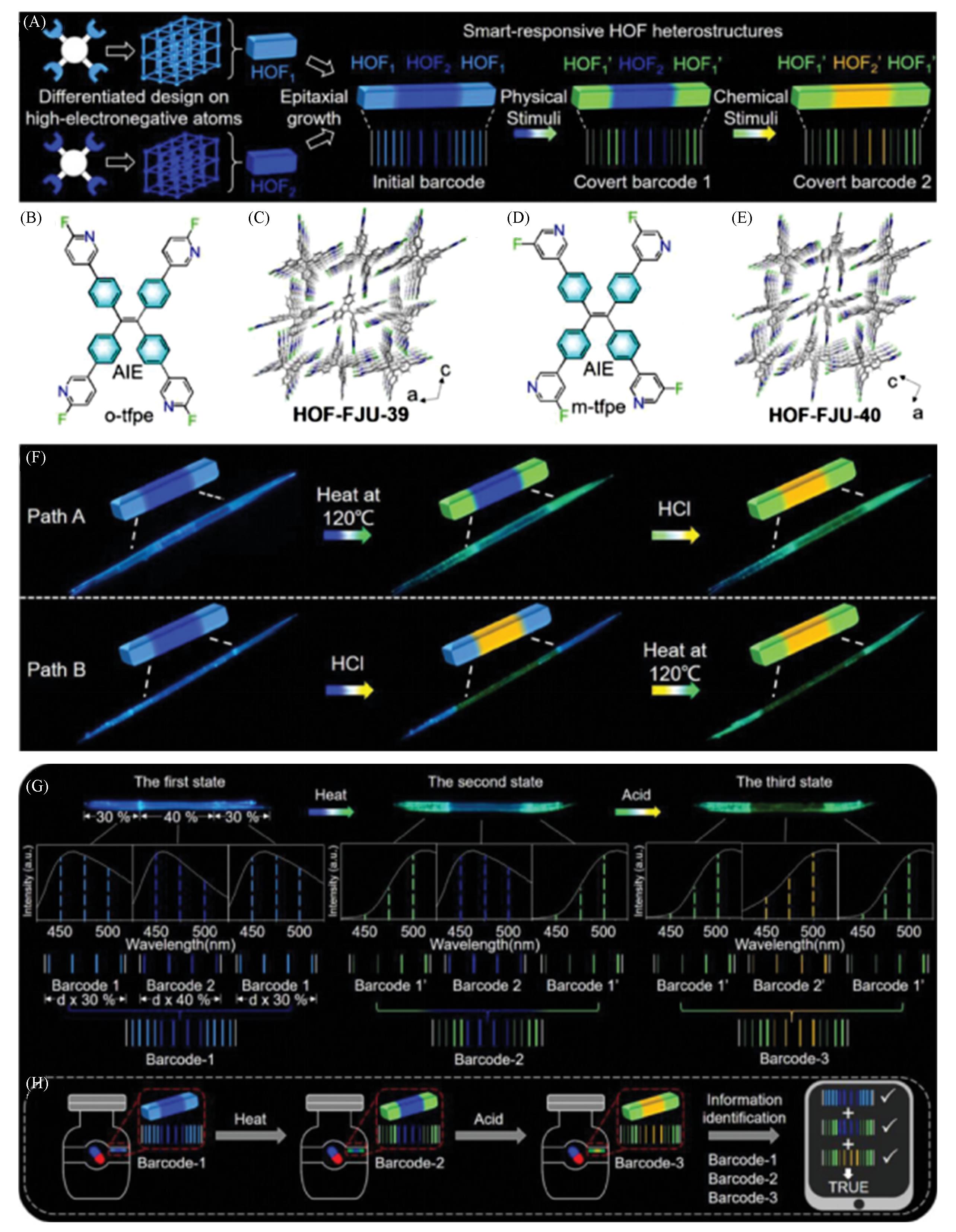
Fig.23 Schematic illustration of the smart⁃responsive HOF heterostructure(A), illustration of the o⁃tfpe and m⁃tfpe(B, D) sectional crystal structures of HOF⁃FJU⁃39 and HOF⁃FJU⁃40(C, E) and PL images of HOF heterostructures under thermal and acid stimulations in different orders(F), the strategy for covert photonic barcodes based on the smart⁃responsive HOF heterostructure(G), proof⁃of⁃concept demonstration of the smart⁃responsive HOF⁃heterostructure⁃based photonic barcodes for anticounterfeiting application(H)[44]Copyright 2023, Wiley-VCH GmbH.
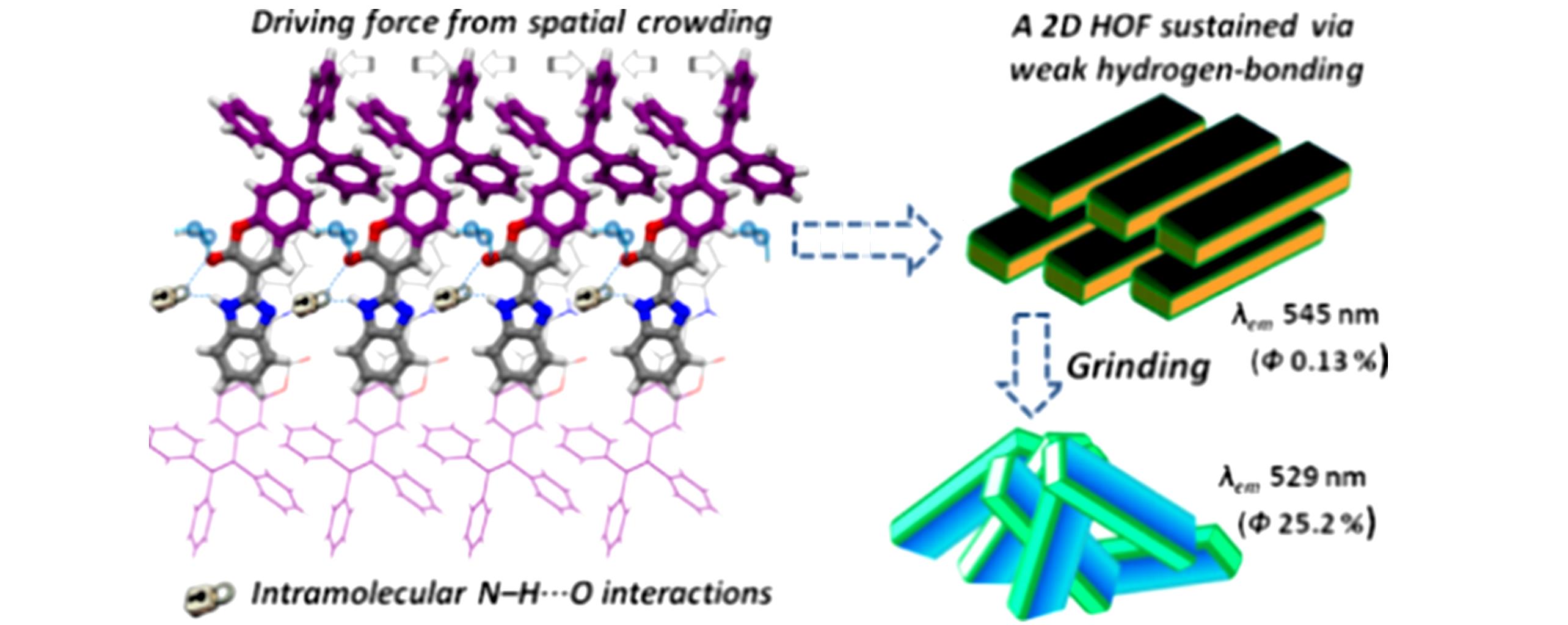
Fig.24 Single crystal structure and mechano⁃responsive luminescence of the C3Ph⁃HOF[45]Copyright 2019, American Chemical Society.
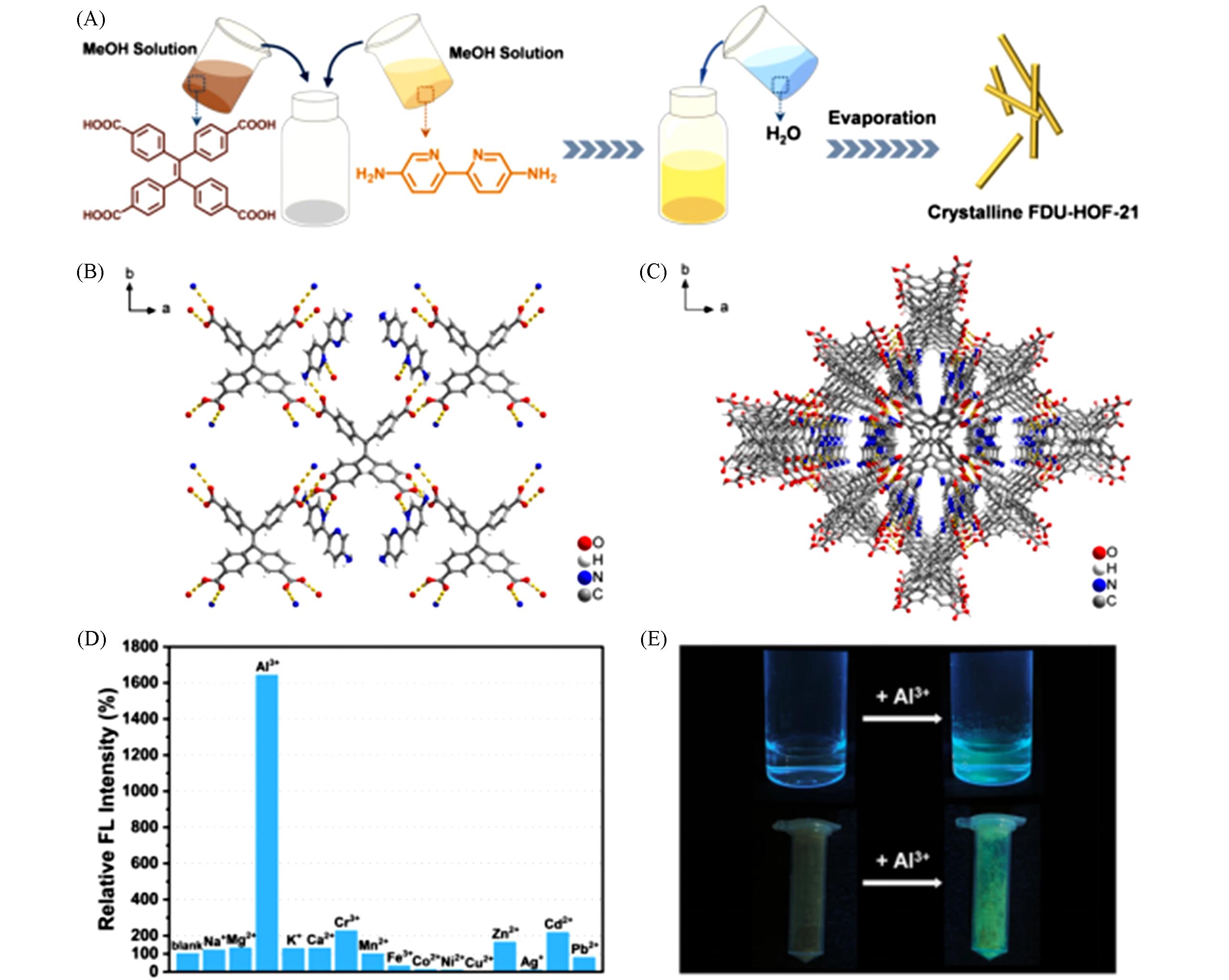
Fig.25 Synthetic process of FDU⁃HOF⁃21(A), crystal structure of FDU⁃HOF⁃21 and view of the connection of adjacent building blocks(B) and representation of the framework along c⁃axis(C), fluorescence(FL) intensity changes of FDU⁃HOF⁃21 aqueous dispersion in response to various ions at λex=330 nm(D), photographs of FDU⁃HOF⁃21 aqueous dispersion and powders after treated with Al3+(under ultraviolet radiation light)(E)[46]Copyright 2025, MDPI AG.
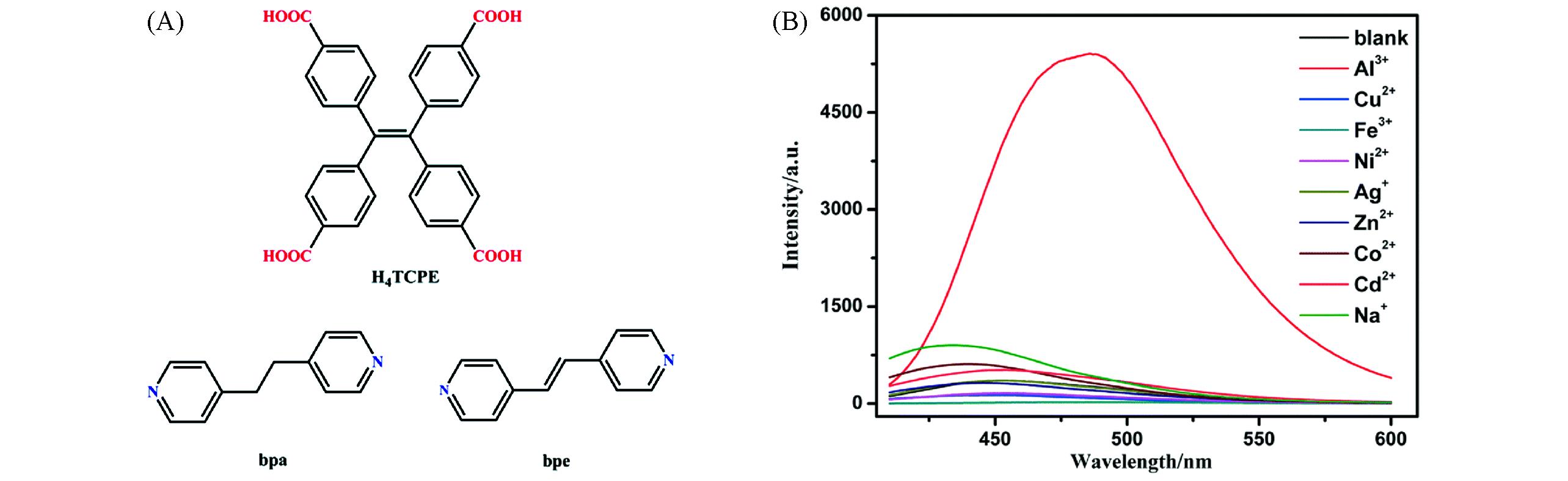
Fig.26 Molecular structures of H4TCPE, bpa and bpe(A) photoluminescence of compound 4(H4TCPE sample prepared by solvothermal method) introduced into different metal ions in CH3CN(5×10⁻⁴ mol/L) at room temperature(λex=376 nm)(B)[47]Copyright 2021, the Royal Society of Chemistry.
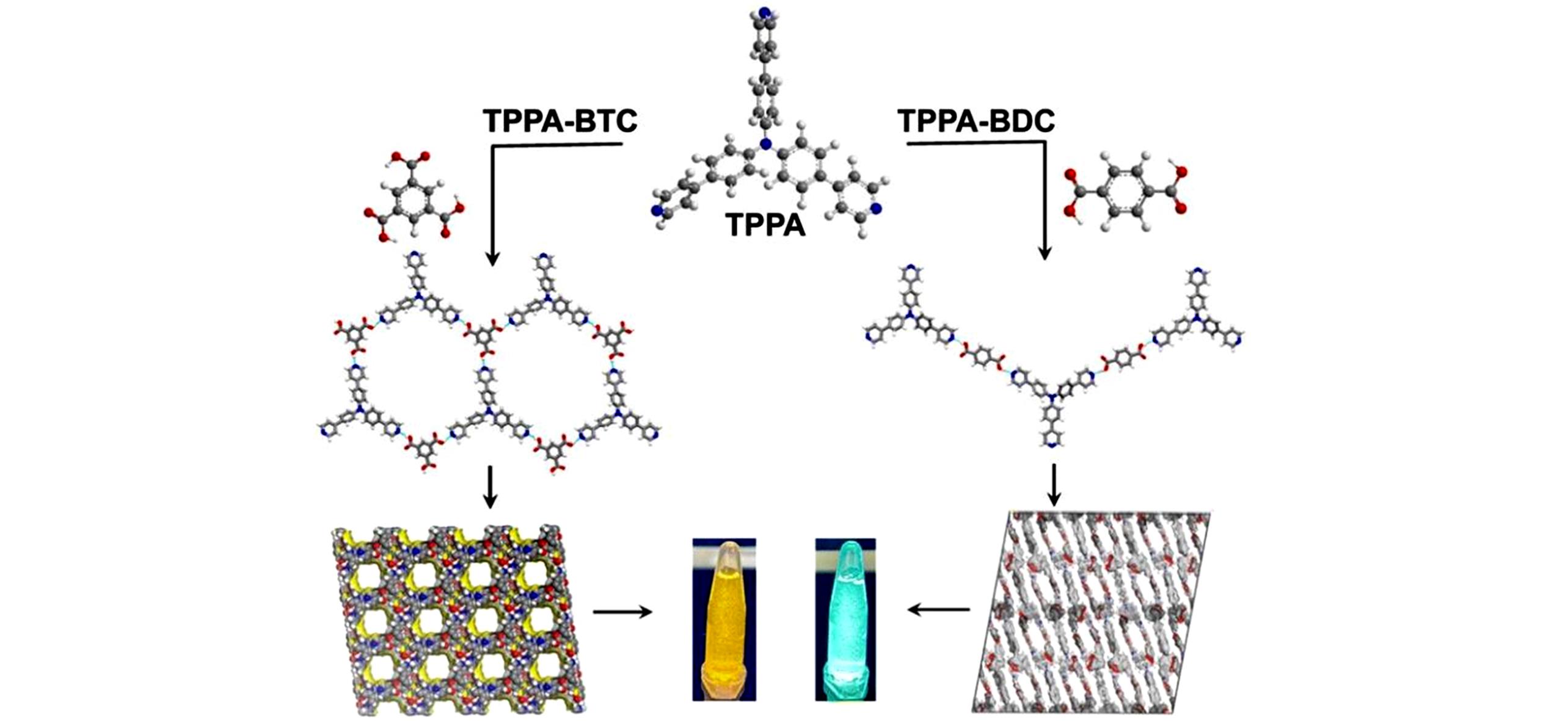
Fig.27 Structure of TPPA and illustration of the fabrication of TPPA⁃BDC and TPPA⁃BTC[48]Copyright 2024, the Royal Society of Chemistry.
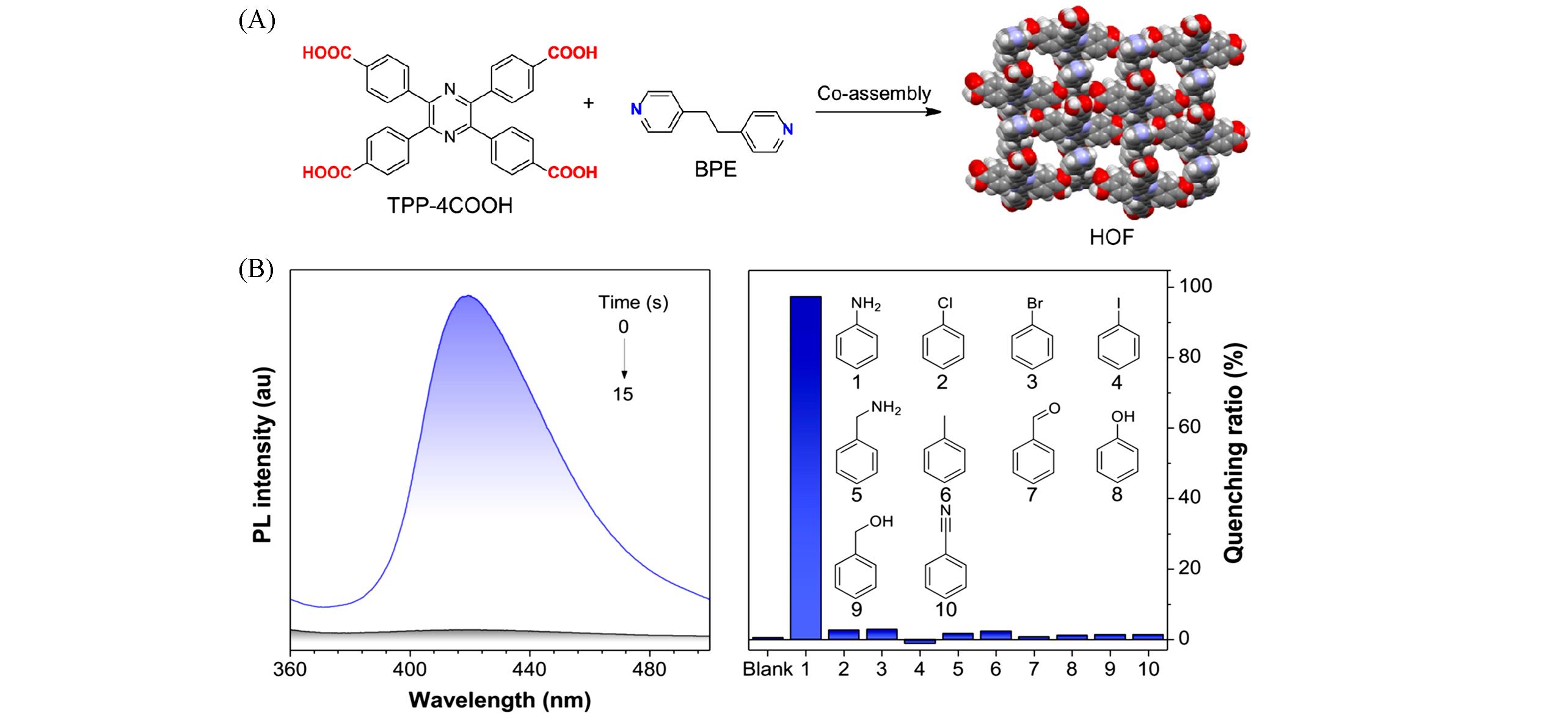
Fig.28 Co⁃assembly of TPP⁃4COOH and BPE into HOF(A) and PL spectra of the HOF in treatment of aniline(75 μmol/L) at 0 and 15 s(λex=340 nm) and quenching ratios of the HOFs in the presence of aniline and other analytes(75 μmol/L), quenching ratio=(I0-I)/I0×100%(B)[49]Copyright 2025, John Wiley & Sons Ltd.
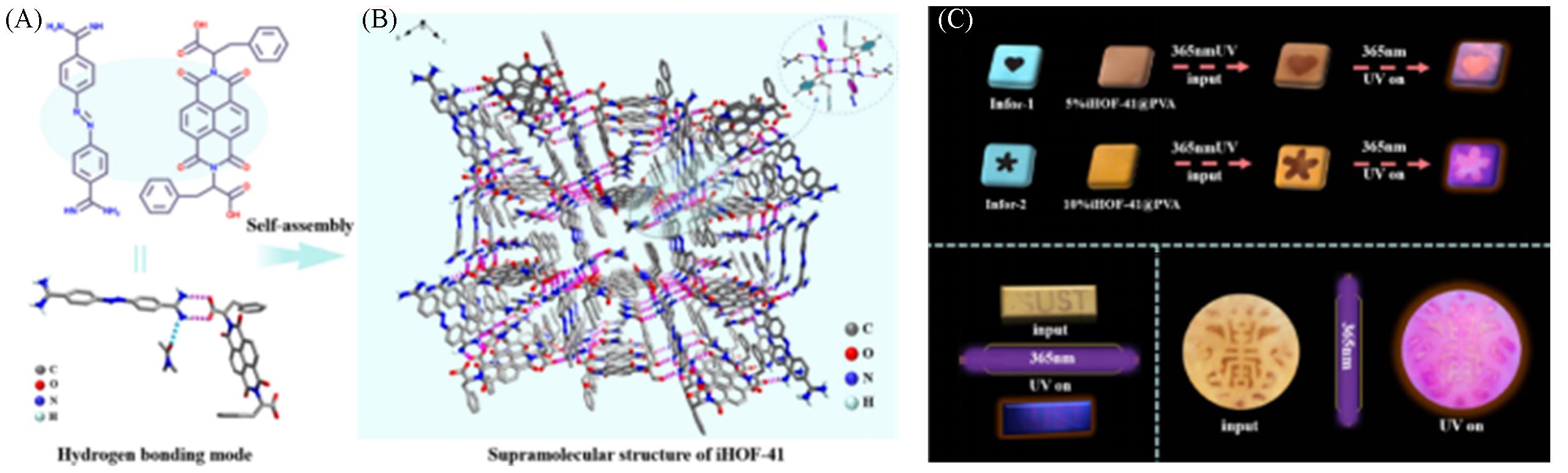
Fig.29 Molecular structures of AZBH and H2PheNDI(A), structure of iHOF⁃41(B), photographs of the iHOF⁃41@PVA film information writing and encryption at different scales(C)[50]Copyright 2024, American Chemical Society.
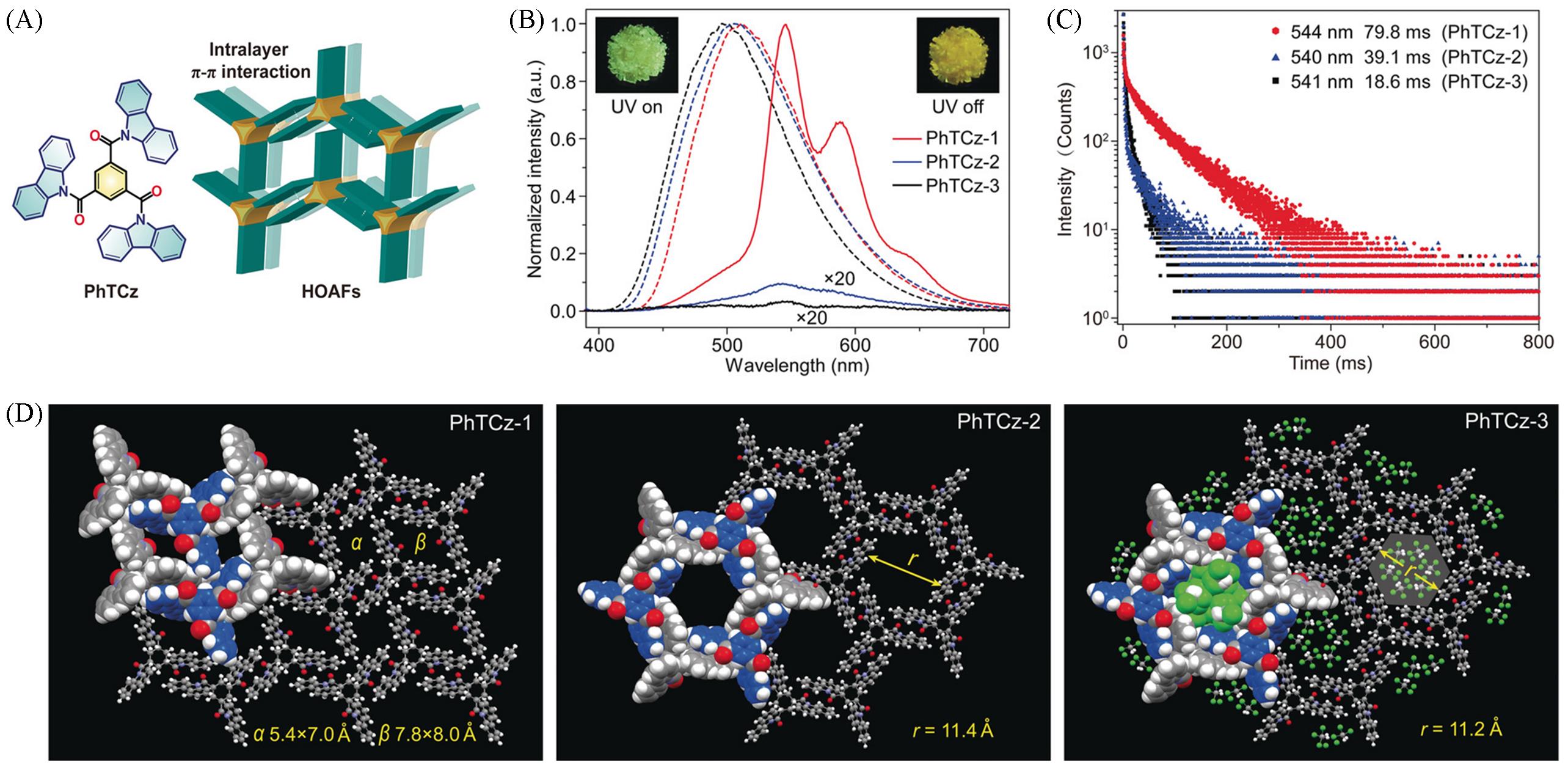
Fig.30 Hydrogen⁃bonded aromatic frameworks (HOAFs) based on PhTCz molecule(A) and steady⁃state photoluminescence(dashed lines) and phosphorescence spectra(solid lines) of PhTCz⁃1 (red), PhTCz⁃2(blue), and PhTCz⁃3(black) excited by 365 nm light under ambient conditions, phosphorescence signals of PhTCz⁃2 and PhTCz⁃3 were amplified(20 W), inset: photographs of PhTCz⁃1 under 365 nm UV light and after the UV light was switched off(B) and lifetime decay profiles of PhTCz⁃1, PhTCz⁃2, and PhTCz⁃3 as monitored at 544, 540, and 541 nm, respectively, after excitation at 365 nm under ambient conditions(C) and molecular stacking of three types of HOAFs: PhTCz⁃1, PhTCz⁃2, and PhTCz⁃3(D)[52]Copyright 2018, Wiley-VCH.
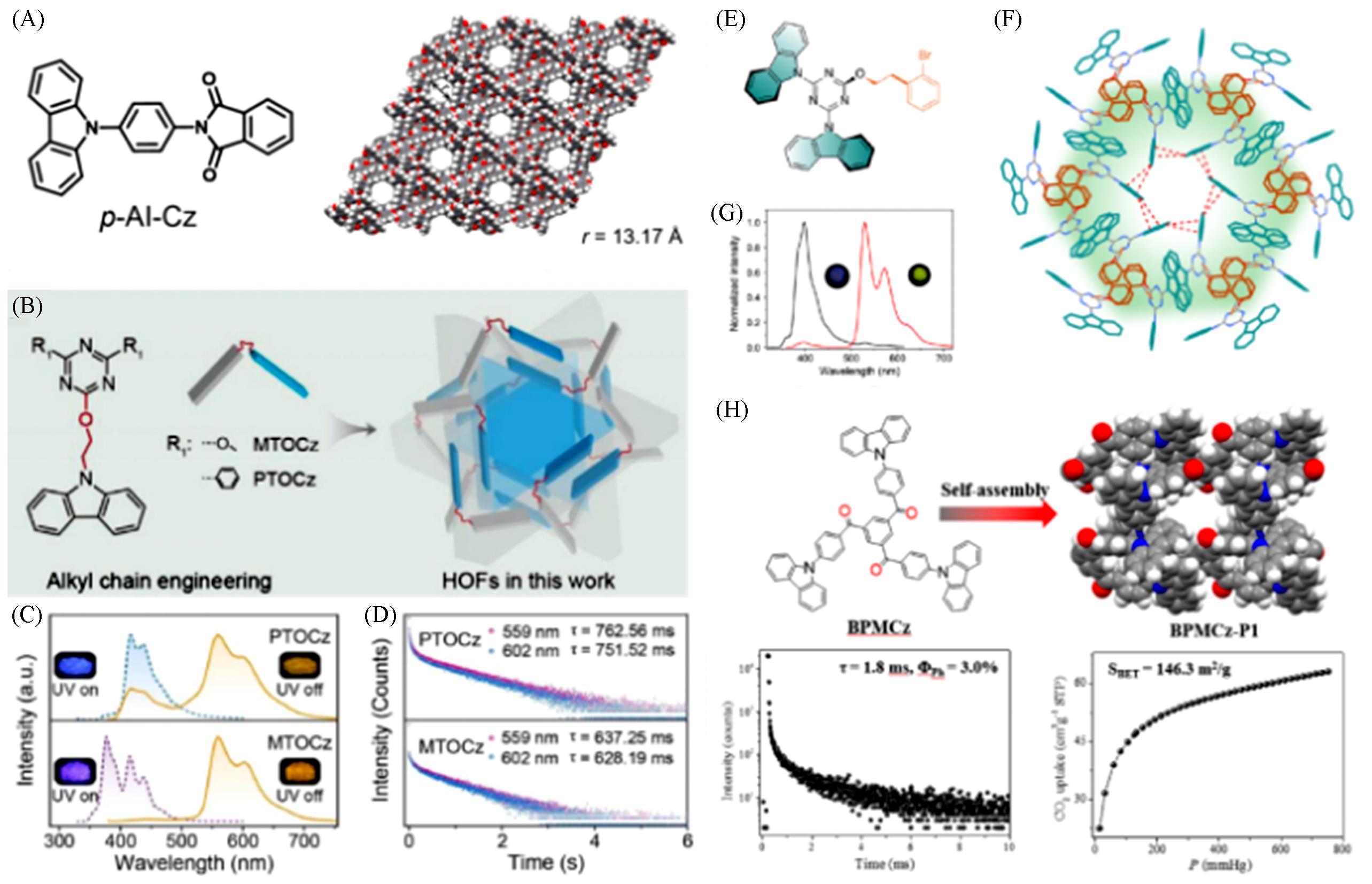
Fig.31 Molecular structure and crystal packing of p⁃AI⁃Cz showing the regular hexagonal pores(A)[53] and target molecules for the construction of hydrogen⁃bonded organic frameworks(HOFs) and schematic diagram of the HOFs(B)[54] and steady⁃state PL(blue or purple lines) and phosphorescence(orange lines) spectra of crystalline PTOCz and MTOCz under ambient conditions, the phosphorescence spectra were collected with a delay time of 8 ms, insets show photographs of PTOCz and MTOCz crystals under 365 nm UV light on (left) and off(right), respectively(C)[54] and lifetime decay profiles of PTOCz and MTOCz crystals at different emission peaks under ambient conditions(D)[54] and the molecular structure of DCzPO(E)[55] and ultralong phosphorescent HOF constructed from single small molecule DCzPO(F)[55] and normalized steady⁃state PL(black line) and phosphorescence spectra(red line) of DCzPO at crystalline state, insert: luminescence images under UV lamp on(left) and off(right)(G)[55] and chemical structure, crystal packing, and corresponding photophysical properties of BPMCz⁃P1(H)[56](B—D) Copyright 2020, Elsevier Inc; (E—G) Copyright 2021, Chinese Chemical Society; (H) Copyright 2021, American Chemical Society.
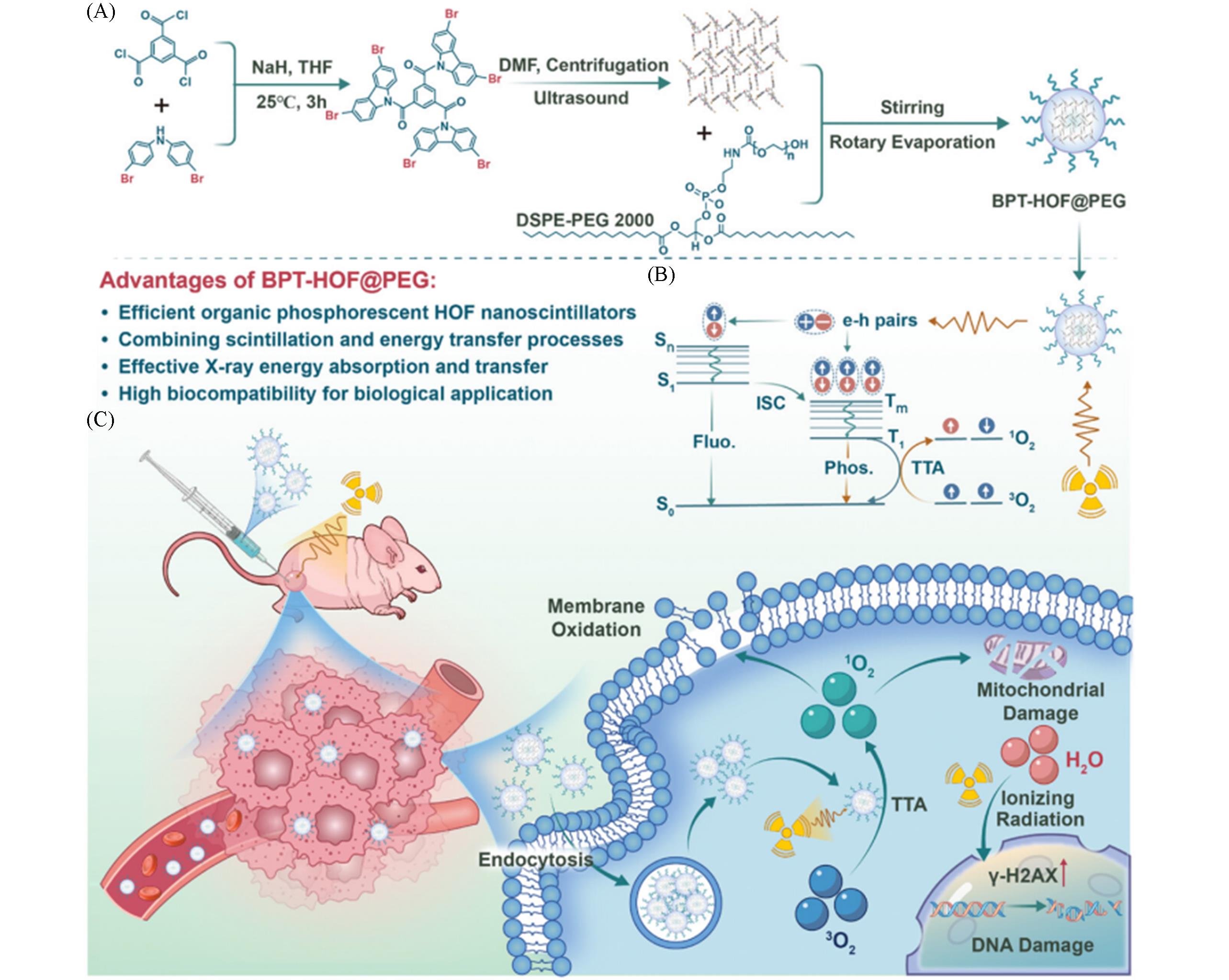
Fig.32 Experimental design, fabrication of BPT⁃HOF@PEG(A) and mechanism of the 1O2 generation by BPT⁃HOF@PEG under X⁃ray irradiation, X⁃ray irradiation induces electrons(red circles) ejection from BPT⁃HOF@PEG, generating abundant electron⁃hole pairs, which form singlet and triplet excitons in a specific ratio via charge recombination, assisted by the enhanced ISC promotes the formation of triplet excitons, which, through TTA, facilitates the conversion of 3O2 to 1O2(B) and schematic illustration of BPT⁃HOF@PEG⁃mediated X⁃PDT effect for HCC treatment; X⁃ray irradiation activates BPT⁃HOF@PEG to produce substantial 1O2, inducing HCC cells membrane oxidation and mitochondrial damage; concurrently, X⁃ray exposure directly inflicts DNA damage, resulting in a synergistic effect that enhances the cytotoxicity against HCC cells(C)[57]Copyright 2025, Wiley-VCH GmbH.
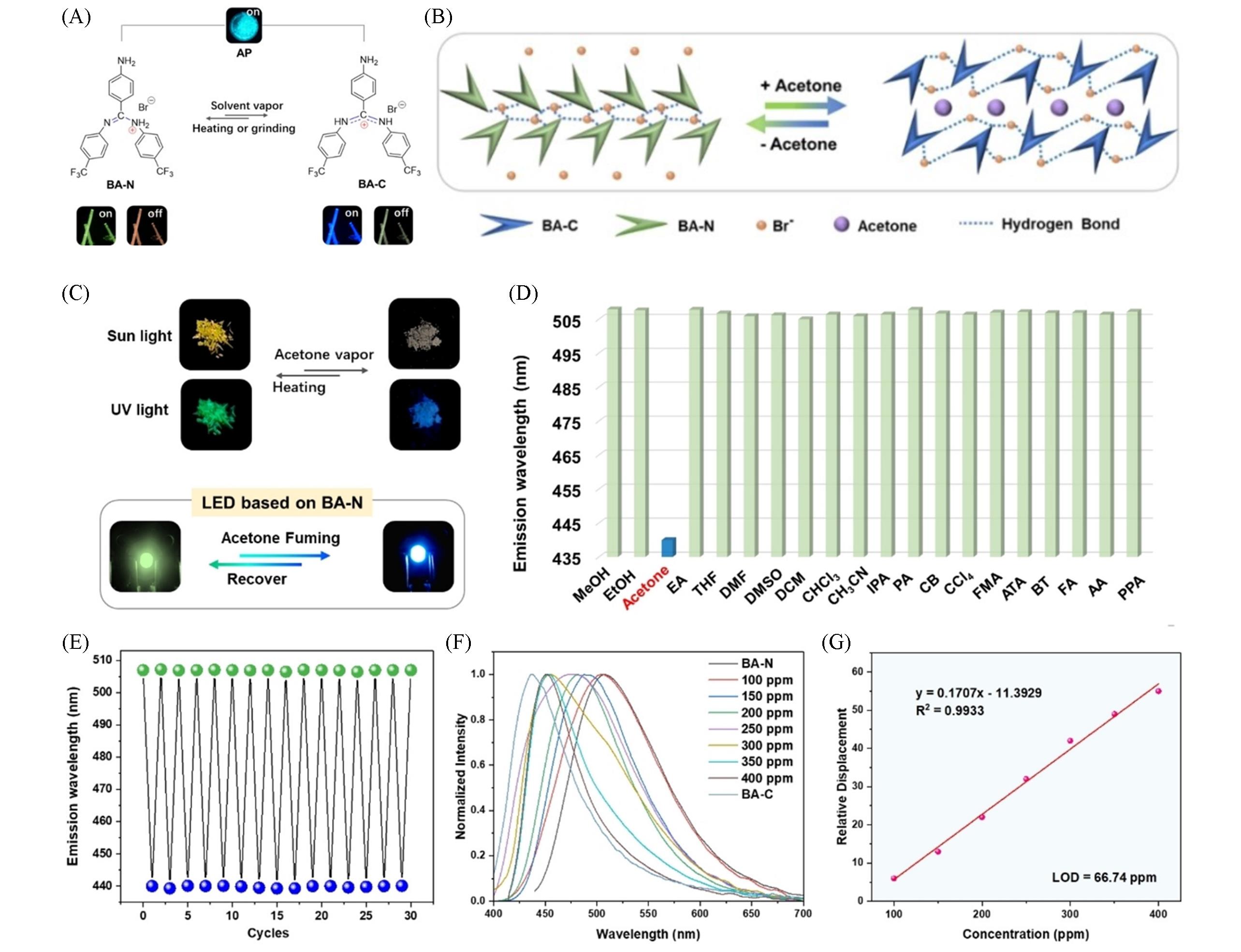
Fig.33 Tautomerism of BA⁃N and BA⁃C. Photos of BA⁃N/BA⁃C were taken under the fluorescence microscope at low temperature when the UV light was turned on and off UV, and the photo of AP was taken with a mobile phone at room temperature(A) and diagram showing the anionic HOF of BA⁃N and BA⁃C(B) and photographs of the reversible switching between BA⁃N and BA⁃C (λex=365 nm), and LED light⁃emitting photos before and after acetone fumigation(C) and histogram of the prompt emission peaks BA⁃N after fumigation(D) and repeatability of the luminescence color switching under alternating stimulation with acetone vapor and heating(E) and normalized prompt emission spectra of the BA⁃N samples treated with different concentrations of acetone solution(F) and linear relationship between the relative displacement and the concentration of acetone in the range 100 to 400 ppm(G)[59]Copyright 2025, Wiley-VCH GmbH.
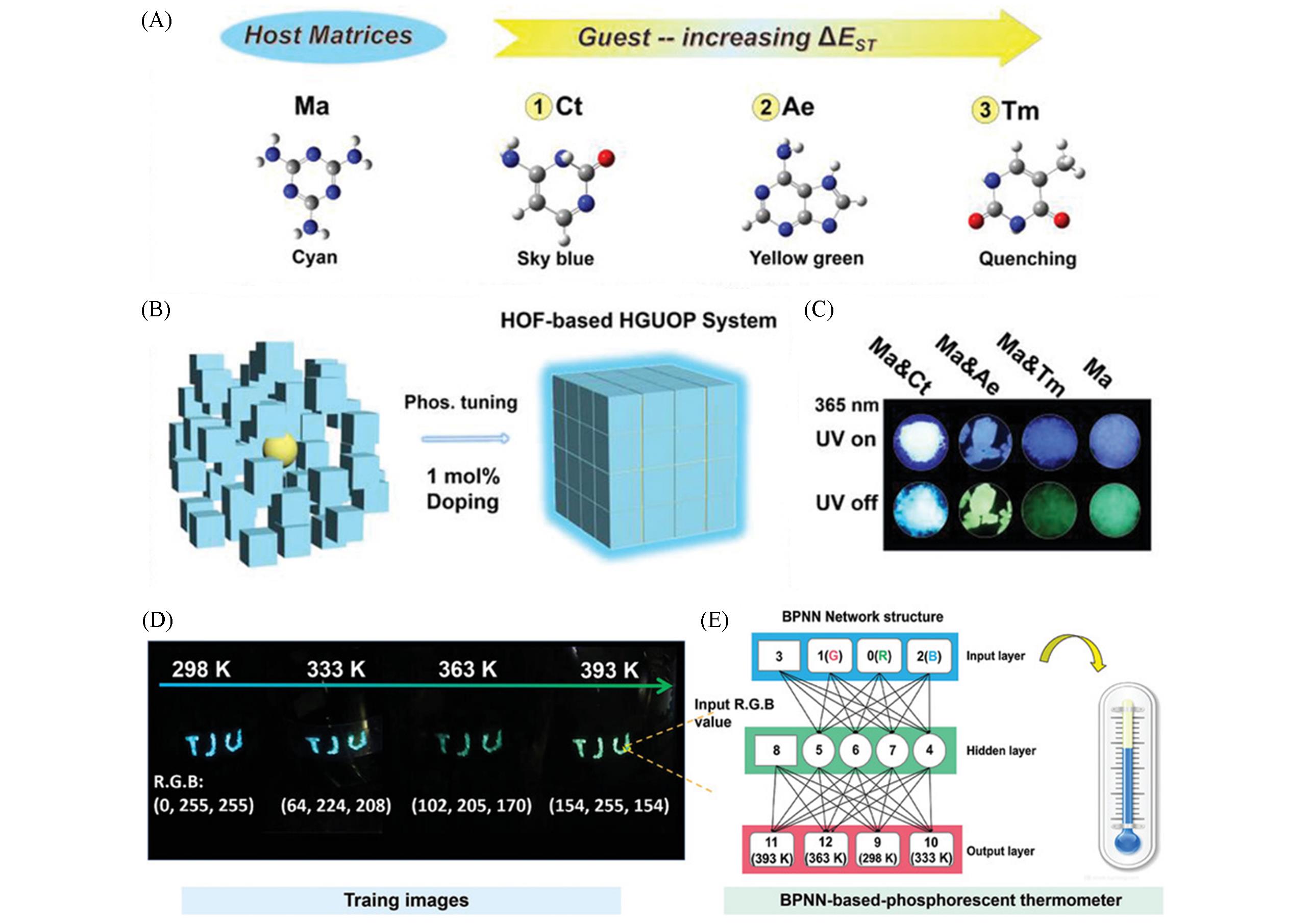
Fig.34 Molecule structures of host(Ma) and three guests(Ct, Ae and Tm)(A), schematic diagram for HOF⁃based HGUOP system by doping 1%(molar fraction) guest into Ma host(B), PL and phosphorescence pictures of Ma&Ct, Ma&Ae, Ma&Tm and Ma(C), phosphorescent thermochromism “TJU” pattern based on Ma&Ct system with relative R.G.B values(D) and the BPNN⁃based⁃phosphorescent thermometer based on Ma&Ct system(irradiation time: ca. 3 s; UV lamp: 20 W)(E)[60]Copyright 2022, Wiley-VCH GmbH.
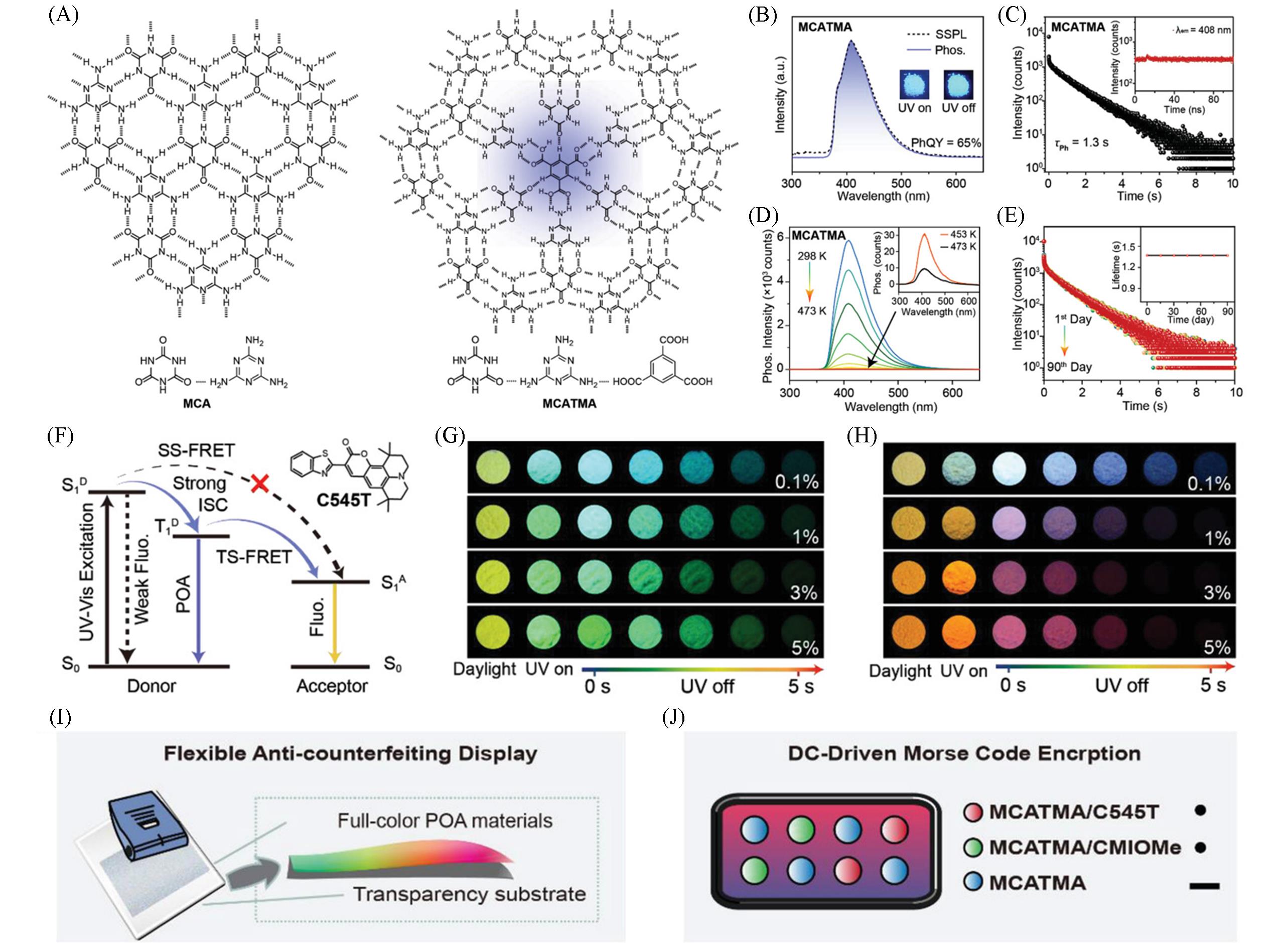
Fig.35 Schematic and molecule structures of MCA and MCATMA(A), steady⁃state PL spectra and phosphorescence (delay 30 ms) spectra and photographs under(UV on) or after(UV off) 254 nm UV light excitation of MCATMA powder(B), afterglow and fluorescence (inset) decay curves of MCATMA powder at 408 nm(the excitation wavelength is 248 nm)(C), phosphorescence spectra of MCATMA at different temperatures from 298 K to 473 K(D), lifetime(inset) and lifetime decay curves(408 nm) of MCATMA powder by 248 nm excitation after different days(E), proposed mechanism for the full⁃ color POA by TS⁃FRET(F), photographs of MCATMA with different contents of CMIOMe(G) and C545T(H), preparation of the flexible and full⁃color anti⁃counterfeiting display(I), preparation of the DC⁃driven Morse code encryption(J)[61]Copyright 2022, Wiley-VCH GmbH.
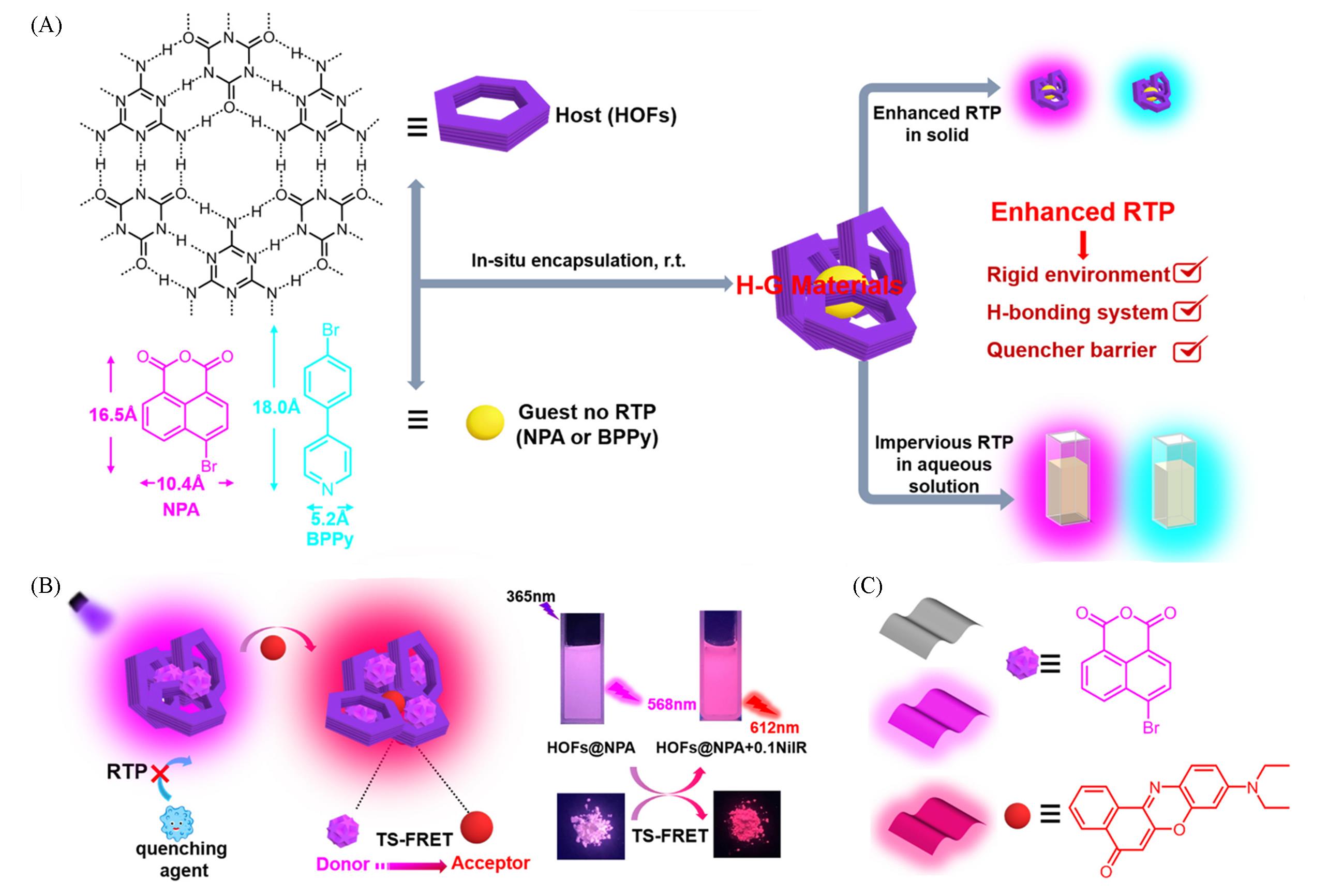
Fig.36 Schematic construction of HOF⁃based RTP materials and their RTP performance(A), schematic figures showing triplet⁃to⁃singlet Förster resonance energy transfer(TS⁃FRET) performance of HOF⁃based RTP materials(B), display of HOF⁃based RTP materials films(C)[62]Copyright 2023, Elsevier Inc.
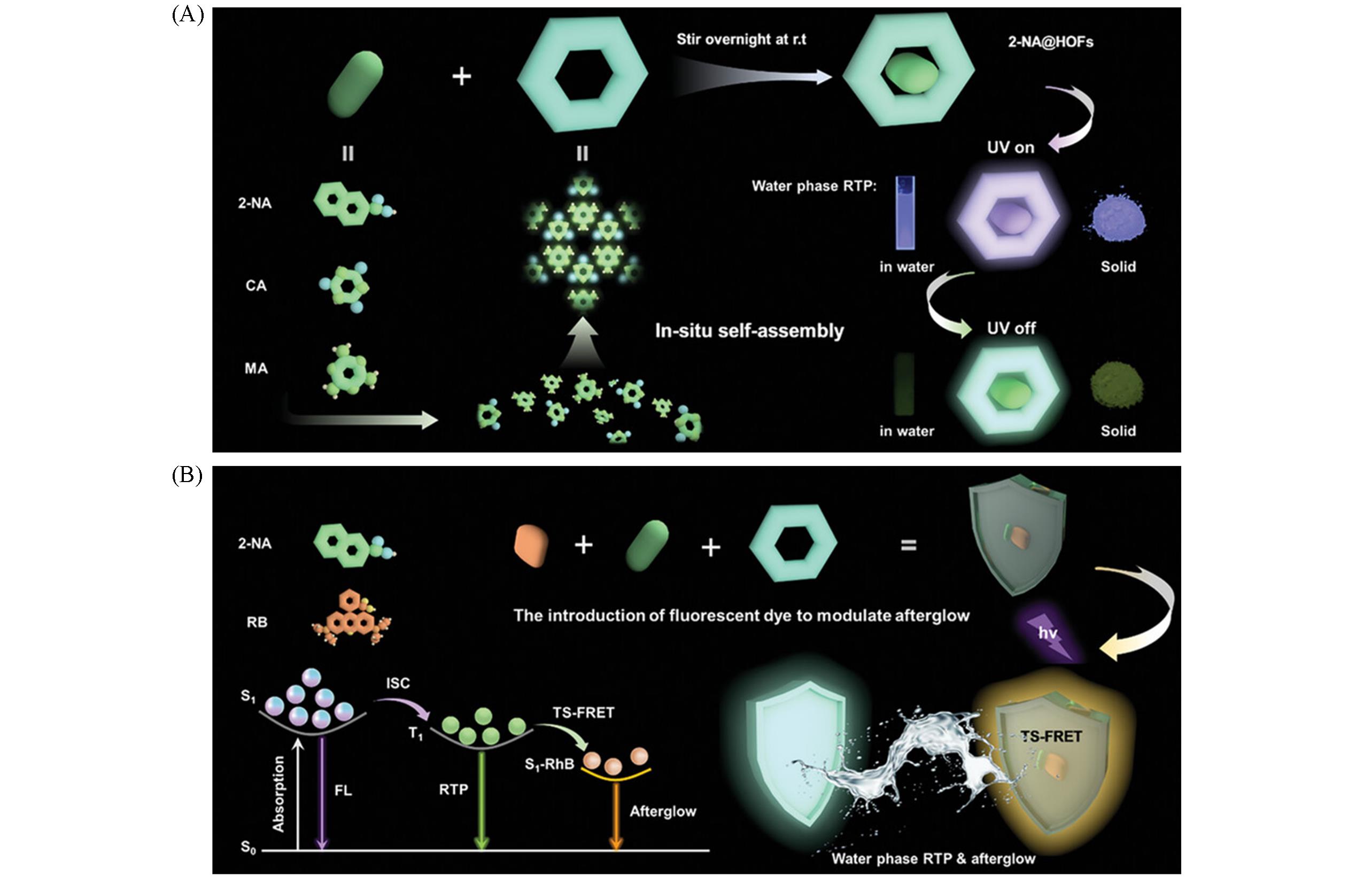
Fig.37 Illustration of the preparation of ultralong robust RTP materials by encapsulating organic phosphors with HOFs(A) and the regulation of afterglow performance based on TS-FRET(B)[63]Copyright 2024, Wiley-VCH GmbH.
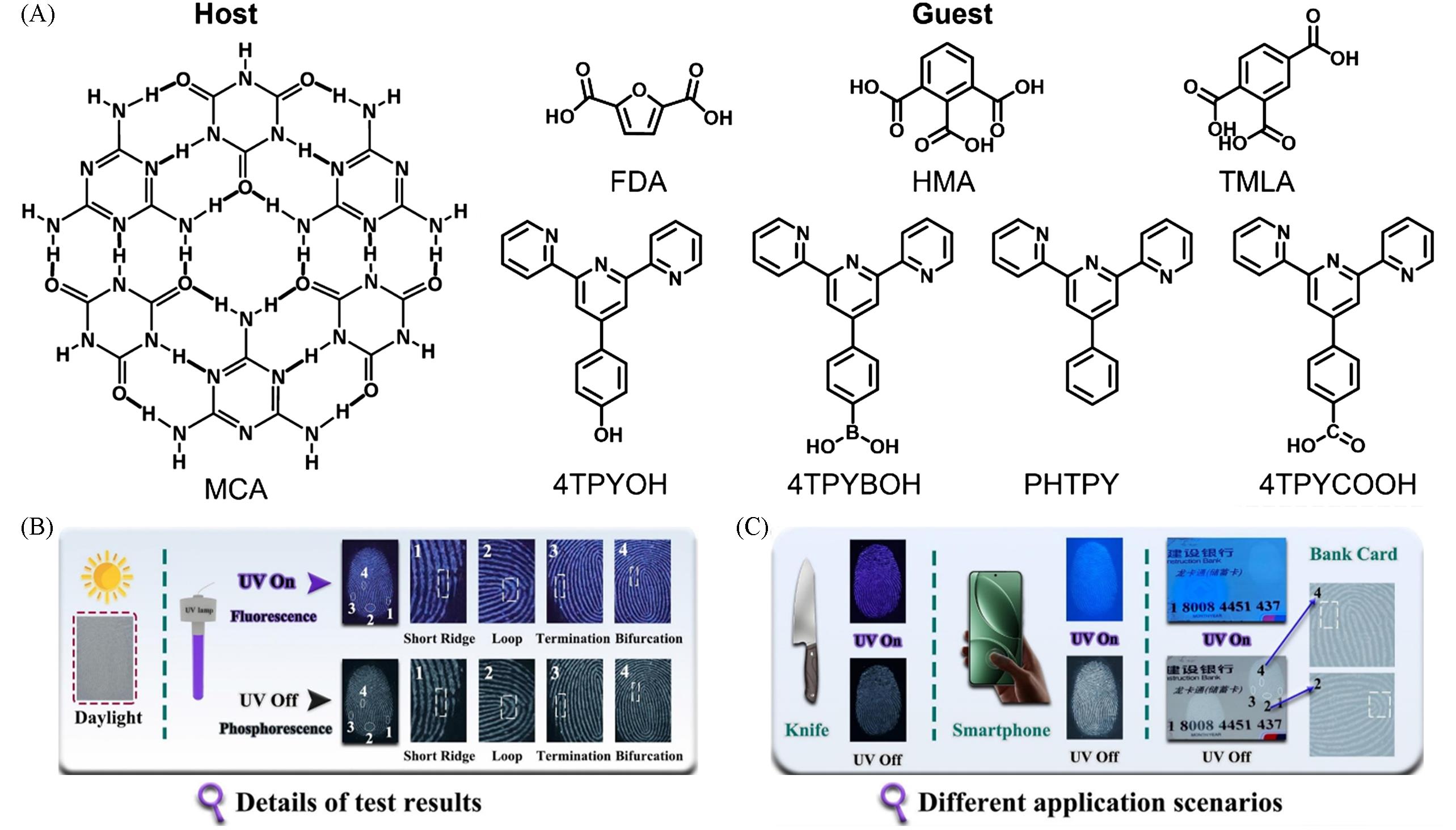
Fig.38 Chemical structures of the host and guest(A)[64,65] and LFP images on glass under daylight and 310 nm UV light, and high⁃resolution fluorescence and phosphorescence images of LFP with details including the short ridge, loop, termination and bifurcation(B)[66] and fluorescence and phosphorescence images of LFP on different physical evidence under 310 nm UV light(C)[66](A) Copyright 2025, American Chemical Society; (B, C) Copyright 2025, Elsevier B.V.
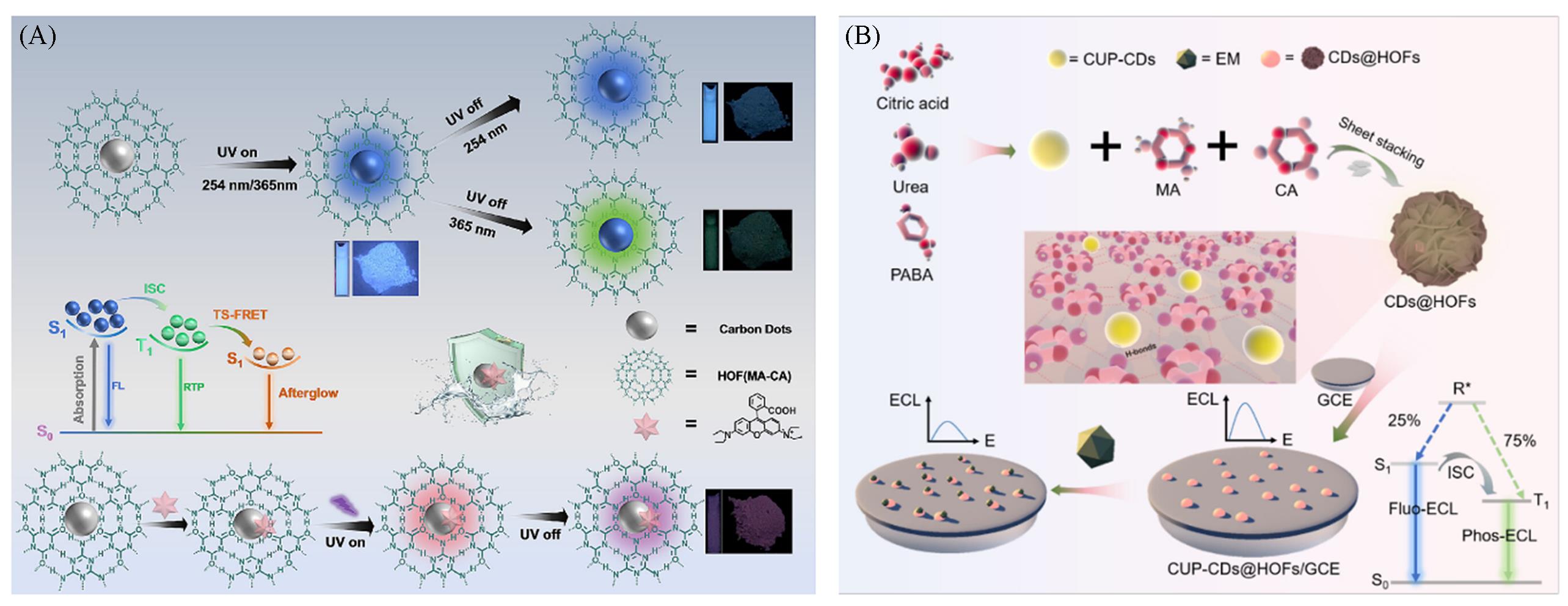
Fig.39 Schematic of the composite with bi⁃phosphorescence prepared by encapsulating CDs within HOFs and TS⁃FRET⁃based afterglow performance tuning application(A)[67], schematic diagram of the CUP⁃CDs@HOFs phosphorescent material for achieving electrochemiluminescence(ECL)(B)[68](A) Copyright 2024, American Chemical Society; (B) Copyright 2025, American Chemical Society.
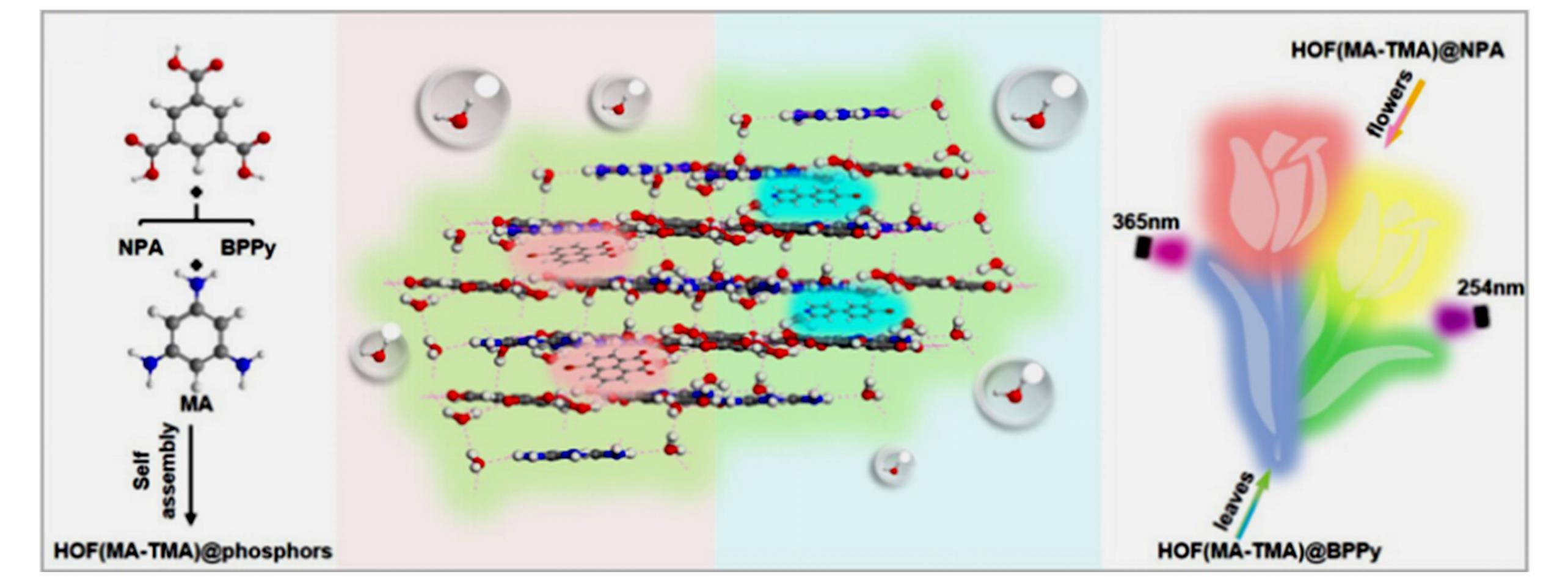
Fig.40 Schematic representations of the preparation of HOF(MA⁃TMA)@phosphors and their smart RTP performance in water environment as well as encryption application(red ball: oxygen atom, blue ball: nitrogen atom, white ball: hydrogen atom)[69]Copyright 2023, Wiley-VCH GmbH.
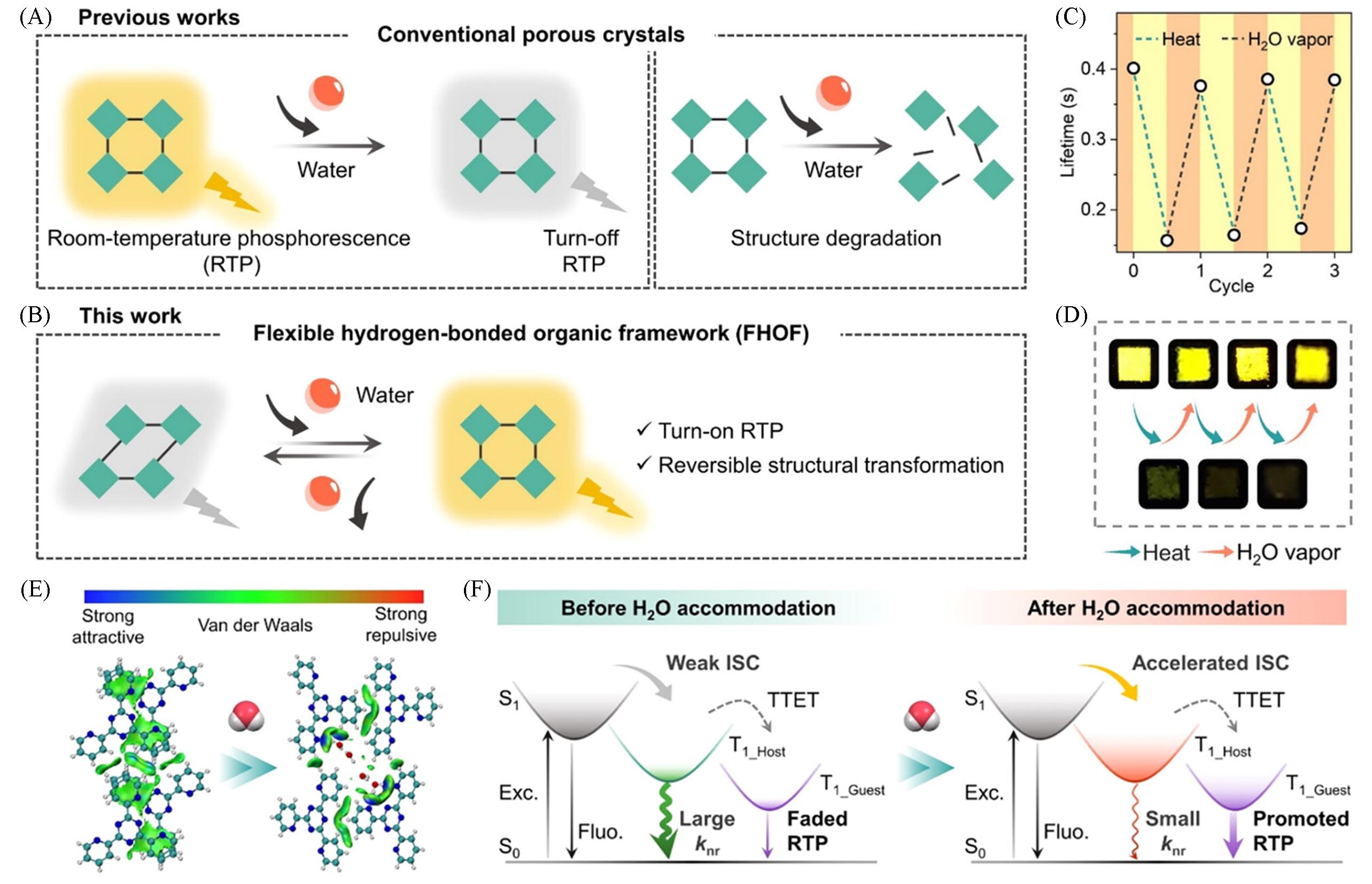
Fig.41 Conventional porous crystals exhibiting turn⁃off RTP phenomena in the normal case when responding to water(left) and the framework degradation of conventional porous crystals in the presence of water(right)(A), the FHOF system exhibiting reversible structural transition accompanied by a turn⁃on RTP property induced by water accommodation in voids(B), lifetimes of TPT⁃ICT (100∶1, molar ratio, used during mixing for TPT/ICT) through treatments of heating at 80 °C and H2O vapor fuming(C), photographs of TPT⁃ICT(100∶1, molar ratio, used during mixing for TPT/ICT) taken at 0.5 s after 365 nm UV⁃light off before and after treatments of heating and H2O vapor fuming(D), distribution of intermolecular NCI regions in the crystal structures of TPT⁃empty and TPT⁃H2O(E), proposed mechanism of the promoted RTP properties in response to H2O accommodation in FHOF systems(F)[70]Copyright 2025, American Chemical Society.
| [1] | He Y. B., Xiang S. C., Chen B. L., J. Am. Chem. Soc., 2011, 133(37), 14570—14573 |
| [2] | Lin R. B., He Y. B., Li P., Wang H. L., Zhou W., Chen B. L., Chem. Soc. Rev., 2019, 48(5), 1362—1389 |
| [3] | Wei W., He L., Han G. R., Lu Y. S., Shi S. L., Yuan Z., Wang X., Li Y. B., Chen B. L., Zhang Z. J., Xiang S. C., Coord. Chem. Rev., 2024, 507, 215760 |
| [4] | Zhang Z. J., Ye Y. X., Xiang S. C., Chen B. L., Acc. Chem. Res., 2022, 55(24), 3752—3766 |
| [5] | Cai S. Z., An Z. F., Huang W., Adv. Funct. Mater., 2022, 32(41), 2207145 |
| [6] | Hu L. H., Gong L. S., Ye W. L., Chen H., Lai X. L., Ye Y. X., Chin. J. Struct. Chem., 2025, 44(11), 100703 |
| [7] | Luo J. D., Xie Z. L., Lam J. W. Y., Cheng L., Chen H. Y., Qiu C. F., Kwok H. S., Zhan X. W., Liu Y. Q., Zhu D. B., Tang B. Z., Chem. Commun., 2001, (18), 1740—1741 |
| [8] | Ge X. Y., Huang Q. Y., Yang Z., Deng H. J., Mao Z., Zhao J., Chi Z. G., Sci. Sin. Chim., 2024, 54(9), 1455—1470 |
| [9] | Zhang Y., Xie S., Zeng Z. B., Tang B. Z., Matter, 2020, 3(6), 1862—1892 |
| [10] | Xiong Z. L., Xiang S. C., Lv Y. C., Chen B. L., Zhang Z. J., Adv. Funct. Mater., 2024, 34(26), 2403635 |
| [11] | Cai S. Z., Yao X. K., Ma H. L., Shi H. F., An Z. F., Aggregate, 2023, 4(3), e320 |
| [12] | Xu X., Yan B., Phys. Chem. Chem. Phys., 2023, 25(3), 1457—1475 |
| [13] | Zhu Y. Q., Wang X. H., Wu M. X., Adv. Funct. Mater., 2023, 33(52), 2308096 |
| [14] | Shi Y. D., Wang S. D., Tao W., Guo J. J., Xie S., Ding Y. L., Xu G. Y., Chen C., Sun X. Y., Zhang Z. M., He Z. K., Wei P. F., Tang B. Z., Nat. Commun., 2022, 13(1), 1882 |
| [15] | Lin Y. X., Jiang C. H., Wang Y. B., Wang J. X., Li B., Qian G. D., J. Mater. Chem. A, 2024, 12(1), 153—161 |
| [16] | Lv Y. C., Li D. L., Ren A., Xiong Z. L., Yao Y. N., Cai K. C., Xiang S. C., Zhang Z. J., Zhao Y. S., ACS Appl. Mater. Interfaces, 2021, 13(24), 28662—28667 |
| [17] | Shi Y. D., Ding Y. L., Tao W., Wei P. F., ACS Appl. Mater. Interfaces, 2022, 14(31), 36071—36078 |
| [18] | Peng Y. X., Gan Y. T., Shi R. G., Huang W., Tao T., J. Phys. Chem. C, 2018, 122(51), 29488—29497 |
| [19] | Xiong J. B., Wang K., Yao Z. Q., Zou B., Xu J. L., Bu X. H., ACS Appl. Mater. Interfaces, 2018, 10(6), 5819—5827 |
| [20] | Lv Y. C., Xiong Z. L., Li Y. B., Li D. L., Liang J. S., Yang Y. S., Xiang F. H., Xiang S. C., Zhao Y. S., Zhang Z. J., J. Phys. Chem. Lett., 2022, 13(1), 130—135 |
| [21] | Han Y. N., Zhang T., Chen X. Y., Chen Q., Hao J. J., Song W. C., Zeng Y. F., Xue P. C., ACS Appl. Mater. Interfaces, 2021, 13(27), 32270—32277 |
| [22] | Yang W. Y., Li L. L., Xue X. L., Deng S. Y., Wei P. F., Chem. Commun., 2025, 61(70), 13113—13116 |
| [23] | Wang J., Zhao L. R., Tong J., Yu Y. M., Wang X. Y., Yu S. Y., Int. J. Mol. Sci., 2022, 23(8), 4206 |
| [24] | Hu M., Ye F. Y., Yu W., Sheng K., Wang W. Z., Zheng Y. S., Chem. Eur. J., 2023, 29(68), e202302567 |
| [25] | Li L., Ma H. L., Zhang J. Y., Zhao E. G., Hao J., Huang H. M., Li H., Li P. F., Gu X. G., Tang B. Z., J. Am. Chem. Soc., 2021, 143(10), 3856—3864 |
| [26] | Yang X. T., Zeng Y., Wei H. R., Gu X. G., Zheng X. Y., Surf. Interfaces, 2024, 52, 104911 |
| [27] | Huang Q. Y., Li W. L., Mao Z., Zhang H., Li Y., Ma D. Y., Wu H., Zhao J., Yang Z. Y., Zhang Y., Gong L., Aldred M. P., Chi Z. G., Chem, 2021, 7(5), 1321—1332 |
| [28] | Bardot M. I., Weyhrich C. W., Shi Z. X., Traxler M., Stern C. L., Cui J., Muller D. A., Becker M. L., Dichtel W. R., Science, 2025, 387(6731), 264—269 |
| [29] | Huang Q. Y., Li W. L., Yang Z., Zhao J., Li Y., Mao Z., Yang Z. Y., Liu S. W., Zhang Y., Chi Z. G., CCS Chem., 2022, 4(5), 1643—1653 |
| [30] | Huang Q. Y., Chen X. X., Li W. L., Yang Z. Y., Zhang Y., Zhao J., Chi Z. G., Chem, 2023, 9(5), 1241—1254 |
| [31] | Huang G. X., Jiang Y. Q., Yang S. F., Li B. S., Tang B. Z., Adv. Funct. Mater., 2019, 29(16), 1900516 |
| [32] | Suzuki Y., Tohnai N., Hisaki I., Chem. Eur. J., 2020, 26(71), 17056—17062 |
| [33] | Sun Z. H., Yin P. P., He S. Y., Zhang K. G., Pan X. R., Wang J. Y., Hao P. N., Zhou Z., Yang X. G., Ma L. F., Tan C. L., Chem. Res. Chinese Universities, 2025, 41(3), 519—524 |
| [34] | Lin Y. X., Wang J. X., Liang C. C., Jiang C. H., Li B., Qian G. D., RSC Adv., 2022, 12(36), 23411—23415 |
| [35] | Lu M. L., Huang W., Gao S. Z., Zhang J. L., Liang W. B., Li Y., Yuan R., Xiao D. R., Anal. Chem., 2022, 94(45), 15832—15838 |
| [36] | Xue Y., Dong W. S., Wang B., Jie G. F., Sens. Actuators B: Chem., 2023, 397, 134702 |
| [37] | Zhang X. Y., Hua M. F., Chen M., Lin A. H., Ye T. X., Chen X. M., Sens. Actuators B: Chem., 2026, 447, 138916 |
| [38] | Wang J. W., Liu Z. D., Yang S. M., Lin Y. Z., Lin Z. H., Ling Q. D., Chem. Eur. J., 2018, 24(2), 322—326 |
| [39] | Yu T., Ou D. P., Yang Z. Y., Huang Q. Y., Mao Z., Chen J. R., Zhang Y., Liu S. W., Xu J. R., Bryce M. R., Chi Z. G., Chem. Sci, 2017, 8(2), 1163—1168 |
| [40] | Huang Q. Y., Li W. L., Mao Z., Qu L. J., Li Y., Zhang H., Yu T., Yang Z. Y., Zhao J., Zhang Y., Aldred M. P., Chi Z. G., Nat. Commun., 2019, 10(1), 3074 |
| [41] | Huang Q. Y., Otake K., Kitagawa S., Angew. Chem. Int. Ed., 2023, 62(43), e202310225 |
| [42] | Wang S. C., Zhang Q. S., Wang Z., Guan S. Q., Zhang X. D., Xiong X. H., Pan M., Angew. Chem. Int. Ed., 2023, 62(52), e202315382 |
| [43] | Lv Y. C., Liang J. S., Xiong Z. L., Zhang H., Li D. L., Yang X., Xiang S. C., Zhang Z. J., Chem. Eur. J., 2023, 29(22), e202204045 |
| [44] | Lv Y. C., Liang J. S., Xiong Z. L., Yang X., Li Y. B., Zhang H., Xiang S. C., Chen B. L., Zhang Z. J., Adv. Mater., 2024, 36(9), 2309130 |
| [45] | Peng Y. X., Liu H. Q., Shi R. G., Feng F. D., Hu B., Huang W., J. Phys. Chem. C, 2019, 123(10), 6197—6204 |
| [46] | Deng Y. L., Wang Y. J., Gao X. Y., Jin Y. K., Liu J. H., Mo G. L., Guo Y. X., Lu L. L., Li P., Molecules, 2025, 30(24), 4725 |
| [47] | Xiao C. Q., Yi W. H., Hu J. J., Liu S. J., Wen H. R., CrystEngComm, 2021, 23(47), 8334—8342 |
| [48] | Liu Y. H., Yan B., Inorg. Chem. Front., 2024, 11(4), 1099—1107 |
| [49] | Li K., Deng X., Xie M. Z., Qiu S. Y., Fan M. F., Zheng C. Z., Li H. Y., Meng M., Chen M., Tang B. Z., Luminescence, 2025, 40(10), e70322 |
| [50] | Zhou B., Cao L. H., Li B. S., Chen X. Y., Bai X. T., ACS Appl. Mater. Interfaces, 2024, 16(43), 58931—58939 |
| [51] | Yang Z., Xu C., Li W. L., Mao Z., Ge X. Y., Huang Q. Y., Deng H. J., Zhao J., Gu F. L., Zhang Y., Chi Z. G., Angew. Chem. Int. Ed., 2020, 59(40), 17451—17455 |
| [52] | Cai S. Z., Shi H. F., Zhang Z. Y., Wang X., Ma H. L., Gan N., Wu Q., Cheng Z. C., Ling K., Gu M. X., Ma C. Q., Gu L., An Z. F., Huang W., Angew. Chem. Int. Ed., 2018, 57(15), 4005—4009 |
| [53] | Zhang L., Li M., Hu T. P., Wang Y. F., Shen Y. F., Yi Y. P., Lu H. Y., Gao Q. Y., Chen C. F., Chem. Commun., 2019, 55(81), 12172—12175 |
| [54] | Yao W., Ma C. Q., Ma H. L., Fu L. S., Lu S., Lv A. Q., Cai S. Z., Hang X. C., Singh M., Shi H. F., An Z. F., Huang W., Giant, 2020, 1, 100007 |
| [55] | Song L. L., Wang X., Zhang M., Jia W. Y., Wang Q., Ye W. P., Wang H., Lv A. Q., Ma H. L., Gu L., Shi H. F., An Z. F., Huang W., CCS Chem., 2021, 3(11), 466—472 |
| [56] | Xiao H., Ma H. L., Han M. X., Wu N., Guo Z. Y., An Z. F., Zhan H., Cryst. Growth Des., 2021, 21(6), 3420—3427 |
| [57] | Gu L. H., Wu H., Li X., Xu J. H., Wang M. D., Li C., Yao L. Q., Diao Y. K., Li Y. C., Chen F. J., Shen F., Xiang H. J., Chen Y., Yang T., Adv. Mater., 2025, 37(13), 2417001 |
| [58] | Wu H. W., Baryshnikov G. V., Kuklin A., Minaev B. F., Wu B., Gu L., Zhu L. L., Ågren H., Zhao Y. L., ACS Appl. Mater. Interfaces, 2021, 13(1), 1314—1322 |
| [59] | Wang S. Q., Liu J., Feng S. W., Wu J. Y., Yuan Z., Chen B. L., Ling Q. D., Lin Z. H., Angew. Chem. Int. Ed., 2024, 63(13), e202400742 |
| [60] | Xu X., Yan B., Adv. Optical Mater., 2022, 10(11), 2200451 |
| [61] | Zhang J. Y., Xu S., Zhang L. Y., Wang X., Bian Y. F., Tang S. L., Zhang R. Q., Tao Y., Huang W., Chen R. F., Adv. Mater., 2022, 34(44), 2206712 |
| [62] | Xia Q. Q., Yu J. L., Chen Z. Y., Xue Z. Y., Wang X. H., Liu X. M., Wu M. X., Cell Rep. Phys. Sci., 2023, 4(7), 101494 |
| [63] | Luo W. Z., Zhou J. Y., Nie Y. J., Li F. M., Cai S. Y., Yin G. Q., Chen T., Cai Z. X., Adv. Funct. Mater., 2024, 34(33), 2401728 |
| [64] | Zhang Z. S., Yan B., Anal. Chem., 2025, 97(43), 24154—24164 |
| [65] | Zhang Z. S., Yan B., ACS Appl. Mater. Interfaces, 2025, 17(20), 29941—29951 |
| [66] | Hu Z. Q., Yan B., Chem. Eng. J., 2025, 518, 164768 |
| [67] | Cai M. J., Qiu Y. J., Li F. M., Cai S. Y., Cai Z. X., ACS Appl. Mater. Interfaces, 2024, 16(35), 46609—46618 |
| [68] | Qiu H. K., Cai M. J., Lai Y. H., Cai Z. X., Anal. Chem., 2025, 97(23), 12400—12407 |
| [69] | Xia Q. Q., Wang X. H., Yu J. L., Chen Z. Y., Lou X. Y., Liu X., Wu M. X., Yang Y. W., Aggregate, 2023, 4(5), e370 |
| [70] | Huang Q. Y., Xue Z. Q., Segawa K., Honda T., Ogawa T., Luo C., Deng H. J., Chi Z. G., Fujikawa T., Miyata K., Onda K., Horike S., Otake K., Kitagawa S., J. Am. Chem. Soc., 2025, 147(50), 46234—46242 |
| [1] | 李银, 汤睿霖, 瞿超, 程亮慧, 胡玉玺, 吴钰祥, 王志明. 离子化策略实现马来酸酐水溶性光敏探针的制备及其在高效抗菌中的应用[J]. 高等学校化学学报, 2026, 47(4): 161. |
| [2] | 任奥成, 李青云, 吉晓帆. 荧光超分子聚合物网络[J]. 高等学校化学学报, 2026, 47(4): 85. |
| [3] | 孙妍, 朱东霞. 近红外激发有机发光材料的构筑及在疾病治疗中的应用[J]. 高等学校化学学报, 2026, 47(4): 72. |
| [4] | 陈翔, 张强, 阴卓颉, 袁望章. 糖与非芳香氨基酸的协同增强发光[J]. 高等学校化学学报, 2026, 47(4): 177. |
| [5] | 徐成硕, 武桐玥, 管伟江, 吕超. 掺杂诱导的氢键网络介观组装及其磷光寿命调控[J]. 高等学校化学学报, 2026, 47(4): 133. |
| [6] | 李雨婷, 罗亮. 拉曼成像技术的前沿进展及与聚集体科学的交叉研究[J]. 高等学校化学学报, 2026, 47(4): 54. |
| [7] | 方瑾钰, 黄瀚玮, 宋航, 吴谦, 赵征, 唐本忠. 智能响应, 精准点亮: 酶响应的聚集诱导发光材料在生物医学中的诊疗新策略[J]. 高等学校化学学报, 2026, 47(4): 20260009. |
| [8] | 吴泽怡, 司文妮, 齐春轩, 李朔, 冯海涛. 基于三苯胺的红光手性荧光探针的构筑及手性识别性能[J]. 高等学校化学学报, 2026, 47(4): 208. |
| [9] | 程建硕, 叶文彦, 周璐璐, 刘谋为, 李忠宇, 唐子然, 俞婉婷, 朱亮亮. 光激发诱导的生物大分子自组装[J]. 高等学校化学学报, 2026, 47(4): 171. |
| [10] | 高鑫, 卿佳, 胡祎辰, 上官之春, 梁同玲, 周永胜, 张关心, 张德清. 具有聚集诱导发光性质的高灵敏度和高光稳定性的脂滴荧光探针[J]. 高等学校化学学报, 2026, 47(4): 102. |
| [11] | 张阳戴翼, 邵研, 姜世梅. 基于动态氢键网络协同调控AIE与力学性能的多响应水凝胶[J]. 高等学校化学学报, 2026, 47(4): 141. |
| [12] | 宋奎柱, 龙宇杰, 王亚茹, 王嘉麒, 吕海燕, 陈传峰. 酸碱和客体可调控的延迟荧光及其逻辑门应用[J]. 高等学校化学学报, 2026, 47(4): 153. |
| [13] | 马欢, 董世龙, 杨均成, 祝海涛, 冯海涛. 基于杯[4]芳烃的手性AIEgen用于酸及氨基酸的对映选择性识别[J]. 高等学校化学学报, 2026, 47(4): 195. |
| [14] | 苏彦刚, 金文东, 于晓强. 高光稳定性NIR荧光探针用于线粒体嵴动态追踪[J]. 高等学校化学学报, 2026, 47(1): 20250302. |
| [15] | 胡浩渊, 胡广泽, 刘雄, 陈曼玉, 张浩可, 孙景志, 唐本忠. 苯甘氨酸修饰的聚(二苯基乙炔): 条件依赖的手性传递与聚集诱导发光增强效应[J]. 高等学校化学学报, 2026, 47(1): 20250292. |
| 阅读次数 | ||||||
|
全文 |
|
|||||
|
摘要 |
|
|||||
