

高等学校化学学报 ›› 2026, Vol. 47 ›› Issue (4): 20260008.doi: 10.7503/cjcu20260008
李雨婷, 罗亮( )
)
收稿日期:2026-01-01
出版日期:2026-04-10
发布日期:2026-02-22
通讯作者:
罗亮
E-mail:liangluo@hust.edu.cn
LI Yuting, LUO Liang()
Received:2026-01-01
Online:2026-04-10
Published:2026-02-22
Contact:
LUO Liang
E-mail:liangluo@hust.edu.cn
Supported by:摘要:
拉曼成像作为一种分子光谱技术, 凭借其出色的特异性和高分辨率, 在生命科学等领域得到了广泛的研究与应用. 然而其发展仍面临信号微弱、 采集速度慢及穿透深度不足等挑战. 近年来, 聚集科学的快速发展为解决拉曼成像的局限性提供了新思路. 聚集诱导发光(AIE)材料在聚集状态下会表现出增强的信号, 有望弥补拉曼信号固有的微弱性. 本文综合评述了拉曼成像技术的前沿进展及其与聚集科学交叉研究的现状, 重点阐述了通过分子工程构建AIE-拉曼双响应探针的策略, 以实现荧光定位与拉曼定量之间的功能互补, 从而显著提高检测的灵敏度和特异性. 这些探针在肿瘤手术导航、 耐药菌诊疗及细胞器动态监测等应用中已展现出单细胞分辨率和高时空准确性. 我们还分析了该领域面临的挑战, 如生物安全性和分子设计的复杂性, 并对未来的发展方向进行了展望, 包括智能响应探针、 人工智能辅助分析以及多模态融合平台. 拉曼成像与AIE的融合将为医学成像等领域的突破性发展指明新方向.
中图分类号:
TrendMD:
李雨婷, 罗亮. 拉曼成像技术的前沿进展及与聚集体科学的交叉研究. 高等学校化学学报, 2026, 47(4): 20260008.
LI Yuting, LUO Liang. Cutting-edge Advances in Raman Imaging Technology and Its Interdisciplinary Research with Aggregate Science. Chem. J. Chinese Universities, 2026, 47(4): 20260008.
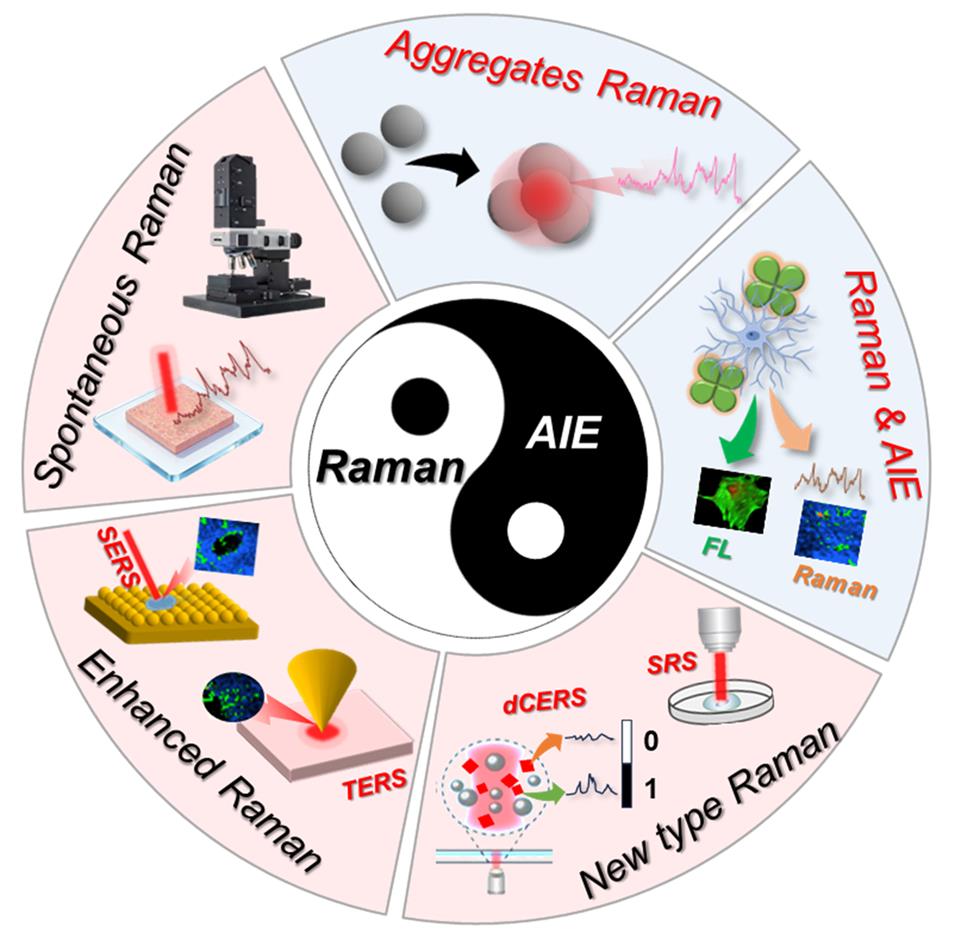
Fig.1 Research progress of Raman imaging and its integration with aggregate science
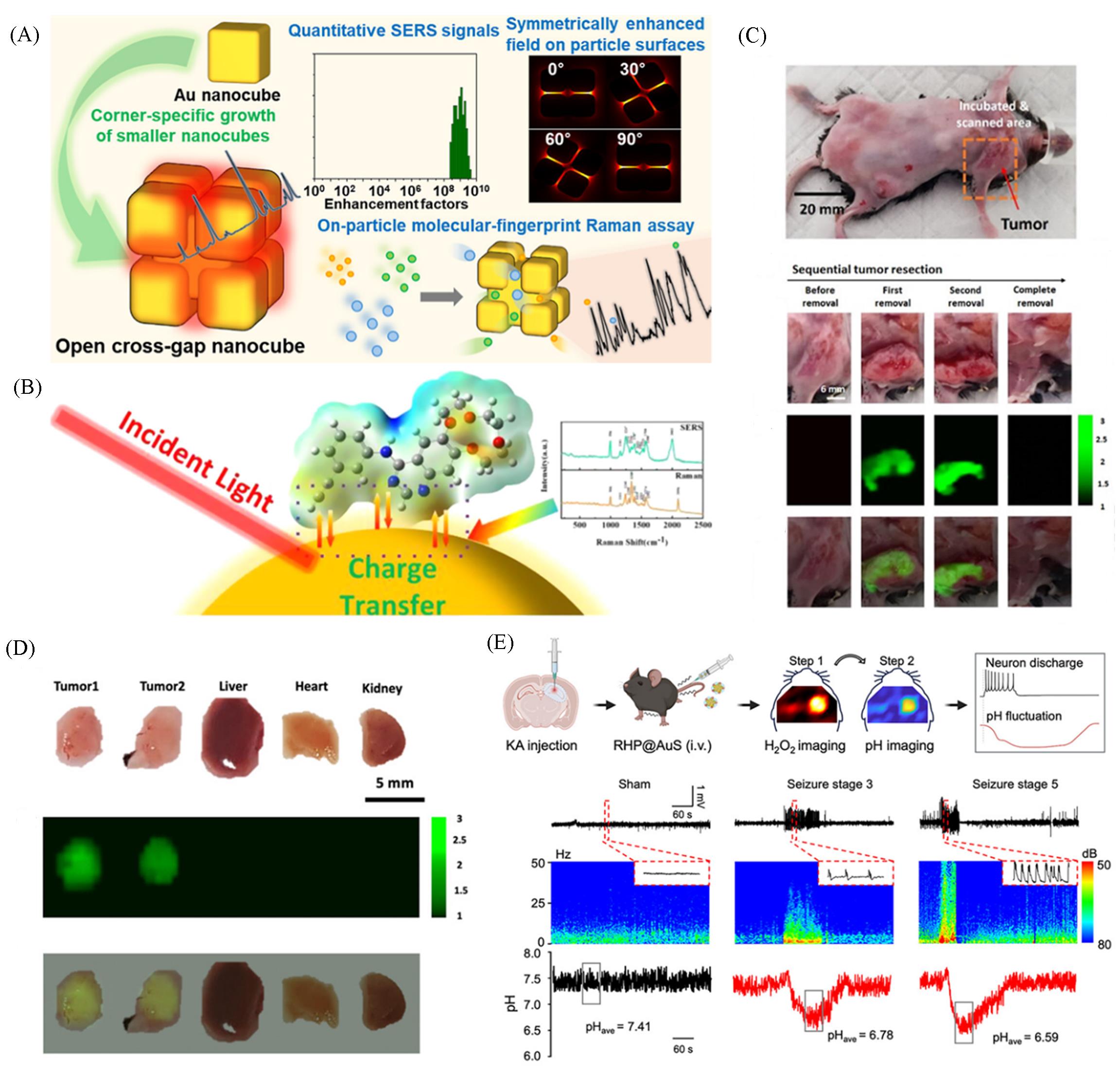
Fig.2 Two enhancement principles of SERS: diagrams illustrating the electromagnetic field enhancement principle[61](A) and the chemical enhancement principle[62](B), utilizing "sugar nanoparticles" to achieve real⁃time intraoperative imaging and complete resection of the spontaneous breast cancer model in mice[58](C), the images obtained by using ratio⁃type Raman probes on tumor tissues and control tissues[58](D), imaging pH fluctuations with RHP@AuS in KA model mice[78](E)(A) Copyright 2024, American Chemical Society; (B) Copyright 2021, American Chemical Society; (C, D) Copyright 2024, Wiley⁃VCH; (E) Copyright 2025, Wiley⁃VCH.
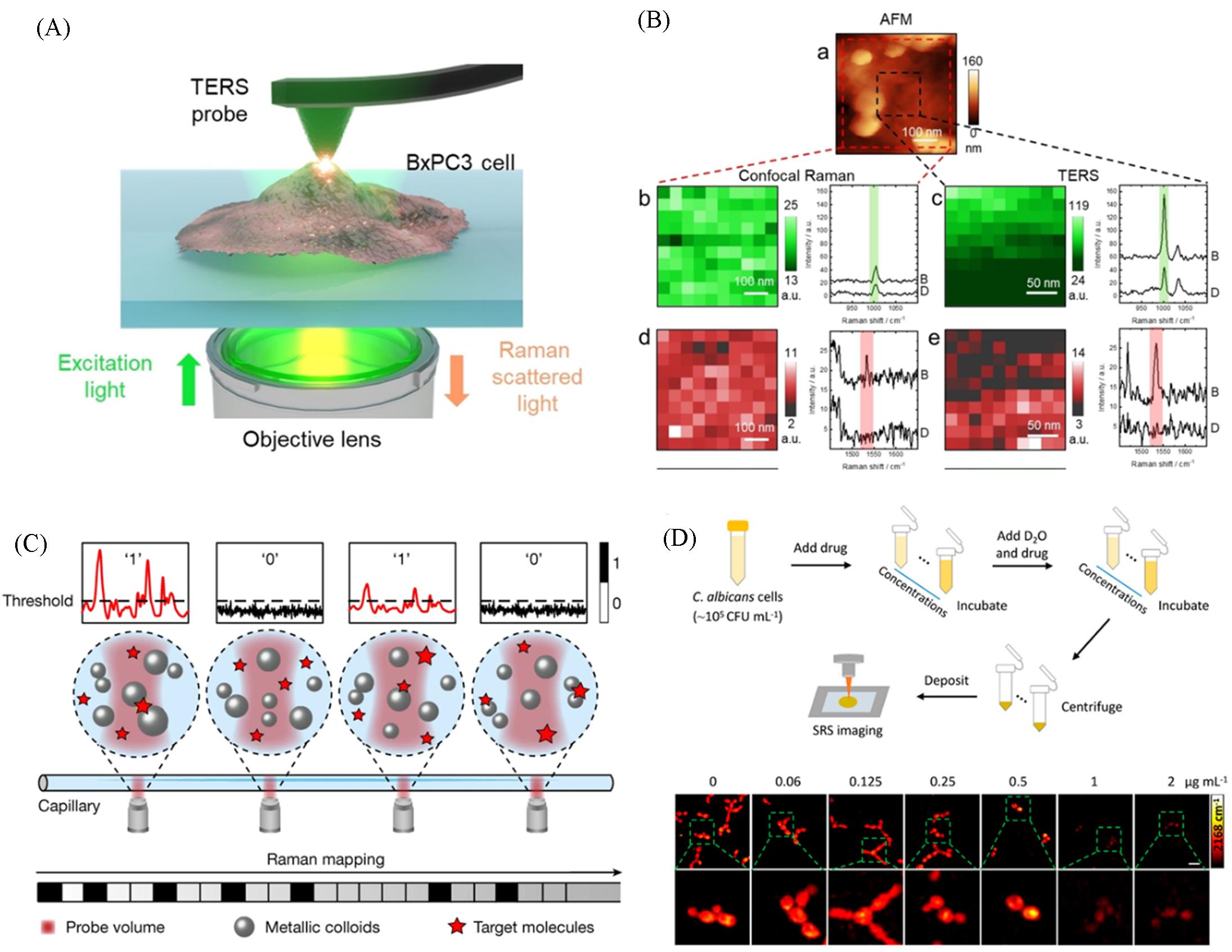
Fig.3 TERS images of the living cell membrane[84](A), compared with Confocal Raman, TERS reveals the heterogeneous distribution of membrane components at the nanoscale[84](B), schematic of dCERS[86](C), and the schematic diagram of rapid AFST using SRS metabolic imaging and a bacterial SRS image based on C—D peaks[87](D)
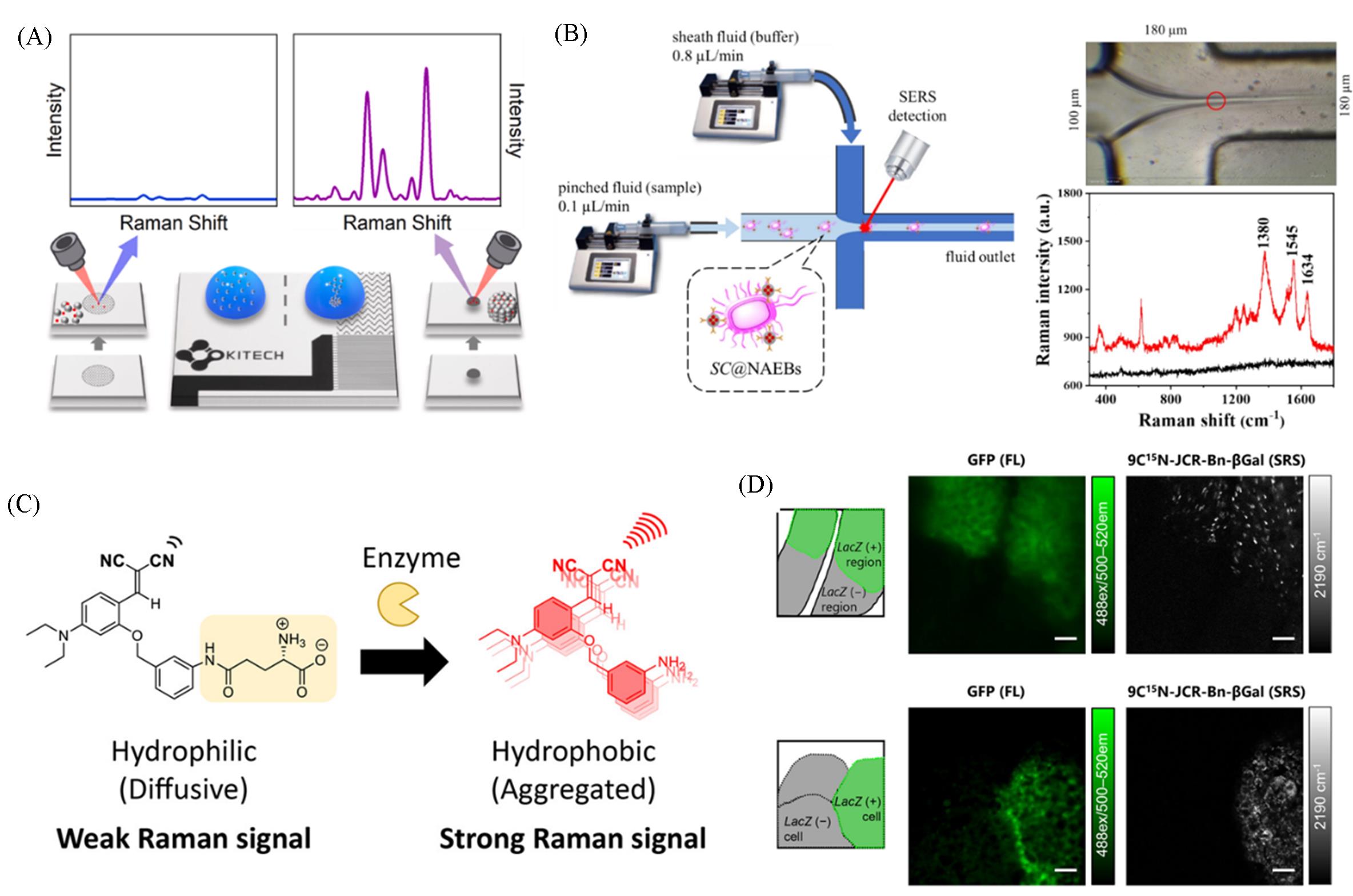
Fig.4 Schematic illustration of the SERS measurement using an AgNP cluster based on SAW[92](A), the device based on NAEBs and equipped with a flow cytometry chip for detecting stem cells, along with the Raman test results[93](B), the BzBMN probe enhances Raman signals through enzyme⁃ controlled aggregation⁃induced mechanism[94](C), utilizing the formation of aggregates for targeted enzyme⁃selective in vitro imaging of the tissue[95](D)(A) Copyright 2024, Elsevier; (B) Copyright 2025, Elsevier; (C) Copyright 2025, American Chemical Society; (D) Copyright 2023, American Chemical Society.
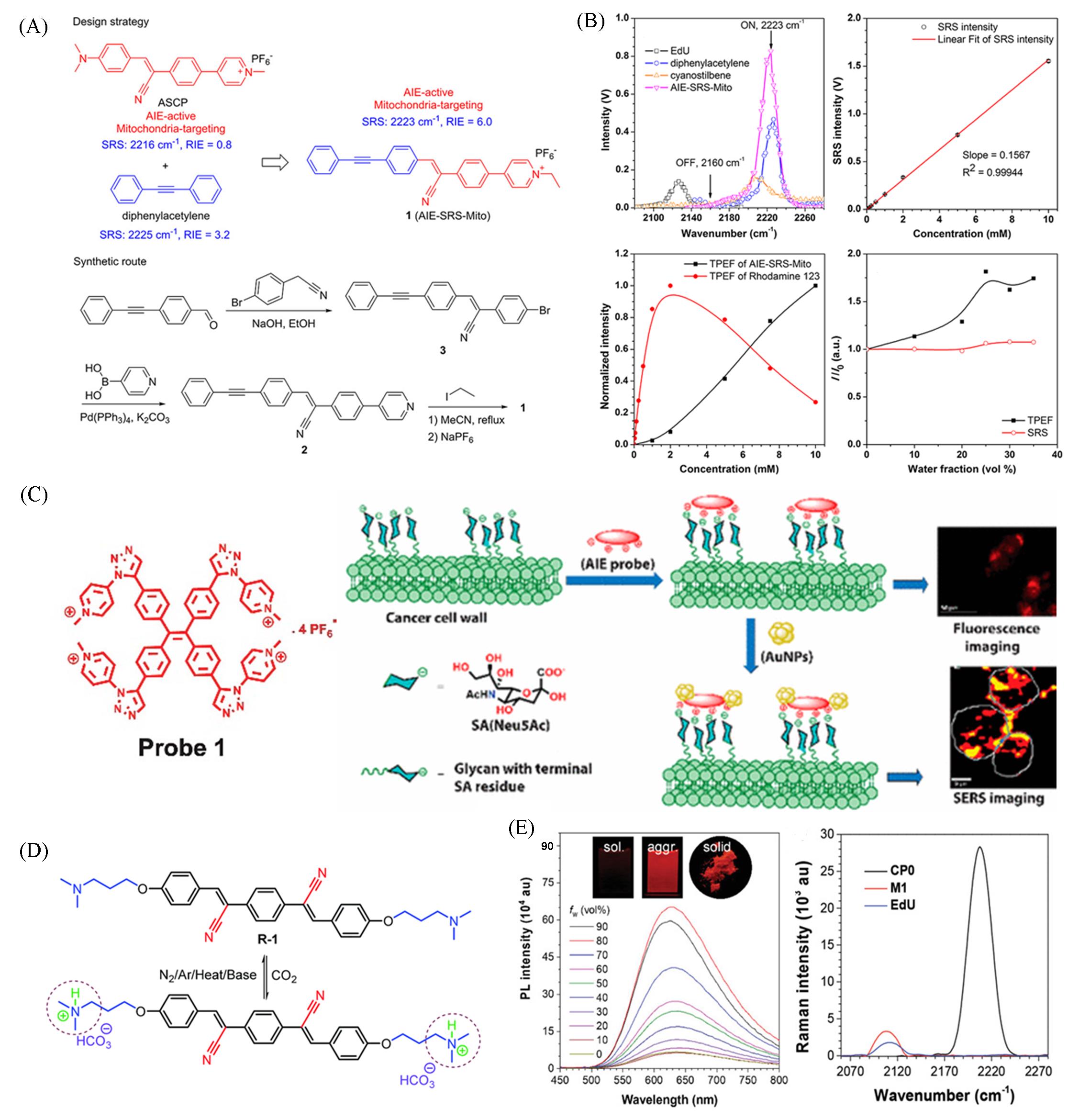
Fig.5 Design Strategy and Synthetic Route of AIE⁃SRS⁃Mito[97](A), SRS and TPEF properties of AIE⁃SRS⁃Mito[97](B), the cell surface glycan imaging was achieved using the cationic probe 1 through fluorescence and SERS methods[98](C), receptor R⁃1 and its interaction with CO2[99](D), the fluorescence and Raman properties of CP0[100](E)(A) Copyright 2017, American Chemical Society; (B) Copyright 2023, American Chemical Society; (C) Copyright 2019, RSC; (D) Copyright 2021, Wiley-VCH.
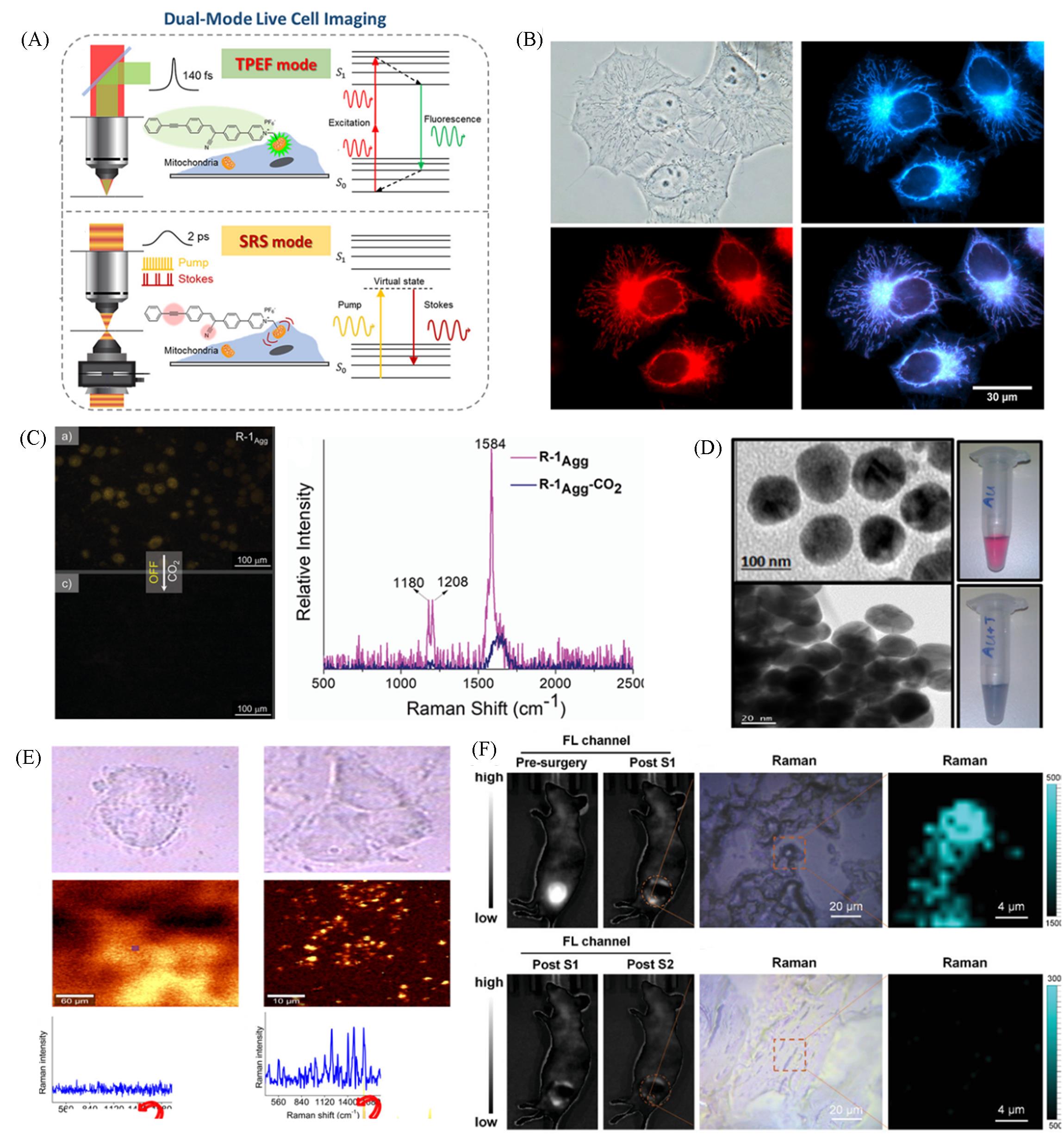
Fig.6 Dual⁃mode live cell imaging using FL⁃SRS[97](A), Mitochondrial specificity of AIE⁃SRS⁃Mito[97](B), the R⁃1 aggregate exhibits reversible bimodal signal attenuation in response to changes in CO2 concentration[99](C), TEM images of TPE⁃In⁃PSA@Au nanoprobe and corresponding visual color changes[101](D), Raman imaging of LNCaP and HeLa cells with TPE⁃In⁃PSA@Au nanoprobes[101](E), the tumor lesions of 4T1 tumor⁃bearing mice were fluorescently located and Raman cleared using CP0 nanoprobes[100](F)
| [92] | Park J. O., Choi Y., Ahn H. M., Lee C. K., Chun H., Park Y. M., Kim K. B., Anal. Chim. Acta, 2024, 1285, 342036 |
| [93] | Fong Z. H., Wang C. H., Yang C. Y., Kan H. C., Lin Y. J., Chen Y. L., Shen Y. C., Yu Y. C., Chau L. K., Io C. W., Wang S. C., Microchem. J., 2025 , 212, 113436 |
| [94] | Okinaka M., Kawatani M., Fujioka H., Spratt S. J., Ito H., Misawa Y., Otake R., Ishikawa A., Kojima R., Urano Y., Ozeki Y., Kamiya M., Anal. Chem., 2025, 97(35), 19057—19065 |
| [95] | Fujioka H., Kawatani M., Spratt S. J., Komazawa A., Misawa Y., Shou J., Mizuguchi T., Kosakamoto H., Kojima R., Urano Y., Obata F., Ozeki Y., Kamiya M., J. Am. Chem. Soc., 2023, 145(16), 8871—8881 |
| [96] | Wang Y., Liang X., Yang Y., Microchim. Acta, 2025, 192(3), 172 |
| [97] | Li X., Jiang M., Lam J. W. Y., Tang B. Z., Qu J. Y., J. Am. Chem. Soc., 2017, 139(47), 17022—17030. |
| [98] | Jana P., Koppayithodi S., Murali M., Saha M., Maiti K. K., Bandyopadhyay S., ACS Sensors, 2023, 8(4), 1693—1699 |
| [99] | Mishra R. K., Vijayakumar S., Mal A., Karunakaran V., Janardhanan J. C., Maiti K. K., Praveen V. K., Chem. Commun., 2019, 55(43), 6046—6049 |
| [100] | Su X., Liu R., Li Y., Han T., Zhang Z., Niu N., Kang M., Fu S., Wang D., Wang D., Tang B. Z., Adv. Healthc. Mater., 2021, 10(24), 2101167 |
| [101] | Ramya A. N., Joseph M. M., Nair J. B., Karunakaran V., Narayanan N., Maiti K. K., ACS Appl. Mater. Interfaces, 2016, 8(16), 10220—10225 |
| [102] | Wang X., Ma Y., Wang C., Yang L., Wei S., Miao A., Sci. Total Environ., 2025, 1003, 180708 |
| [103] | He W., Zhang T., Bai H., Kwok R. T. K., Lam J. W. Y., Tang B. Z., Adv. Healthc. Mater., 2021, 10(24), 2101055 |
| [104] | Guan R., Yu Q., Li J., Methods, 2023, 216, 11—20 |
| [1] | Esteban R., Baumberg J. J., Aizpurua J., Acc. Chem. Res., 2022, 55(14), 1889—1899 |
| [2] | Shipp D. W., Sinjab F., Notingher I., Adv. Opt. Photonics, 2017, 9(2), 315—428 |
| [3] | Jones R. R., Hooper D. C., hang L., Wolverson D., Valev V. K., Nanoscale Res. Lett., 2019, 14(1), 231 |
| [4] | Pisano F., Masmudi⁃Martín M., Andriani M. S., Cid E., Kazemzadeh M., Pisanello M., Balena A., Collard L., Parras T. J., Bianco M., Baena P., Tantussi F., Grande M., Sileo L., Gentile F., de Angelis F., de Vittorio M., Menendez de la Prida L., Valiente M., Pisanello F., Nat. Methods, 2025, 22(2), 371—379 |
| [5] | Zhu L., Li J., Pan J., Wu N., Xu Q., Zhou Q. Q., Wang Q., Han D., Wang Z., Xu Q., Liu X., Guo J., Wang J., Zhang Z., Wang Y., Cai H., Li Y., Pan H., Zhang L., Chen X., Lu G., Adv. Sci., 2024, 11(36), 2401014 |
| [6] | Huang C. C., Hsu Z. H., Lai Y. S., Trends Food Sci. Tech., 2021, 116, 525—532 |
| [7] | Song L., Li J., Small, 2025, 21(4), 2407787 |
| [8] | Zhang C., Aldana⁃Mendoza J. A., J. Phys. Photon., 2021, 3(3), 032002 |
| [9] | Zheng Y., Tan H., Jacobsen A., Liu Y., Ye C., Zhao Y., Xiang C., Yvind K., Pu M., Laser Photonics Rev., 2025, e02237, https://doi.org/10.1002/lpor.202502237 |
| [10] | Xu Q., Ding N., Ma D., Lin H., Lin B., Ma X., Yang J., Guo L., Anal. Chem., 2024, 96(30), 12217—12224. |
| [11] | Zhang Y., Gu Y., He J., Thackray B. D., Ye J., Nat. Commun., 2019, 10(1), 3905 |
| [12] | Dodo K., Tipping W. J., Yamakoshi H., Egoshi S., Kubo T., Kumamoto Y., Faulds K., Graham D., Fujita K., Sodeoka M., Nat. Rev. Methods Prim., 2025, 5(1), 20 |
| [13] | Siddhanta S., Kuzmin A. N., Pliss A., Baev A. S., Khare S. K., Chowdhury P. K., Ganguli A. K., Prasad P. N., Adv. Opt. Photonics, 2023, 15(2), 318—384 |
| [14] | Wang S., Liang Z., Gong Y., Yin Y., Wang K., He Q., Wang Z., Bai J., J. Photoch. Photobio. B, 2016, 163, 177—184 |
| [15] | Li Y., Shen R., Wu H., Yu L., Wang Z., Wang D., Spectrochim. Acta Part A: Molecular and Biomolecular Spectroscopy, 2020, 225, 117483 |
| [16] | Surmacki J. M., Sergot K., Spectrochim. Acta Part A: Molecular and Biomolecular Spectroscopy, 2026, 347, 126954 |
| [17] | Jang H., Li Y., Fung A. A., Bagheri P., Hoang K., Skowronska-Krawczyk D., Chen X., Wu J. Y., Bintu B., Shi L., Nat. Methods, 2023, 20(3), 448—458 |
| [18] | Shi L., Li Y., Li Z., Light: Sci. Appl., 2023, 12(1), 234 |
| [19] | Abedin S., Li Y., Sifat A. A., Roy K., Potma E. O., Nano Lett., 2022, 22(16), 6685—6691 |
| [20] | Zhitnitsky A., Benjamin E., Bitton O., Oron D., Nat. Commun., 2024, 15(1), 10073 |
| [21] | de la Cadena A., Vernuccio F., Ragni A., Sciortino G., Vanna R., Ferrante C., Pediconi N., Valensise C., Genchi L., Laptenok S. P., Doni A., Erreni M., Scopigno T., Liberale C., Ferrari G., Sampietro M., Cerullo G., Polli D., APL Photonics, 2022, 7(7), 076104 |
| [22] | Zhang Y., Deng X., Wang S., Zhou W., Wu Z., Tang X., Lee H. J., Zhang D., Angew. Chem. Int. Ed., 2025, 64(32), e202505038 |
| [23] | Song R., Yin X., Zhu M., Chen X., Zhang Z., Lyu X., Jiang S., Liu Z., Li Y., Zhang Z., Ban T., Li Y., VIEW, 2025, 6(4), 20240146 |
| [24] | Wang M., Zhang C., Yan S., Chen T., Fang H., Yuan X., ACS Photonics, 2021, 8(6), 1801—1809 |
| [25] | Pandya R., Dorchies F., Romanin D., Lemineur J. F., Kanoufi F., Gigan S., Chin A. W., de Aguiar H. B., Grimaud A., Nat. Commun., 2024, 15(1), 8362 |
| [26] | Hu C., Wang X., Liu L., Fu C., Chu K., Smith Z. J., Analyst, 2021, 146(7), 2348—2357 |
| [27] | Zhou Q., Zou Z., Han L., Coatings, 2022, 12(8), 1229 |
| [28] | Zhang T., Li Y., Lv X., Jiang S., Jiang S., Sun Z., Zhang M., Li Y., Adv. Funct. Mater., 2024, 34(17), 2315668 |
| [29] | Haque M. I. U., Lebron A., Alvarez F. J. D., Neal J. F., Mamak M., Mukherjee D., Ovchinnikova O. S., Hinkle J. D., Appl. Phys. Lett., 2024, 125(20), 204104 |
| [30] | Wang X., Hu C., Chu K., Smith Z. J., Analyst, 2020, 145(20), 6607—6616 |
| [31] | Zhou Y., Zhang Y., Xie H., Wu Z., Shi B., Lin L. L., Ye J., ACS Nano, 2024, 18(52), 35393—35404 |
| [32] | Camp Jr C. H., Lee Y. J., Heddleston J. M., Hartshorn C. M., Walker A. R. H., Rich J. N., Lathia J. D., Cicerone M. T., Nat. Photonics, 2014, 8(8), 627—634 |
| [33] | Zhu W., Wang J., Lei K., Yan X., Xu J., Liu S., Li C., Biosens. Bioelectron., 2025, 271, 116953 |
| [34] | Luo J. D., Xie Z. L., Lam J. W. Y., Cheng L., Chen H. Y., Qiu C. F., Kwok H. S., Zhan X. W., Liu Y. Q., Zhu D. B., Tang B. Z., Chem. Commun., 2001, (18), 1740—1741 |
| [35] | Zhang Q., Zhang Z., Liu J., Song A., Li C., Yang X., Zhang D., Ye Y., Coord. Chem. Rev., 2026, 547, 217122 |
| [36] | Wu B., Shen J., Wang W., Xue T., He Y., Dyes Pigments, 2019, 170, 107569 |
| [37] | Baroni N., Turshatov A., Adams M., Dolgopolova E. A., Schlisske S., Hernandez-Sosa G., Wöll C., Shustova N. B., Richards B. S., Howard I. A., ACS Appl. Mater. Interfaces, 2018, 10(30), 25754—25762 |
| [38] | Rana S., Nayak S. R., Patel S., Vaidyanathan S., J. Mater. Chem. C, 2024, 12 (3), 765—818 |
| [39] | Blas⁃Gómez S., Alonso⁃Moreno C., Garzón⁃Ruiz A., Bravo I., Innovation, 2025, 101081, https://doi.org/10.1016/j.xinn.2025.101081 |
| [40] | Chen S., Wang H., Hong Y., Tang B. Z., Mater. Horiz., 2016, 3(4), 283—293 |
| [41] | Zhang W., Cheng Y., Xu B., Luo Y., Su X., Zhou J., Wang X., Wu T., Chen N., Qiu H., Wu X., Xie L., Dyes Pigments, 2025, 239, 112750 |
| [42] | Petdee S., Arunlimsawat S., Itsoponpan T., Rueantong K., Saenubol A., Janthakit P., Nalaoh P., Sudyoadsuk T., Promarak V., Opt. Mater., 2024, 157, 116413 |
| [43] | Zhang W., Kong J., Miao R., Song H., Ma Y., Zhou M., Fang Y., Adv. Funct. Mater., 2024, 34(7), 2311404 |
| [44] | Gadiyaram S., Ghosh A., Ghule V. D., Sharma P. K., Amilan J. D., Microchem. J., 2024, 204, 110957 |
| [45] | Khan I. M., Niazi S., Iqbal Khan M. K., Pasha I., Mohsin A., Haider J., Iqbal M. W., Rehman A., Yue L., Wang Z., TrAC Trends in Analytical Chemistry(TrAC), 2019, 119, 115637 |
| [46] | Situ B., Ye X., Zhao Q., Mai L., Huang Y., Wang S., Chen J., Li B., He B., Zhang Y., Zou J., Tang B. Z., Pan X., Zheng L., Adv. Sci., 2020, 7(4), 1902760 |
| [47] | Song S., Wang Y., Zhao Y., Huang W., Zhang F., Zhu S., Wu Q., Fu S., Tang B. Z., Wang D., Matter, 2022, 5(9), 2847—2863 |
| [48] | Yang Q., Wu Y., Chen J., Lu M., Wang X., Zhang Z., Xiong H., Choo J., Chen L., Coord. Chem. Rev., 2024, 507, 215768 |
| [49] | Bao Y., Guo L., Gao Z., Yan Y., Duan Y., Zhao Y., Wang H., Xiao C., Anal. Chem., 2025, 97(51), 28111—28123 |
| [50] | Wang N., Cao H., Wang L., Ren F., Zeng Q., Xu X., Liang J., Zhan Y., Chen X., Curr. Med. Chem., 2020, 27(36), 6188—6207 |
| [51] | Kamei K. I. F., Wakamoto Y., Microscopy, 2025, 74(3), 189—200 |
| [52] | Hobro A. J., Smith N. I., Vib. Spectrosc., 2024, 131, 103668 |
| [53] | Ando J., Palonpon A. F., Sodeoka M., Fujita K., Curr. Opin. Chem. Biol., 2016, 33, 16—24 |
| [54] | Verduijn J., Degroote E., Skirtach A. G., Commun. Biol., 2025, 8(1), 218 |
| [55] | Lazzini G., Gaeta R., Pollina L. E., Comandatore A., Furbetta N., Morelli L., D’Acunto M., Sci. Rep., 2025, 15(1), 13240 |
| [56] | Ma R., Zhou L., Jiang S., Zhao X., Ma R., Sun J., Xia L., Liu X., Wang X., Meng Q., Yu H., Li Y., Anal. Chem., 2025, 97(13), 7378—7387 |
| [57] | Sacharz J., Wrona E., Zięba⁃Palus J., Lewandowski M. H., Palus⁃Chramiec K., Chrobok Ł., Birczyńska⁃Zych M., Phan W., Wesełucha⁃Birczyńska A., J. Mol. Struct., 2025, 1348, 143396 |
| [58] | Liu K., Ullah A. K. M. A., Juhong A., Yang C. W., Yao C. Y., Li X., Bumpers H. L., Qiu Z., Huang X., Small Sci., 2024, 4(5), 2300154 |
| [59] | Chang H., Hur W., Kang H., Jun B. H., Light: Science & Applications, 2025, 14(1), 79 |
| [60] | Chen B., Gao J., Sun H., Chen Z., Qiu X., Methods, 2025, 241, 67—93 |
| [61] | Kim J., Kim J. M., Choi K., Park J. E., Nam J. M., J. Am. Chem. Soc., 2024, 146 (20), 14012—14021 |
| [62] | Lian S., Gao X., Song C., Li H., Lin J., Langmuir, 2021, 37(44), 12907—12918 |
| [63] | He C., Jiang L., Shi X., Zhuo Y., Yuan R., Yang X., Anal. Chim. Acta, 2025, 1339, 343604 |
| [64] | Yu J. H., Steinberg I., Davis R. M., Malkovskiy A. V., Zlitni A., Radzyminski R. K., Jung K. O., Chung D. T., Curet L. D., D’Souza A. L., Chang E., Rosenberg J., Campbell J., Frostig H., Park S. M., Pratx G., Levin C., Gambhir S. S., ACS Nano, 2021, 15(12), 19956—19969 |
| [65] | Harmsen S., Wall M. A., Huang R., Kircher M. F., Nat. Protoc., 2017, 12(7), 1400—1414 |
| [66] | Qian X., Peng X. H., Ansari D. O., Yin⁃Goen Q., Chen G. Z., Shin D. M., Yang L., Young A. N., Wang M. D., Nie S., Nat. Biotechnol., 2008, 26(1), 83—90 |
| [67] | Harmsen S., Huang R., Wall M. A., Karabeber H., Samii J. M., Spaliviero M., White J. R., Monette S., O’Connor R., Pitter K. L., Sastra S. A., Saborowski M., Holland E. C., Singer S., Olive K. P., Lowe S. W., Blasberg R. G., Kircher M. F., Sci. Transl. Med., 2015, 7(271), 271ra7 |
| [68] | Yang Y., Zhu J., Weng G. J., Li J. J., Zhao J. W., Chem. Eng. J., 2021, 409, 128173 |
| [69] | Zhang Q. H., Liu K., Qin K., Fu S. J., Du J., Lu Y. Q., Zhu Y. Y., Chen Y. F., Zhang X. J., Physical Review Lett., 2025, 134(13), 136902 |
| [70] | Li M., Qiu Y., Fan C., Cui K., Zhang Y., Xiao Z., Acta Pharmaceutica Sinica B, 2018, 8(3), 381—389 |
| [71] | Samanta A., Maiti K. K., Soh K. S., Liao X., Vendrell M., Dinish U. S., Yun S. W., Bhuvaneswari R., Kim H., Rautela S., Chung J., Olivo M., Chang, Y. T., Angew. Chem. Int. Ed., 2011, 50(27), 6089—6092 |
| [72] | Tian S., Li H., Li Z., Tang H., Yin M., Chen Y., Wang S., Gao Y., Yang X., Meng F., Lauher J. W., Wang P., Luo L., Nat. Commun., 2020, 11(1), 81 |
| [73] | Chen M., Zhang L., Gao M., Zhang X., Talanta, 2017, 172, 176—181 |
| [74] | Zhang Y. Y., Tian S. D., Huang L. P., Li Y. A., Lu Y., Li H. Y., Chen G. P., Meng F. L., Liu G. L., Yang X. L., Tu J. S., Sun C. M., Luo L., Nat. Commun., 2022, 13(1), 4553 |
| [75] | Zhao L., Cao Y., Xin Y., Liu C., Yang J., Li Y., Tian S., Liu Z., Jia H., Liu M., Hu M., Luo L., Meng F., Small, 2025, 21(13), e2411419 |
| [76] | Ge K., Ni R., Tao P., Zhao X., Luo Y., Zhu Y., Song B., Zhang W., Dai S., Zhang N., Xu T., Zhang P., Opt. Commun., 2024, 554, 130183 |
| [77] | Jeong S., Kim Y. I., Kang H., Kim G., Cha M. G., Chang H., Jung K. O., Kim Y. H., Jun B. H., Hwang, D. W., Lee Y. S., Youn H., Lee Y. S., Kang K. W., Lee D. S., Jeong D. H., Sci. Rep., 2015, 5(1), 9455 |
| [78] | Zhao J., Chen Y., Tang Y., Li B., Wang Q., Wang J., Gao X., Zhang Y., Wang J., Lei Z., Li C., Wang C., Angew. Chem. Int. Ed., 2025, 64(25), e202504822 |
| [79] | Heiner Z., Gühlke M., Živanović V., Madzharova F., Kneipp J., Nanoscale, 2017, 9(23), 8024—8032 |
| [80] | Gao C., Lin W., Wang J., Wang R., Wang J., Plasmonics, 2018, 13(4), 1343—1358 |
| [81] | Jorio A., Nadas R., Pereira A. G., Rabelo C., Gadelha A. C., Vasconcelos T. L., Zhang W., Miyata Y., Saito R., Costa M. D. D., Cançado L. G., 2D Materials, 2024, 11(3), 033003 |
| [82] | Hwang J., Jhe W., Jpn. J. Appl. Phys., 2025, 64(4), 040801 |
| [83] | Zenobi R.. Kumar N., Verma P., Nano Lett., 2025, 25(10), 3707—3716 |
| [84] | Mrđenović D., Ge W., Kumar N., Zenobi R., Angew. Chem. Int. Ed., 2022, 61(43), e202210288 |
| [85] | Bakhtbidar M., Gueckelhorn D., Fernández⁃Serra M., López Y. L. L., Merlen A., Ruediger A., Adv. Mater. Interfaces, 2025, 12(11), 2401024 |
| [86] | Bi X., Czajkowsky D. M., Shao Z., Ye J., Nature, 2024, 628(8009), 771—775 |
| [87] | Chen C., Wang Y., Wu F., Hong W., Anal. Chem., 2023, 95(42), 15556—15565 |
| [88] | Gupta S., Singh R., Bhardwaj S., Kuzmin A., Thakkur S., Garg S., Rzhevskii A., Vaitla J., Baev A., Siddhanta S., Prasad P. N., ACS Photonics, 2025, 12(9), 5074—5086 |
| [89] | Gu Y., Bi X., Ye J., J. Mater. Chem. B, 2020, 8(31), 6944—6955 |
| [90] | Li W., Yang L., Yin Y., Xu H., Li S., Xu J., Liu G., Gao H., Liu D., Angew. Chem. Int. Ed., 2025, 64(46), e202509898 |
| [91] | Tang Y., Chen X., Zhang S., Smith Z. J., Gao T., Anal. Chem., 2021, 93(47), 15659—15666 |
| [1] | 程建硕, 叶文彦, 周璐璐, 刘谋为, 李忠宇, 唐子然, 俞婉婷, 朱亮亮. 光激发诱导的生物大分子自组装[J]. 高等学校化学学报, 2026, 47(4): 171. |
| [2] | 高鑫, 卿佳, 胡祎辰, 上官之春, 梁同玲, 周永胜, 张关心, 张德清. 具有聚集诱导发光性质的高灵敏度和高光稳定性的脂滴荧光探针[J]. 高等学校化学学报, 2026, 47(4): 102. |
| [3] | 杨湛, 邓皇俊, 池振国. 具有聚集诱导发光性质的氢键有机框架的研究进展[J]. 高等学校化学学报, 2026, 47(4): 20260012. |
| [4] | 李银, 汤睿霖, 瞿超, 程亮慧, 胡玉玺, 吴钰祥, 王志明. 离子化策略实现马来酸酐水溶性光敏探针的制备及其在高效抗菌中的应用[J]. 高等学校化学学报, 2026, 47(4): 161. |
| [5] | 任奥成, 李青云, 吉晓帆. 荧光超分子聚合物网络[J]. 高等学校化学学报, 2026, 47(4): 85. |
| [6] | 孙妍, 朱东霞. 近红外激发有机发光材料的构筑及在疾病治疗中的应用[J]. 高等学校化学学报, 2026, 47(4): 72. |
| [7] | 方瑾钰, 黄瀚玮, 宋航, 吴谦, 赵征, 唐本忠. 智能响应, 精准点亮: 酶响应的聚集诱导发光材料在生物医学中的诊疗新策略[J]. 高等学校化学学报, 2026, 47(4): 20260009. |
| [8] | 吴泽怡, 司文妮, 齐春轩, 李朔, 冯海涛. 基于三苯胺的红光手性荧光探针的构筑及手性识别性能[J]. 高等学校化学学报, 2026, 47(4): 208. |
| [9] | 张阳戴翼, 邵研, 姜世梅. 基于动态氢键网络协同调控AIE与力学性能的多响应水凝胶[J]. 高等学校化学学报, 2026, 47(4): 141. |
| [10] | 马欢, 董世龙, 杨均成, 祝海涛, 冯海涛. 基于杯[4]芳烃的手性AIEgen用于酸及氨基酸的对映选择性识别[J]. 高等学校化学学报, 2026, 47(4): 195. |
| [11] | 苏彦刚, 金文东, 于晓强. 高光稳定性NIR荧光探针用于线粒体嵴动态追踪[J]. 高等学校化学学报, 2026, 47(1): 20250302. |
| [12] | 胡浩渊, 胡广泽, 刘雄, 陈曼玉, 张浩可, 孙景志, 唐本忠. 苯甘氨酸修饰的聚(二苯基乙炔): 条件依赖的手性传递与聚集诱导发光增强效应[J]. 高等学校化学学报, 2026, 47(1): 20250292. |
| [13] | 叶伟卿, 逯慧, 陈婉京, 李宁静, 张瑜, 王丽华, 李江, 诸颖, 李明强, 樊春海, 贾思思, 陈静. 配体工程增强金纳米团簇的聚集诱导发光[J]. 高等学校化学学报, 2025, 46(8): 20250100. |
| [14] | 陈珊, 卓育妃, 李婧影. 基于核酸的蛋白标记技术在膜受体可视化分析中的应用[J]. 高等学校化学学报, 2025, 46(7): 20240567. |
| [15] | 江霆杰, 曹珏然, 姚胜峰, 宋健, 李娜, 陈永颖, 李唯, 张浩然, 雷炳富. 菠菜基水溶红色荧光碳点的微波合成及Pb2+荧光检测性能[J]. 高等学校化学学报, 2025, 46(6): 20250082. |
| 阅读次数 | ||||||
|
全文 |
|
|||||
|
摘要 |
|
|||||
