

高等学校化学学报 ›› 2026, Vol. 47 ›› Issue (4): 20250390.doi: 10.7503/cjcu20250390
任奥成1, 李青云1( ), 吉晓帆2()
收稿日期:2025-12-20
出版日期:2026-04-10
发布日期:2026-02-04
通讯作者:
李青云,吉晓帆
E-mail:liqingyun@wmu.edu.cn;xiaofanji@hust.edu.cn
基金资助:
REN Aocheng1, LI Qingyun1(), JI Xiaofan2()
Received:2025-12-20
Online:2026-04-10
Published:2026-02-04
Contact:
LI Qingyun, JI Xiaofan
E-mail:liqingyun@wmu.edu.cn;xiaofanji@hust.edu.cn
Supported by:摘要:
超分子聚合物网络(Supramolecular polymer networks, SPNs)是一类通过动态可逆的非共价相互作用将聚合物交联形成的功能体系, 其独特结构推动了多种功能材料的发展. 作为其中重要的分支, 荧光超分子聚合物网络(Fluorescent supramolecular polymer networks, FSPNs)通过结合非共价相互作用的动态性与荧光基团丰富的光物理性质, 显著拓展了聚合物材料的种类与功能维度, 在信息存储材料、 化学传感及光电功能材料等领域展现出广阔的应用前景. 本文依据非共价相互作用类型对近5年来FSPNs的研究进展进行了分类评述, 并展望了其未来发展方向. 本文旨在系统梳理该领域的制备策略与应用现状, 以期为深入理解FSPNs提供参考, 并对构建先进荧光材料与设计多功能聚合物材料提供有益借鉴.
中图分类号:
TrendMD:
任奥成, 李青云, 吉晓帆. 荧光超分子聚合物网络. 高等学校化学学报, 2026, 47(4): 20250390.
REN Aocheng, LI Qingyun, JI Xiaofan. Fluorescent Supramolecular Polymer Networks. Chem. J. Chinese Universities, 2026, 47(4): 20250390.
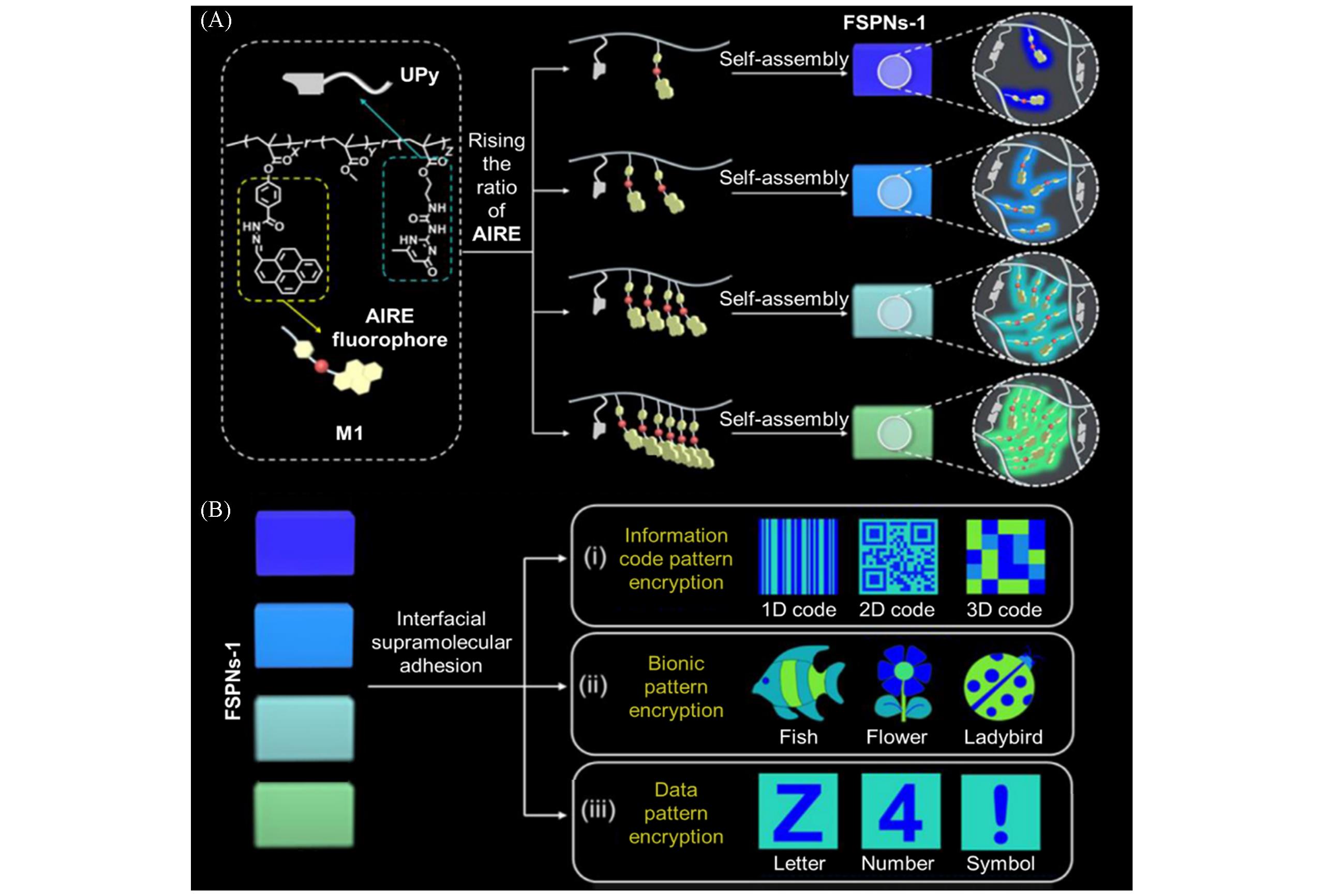
Fig.1 Chemical structures and cartoon representations of polymers M1 and FSPNs⁃1 with distinct fluorescent colors(A) and various applications based on the FSPNs⁃1 assemblies via interfacial hydrogen bonds(B)[49]Copyright 2022, KeAi.
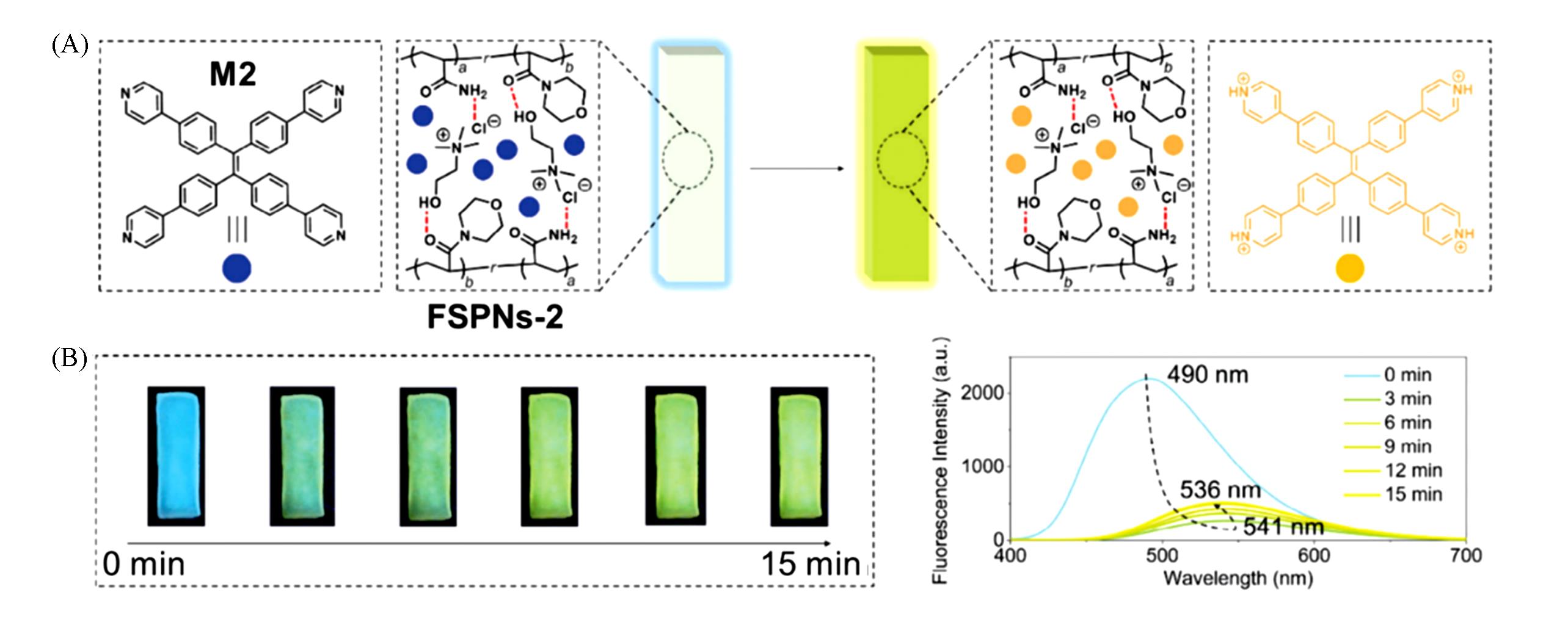
Fig.2 Chemical structures and cartoon representations(A), and photographs along with fluorescence spectra of M2 and FSPNs⁃2 triggered by HAc solution(B)[50]Copyright 2025, Wiley-VCH GmbH.
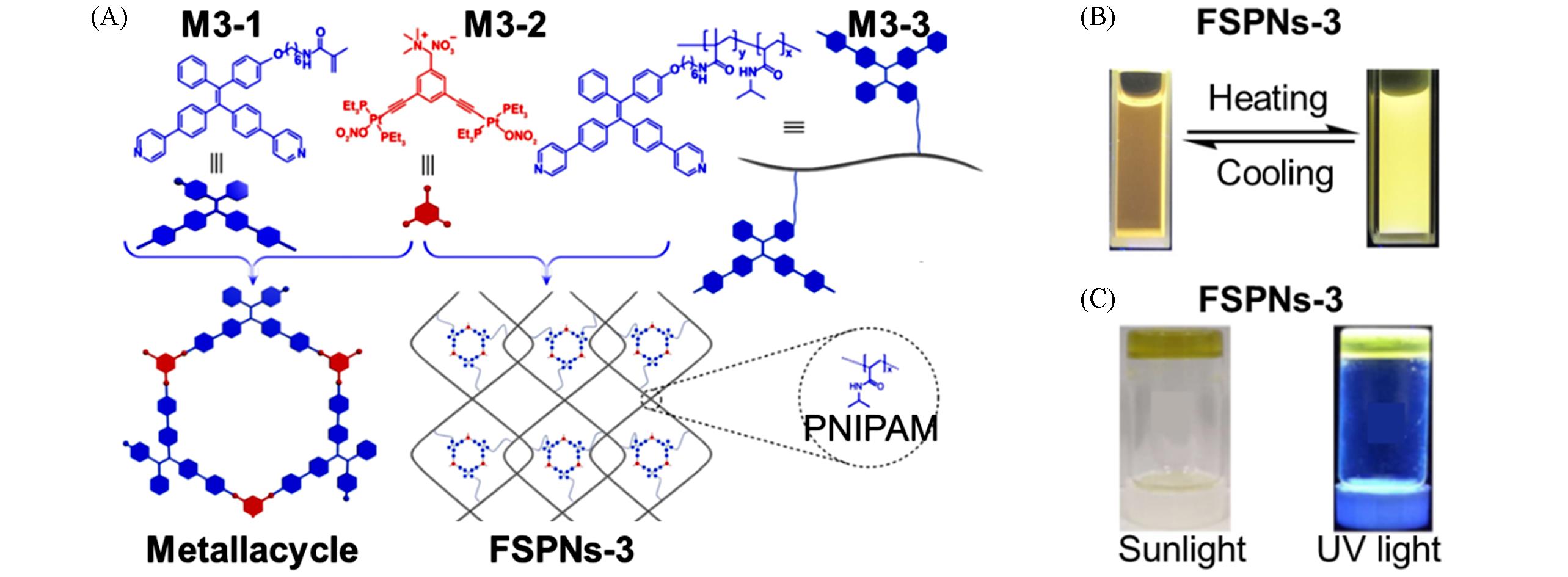
Fig.3 Chemical structures and cartoon representations of M3⁃1, M3⁃2, M3⁃3, metallacycle and FSPNs⁃3(A), the reversibly thermoresponsive behavior demonstrated by FSPNs⁃3 in aqueous solution upon UV light(B), and optical and fluorescence photographs of FSPNs⁃3 in DMSO(C)[56]Copyright 2020, Wiley-VCH GmbH.
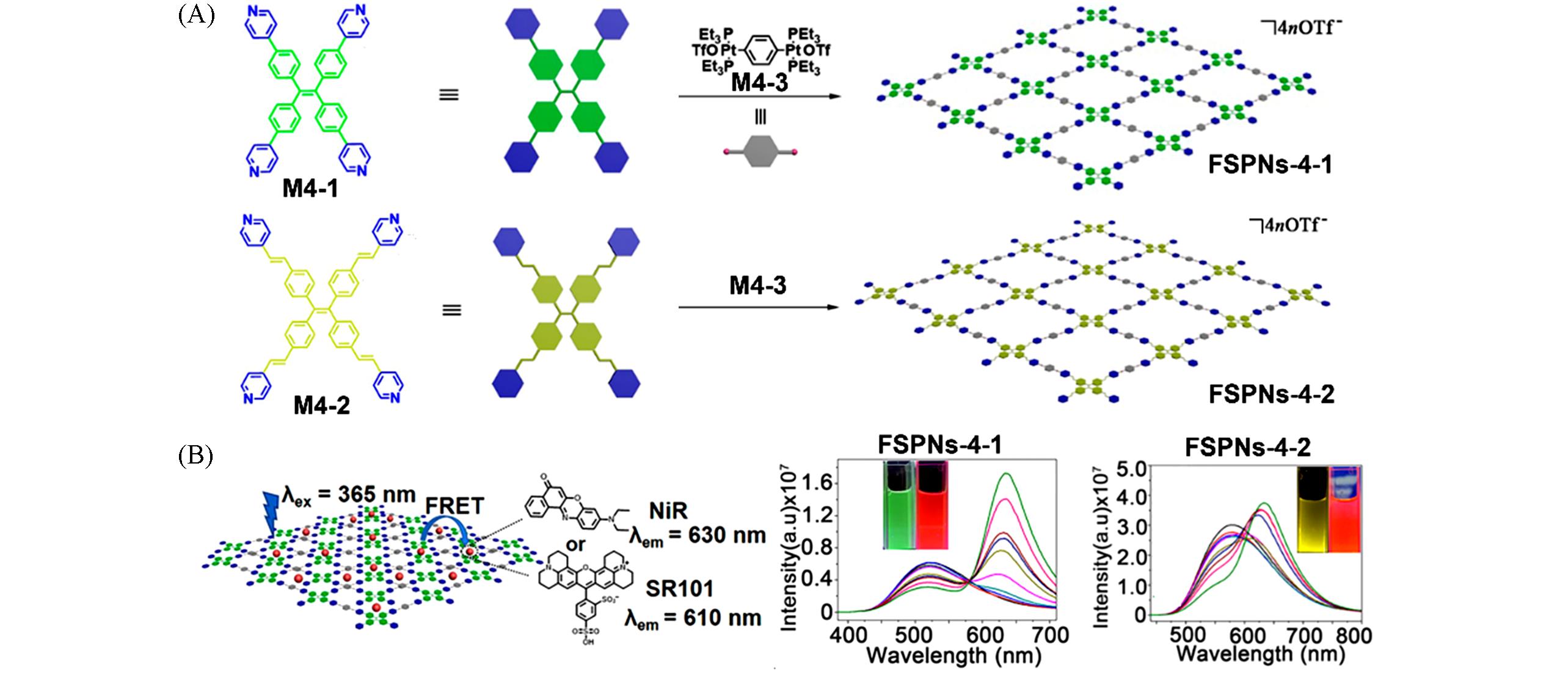
Fig.4 Chemical structures and cartoon representations of M4⁃1, M4⁃2, M4⁃3, FSPNs⁃4⁃1 and FSPNs⁃4⁃2(A), and cartoon representations of the FRET process occurring in FSPNs⁃4⁃1 or FSPNs⁃4⁃2, along with their corresponding fluorescent spectra(B)[57]Copyright 2020, American Chemical Society.
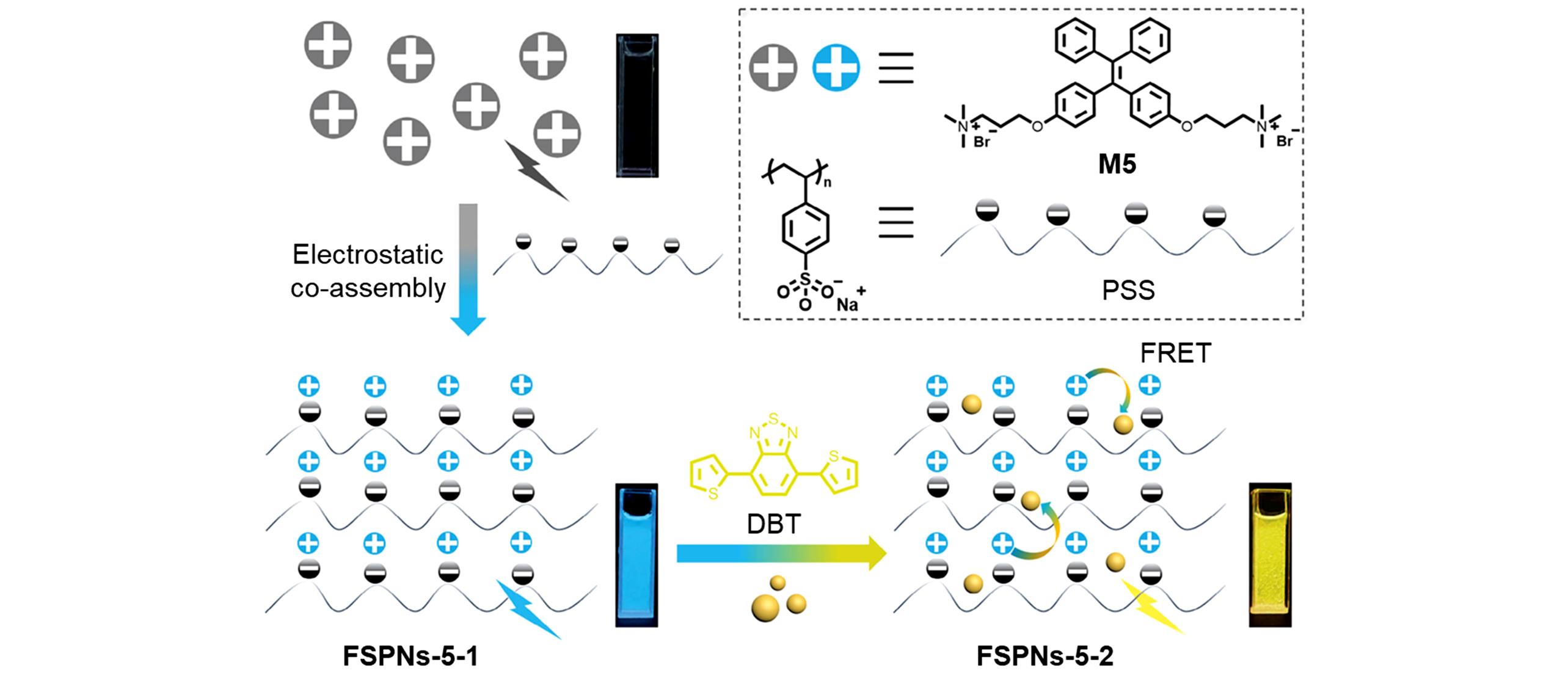
Fig.5 Chemical structures and cartoon representations of M5, PSS, DBT, FSPNs⁃5⁃1 and FSPNs⁃5⁃2, along with the FRET process occurring in FSPNs⁃5⁃2[63]Copyright 2025, Wiley-VCH GmbH.
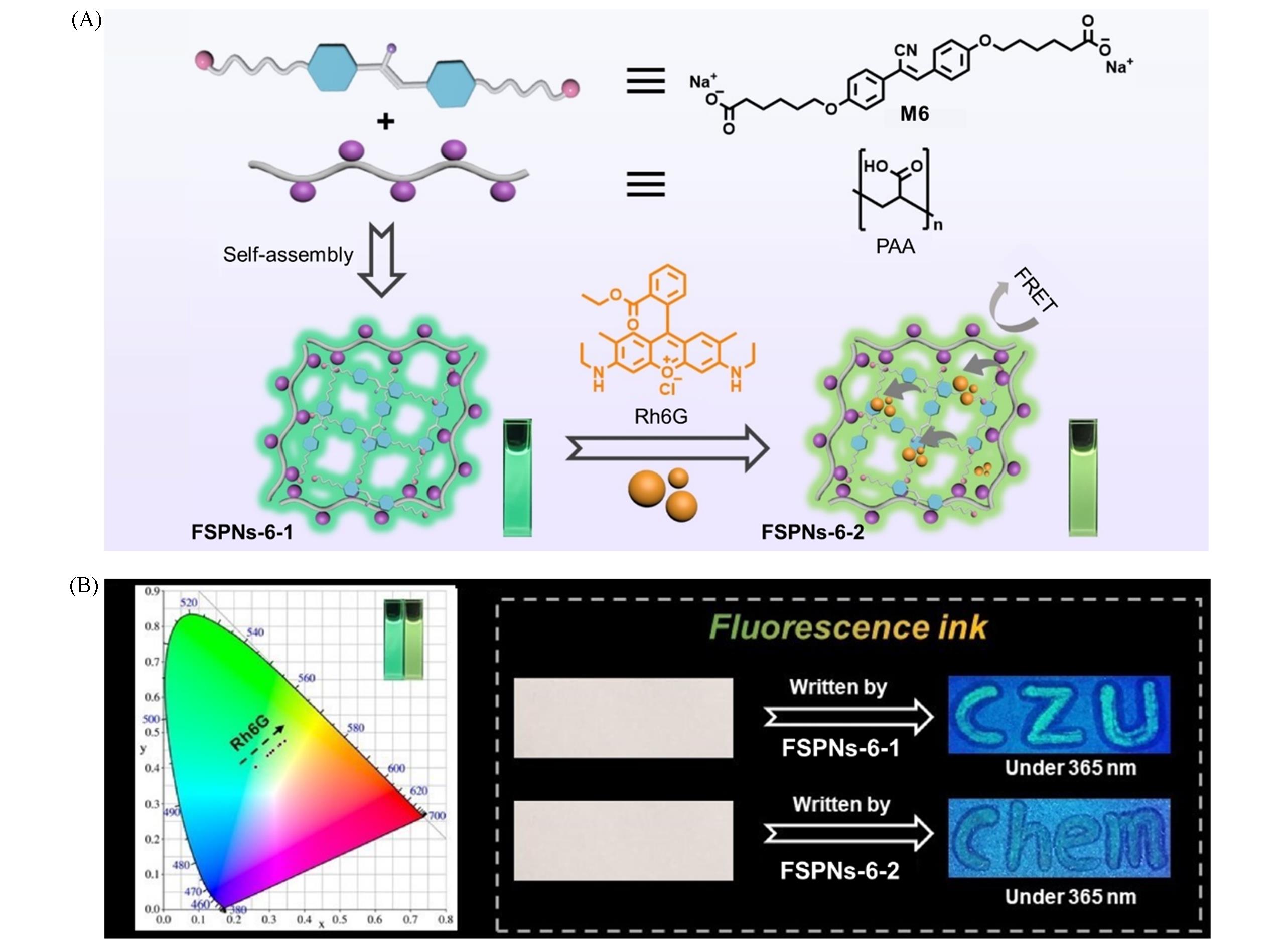
Fig.6 Chemical structures and cartoon representations of M6, Rh6G, PAA, FSPNs⁃6⁃1 and FSPNs⁃6⁃2, along with the FRET process occurring in FSPNs⁃6⁃2(A) and CIE image of FSPNs⁃6⁃1 and FSPNs⁃6⁃2, as well as their fluorescence ink applications(B)[64]Copyright 2025, Wiley-VCH GmbH.
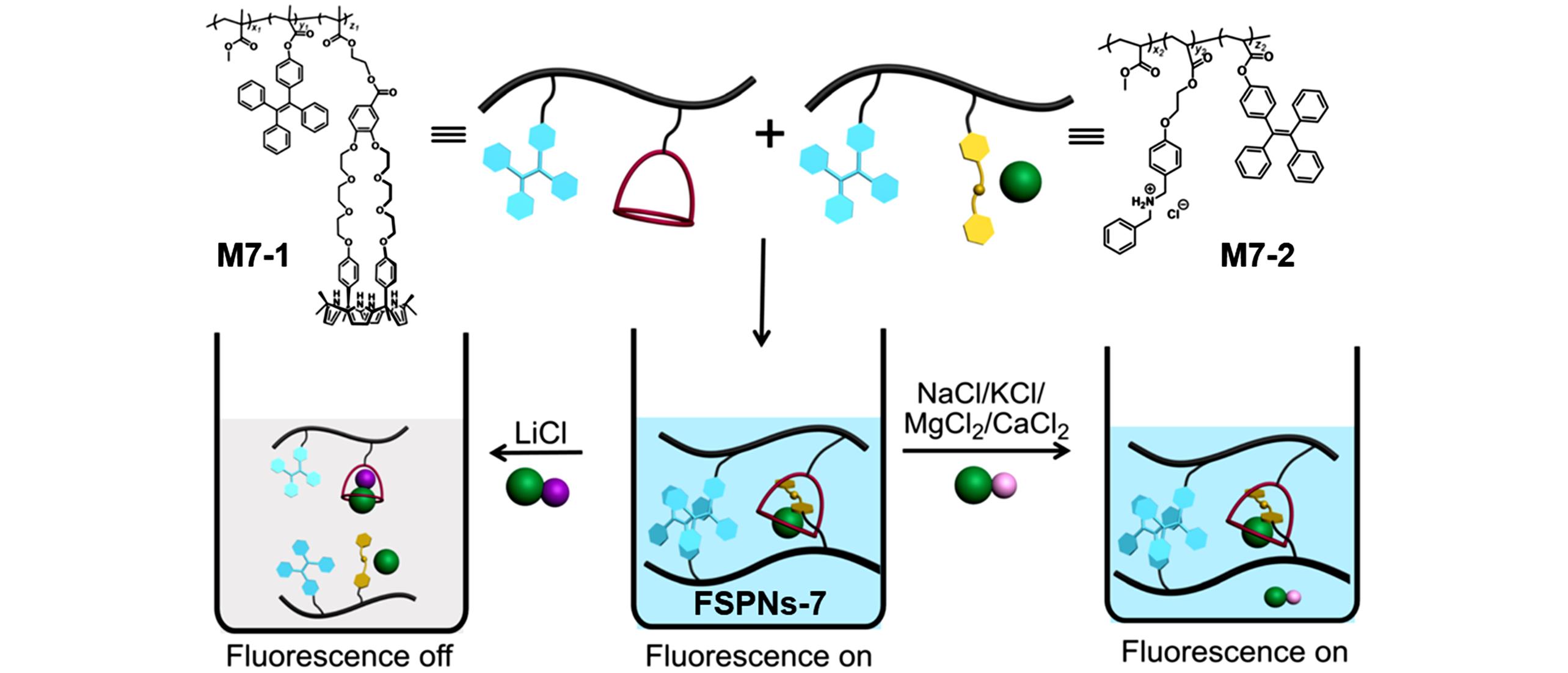
Fig.7 Chemical structures and cartoon representations of M7⁃1, M7⁃2 and FSPNs⁃7, as well as the ion⁃responsive process[73]Copyright 2023, the Royal Society of Chemistry.
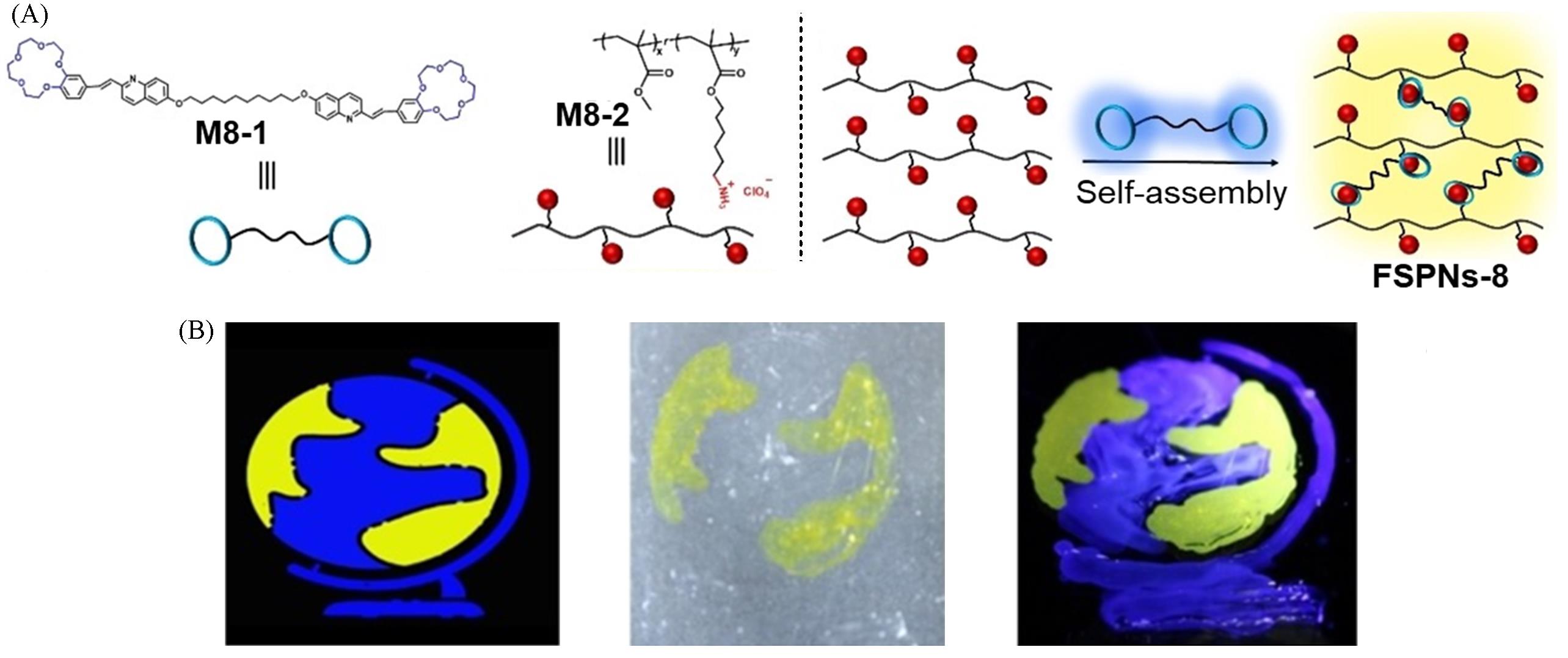
Fig.8 Chemical structures and cartoon representations of M8⁃1, M8⁃2 and FSPNs⁃8[74]Copyright 2024, Wiley-VCH GmbH.
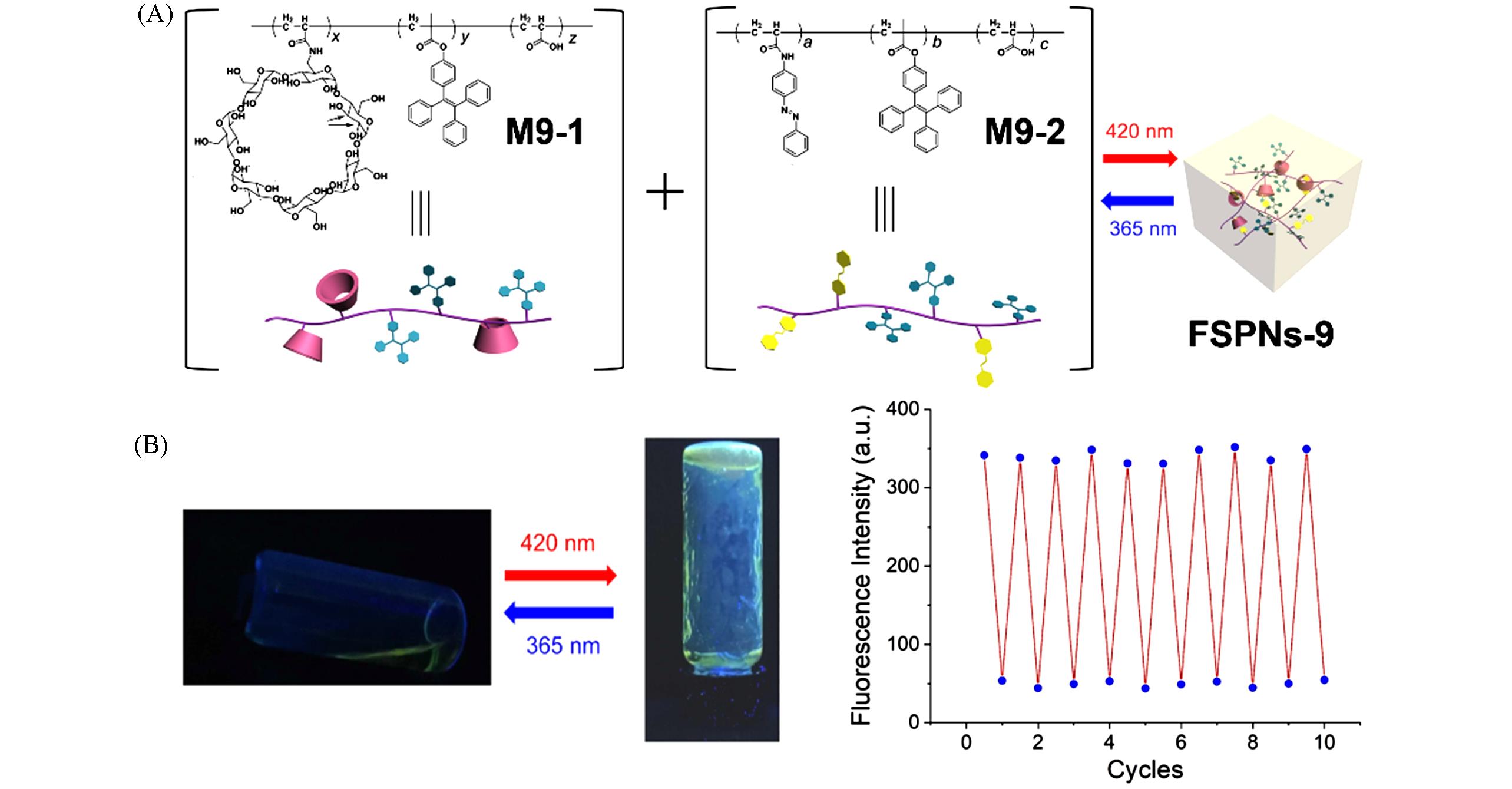
Fig.9 Chemical structures and cartoon representations of M9⁃1, M9⁃2, and FSPNs⁃9(A), and photographs and fluorescence intensity spectra of the reversible sol⁃gel transition of FSPNs⁃9 upon the irradiation at 420 nm/365 nm(B)[79]Copyright 2020, Wiley-VCH GmbH.
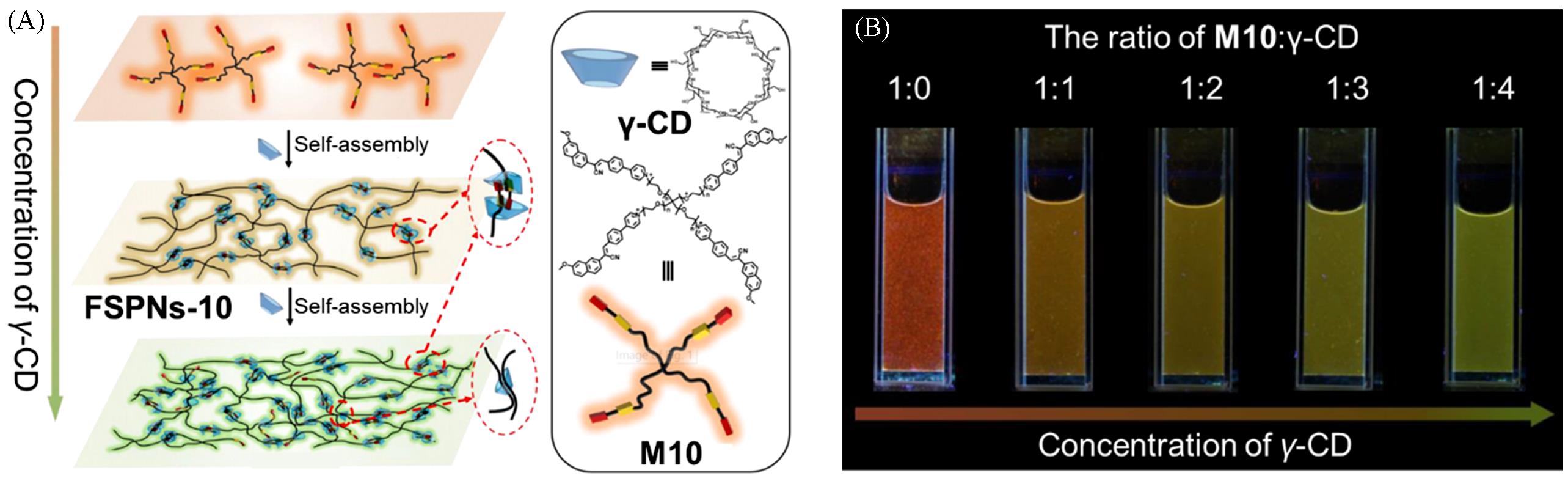
Fig.10 Chemical structures and cartoon representations of γ⁃CD, M10, and FSPNs⁃10(A), and photographs of the mixture solutions of M10 and γ⁃CD with an increasing proportion of γ⁃CD under 365 nm light(B)[80]Copyright 2022, Elsevier.
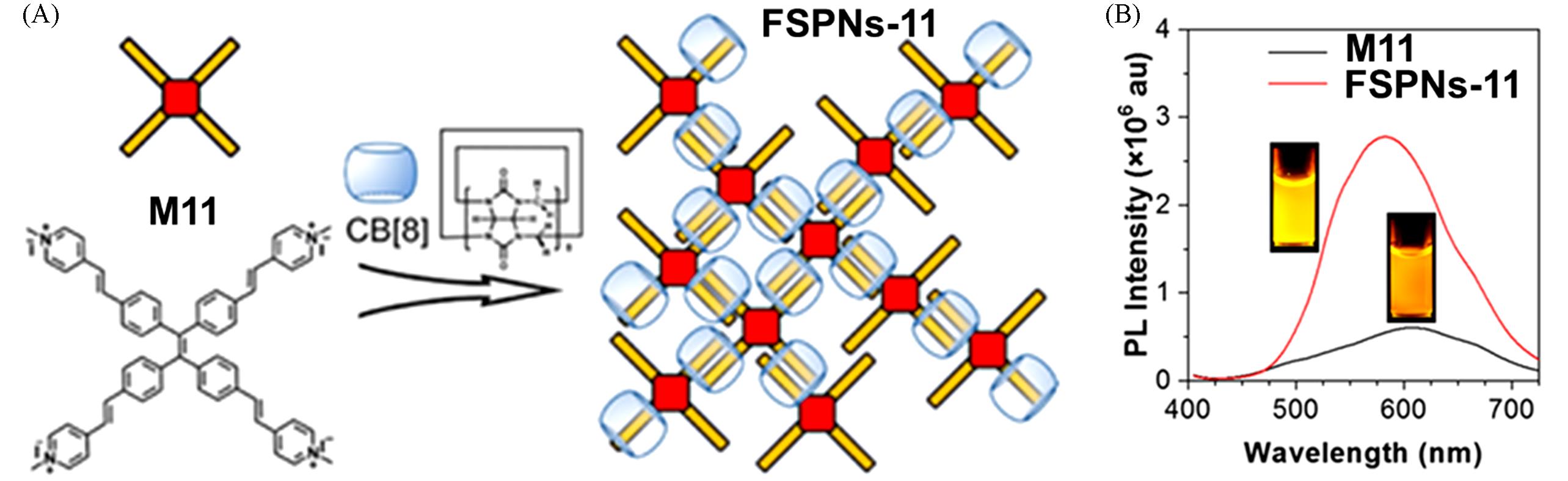
Fig.11 Chemical structures and cartoon representations(A) and fluorescent spectra(B) of M11, CB[8], and FSPNs⁃11[84]Copyright 2020, American Chemical Society.
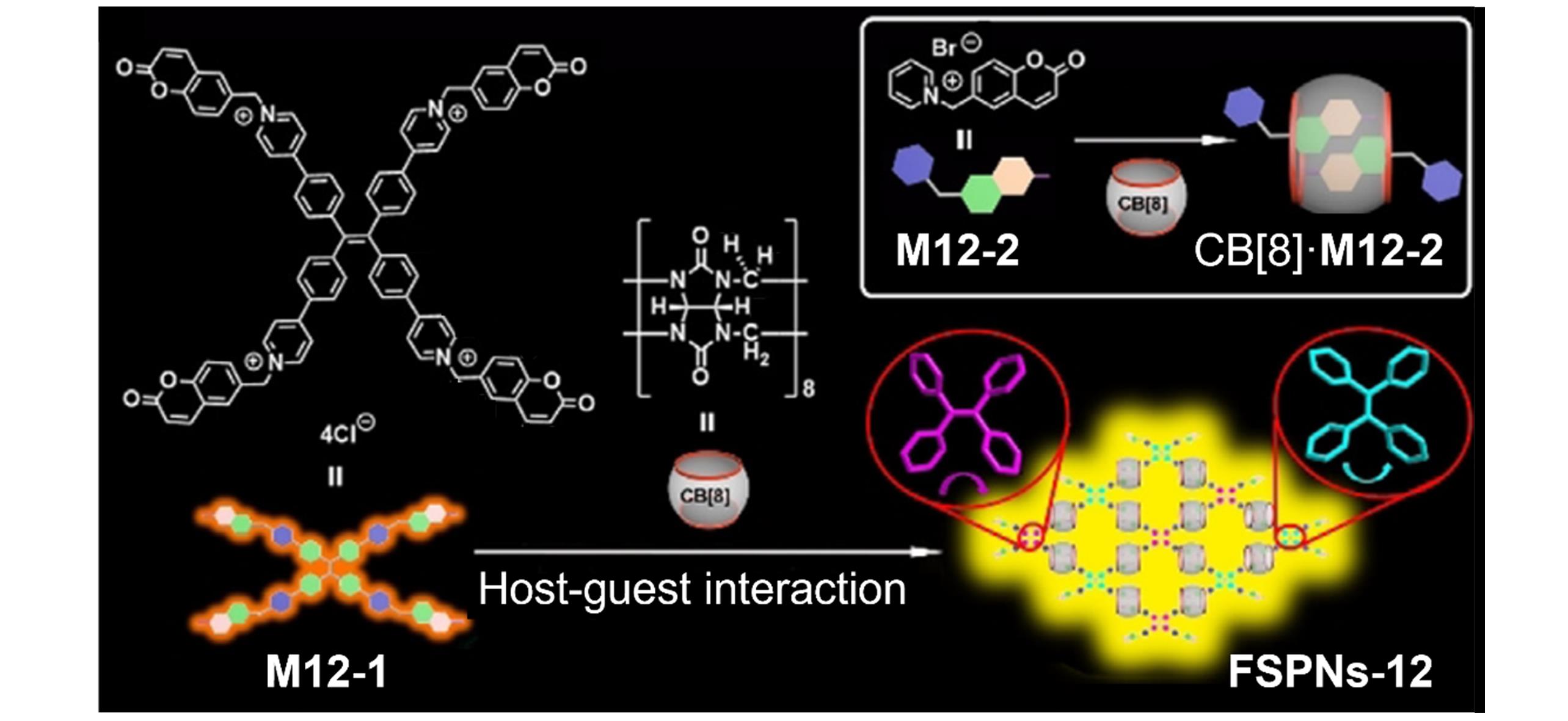
Fig.12 Chemical structures and cartoon representations of M12⁃1, M12⁃2, and FSPNs⁃12[85]Copyright 2021, Wiley-VCH GmbH.
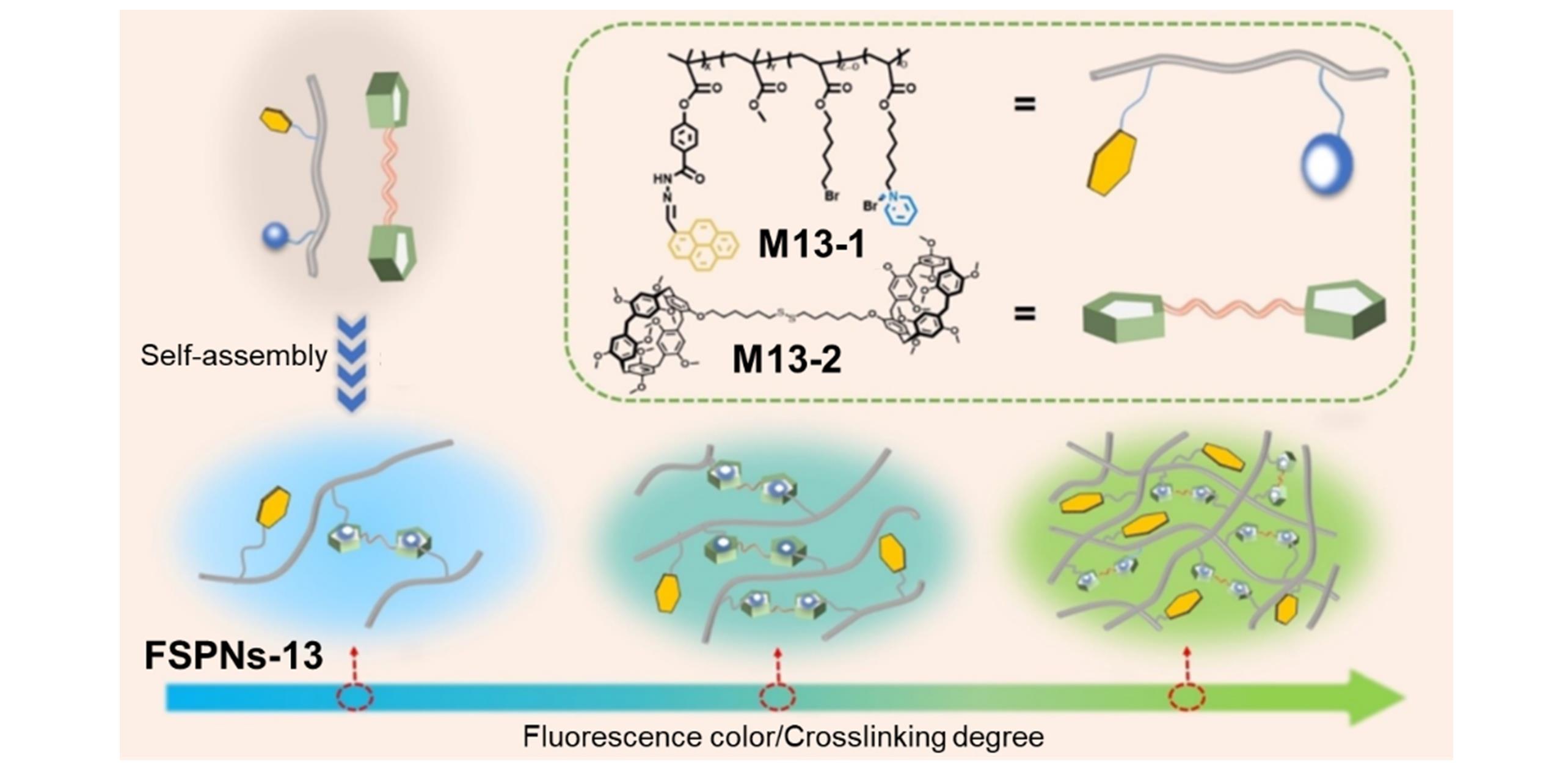
Fig.13 Chemical structures and cartoon representations of M13⁃1, M13⁃2, FSPNs⁃13, and the related fluorescent color transitions depending on the crosslinking degree[90]Copyright 2023, Wiley-VCH GmbH.
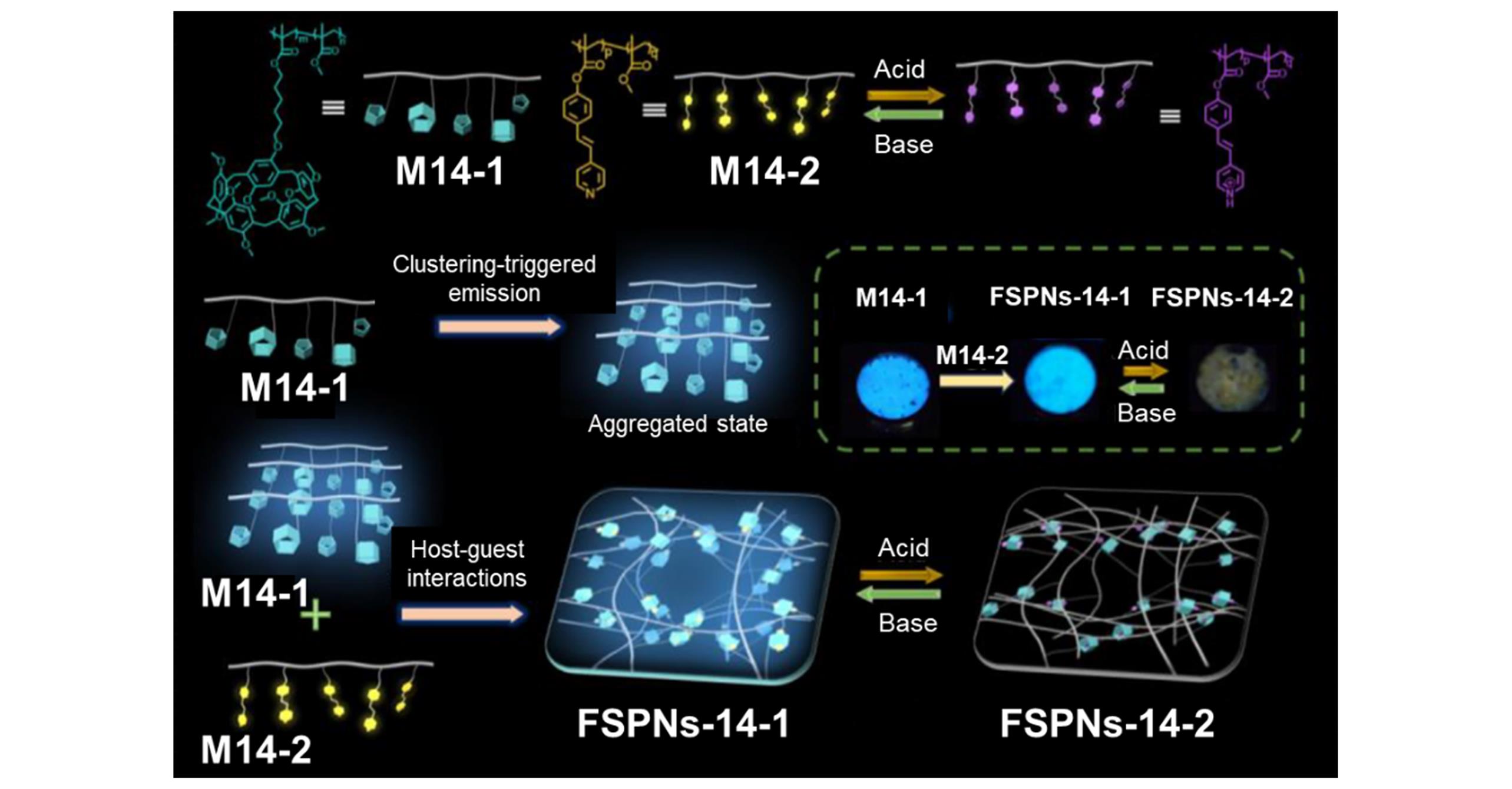
Fig.14 Chemical structures and cartoon representations of M14⁃1, M14⁃2, FSPNs⁃14⁃1, and FSPNs⁃14⁃2, as well as their fluorescent response to acid/base[91]Copyright 2024, Wiley-VCH GmbH.
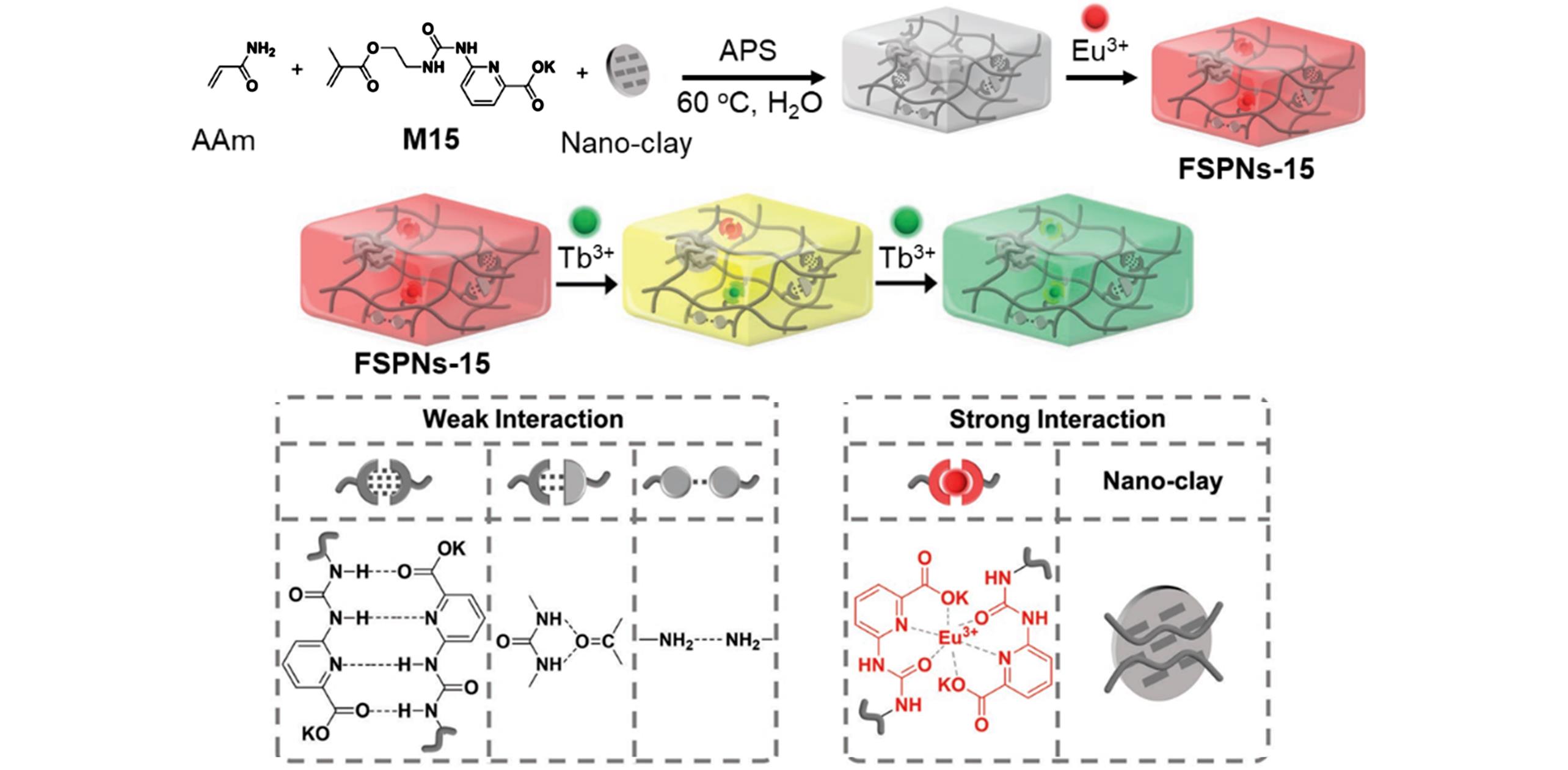
Fig.15 Chemical structures and cartoon representations of AAm, M15, nano⁃clay and FSPNs⁃15, as well as FSPNs⁃15’s fluorescent response to Tb3+[95]Copyright 2023, Wiley-VCH GmbH.
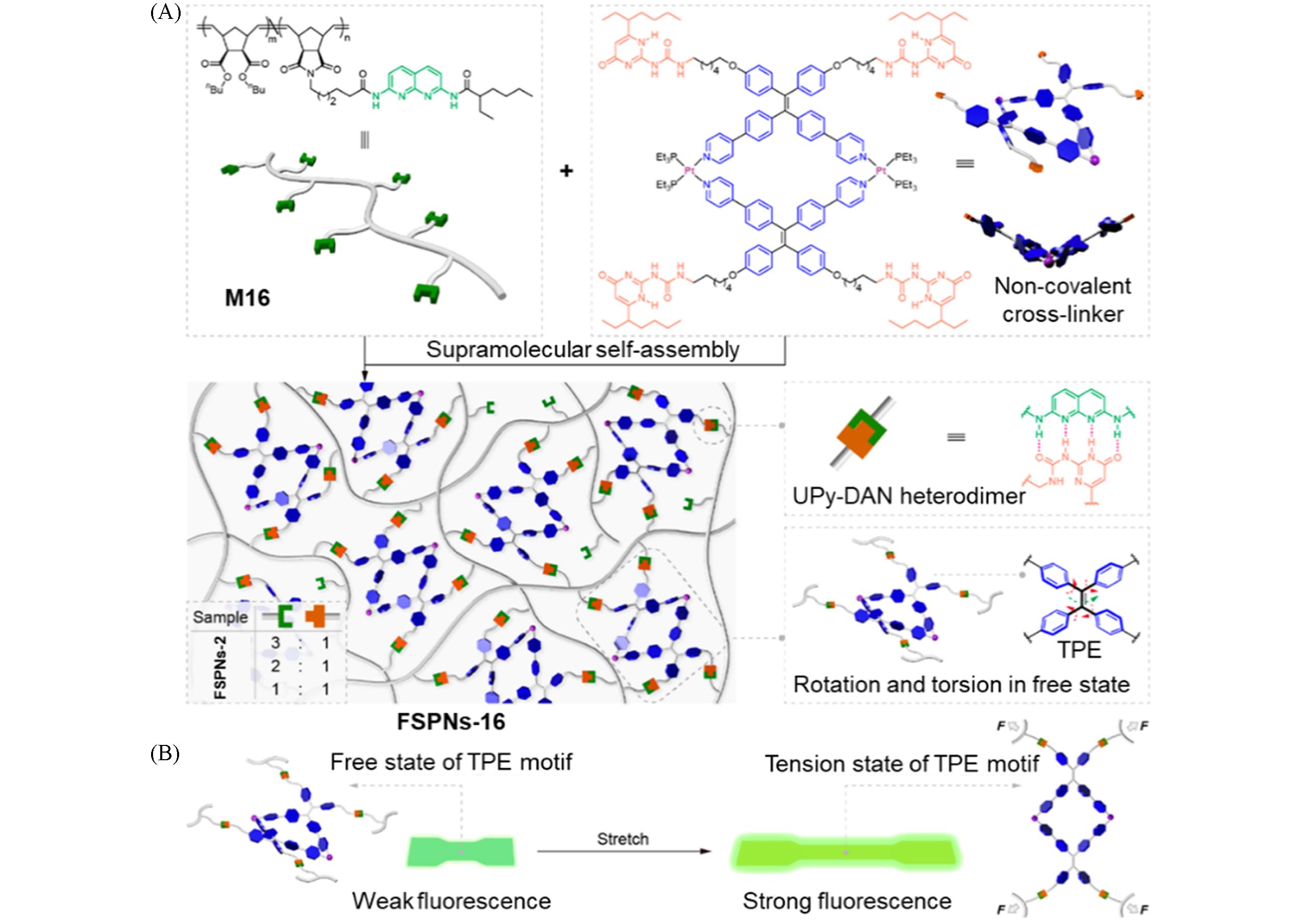
Fig.16 Chemical structures and cartoon representations of M16, FSPNs⁃16 and non⁃covalent cross⁃linker(A), and fluorescence response behavior of the network during the stretching process of FSPNs⁃16(B)[52]Copyright 2024, American Chemical Society.
| [1] | Liu Y., Wang L., Zhao L., Zhang Y., Li Z. T., Huang F., Chem. Soc. Rev., 2024, 53(3), 1592—1623 |
| [2] | Xia D., Wang P., Ji X., Khashab N. M., Sessler J. L., Huang F., Chem. Rev., 2020, 120(13), 6070—6123 |
| [3] | Zhang D. W., Wang H., Li Z. T., Chem. J. Chinese Universities, 2020, 41(6), 1139—1150 |
| 张丹维, 王辉, 黎占亭. 高等学校化学学报, 2020, 41(6), 1139—1150 | |
| [4] | Yang L., Tan X., Wang Z., Zhang X., Chem. Rev., 2015, 115(15), 7196—7239 |
| [5] | Han W., Xiang W., Li Q., Zhang H., Yang Y., Shi J., Ji Y., Wang S., Ji X., Khashab N. M., Sessler J. L., Chem. Soc. Rev., 2021, 50(18), 10025—10043 |
| [6] | Peng H. Q., Zhu W., Guo W. J., Li Q., Ma S., Bucher C., Liu B., Ji X., Huang F., Sessler J. L., Prog. Polym. Sci., 2023, 137, 101635 |
| [7] | Zhao Y., Song S., Ren X., Zhang J., Lin Q., Zhao Y., Chem. Rev., 2022, 122(6), 5604—5640 |
| [8] | Mako T. L., Racicot J. M., Levine M., Chem. Rev., 2019, 119(1), 322—477 |
| [9] | Wang B., Liu Y., Chen X., Liu X. T., Liu Z., Lu C., Chem. Soc. Rev., 2024, 53(20), 10189—10215 |
| [10] | Wang H., Ji X., Li Z., Huang F., Adv. Mater., 2017, 29(14), 1606117 |
| [11] | Wu L. J., Deng A., Liu J. X., Lin R. L., Ye M. F., Huang G. Z., Aggregate, 2025, 6(10), e70145 |
| [12] | Du X. C., Hao H. X., Qin A. J., Tang B. Z., Chem. J. Chinese Universities, 2020, 41(3), 411—416 |
| 杜宪超, 郝红霞, 秦安军, 唐本忠. 高等学校化学学报, 2020, 41(3), 411—416 | |
| [13] | Luo J., Xie Z., Lam J. W. Y., Cheng L., Chen H., Qiu C., Kwok H. S., Zhan X., Liu Y., Zhu D., Tang B. Z., Chem. Commun., 2001, 1740—1741 |
| [14] | Yuan Y., Yang M., Lin X., Li W. G., Yang Z., Liu G., Xu Q., Chen Y. X., Pang H., Tian T., Supramol. Mater., 2026, 5, 100122 |
| [15] | Zhong J., Mareque⁃Rivas J. C., Lan X., Su Y. X., Aggregate, 2025, 6(8), e70081 |
| [16] | Hu R., Qin A., Tang B. Z., Prog. Polym. Sci., 2020, 100, 101176 |
| [17] | Chen P., Zhang G., Li J., Ma L., Zhou J., Zhu M., Li S., Wang Z., Chem. Res. Chinese Universities, 2024, 40(2), 293—304 |
| [18] | Xiong J., Wu M., Yao L. Y., Chem. Res. Chinese Universities, 2024, 40(5), 887—893 |
| [19] | Duan Q., Zhang Q., Zhang J., Lin S., Xiao T., Wang L., Chin. Chem. Lett., 2025, 36(12), 111421 |
| [20] | Liu H., Hu Z. Q., Zhang H. C., Ji X. F., Polym. Bull., 2023, 36(11), 1420—1437 |
| 刘会, 胡紫晴, 张涵威, 吉晓帆. 高分子通报, 2023, 36(11), 1420—1437 | |
| [21] | Sun Z., Yin P., He S., Zhang K., Pan X., Wang J., Hao P., Zhou Z., Yang X., Ma L., Tan C., Chem. Res. Chinese Universities, 2025, 41(3), 519—524 |
| [22] | Huang Q., Chen Y., Wang S., Liu K., Zhao X. Z., Mao X., Tang B. Z., Rao L., Aggregate, 2025, 6(11), e70156 |
| [23] | Chu B., Zhang H., Zhang X., Tang B. Z., Acc. Chem. Res., 2025, 58(12), 1924—1935 |
| [24] | Ye S., Bao Y., Chem. Mater., 2024, 36(12), 5878—5896 |
| [25] | Shen Y., Le X., Wu Y., Chen T., Chem. Soc. Rev., 2024, 53(2), 606—623 |
| [26] | Wei S., Li Z., Lu W., Liu H., Zhang J., Chen T., Tang B. Z., Angew. Chem. Int. Ed., 2021, 60(16), 8608—8624 |
| [27] | Wang R., Zhang Y., Lu W., Wu B., Wei S., Wu S., Wang W., Chen T., Angew. Chem. Int. Ed., 2023, 62(23), e202300417 |
| [28] | Zhao Z., Zhang H., Lam J. W. Y., Tang B. Z., Angew. Chem. Int. Ed., 2020, 59(25), 9888—9907 |
| [29] | Li B., He T., Shen X., Tang D., Yin S., Polym. Chem., 2019, 10(7), 796—818 |
| [30] | Guan W. L., Chen J. F., Liu J., Shi B., Yao H., Zhang Y. M., Wei T. B., Lin Q., Coordin. Chem. Rev., 2024, 507, 215717 |
| [31] | Wen J., Jiang S., Wang J., Li X., Bi Z., Jin Y., Fan L., Wang L., Wu Y., Gan F., Polymer, 2023, 278, 126006 |
| [32] | Gong G. F., Chen Y. Y., Zhang Y. M., Fan Y. Q., Zhao Q., An J. N., Yao H., Wei T. B., Lin Q., ACS Sustainable Chem. Eng., 2020, 8(15), 5831—5836 |
| [33] | Liu Y., Chen X., Liu X., Guan W., Lu C., Chem. Soc. Rev., 2023, 52(4), 1456—1490 |
| [34] | Guo C., Sedgwick A. C., Hirao T., Sessler J. L., Coordin. Chem. Rev., 2021, 427, 213560 |
| [35] | Liu Z., Liu Y., Chem. Soc. Rev., 2022, 51(11), 4786—4827 |
| [36] | Qu D. H., Wang Q. C., Zhang Q. W., Ma X., Tian H., Chem. Rev., 2015, 115(15), 7543—7588 |
| [37] | Hua B., Shao L., Li M., Liang H., Huang F., Acc. Chem. Res., 2022, 55(7), 1025—1034 |
| [38] | Lu W., Si M., Le X., Chen T., Acc. Chem. Res., 2022, 55(16), 2291—2303 |
| [39] | Zhu G., Zhang Q., Peng B., Liu S., Lin C., Kuehne A. J.C., Cheng M., Shi F., Supramol. Mater., 2025, 4, 100099 |
| [40] | Mohammadi⁃Jorjafki M., Babazadeh⁃Mamaqani M., Khalilzadeh R., Roghani⁃Mamaqani H., Hoogenboom R., Wang F., Prog. Polym. Sci., 2025, 166, 101986 |
| [41] | Xu S., Wang M., Liu H., Li J., Deng R., Ji X., Sci. China Chem., 2025, 68, 4326—4337 |
| [42] | Hou Y., Zhang Z., Zhang M., Acc. Chem. Res., 2025, 58(10), 1644—1656 |
| [43] | Xu J., Deng S., Wei P., J. Am. Chem. Soc., 2024, 146(49), 34176—34187 |
| [44] | Li Z., Ji X., Xie H., Tang B. Z., Adv. Mater., 2021, 33(33), 2100021 |
| [45] | Zhang H., Li J., Hu Z., Ji X., Chin. J. Chem., 2024, 42(22), 2699—2704 |
| [46] | Chen S., Zhang K., Li Z., Wu Y., Zhu B., Zhu J., Supramol. Mater., 2023, 2, 100032 |
| [47] | Ji X., Ahmed M., Long L., Khashab N. M., Huang F., Sessler J. L., Chem. Soc. Rev., 2019, 48(10), 2682—2697 |
| [48] | Chen L., You W., Wang J., Yang X., Xiao D., Zhu H., Zhang Y., Li G., Yu W., Sessler J. L., Huang F., J. Am. Chem. Soc., 2024, 146(1), 1109—1121 |
| [49] | Zhang H., Liu H., Hu Z., Ji X., Supramol. Mater., 2022, 1, 100018 |
| [50] | Li Q., Quan X., Xu S., Hu Z., Hu R., Li G., Han B., Ji X., Small, 2025, 21(3), 2408037 |
| [51] | Wild A., Winter A., Schlütter F., Schubert U. S., Chem. Soc. Rev., 2011, 40(3), 1459—1511 |
| [52] | Liu Y., Liu Y., Zhao J., Wang W., Liu G., Zhao X., Wang Y., Deng J., Yue C., Yang L., Shi X., Zhang Z., Yu W., Yan X., Macromolecules, 2024, 57(19), 9323—9333 |
| [53] | Li G., Zhou Z., Yuan C., Guo Z., Liu Y., Zhao D., Liu K., Zhao J., Tan H., Yan X., Angew. Chem. Int. Ed., 2020, 59(25), 10013—10017 |
| [54] | Li Y., Huang F., Stang P. J., Yin S., Acc. Chem. Res., 2024, 57(8), 1174—1187 |
| [55] | Zhang R., Li R., Huang F., Zhang M., Prog. Polym. Sci., 2023, 141, 101680 |
| [56] | Jeyakkumar P., Liang Y., Guo M., Lu S., Xu D., Li X., Guo B., He G., Chu D., Zhang M., Angew. Chem. Int. Ed., 2020, 59(35), 15199—15203 |
| [57] | Wang P., Miao X., Meng Y., Wang Q., Wang J., Duan H., Li Y., Li C., Liu J., Cao L., ACS Appl. Mater. Interfaces, 2020, 12(20), 22630—22639 |
| [58] | Li X., Gong J. P., Nat. Rev. Mater., 2024, 9(6), 380—398 |
| [59] | Wu Y., Qu J., Zhang X., Ao K., Zhou Z., Zheng Z., Mu Y., Wu X., Luo Y., Feng S. P., ACS Nano, 2021, 15(8), 13427—13435 |
| [60] | Zhang Y., Cai C., Li F., Tan X., Li Q., Ni X., Dong S., Mater. Horiz., 2024, 11(22), 5641—5649 |
| [61] | Zhuo S., Liang Y., Wu Z., Zhao X., Han Y., Guo B., Mater. Horiz., 2024, 11(1), 37—101 |
| [62] | Wang H., Zhu C. N., Zeng H., Ji X., Xie T., Yan X., Wu Z. L., Huang F., Adv. Mater., 2019, 31(12), 1807328 |
| [63] | Duan Q., Li X., Wu Z., Lin S., Zeng R., Xiao T., Macromol. Rapid Comm., 2025, 46(3), 2400752 |
| [64] | Duan Q., Chen D., Zhang Q., Lin S., Zeng R., Xiao T., ChemNanoMat, 2025, 11(1), e202400501 |
| [65] | He Q., Vargas⁃Zúñiga G. I., Kim S. H., Kim S. K., Sessler J. L., Chem. Rev., 2019, 119(17), 9753—9835 |
| [66] | Xue M., Yang Y., Chi X., Yan X., Huang F., Chem. Rev., 2015, 115(15), 7398—7501 |
| [67] | Fu H. G., Chen Y., Liu Y., ACS Appl. Mater. Interfaces, 2019, 11(17), 16117—16122 |
| [68] | Lu C., Zhang M., Tang D., Yan X., Zhang Z., Zhou Z., Song B., Wang H., Li X., Yin, S., Sepehrpour H., J. Am. Chem. Soc., 2018, 140(24), 7674—7680 |
| [69] | Ji X., Yao Y., Li J., Yan X., Huang F., J. Am. Chem. Soc., 2013, 135(1), 74—77 |
| [70] | Wang H., Ji X., Ahmed M., Huang F., Sessler J. L., J. Mater. Chem. A, 2019, 7(4), 1394—1403 |
| [71] | Jie K., Zhou Y., Ji X., Polym. Chem., 2015, 6(2), 218—222 |
| [72] | Ji X., Jie K., Zimmerman S. C., Huang F., Polym. Chem., 2015, 6(11), 1912—1917 |
| [73] | Wang H., Jones L. O., Zhao T., Hwang I., Lynch V. M., Khashab N. M., Schatz G. C., Page Z. A., Sessler J. L., Chem. Sci., 2023, 14(15), 4120—4125 |
| [74] | Han W., Tian H., Qiang T., Wang H., Wang P., Chem. Eur. J., 2024, 30(12), e202303569 |
| [75] | Crini G., Chem. Rev., 2014, 114(21), 10940—10975 |
| [76] | Webber M. J., Langer R., Chem. Soc. Rev., 2017, 46(21), 6600—6620 |
| [77] | Zhou X., Zhang H., Liu Y., Chem. Sci., 2024, 15(44), 18259—18271 |
| [78] | Balli M. V., Biedermann F., Prodi L., Picchetti P., Chem. Soc. Rev., 2025, 54(17), 7769—7869 |
| [79] | Han W., Liu Z., Wang S., Ji Y., Zhang X., ChemistrySelect, 2020, 5(7), 2300—2305 |
| [80] | Yang Y., Liu S., Liu H., Li Q., Zhang H., Hu Z., Lu X., Ji X., Giant, 2022, 11, 100112 |
| [81] | Li Q., Yu Z., Redshaw C., Xiao X., Tao Z., Chem. Soc. Rev., 2024, 53(7), 3536—3560 |
| [82] | Liu J. X., Chen K., Redshaw C., Chem. Soc. Rev., 2023, 52(4), 1428—1455 |
| [83] | Bhaumik S. K., Biswas R., Banerjee S., Chem. Eur. J., 2021, 16(16), 2195—2210 |
| [84] | Bai H., Liu Z., Zhang T., Du J., Zhou C., He W., Chau J. H. C., Kwok R. T. K., Lam J. W. Y., Tang B. Z., ACS Nano, 2020, 14(6), 7552—7563 |
| [85] | Li Y., Li Q., Miao X., Qin C., Chu D., Cao L., Angew. Chem. Int. Ed., 2021, 60(12), 6744—6751 |
| [86] | Kato K., Fa S., Ohtani S., Shi T. h., Brouwer A. M., Ogoshi T., Chem. Soc. Rev., 2022, 51(9), 3648—3687 |
| [87] | Chen J., Zhang Y., Meng Z., Guo L., Yuan X., Zhang Y., Chai Y., Sessler J. L., Meng Q., Li C., Chem. Sci., 2020, 11(24), 6275—6282 |
| [88] | Zhang Z. Y., Li C., Acc. Chem. Res., 2022, 55(6), 916—929 |
| [89] | Wu J. R., Wu G., Yang Y. W., Acc. Chem. Res., 2022, 55(21), 3191—3204 |
| [90] | Sheng L., Liu H., Hu Z., Ji X., Chem. Eur. J., 2023, 29(42), e202300990 |
| [91] | Zhang M., Cheng Y., Zhang T., Liang B., Wei X., Wang P., Xia D., Yan X., Aggregate, 2024, 5(5), e608 |
| [92] | Hu X. Y., Xiao T., Lin C., Huang F., Wang L., Acc. Chem. Res., 2014, 47(7), 2041—2051 |
| [93] | Li S. L., Xiao T., Lin C., Wang L., Chem. Soc. Rev., 2012, 41(18), 5950—5968 |
| [94] | Kim Cuc T. T., Nhien P. Q., Khang T. M., Chen H. Y., Wu C. H., Hue B. T. B., Li Y. K., Wu J. I., Lin H. C., ACS Appl. Mater. Interfaces, 2021, 13(17), 20662—20680 |
| [95] | Li W., Zhang H., Lu W., Zhang Y., Zheng T., Yang G., Chen T., Adv. Optical Mater., 2023, 11(8), 2202738 |
| [1] | 张阳戴翼, 邵研, 姜世梅. 基于动态氢键网络协同调控AIE与力学性能的多响应水凝胶[J]. 高等学校化学学报, 2026, 47(4): 141. |
| [2] | 宋奎柱, 龙宇杰, 王亚茹, 王嘉麒, 吕海燕, 陈传峰. 酸碱和客体可调控的延迟荧光及其逻辑门应用[J]. 高等学校化学学报, 2026, 47(4): 153. |
| [3] | 马欢, 董世龙, 杨均成, 祝海涛, 冯海涛. 基于杯[4]芳烃的手性AIEgen用于酸及氨基酸的对映选择性识别[J]. 高等学校化学学报, 2026, 47(4): 195. |
| [4] | 程建硕, 叶文彦, 周璐璐, 刘谋为, 李忠宇, 唐子然, 俞婉婷, 朱亮亮. 光激发诱导的生物大分子自组装[J]. 高等学校化学学报, 2026, 47(4): 171. |
| [5] | 高鑫, 卿佳, 胡祎辰, 上官之春, 梁同玲, 周永胜, 张关心, 张德清. 具有聚集诱导发光性质的高灵敏度和高光稳定性的脂滴荧光探针[J]. 高等学校化学学报, 2026, 47(4): 102. |
| [6] | 杨湛, 邓皇俊, 池振国. 具有聚集诱导发光性质的氢键有机框架的研究进展[J]. 高等学校化学学报, 2026, 47(4): 20260012. |
| [7] | 李银, 汤睿霖, 瞿超, 程亮慧, 胡玉玺, 吴钰祥, 王志明. 离子化策略实现马来酸酐水溶性光敏探针的制备及其在高效抗菌中的应用[J]. 高等学校化学学报, 2026, 47(4): 161. |
| [8] | 孙妍, 朱东霞. 近红外激发有机发光材料的构筑及在疾病治疗中的应用[J]. 高等学校化学学报, 2026, 47(4): 20260002. |
| [9] | 李雨婷, 罗亮. 拉曼成像技术的前沿进展及与聚集体科学的交叉研究[J]. 高等学校化学学报, 2026, 47(4): 20260008. |
| [10] | 方瑾钰, 黄瀚玮, 宋航, 吴谦, 赵征, 唐本忠. 智能响应, 精准点亮: 酶响应的聚集诱导发光材料在生物医学中的诊疗新策略[J]. 高等学校化学学报, 2026, 47(4): 20260009. |
| [11] | 吴泽怡, 司文妮, 齐春轩, 李朔, 冯海涛. 基于三苯胺的红光手性荧光探针的构筑及手性识别性能[J]. 高等学校化学学报, 2026, 47(4): 208. |
| [12] | 陈广东, 暴崧旭, 聂志鸿, 刘堃, 杨扬. 纺锤形二氧化硅胶体粒子的制备及组装[J]. 高等学校化学学报, 2026, 47(2): 20250336. |
| [13] | 苏彦刚, 金文东, 于晓强. 高光稳定性NIR荧光探针用于线粒体嵴动态追踪[J]. 高等学校化学学报, 2026, 47(1): 20250302. |
| [14] | 胡浩渊, 胡广泽, 刘雄, 陈曼玉, 张浩可, 孙景志, 唐本忠. 苯甘氨酸修饰的聚(二苯基乙炔): 条件依赖的手性传递与聚集诱导发光增强效应[J]. 高等学校化学学报, 2026, 47(1): 20250292. |
| [15] | 张兆萱, 邓璞, 沈杰. 分子介导组装高性能表面等离激元器件[J]. 高等学校化学学报, 2025, 46(9): 20250133. |
| 阅读次数 | ||||||
|
全文 |
|
|||||
|
摘要 |
|
|||||
