

Chem. J. Chinese Universities ›› 2026, Vol. 47 ›› Issue (8): 20260062.doi: 10.7503/cjcu20260062
• Articles: Inorganic Chemistry • Previous Articles Next Articles
SONG Zhiguo, WANG Xin, ZHU Zhihui, XU Yiminmg, WANG Min( )
)
Received:2026-02-02
Online:2026-08-10
Published:2026-05-25
Contact:
WANG Min
E-mail:wangmin@qymail.bhu.edu.cn
Supported by:CLC Number:
TrendMD:
SONG Zhiguo, WANG Xin, ZHU Zhihui, XU Yiminmg, WANG Min. Highly Selective Detection of Fe3+ by Mononuclear Cd(II) Complex Sensor Containing Naphthalene Disulfonic Acid Ligands[J]. Chem. J. Chinese Universities, 2026, 47(8): 20260062.
| Formula | C22H20CdN8O6S2 | μ/mm-1 | 1.050 |
|---|---|---|---|
| Formula weight | 668.98 | F(000) | 1344 |
| Temperature/K | 296.15 | Crystal size | 0.24 mm×0.22 mm×0.20 mm |
| λ/nm | 0.071073 | Theta range/(°) | 2.383—25.096 |
| Crystal system | Monoclinic | Index ranges | -11 ≤ h ≤ 11 |
| Space group | C1c1 | -20 ≤ k ≤ 20 | |
| a/nm | 0.98439(9) | -18 ≤ l ≤ 18 | |
| b/nm | 1.70932(15) | Dc/(Mg·m-3) | 1.701 |
| c/nm | 1.57981(13) | Total reflections | 27807 |
| α/(°) | 90 | Unique reflections | 4633 |
| β/(°) | 100.627(2) | Goodness⁃of⁃fit F2 | 1.089 |
| γ/(°) | 90 | R1, ωR2* | 0.0212, 0.0521 |
| V/nm3 | 2.6127(4) | R1, ωR2(all data)* | 0.0216, 0.0522 |
| Z | 4 | CCDC No. | 2348654 |
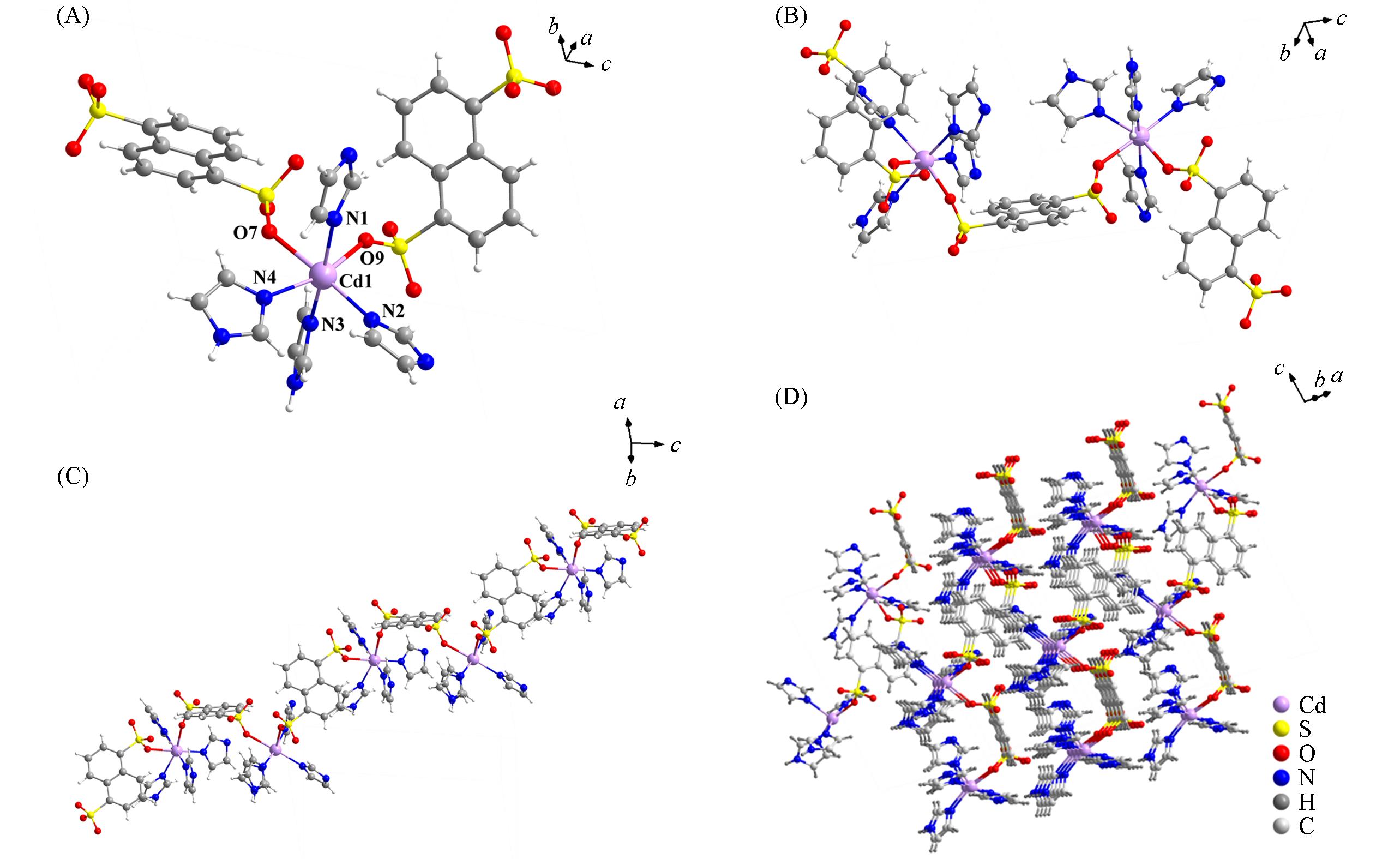
Table 1 Crystallographic data for Cd(Im)4(1,5-NDA)2
| Formula | C22H20CdN8O6S2 | μ/mm-1 | 1.050 |
|---|---|---|---|
| Formula weight | 668.98 | F(000) | 1344 |
| Temperature/K | 296.15 | Crystal size | 0.24 mm×0.22 mm×0.20 mm |
| λ/nm | 0.071073 | Theta range/(°) | 2.383—25.096 |
| Crystal system | Monoclinic | Index ranges | -11 ≤ h ≤ 11 |
| Space group | C1c1 | -20 ≤ k ≤ 20 | |
| a/nm | 0.98439(9) | -18 ≤ l ≤ 18 | |
| b/nm | 1.70932(15) | Dc/(Mg·m-3) | 1.701 |
| c/nm | 1.57981(13) | Total reflections | 27807 |
| α/(°) | 90 | Unique reflections | 4633 |
| β/(°) | 100.627(2) | Goodness⁃of⁃fit F2 | 1.089 |
| γ/(°) | 90 | R1, ωR2* | 0.0212, 0.0521 |
| V/nm3 | 2.6127(4) | R1, ωR2(all data)* | 0.0216, 0.0522 |
| Z | 4 | CCDC No. | 2348654 |
| Bond | Experimental | Simulated b | Bond | Experimental | Simulated b |
|---|---|---|---|---|---|
| Cd1—O7 | 0.2456(3) | 0.2462 | O9—Cd1—O7 | 81.10(11) | 82.46 |
| Cd1—O9 | 0.2333(3) | 0.2339 | O9—Cd1—N4 | 162.45(12) | 161.22 |
| Cd1—N1 | 0.2265(3) | 0.2312 | N1—Cd1—N3 | 168.76(13) | 167.07 |
| Cd1—N3 | 0.2295(3) | 0.2358 | N1—Cd1—O9 | 85.14(12) | 84.80 |
| Cd1—N4 | 0.2345(4) | 0.2398 | N2—Cd1—O7 | 177.09(12) | 176.53 |
| Cd1—N2 | 0.2324(3) | 0.2381 | N2—Cd1—O9 | 100.23(13) | 99.23 |
Table 2 Partial bond length(nm) and bond angle(°) of Cd(Im)4(1,5-NDA)2a
| Bond | Experimental | Simulated b | Bond | Experimental | Simulated b |
|---|---|---|---|---|---|
| Cd1—O7 | 0.2456(3) | 0.2462 | O9—Cd1—O7 | 81.10(11) | 82.46 |
| Cd1—O9 | 0.2333(3) | 0.2339 | O9—Cd1—N4 | 162.45(12) | 161.22 |
| Cd1—N1 | 0.2265(3) | 0.2312 | N1—Cd1—N3 | 168.76(13) | 167.07 |
| Cd1—N3 | 0.2295(3) | 0.2358 | N1—Cd1—O9 | 85.14(12) | 84.80 |
| Cd1—N4 | 0.2345(4) | 0.2398 | N2—Cd1—O7 | 177.09(12) | 176.53 |
| Cd1—N2 | 0.2324(3) | 0.2381 | N2—Cd1—O9 | 100.23(13) | 99.23 |
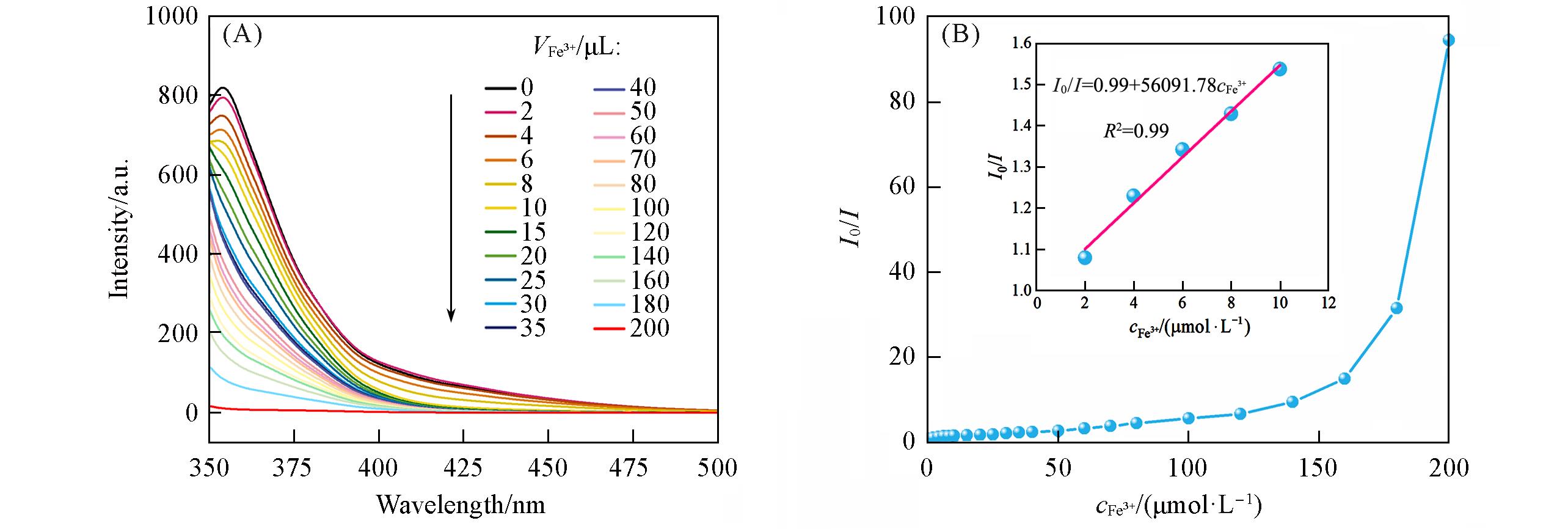
| Fluorescent sensing material | LOD/(μmol·L-1) | Ref. | Fluorescent sensing material | LOD/(μmol·L-1) | Ref. |
|---|---|---|---|---|---|
| [CdL(H2O)(NO3)·H2O] n | 253 | [ | [Cd(LBIX)(HEA)] n | 1.14 | [ |
| [Cd(HDCPN)(1,4⁃bib)0.5(H2O)2] n | 132 | [ | [Cd4(L)4(1,4⁃bib)4]·2DMA | 0.65 | [ |
| [Zn3Eu2(TTHA)2(H2O)6]·6HO | 16.8 | [ | [Mn(na)2(Dmbpy)(H2O)]·Hna | 0.52 | [ |
| [Zn2(cptpy)(btc)(H2O)] n | 9.73 | [ | Cd(Im)4(1,5⁃NDA)2 | 0.46 | This work |
Table 3 Comparison of LOD for Fe3+ detection using different fluorescent sensing materials
| Fluorescent sensing material | LOD/(μmol·L-1) | Ref. | Fluorescent sensing material | LOD/(μmol·L-1) | Ref. |
|---|---|---|---|---|---|
| [CdL(H2O)(NO3)·H2O] n | 253 | [ | [Cd(LBIX)(HEA)] n | 1.14 | [ |
| [Cd(HDCPN)(1,4⁃bib)0.5(H2O)2] n | 132 | [ | [Cd4(L)4(1,4⁃bib)4]·2DMA | 0.65 | [ |
| [Zn3Eu2(TTHA)2(H2O)6]·6HO | 16.8 | [ | [Mn(na)2(Dmbpy)(H2O)]·Hna | 0.52 | [ |
| [Zn2(cptpy)(btc)(H2O)] n | 9.73 | [ | Cd(Im)4(1,5⁃NDA)2 | 0.46 | This work |
| Water sample | Recovery(%) | ||
|---|---|---|---|
| Sea Water | 2.00 | 2.07 | 103.50 |
| 4.00 | 4.12 | 103.00 | |
| 8.00 | 8.15 | 101.88 | |
| Lake Water | 2.00 | 2.04 | 102.00 |
| 4.00 | 4.06 | 101.50 | |
| 8.00 | 8.11 | 101.38 |
Table 4 Determination of Fe3+ in water samples
| Water sample | Recovery(%) | ||
|---|---|---|---|
| Sea Water | 2.00 | 2.07 | 103.50 |
| 4.00 | 4.12 | 103.00 | |
| 8.00 | 8.15 | 101.88 | |
| Lake Water | 2.00 | 2.04 | 102.00 |
| 4.00 | 4.06 | 101.50 | |
| 8.00 | 8.11 | 101.38 |
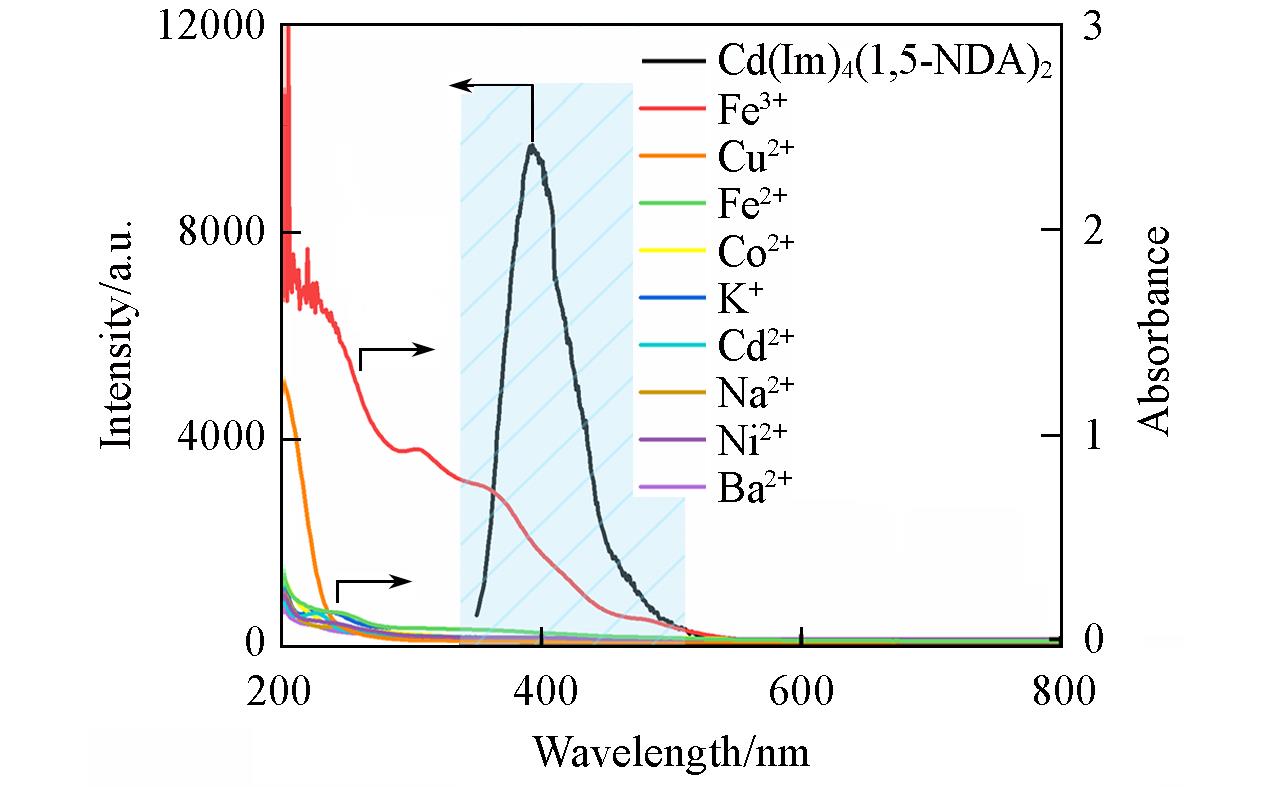
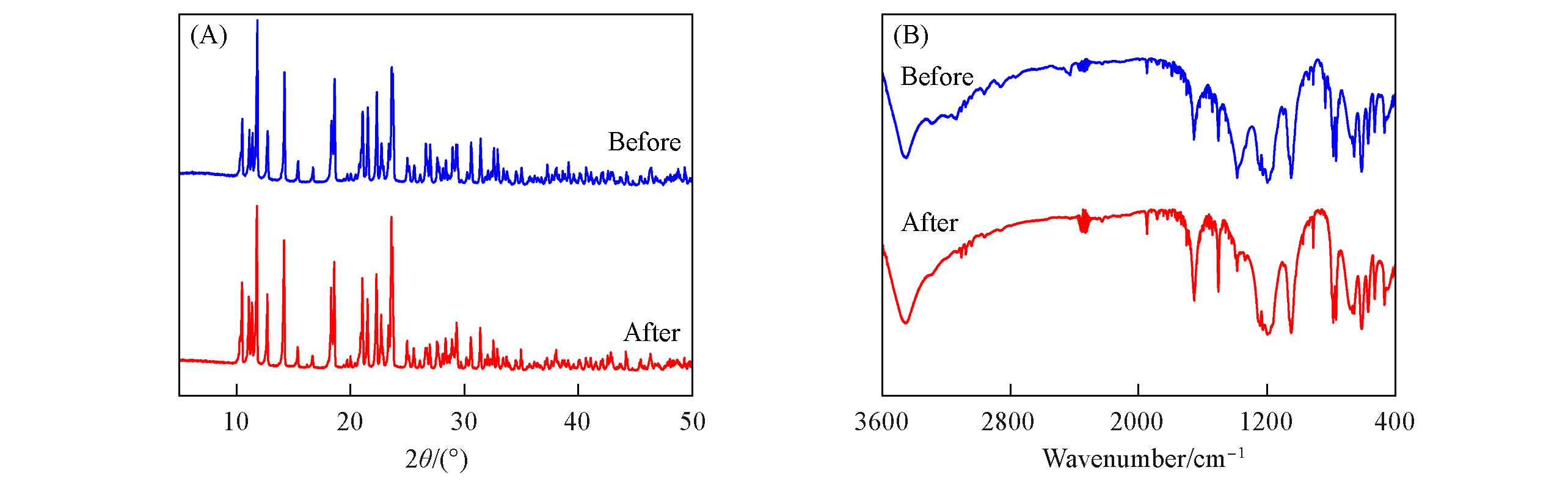
| Sample | Entry | ICP test value of c(Cd2+)/(mg·L-1) | Fe3+ added amount/(g·L-1) | ICP test value of c(Fe3+)/(g·L-1) |
|---|---|---|---|---|
| I | 1 | 3.92 | — | 0 |
| 2 | 3.94 | — | 0 | |
| 3 | 3.93 | — | 0 | |
| II | 1 | 3.96 | 0.201 | 0.128 |
| 2 | 4.05 | 0.201 | 0.137 | |
| 3 | 4.01 | 0.201 | 0.132 |
Table 5 Concentrations of Cd2+ and Fe3+ in Sample I and Sample II
| Sample | Entry | ICP test value of c(Cd2+)/(mg·L-1) | Fe3+ added amount/(g·L-1) | ICP test value of c(Fe3+)/(g·L-1) |
|---|---|---|---|---|
| I | 1 | 3.92 | — | 0 |
| 2 | 3.94 | — | 0 | |
| 3 | 3.93 | — | 0 | |
| II | 1 | 3.96 | 0.201 | 0.128 |
| 2 | 4.05 | 0.201 | 0.137 | |
| 3 | 4.01 | 0.201 | 0.132 |
| [1] | Carter K. P., Alexandra M. Y., Amy E. P., Chem. Rev., 2014, 114(8), 4564—4601 |
| [2] | Wang K., Geng T. M., Guo C., Zhou X. H., Zhu F., Anal. Chim. Acta., 2023, 1279, 341747 |
| [3] | Gao Z. H., Fu L., Dong G. Y., Polyhedron, 2024, 256, 117006 |
| [4] | Liu R., Zhang Y., Piao Y., Meng L. Y., Carbon Lett., 2021, 31, 821—829 |
| [5] | Zhang Y., Qi H., Huang Y., Zhang F., Liu H., Wang Z. J., Li R., J. Mater. Chem. B, 2021, 9, 4654—4662 |
| [6] | Zeki O. C., Eylem C. C., Reçber T., Kır S., Nemutlu E. J., Pharm. Biomed. Anal., 2020, 190, 113509 |
| [7] | Chen D. M., Zhang N. N., Liu C. S., Du M., J. Mater. Chem. C, 2017, 5(9), 2311—2317 |
| [8] | Li Y., Shi X., Min H., Li T., Yan B., Talanta, 2024, 280, 126719 |
| [9] | Li L., Gao S., Yang L., Liu Y. L., Li P., Ye F., Fu Y., J. Hazard. Mater., 2021, 404, 124015 |
| [10] | Gao N. N., Ling Y. T., Wang Y., J. Mol. Struct., 2024, 1311, 138427 |
| [11] | George N., Singh G., Singh R., Singh G., Singh H., Kaur G., Singh J., Polyhedron, 2023, 242, 116496 |
| [12] | Shen Z., Li Q. Y., Qin L. X., Fan M. T., Zhao Q., Inorg. Chim. Acta, 2025, 588, 122871 |
| [13] | Shakya S. ,Khan I. M., Ahmad M., J. Photochem. Photobiol. A, 2020, 392, 112402 |
| [14] | Chen J. L., Song J. F., Hao H. M., Zhou S. Y., Zhu H. Y., Zhang X. Q., J. Mol. Struct., 2025, 1340, 142485 |
| [15] | Pei Y. Y., Gao J., Liu X., Xue H. Y., J. Fluoresc., 2020, 30(5), 1241—1250 |
| [16] | Samanta P., Desai A. V., Sharma S., Chandra P., Ghosh S. K., Inorg. Chem., 2018, 57, 2360—2364 |
| [17] | Senthilkumar S., Goswami R., Smith V. J., Bajaj H. C., Neogi S., ACS Sustain. Chem. Eng., 2018, 6, 10295—10306 |
| [18] | Shahabadi N., Ghaffari L., Mardani Z., Shiri F., Nucleosides, Nucleotides Nucleic Acids, 2024, 43(6), 493—516 |
| [19] | Wang J. ,Zhao Y., Fan L., Zhang J., Sun C., Li W., Chang Z., Inorg. Chim. Acta, 2025, 574, 122415 |
| [20] | Zhao B., Liu H., Gu Y., Sun Q., Inorg. Nano⁃Met. Chem., 2023, 53(8), 769—775 |
| [21] | Wen Q., Chen J. L., Song J. F., Zhou S. Y., Zhu H. Y., Zhang X. Q., J. Mol. Struct., 2024, 1300, 137235 |
| [22] | An H. L., Duan Y., Chen T. T., Chai L. Q., J. Mol. Struct., 2024, 1310, 138320 |
| [23] | Wang X., Shi Y. W., Yang R. J., Song Z. G., Wang M., Acta Chim. Sinica, 2025, 83(7), 674—684 |
| 王鑫, 史燚威, 杨瑞杰, 宋志国, 王敏. 化学学报, 2025, 83(7), 674—684 | |
| [24] | Huang Y., Gao R. H., Liu M., Chen L. X., Ni X. L., Xiao X., Tao Z., Angew. Chem., 2021, 133(28), 15294—15319 |
| [25] | Chen K., Zhu Z. Q., Zhang M. H., Yang X., Li J., Chen C., Redshaw C., CrystEngComm, 2023, 25(6), 961—970 |
| [26] | Song W., Wang L. Q., Zeng S. L., Wang L., Fan Y., Xu J. N., Chem. J. Chinese Universities, 2018, 39(7), 1406—1411 |
| 宋伟, 王力群, 曾双利, 王莉, 范勇, 徐家宁. 高等学校化学学报, 2018, 39(7), 1406—1411 | |
| [27] | Yi M. J., Xiao X., Zhang Y. Q., Xue S. F., Tao Z., Zhang J. X., Acta Chim. Sinica, 2014, 72(8), 949—955 |
| 易君明, 肖欣, 张云黔, 薛赛凤, 陶朱, 张建新. 化学学报, 2014, 72(8), 949—955 | |
| [28] | Bruker S., SMART(version 5.628) SAINT(version 6.45), SADABS, Bruker AXS Inc., Madison, Wisconsin, USA. 2001 |
| [29] | Dolomanov O. V., Bourhis L. J., Gildea R. J., Howard J. A. K., Puschmann H. J., Appl. Crystallogr., 2009, 42, 339—341 |
| [30] | Sheldrick G. M., SHELXL⁃97, Program for Crystal Structure Solution, University of Göttingen, Göttingen, 1997 |
| [31] | Becke A. D., J. Chem. Phys., 1993, 981, 448799 |
| [32] | Lee C., Yang W., Parr R. G., Phys. Rev. B, 1988, 37, 785—789 |
| [33] | Lu T., Chen F. W., J. Comput. Chem., 2012, 33, 580—592 |
| [34] | Humphrey W., Dalke A., Schulten K., J. Mol. Graphics 1996, 14, 33—38 |
| [35] | Hema M. K., Karthik C. S., Pampa K. J., Mallu P., Lokanath N. K., J. Mol. Struct., 2021, 1243, 130774 |
| [36] | Liang R., Wang Y. T., Guo Y. K., Xuan X. P., Chin. J. Inorg. Chem., 2017, 33(8), 1465—1473 |
| 梁蕊, 王玉停, 郭永康, 轩小朋. 无机化学学报, 2017, 33(8), 1465—1473 | |
| [37] | Wu G. Z., Wang P. F., Li S. Q., Fang X. L., Chin. J. Inorg. Chem., 2020, 36(2), 226—232 |
| 吴国志, 汪鹏飞, 李善青, 方霄龙. 无机化学学报, 2020, 36(2), 226—232 | |
| [38] | Shu Q. D., Kong S. N., Wei Y. Z., Shu M. H., Polyhedron, 2019, 118, 96—102 |
| [39] | Zhang D. C., Jia J. H., Liang D., Cai X. B., Zhao Y. Q., Hu X. L., Jiang Y. B., Lu C. Z., Acta Chim. Sinica, 2024, 82(8), 887—893 |
| 张登朝, 贾吉慧, 梁栋, 蔡显宝, 赵雨晴, 胡祥龙, 江钰冰, 卢灿忠. 化学学报, 2024, 82(8), 887—893 | |
| [40] | Li Z., Li R., Li X., Chem. J. Chinese Universities, 2018, 39(11), 2363—2374 |
| 李铮, 李睿, 李夏. 高等学校化学学报, 2018, 39(11), 2363—2374 | |
| [41] | Zhang Y., Su Y. X., Cai Z., Tong L., Dong W. K., J. Mol. Struct., 2024, 1309, 138164 |
| [42] | Ren Y. Y., Li X., Han Y. F., Acta Chim. Sinica, 2023, 81(7), 735—740 |
| 任妍妍, 李欣, 韩英锋. 化学学报, 2023, 81(7), 735—740 | |
| [43] | Tang L., Chen L. Y., Hou X. Y., Wang X., Wang J. J., Chin. J. Inorg. Chem., 2023, 39(1), 168—180 |
| 唐龙, 陈鲁园, 侯向阳, 王潇, 王记江. 无机化学学报, 2023, 39(1), 168—180 | |
| [44] | Zheng L. N., Liu S., Xue N., Du Y., Ding T., Xu L. Y., Sun Y. Z., J. Mol. Struct., 2024, 1305, 137794 |
| [45] | Gao L. L., Li M. X., Du Y. E., Chen Y. Q., Chin. J. Inorg. Chem., 2020, 36(12), 2359—2366 |
| 高玲玲, 李梦雪, 杜意恩, 陈勇强. 无机化学学报, 2020, 36(12), 2359—2366 | |
| [46] | Li J. L., Xiao Y., Wang L. Y., Xing Y. H., Bai F. Y., Shi Z., Polyhedron, 2022, 214, 115648 |
| [47] | Chen H., Fan P., Tu X., Min H., Yu X., Li X., Cheng P., Chem. Asian J., 2019, 14(20), 3611—3619 |
| [48] | Dong L. L., Liu J., Ynag H., Fu Y. P., Liu H. L., Chen X. L., Cui H. L., Liu L., Wang J. J., Chin. J. Inorg. Chem., 2025, 41(4), 809—820 |
| 董璐璐, 刘洁, 杨华, 符钰培, 刘红丽, 陈小莉, 崔华莉, 刘琳, 王记江. 无机化学学报, 2025, 41(4), 809—820 | |
| [49] | Wang C., Ji Z. Y., Spectrosc. Spectral Anal., 2025, 45(3), 658—664 |
| 王策, 姬占有. 光谱学与光谱分析, 2025, 45(3), 658—664 | |
| [50] | Chen C.C., Cai Y., Wang L. F., Wu Y. D., Yin H. J., Zhou J. R., Ni C. L., Liu W., Inorg. Chem., 2021, 60, 5463—5473 |
| [51] | Wen L., Zheng X., Lv K., Wang C., Xu X., Inorg. Chem., 2015, 54, 7133—7135 |
| [52] | Zhang X. Q., Chen F. M., Wen Q., Zhou C. C., He X., Li Y., Liu H. F., J. Mol. Struct., 2022, 1252, 132183 |
| [53] | Zhong L. N., Chen J. L., Zhao Q. H., Chin. J. Inorg. Chem., 2025, 414), 709—718(钟丽娜, 陈晶玲, 赵青华. 无机化学学报, 2025, 41(4), 709—718 |
| [54] | Zhu X., Yan X., Kang E., Han Y., Yin C., Ye S. Angew. Chem. Int. Ed., 2025, 64(5), e202417218 |
| [55] | Ge K. M., Wang D., Xu Z. J., Chu R. Q., J. Mol. Struct., 2020, 217, 127862 |
| [56] | Li J., Zhu Y., Xu H., Zheng T. F., Liu S. J., Wu Y., Chen J. L., Chen Y. Q., Wen H. R., Inorg. Chem., 2022, 61, 3607—3615 |
| [57] | Mukherjee D., Pal A., Pal S. C., Saha A., Das M. C., Inorg. Chem., 2022, 61, 16852—16962 |
| [58] | Liu J. J., Yu L. M., Han F. X., Chen F. Y., Cheng F. X., J. Solid State Chem., 2018, 270, 45—50 |
| [59] | Zeng Y. N., Zheng H. Q., Gu J. F., Cao G. J., Zhuang W. E., Lin J. D., Cao R., Lin Z., J. Inorg. Chem., 2019, 58, 13360—13369 |
| [1] | ZHOU Haigang, CHENG Meng, ZHANG Yue, WEI Xubing, LI Xiaowei, HU Songqing. Construction and Performance of Fluorescent Thiophene-based MOFs for Pollutant Recognition [J]. Chem. J. Chinese Universities, 2026, 47(6): 20250274. |
| [2] | WEN Gehua, XUE Jingyi. One-Dimensional Uranyl Carboxyphosphonate Coordination Polymer for Highly Sensitive and Selective Detection of Fe3+ ion in Aqueous Media [J]. Chem. J. Chinese Universities, 2025, 46(12): 20250165. |
| [3] | ZHU Xuanqi, CUI Liying, ZHAO Xinyu, JIANG Ling, ZHANG Xue. Fe3+-doped Polyaminopyrrole Nanoparticles for in situ Magnetic Resonance Imaging and Photothermal Therapy of Breast Cancer [J]. Chem. J. Chinese Universities, 2025, 46(1): 20240156. |
| [4] | XU Xiaohua, WANG Li, LIN Pengcheng, MA Tianfeng, SHI Lin, WANG Huan, LU Yongchang. Preparation of NPCl-CDs/Fe 3+ Fluorescent Probe and the Detection for L -Cys [J]. Chem. J. Chinese Universities, 2024, 45(9): 20240251. |
| [5] | LU Cong, LI Zhenhua, LIU Jinlu, HUA Jia, LI Guanghua, SHI Zhan, FENG Shouhua. Synthesis, Structure and Fluorescence Detection Properties of a New Lanthanide Metal-Organic Framework Material [J]. Chem. J. Chinese Universities, 2022, 43(6): 20220037. |
| [6] | MA Jianxin, LIU Xiaodong, XU Na, LIU Guocheng, WANG Xiuli. A Multi-functional Zn(II) Coordination Polymer with Luminescence Sensing, Amperometric Sensing, and Dye Adsorption Performance [J]. Chem. J. Chinese Universities, 2022, 43(1): 20210585. |
| [7] | WU Ji, ZHANG Hao, LUO Yuhui, GENG Wuyue, LAN Yaqian. A Microporous Cationic Ga(III)-MOF with Fluorescence Properties for Selective sensing Fe3+ Ion and Nitroaromatic Compounds [J]. Chem. J. Chinese Universities, 2022, 43(1): 20210617. |
| [8] | LI Ran, ZHANG Xudong, MU Lidan, SUN Tong, AI Ganggang, SHA Yelong, ZHANG Yuqi, WANG Jijiang. Preparation and Application of Triplethiophene Derivative Functionalized SiO2 Inverse Opal Photonic Crystal Fluorescent Films [J]. Chem. J. Chinese Universities, 2021, 42(9): 2989. |
| [9] | HUANG He, LI Chunguang, SHI Zhan, FENG Shouhua. Microwave-assisted Hydrothermal Synthesis of Carbon Dots Based on Tyrosine and Their Application in Ion Detection and Bioimaging [J]. Chem. J. Chinese Universities, 2019, 40(8): 1579. |
| [10] |
LIANG Zupei, SU Feifei, GUO Rong, TANG Yuyao, JIN Shuo, YU Zihuan, LI Jian, MA Shulan.
Photoluminescence Property of Layered Double Hydroxide Composite with Fluorescein and Detection Towards F |
| [11] |
LIU Huanhuan,YUAN Long,LIU Jinghai,HOU Changmin,FENG Shouhua.
Preparation and Thermochromic Property of Fe3+-doped Sm3Ga5 |
| [12] | XU Yuan, CHEN Yanhua, DING Lan. One-pot Microwave-assisted Synthesis of Passivated Fluorescent Carbon Dots for Fe(Ⅲ) Detection† [J]. Chem. J. Chinese Universities, 2018, 39(7): 1420. |
| [13] | . Synthesis, Structures and Density of State of Oxalate-bridged Dinuclear Cd(Ⅱ) Complex: [Cd2(phen)2ox(NO3)2 (H2O)2] [J]. Chem. J. Chinese Universities, 2011, 32(6): 1250. |
| [14] | FU Hong-Gang, WANG Jian-Qiang, REN Zhi-Yu, YAN Peng-Fei, YU Hai-Tao, XIN Bai-Fu, YUAN Fu-Long. Structure Influence of Fe3+Doped TiO2/SiO2Film on the Photocatalytic Properties [J]. Chem. J. Chinese Universities, 2003, 24(9): 1671. |
| [15] | JIANG Zhi-Liang, LIU Shao-Pu, WANG Li-Sheng, QIN Ai-Miao, LIANG Hong . Spectroscopic Characteristic of the Gold Nanoparticle-fluorescein System [J]. Chem. J. Chinese Universities, 2003, 24(7): 1201. |
| Viewed | ||||||
|
Full text |
|
|||||
|
Abstract |
|
|||||
