

Chem. J. Chinese Universities ›› 2026, Vol. 47 ›› Issue (8): 20260061.doi: 10.7503/cjcu20260061
• Physical Chemistry • Previous Articles Next Articles
TIAN Zhenhua1,2( ), GONG Gu1, HAN Xiufei1, HAO Chuanyu1, GAO Panpan1, SUN Xiaodan1
Received:2026-02-01
Online:2026-08-10
Published:2026-04-03
Contact:
TIAN Zhenhua
E-mail:tian_amb@163.com
Supported by:CLC Number:
TrendMD:
TIAN Zhenhua, GONG Gu, HAN Xiufei, HAO Chuanyu, GAO Panpan, SUN Xiaodan. Preparation and Photocatalytic Performance of Highly Efficient Visible-light Responsive ZnFe2O4/MXene[J]. Chem. J. Chinese Universities, 2026, 47(8): 20260061.
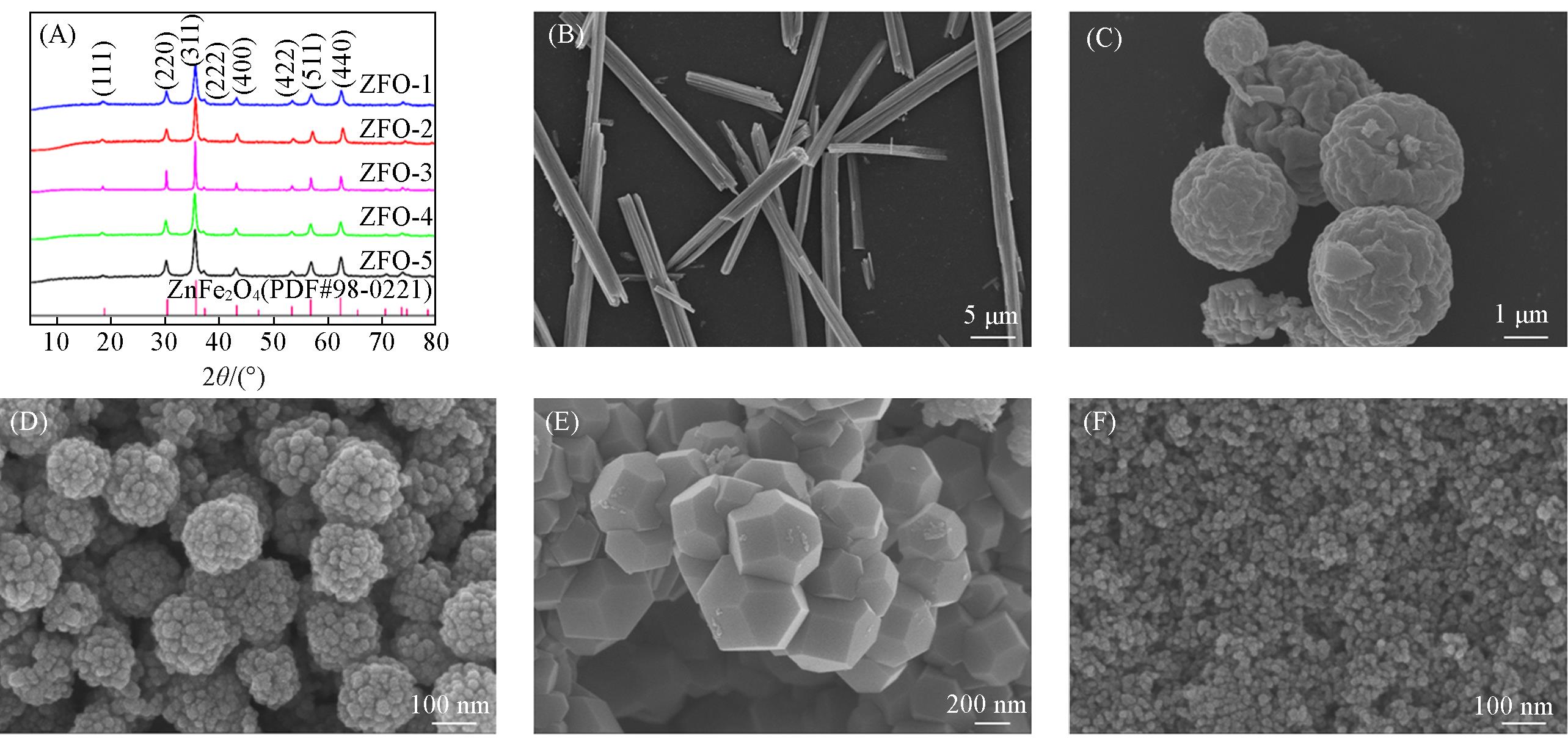
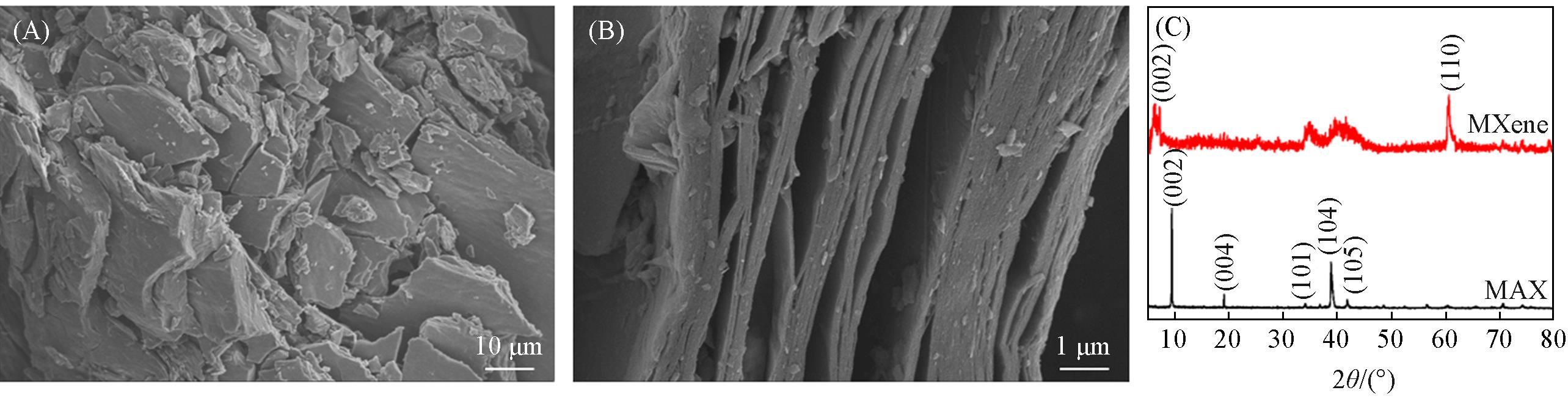
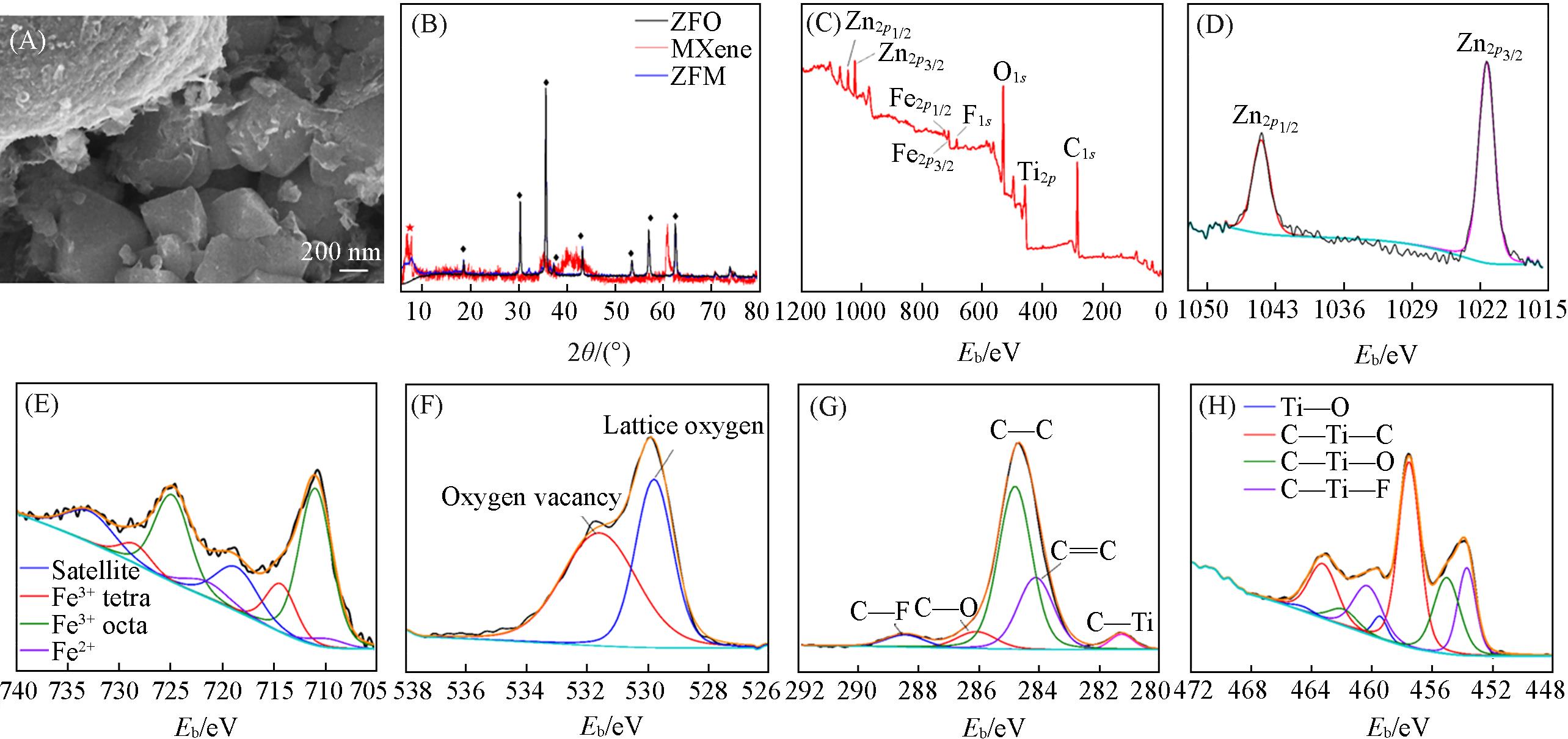
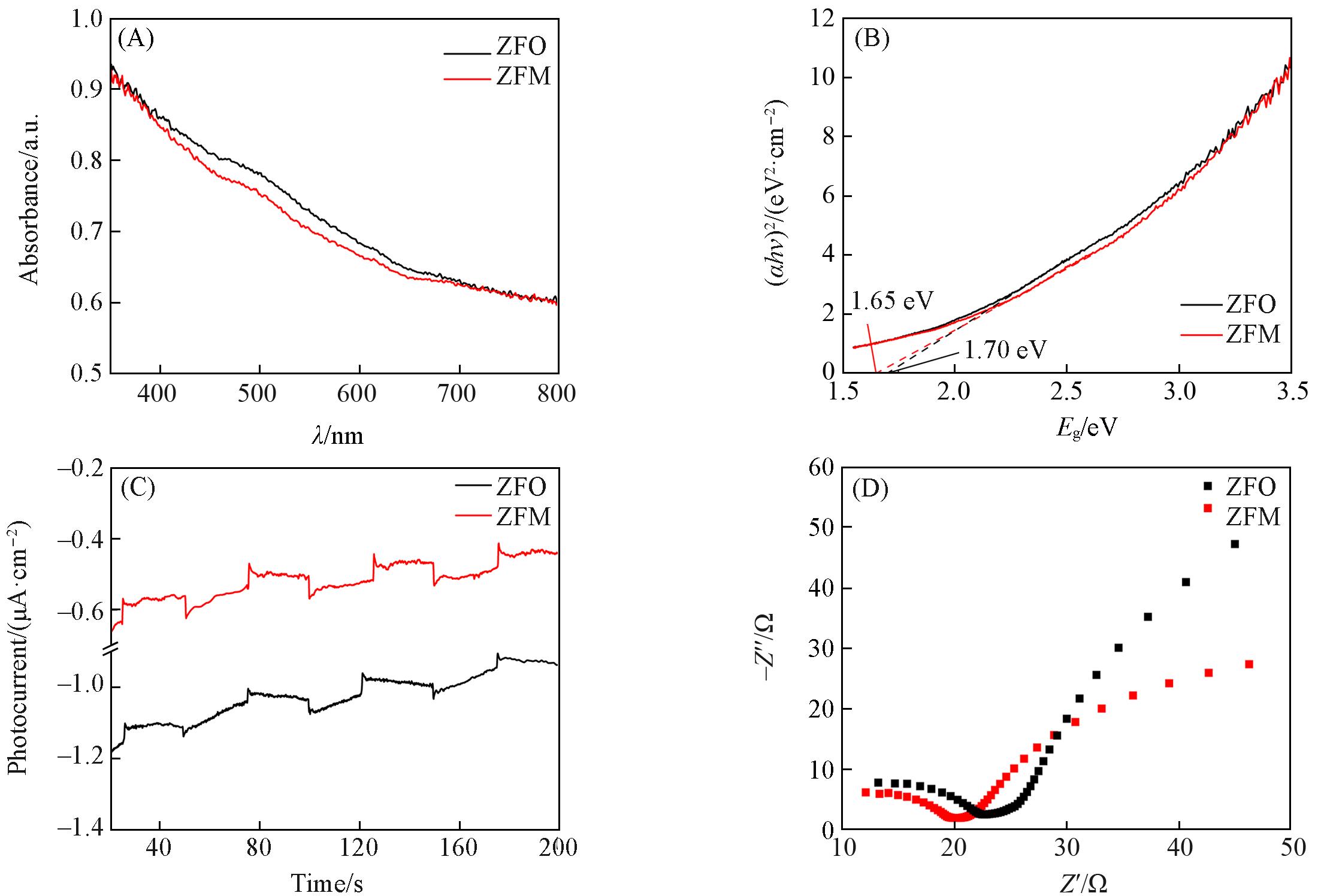
| Catalyst | Light source | Degradation efficiency(%) | Time/min | Ref. |
|---|---|---|---|---|
| ZnFe2O4/g⁃C3N4 | Visible | 96.3 | 180 | [ |
| Ni2+ doped ZnFe2O4 | Visible | 96.2 | 120 | [ |
| ZnO/ZnFe2O4/TiO2 | Visible | 96.3 | 150 | [ |
| CeO2/ZnFe2O4 | Visible | 90.5 | 90 | [ |
| Ag⁃ZnFe2O4@graphene | Visible | 83.0 | 180 | [ |
| GO quantum dots decorated ZnO⁃ZnFe2O4 | Visible | 94.0 | 240 | [ |
| ZnFe2O4/BiVO4+H2O2 | Visible | 98.8 | 60 | [ |
| ZnFe2O4/SnO2+H2O2 | Solar | 95.2 | 60 | [ |
| ZnFe2O4/rGO+H2O2 | Solar | 87.0 | 70 | [ |
| ZnFe2O4/biochar+H2O2 | Visible | 90.0 | 60 | [ |
| ZnFe2O4/MXene+H2O2 | Visible | 96.9 | 20 | Present work |
Table 1 Comparison of photocatalytic efficiency of ZnFe2O4-based photocatalysts reported in previously studies
| Catalyst | Light source | Degradation efficiency(%) | Time/min | Ref. |
|---|---|---|---|---|
| ZnFe2O4/g⁃C3N4 | Visible | 96.3 | 180 | [ |
| Ni2+ doped ZnFe2O4 | Visible | 96.2 | 120 | [ |
| ZnO/ZnFe2O4/TiO2 | Visible | 96.3 | 150 | [ |
| CeO2/ZnFe2O4 | Visible | 90.5 | 90 | [ |
| Ag⁃ZnFe2O4@graphene | Visible | 83.0 | 180 | [ |
| GO quantum dots decorated ZnO⁃ZnFe2O4 | Visible | 94.0 | 240 | [ |
| ZnFe2O4/BiVO4+H2O2 | Visible | 98.8 | 60 | [ |
| ZnFe2O4/SnO2+H2O2 | Solar | 95.2 | 60 | [ |
| ZnFe2O4/rGO+H2O2 | Solar | 87.0 | 70 | [ |
| ZnFe2O4/biochar+H2O2 | Visible | 90.0 | 60 | [ |
| ZnFe2O4/MXene+H2O2 | Visible | 96.9 | 20 | Present work |
| [1] | Khan S., Noor T., Iqbal N., Yaqoob L., ACS Omega, 2024, 9(20), 21751—21767 |
| [2] | Solayman H. M., Hossen M. A., Abd Aziz A., Yahya N. Y., Leong K. H., Sim L. C., Monir M. U., Zoh K. D., J. Environ. Chem. Eng., 2023, 11(3), 109610 |
| [3] | Tian Z. H., Gao P. P., Yu R. H., Zhao W. J., Chem. J. Chinese Universities, 2024, 45(3), 20230416 |
| 田振华, 高盼盼, 于若泓, 赵文杰. 高等学校化学学报, 2024, 45(3), 20230416 | |
| [4] | Kang S., Zhang K., Wei Y. J., Wang C. Y., Chem. J. Chinese Universities, 2025, 46(4), 20240488 |
| 康莎, 章柯, 卫亚静, 王传义. 高等学校化学学报, 2025, 46(4), 20240488 | |
| [5] | Choudhary S., Hasina D., Saini M., Ranjan M., Mohapatra S., J. Alloy. Compd., 2022, 895, 162723 |
| [6] | Manohar A., Krishnamoorthi C., Naidu K. C. B., Pavithra C., Appl. Phys. A: Mater., 2019, 125(7), 477 |
| [7] | Sabzehmeidani M. M., Karimi H., Ghaedi M., Avargani V. M., Mater. Res. Bull., 2021, 143, 111449 |
| [8] | Nguyen L. T. T., Nguyen T. T., Nguyen L. T. H., Mai T. X., Bui N. D., Chu N. M., Nguyen H. Q., Nguyen N. T. T., Tran T. V., Environ. Sci. Pollut. R., 2023, 31(60), 67368—67381 |
| [9] | Song T., Meng X., Wang H., Zhang C., Ge M., Sep. Purif. Technol., 2022, 297, 121474 |
| [10] | Li X., Xing H., Yang X., Wang D., Feng J., Zong Y., Zhu X., Li X., Zheng X., J. Mater. Sci.⁃Mater. El., 2023, 34(15), 1204 |
| [11] | Dhiman M., Sharma R., Kumar V., Singhal S., Ceram. Int., 2016, 42(11), 12594—12605 |
| [12] | Lee K. T., Chuah X. F., Cheng Y. C., Lu S. Y., J. Mater. Chem. A, 2015, 3(36), 18578—18585 |
| [13] | Patil M. S., Sheikh A. D., Sharma K. K. K., J. Water Process Eng., 2025, 75, 108008 |
| [14] | Ye J., Tian D., Song W., Lin H., Fan Q., Li X., J. Alloy. Compd., 2025, 1010, 177808 |
| [15] | Zhang H., Li M., Zhu C., Tang Q., Kang P., Cao J., Ceram. Int., 2020, 46(1), 81—88 |
| [16] | Ba Z. C., Liang D. X., Xie Y. J., Chem. J. Chinese Universities, 2021, 42(4), 1225—1240 |
| 巴智晨, 梁大鑫, 谢延军. 高等学校化学学报, 2021, 42(4), 1225—1240 | |
| [17] | He H., Fang Y., Sun X., Li X., Li S., Cao Y., React. Chem. Eng., 2024, 9(1), 172—185 |
| [18] | Wang Q., Zhu F., Cheng H., Komarneni S., Ma J., Chemosphere, 2023, 328, 138546 |
| [19] | Doo S., Chae A., Kim D., Oh T., Ko T. Y., Kim S. J., Koh D. Y., Koo C. M., ACS Appl. Mater. Interfaces, 2021, 13(19), 22855—22865 |
| [20] | Zhang S., Guo R., Liang M., Li L., Process Safet. Environ., 2022, 165, 323—335 |
| [21] | Zhang T., Pan L., Tang H., Du F., Guo Y., Qiu T., Yang J., J. Alloy. Compd., 2017, 695, 818—826 |
| [22] | Liu S., Wang M., Ge C., Zhang X., Lei S., Hussain S., Wang M., Qiao G., Liu G., Appl. Surf. Sci., 2023, 610, 155440 |
| [23] | Patil M. S., Sheikh A. D., Devan R. S., Sharma K. K. K., Inorg. Chem. Commun., 2025, 180, 115088 |
| [24] | Suchomski C., Breitung B., Witte R., Knapp M., Bauer S., Baumbach T., Reitz C., Brezesinski T., Beilstein J. Nanotechnol., 2016, 7, 1350—1360 |
| [25] | Luo X., Duan Z., Zhu Y., Ni J., Li Y., Zhang J., Chen Y., Wang X., Zhao G., Mater. Res. Bull., 2022, 155, 11195 |
| [26] | Ding Y., Xiang S., Zhi W., Gong S., He G., Wang T., Cai D., Soft Matter, 2021, 17(18), 4703—4706 |
| [27] | Wang X., Wang Z., Qiu J., Angew. Chem. Int. Ed., 2021, 60(51), 26587—26591 |
| [28] | Zhang J., Wang X., Zhang Y., Li R., Xing Z., Lu M., J. Alloy. Compd., 2025, 1014, 178740 |
| [29] | Zhang F., Xiao X., Xiao Y., J. Alloy. Compd., 2022, 923, 166417 |
| [30] | Shen W. T., Du J. X., Mei X. Y., Liu S., Liu F. J., Si Y. S., J. Mater. Res., 2024, 39, 2317—2331 |
| [31] | Ranjith K. S., Mohammadi A., Raju G. S. R., Huh Y. S., Han Y. K., Nano Converg., 2024, 11(1), 51 |
| [32] | Feng J., Nian P., Peng L., Zhang A., Sun Y., Chemosphere, 2021, 271, 129575 |
| [33] | Sun K., Wang X., Yuan H., Hou J., Shi W., Li C., Guo F., Sep. Purif. Technol., 2024, 351, 128044 |
| [34] | Bi F., Zhou B., Li R., Du R., Zheng Z., Fu X., Zhao L., Xiao S., Wang L., Dong X., Mater. Today Commun., 2024, 41, 111066 |
| [35] | Manohar A., Chintagumpala K., Kim K. H., Ceram. Int., 2021, 47(5), 7052—7061 |
| [36] | Zhang J., Kuang M., Cao Y., Ji Z., Solid State Sci., 2022, 129, 106913 |
| [37] | Al⁃Shwaiman H. A., Akshhayya C., Syed A., Bahkali A. H., Elgorban A. M., Das A., Varma R. S., Khan S. S., Mater. Chem. Phys., 2022, 279, 125759 |
| [38] | Varsha Raj G., Priyadarshini H. N., Prashantha K., Nagaraju G., Udayabhanu, Ramakrishnappa T., Opti. Mater., 2024, 147, 114704 |
| [39] | Li B., Yu X., Yu X., Du R., Liu L., Zhang Y., Appl. Surf. Sci., 2019, 478, 991—997 |
| [40] | Cao Y., Ren Y., Zhang J., Xie T., Lin Y., Opti. Mater., 2021, 121, 111637 |
| [41] | Guo L., Okinaka N., Zhang L., Watanabe S., Mater. Chem. Phys., 2021, 262, 124273 |
| [42] | Leichtweis J., Ferreira Piazzi Fuhr A. C., Welter N., Ramírez Mérida L. G., Carissimi E., Waste Biomass Valori., 2026, 17, 187—199 |
| [43] | Schultz T., Frey N. C., Hantanasirisakul K., Park S., May S. J., Shenoy V. B., Gogotsi Y., Koch N., Chem. Mater., 2019, 17, 6590—6597 |
| [44] | Li X. B., Wan Y. Y., Xie Y., Fu Y. M., Deng F., Zhou Y. T., Luo Y. D., Han L., Ma J., Dong F., Zhu Y. F., Adv. Funct. Mater., 2025, e23047 |
| [45] | Wan Y. Y., Liu H. F., Li X. B., Wang H. Y., Deng F., Zhou Y. T., Luo Y. D., Xie Y., Jiang H. L., Zhang Y., Ding L., Dong F., Zhu Y. F., Sci. China Technol. Sci., 2025, 68, 2210501 |
| [46] | Li X. B., Han T., Zhou Y.T., Wang M., Tian Z. L., Deng F., Luo Y. D., Xie Y., Huang J. T., Han L., Chen Z., Feng Z. J., Chen W., Appl. Catal. B: Environ. Energy, 2024, 350, 123913 |
| [1] | HUANG Shiyu, JIANG Hongbin, LIU Heran, DAI Wenchen, XU Xiaochen, CHEN Jie, YANG Guang, YANG Fenglin. Study on Co(x)/ γ⁃Al2O3 Heterogeneous Catalyst Activation of Peracetic Acid for Treating Methylene Blue Wastewater [J]. Chem. J. Chinese Universities, 2026, 47(8): 20250377. |
| [2] | REN Shufang, GUO Tong, WANG Zihan, LIU Yahui, CHEN Yu, ZENG Junling. Construction of Molecular Imprinted Electrochemical Sensor Based on 2D Ti3C2T x Nanosheet/Conductive Kochen Black Composite Polymethacrylic Acid and the Detection of Dopamine [J]. Chem. J. Chinese Universities, 2025, 46(7): 20250040. |
| [3] | JIANG Yanli, XU Yunsong, WANG Jiankang, LI Weihao, SONG Ying, WANG Xinzhi, YAO Zhongping. Preparation of Ti3C2-MXene/CuS/PVDF Composite Photothermal Membrane and Its Solar-driven Interfacial Water Evaporation Performance [J]. Chem. J. Chinese Universities, 2025, 46(4): 20240469. |
| [4] | WANG Chunhui, ZHANG Yang, HAN Zhe, GAO Yuan, HE Puyong, FAN Chaoyue, QIU Jie. Synthesis, Structure, Magnetism of a Thorium-Iron Oxo Cluster and Its Application in Catalyzing the Coupling Reaction of Benzylamine [J]. Chem. J. Chinese Universities, 2025, 46(3): 20240437. |
| [5] | ZHU Xuanqi, CUI Liying, ZHAO Xinyu, JIANG Ling, ZHANG Xue. Fe3+-doped Polyaminopyrrole Nanoparticles for in situ Magnetic Resonance Imaging and Photothermal Therapy of Breast Cancer [J]. Chem. J. Chinese Universities, 2025, 46(1): 20240156. |
| [6] | TIAN Yongtu, ZHANG Yang, LI Hongjie, LAI Hua, CHENG Zhongjun. Directional Removal of Water Droplets by Magnetic Responsive Polydimethylsiloxane Arrays [J]. Chem. J. Chinese Universities, 2024, 45(9): 20240220. |
| [7] | ZHANG Huilian, YANG Xinjie, LI Jun, LI Quan, ZHANG Fujuan, ZHANG Yanli, WANG Hongbin, YANG Wenrong, PANG Pengfei. Fluorescent Probe for Detection of Hg2+ and S2- Based on N-Doped Ti3C2 MXene Quantum Dots [J]. Chem. J. Chinese Universities, 2024, 45(5): 20230504. |
| [8] | TIAN Zhenhua, GAO Panpan, YU Ruohong, ZHAO Wenjie. Preparation of Adsorption-degradation Collagen/ZnO Composites Based on Chrome-tanned Leather Shavings [J]. Chem. J. Chinese Universities, 2024, 45(3): 20230416. |
| [9] | SHI Qian, LIU Dongmei, FANG Xiaoni, LIU Baohong. High-throughput Analysis of Tyrosinase Activity and Inhibitors Based on Matrix-assisted Laser Desorption/ionization Mass Spectrometry [J]. Chem. J. Chinese Universities, 2024, 45(11): 20240330. |
| [10] | SUN Jinghua, GUO Chunyan, DONG Jie, ZHANG Ruiping. Melanin-based Targeted Nanodrugs for Photothermal Therapy of Breast Cancer [J]. Chem. J. Chinese Universities, 2023, 44(8): 20230044. |
| [11] | CHEN Hongru, BAI Yang, ZHOU Qiuju, ZHANG Zhiguo. Application of 2D NMR in Organic Photovoltaics [J]. Chem. J. Chinese Universities, 2023, 44(7): 20230104. |
| [12] | XU Ruotao, WANG Qiang, BAO Qingjia, WANG Weiyu, ZHANG Zhi, LIU Zhaoyang, XU Jun, DENG Feng. In situ Magnetic Resonance Imaging of Solvent Infiltration on γ -Al2O3 Particles [J]. Chem. J. Chinese Universities, 2023, 44(4): 20220587. |
| [13] | HU Dongdong, LAI Hua, LIU Yuyan, SONG Yingbin, LUO Xin, ZHANG Dongjie, FAN Zhimin, XIE Zhimin, CHENG Zhongjun. Magnetic Gradient Slippery Surfaces with Shape Memory Property for Smart Sliding Control of Superparamagnetic Droplet [J]. Chem. J. Chinese Universities, 2023, 44(2): 20220442. |
| [14] | LIU Kun, YANG Minghao, ZHOU Xiongfeng, BAI Yang, RAN Congfu. Influence of Magnetic Field Assisted Surface Dielectric Barrier Discharge on the Chemical Activity and Sterilization Effect of Plasma Activated Water [J]. Chem. J. Chinese Universities, 2023, 44(12): 20230327. |
| [15] | ZHENG Haijiao, XU Wenhui, JIA Qiong. Vinyl Sulfone Functionalized Magnetic Nanoparticles and Its Application in Palmitoylated Peptides Enrichment [J]. Chem. J. Chinese Universities, 2023, 44(11): 20230239. |
| Viewed | ||||||
|
Full text |
|
|||||
|
Abstract |
|
|||||
