

Chem. J. Chinese Universities ›› 2026, Vol. 47 ›› Issue (1): 20250319.doi: 10.7503/cjcu20250319
• Review • Previous Articles Next Articles
HU Jinhong, CAI Mingwei, GAN Yile, ZHANG Yang, SHI Hainan( ), MIN Yonggang()
Received:2025-10-31
Online:2026-01-10
Published:2025-12-10
Contact:
SHI Hainan, MIN Yonggang
E-mail:4015081@qq.com;ygmin@gdut.edu.cn
Supported by:CLC Number:
TrendMD:
HU Jinhong, CAI Mingwei, GAN Yile, ZHANG Yang, SHI Hainan, MIN Yonggang. “IC-Display-Device/Gas separation-Composite”—Breakthroughs in Core Technologies, Performance Optimization, and Application Exploration of Multifunctional Polyimide Materials[J]. Chem. J. Chinese Universities, 2026, 47(1): 20250319.

| Characteristic | Negative⁃tone photosensitive polyimide | Positive⁃tone photosensitive polyimide |
|---|---|---|
| Core mechanism | Photo⁃induced crosslinking | Photo⁃induced increase in solubility |
| Photosensitive groups | Acrylate groups, epoxy groups, vinyl ether, etc. | Diazonaphthoquinone(DNQ) compounds, etc. |
| Development result | Exposed areas are insoluble and retained | Exposed areas are soluble and removed |
| Features | Mature process, widely applied, good adhesion, | Higher resolution, good pattern precision |
| fast photosensitivity, low cost | ||
| Application scenarios | Advanced packaging, insulating buffer layers | High⁃density integrated circuits, fine pattern transfer |
Table 1 Characteristics of negative/positive photoresist polyimide
| Characteristic | Negative⁃tone photosensitive polyimide | Positive⁃tone photosensitive polyimide |
|---|---|---|
| Core mechanism | Photo⁃induced crosslinking | Photo⁃induced increase in solubility |
| Photosensitive groups | Acrylate groups, epoxy groups, vinyl ether, etc. | Diazonaphthoquinone(DNQ) compounds, etc. |
| Development result | Exposed areas are insoluble and retained | Exposed areas are soluble and removed |
| Features | Mature process, widely applied, good adhesion, | Higher resolution, good pattern precision |
| fast photosensitivity, low cost | ||
| Application scenarios | Advanced packaging, insulating buffer layers | High⁃density integrated circuits, fine pattern transfer |
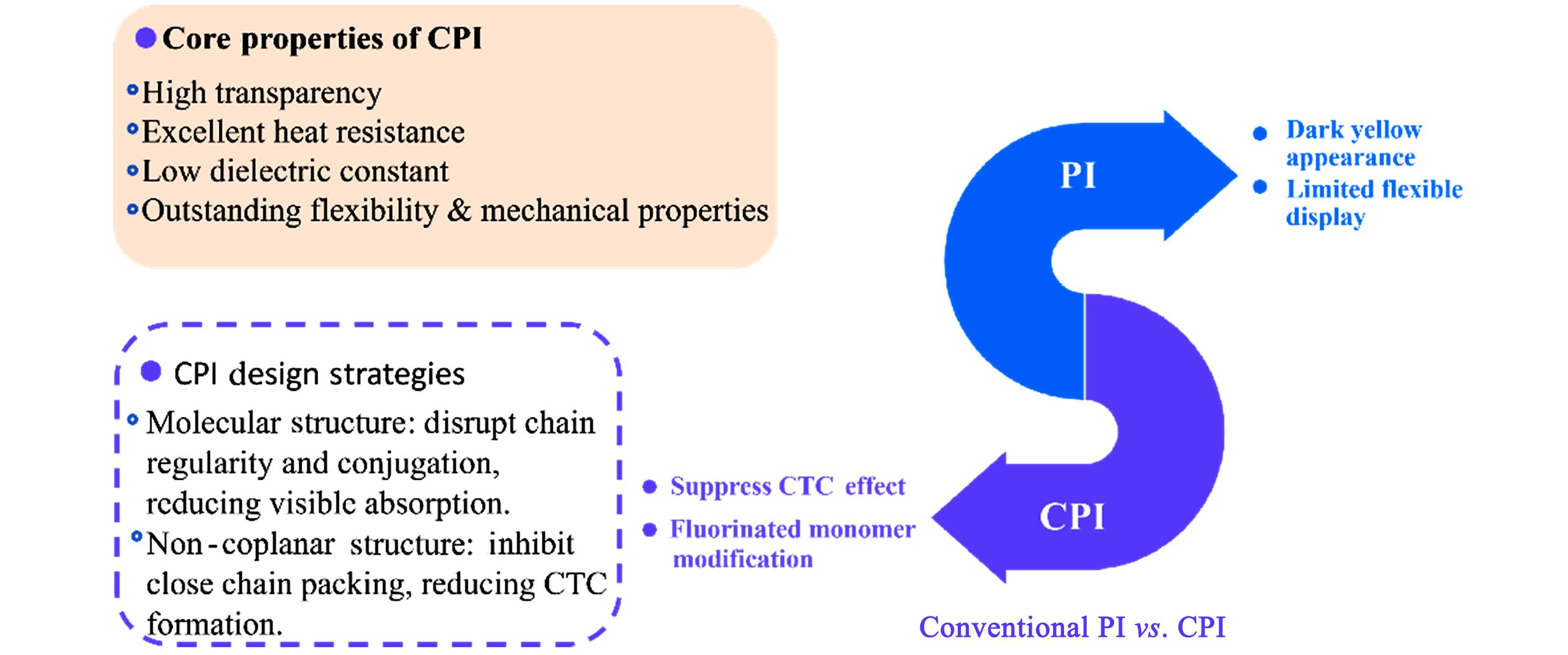
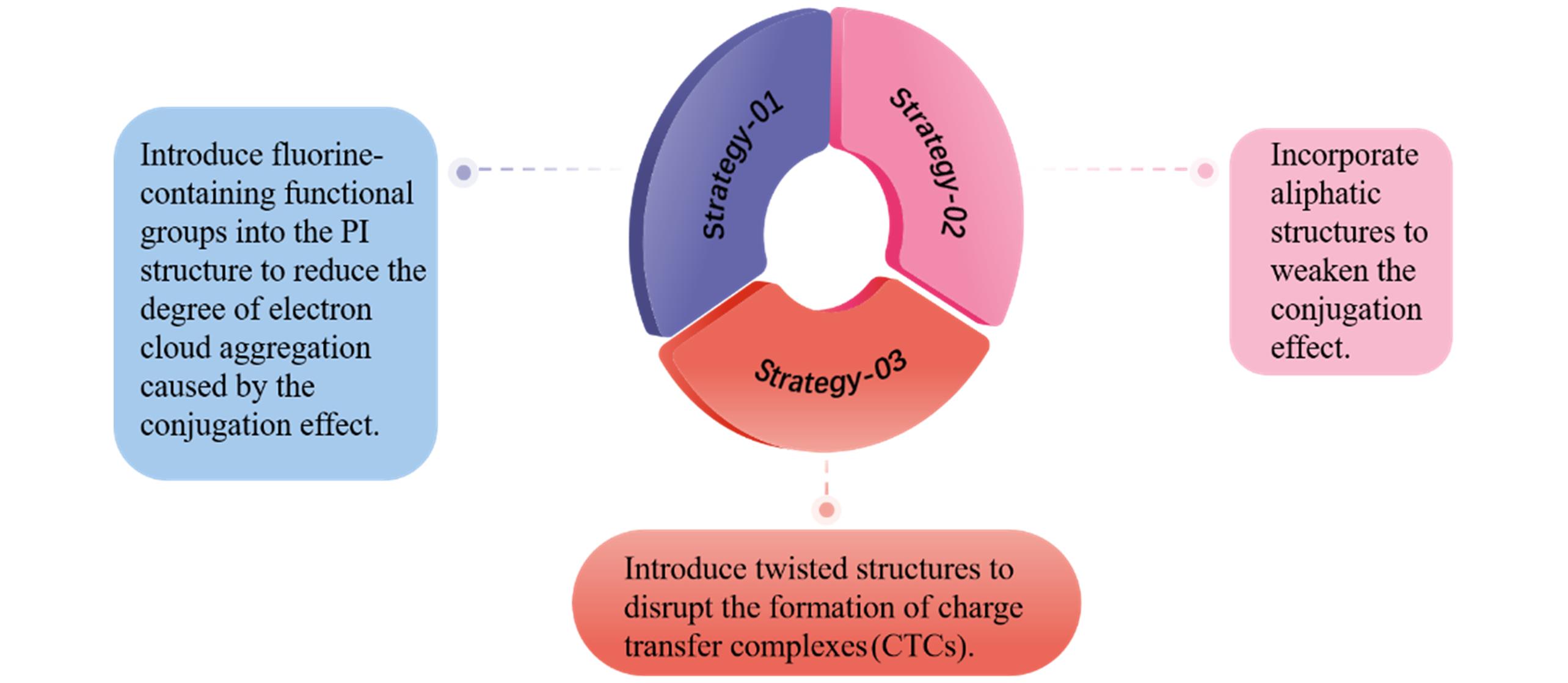
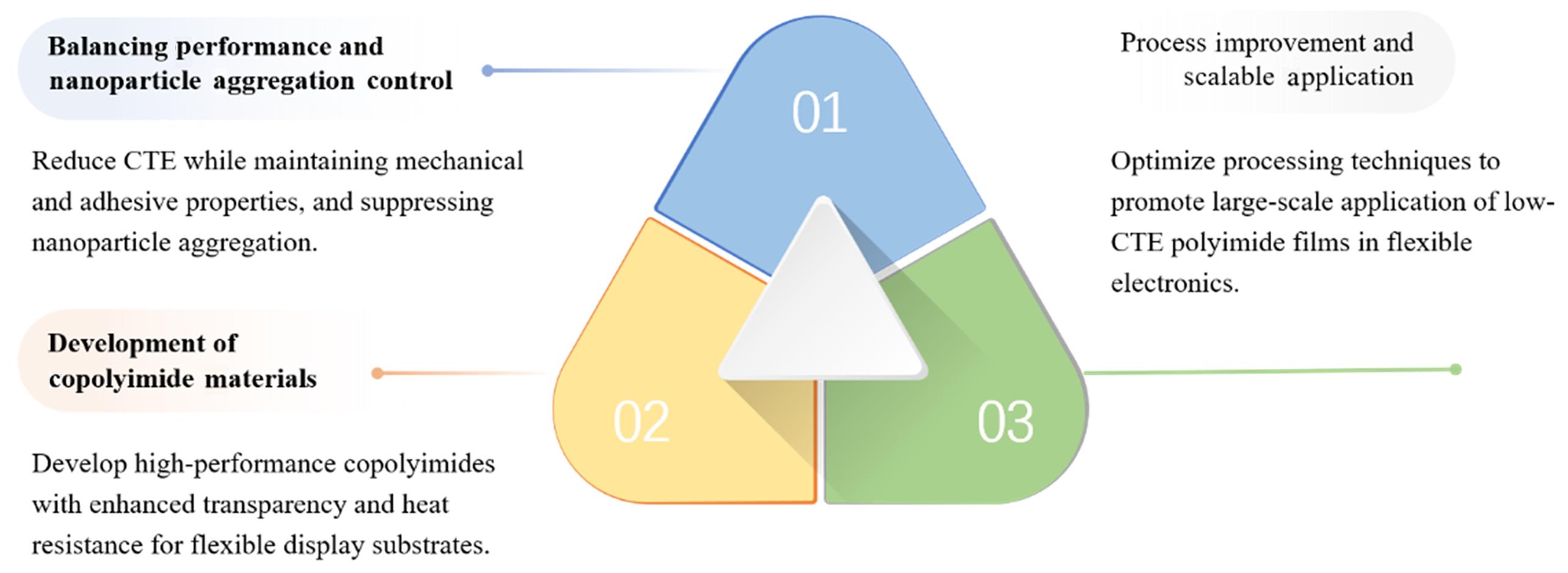
| Application field | Application |
|---|---|
| Mechanical | TPI, with excellent mechanical properties and friction resistance, can replace titanium alloys for manufacturing engine |
| industry | inner covers, dense parts, and clutch rings |
| Aerospace | TPI exhibits good flame retardancy, applicable to producing aircraft components and reducing fire⁃related damage risks |
| Electronics & | In harsh environments(high temperature, pressure, humidity), TPI maintains good electrical insulation, used for |
| communications | wafer carriers, electronic insulating films, and connectors |
| Medical | Artificial bones made from TPI resin are lightweight, non⁃toxic, and highly corrosion⁃resistant |
| Power | TPI, featuring good thermal stability and dielectric properties, is applied in wires, cables, and power equipment |
| Coatings | Coating metal surfaces with TPI fine powder creates coatings with excellent insulation, corrosion/heat/water |
| resistance, widely used in chemical anticorrosion, home appliances, electronics, and machinery |
Table 2 TPI application areas and their use scenarios
| Application field | Application |
|---|---|
| Mechanical | TPI, with excellent mechanical properties and friction resistance, can replace titanium alloys for manufacturing engine |
| industry | inner covers, dense parts, and clutch rings |
| Aerospace | TPI exhibits good flame retardancy, applicable to producing aircraft components and reducing fire⁃related damage risks |
| Electronics & | In harsh environments(high temperature, pressure, humidity), TPI maintains good electrical insulation, used for |
| communications | wafer carriers, electronic insulating films, and connectors |
| Medical | Artificial bones made from TPI resin are lightweight, non⁃toxic, and highly corrosion⁃resistant |
| Power | TPI, featuring good thermal stability and dielectric properties, is applied in wires, cables, and power equipment |
| Coatings | Coating metal surfaces with TPI fine powder creates coatings with excellent insulation, corrosion/heat/water |
| resistance, widely used in chemical anticorrosion, home appliances, electronics, and machinery |
| Membrane | Permeability(Barrer) | Ideal selectivity(αX/Y) | Ref. | ||||
|---|---|---|---|---|---|---|---|
| H₂ | CO₂ | N₂ | CH₄ | H₂/CH₄ | H₂/CO₂ | ||
| 6F⁃D⁃S⁃CMS | 3464 | 904 | 12 | 0.91 | 3807 | 2.7 | [ |
| 6F⁃D⁃S⁃CMS⁃850 | 523 | 3.5 | 0.32 | 0.08 | 6538 | 149 | [ |
| PEK⁃C⁃900 | 2919 | 26.3 | 12.3 | 1.57 | 1859 | 110 | [ |
| 6F⁃DABA⁃75⁃CM576 | 5832 | 3573 | 113 | 69 | 84.3 | 1.6 | [ |
| BAPP⁃PMDA⁃900 | 323 | 192 | 2 | 1 | 323 | 1.7 | [ |
| TR⁃CMS⁃0.5 | 3843 | 901 | 14.6 | 6.3 | 610 | 4.3 | [ |
| Ti⁃MOF | 6444 | 4633 | 118 | 118 | 54.6 | 1.4 | [ |
| CMS/10X⁃7.5 | 1709 | 691 | 16.2 | 3.1 | 551 | 2.5 | [ |
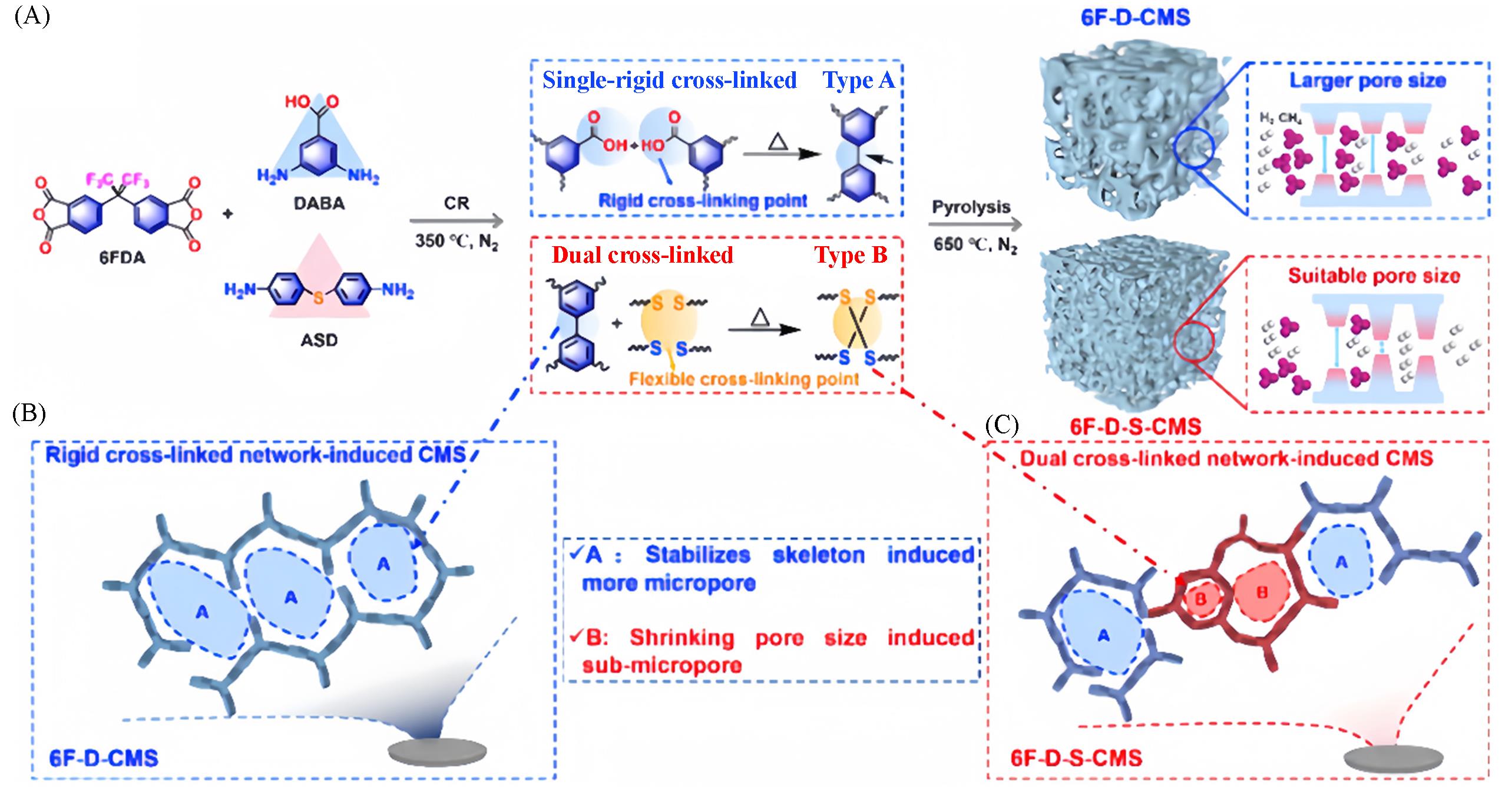
Table 3 Comparison of the performance of the prepared gas separation membranes with some reported CMS membranes(tested at 35 ℃ and 0.2 MPa)
| Membrane | Permeability(Barrer) | Ideal selectivity(αX/Y) | Ref. | ||||
|---|---|---|---|---|---|---|---|
| H₂ | CO₂ | N₂ | CH₄ | H₂/CH₄ | H₂/CO₂ | ||
| 6F⁃D⁃S⁃CMS | 3464 | 904 | 12 | 0.91 | 3807 | 2.7 | [ |
| 6F⁃D⁃S⁃CMS⁃850 | 523 | 3.5 | 0.32 | 0.08 | 6538 | 149 | [ |
| PEK⁃C⁃900 | 2919 | 26.3 | 12.3 | 1.57 | 1859 | 110 | [ |
| 6F⁃DABA⁃75⁃CM576 | 5832 | 3573 | 113 | 69 | 84.3 | 1.6 | [ |
| BAPP⁃PMDA⁃900 | 323 | 192 | 2 | 1 | 323 | 1.7 | [ |
| TR⁃CMS⁃0.5 | 3843 | 901 | 14.6 | 6.3 | 610 | 4.3 | [ |
| Ti⁃MOF | 6444 | 4633 | 118 | 118 | 54.6 | 1.4 | [ |
| CMS/10X⁃7.5 | 1709 | 691 | 16.2 | 3.1 | 551 | 2.5 | [ |
| [1] | Luo J. R., Liu Y. D., Liu H., Chen W. P., Cui T. T., Xiao L., Min Y., Materials, 2022, 15, 8014 |
| [2] | Chen Y., Liu Y., Min Y., Materials, 2022, 15, 2755 |
| [3] | Wu J., Zhang S., Cai M., Li Q., Wang Z., Lu X., Min Y., High Perform. Polym., 2023, 35, 1026 |
| [4] | Chen Y., Liu Y., Min Y., Polymers, 2023, 15, 1256 |
| [5] | Tan W. Y., Jian L. F., Chen W. P., Zhang Y. W., Lu X. C., Huang W. J., Zhang J. S., Wu J. W., Feng J. L., Liu Y. D., Cui T. T., Min Y. G., Chin. J. Polym. Sci., 2023, 41, 288 |
| [6] | Jian L. F., Lu Z. Y., Tan W. Y., Min Y. G., Mod. Plast. Process. Appl., 2024, 36, 17 |
| 简凌锋, 卢治宇, 谭婉怡, 闵永刚. 现代塑料加工应用, 2024, 36, 17 | |
| [7] | Lu X. C., Yu W. T., Weng M. M., Liu Y. D., Zhang J. S., Fang J. Y., Min Y. G., Insul. Mater., 2021, 54, 11 |
| 卢小闯, 余文涛, 翁梦蔓, 刘屹东, 张继升, 方基永, 闵永刚. 绝缘材料, 2021, 54, 11 | |
| [8] | Lu J., Zhang J., Liu H., Chen W., Luo J., Wang Z., Cui T., Min Y., Liu Y., High Perform. Polym., 2023, 35, 936 |
| [9] | Huang X. W., Liao S. Y., Liu Y. D., Rao Q. S., Peng X. K., Min Y. G., Electrochimica Acta, 2021, 389, 138747 |
| [10] | Hu J. Q., Li Y. Z., Liao S. Y., Huang X. W., Chen Y. Z., Peng X. K., Yang Y. B., Min Y. G., ACS Appl. Energy Mater., 2021, 4, 9721 |
| [11] | Song T., Min Y., J. Appl. Polym. Sci., 2024, 141, e55721 |
| [12] | Liu C. S., Hu J. Q., Mao T. T., Liao S. Y., Feng R. M., Liu Y. D., Min Y. G., Chin. J. Polym. Sci., 2024, 42, 521 |
| [13] | Huang J., Su J., Weng M., Xiong L., Wang P., Liu Y., Lin X., Min Y., Sol. Energy Mater. Sol. Cells, 2022, 245, 111872 |
| [14] | Cao Y., Zhao Z., Zeng X., Teng J., Huang J., Min Y., Adv. Compos. Hybrid Mater., 2025, 8, 104 |
| [15] | Yu W., Lin J., Cao Y., Fang J., Wang Z., Huang J., Min Y., RSC Adv., 2024, 14, 16971 |
| [16] | Cao Y., Zeng X., Su J., Yu W., Zhang H., Abdou S. N., Ibrahim M. M., Fallatah A. M., Zhang J., Amangeldi N., Algadi H., Ainur Y., Toktarbay Z., Huang J., Min Y., Guo Z., Carbon, 2025, 242, 120427 |
| [17] | Wang Z., Min Y., Fang J., Yu W., Huang W., Lu X., Wang B., RSC Adv., 2023, 13, 7055 |
| [18] | Yu W., Lin J., Zhao Z., Fang J., Wang Z., Huang J., Min Y., RSC Adv., 2024, 14, 9716 |
| [19] | Huang J., Zeng X., Yu W., Zhang H., Min Y., Diam. Relat. Mater., 2025, 152, 111968 |
| [20] | Ji W., Li K., Min Y. G., Shi W., Li J., Ma X., J. Membr. Sci., 2021, 623, 119091 |
| [21] | Cai M., Chen J., Liu H., Sun L., Wu J., Han Z., Chen Z., Cui T., Zhang S., Ma X., Min Y., Sep. Purif. Technol., 2024, 341, 126945 |
| [22] | Zhang S., Xu Z., Weng Y., Cai M., Wang Y., Zhu W., Min Y., Ma X., J. Membr. Sci., 2023, 672, 121464 |
| [23] | Cai M., Liu H., Chen J., Wu J., Han Z., Chen Z., Zhang S., Min Y., Microporous Mesoporous Mater., 2024, 365, 112889 |
| [24] | Cai M., Liang H., Liang F., Tao M., Sun L., Ma X., Zhang S., Min Y., Angew. Chem. Int. Ed., 2025, 64, e202509756 |
| [25] | Zhang S., Lu X., Cai M., Wang Z., Han Z., Chen Z., Liu R., Li K., Min Y., Polymers, 2022, 14, 5391 |
| [26] | Cai M., Liu H., Chen J., Sun L., Wu J., Chen Z., Han Z., Cui T., Zhang S., Min Y., Ma X., Sep. Purif. Technol., 2024, 335, 126163 |
| [27] | Luo X. L., Wu J. H., Liu J., Wang Z. Q., Min Y. G., Liu Y. D., Funct. Mater., 2023, 54, 7145 |
| 罗旭良, 吴嘉豪, 刘靖, 王子青, 闵永刚, 刘屹东. 功能材料, 2023, 54, 7145 | |
| [28] | Weng M. M., Yu W. T., Lu X. C., Li Q. L., Liu J., Liu Y. D., Min Y. G., Insul. Mater., 2021, 54(4), 1 |
| 翁梦蔓, 余文涛, 卢小闯, 李清玲, 刘佳, 刘屹东, 闵永刚. 绝缘材料, 2021, 54(4), 1 | |
| [29] | Weng M. M., Zhao X. J., Luo X. L., Min Y. G., Polym. Bull., 2023, 36, 1090 |
| 翁梦蔓, 赵晓君, 罗旭良, 闵永刚. 高分子通报, 2023, 36, 1090 | |
| [30] | Luo X., Huang J., Wang X., Weng M., Cao Y., Min Y., Chem. Commun., 2023, 59, 13321 |
| [31] | Weng M., Luo X., Jian L., Liang J., Hu J., Liu Y., Zhang J., Feng X., Min Y., Appl. Surf. Sci., 2022, 578, 152029 |
| [32] | Liaw D. J., Wang K. L., Huang Y. C., Lee K. R., Lai J. Y., Ha C. S., Prog. Polym. Sci., 2012, 37, 907 |
| [33] | Viehbeck A., Goldberg M. J., Kovac C. A., J. Electrochem. Soc., 1990, 137, 1460 |
| [34] | Rothman L. B., J. Electrochem. Soc., 1980, 127, 2216 |
| [35] | Muruganand S., Narayandass S. K., Mangalaraj D., Vijayan T. M., Polym. Int., 2001, 50, 1089 |
| [36] | Chen S. T., MRS Online Proc. Libr. OPL, 1995, 381, 141 |
| [37] | Ohya H., Kudryavsev V. V., Semenova S. I., Polyimide Membranes: Applications, Fabrications and Properties, Routledge, London, 2022 |
| [38] | Dixit B. C., Dixit R. B., Desai D. J., Int. J. Polym. Mater., 2009, 58(4), 229 |
| [39] | Jeon J. Y., Tak T. M., J. Appl. Polym. Sci., 1996, 61, 371 |
| [40] | Dong J., Yin C., Luo W., Zhang Q., J. Mater. Sci., 2013, 48, 7594 |
| [41] | Chen T. A., Jen A. K. Y., Cai Y., Macromolecules, 1996, 29, 535 |
| [42] | Fang B., Pan K., Meng Q., Cao B., Polym. Int., 2012, 61, 111 |
| [43] | Rensch T., Fabig S., Grätz S., Borchardt L., ChemSusChem, 2022, 15, e202101975 |
| [44] | Xu Z., Croft Z. L., Guo D., Cao K., Liu G., J. Polym. Sci., 2021, 59, 943 |
| [45] | Bell V. L., Stump B. L., Gager H., J. Polym. Sci. Polym. Chem. Ed., 1976, 14, 2275 |
| [46] | Sezer Hicyilmaz A., Celik Bedeloglu A., SN Appl. Sci., 2021, 3, 363 |
| [47] | Kreuz J. A., Edman J. R., Adv. Mater., 1998, 10, 1229 |
| [48] | Peng X. K., Huang X. W., Liu R. T., Zhang Y. W., Zhang S. Y., Huang J. T., Min Y. G., Mater. Rev., 2022, 36, 184 |
| 朋小康, 黄兴文, 刘荣涛, 张永文, 张诗洋, 黄锦涛, 闵永刚. 材料导报, 2022, 36, 184 | |
| [49] | Liu H., Liu Y. D., Chen W. P., Cui T. T., Min Y. G., Chem. Bull., 2024, 87, 605 |
| 刘恒, 刘屹东, 陈伟鹏, 崔婷婷, 闵永刚. 化学通报, 2024, 87, 605 | |
| [50] | Meador M. A. B., McMillon E., Sandberg A., Barrios E., Wilmoth N. G., Mueller C. H., Miranda F. A., ACS Appl. Mater. Interfaces, 2014, 6, 6062 |
| [51] | Zhang D., Li L., Wang Y., Zhang C., Teng C., J. Sol⁃Gel Sci. Technol., 2023, 108, 1 |
| [52] | Liu C. S., Chen Y. W., Cao J. R., Liu J., Ma X. H., Liu Y. D., Min Y. G., Insul. Mater., 2021, 54(2), 1 |
| 刘存生, 陈钰玮, 曹景茹, 刘佳, 马小华, 刘屹东, 闵永刚. 绝缘材料, 2021, 54(2), 1 | |
| [53] | Du Q., Chen W., Guo H., Wang Z., Zhao L., Zhu Y., Tan W., Min Y., Liu Y., J. Polym. Sci., 2024, 62, 3066 |
| [54] | Liu Y., Chen W., Liu H., Luo J., Zhao L., Zhang J., Wang H., Wu J. W., Feng J. L., Zhu Y., Tan W. Y., Cui T., Min Y., Polym. Degrad. Stab., 2023, 209, 110264 |
| [55] | Wang Q., Huang F., Cornelius C. J., Fan Y., J. Membr. Sci., 2021, 621, 118785 |
| [56] | Hou M., Qi W., Li L., Xu R., Xue J., Zhang Y., Song C., Wang T., J. Membr. Sci., 2021, 635, 119541 |
| [57] | Chen S., Wahiduzzaman M., Ji T., Liu Y., Li Y., Wang C., Sun Y., He G., Maurin G., Wang S., Liu Y., Angew. Chem., 2025, 137, e202413701 |
| [58] | Liu L., Li Q., Sun L., Riaz A., Li J., Wang Y., Pinnau I., Ma X., J. Membr. Sci., 2025, 717, 123647 |
| [59] | Lei L., Pan F., Lindbråthen A., Zhang X., Hillestad M., Nie Y., Bai L., He X., Guiver M. D., Nat. Commun., 2021, 12, 268 |
| [60] | Hu L., Lee W. I., Roy S., Subramanian A., Kisslinger K., Zhu L., Fan S., Hwang S., Bui V. T., Tran T., Zhang G., Ding Y., Ajayan P. M., Nam C. Y., Lin H., Nat. Commun., 2024, 15, 5688 |
| [61] | Zhang C., Koros W. J., Adv. Mater., 2017, 29, 1701631 |
| [62] | Cai M. W., Wang Z., Lu X. C., Wu J. H., Zhang S. Y., Min Y. G., Chem. Bull., 2023, 86, 153 |
| 蔡铭威, 王知, 卢小闯, 吴嘉豪, 张诗洋, 闵永刚. 化学通报, 2023, 86, 153 | |
| [63] | Zhang S. Y., Ye B., Zhao W. T., Min Y. G., Contemp. Chem. Res., 2022, (19), 17—20 |
| 张诗洋, 叶彬, 赵文通, 闵永刚. 当代化工研究, 2022, (19), 17—20 | |
| [64] | Wang Z., Zhang S. Y., Cai M. W., Lu X. C., Liu Y. D., Min Y. G., Chem. Bull., 2023, 86, 270 |
| 王知, 张诗洋, 蔡铭威, 卢小闯, 刘屹东, 闵永刚. 化学通报, 2023, 86, 270 | |
| [65] | Cai M. W., Wang Z., Lu X. C., Zhuang J. W., Wu J. H., Zhang S. Y., Min Y. G., Chem. Ind. Eng. Prog., 2023, 42, 5232 |
| 蔡铭威, 王知, 卢小闯, 庄俊伟, 吴嘉豪, 张诗洋, 闵永刚. 化工进展, 2023, 42, 5232 | |
| [66] | Zhao X. J., Luo X. L., Weng M. M., Min Y. G., Funct. Mater., 2023, 54, 12018 |
| 赵晓君, 罗旭良, 翁梦蔓, 闵永刚. 功能材料, 2023, 54, 12018 | |
| [67] | Ha H. W., Choudhury A., Kamal T., Kim D. H., Park S. Y., ACS Appl. Mater. Interfaces, 2012, 4, 4623 |
| [68] | Huang J., Lv H., Zhao X., Lee J. M., Min Y., J. Appl. Polym. Sci., 2025, 142, e56879 |
| [1] | GUO Zhuohuan, WANG Dayang. Thermodynamic Correlation Between Surface Carboxyl Configuration and Wettability [J]. Chem. J. Chinese Universities, 2026, 47(1): 239. |
| [2] | ZHAN Senhua, SHI Tongfei. Machine Learning Model for Predicting the Glass Transition Temperature of Polyimides Based on Molecular Fingerprints and Quantum Chemical Descriptors [J]. Chem. J. Chinese Universities, 2025, 46(4): 20240556. |
| [3] | WAN Zhixin, YU Wei, ZHANG Minxuan, XU Ge, MAO Aiqin. Magnetron-Sputtered MoON Thin Film Electrode for High-performance Electrochemical Energy Storage [J]. Chem. J. Chinese Universities, 2025, 46(12): 20250220. |
| [4] | WU Jialei, YU Liqin, XIE Shengming, WANG Bangjin, ZHANG Junhui, YUAN Liming. Preparation of a Chiral Polyimine Macrocycle Bonded Chiral Stationary Phase via Thiol-ene Click Reaction for Enantioseparation in High-performance Liquid Chromatography [J]. Chem. J. Chinese Universities, 2025, 46(11): 20250102. |
| [5] | GOU Lei, SUN Aihong, LIANG Kai, WANG Yanjing, FAN Xiaoyong, LI Donglin. Construction of Lanthanide-based Corrosion-resistant Films for Aqueous Zinc Batteries with Ultra-long Cycle Life [J]. Chem. J. Chinese Universities, 2025, 46(10): 20250105. |
| [6] | ZHANG Yining, WEI Lai, SHI Tongfei, XU Lin. Influence of Interface Adsorption on the Dewetting Kinetics of Polymer Liquid Films [J]. Chem. J. Chinese Universities, 2024, 45(5): 20240046. |
| [7] | SUN Bing, LI Saimeng, ZHOU Kangkang, PENG Zhongxiang, YE Long. Mechanical Parameters of Organic Photovoltaic Films: Manipulation and Prediction [J]. Chem. J. Chinese Universities, 2023, 44(9): 20230168. |
| [8] | YANG Hang, FAN Chenling, CUI Naizhe, LI Xiaoxiao, ZHANG Wenjing, CUI Chaohua. Cooperative Effect of Solvent Additive and Solvent Vapor Annealing on High-performance Thick-film Organic Solar Cells [J]. Chem. J. Chinese Universities, 2023, 44(9): 20230162. |
| [9] | ZHANG Yongqian, ZHU Xiaoyu, MIAO Junhui, LIU Jun, WANG Lixiang. Effect of Alkyl-chain Branching Position on Molecular Aggregation of All-fused-ring Molecules [J]. Chem. J. Chinese Universities, 2023, 44(7): 20230068. |
| [10] | LIU Chunlei, YANG Jikai, LIU Yulin, LI Siyuan, LIU Haorui. High-performance Electro-optical Dual-control Color-changing Devices Based on WO3/Ag and TiO2/NiO/CdS Composite Electrodes [J]. Chem. J. Chinese Universities, 2023, 44(10): 20230203. |
| [11] | QIU Xinsheng, WU Qin, SHI Daxin, ZHANG Yaoyuan, CHEN Kangcheng, LI Hansheng. Preparation and High Temperature Fuel Cell Performance of Ionic Crosslinked Sulfonated Polyimides for Proton Exchange Membranes [J]. Chem. J. Chinese Universities, 2022, 43(8): 20220140. |
| [12] | GONG Yanxi, WANG Jianbing, CHAI Buyu, HAN Yuanchun, MA Yunfei, JIA Chaomin. Preparation of Potassium Doped g-C3N4 Thin Film Photoanode and Its Application in Photoelectrocatalytic Oxidation of Diclofenac Sodium in Water [J]. Chem. J. Chinese Universities, 2022, 43(6): 20220005. |
| [13] | ZHAO Junyu, WANG Chunbo, WANG Chengyang, ZHANG Ke, CONG Bing, YANG Lan, ZHAO Xiaogang, CHEN Chunhai. Preparation and Performance of Thermally Conductive Expanded Graphite/Polyetherimide Composites [J]. Chem. J. Chinese Universities, 2022, 43(4): 20210800. |
| [14] | YAN Wenqing, ZHANG Zeyao, LI Yan. Controlled Preparation of Carbon Nanotube Transparent Conductive Films [J]. Chem. J. Chinese Universities, 2022, 43(3): 20210626. |
| [15] | WANG Ruijie, JIAO Xiaoyu, PAN Yu, WANG Xunchun, YANG Yang, CHENG Zhongjun. Preparation of Transparent Antistatic Multifunctional Superhydrophobic Film [J]. Chem. J. Chinese Universities, 2022, 43(3): 20210703. |
| Viewed | ||||||
|
Full text |
|
|||||
|
Abstract |
|
|||||
