

高等学校化学学报 ›› 2026, Vol. 47 ›› Issue (5): 20260064.doi: 10.7503/cjcu20260064
张哲浩, 宛新华, 张洁( )
)
收稿日期:2026-02-03
出版日期:2026-05-10
发布日期:2026-03-19
通讯作者:
张洁
E-mail:jz10@pku.edu.cn
基金资助:
ZHANG Zhehao, WAN Xinhua, ZHANG Jie()
Received:2026-02-03
Online:2026-05-10
Published:2026-03-19
Contact:
ZHANG Jie
E-mail:jz10@pku.edu.cn
Supported by:摘要:
圆偏振发光(CPL)材料在三维显示、 信息存储与手性传感等领域具有巨大潜力. 螺旋聚苯乙炔衍生物具有螺旋结构动态可调、 侧基易于功能化等特点, 是构筑智能CPL材料的理想体系; 其螺旋构象的精准调控及有序自组装是实现高性能CPL与功能集成的关键. 本文综合评述了螺旋聚(3,5-二取代苯乙炔)体系的研究进展, 重点阐述其通过分子内相互作用调控螺旋构象并实现圆偏振发光可逆转换的机制, 总结了该类聚合物通过自组装形成液晶相及二维纳米结构等超分子策略, 从而实现圆偏振发光信号放大的有效途径. 这些工作为实现从螺旋聚合物到宏观手性光功能材料的可控构筑提供了重要的方法与思路. 本文还介绍了聚(3,5-二取代苯乙炔)的CPL在手性识别检测和力致荧光变色等功能材料中的应用. 最后, 总结了当前该类材料在侧基功能拓展、 固态器件制备及性能综合优化等领域面临的挑战, 并对未来发展方向进行了展望.
中图分类号:
TrendMD:
张哲浩, 宛新华, 张洁. 螺旋聚苯乙炔衍生物圆偏振发光材料的构象调控、 自组装与功能化. 高等学校化学学报, 2026, 47(5): 20260064.
ZHANG Zhehao, WAN Xinhua, ZHANG Jie. Circularly Polarized Light Materials Based on Helical Poly(phenylacetylene) Derivatives: Conformational Regulation, Self-Assembly and Functionalization. Chem. J. Chinese Universities, 2026, 47(5): 20260064.
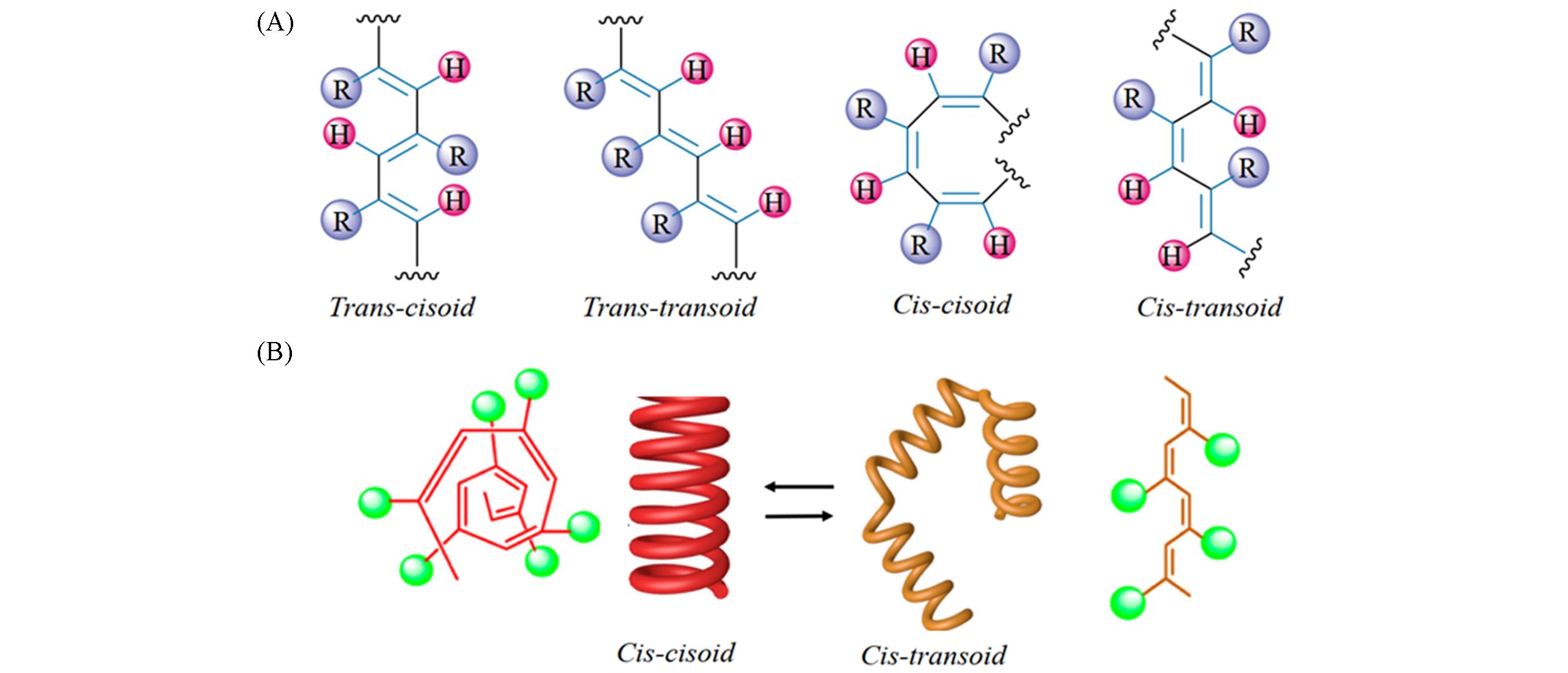
Fig.1 Four conformations of monosubstituted PA[33](A) and the reversible cc⁃ct conformational transformation of poly(phenylacetylene)[29](B)(A) Copyright 2021, Chinese Chemical Society; (B) Copyright 2016, American Chemical Society.
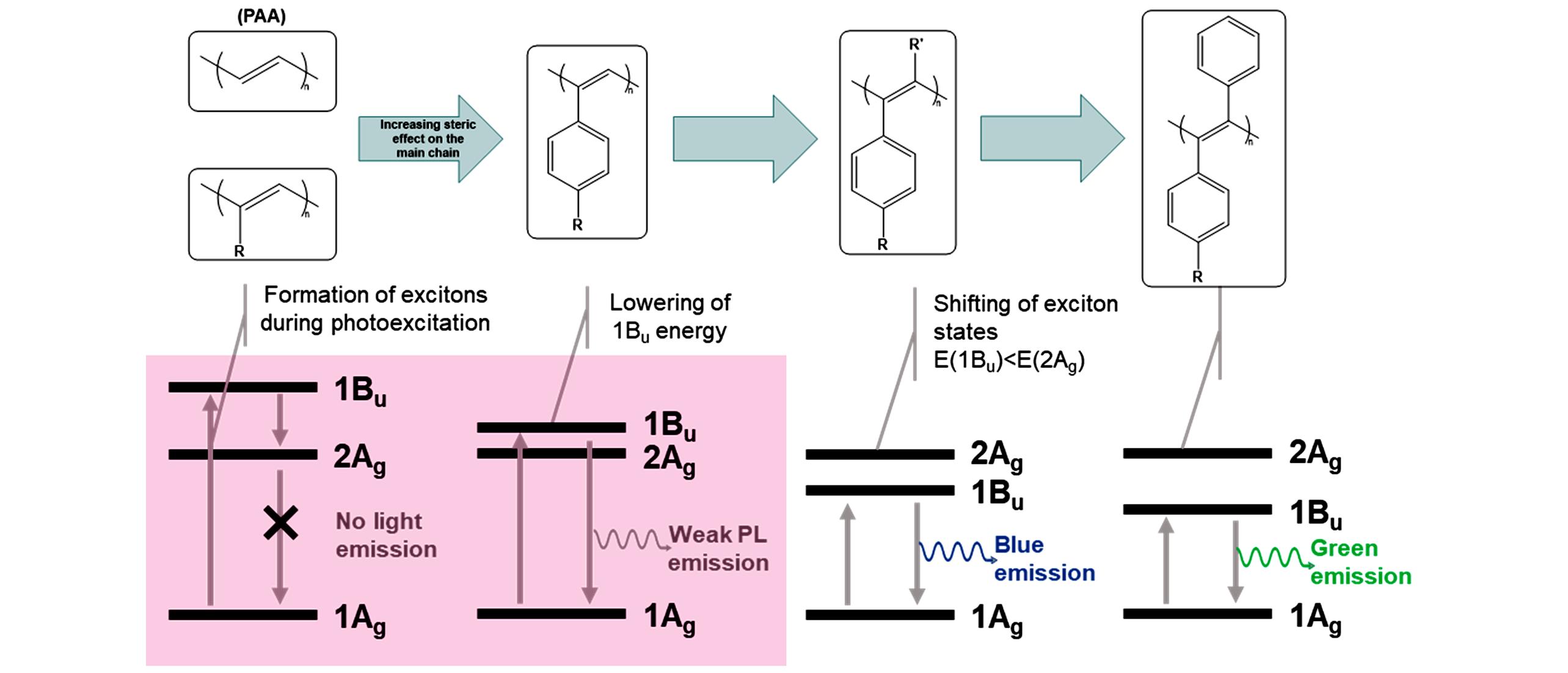
Fig.2 Electronic energy level diagrams of monosubstituted PAs with different structures[34]Copyright 2011, American Chemical Society
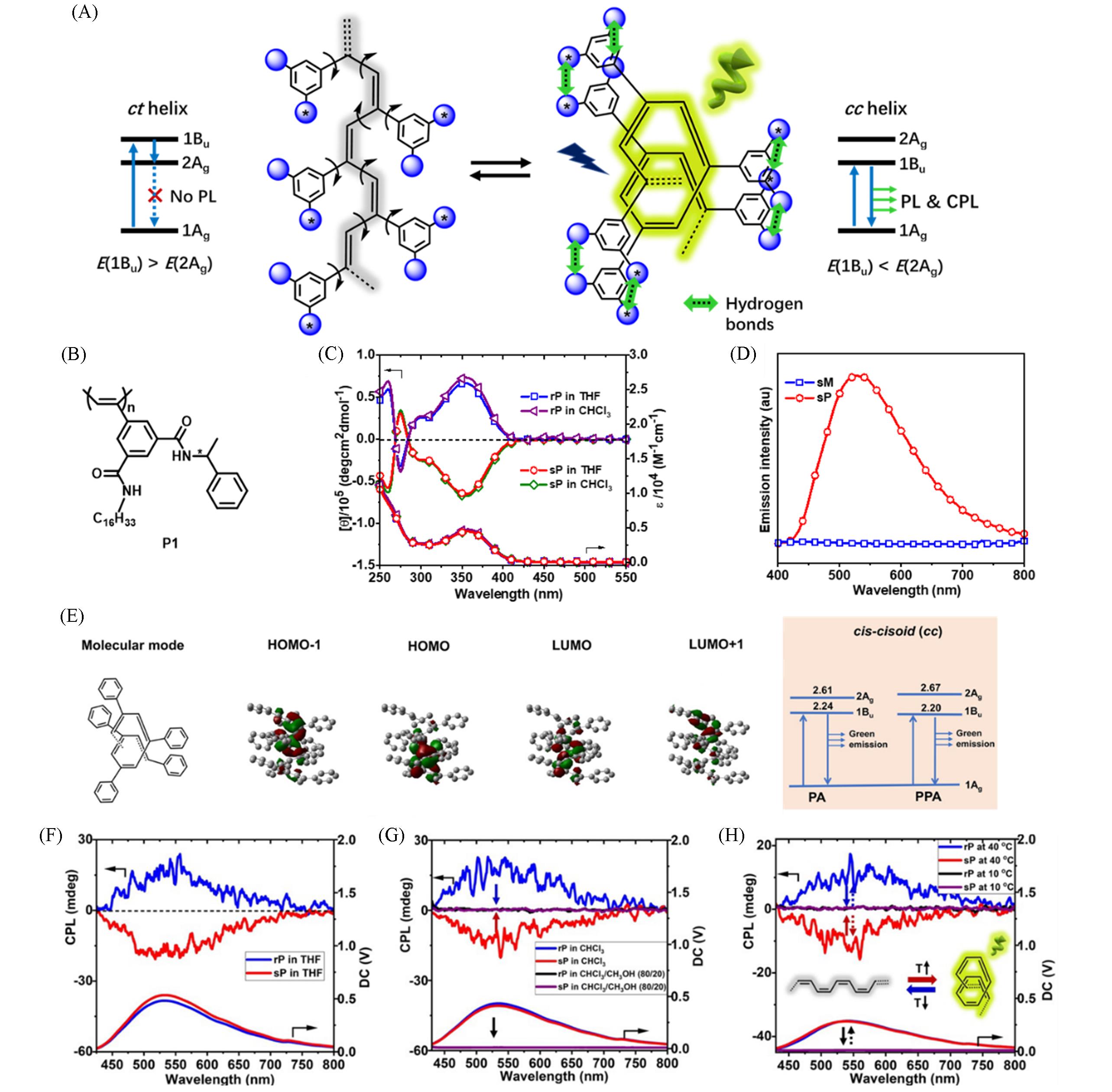
Fig.3 cc⁃ct conformational transition and electronic energy levels of PPA(A), chemical structure of polymer P1(B), CD spectra(C), fluorescence emission spectra(D) and calculated energy level variations of polyacetylene in the cc conformation(E), CPL spectra of the polymer(F), solvent effects on CPL(G) and temperature effects on CPL(H)[46]Copyright 2021, John Wiley & Sons Inc.
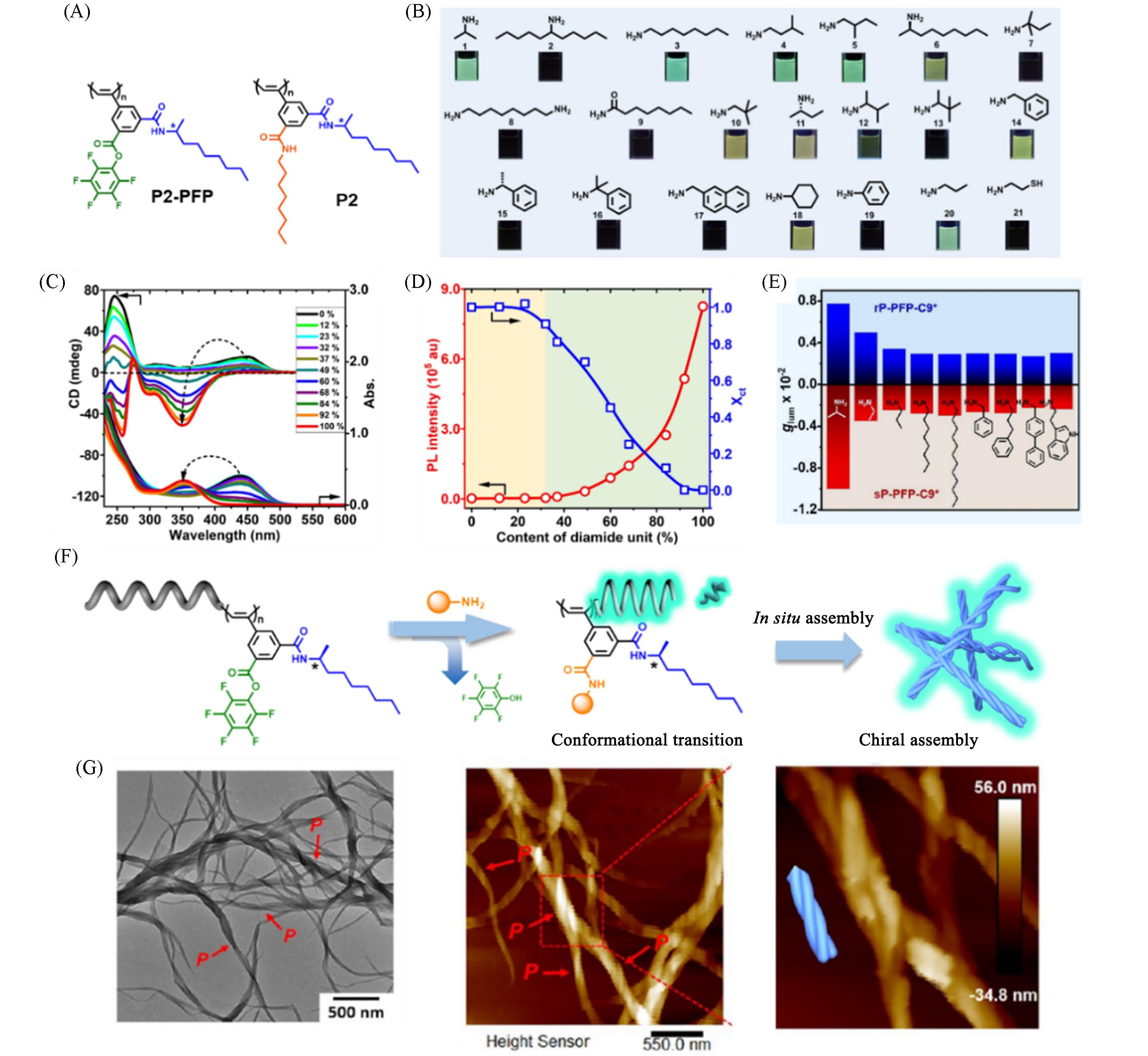
Fig.4 Chemical structures of P2⁃PFP and polymer P2(A), fluorescence results of P2⁃PFP after active ester⁃amine reactions with chiral amines(B), correlation between Xct and the CD and absorption spectra during the reaction(C), relationship between fluorescence emission and Xctafter the reaction(D), glum values of CPL spectra after active ester⁃amine reactions between the polymer and different amines(E)[47], schematic illustration of the self⁃assembly of P2 into chiral fibers(F) and TEM and AFM images of the chiral fibers formed after assembly of the P2 polymer(G)[48](A—E) Copyright 2021, John Wiley & Sons Inc.(F, G) Copyright 2025, American Chemical Society.
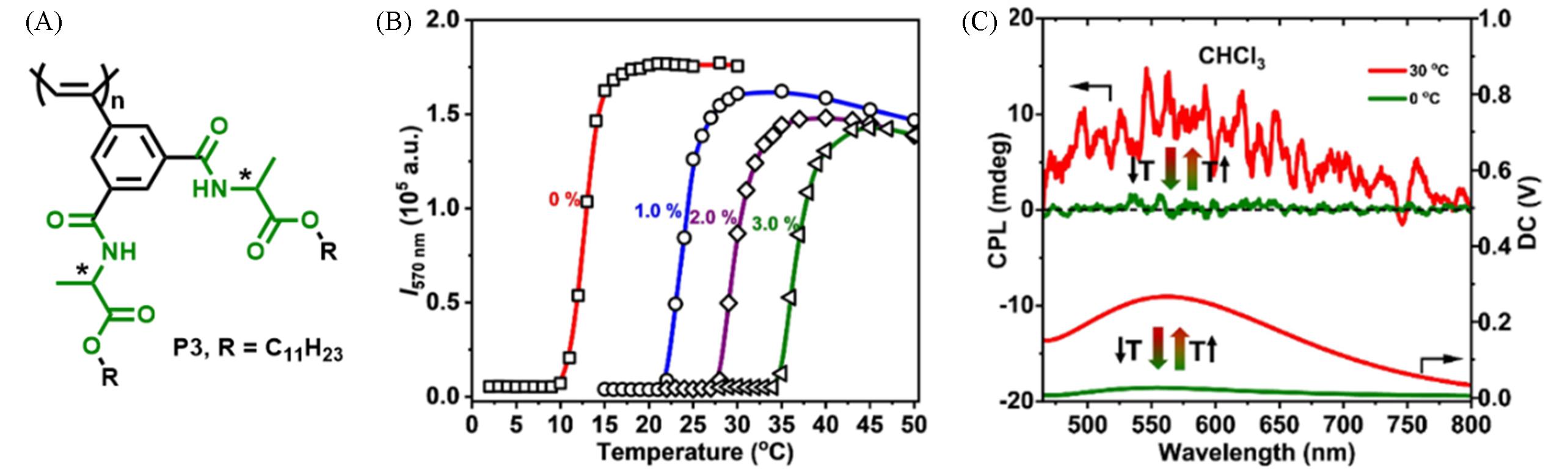
Fig.5 Chemical structure of polymer P3(A), dependence of the fluorescence intensity at 570 nm on temperature upon addition of different volume fractions of methanol(B) and temperature dependence of CPL(C)[49]Copyright 2023, John Wiley & Sons Inc.
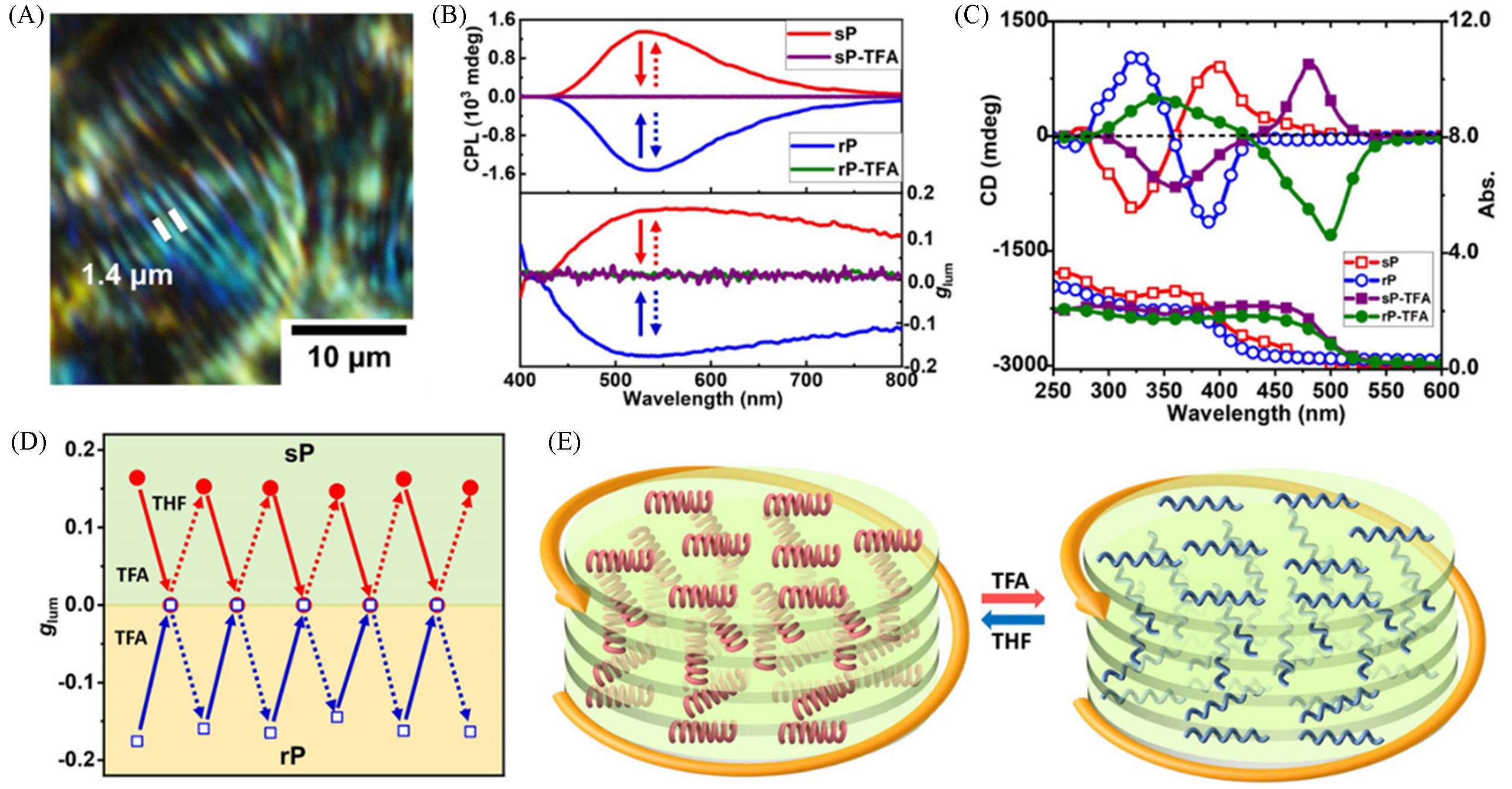
Fig.6 Characteristic fingerprint textures of the cholesteric liquid crystalline phase of polymer P1(A), CPL signals(B) and CD signals of the liquid crystalline film(C)[46]Copyright 2021, John Wiley & Sons Inc.
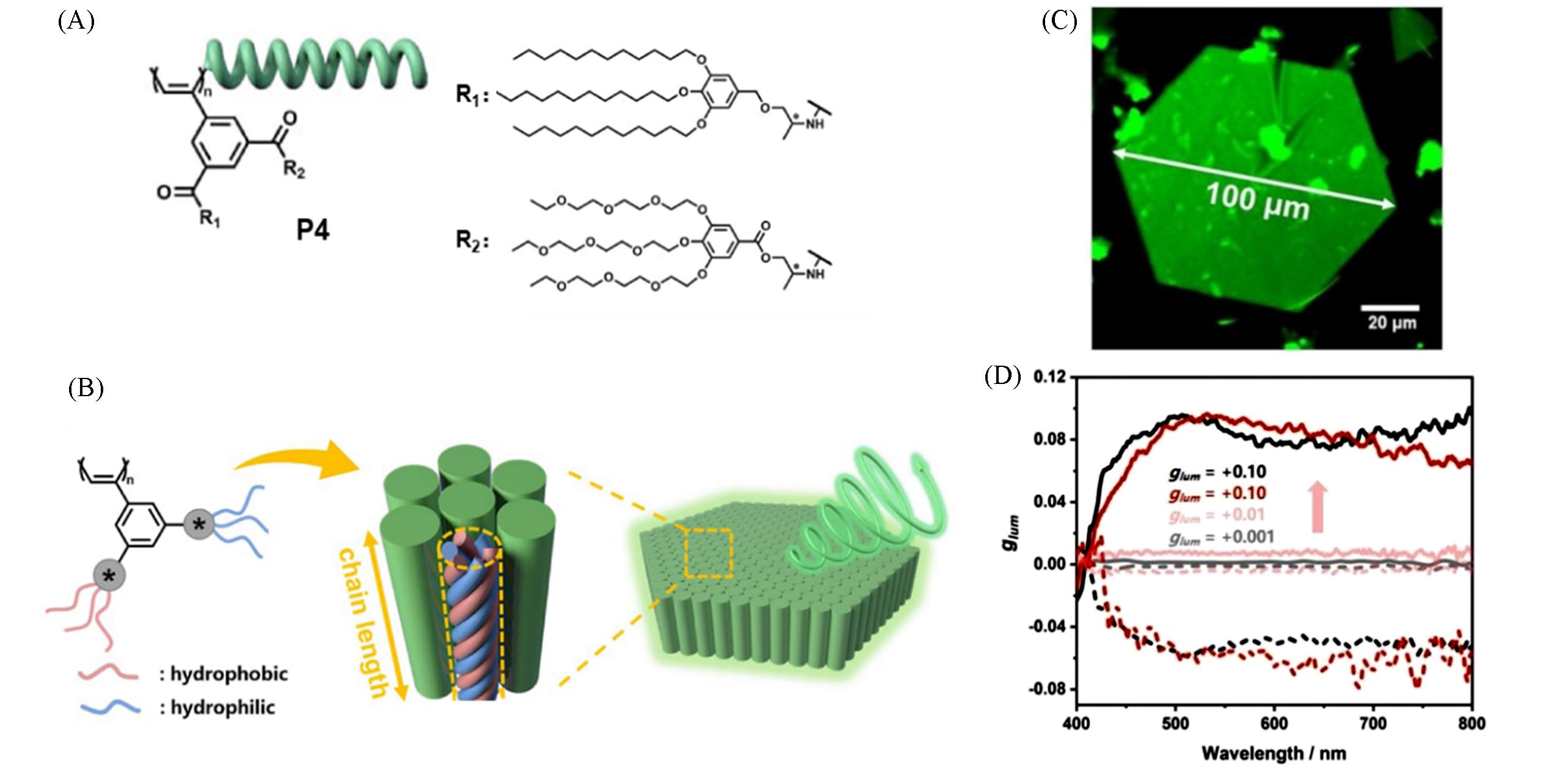
Fig.7 Chemical structure of polymer P4(A), schematic illustration of the self⁃assembled structures(B), hexagonal nanosheets observed by LSCM(C) and CPL spectra of the P4 polymer in solution and after self⁃assembly(D)[61]Copyright 2022, John Wiley & Sons Inc.
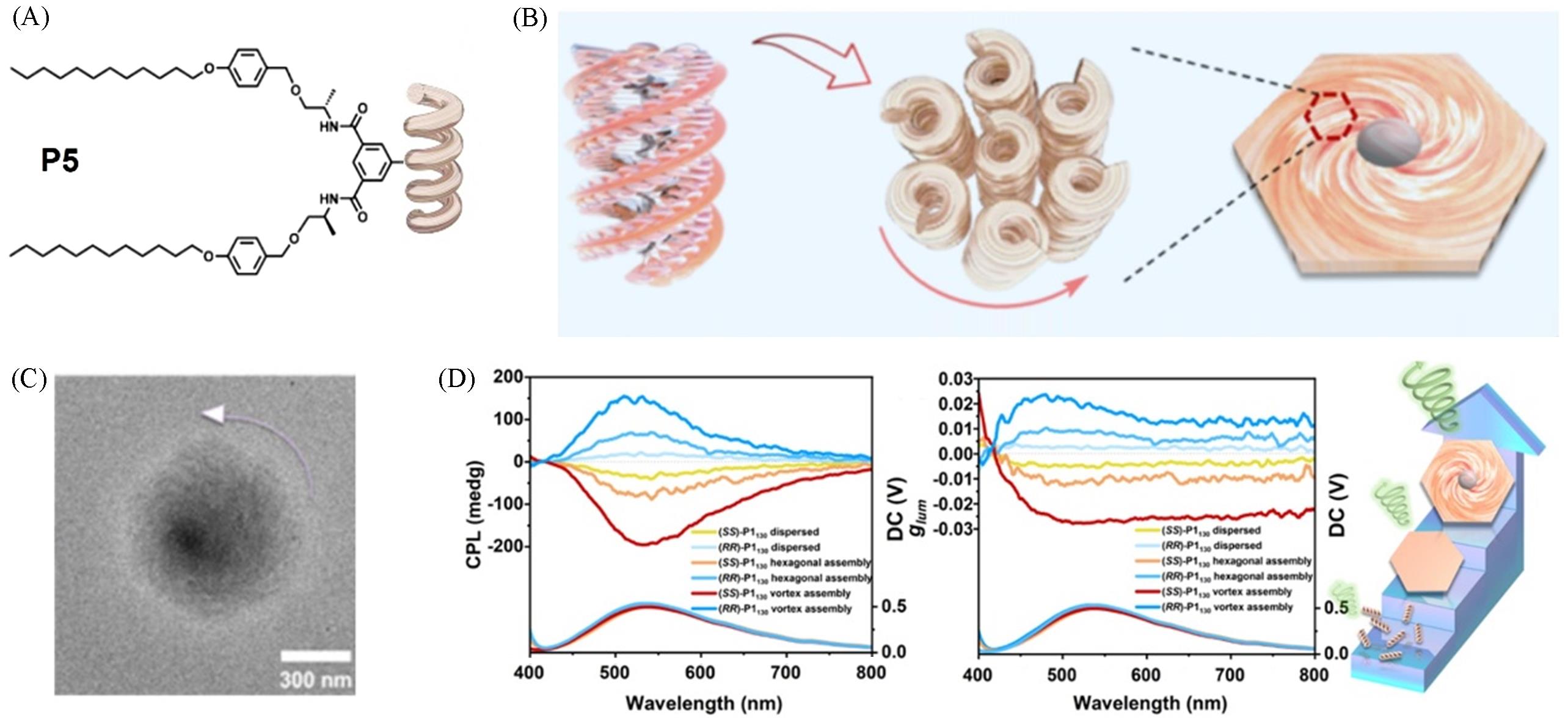
Fig.8 Chemical structure of polymer P5(A), schematic illustration of self⁃assembly into vortex⁃like lamellae(B), TEM image of the vortex⁃like lamellae(C) and CPL signals and corresponding glum values of the polymer in solution, in hexagonal two⁃dimensional structures and in vortex⁃like lamellae(D)[62]Copyright 2025, American Chemical Society
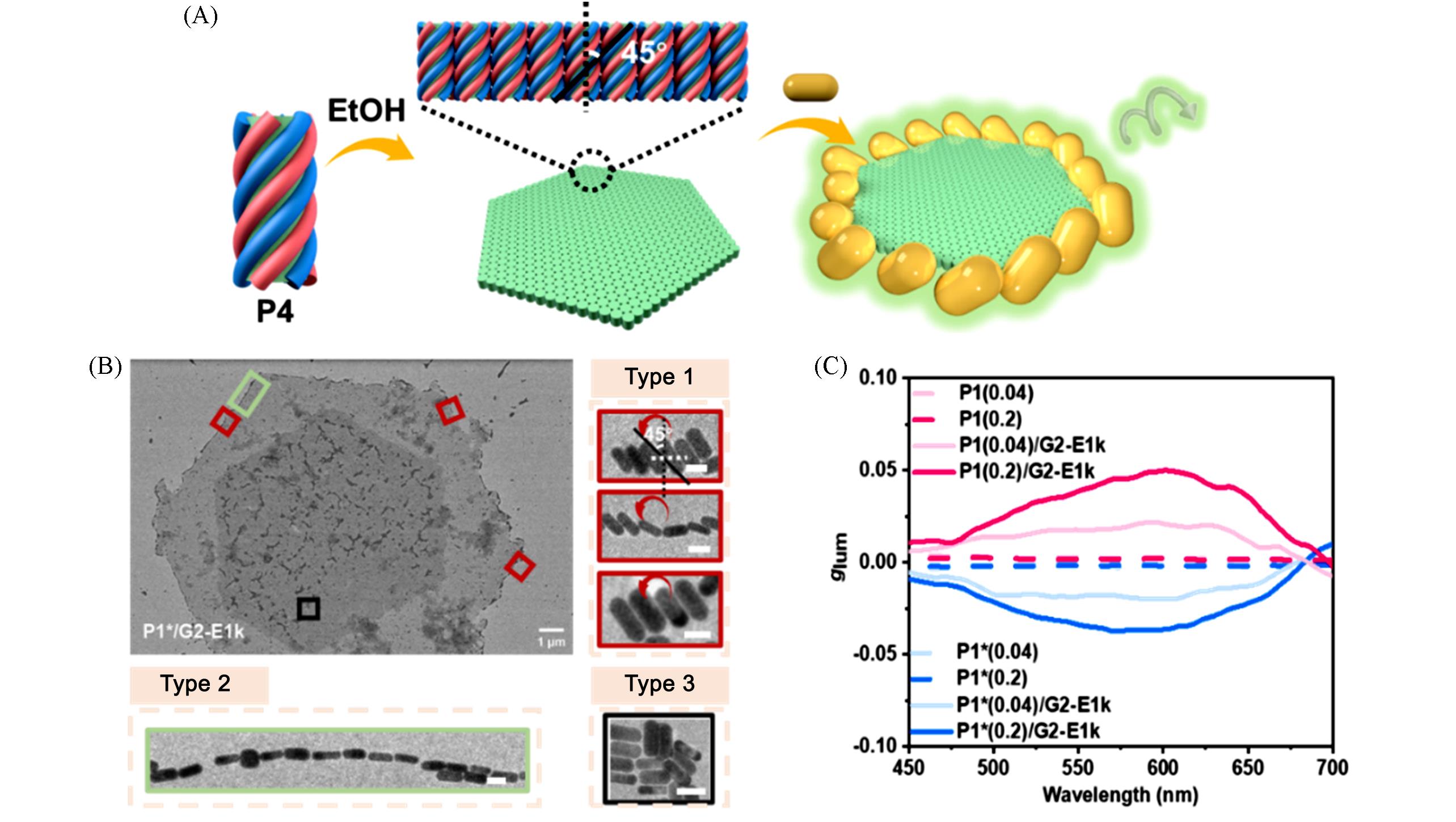
Fig.9 Schematic illustration of co⁃assembly of hexagonal assemblies of polymer P4 with gold nanorods(A) and corresponding TEM image(B), glum values of CPL for the polymer in solution, in two⁃dimensional assemblies and in co⁃assemblies with gold nanorods(C)[63]Copyright 2025, The Royal Society of Chemistry
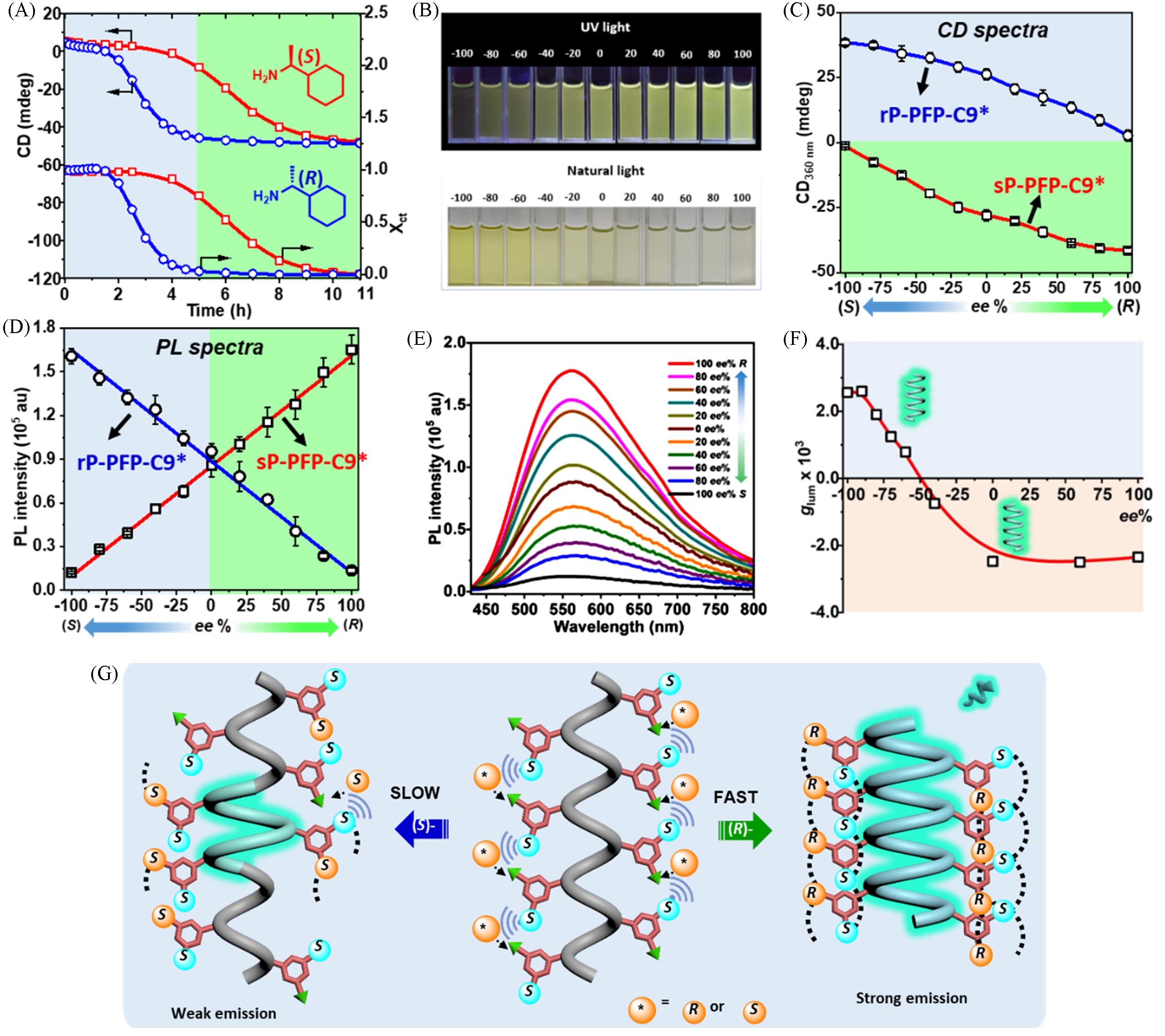
Fig.10 Time⁃dependent evolution of CD signals during the reaction of P2⁃PFP with 1⁃cyclohexylethylamines of different chiralities(A), color changes(B), CD spectra(C) and fluorescence emission spectra(D) of P2⁃PFP after reaction with 3⁃methyl⁃2⁃butanamine with different ee values, correlation between glum values after the reaction and the ee values of the chiral amine reactants(F) and schematic illustration of conformational transition induced by post⁃polymerization modification(G)[47]Copyright 2021, John Wiley & Sons Inc.
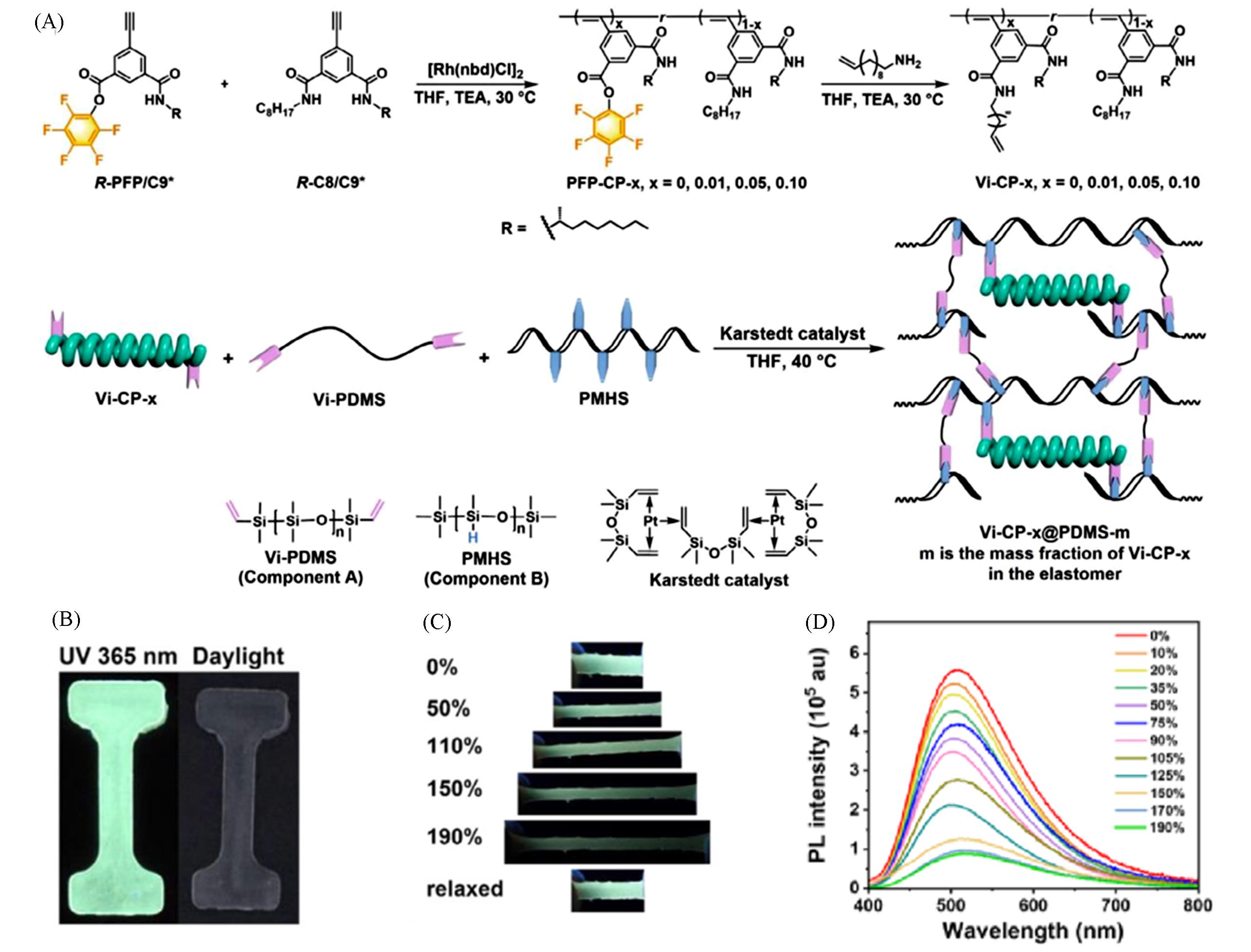
Fig.11 Synthetic route of MFC elastomers(A), dumbbell⁃shaped elastomer(B) and relationship between the degree of stretching and fluorescence observed by the naked eye(C) and fluorescence emission spectra as a function of stretching(D)[71]Copyright 2025, John Wiley & Sons Inc.
| [1] | Zhou Y., Wang Y., Song Y., Zhao S., Zhang M., Li G., Guo Q., Tong Z., Li Z., Jin S., Yao H. B., Zhu M., Zhuang T., Nat. Commun., 2024, 15(1), 251 |
| [2] | Shi Y., Han J., Li C., Zhao T., Jin X., Duan P., Nat. Commun., 2023, 14(1), 6123 |
| [3] | Han J., Guo S., Lu H., Liu S., Zhao Q., Huang W., Adv. Opt. Mater., 2018, 6(17), 1800538 |
| [4] | Zhang Y., Yu S., Han B., Zhou Y., Zhang X., Gao X., Tang Z., Matter, 2022, 5(3), 837—875 |
| [5] | Gong Z. L., Zhu X., Zhou Z., Zhang S., Dong Y., Zhao B., Zhang Y. P., Deng J., Cheng Y., Zheng Y. X., Zang S. Q., Kuang H., Duan P., Yuan M., Chen C. F., Zhao Y., Zhong Y. W., Tang B., Liu M., Sci. China Chem., 2021, 64 |
| [6] | Xu L. R., Wang J. Y., Huang J. T., He Q. Y., Lu S. L., Feng D. C., Ma Z. T., Yuan Z. K., Yang Y. Z., Chen X. D., Chin. J. Polym. Sci., 2025, 43(11), 2118—2127 |
| [7] | Zhang R., Song L., Yin W., Zhao B., Deng J., Sci. China Chem., 2025, 68(7), 3247—3259 |
| [8] | Shi L., Tian F., Wang S., Sci. China Chem., 2025, 68(8), 3429—3448 |
| [9] | Li W. J., Gu Q., Wang X. Q., Zhang D. Y., Wang Y. T., He X., Wang W., Yang H. B., Angew. Chem. Int. Ed., 2021, 60(17), 9507—9515 |
| [10] | Zhao T., Han J., Jin X., Liu Y., Liu M., Duan P., Angew. Chem., 2019, 131(15), 5032—5036 |
| [11] | Jiang J., Ma F., Dong R., Zhang S., Zhang Z., Tan H., Cai X., Qiu Z., Xiong Y., Han W., Zhao Z., Tang B. Z., J. Am. Chem. Soc., 2023, 145(50), 27282—27294 |
| [12] | Liao P., Zang S., Wu T., Jin H., Wang W., Huang J., Tang B. Z., Yan Y., Nat. Commun., 2021, 12(1), 5496 |
| [13] | Lin F., Zhang X., Zhao J., Shi S., Liu D., Wang K., Geng Z., Song F., Li F., Tang B. Z., Angew. Chem. Int. Ed., 2026, 65(2), e15768 |
| [14] | Ma J. L., Peng Q., Zhao C. H., Chemistry⁃A European Journal, 2019, 25(68), 15441—15454 |
| [15] | Zhao T., Han J., Duan P., Liu M., Acc. Chem. Res., 2020, 53(7), 1279—1292 |
| [16] | Yang S., Zhang S., Hu F., Han J., Li F., Coord. Chem. Rev., 2023, 485, 215116 |
| [17] | Watanabe K., Akagi K., Sci. Technol. Adv. Mater., 2014, 15(4), 044203 |
| [18] | Yu S. H., Wang L., Zhang M. C., Li H. K., Chin. J. Polym. Sci., 2025, 43(9), 1496—1504 |
| [19] | Zou H., Wu Q. L., Zhou L., Hou X. H., Liu N., Wu Z. Q., Chin. J. Polym. Sci., 2021, 39(12), 1521—1527 |
| [20] | Wang D., Hu D., Xue P., Yang W., Lai J., Wang Y., Shi J., Ma L., Ding K., Cai Y. P., Zhang Y., Li F., Zheng Q., Sci. China Chem., 2025, 68(6), 2660—2670 |
| [21] | Yashima E., Maeda K., Iida H., Furusho Y., Nagai K., Chem. Rev., 2009, 109(11), 6102—6211 |
| [22] | Cheuk K. K. L., Lam J. W. Y., Chen J., Lai L. M., Tang B. Z., Macromolecules, 2003, 36(16), 5947—5959 |
| [23] | Shi G., Wang S., Guan X., Zhang J., Wan X., Chem. Commun., 2018, 54(85), 12081—12084 |
| [24] | Maeda K., Mochizuki H., Watanabe M., Yashima E., J. Am. Chem. Soc., 2006, 128(23), 7639—7650 |
| [25] | Li S., Liu K., Kuang G., Masuda T., Zhang A., Macromolecules, 2014, 47(10), 3288—3296 |
| [26] | Louzao I., Seco J. M., Quiñoá E., Riguera R., Angew. Chem. Int. Ed., 2010, 49(8), 1430—1433 |
| [27] | Freire F., Seco J. M., Quiñoá E., Riguera R., Angew. Chem. Int. Ed., 2011, 50(49), 11692—11696 |
| [28] | Sakai R., Sakai N., Satoh T., Li W., Zhang A., Kakuchi T., Macromolecules, 2011, 44(11), 4249—4257 |
| [29] | Wang S., Feng X., Zhao Z., Zhang J., Wan X., Macromolecules, 2016, 49(22), 8407—8417 |
| [30] | Zhao Z., Wang S., Ye X., Zhang J., Wan X., ACS Macro Lett., 2017, 6(3), 205—209 |
| [31] | Freire F., Quiñoá E., Riguera R., Chem. Commun., 2017, 53(3), 481—492 |
| [32] | Sun Z. Z., Zhang Y. N., Qiu H. Y., Lu X. T., Ren L. X., Shen L. F., Li W., Zhang A., Chin. J. Polym. Sci., 2023, 41(10), 1543—1554 |
| [33] | Wang S., Zhang J., Wan X., Acta Polymerica Sinica, 2021, 52(08), 898—911 |
| 汪胜, 张洁, 宛新华. 高分子学报, 2021, 52(08), 898—911 | |
| [34] | San Jose B. A., Matsushita S., Moroishi Y., Akagi K., Macromolecules, 2011, 44(16), 6288—6302 |
| [35] | Zhao B., Pan K., Deng J., Macromolecules, 2018, 51(18), 7104—7111 |
| [36] | Wang S., Feng X., Zhao Z., Zhang J., Wan X., Macromolecules, 2016, 49(22), 8407—8417 |
| [37] | Wang S., Feng X., Zhang J., Yu P., Guo Z., Li Z., Wan X., Macromolecules, 2017, 50(9), 3489—3499 |
| [38] | Wang S., Chen J., Feng X., Shi G., Zhang J., Wan X., Macromolecules, 2017, 50(12), 4610—4615 |
| [39] | Wang S., Shi G., Guan X., Zhang J., Wan X., Macromolecules, 2018, 51(4), 1251—1259 |
| [40] | Wang S., Tan J., Guan X., Chen J., Zhang J., Wan X., Eur. Polym. J., 2019, 118, 312—319 |
| [41] | Chen J., Cai S., Wang R., Wang S., Zhang J., Wan X., Macromolecules, 2020, 53(5), 1638—1644 |
| [42] | Wang S., Feng X., Zhang J., Wan X., Chin. J. Chem., 2020, 38(6), 570—576 |
| [43] | Wang S., Cai S. L., Zhang J., Wan X. H., Chin. J. Polym. Sci., 2020, 38(7), 685—695 |
| [44] | Cai S., Chen J., Wang S., Zhang J., Wan X., Angew. Chem., 2021, 133(17), 9772—9778 |
| [45] | Guan X., Wang S., Shi G., Zhang J., Wan X., Macromolecules, 2021, 54(10), 4592—4600 |
| [46] | Wang S., Hu D., Guan X., Cai S., Shi G., Shuai Z., Zhang J., Peng Q., Wan X., Angew. Chem. Int. Ed., 2021, 60(40), 21918—21926 |
| [47] | Wang S., Xie S., Zeng H., Du H., Zhang J., Wan X., Angew. Chem. Int. Ed., 2022, 61(23), e202202268 |
| [48] | Wang S., Sun X., Zeng H., Xie S., Zhang J., Wan X., Macromolecules, 2025, 58(3), 1235—1244 |
| [49] | Wang S., Sun X., Zeng H., Zhang J., Wan X., Chem.⁃Eur. J., 2023, 29(42), e202301080 |
| [50] | Chen W., Ma K., Duan P., Ouyang G., Zhu X., Zhang L., Liu M., Nanoscale, 2020, 12(38), 19497—19515 |
| [51] | Sang Y., Han J., Zhao T., Duan P., Liu M., Adv. Mater., 2020, 32(41), 1900110 |
| [52] | Elsabahy M., Heo G. S., Lim S. M., Sun G., Wooley K. L., Chem. Rev., 2015, 115(19), 10967—11011 |
| [53] | Tanner P., Baumann P., Enea R., Onaca O., Palivan C., Meier W., Acc. Chem. Res., 2011, 44(10), 1039—1049 |
| [54] | Kim H. C., Park S. M., Hinsberg W. D., Chem. Rev., 2010, 110(1), 146—177 |
| [55] | San Jose B. A., Matsushita S., Akagi K., J. Am. Chem. Soc., 2012, 134(48), 19795—19807 |
| [56] | Ma J., Fang C., Chen C., Jin L., Wang J., Wang S., Tang J., Li D., ACS Nano, 2019, 13(3), 3659—3665 |
| [57] | Wang X., Han X., Cheng C., Kang X., Liu Y., Cui Y., J. Am. Chem. Soc., 2022, 144(16), 7366—7373 |
| [58] | Liu Y., Liu L., Chen X., Liu Y., Han Y., Cui Y., J. Am. Chem. Soc., 2021, 143(9), 3509—3518 |
| [59] | Sun B., Kim Y., Wang Y., Wang H., Kim J., Liu X., Lee M., Nat. Mater., 2018, 17(7), 599—604 |
| [60] | Cai S., Chen J., Wang S., Zhang J., Wan X., Angew. Chem., 2021, 133(17), 9772—9778 |
| [61] | Cai S., Huang Y., Xie S., Wang S., Guan Y., Wan X., Zhang J., Angew. Chem. Int. Ed., 2022, 61(52), e202214293 |
| [62] | Huang Y., Kang S., Cai S., Zhang Z., Yu P., Sun X., Wan X., Zhang J., J. Am. Chem. Soc., 2025, 147(44), 40849—40858 |
| [63] | Yu P., Zhao W., Huang Y., Zeng H., Wan X., Zhang J., J. Mater. Chem. C, 2025, 13(15), 7502—7508 |
| [64] | Yan D., Ma Y., Wang H., Jia W., Niu X., Wang H., Zou W., Wang L., Green Chem., 2025, 27(25), 7564—7574 |
| [65] | Davis D. A., Hamilton A., Yang J., Cremar L. D., Van Gough D., Potisek S. L., Ong M. T., Braun P. V., Martínez T. J., White S. R., Moore J. S., Sottos N. R., Nat., 2009, 459(7243), 68—72 |
| [66] | Liu C., Xiao G., Yang M., Zou B., Zhang Z. L., Pang D. W., Angew. Chem. Int. Ed., 2018, 57(7), 1893—1897 |
| [67] | Caruso M. M., Davis D. A., Shen Q., Odom S. A., Sottos N. R., White S. R., Moore J. S., Chem. Rev., 2009, 109(11), 5755—5798 |
| [68] | Cao B. H., Chen W., Wei W. Y., Chen Y. L., Yuan Y., Chin. J. Polym. Sci., 2021, 39(11), 1403—1411 |
| [69] | Kiebala D. J., Style R., Vanhecke D., Calvino C., Weder C., Schrettl S., Adv. Funct. Mater., 2023, 33(50), 2304938 |
| [70] | Yamakado T., Saito S., J. Am. Chem. Soc., 2022, 144(6), 2804—2815 |
| [71] | Kang S. M., Chen M. X., Li Y., Sun X., Liu Y., Wang S., Zhang J., Wan X., Angew. Chem. Int. Ed., 2025, 64(45), e202513866 |
| [1] | 李伟健, 徐小琴, 王威, 杨海波. 聚集诱导发光树枝状分子的研究进展[J]. 高等学校化学学报, 2026, 47(5): 20260003. |
| [2] | 武宇乾, 夏阳, 李琬卉, 王小野. 基于非手性聚合物的共组装圆偏振发光材料[J]. 高等学校化学学报, 2026, 47(5): 20260006. |
| [3] | 马欢, 董世龙, 杨均成, 祝海涛, 冯海涛. 基于杯[4]芳烃的手性AIEgen用于酸及氨基酸的对映选择性识别[J]. 高等学校化学学报, 2026, 47(4): 20260049. |
| [4] | 吴泽怡, 司文妮, 齐春轩, 李朔, 冯海涛. 基于三苯胺的红光手性荧光探针的构筑及手性识别性能[J]. 高等学校化学学报, 2026, 47(4): 20250258. |
| [5] | 程建硕, 叶文彦, 周璐璐, 刘谋为, 李忠宇, 唐子然, 俞婉婷, 朱亮亮. 光激发诱导的生物大分子自组装[J]. 高等学校化学学报, 2026, 47(4): 20250398. |
| [6] | 黄华琛, 徐广海, 韩媛媛, 崔杰. 环形ABC三嵌段共聚物在A嵌段选择性溶剂中自组装行为的Monte Carlo模拟[J]. 高等学校化学学报, 2025, 46(5): 20250012. |
| [7] | 李嘉明, 王丹, 冯玉军, 殷鸿尧. 油酰二乙醇胺在丙三醇/水混合溶剂中的自组装及流变性能[J]. 高等学校化学学报, 2025, 46(4): 20240528. |
| [8] | 谭晓萍, 吴宏伟, 王丹丹, 张金, 章俊辉. 手性金纳米探针用于药物分子对映体的比色检测[J]. 高等学校化学学报, 2025, 46(2): 20240352. |
| [9] | 陈晓萍, 黄士, 郭千千, 刘宁, 倪建聪, 杨伟强, 林振宇. 镓铟共晶-自组装单分子层的功能性分子结研究进展[J]. 高等学校化学学报, 2025, 46(2): 20240451. |
| [10] | 白乙艳, 王晨阳, 高阳, 李佳敏, 杨海英. 基于单颗粒碰撞电化学的烷硫醇在纳米金表面的自组装行为[J]. 高等学校化学学报, 2025, 46(2): 20240402. |
| [11] | 吴燕茹, 李安明, 高美华, 庄文昌. 十二烷基磺酸钠在正丙醇/水混合溶液中囊泡的形成及性能[J]. 高等学校化学学报, 2025, 46(11): 20250210. |
| [12] | 李勇, 李燕, 杨景儿, 王柏萍, 尹君雅, 耿鹏, 杨扬, 黄文权. 超声辅助自组装构建多功能铁-原卟啉纳米粒及多模态肿瘤治疗[J]. 高等学校化学学报, 2025, 46(11): 20250176. |
| [13] | 陈俊年, 张海峰, 王海兵, 杨火诚, 罗忠. 基于超分子纳米递送系统的精准医疗研究进展[J]. 高等学校化学学报, 2025, 46(1): 20240267. |
| [14] | 段一雄, 杨柏, 李云峰. 纤维素纳米晶的空间受限自组装: 从胶体液晶到功能材料[J]. 高等学校化学学报, 2023, 44(2): 20220474. |
| [15] | 雷娜娜, 杨守业, 范黎明, 陈晓. 低共熔溶剂中多色稀土发光增强超分子凝胶的构筑及性能[J]. 高等学校化学学报, 2023, 44(12): 20230389. |
| 阅读次数 | ||||||
|
全文 |
|
|||||
|
摘要 |
|
|||||
