

高等学校化学学报 ›› 2026, Vol. 47 ›› Issue (10): 20260067.doi: 10.7503/cjcu20260067
冯靖淇1,2, 樊春海3, 陈静4( )
)
收稿日期:2026-02-02
出版日期:2026-10-10
发布日期:2026-08-29
通讯作者:
陈静
E-mail:chenjing929@shu.edu.cn
基金资助:
FENG Jingqi1,2, FAN Chunhai3, CHEN Jing4()
Received:2026-02-02
Online:2026-10-10
Published:2026-08-29
Contact:
CHEN Jing
E-mail:chenjing929@shu.edu.cn
Supported by:摘要:
金纳米团簇(Au NCs)具有原子级精确的结构, 核心尺寸在1~3 nm范围内, 是连接有机金属分子与传统金纳米颗粒的独特体系, 兼具类分子特性与纳米材料优势, 其从分子态到金属态的转变是纳米科学领域的核心问题之一. 大尺寸(>100个金原子)金纳米团簇随尺寸增大, 能级逐渐从离散向连续转变, 呈现金属特性. 然而, 这一转变并非仅由尺寸决定, 在特定的临界尺寸区域内, 团簇的金属性还受到晶体结构、 几何形貌等多重因素的协同调控. 在临界尺寸区域内, 团簇呈现出兼具分子性与金属性的双重特性, 该特性受晶体结构、 几何形貌等多重因素协同调控, 针对这一区域的研究已广泛且深入地开展. 本文综合评述了大尺寸金纳米团簇金属性演化的研究进展, 概述了非金属性、 金属性及临界区域团簇的尺寸、 结构与金属性间的构效关系, 梳理了金属性的测定判据与关键研究技术. 最后, 讨论了该领域未来的挑战和发展方向.
中图分类号:
TrendMD:
冯靖淇, 樊春海, 陈静. 尺寸与结构对金纳米团簇金属性演化的协同调控. 高等学校化学学报, 2026, 47(10): 20260067.
FENG Jingqi, FAN Chunhai, CHEN Jing. Synergistic Regulation of Size and Structure on the Metallicity Evolution of Gold Nanoclusters. Chem. J. Chinese Universities, 2026, 47(10): 20260067.
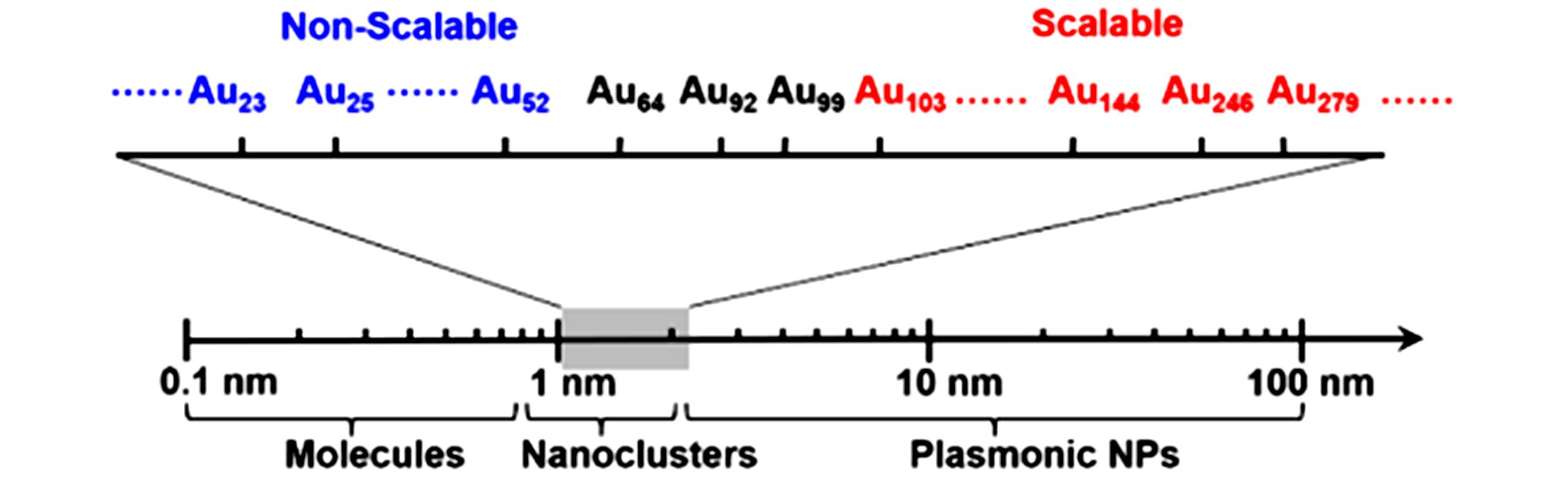
Fig.1 Size evolution of metallicity and non⁃metallicity[23]Copyright 2019, American Chemical Society.
| Au NCs | Core structure | Metallicity | Determination criteria | Research methods | Ref. |
|---|---|---|---|---|---|
| Au102 | Marks decahedron | No | Exhibits multiple characteristic absorption peaks | Single⁃crystal X⁃ray diffraction(SC⁃XRD), UV⁃Vis⁃NIR absorption spectroscopy, and theoretical calculation | [ |
| Au110 | Face centered cubic(fcc) | No | Electron⁃phonon coupling is power⁃law dependent; no surface plasmon resonance absorption | SC⁃XRD and femtosecond absorption spectroscopy | [ |
| Au130 | Truncated decahedron | No | Exhibits multiple characteristic absorption peaks; electron⁃phonon coupling is power⁃law dependent | SC⁃XRD, scanning/transmission electron microscopy(STEM), UV⁃Vis⁃NIR absorp⁃tion spectroscopy, femtosecond absorption spectroscopy, and electrochemical characterization | [ |
| Au133 | Icosahedron | No | Electron⁃phonon coupling is independent of power law | SC⁃XRD, high resolution electrospray ionization mass spectrometry(ESI⁃MS), femtosecond absorption spectroscopy, and electrochemical characterization | [ |
| Au144 | Cage⁃like hollow icosahedron | Critical(dual characteristics) | Electron⁃phonon coupling shows weak power⁃law dependence; multiple characteristic absorption peaks for charge carriers | SC⁃XRD, ESI⁃MS, femtosecond absorption spectroscopy, and electrochemical characterization | [ |
| Au156 | Rod⁃like core with homologous structure(long⁃axis short⁃axis Anisotropy) | Critical | Exhibits multiple characteristic absorption peaks; long⁃axis electron⁃phonon coupling is power⁃law dependent; short⁃axis shows distinct characteristics | SC⁃XRD, UV⁃Vis⁃NIR absorption spectroscopy, and femtosecond absorption spectroscopy | [ |
| Au191 | Monotwinned/ stacking⁃faulted fcc structure | Critical | Exhibits multiple characteristic absorption peaks; weak electron⁃phonon coupling; no plasmon resonance after ligand removal | SC⁃XRD, UV⁃Vis⁃NIR absorption spectroscopy, and theoretical calculation | [ |
| Au246 | Multiple⁃twin fivefold symmetry | No | Exhibits multiple characteristic absorption peaks; electron⁃phonon coupling is independent of power law | SC⁃XRD, UV⁃Vis⁃NIR absorption spectroscopy, and femtosecond absorption spectroscopy | [ |
| Au279 | Truncated octahedron (similar to fcc arrangement) | Yes | Ground⁃state absorption shows a single broad peak; no discrete peaks in the fluorescence spectrum; electron⁃ phonon coupling is independent of power law | SC⁃XRD, UV⁃Vis⁃NIR absorption spectroscopy, variable⁃temperature spectroscopy, and femtosecond absorption spectroscopy | [ |
| Au317 | fcc | Yes | Absorption spectrum shows a single broad peak; non⁃continuous electron state distribution near the Fermi level | Theoretical calculation | [ |
| Au333 | fcc | Yes | Absorption spectrum shows a single broad peak; prominent plasmon peak in the fluorescence spectrum; electron⁃phonon coupling is independent of power law | High⁃angle annular dark⁃field STEM(HAADF⁃STEM), UV⁃Vis⁃NIR absorption spectroscopy, femtosecond absorption spectroscopy, and variable⁃temperature spectroscopy | [ |
| Au~520 | fcc | Yes | Exhibits strong localized surface plasmon resonance; electronic structure is continuous | Mass spectrometry and HAADF⁃STEM | [ |
| Au~1000 | fcc | Yes | Significant surface plasmon resonance absorption | High⁃resolution transmission electron microscopy(HRTEM) and XRD | [ |
Table 1 Core structure, determination criteria and research methods of metallicity in gold nanoclusters(>100 Au atoms)
| Au NCs | Core structure | Metallicity | Determination criteria | Research methods | Ref. |
|---|---|---|---|---|---|
| Au102 | Marks decahedron | No | Exhibits multiple characteristic absorption peaks | Single⁃crystal X⁃ray diffraction(SC⁃XRD), UV⁃Vis⁃NIR absorption spectroscopy, and theoretical calculation | [ |
| Au110 | Face centered cubic(fcc) | No | Electron⁃phonon coupling is power⁃law dependent; no surface plasmon resonance absorption | SC⁃XRD and femtosecond absorption spectroscopy | [ |
| Au130 | Truncated decahedron | No | Exhibits multiple characteristic absorption peaks; electron⁃phonon coupling is power⁃law dependent | SC⁃XRD, scanning/transmission electron microscopy(STEM), UV⁃Vis⁃NIR absorp⁃tion spectroscopy, femtosecond absorption spectroscopy, and electrochemical characterization | [ |
| Au133 | Icosahedron | No | Electron⁃phonon coupling is independent of power law | SC⁃XRD, high resolution electrospray ionization mass spectrometry(ESI⁃MS), femtosecond absorption spectroscopy, and electrochemical characterization | [ |
| Au144 | Cage⁃like hollow icosahedron | Critical(dual characteristics) | Electron⁃phonon coupling shows weak power⁃law dependence; multiple characteristic absorption peaks for charge carriers | SC⁃XRD, ESI⁃MS, femtosecond absorption spectroscopy, and electrochemical characterization | [ |
| Au156 | Rod⁃like core with homologous structure(long⁃axis short⁃axis Anisotropy) | Critical | Exhibits multiple characteristic absorption peaks; long⁃axis electron⁃phonon coupling is power⁃law dependent; short⁃axis shows distinct characteristics | SC⁃XRD, UV⁃Vis⁃NIR absorption spectroscopy, and femtosecond absorption spectroscopy | [ |
| Au191 | Monotwinned/ stacking⁃faulted fcc structure | Critical | Exhibits multiple characteristic absorption peaks; weak electron⁃phonon coupling; no plasmon resonance after ligand removal | SC⁃XRD, UV⁃Vis⁃NIR absorption spectroscopy, and theoretical calculation | [ |
| Au246 | Multiple⁃twin fivefold symmetry | No | Exhibits multiple characteristic absorption peaks; electron⁃phonon coupling is independent of power law | SC⁃XRD, UV⁃Vis⁃NIR absorption spectroscopy, and femtosecond absorption spectroscopy | [ |
| Au279 | Truncated octahedron (similar to fcc arrangement) | Yes | Ground⁃state absorption shows a single broad peak; no discrete peaks in the fluorescence spectrum; electron⁃ phonon coupling is independent of power law | SC⁃XRD, UV⁃Vis⁃NIR absorption spectroscopy, variable⁃temperature spectroscopy, and femtosecond absorption spectroscopy | [ |
| Au317 | fcc | Yes | Absorption spectrum shows a single broad peak; non⁃continuous electron state distribution near the Fermi level | Theoretical calculation | [ |
| Au333 | fcc | Yes | Absorption spectrum shows a single broad peak; prominent plasmon peak in the fluorescence spectrum; electron⁃phonon coupling is independent of power law | High⁃angle annular dark⁃field STEM(HAADF⁃STEM), UV⁃Vis⁃NIR absorption spectroscopy, femtosecond absorption spectroscopy, and variable⁃temperature spectroscopy | [ |
| Au~520 | fcc | Yes | Exhibits strong localized surface plasmon resonance; electronic structure is continuous | Mass spectrometry and HAADF⁃STEM | [ |
| Au~1000 | fcc | Yes | Significant surface plasmon resonance absorption | High⁃resolution transmission electron microscopy(HRTEM) and XRD | [ |
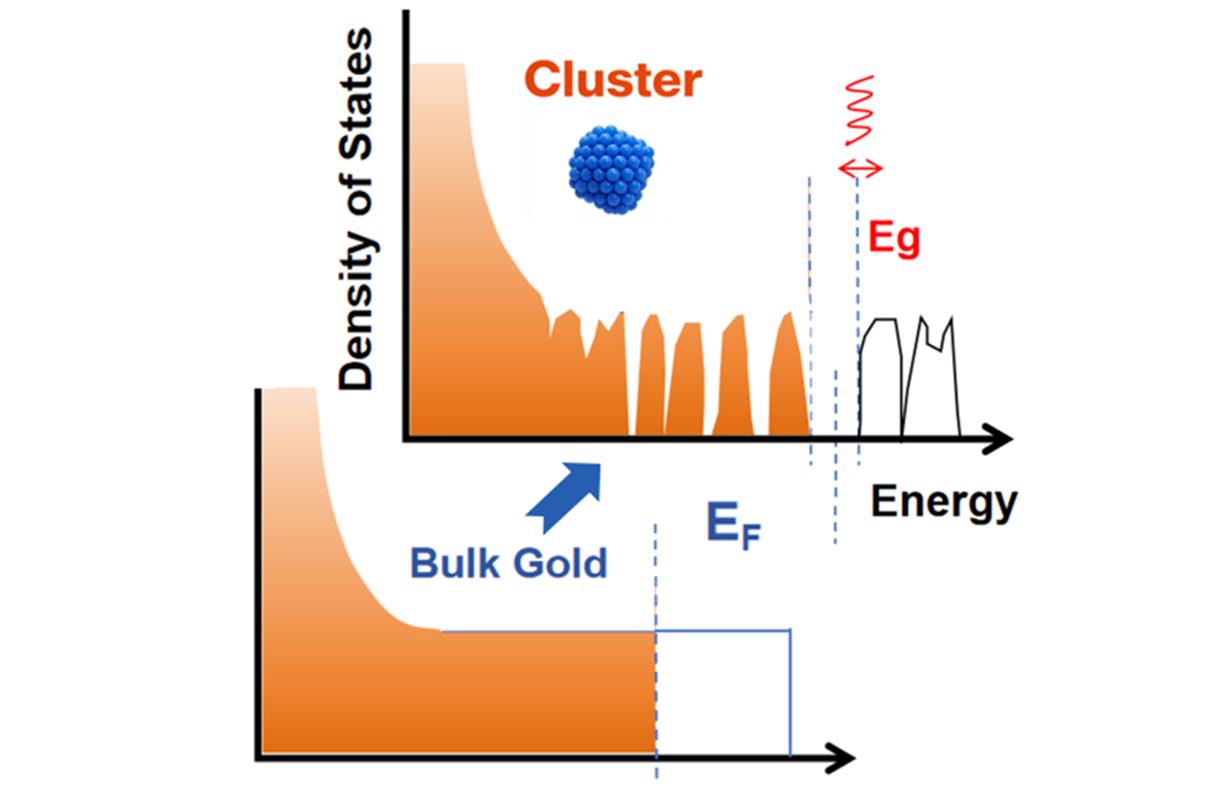
Fig.2 Evolution from continuous energy bands to discrete energy levels[26]Copyright 2009, American Chemical Society.
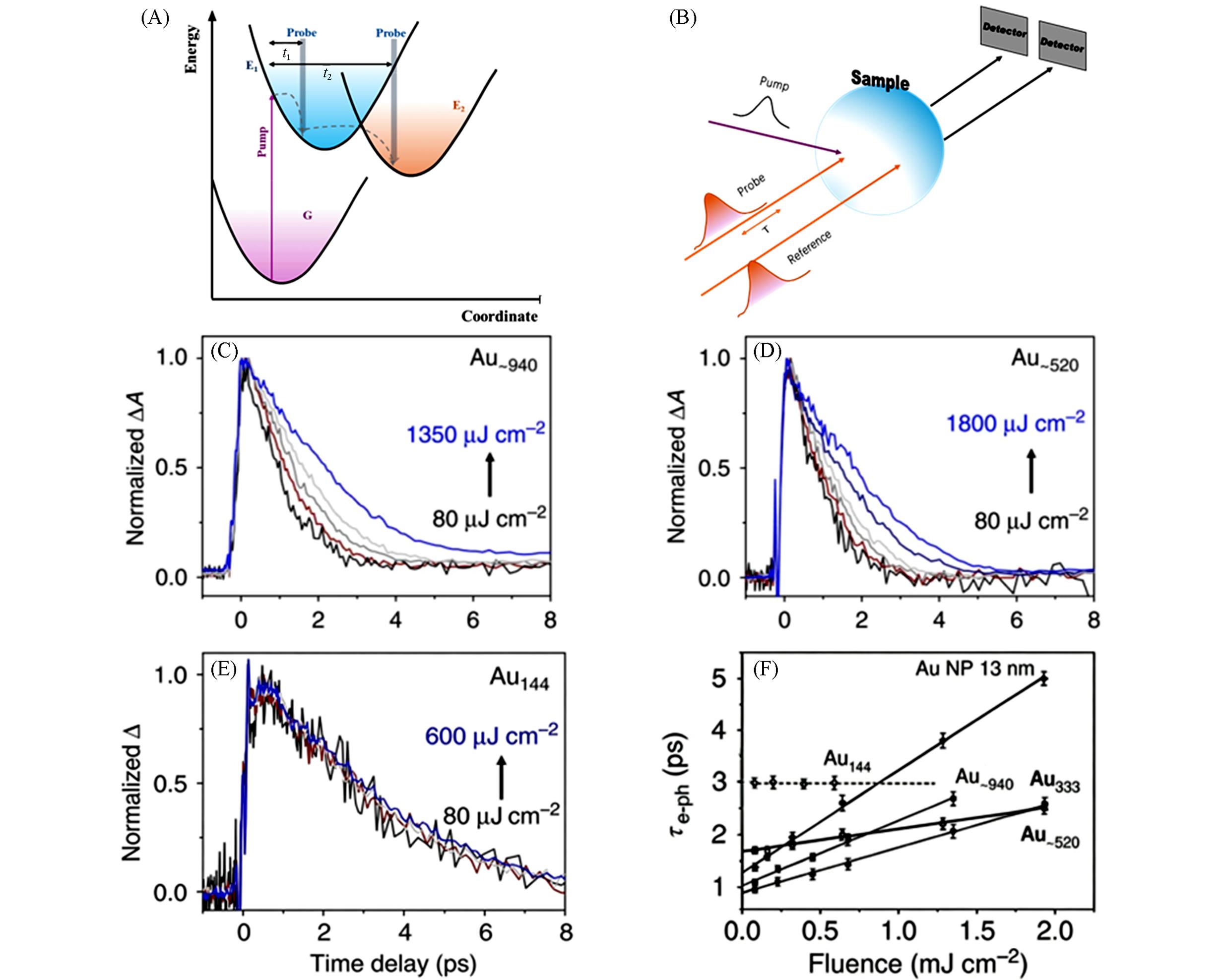
Fig.3 Schematic diagrams of transient absorption(TA) detection principle(A) and TA detection technique(B), electron⁃phonon coupling dynamic curves of Au~940(C), Au~520(D), Au144(E), and Au NP and Au NCs under different pump powers(F)[28](C—F) Copyright 2016, Open acess.
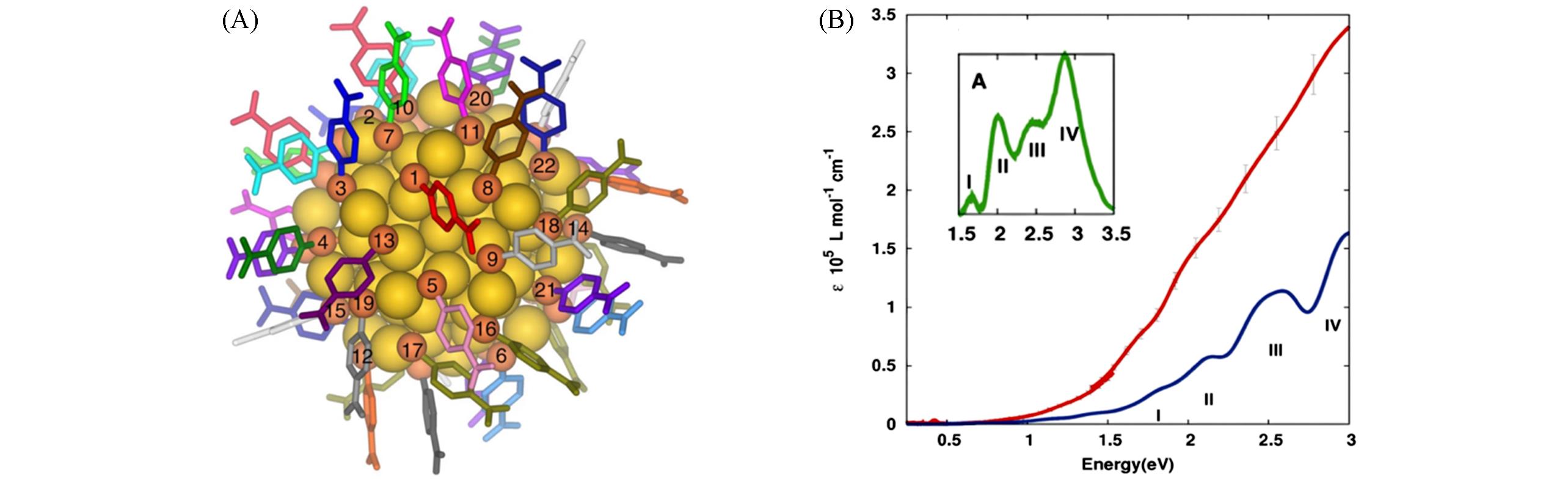
Fig.4 Total structure, with numbering and unique colouring of all the 22 symmetry⁃unique ligands(A)[58] and experimental and theoretical absorption spectra of Au102(p⁃MBA)44 nanoclusters(B)[35](A) The same numbering scheme is used throughout this paper. Gold is yellow and sulfur is orange. (B) The red curve represents the experimentally measured absolute molar absorption coefficient, and the blue curve shows the LR-TDDFT calculation results based on the Au102(SMe)44 model. The inset marks the characteristic peaks(I—IV) in the range of 1.5—3.5 eV, and the main plot shows that the electronic transition starts at ~0.45 eV in the mid-infrared region, which is highly consistent with the theoretically predicted band gap of 0.55 eV.(A) Copyright 2016, Open Acess; (B) Copyright 2011, American Chemical Society.
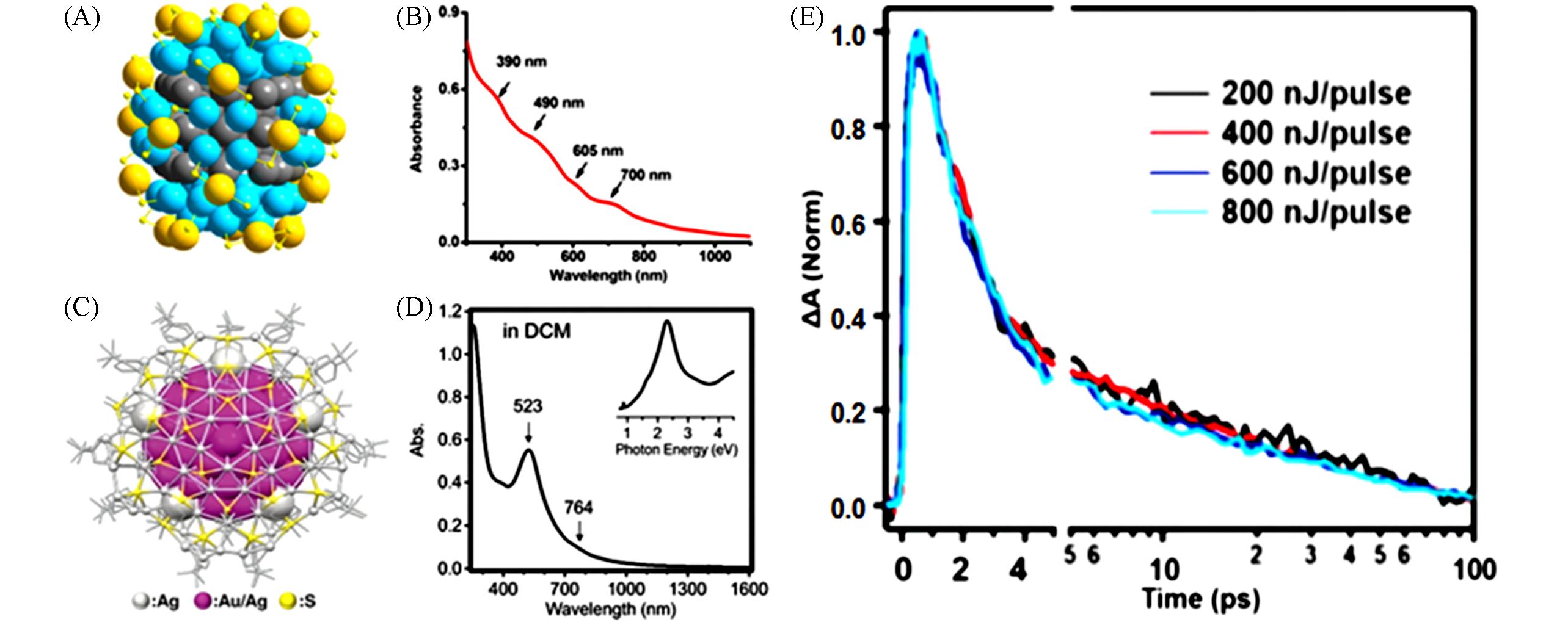
Fig.5 Structure of Au130(p⁃MBT)50(A)[41], steady⁃state UV⁃Vis⁃NIR absorption spectrum of Au130(p⁃MBT)50(B)[43], atomic structure of Au130-x Ag x alloy nanoclusters(C) steady⁃state UV⁃Vis⁃NIR absorption spectra of Au130-x Ag x alloy nanoclusters(D) and pump⁃energy⁃dependent ultrafast dynamics of Au130-x Ag x alloy nanoclusters(E)[60](A) Copyright 2015, American Chemical Society; (B) Copyright 2017, American Chemical Society; (C—E) Copyright 2019, John Wiley and Sons.
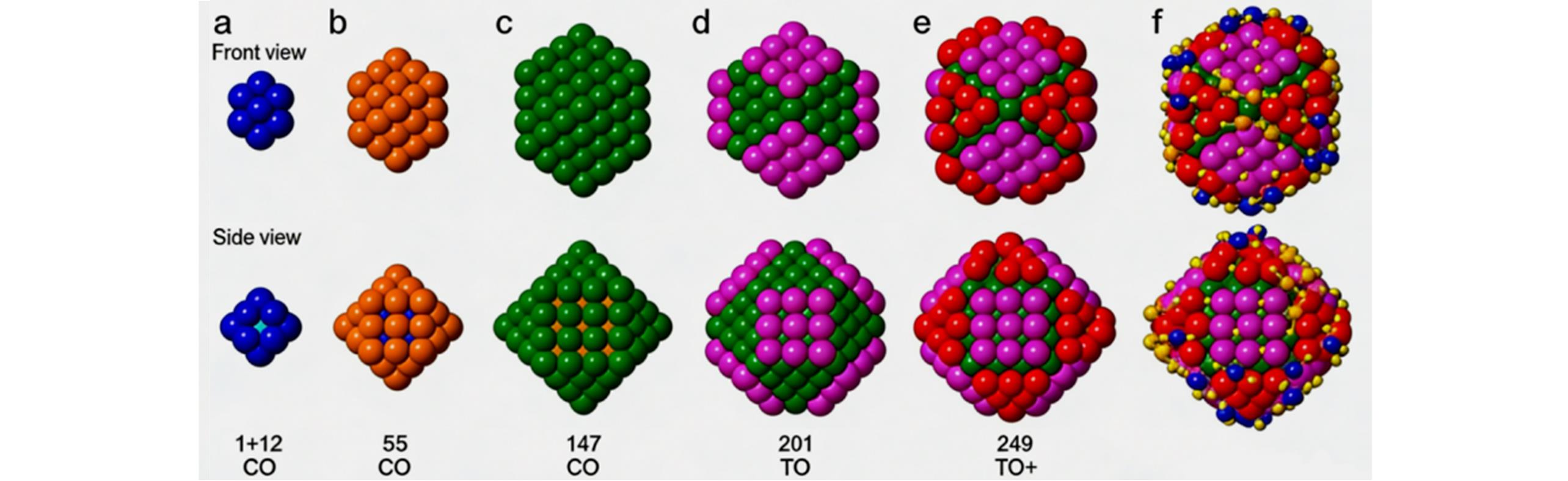
Fig.6 Atomic arrangement of Au₂₇₉ and its fcc structure core[53]Copyright 2017, American Chemical Society.
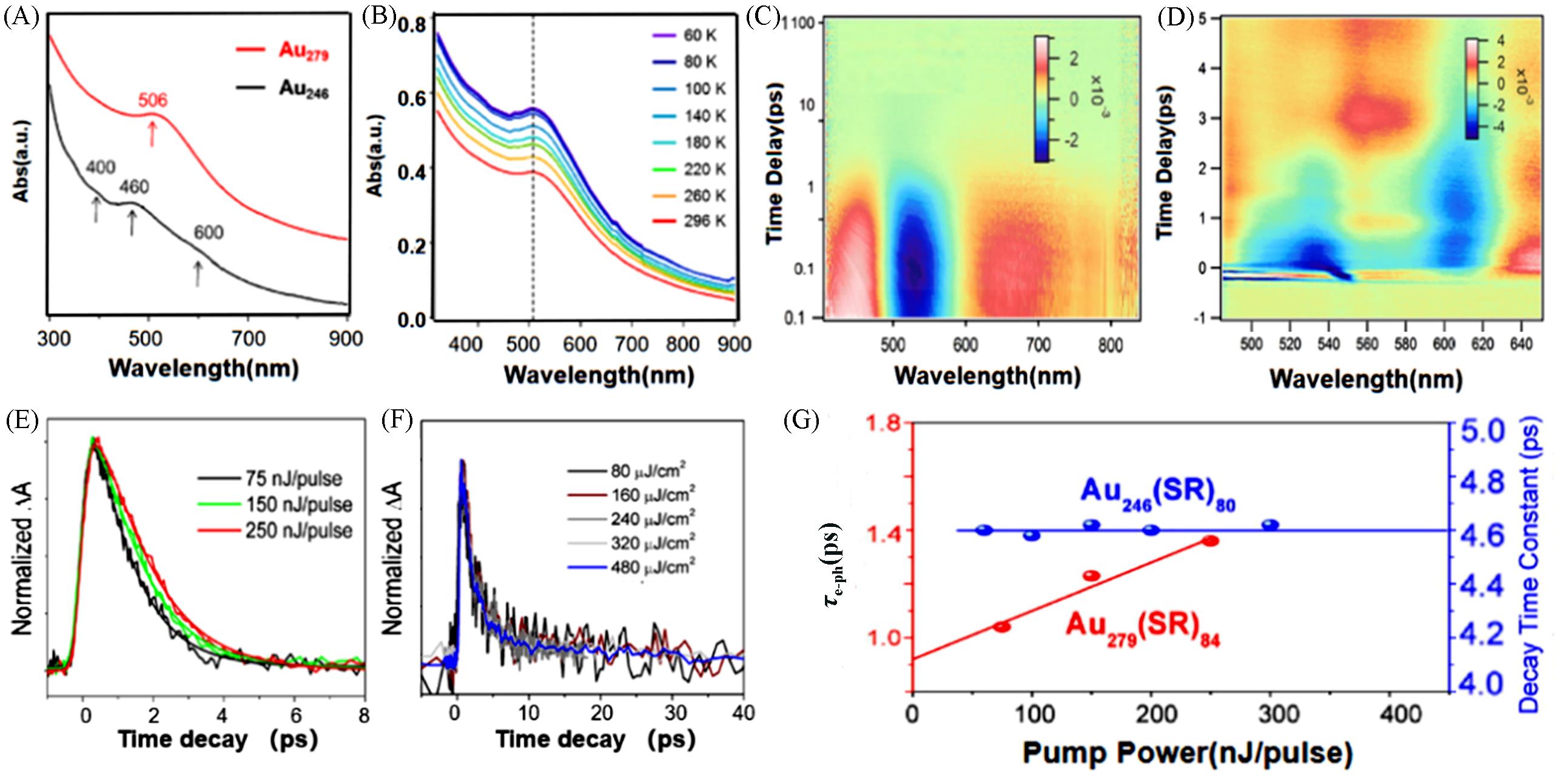
Fig.7 Steady⁃state UV⁃Vis⁃NIR absorption spectrum of Au279(A), temperature⁃dependent spectra of Au279(B)[22], femtosecond transient absorption spectra of Au279(C)[22] and Au246(D)[50], normalized transient absorption kinetics of Au279 at 360 nm pump with pulse energies of 75, 150, and 250 nJ/pulse(E)[22], normalized transient absorption kinetics of Au246 at 470 nm pump with fluences of 80, 160, 240, 320, and 480 μJ/cm²(F)[50] and extracted τe-ph of Au246(in blue, 470 nm pump) and Au279(in red, 360 nm pump) as a function of pump power(G)[22](A—C), (E), (G) Copyright 2018, American Chemical Society; (D), (F) Copyright 2017, John Wiley and Sons.
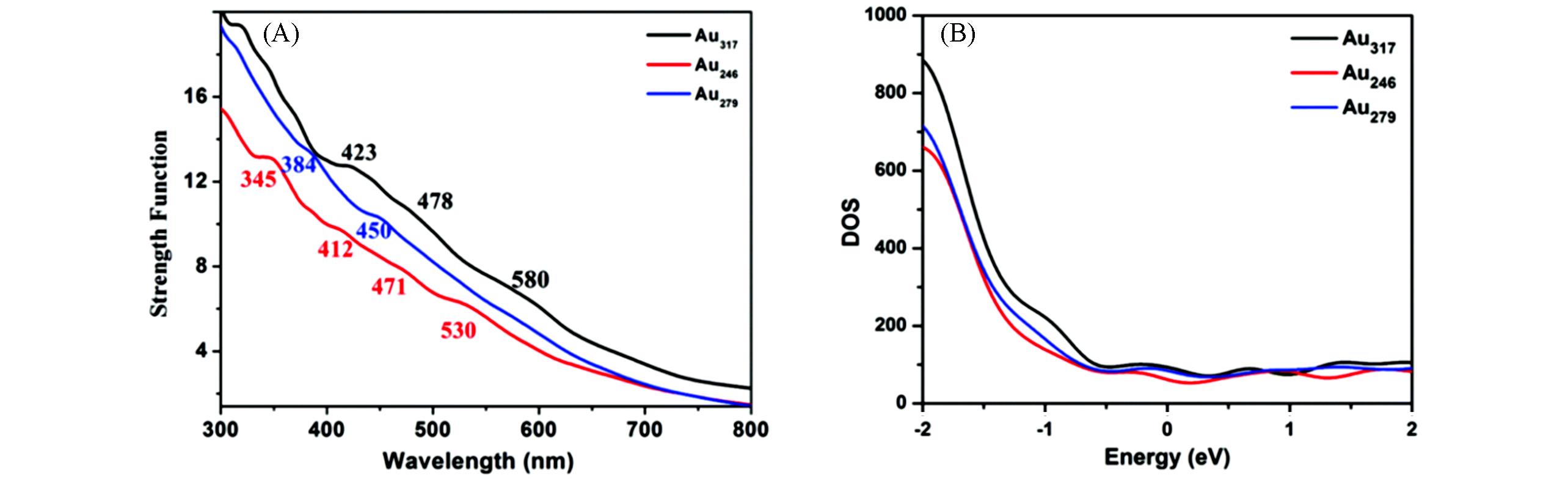
Fig.8 UV⁃Vis absorption spectra calculated by time⁃dependent density functional theory(A) and calculated electronic density of states(B)[54] of Au246, Au279 and Au317
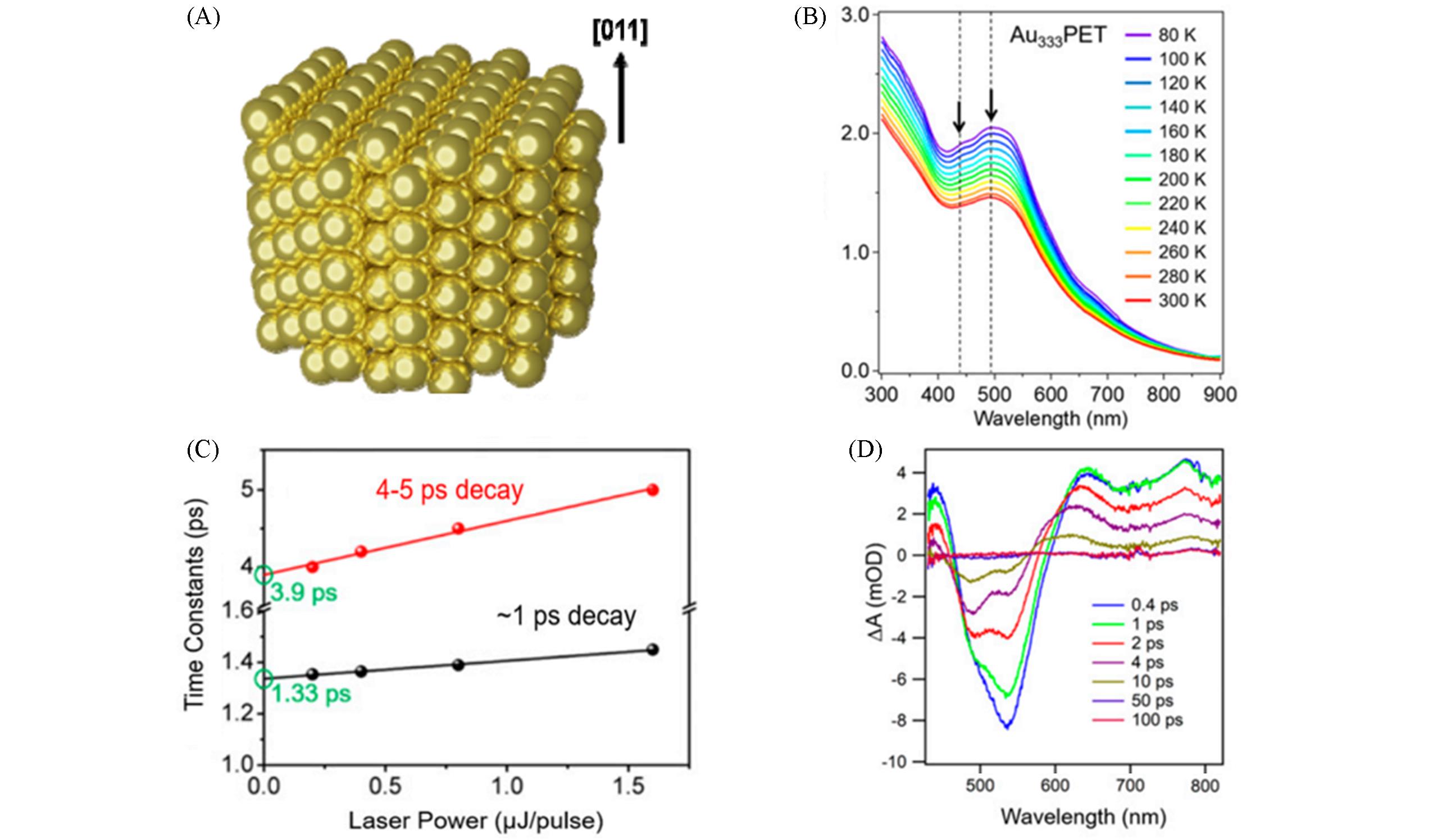
Fig.9 Model structure of Au333 constructed from HAADF⁃STEM images(A), temperature⁃dependent steady⁃state optical absorption spectra of Au333 in 2⁃methyltetrahydrofuran(B), pump⁃energy dependence of the coupling times underlying the two key relaxation processes at ~1 ps and 4—5 ps under 360 nm excitation(C) and transient absorption spectra at time delays from 0.4 to 100 ps[55](D)Copyright 2019, Open Acess.
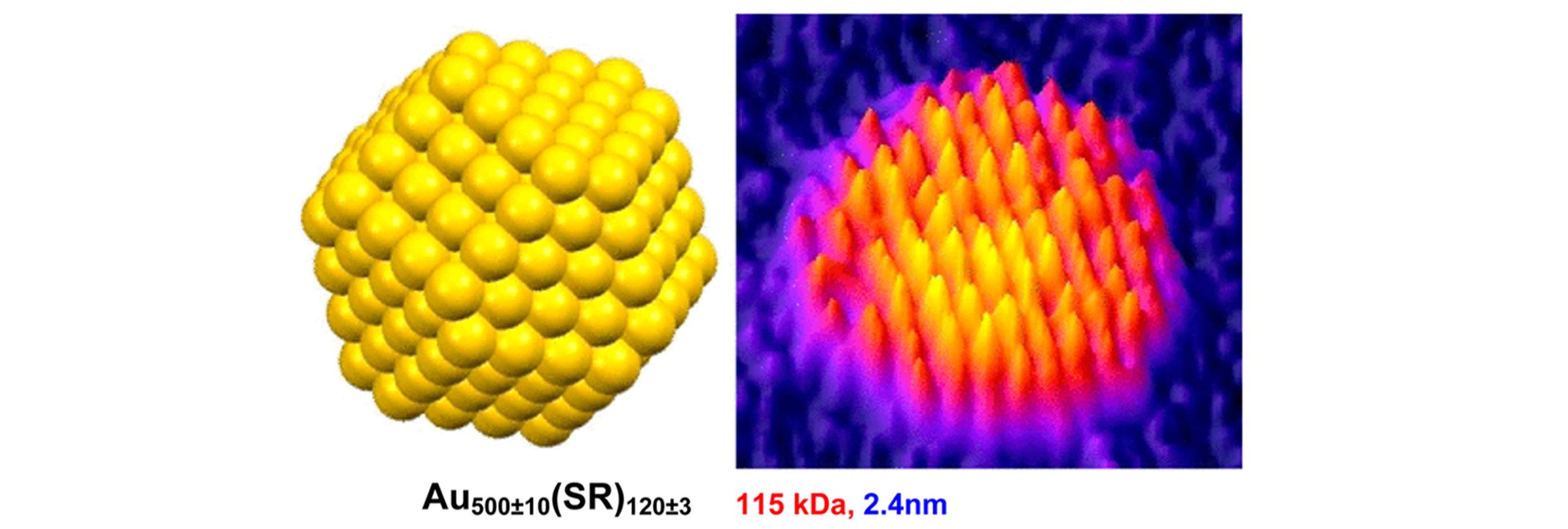
Fig.10 High⁃resolution HAADF⁃STEM image of a single particle with a field of view of 5 nm×5 nm[56]Copyright 2014, American Chemical Society.
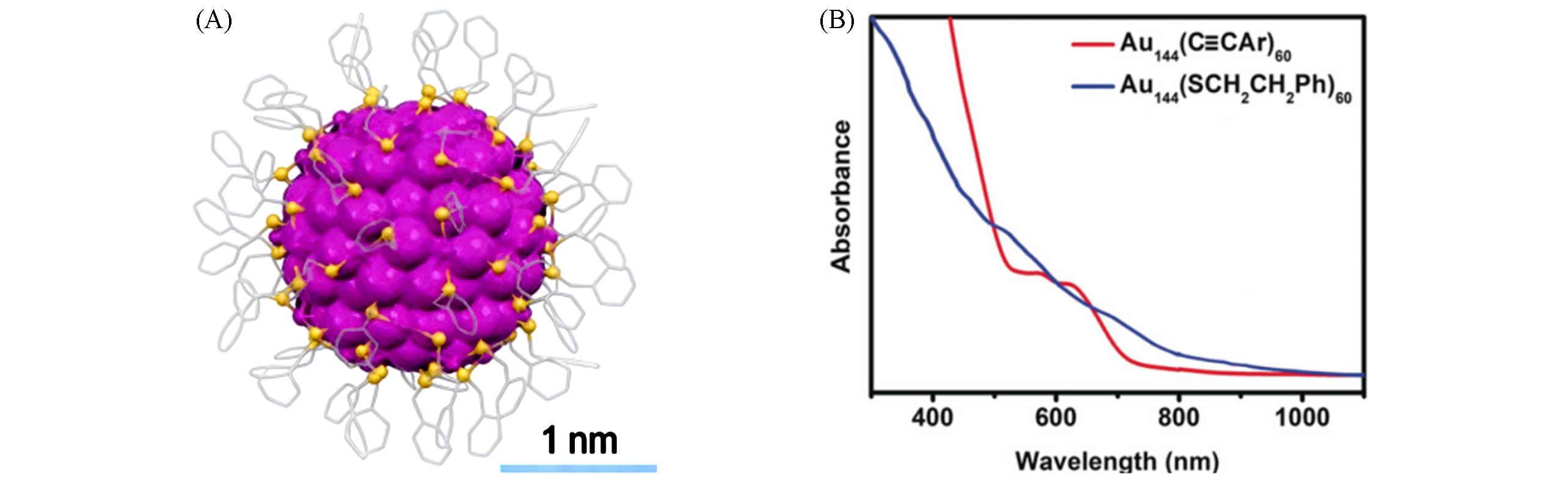
Fig.11 Precise structure of Au144(SCH2Ph)60(A)[71] and UV‑Vis‑NIR absorption spectra of Au144(C≡CAr)60 and Au144(SR)60(B)[72](A) Copyright 2018, Open Acess; (B) Copyright 2019, John Wiley and Sons.
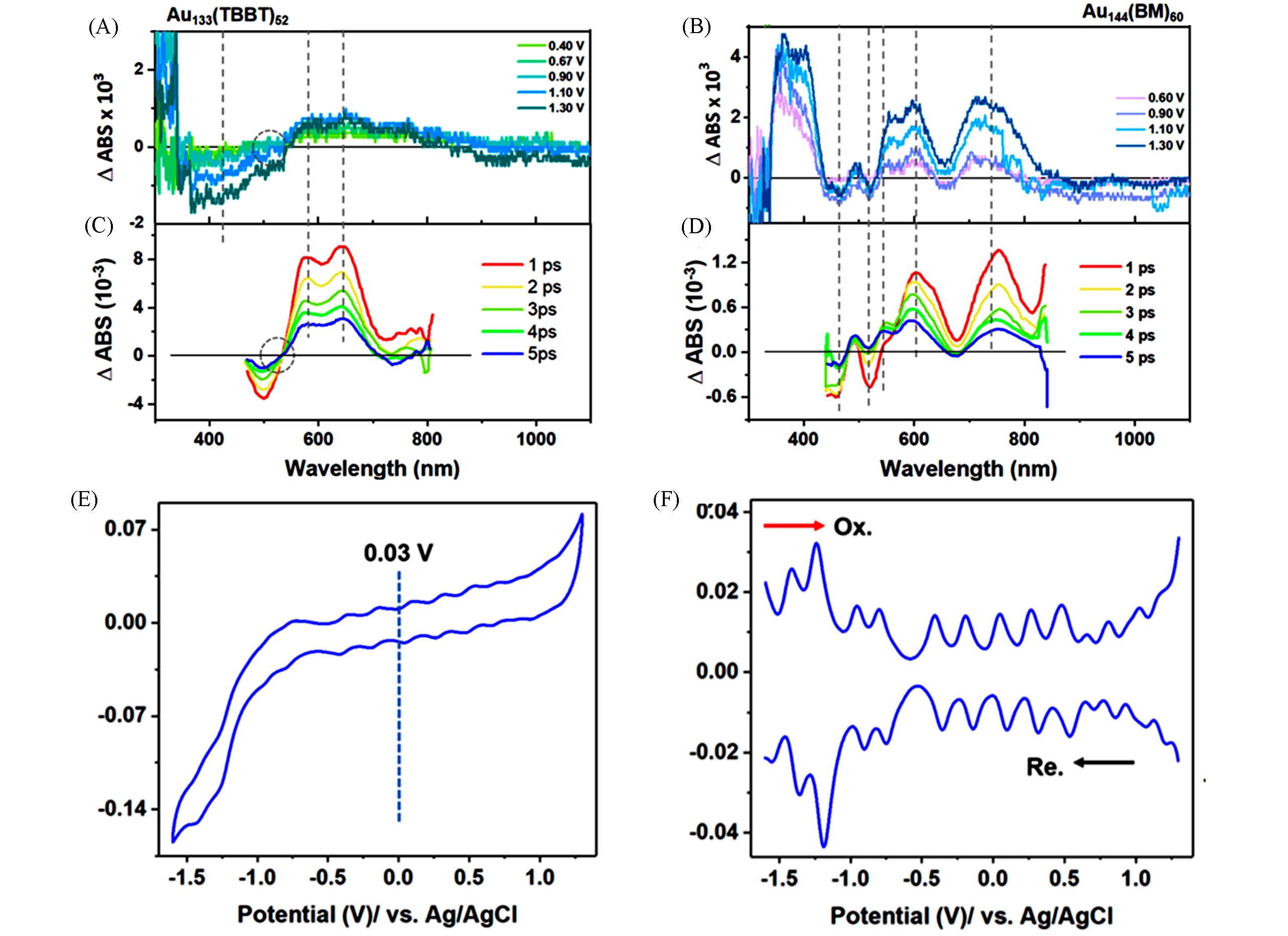
Fig.12 Electrochemical spectra of Au133(A) and Au144(B) after oxidative electrolysis, transient absorption spectra of Au133(C) and Au144(D) at different delay times(1—5 ps), cyclic voltammetry(CV) curve(E) and differential pulse voltammetry(DPV) curve(F) of Au144[73]Copyright 2020, American Chemical Society.
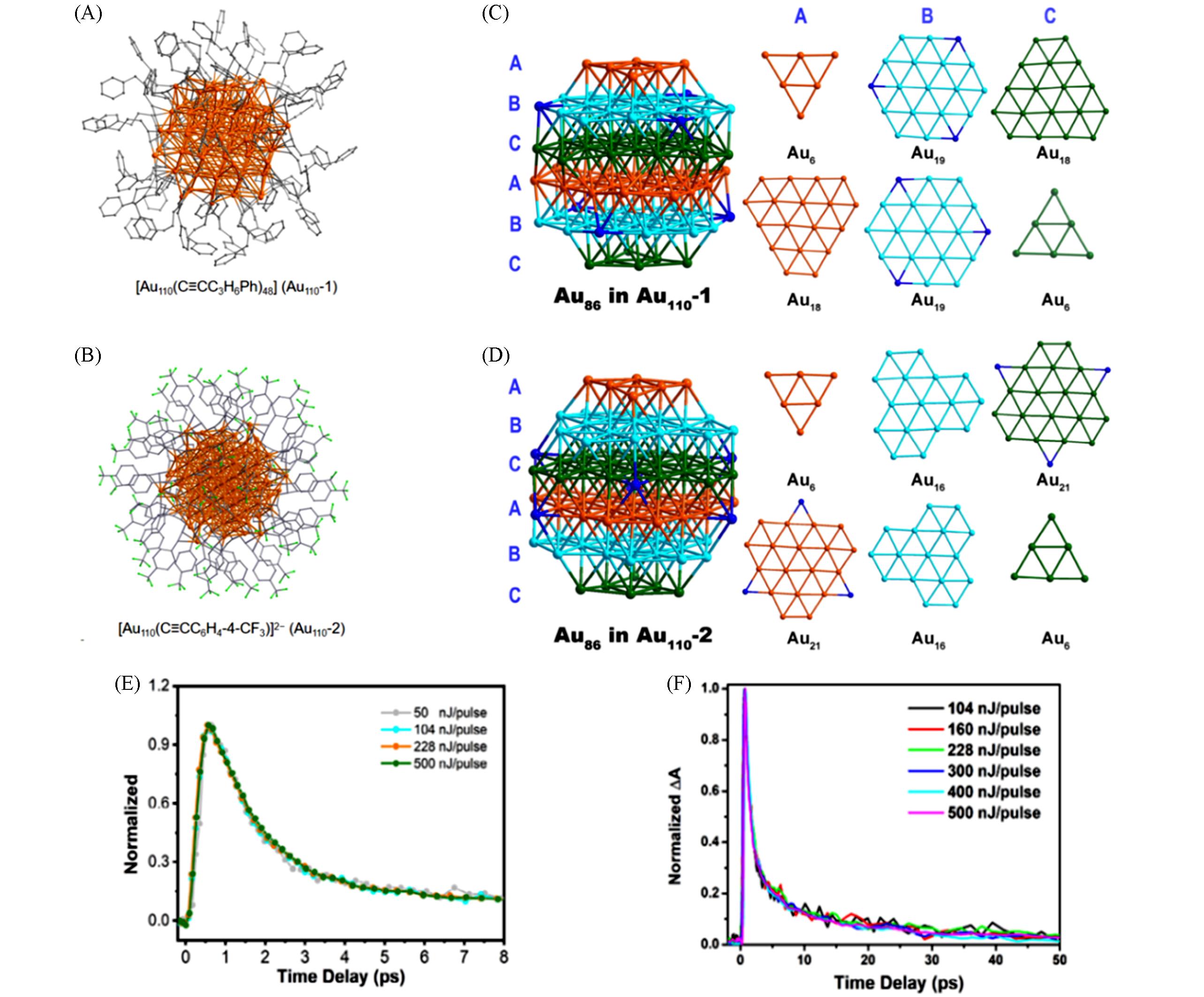
Fig.13 Precise structure of Au110⁃1(A)[37] and Au110⁃2(B)[38], Au86 fcc core of Au110⁃1(C) and Au110⁃2(D)[38], and transient absorption kinetic curves of Au110⁃1(E)[37] and Au110⁃2(F)[38] under different laser powers(C), (D) Stacked layer by layer along the orientation. Blue spheres indicate the differences between the two Au86 cores. (A), (C), (D), (E) Copyright 2025, Open Access; (B), (F) Copyright 2020, American Chemical Society.
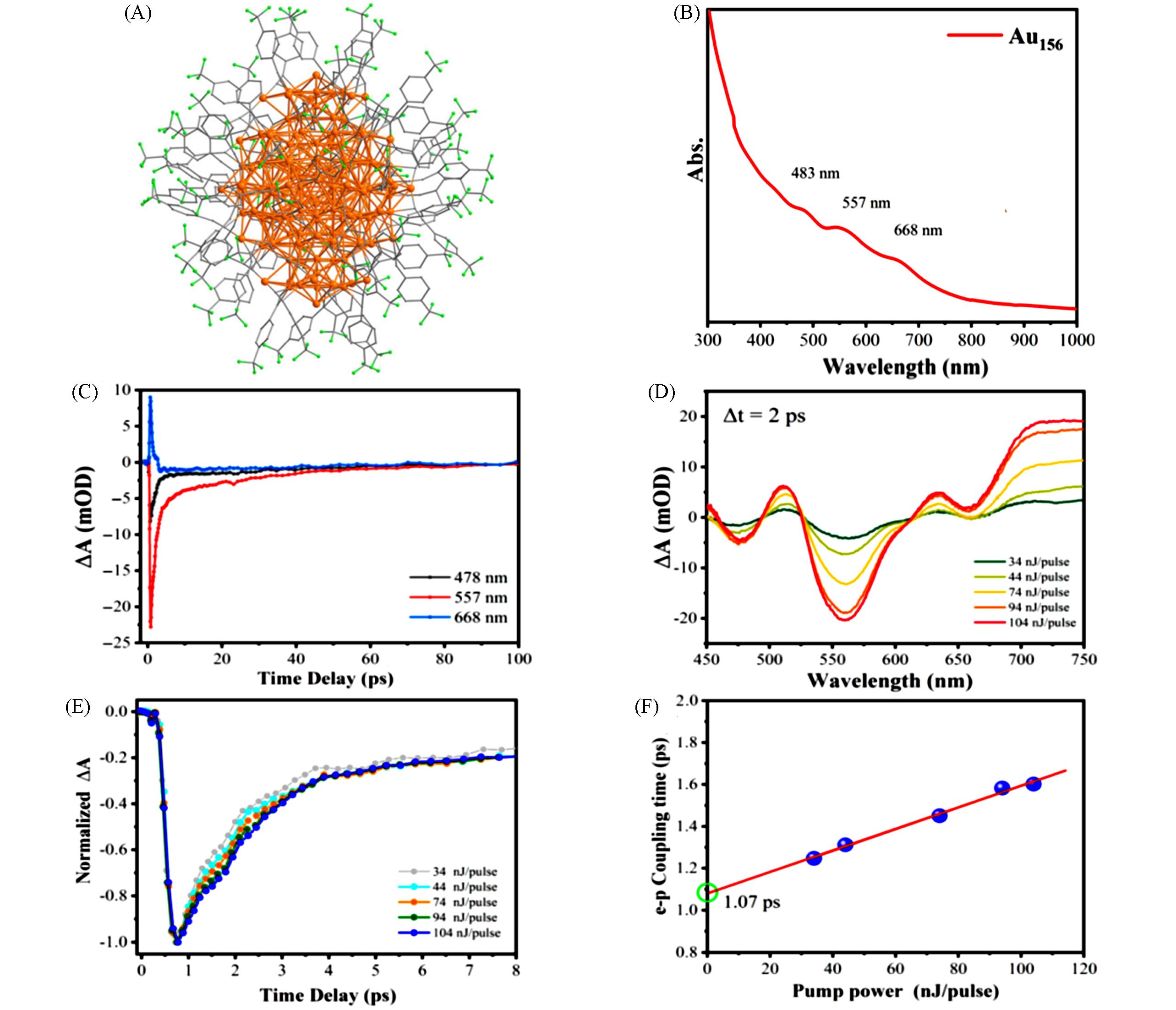
Fig.14 Precise structure(A) and steady⁃state UV⁃Vis⁃NIR absorption spectrum(B) of Au156, kinetic traces of Au156 at 478, 557, and 668 nm(C), corresponding transient absorption spectra of Au156 under different pump pulse energies(D), normalized decay kinetics at 557 nm with different pump pulse energy(E) and relaxation time as a function of 400 nm pump pulse energy(F)[48]Copyright 2021, American Chemical Society.
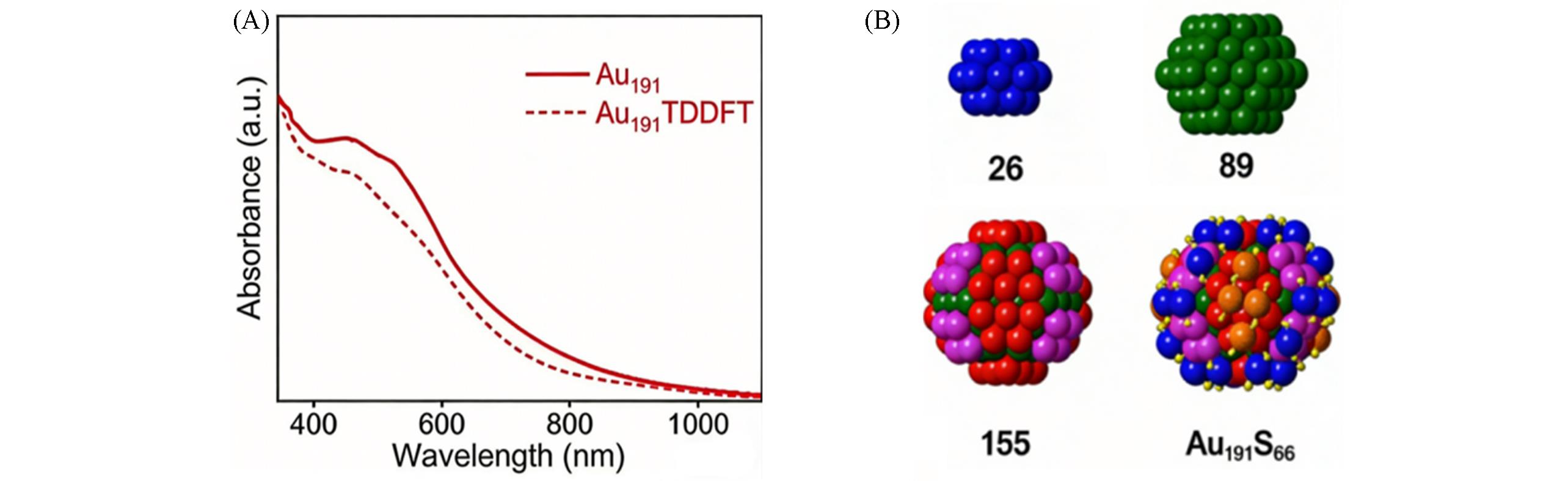
Fig.15 Steady⁃state UV⁃Vis⁃NIR absorption spectrum(A) and core fcc twinned Au155 structure(B) of Au191[48]Copyright 2020, American Chemical Society.
| [1] | Jin R., Nanoscale, 2015, 7(5), 1549—1565 |
| [2] | Jin R., Zeng C., Zhou M., Chen Y., Chem. Rev., 2016, 116(18), 10346—10413 |
| [3] | Jin R., Higaki T., Comm. Chem., 2021, 4(1), 28 |
| [4] | Yau S. H., Varnavski O., Goodson T. III., Acc. Chem. Res., 2013, 46(7), 1506—1516 |
| [5] | Zhu M., Aikens C. M., Hollander F. J., Schatz G. C., Jin R., J. Am. Chem. Soc., 2008, 130(18), 5883—5885 |
| [6] | Zhou M., Higaki T., Hu G., Sfeir M. Y., Chen Y., Jiang D. E., Jin R., Science, 2019, 364(6437), 279—282 |
| [7] | Ye W. Q., Lu H., Chen W. J., Li N. J., Zhang Y., Wang L. H., Li J., Zhu Y., Li M. Q., Fan C. H., Jia S. S., Chen J., Chem. J. Chinese Universities, 2025, 46(8), 20250100 |
| 叶伟卿, 逯慧, 陈婉京, 李宁静, 张瑜, 王丽华, 李江, 诸颖, 李明强, 樊春海, 贾思思, 陈静. 高等学校化学学报, 2025, 46(8), 20250100 | |
| [8] | Stoll T., Sgrò E., Jarrett J. W., Réhault J., Oriana A., Sala L., Branchi F., Cerullo G., Knappenberger K. L. Jr., J. Am. Chem. Soc., 2016, 138(6), 1788—1791 |
| [9] | Yi C., Zheng H., Herbert P. J., Chen Y., Jin R., Knappenberger K. L. Jr., J. Phys. Chem. C, 2017, 121(44), 24894—24902 |
| [10] | Song Y., Jin S., Kang X., Xiang J., Deng H., Yu H., Zhu M., Chem. Mater., 2016, 28(8), 2609—2617 |
| [11] | Du X., Liu Z., Higaki T., Zhou M., Jin R., Chem. Sci., 2022, 13(7), 1925—1932 |
| [12] | Dass A., J. Am. Chem. Soc., 2011, 133(48), 19259—19261 |
| [13] | Hodak J. H., Henglein A., Hartland G. V., J. Chem. Phys., 2000, 112(13), 5942—5947 |
| [14] | Castañeda J., Rogers B., Sosa Y., Muñoz J. A., Bhattarai B., Martinez A. M., Phipps M. L., Morales D. P., Montoya Rush M. N., Yacaman M. J., Montaño G. A., Gibbs J. G., Martinez J. S., Small, 2025, 21(25), 2411517 |
| [15] | Bian G., Chen D., Chen Y., Zhang W., Fang L., You Q., Wang R., Gu W., Zhou Y., Yan N., Zhuang S., Ji S., Zhou M., Wang C., Liao L., Tang Q., Yang J., Wu Z., Sci. Adv., 2025, 11(15), eadu1996 |
| [16] | Ma X. H., Li J., Luo P., Hu J. H., Han Z., Dong X. Y., Xie G., Zang S. Q., Nat. Commun., 2023, 14(1), 4121 |
| [17] | Maity S., Kolay S., Chakraborty S., Devi A., Rashi, Patra A., Chem. Soc. Rev., 2025, 54(4), 1785—1844 |
| [18] | Li S., Yang N., Ma Q., Li S., Tong S., Luo J., Song X., Yang H., Anal. Chem., 2023, 95(44), 16153—16159 |
| [19] | Zhang C., Gao X., Chen W., He M., Yu Y., Gao G., Sun T., iScience, 2022, 25(10), 105022 |
| [20] | Chen Z., Yuan P., Chen C., Wang X., Wang J., Jia J., Davaasuren B., Lai Z., Khashab N. M., Huang K. W., Bakr O. M., Yin J., Salama K. N., Adv. Mater., 2024, 36(51), e2404291 |
| [21] | Sooraj B. N. S., Pradeep T., Atomically Precise Metal Nanoclusters, Elsevier, Amsterdam, 2023, 83—101 |
| [22] | Higaki T., Zhou M., Lambright K. J., Kirschbaum K., Sfeir M. Y., Jin R., J. Am. Chem. Soc., 2018, 140(17), 5691—5695 |
| [23] | Zhou M., Higaki T., Li Y., Zeng C., Li Q., Sfeir M. Y., Jin R., J. Am. Chem. Soc., 2019, 141(50), 19754—19764 |
| [24] | Knoppe S., Verbiest T., J. Am. Chem. Soc., 2017, 139(42), 14853—14856 |
| [25] | Negishi Y., Nakazaki T., Malola S., Takano S., Niihori Y., Kurashige W., Yamazoe S., Tsukuda T., Häkkinen H., J. Am. Chem. Soc., 2015, 137(3), 1206—1212 |
| [26] | Varnavski O., Ramakrishna G., Kim J., Lee D., Goodson T., J. Am. Chem. Soc., 2010, 132(1), 16—17 |
| [27] | Zhou M., Du X., Wang H., Jin R., ACS Nano, 2021, 15(9), 13980—13992 |
| [28] | Zhou M., Zeng C., Chen Y., Zhao S., Sfeir M. Y., Zhu M., Jin R., Nat. Commun., 2016, 7(1),13240 |
| [29] | Hodak J. H., Martini I., Hartland G. V., Chem. Phys. Lett., 1998, 284(1/2), 135—141 |
| [30] | Chen Y., Zeng C., Kauffman D. R., Jin R., Nano Lett., 2015, 15(5), 3603—3609 |
| [31] | Qian H., Jin R., Chem. Mater., 2011, 23(8), 2209—2217 |
| [32] | Lei Z., Zhao P., Guan Z. J., Nan Z. A., Ehara M., Wang Q. M., Chem. Eur. J., 2024, 30(42), e202401094 |
| [33] | Mukherjee S., Mandal S., Spectroscopy and Characterization of Nanomaterials and Novel Materials: Experiments, Modeling, Simulations, and Applications, Wiley-VCH, Weinheim, 2022, 187—209 |
| [34] | Jadzinsky P. D., Calero G., Ackerson C. J., Bushnell D. A., Kornberg R. D., Science, 2007, 318(5849), 430—433 |
| [35] | Hulkko E., Lopez⁃Acevedo O., Koivisto J., Levi⁃Kalisman Y., Kornberg R. D., Pettersson M., Häkkinen H., J. Am. Chem. Soc., 2011, 133(11), 3752—3755 |
| [36] | Mustalahti S., Myllyperkiö P., Malola S., Lahtinen T., Salorinne K., Koivisto J., Häkkinen H., Pettersson M., ACS Nano, 2015, 9(3), 2328—2335 |
| [37] | Wang J. Q., Shi S., He R. L., Yuan S. F., Yang G. Y., Liang G. J., Wang Q. M., J. Am. Chem. Soc., 2020, 142(42), 18086—18092 |
| [38] | Hu F., Yang G., Long Z. C., Shi W. Q., Liang G. J., Wang J. Q., Wang Q. M., Small, 2025, 21(21), 2502106 |
| [39] | Tlahuice⁃Flores A., Santiago U., Bahena D., Vinogradova E., Conroy C. V., Ahuja T., Bach S. B. H., Ponce A., Wang G., José⁃Yacamán M., Whetten R. L., J. Phys. Chem. A, 2013, 117(40), 10470—10476 |
| [40] | Du X., Zhang X., Ma H., Zhou M., Higaki T., Wang G., Wang H., Jin R., ChemElectroChem, 2024, 11(7), e202300528 |
| [41] | Chen Y., Zeng C., Liu C., Kirschbaum K., Gayathri C., Gil R. R., Rosi N. L., Jin R., J. Am. Chem. Soc., 2015, 137(32), 10076—10079 |
| [42] | Wang D., Padelford J. W., Ahuja T., Wang G., ACS Nano, 2015, 9(8), 8344—8351 |
| [43] | Padelford J. W., Zhou M., Chen Y., Jin R., Wang G., J. Phys. Chem. C, 2017, 121(39), 21217—21224 |
| [44] | Zeng C., Chen Y., Kirschbaum K., Appavoo K., Sfeir M. Y., Jin R., Sci. Adv., 2015, 1(2), e1500045 |
| [45] | Dass A., Theivendran S., Nimmala P. R., Kumara C., Jupally V. R., Fortunelli A., Sementa L., Barcaro G., Zuo X., Noll B. C., J. Am. Chem. Soc., 2015, 137(14), 4610—4613 |
| [46] | Zhang W., Kong J., Li Y., Kuang Z., Wang H., Zhou M., Chem. Sci., 2022, 13(27), 8124—8130 |
| [47] | Yi C., Tofanelli M. A., Ackerson C. J., Knappenberger K. L. Jr., J. Am. Chem. Soc., 2013, 135(48), 18222—18228 |
| [48] | Hu F., Guan Z. J., Yang G., Wang J. Q., Li J. J., Yuan S. F., Liang G. J., Wang Q. M., J. Am. Chem. Soc., 2021, 143(41), 17059—17067 |
| [49] | Sakthivel N. A., Shabaninezhad M., Sementa L., Yoon B., Stener M., Whetten R. L., Ramakrishna G., Fortunelli A., Landman U., Dass A., J. Am. Chem. Soc., 2020, 142(37), 15799—15814 |
| [50] | Zhou M., Zeng C., Song Y., Padelford J. W., Wang G., Sfeir M. Y., Higaki T., Jin R., Angew. Chem. Int. Ed., 2017, 56(51), 16257—16261 |
| [51] | Zeng C., Chen Y., Kirschbaum K., Lambright K. J., Jin R., Science, 2016, 354(6319), 1580—1584 |
| [52] | Sakthivel N. A., Stener M., Sementa L., Fortunelli A., Ramakrishna G., Dass A., J. Phys. Chem. Lett., 2018, 9(6), 1295—1300 |
| [53] | Sakthivel N. A., Theivendran S., Ganeshraj V., Oliver A. G., Dass A., J. Am. Chem. Soc., 2017, 139(43), 15450—15459 |
| [54] | Li L., Wang P., Pei Y., Nanoscale, 2022, 14(15), 5694—5700 |
| [55] | Higaki T., Zhou M., He G., House S. D., Sfeir M. Y., Yang J. C., Jin R., Proc. Natl. Acad. Sci. U.S.A., 2019, 116(27), 13215—13220 |
| [56] | Kumara C., Zuo X., Ilavsky J., Chapman K. W., Cullen D. A., Dass A., J. Am. Chem. Soc., 2014, 136(20), 7410—7417 |
| [57] | Kumara C., Zuo X., Cullen D. A., Dass A., ACS Nano, 2014, 8(6), 6431—6439 |
| [58] | Salorinne K., Malola S., Wong O. A., Rithner C. D., Chen X., Ackerson C. J., Häkkinen H., Nat. Commun., 2016, 7(1), 10401 |
| [59] | Callmann C. E., Vasher M. K., Das A., Kusmierz C. D., Mirkin C. A., Small, 2023, 19(24), 2300097 |
| [60] | Higaki T., Liu C., Morris D. J., He D. G., Luo T. Y., Sfeir M. Y., Zhang P., Rosi N. L., Jin R., Angew. Chem. Int. Ed., 2019, 58(52), 18798—18802 |
| [61] | Zhao J., Ziarati A., Bürgi T., Angew. Chem. Int. Ed., 2025, 64(26), e202504320 |
| [62] | Li S., Nagarajan A. V., Du X., Li Y., Liu Z., Kauffman D. R., Mpourmpakis G., Jin R., Angew. Chem. Int. Ed., 2022, 61(47), e202211771 |
| [63] | Seong H., Efremov V., Park G., Kim H., Yoo J. S., Lee D., Angew. Chem. Int. Ed., 2021, 60(26), 14563—14570 |
| [64] | Fang Y., Wang P., Pei Y., Xiong L., J. Phys. Chem. Lett., 2025, 16(19), 4675—4682 |
| [65] | Wang G., Lu H., Li J., Wang L., Zhu Y., Song S., Ge Z., Li Q., Chen J., Fan C., Chem. Res. Chin. Univ., 2024, 40(4), 670—674 |
| [66] | Wang P., Xiong L., Sun X., Ma Z., Pei Y., Nanoscale, 2018, 10(8), 3918—3929 |
| [67] | Wang H., Brandl D. W., Nordlander P., Halas N. J., Acc. Chem. Res., 2007, 40(1), 53—62 |
| [68] | Whetten R. L., Khoury J. T., Alvarez M. M., Murthy S., Vezmar I., Wang Z. L., Stephens P. W., Cleveland C. L., Luedtke W. D., Landman U., Adv. Mater., 1996, 8(5), 428—433 |
| [69] | Vergara S., Santiago U., Kumara C., Alducin D., Whetten R. L., Jose Yacaman M., Dass A., Ponce A., J. Phys. Chem. C, 2018, 122(46), 26733—26738 |
| [70] | Fang Y., Xiong L., Chem. Commun., 2025, 61(56), 10383—10386 |
| [71] | Yan N., Xia N., Liao L., Zhu M., Jin F., Jin R., Wu Z., Sci. Adv., 2018, 4(10), eaat7259 |
| [72] | Lei Z., Li J. J., Wan X. K., Zhang W. H., Wang Q. M., Angew. Chem. Int. Ed., 2018, 57(28), 8639—8643 |
| [73] | Chen S., Higaki T., Ma H., Zhu M., Jin R., Wang G., ACS Nano, 2020, 14(12), 16781—16790 |
| [74] | Zeng C., Chen Y., Iida K., Nobusada K., Kirschbaum K., Lambright K. J., Jin R., J. Am. Chem. Soc., 2016, 138(12), 3950—3953 |
| [75] | Sakthivel N. A., Sementa L., Yoon B., Landman U., Fortunelli A., Dass A., J. Phys. Chem. C, 2020, 124(2), 1655—1666 |
| [76] | Gao P., Xin R., Li F., Zhao M., Zhong R., Song Y., Shan W., Reaction Kinetics, Mechanisms and Catalysis, 2025, 138(6), 4305—4317 |
| [77] | Halperin W. P., Rev. Mod. Phys., 1986, 58(3), 533—606 |
| [78] | Kubo R., Ann. Rev. Mater. Sci., 1984, 14, 49—66 |
| [79] | Yu X., Pei W., Xu W. W., Zhao Y., Su Y., Zhao J., Inorg. Chem., 2023, 62(51), 20450—20457 |
| [80] | Malola S., Häkkinen H., Phys. Chem. Chem. Phys., 2018, 20(16), 10743—10750 |
| [1] | 张玉敏, 刘海燕, 宋文波. 自组装纳米金膜上铂微/纳结构电催化剂的制备及性能[J]. 高等学校化学学报, 2010, 31(1): 157. |
| 阅读次数 | ||||||
|
全文 |
|
|||||
|
摘要 |
|
|||||
