

Chem. J. Chinese Universities ›› 2020, Vol. 41 ›› Issue (5): 1048.doi: 10.7503/cjcu20190703
• Physical Chemistry • Previous Articles Next Articles
CHENG Shifu,HU Hao,CHEN Bihua,WU Haihong( ),GAO Guohua(),HE Mingyuan
Received:2019-12-24
Online:2020-05-10
Published:2020-02-26
Contact:
Haihong WU,Guohua GAO
E-mail:hhwu@chem.ecnu.edu.cn;ghgao@chem.ecnu.edu.cn
Supported by:CLC Number:
TrendMD:
CHENG Shifu,HU Hao,CHEN Bihua,WU Haihong,GAO Guohua,HE Mingyuan. Preparation and Electrochemical Performance of Porous Carbons Prepared from Binary Ionic Liquids †[J]. Chem. J. Chinese Universities, 2020, 41(5): 1048.
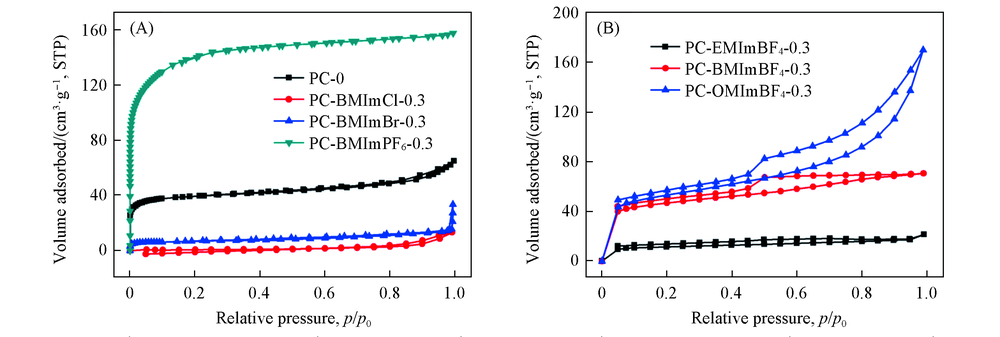
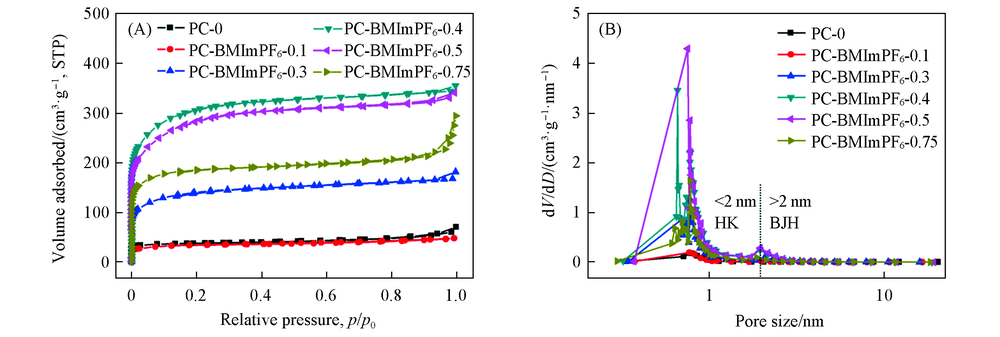
| Entry | Sample | Yield(%) | SBET/(m2·g-1) | Vt/(cm3·g-1) | Averagepore size/nm |
|---|---|---|---|---|---|
| 1 | PC-0 | 8.43 | 144 | 0.13 | 3.7 |
| 2 | PC-BMImCl-0.3 | 8.83 | 3 | 0.02 | 33.7 |
| 3 | PC-BMImBr-0.3 | 9.16 | 22 | 0.05 | 9.3 |
| 4 | PC-BMImPF6-0.3 | 13.24 | 452 | 0.24 | 2.2 |
| 5 | PC-EMImBF4-0.3 | 12.11 | 37 | 0.03 | 3.5 |
| 6 | PC-BMImBF4-0.3 | 11.27 | 151 | 0.11 | 2.9 |
| 7 | PC-OMImBF4-0.3 | 13.33 | 176 | 0.26 | 6.0 |
| 8 | PC-BMImPF6-0.1 | 13.42 | 126 | 0.09 | 2.7 |
| 9 | PC-BMImPF6-0.4 | 12.24 | 1111 | 0.55 | 2.0 |
| 10 | PC-BMImPF6-0.5 | 13.53 | 1018 | 0.52 | 2.1 |
| 11 | PC-BMImPF6-0.75 | 12.83 | 685 | 0.46 | 2.7 |
| Sample | CHNS analysis(%) | XPS analysis(%) | ||||||||
|---|---|---|---|---|---|---|---|---|---|---|
| C | H | N | S | Others* | C | N | S | P | O | |
| PC-0 | 81.81 | 0.20 | 3.81 | 4.03 | 10.15 | 83.74 | 1.55 | 2.09 | 0 | 12.62 |
| PC-BMImPF6-0.3 | 79.02 | 1.15 | 2.92 | 1.91 | 14.99 | 74.50 | 1.66 | 0.61 | 2.80 | 20.43 |
| PC-BMImPF6-0.4 | 75.76 | 1.27 | 3.08 | 1.98 | 17.92 | 72.22 | 2.26 | 0.17 | 4.81 | 20.04 |
| PC-BMImPF6-0.5 | 60.58 | 1.47 | 3.40 | 1.43 | 33.13 | 65.39 | 1.79 | 0.10 | 3.31 | 29.41 |
| [1] |
Zhai Y. P., Dou Y. Q., Zhao D. Y., Fulvio F. P., Mayes R. T., Dai S., Adv. Mater., 2011,23, 4828—4850
doi: 10.1002/adma.201100984 URL pmid: 21953940 |
| [2] | Li M. M., Xu F., Li H. R., Wang Y., Catal. Sci. Technol., 2016,6, 3670—3693 |
| [3] | Inagaki M., Toyoda M., Soneda Y., Morishita T ., Carbon, 2018,132, 104—140 |
| [4] |
Fulvio P. F., Lee J. S., Mayes R. T., Wang X. Q., Mahurin S. M., Dai S., Phys. Chem. Chem. Phys., 2011,13, 13486—13491
doi: 10.1039/c1cp20631a URL pmid: 21566848 |
| [5] | Zhou X., Gao Y. J., Deng S. W., Cheng S., Zhang S. H., Hu H., Zhuang G. L., Zhong X., Wang J. G., Ind. Eng. Chem. Res., 2017,56, 11100—11110 |
| [6] | Gao J., He C. C., Liu J. G., Ren P. J., Lu H. B., Feng J. Y., Zou Z. G., Yin Z., Wen X. D., Tan X. Y., Catal. Sci. Technol., 2018,8, 1142—1150 |
| [7] |
Sun L., Zhou H., Li L., Yao Y., Qu H. N., Zhang C. L., Liu S. H., Zhou Y. M., ACS Appl. Mater. Interfaces, 2017,9, 26088—26095
doi: 10.1021/acsami.7b07877 URL pmid: 28715170 |
| [8] | Sun L., Zhou H., Li Y. H., Yu F., Zhang C. L., Liu X. Q., Zhou Y. M., Mater. Lett., 2017,189, 107—109 |
| [9] | Liu Y., Zhao C. F., Zhang A. R., Xing J. L., Wei D. L., Ai Y. J., Sci. Sin. Chim., 2019,49(1), 91—102 |
| ( 柳杨, 赵超锋, 张安睿, 邢金璐, 卫冬丽, 艾玥洁 . 中国科学: 化学, 2019,49(1), 91—102) | |
| [10] |
Zhao L., Hu Y. S., Li H., Wang Z. X., Chen L. Q., Adv. Mater., 2011,23, 1385—1388
doi: 10.1002/adma.201003294 URL pmid: 21400601 |
| [11] | Balach J., Wu H. P., Polzer F., Kirmse H., Zhao Q., Wei Z. X., Yuan J. Y., RSC Adv., 2013,3, 7979—7986 |
| [12] | Shao Y. Y., Sui J. H., YinG. P., Gao Y. Z., Appl. Catal. B, 2008,79, 89—99 |
| [13] | Hasché F., Fellinger T. P., Oezaslan M., Paraknowitsch J. P., Antonietti M., Strasser P., ChemCatChem, 2012,4, 479—483 |
| [14] | Zeng F. M., Li Z., Li X. Y., Wang J., Kong Z., Sun Y. C., Liu Z. J., Feng H. B., Appl. Surf. Sci., 2019,467, 229—235 |
| [15] | Shi L. L., Jin L. H., Meng Z., Sun Y. N., Li C., Shen Y. H., RSC Adv., 2018,8, 39937—39947 |
| [16] | Liu Y. H., Jin L., Xue B. C., Guo Y. P., Chem. J. Chinese Universities, 2018,39(6), 1242—1248 |
| ( 刘艳华, 金璐, 薛北辰, 郭玉鹏 . 高等学校化学学报, 2018,39(6), 1242—1248) | |
| [17] | Gao Y., Pang L. Y., Cao L. Y., Wang W., Guo Y. P., Zhao C., Chem. J. Chinese Universities, 2017,38(3), 341—345 |
| ( 高烨, 庞丽云, 曹礼媛, 王威, 郭玉鹏, 赵纯 . 高等学校化学学报, 2017,38(3), 341—345) | |
| [18] | Wasserscheid P., Keim W., Angew. Chem. Int. Ed., 2000,39, 3773—3789 |
| [19] | Lu J. M., Yan F., Texter J., Prog. Polym. Sci., 2009,34, 431—448 |
| [20] | Yuan J. Y., Antonietti M., Polymer, 2011,52, 1469—1482 |
| [21] |
Fellinger T. P., Thomas A., Yuan J. Y., Antonietti M., Adv. Mater., 2013,25, 5838—5855
doi: 10.1002/adma.201301975 URL pmid: 24425624 |
| [22] |
Lee J. S., Wang X. Q., Luo H. M., Baker G. A., Dai S., J. Am. Chem. Soc., 2009,131, 4596—4597
doi: 10.1021/ja900686d URL pmid: 19296590 |
| [23] |
Lee J. S., Wang X. Q., Luo H., Dai S., Adv. Mater., 2010,22, 1004—1007
doi: 10.1002/adma.200903403 URL pmid: 20217829 |
| [24] |
Paraknowitsch J. P., Zhang J., Su D. S., Thomas A., Antonietti M., Adv. Mater., 2010,22, 87—92
doi: 10.1002/adma.200900965 URL pmid: 20217703 |
| [25] | Paraknowitsch J. P., Thomas A., Antonietti M., J. Mater. Chem., 2010,20, 6746—6758 |
| [26] |
Wang X. Q., Dai S., Angew. Chem. Int. Ed., 2010,49, 6664—6668
doi: 10.1002/anie.201003163 URL pmid: 20677305 |
| [27] |
Fechler N., Fellinger T. P., Antonietti M., Adv. Mater., 2013,25, 75—79
doi: 10.1002/adma.201203422 URL pmid: 23027658 |
| [28] | Kuzmicz D., Coupillaud P., Men Y. J., Vignolle J., Vendraminetto G., Ambrogi M., Taton D., Yuan J. Y., Polymer, 2014,55, 3423—3430 |
| [29] | Cheng S. F., Chen B. H., Qin L., Zhang Y. Y., Gao G. H., He M. Y., RSC Adv., 2019,9, 8137—8145 |
| [30] |
Yang H. M., Cui X. J., Deng Y. Q., Shi F., J. Mater. Chem., 2012,22, 21852—21856
doi: 10.1039/c2jm35258c URL |
| [31] | Guo D. C., Mi J., Hao G. P., Dong W., Xiong G., Li W. C., Lu A. H., Energy Environ. Sci., 2013,6, 652—659 |
| [32] | Zhang S. G., Dokko K., Watanabe M., Chem. Mater., 2014,26, 2915—2926 |
| [1] | CUI Wei, ZHAO Deyin, BAI Wenxuan, ZHANG Xiaodong, YU Jiang. CO2 Absorption in Composite of Aprotic Solvent and Iron-based Ionic Liquid [J]. Chem. J. Chinese Universities, 2022, 43(8): 20220120. |
| [2] | PENG Kuilin, LI Guilin, JIANG Chongyang, ZENG Shaojuan, ZHANG Xiangping. Research Progress for the Role of Electrolytes in the CO2 Electrochemical Reduction [J]. Chem. J. Chinese Universities, 2022, 43(7): 20220238. |
| [3] | JI Shuangqi, JIN Zhao, GUAN Wenna, PAN Xiangyu, GUAN Tong. Preparation and Chromatographic Performance of Mixed-mode Silica Stationary Phase Modified by Double Cationic Ionic Liquid and Octadecyl Group [J]. Chem. J. Chinese Universities, 2022, 43(6): 20220008. |
| [4] | CHANG Sihui, CHEN Tao, ZHAO Liming, QIU Yongjun. Thermal Degradation Mechanism of Bio-based Polybutylactam Plasticized by Ionic Liquids [J]. Chem. J. Chinese Universities, 2022, 43(11): 20220353. |
| [5] | WANG Man, WANG Xin, ZHOU Jing, GAO Guohua. Efficient Synthesis of Dimethyl Carbonate via Transesterification of Methanol and Ethylene Carbonate Catalyzed by Poly(ionic liquid)s [J]. Chem. J. Chinese Universities, 2021, 42(12): 3701. |
| [6] | WAN Ren, SONG Fan, PENG Changjun, LIU Honglai. Group Contribution Method for Infinite Dilution Molar Conductivity of Unconventional Ions in Water [J]. Chem. J. Chinese Universities, 2021, 42(12): 3672. |
| [7] | ZHOU Molin, JIANG Xin, YI Ting, YANG Xiangguang, ZHANG Yibo. Improvement of Interface Stability Between Sulfide Solid Electrolyte Li10GeP2S12 and Lithium Metal [J]. Chem. J. Chinese Universities, 2020, 41(8): 1810. |
| [8] | GAO Chong,YU Fengli,XIE Congxia,YU Shitao. Baeyer-Villiger Oxidation of Cyclic Ketones Catalyzed by Amino Alcohol Heteropoly Acid Ionic Liquid † [J]. Chem. J. Chinese Universities, 2020, 41(5): 1101. |
| [9] | GAO Naiwei, MA Qiang, HE Yonglin, WANG Yapei. Green Electronic Devices Based on Ionic Liquids † [J]. Chem. J. Chinese Universities, 2020, 41(5): 901. |
| [10] | PIAO Huilan,MA Pinyi,QIN Zucheng,JIANG Yanxiao,SUN Ying,WANG Xinghua,SONG Daqian. Determination of Triazine Herbicides from Fruit Juice Samples Using Effervescence Assisted Microextraction Method Based on Acidic Ionic Liquid Packed Syringe [J]. Chem. J. Chinese Universities, 2020, 41(2): 228. |
| [11] | ZHANG Li,QIAN Mingchao,LIU Xueke,Gao Shuaitao,YU Jiang,XIE Haishen,WANG Hongbin,SUN Fengjiang,SU Xianghong. Dynamic Study of Oxidative Desulfurization by Iron-based Ionic Liquids/NHD † [J]. Chem. J. Chinese Universities, 2020, 41(2): 317. |
| [12] | WANG Nan,YAO Kaisheng,ZHAO Chenchen,LI Tianjin,LU Weiwei. Ionic Liquid-assisted Synthesis of AuPd Nanosponges and Their Catalytic Performance † [J]. Chem. J. Chinese Universities, 2020, 41(1): 62. |
| [13] | LI Chenguang, HUA Er, LIU Tianxia. Tribological Behaviour of Protic Ionic Liquid Composed of 2-Ethylhexylethylenediaminium Cation and Trifluoromethanesulfonate Anion as Liquid Paraffin Additive† [J]. Chem. J. Chinese Universities, 2019, 40(7): 1411. |
| [14] | LIU Xiaozhou, GUAN Xinyu, FANG Qianrong, JIN Yongri. Three-dimensional Covalent Organic Frameworks Synthesized by Room Temperature Ionic Liquid Method† [J]. Chem. J. Chinese Universities, 2019, 40(7): 1341. |
| [15] | DING Zhongxie,LIANG Jinhua,LIU Zhen,SHEN Jiecan,ZHANG Feng,REN Xiaoqian,JIANG Min. Functional Specific Heteropoly Acid Ionic Liquid Catalyzed Direct Esterification of Aqueous Succinate Solution† [J]. Chem. J. Chinese Universities, 2019, 40(5): 1029. |
| Viewed | ||||||
|
Full text |
|
|||||
|
Abstract |
|
|||||
