高等学校化学学报

• 研究论文 • 上一篇    下一篇

[点亮聚集体之光,共筑学术丰碑庆祝唐本忠院士七秩华诞专辑]基于给/受体双重相似性“桥联”聚合物受体的侧链工程构筑高性能三元有机太阳能电池

刘苗苗1,2, 傅梦然1,2, 高  蝶2, 张万鹏1, 梁  莹2, 何媛媛3, 赵巧巧1*, 赵廷兴2*, 李鸿波2, 丁自成5, 韩艳春4*   

  1. 1. 齐鲁工业大学(山东省科学院),绿色造纸与资源循环全国重点实验室

    2. 西南科技大学材料与化学学院

    3. 重庆大学材料科学与工程学院

    4. 中国科学院长春应用化学研究所,高分子科学与技术全国重点实验室 5. 陕西师范大学材料科学与工程学院

  • 收稿日期:2025-10-31 修回日期:2025-12-23 网络首发:2026-01-10 发布日期:2026-01-10
  • 通讯作者: 赵巧巧 E-mail:18766192180@163.com
  • 基金资助:
    山东省自然科学基金(批准号:ZR2022QE135)、国家自然科学基金(批准号:52203024)、山东省高等学校“青创团队计划”(批准号:2023KJ330)、全国重点实验室建设重大科研专项(批准号:2025ZDGZ02)、西南科技大学博士基金(批准号:22zx7129)及四川省自然科学基金(批准号:2024NSFSC2006)资助

Side-Chain Engineering of “Bridging” Polymer Acceptors with Donor/Acceptor Dual Similarity for High-Performance Ternary Organic Solar Cells

LIU Miaomiao1,2, FU Mengran1,2, GAO Die2, ZHANG Wanpeng1, LIANG Ying2, HE Yuanyuan3, ZHAO Qiaoqiao1*, ZHAO Tingxing2*, LI Hongbo2, DING Zicheng5, HAN Yanchun4*   

  1. 1. State Key Laboratory of Green Papermaking and Resource Recycling, Qilu University of Technology, Shandong Academy of Sciences

    2. School of Materials and Chemistry, Southwest University of Science and Technology

    3. College of Materials Science and Engineering, Chongqing University

    4. State Key Laboratory of Polymer Science and Technology, Changchun Institute of Applied Chemistry, Chinese Academy of Sciences 5. School of Materials Science and Engineering, Shaanxi Normal University

  • Received:2025-10-31 Revised:2025-12-23 Online First:2026-01-10 Published:2026-01-10
  • Supported by:
    Supported by the Shandong Provincial Natural Science Foundation, China(No.ZR2022QE135), the National Natural Science Foundation of China(No.52203024), the Youth Innovation Team Project of Shandong Provincial University, China(No.2023KJ330), the Major Scientific Research Project for the Construction of State Key Lab, China(No.2025ZDGZ02), the Doctoral Research Foundation of SWUST, China(No.22zx7129) and the Natural Science Foundation of Sichuan Province of China(No.2024NSFSC2006)

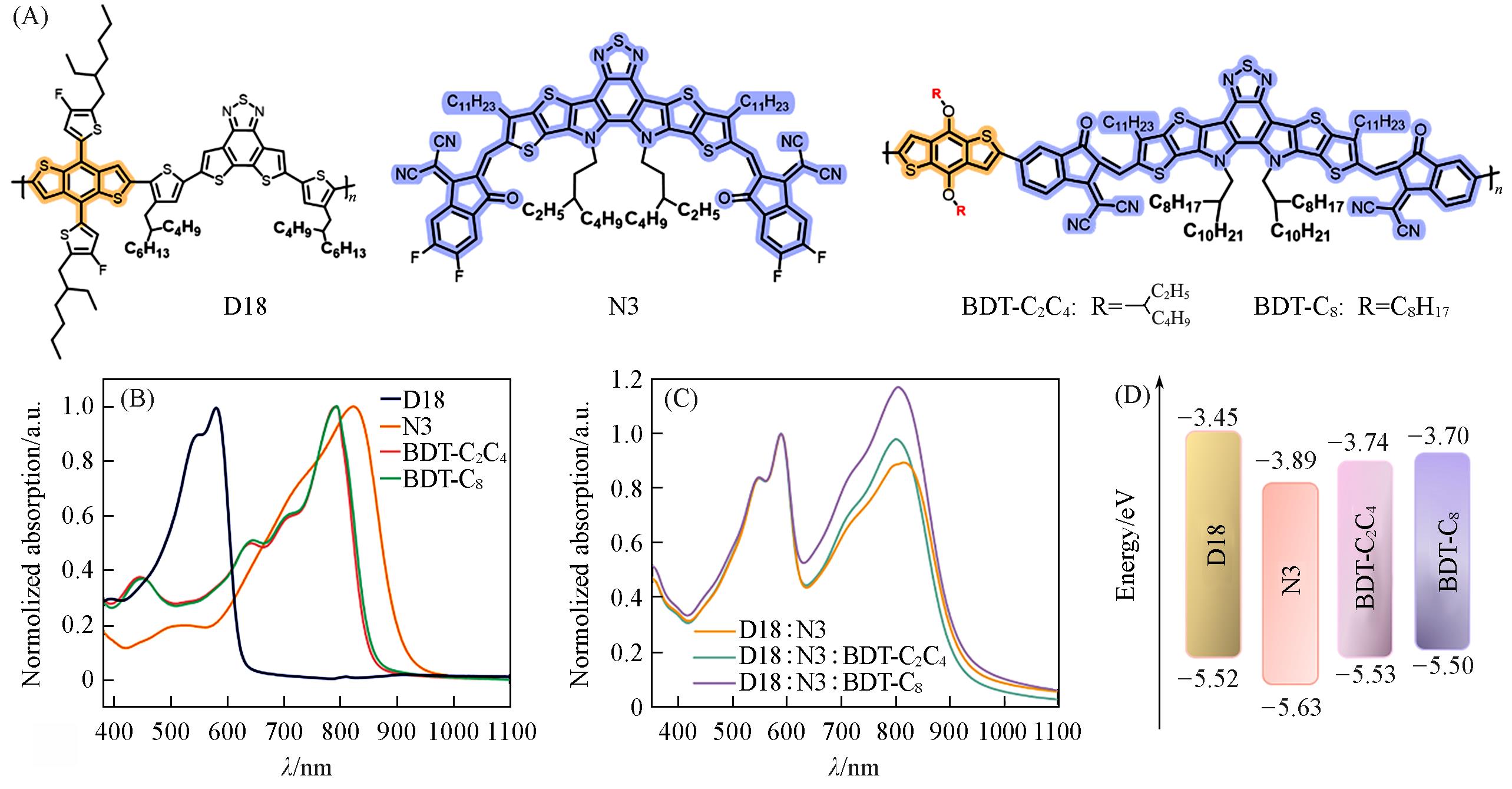
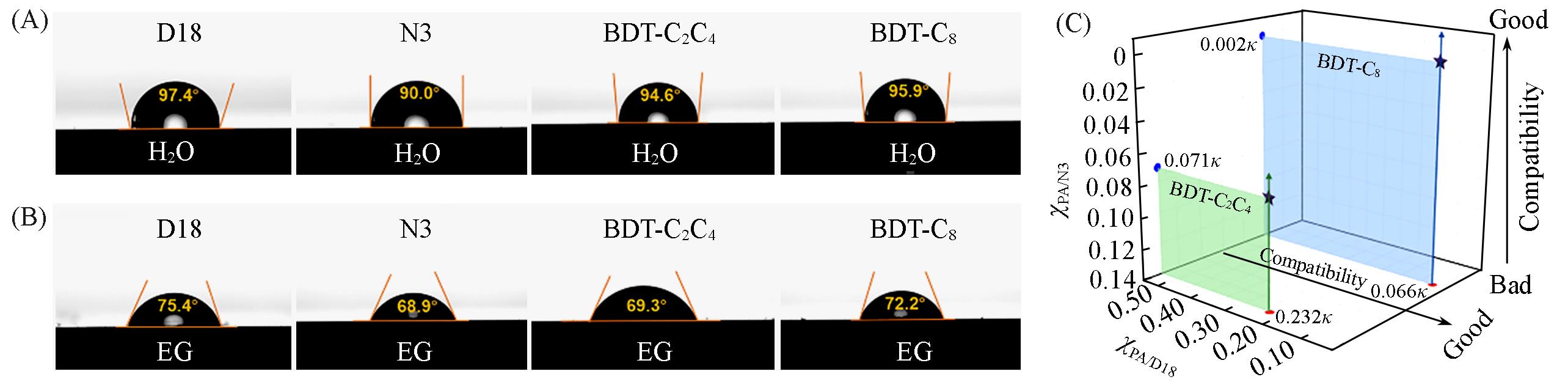
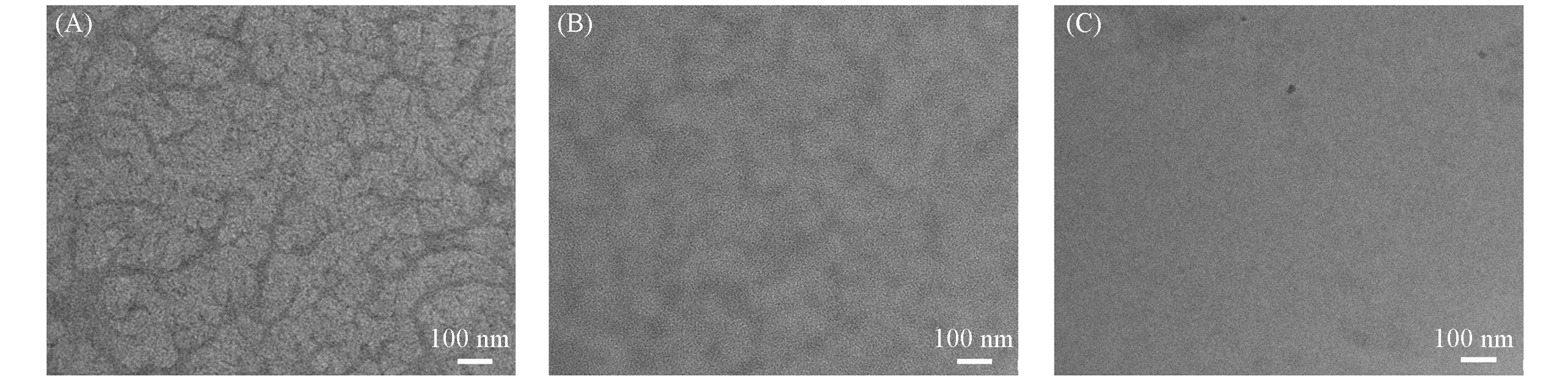
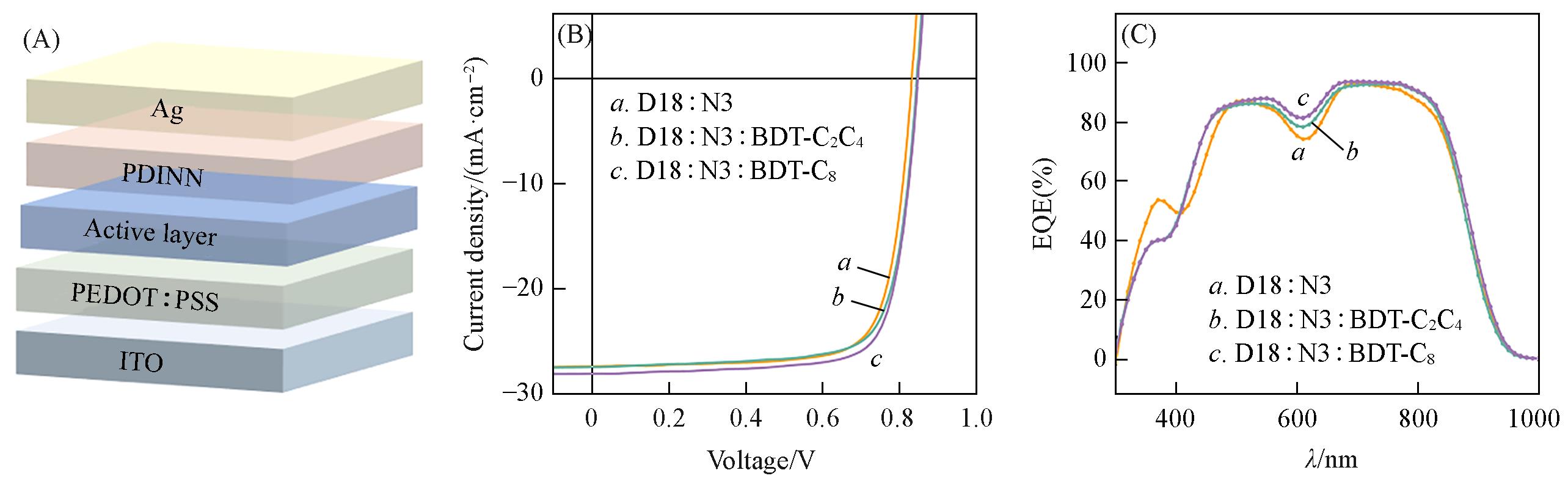
摘要: 活性层形貌对有机太阳能电池(OSCs)的光伏性能具有决定性影响。然而,二元共混体系通常因不合适的相分离形貌而导致太阳能电池器件效率受限。本文通过将苯并二噻吩(BDT)单元作为给电子基团(类似于D18(聚[(2,6-(4,8-双(5-(2-乙基己基-3-氟)噻吩-2-基)-苯并[1,2-b:4,5-b']二噻吩))-交替-(5,5-(1',3'-二-2-噻吩-5,7-双(2-乙基己基)苯并[1',2'-c:4',5'-c']二噻吩-4,8-二酮))])的给电子单元),并与Y6(2,2'-((2Z,2'Z)-((12,13-双(2-丁基辛基)-12,13-二氢-3,9-二壬基噻吩并[2,3]噻吩并[3,2-b]吡咯并[4,5-g]噻吩并[2,3-b]吲哚-2,10-二基)双(甲亚基))双(3-氧代-2,3-二氢-1H-茚-2,1-二亚基))二丙二腈)衍生物作为受体基团相结合,设计合成了两种“桥接”型聚合物受体(PAs),即BDT-C2C4(苯并二噻吩-(2-乙基己基)氧基)和BDT-C8(苯并二噻吩-辛氧基),对应BDT单元上的侧链分别为(2-乙基己基)氧基和辛氧基侧链。这两种聚合物受体与给体D18、受体N3(2,2'-((2Z,2'Z)-((12,13-双(2-丁基辛基)-3,9-二壬基-12,13-二氢-[1,2,5]噻二唑并[3,4-e]噻吩并[2",3":4',5']噻吩并[2',3':4,5]吡咯并[3,2-g]噻吩并[2',3':4,5]噻吩并[3,2-b]吲哚-2,10-二基)双(甲亚基))双(5,6-二氟-3-氧代-2,3-二氢-1H-茚-2,1-二亚基))二丙二腈)呈现出互补的吸收光谱和梯度能级结构,其中BDT-C8与D18、N3的相容性优于BDT-C2C4。当将两种PAs作为第三组分加入至D18:N3混合体系时,活性层形貌均得到显著改善。其中D18:N3:BDT-C8三元共混体系表现出显著优化的形貌特征,即相分离尺度更小,并形成纤维状网络结构。最终,基于D18:N3:BDT-C8的器件实现了18.18%的功率转化效率,显著高于二元器件(约17.37%)。本文提出了一种相容剂策略来优化三元有机太阳能电池的共混形貌和光伏性能,能有效减小活性层的相分离形貌,提高效率。

关键词: 有机太阳能电池, 三元策略, 聚合物受体, 活性层形貌

Abstract: The active layer morphology plays a critical role in determining photovoltaic performance of organic solar cells(OSCs). However, binary blends often suffer from suboptimal phase separation, which limits the efficiency of OSCs. Herein, two bridging polymer acceptors(PAs)—BDT-C2C4(benzodithiophene-(2-ethylhexyl)oxy) and BDT-C8(benzodithiophene-octyloxy)—are designed and synthesized by combining a benzodithiophene(BDT) unit as the donor moiety(analogous to the donor unit of D18(5-(5-(4,8-bis(5-(2-ethylhexyl)-4-fluorothiophen-2-yl)-6-methylbenzo[1,2-b:4,5-b']dithiophen-2-yl)-4-(2-butyloctyl)thiophen-2-yl)-8-(4-(2-butyloctyl)-5-methylthiophen-2-yl)dithieno[3',2':3,4;2'',3'':5,6]benzo[1,2-c][1,2,5]thiadiazole)), and a Y6(2,2'-((2Z,2'Z)-((12,13-Bis(2-butyloctyl)-12,13-dihydro-3,9-dinonylthieno[2,3]thieno[3,2-b]pyrrolo[4,5-g]thieno[2,3-b]indole-2,10-diyl)bis(methanylylidene))bis(3-oxo-2,3-dihydro-1H-indene-2,1-diylidene))dimalononitrile) derivative as the acceptor moiety. BDT-C2C4 and BDT-C8 are functionalized with (2-ethylhexyl)oxy and octyloxy side chains on the BDT unit, respectively. Both PAs show complementary absorption and cascaded energy levels with the donor D18 and the acceptor N3(2,2'-((2Z,2'Z)-((12,13-bis(3-ethylheptyl)-3,9-diundecyl-12,13-dihydro-[1,2,5]thiadiazolo[3,4-e]thieno[2'',3'':4',5']thieno[2',3':4,5]pyrrolo[3,2-g]thieno[2',3':4,5]thieno[3,2-b]indole-2,10-diyl)bis(methaneylylidene))bis(5,6-difluoro-3-oxo-2,3-dihydro-1H-indene-2,1-diylidene))dimalononitrile), but BDT-C8 exhibits better compatibility with D18 and N3 compared to BDT-C2C4. When incorporated as a third component into D18:N3 blend, both PAs improve the active layer morphology. In particular, the D18:N3:BDT-C8 blend shows significantly optimized morphology, featuring reduced phase separation and a fibrous network structure. As a result, the device based on D18:N3:BDT-C8 achieves a power conversion efficiency of 18.18%, significantly higher than that of binary device (ca.17.37%). This work presents a compatibilizer strategy for optimizing blend morphology towards high-performance ternary OSCs.

Key words: Organic solar cell, Ternary strategy, Polymer acceptor, Active layer morphology

中图分类号: 

TrendMD: