

高等学校化学学报 ›› 2026, Vol. 47 ›› Issue (5): 20250414.doi: 10.7503/cjcu20250414
柳力群, 唐翊彭, 王旭, 胡斌( )
)
收稿日期:2025-12-31
出版日期:2026-05-10
发布日期:2026-03-13
通讯作者:
胡斌
E-mail:bhu@scut.edu.cn
基金资助:
LIU Liqun, TANG Yipeng, WANG Xu, HU Bin()
Received:2025-12-31
Online:2026-05-10
Published:2026-03-13
Contact:
HU Bin
E-mail:bhu@scut.edu.cn
Supported by:摘要:
在传统有机光电子学中, 激发态电子与分子振动及晶格声子之间的强电-声子耦合通常导致超快非辐射能量耗散, 从而限制发光效率与器件性能的进一步提升. 围绕这一科学问题, 过去十余年中研究者主要通过分子结构刚性化、 构象受限设计以及材料与器件的结构调控等策略削弱非绝热电-声子耦合通道, 以抑制非辐射跃迁并提高光电性能. 近年来研究发现, 在具有高度有序聚集结构的有机体系中, 声子动力学本身并非总是超快弛豫状态. 通过光激发调制拉曼光谱等实验手段, 在特定有序聚集体中首次观测到毫秒乃至秒的异常慢声子弛豫行为. 进一步的动力学研究表明, 当声子弛豫过程显著减慢时, 激发态电子向晶格的非辐射能量转移速率将受到声子动力学时间尺度的限制, 从而在动力学意义上延长激发态寿命并重塑激发态演化路径. 另一方面, 在有序供体-受体聚集体系中, 分子间电荷转移激发态与极化有序结构的协同作用, 还可诱导一种不同于传统重原子机制的非常规自旋-轨道耦合行为. 该类自旋-轨道耦合并非源于重原子效应, 而体现为由聚集态极化有序结构所稳定的、 作用于激发态动力学过程中的自旋混合与自旋转化通道, 并可通过磁场调控发光等动力学可观测量加以表征. 本文综合评述了有机聚集体发光体系中电-声子耦合引发非辐射跃迁的传统物理方式, 总结了分子、 材料与器件层面抑制非辐射损耗的主要策略, 并重点评述了近年来关于异常慢声子动力学及其对激发态时间尺度调控的代表性研究进展以及由电荷转移态与极化有序结构诱导的非常规自旋-轨道耦合现象. 在此基础上, 提出了将声子从单纯的能量耗散通道转而视为激发态动力学调控因素的“声子增益光电效应”概念, 强调通过调控声子弛豫速率与聚集态结构序参量, 实现对有机光电体系激发态过程的多维动力学调控.
中图分类号:
TrendMD:
柳力群, 唐翊彭, 王旭, 胡斌. 有机分子聚集体中的反常声子动力学及其非传统自旋-轨道耦合光电效应. 高等学校化学学报, 2026, 47(5): 20250414.
LIU Liqun, TANG Yipeng, WANG Xu, HU Bin. Ultra-slow Phonon Dynamics in Organic Aggregated Luminescent Systems and Their Impact on Excited-state Processes. Chem. J. Chinese Universities, 2026, 47(5): 20250414.
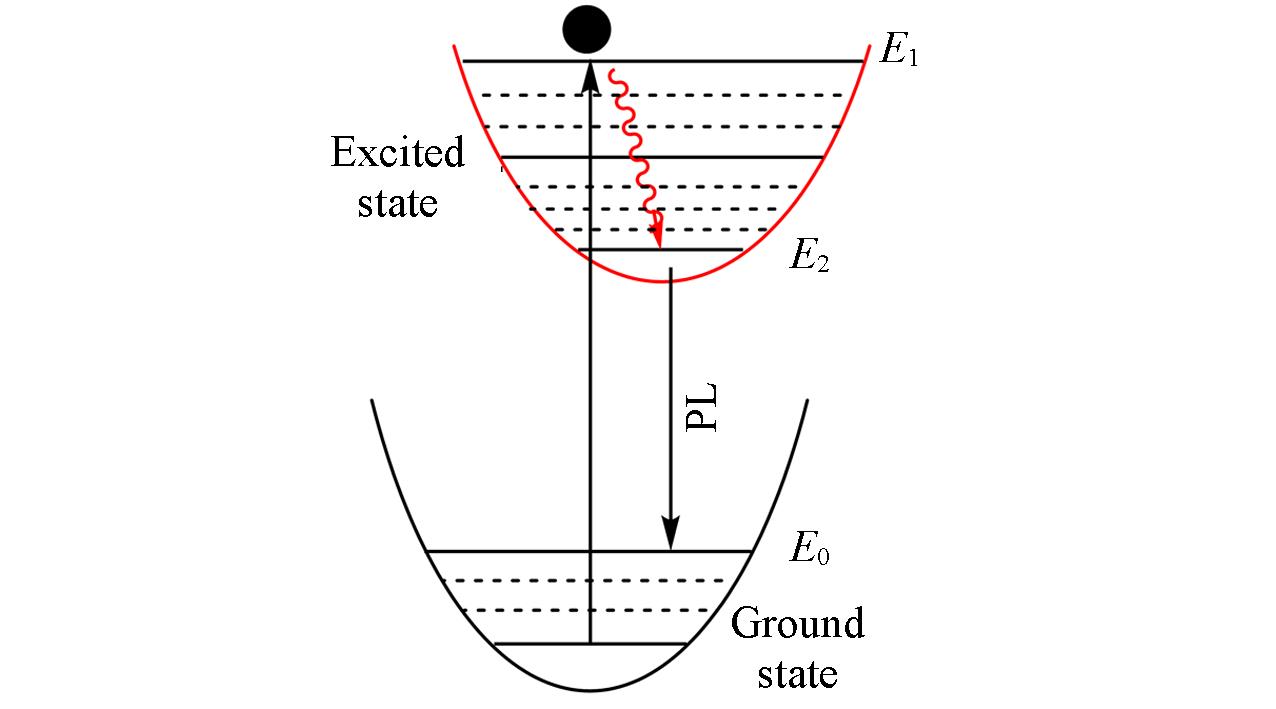
Fig.1 Ultrafast phonon vibrations leading to unusable excited⁃state loss between E₂ and E₁Here, E₂ and E₁ denote schematic energy levels introduced to illustrate the energy relaxation relationship between a high-energy excited state and a lower-energy state, rather than representing specific electronic, spin, or vibrational energy levels.
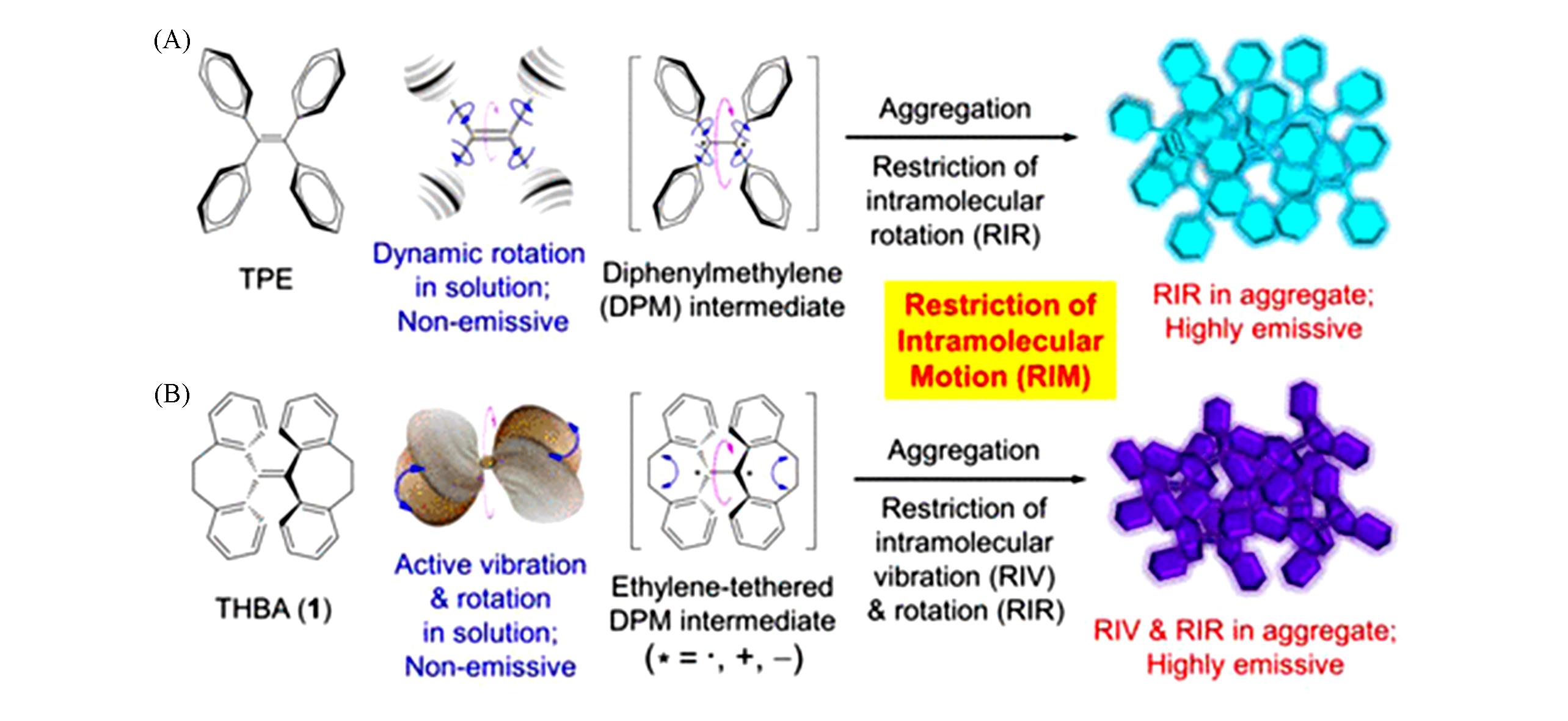
Fig.2 Chemical structures of tetraphenylethene(TPE)(A) and 10,10′,11,11′⁃tetrahydro⁃5,5′ bidibenzo[a,d][7]⁃annulenylidene(THBA)(B)[38](A) Governed the RIRs; (B) a TPE derivative with the AIE effect, working under the restriction of intramolecular vibrations(RIVs).Reproduced from ref.[38], Copyright 2022, American Chemical Society.
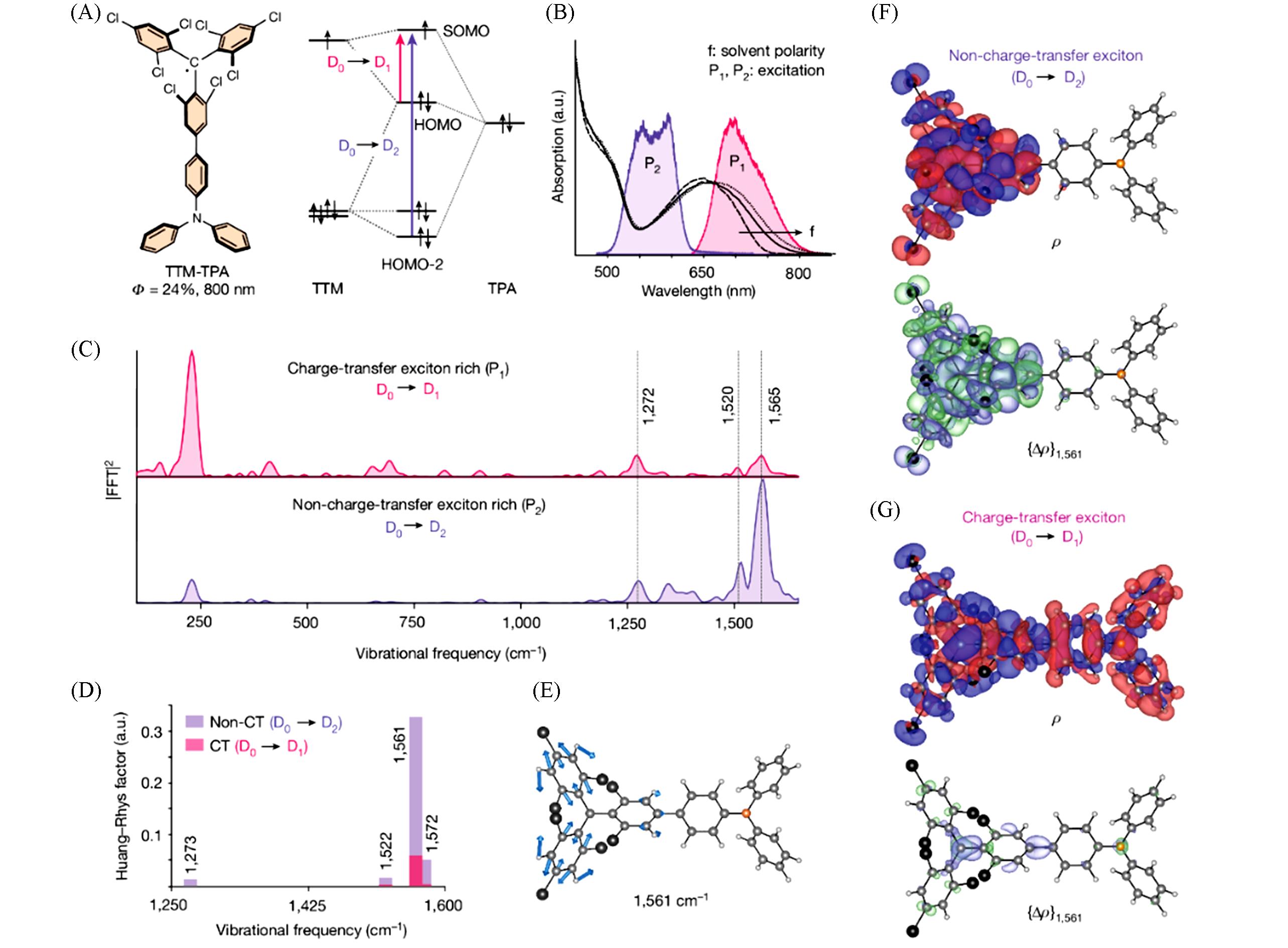
Fig.3 Selective coupling of different excitonic states to high⁃frequency molecular vibrations in TTM⁃TPAExcitons with pronounced charge-transfer character exhibit substantially weakened exciton-vibration coupling under high-frequency vibrational modes, thereby effectively suppressing nonradiative energy dissipation. (A) Molecular structure of the NIR emitter TTM-TPA and the corresponding orbital diagram, indicating two lowest-energy transitions used for band-selective excitation(purple and magenta; not to scale); (B) absorption spectra of TTM-TPA in solvents with varying polarity [shaded regions denote excitation bands(P1, P2)]; (C) early- time(100—1250 fs) vibrational coherence spectra following selective excitation; (D) calculated Huang-Rhys factors for D0→D1 and D0→D2 transitions in the high-frequencregime; (E) displacement vector of the 1561 cm-1 breathing mode on the optimized structure; (F,G) exciton transition densities for D2(non-CT) and D1(CT) states, and their modulation along the 1561 cm-1 mode.Reproduced from Ref. [44] under the terms of the Creative Commons CC BY license. Copyright 2021, the Author(s).
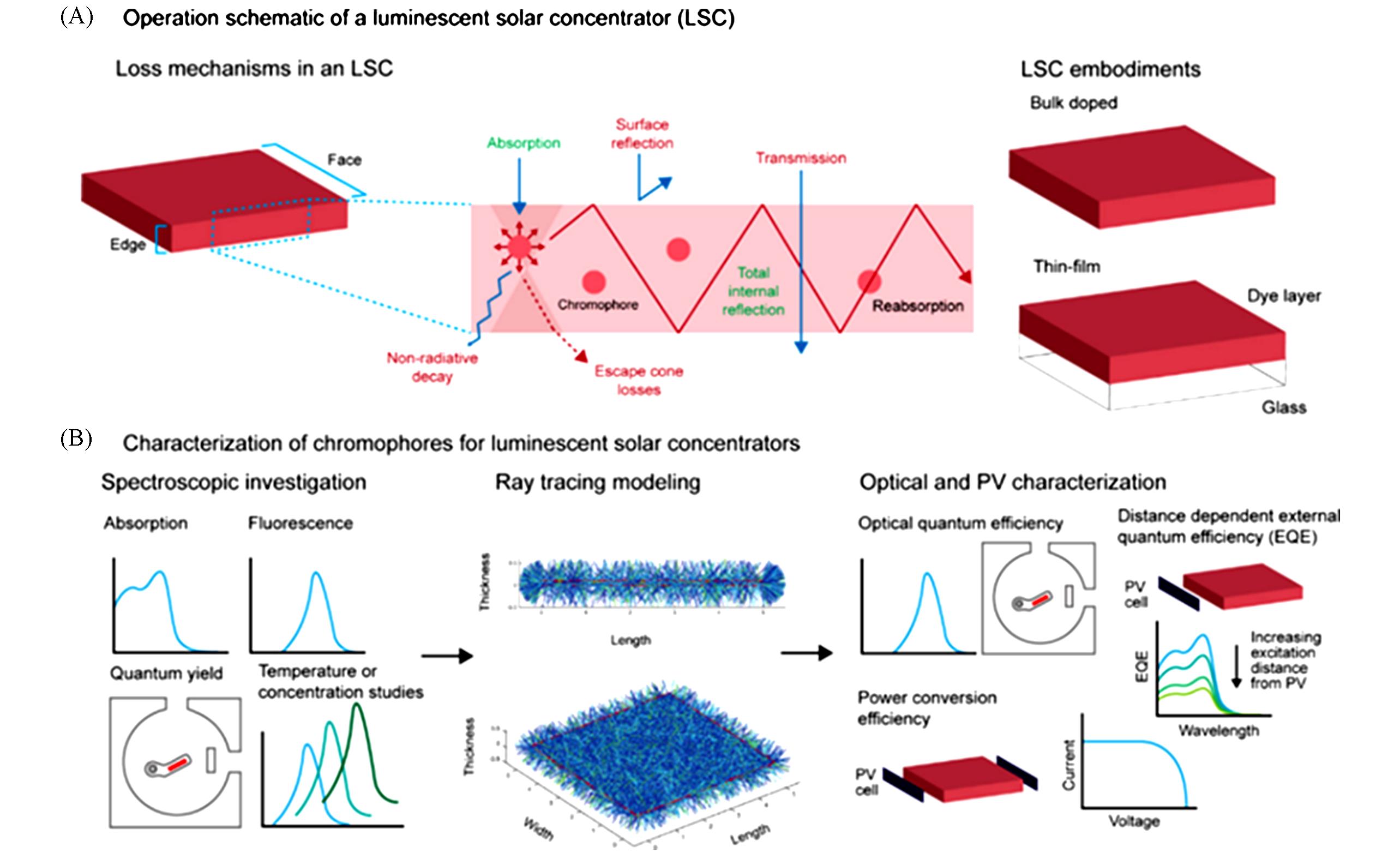
Fig.4 Schematic of an luminescent solar concentrators(LSC)(A) and our LSC characterization workflow(B)[46](A) There are various mechanisms by which incident light can be lost: surface reflection, transmission, nonradiative decay, and escape cone losses(in red). Reabsorption leads to nonradiative decay or emission into an escape cone; (B) the photophysical properties of the organic chromophores are measured carefully both in solution and in the polymer matrix, which is typically poly(methyl methacrylate, PMMA). The measured photophysical quantities are used as inputs in ray tracing modeling as an intermediate screening procedure. The output of the model is then verified using various methods: optical quantum efficiency, power conversion efficiency of an LSC-PV assembly, and distance dependent external quantum efficiency measurements to investigate reabsorption.Copyright 2025, American Chemical Society.
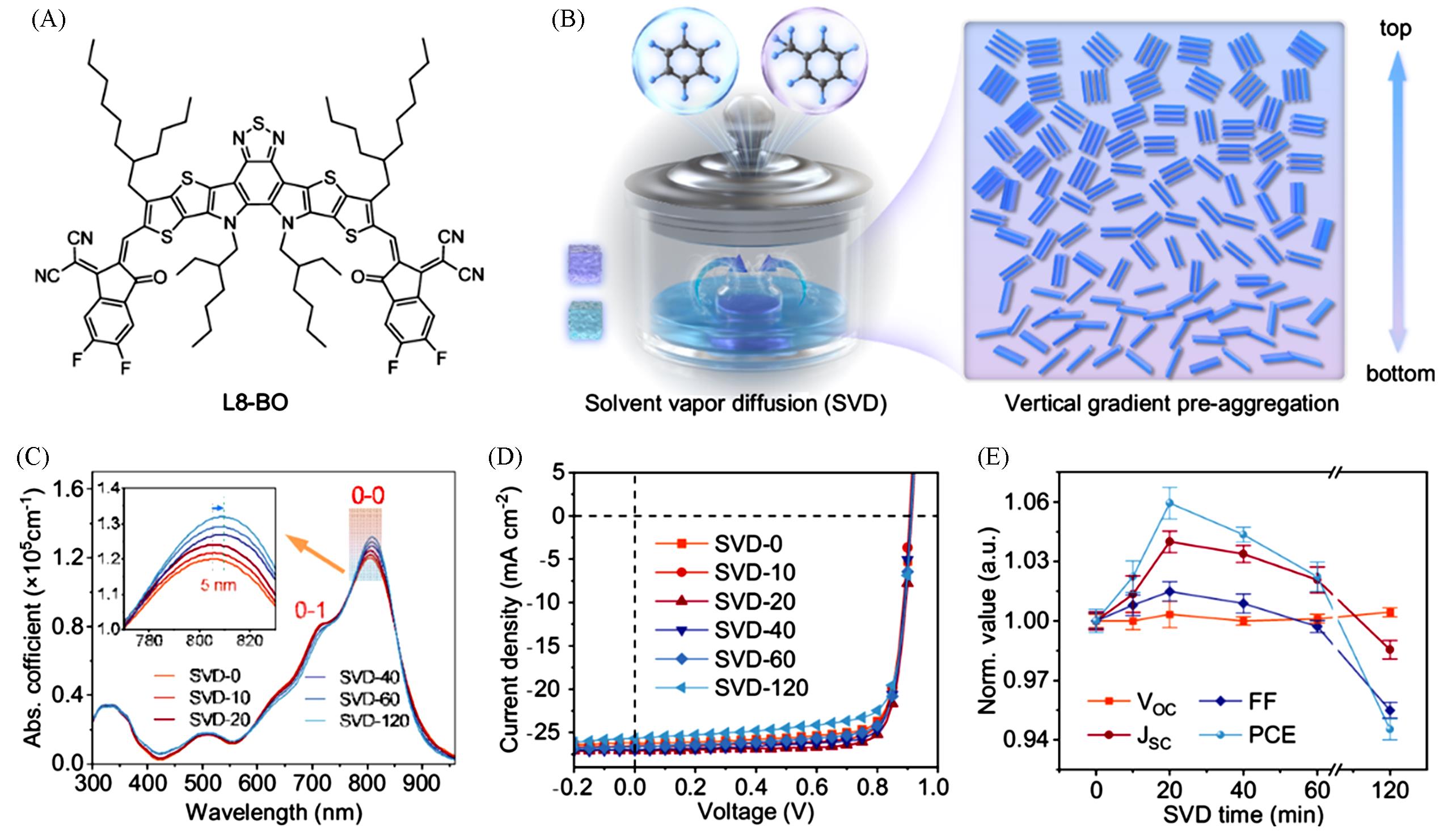
Fig.5 Solvent vapor diffusion⁃driven morphological regulation in organic solar cells[48](A) Chemical structure of L8-BO; (B) schematic illustration of the SVD process enabling vertical gradient control of acceptor pre-aggregation in solution; (C) absorption coefficient spectra of L8-BO films prepared from solutions with different SVD durations; (D) J-V curves of OSCs fabricated with L8-BO subjected to various SVD durations; (E) normalized VOC, JSC, FF, and PCE as a function of SVD duration. Each parameter was calculated from 10 individual devices.Copyright 2024, the Author(s).
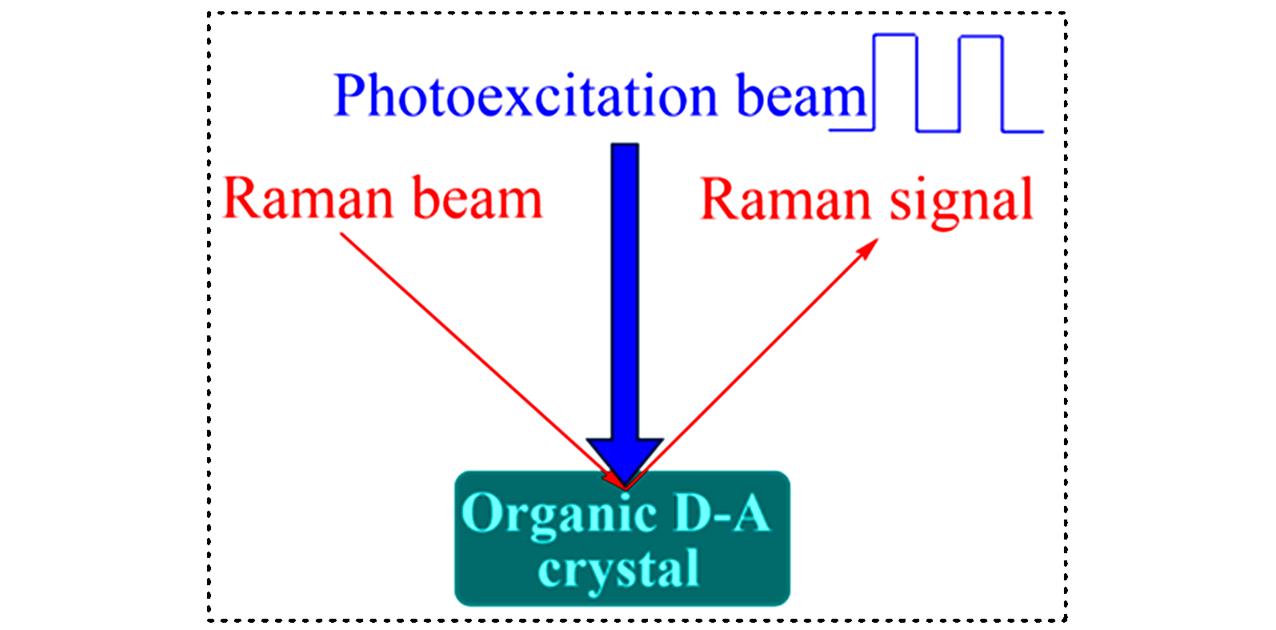
Fig.6 Schematic illustration of the time⁃resolved excitation⁃ modulated Raman scattering spectroscopy experiment[28]Copyright 2014, Wiley-VCH GmbH.
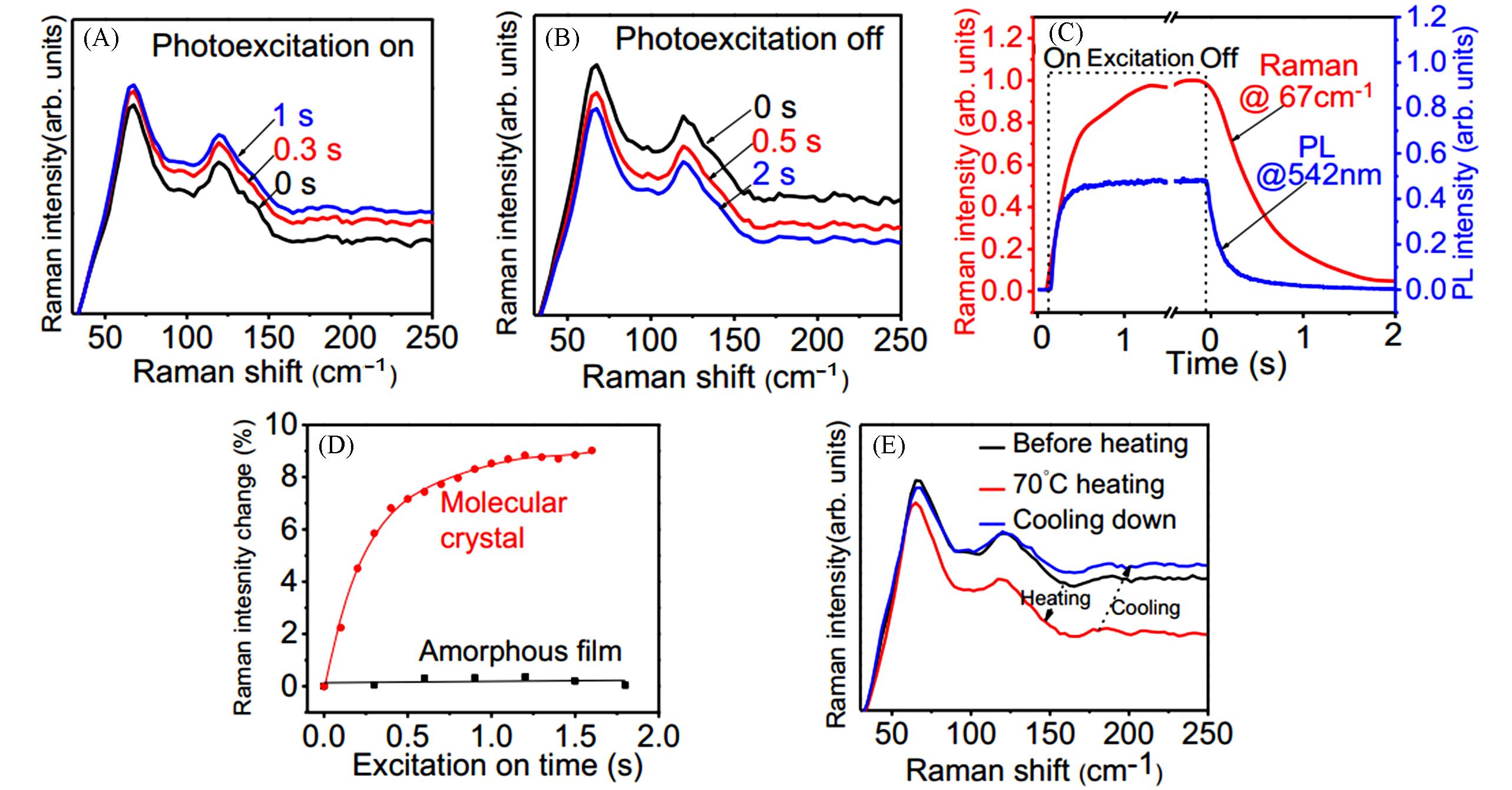
Fig.7 Second⁃scale slow phonon effects in CD⁃49 crystals[27](A) Raman spectra collected under 375 nm laser excitation at varying illumination durations; (B) Raman spectra recorded at different time intervals after turning off the 375 nm excitation; (C) time evolution of the Raman intensity at 67 cm-1 and photoluminescence(PL) intensity at 542 nm during the on/off switching of 375 nm excitation; (D) temporal profiles of Raman intensities for the molecular crystal (67 cm-1) and the amorphous film (59 cm-1) under modulation of 375 nm excitation; (E) Raman spectra obtained during thermal cycling, including heating to 70 ℃ and subsequent cooling back to room temperature.Copyright 2014, the Author(s).
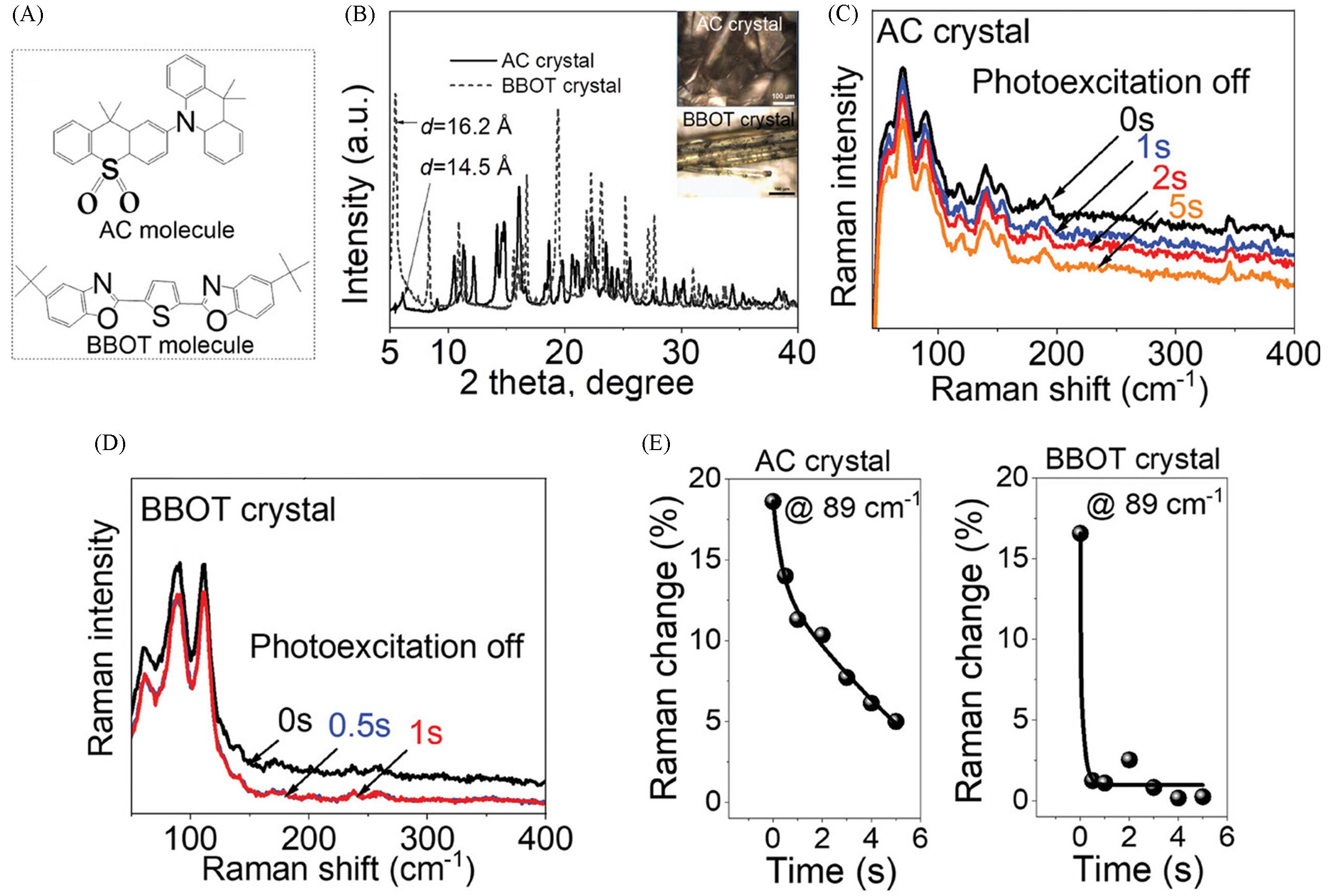
Fig.8 Excited⁃state loss induced by phonon dynamics(normal phonon behavior) and excited⁃state gain induced by abnormal slow phonon dynamics[28]Experimental results show that normal phonon dynamics occur in disordered aggregated donor-acceptor(D-A) molecules, whereas abnormal slow phonon dynamics emerge in ordered aggregated D-A molecules. Schematic illustrations of phonon dynamics are presented: normal phonon dynamics correspond to ultrafast relaxation-induced excited-state loss, while abnormal slow phonon dynamics correspond to ultraslow relaxation-induced excited-state gain. (A) Molecular structure of the AC compound; (B) X-ray diffraction (XRD) patterns of AC and BBOT crystals (inset: corresponding crystal photographs); (C) time-resolved Raman spectra of the AC crystal collected at different delay times after terminating photoexcitation, revealing ultralong phonon relaxation dynamics; (D) Raman spectra of the BBOT crystal recorded after cessation of photoexcitation, showing no evidence of slow phonon relaxation; (E) comparison of lattice vibrational relaxation at 89 cm-1 in AC and BBOT crystals, exhibiting slow and fast decay processes, respectively.Copyright 2014, Wiley-VCH GmbH.
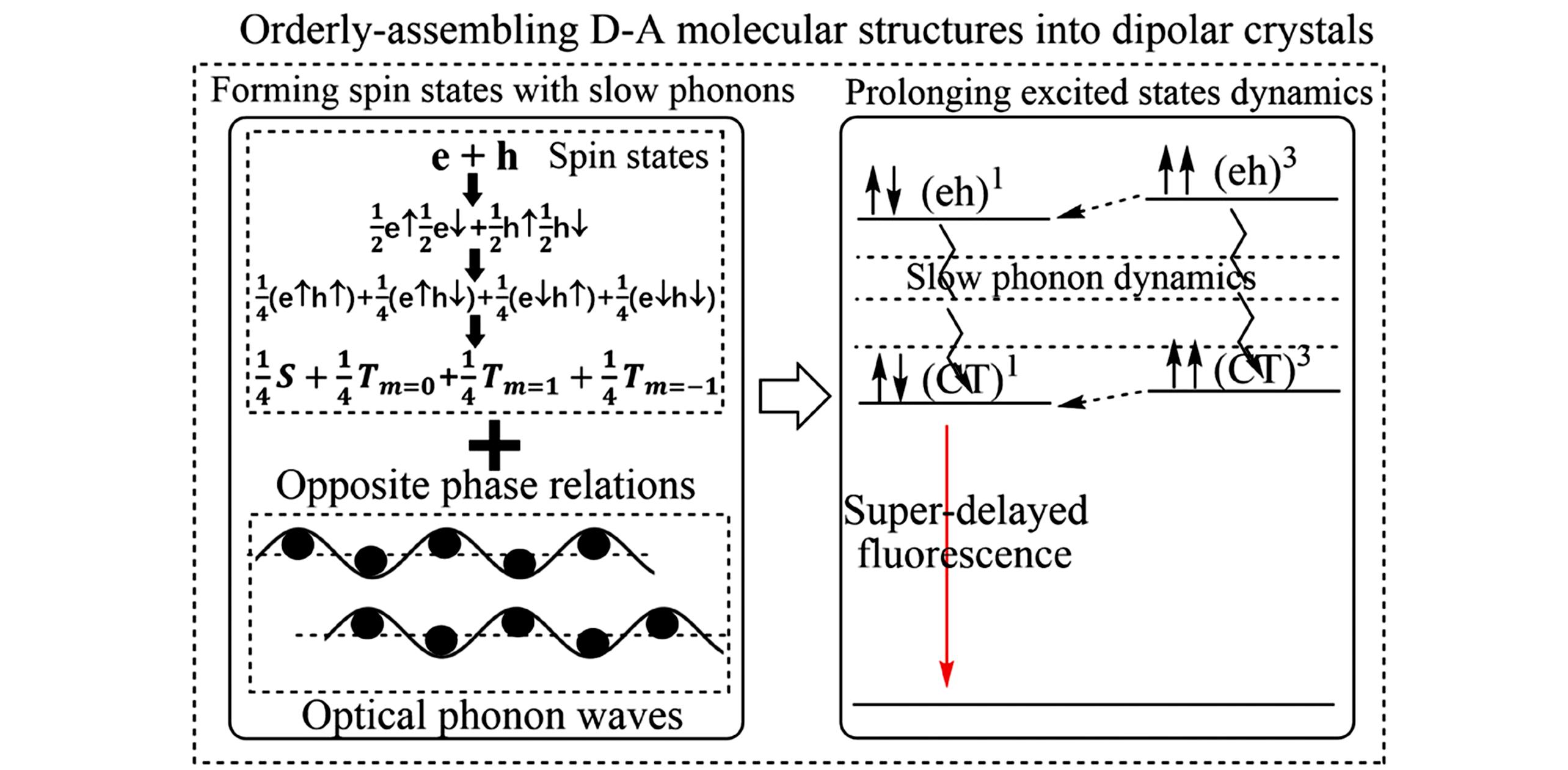
Fig.9 Slow⁃phonon⁃dynamics⁃driven extension of the excited⁃state lifetime[28]Copyright 2014, Wiley-VCH GmbH.
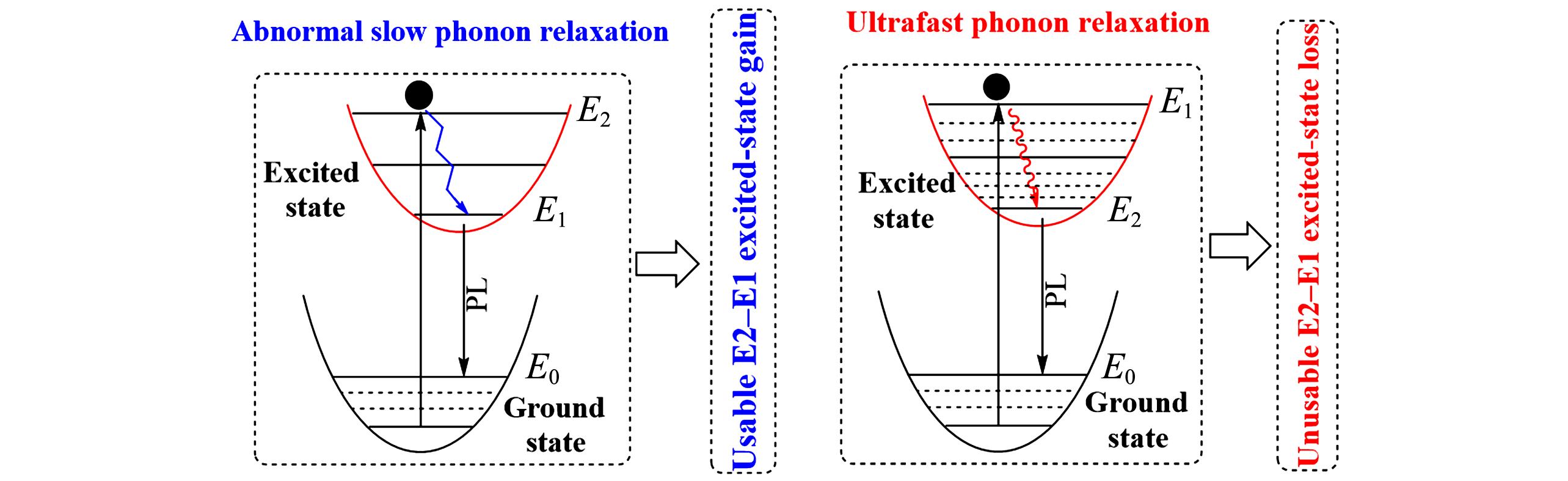
Fig.10 Schematic illustration of the reversal of ultrafast phonon⁃induced excited⁃state loss into a phonon⁃vibration⁃induced excited⁃state gain enabled by ultraslow phonon relaxation dynamicsHere, E₂ and E₁ denote schematic energy levels used to illustrate the energy relaxation relationship between a high-energy excited state and a lower-energy state, rather than representing specific electronic, spin, or vibrational energy levels.
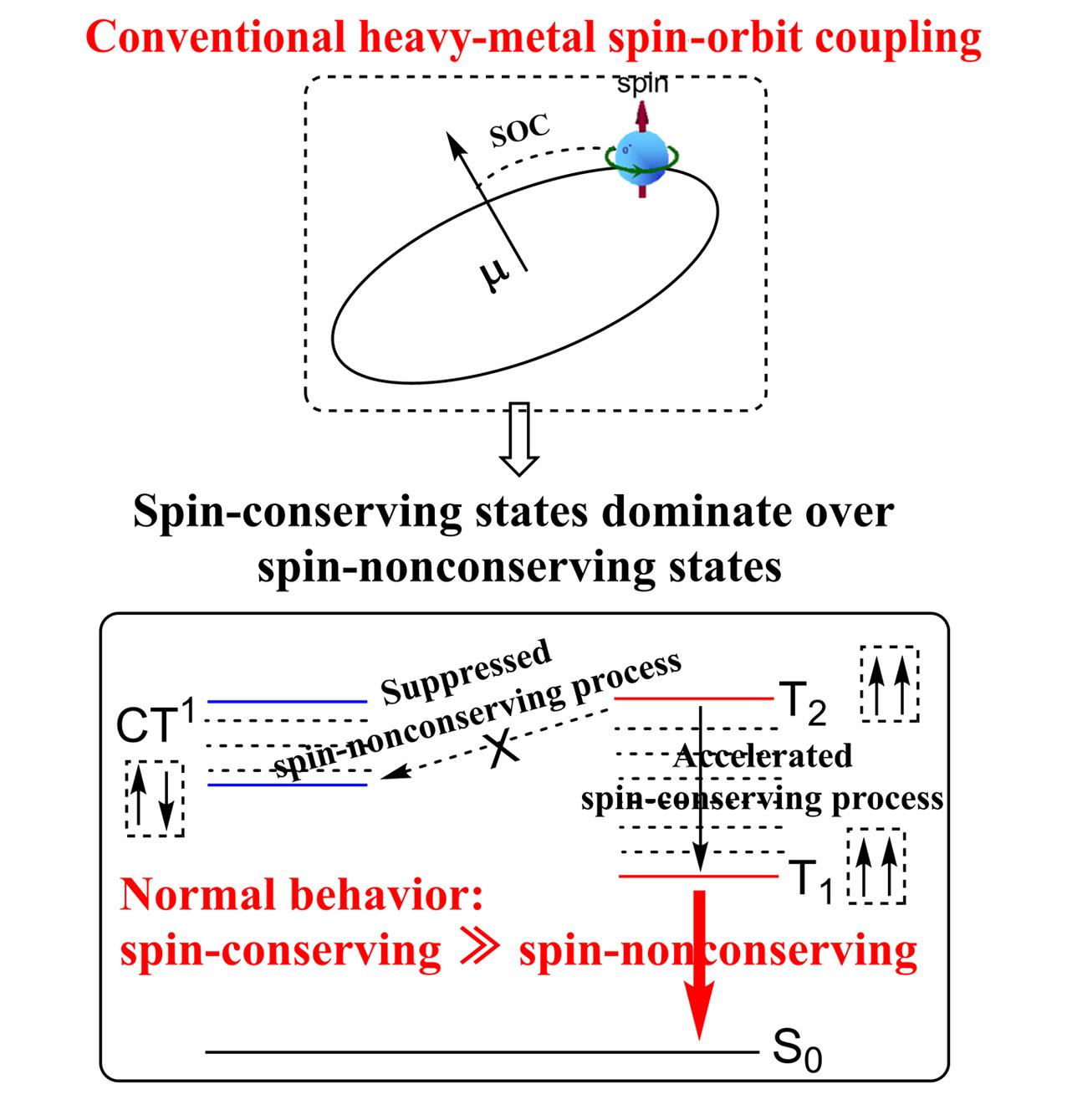
Fig.11 Dominance of spin⁃conserving states over spin⁃ nonconverging states induced by conventional heavy⁃metal spin⁃orbit coupling
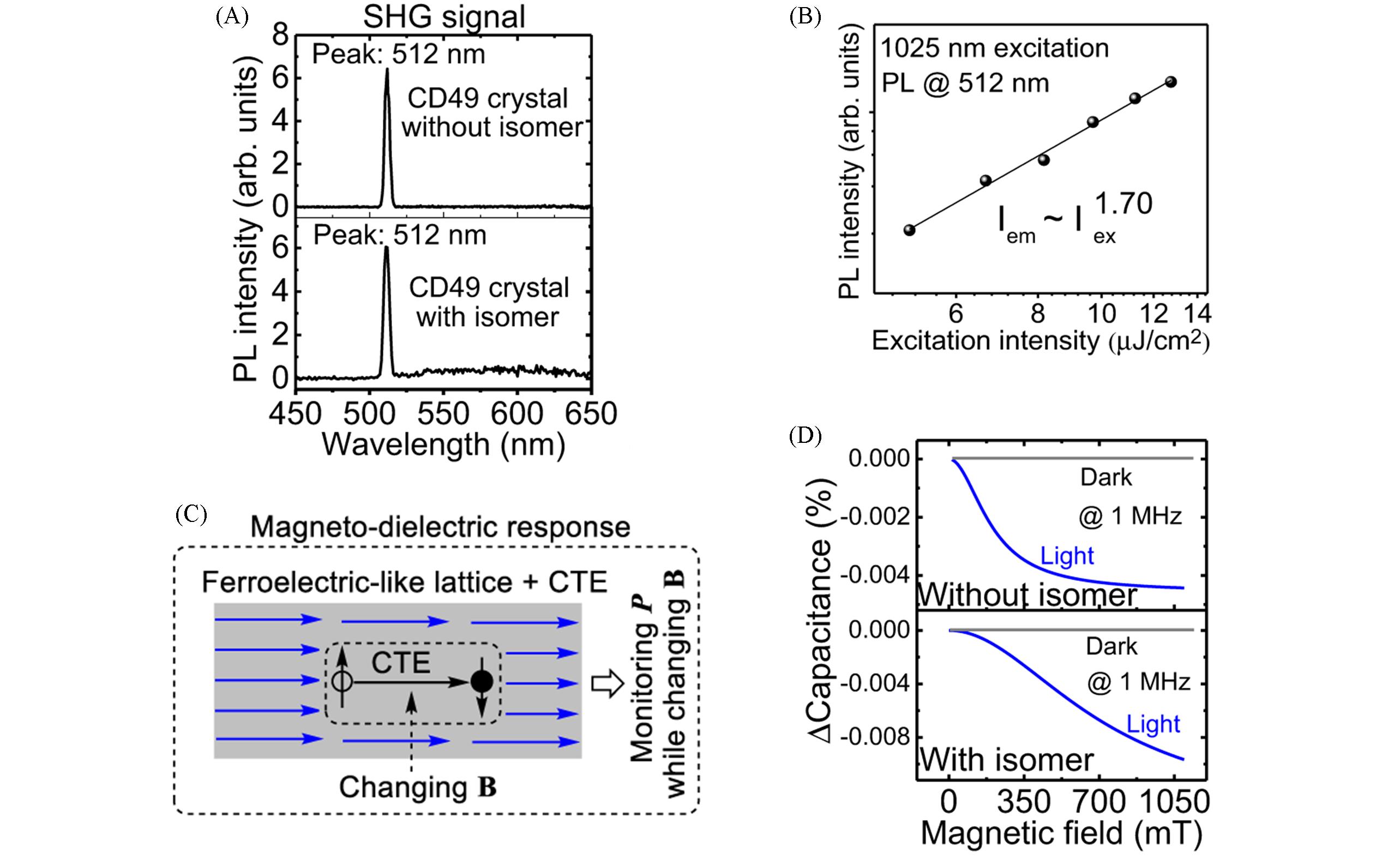
Fig.12 Second⁃harmonic generation(SHG) experiments and magneto⁃dielectric response measurements of CD⁃49 crystals[27](A) Second-harmonic generation(SHG) responses of CD49 crystals synthesized in the presence and absence of isomeric molecules under 1025 nm excitation; (B) dependence of SHG intensity on excitation power, correlating excitation and emission behaviors; (C) schematic illustration of the magneto-dielectric approach for probing the interaction between ferroelectric-like lattice polarization and intermolecular crystalline charge-transfer excitons(CTEs); (D) magneto-dielectric measurements at 1 MHz as a function of magnetic field under 343 nm photoexcitation, compared with the dark condition.Copyright 2014, Royal Society of chemistry.
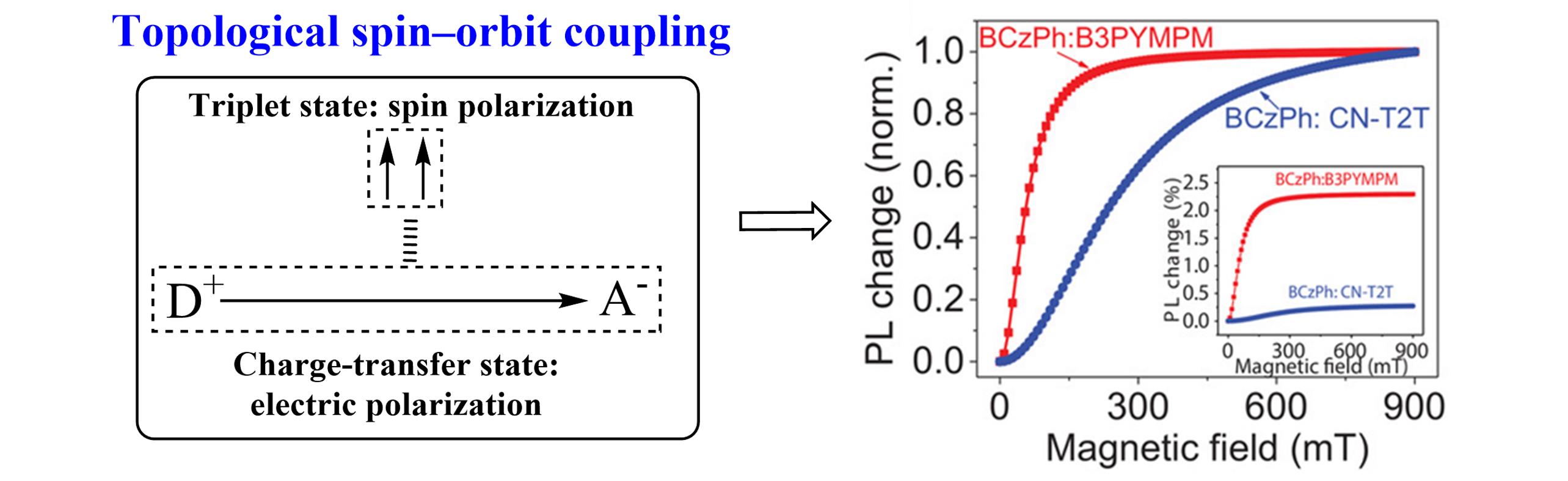
Fig.13 Magnetic⁃field effects reveal topological spin⁃orbit coupling[52]Electromagnetic coupling arising from charge-transfer-state polarization and triplet-spin interactions gives rise to spin-orbit coupling with topological characteristics. Copyright 2019, Wiley-VCH GmbH.
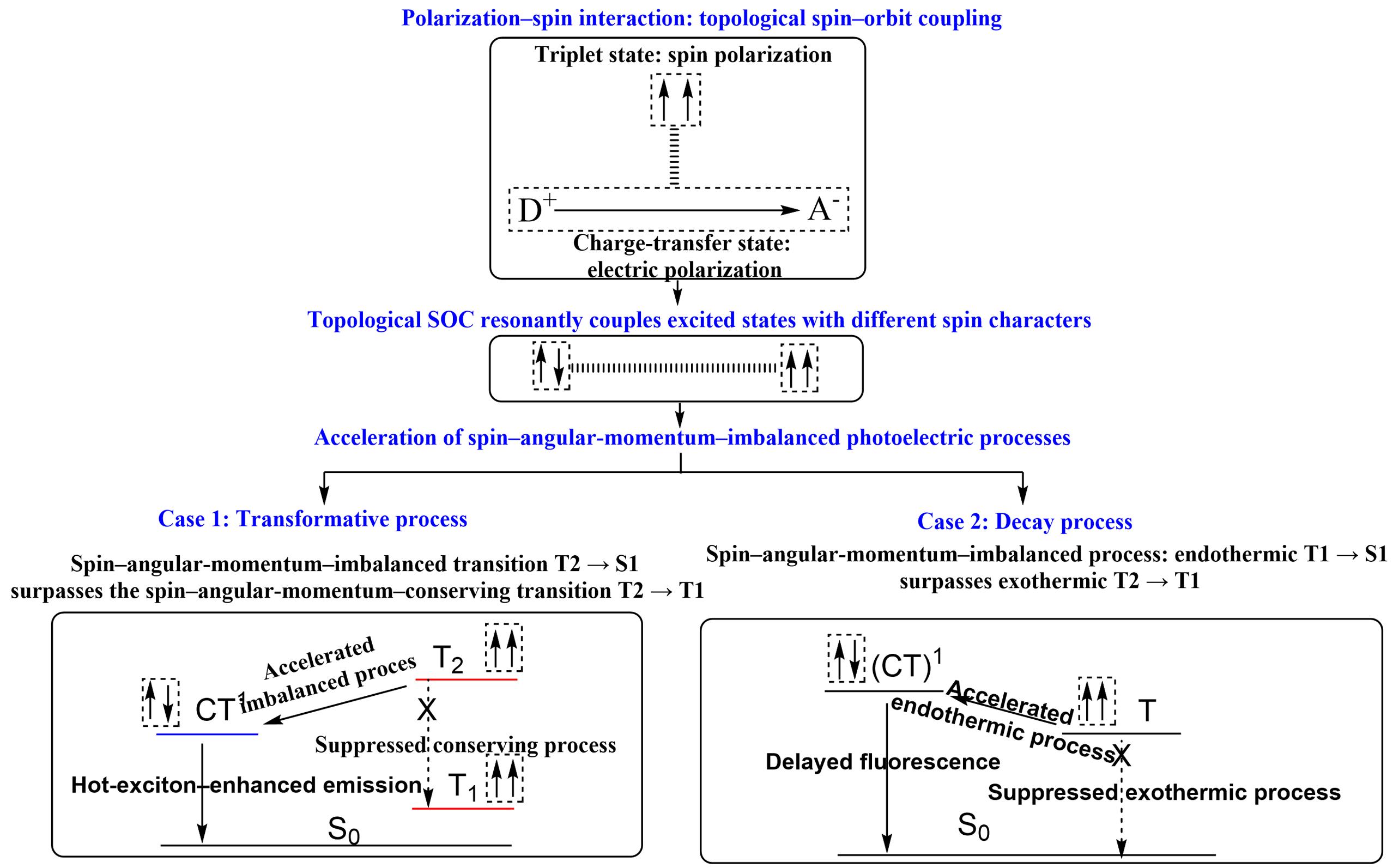
Fig.14 Topological spin⁃orbit coupling(SOC) breaks the limitations of excitonic photoelectric effects imposed by spin⁃angular⁃momentum⁃conserving states, giving rise to an inverted behavior in which spin⁃angular⁃momentum⁃nonconverging states accelerate photoelectric processes
| [31] | Qiu W., Liu D., Li M., Cai X., Chen Z., He Y., Liang B., Peng X., Qiao Z., Chen J., Li W., Nat. Commun., 2023, 14, 2564 |
| [32] | Li M., Hua L., Zhao J., Liu Y., Yan S., Ren Z., Angew. Chem. Int. Ed., 2025, 64, e202501179 |
| [33] | Ghosh P., Alvertis A. M., Chowdhury R., Murto P., Gillett A. J., Dong S., Sneyd A. J., Cho H. H., Evans E. W., Monserrat B., Li F., Nature, 2024, 629, 355—362 |
| [34] | Zhang Z., Yang Y., Li T., Hou H., Geng Y., Lin Q., Lin Y., Angew. Chem. Int. Ed., 2025, 64, e202507637 |
| [35] | Banal J. L., Zhang B, Jones D. J., Ghiggino K. P., Wong W. W., Acc. Chem. Res., 2017, 50, 49—57 |
| [36] | De Nisi F., Francischello R., Battisti A., Panniello A., Fanizza E., Striccoli M., Gu X., Leung N. L. C., Tang B. Z., Pucci A., Mater. Chem. Front., 2017, 1, 1406 |
| [37] | Zhou W., Dai X., Fan B., Li H., Xu X., Wu Y., Peng Q., Nat. Commun., 2025, 16, 11188 |
| [38] | He Z., Ke C., Tang B., ACS Omega, 2018, 3, 3267—3277 |
| [39] | Li Y. L., Li M. K., Yang Z. Y., Chen Y. C., Ruan C. H., Yu Y., Luo X. A., Zhong W. K., Ma D. G., Ma Y. G., Ying L., Adv. Mater., 2026, 38, e17600 |
| [40] | Zhang G. F., Chen Z. Q., Aldred M. P., Hu Z., Chen T., Huang Z., Meng X., Zhu M. Q., Chem. Commun., 2014, 50, 12058—12060 |
| [41] | Wang M., Huang Y. H., Lin K. S., Yeh T. H., Duan J., Ko T. Y., Liu S. W., Wong K. T., Hu B., Adv. Mater., 2019, 31, 1904114 |
| [42] | He L., Li M., Urbas A., Hu B., Adv. Mater, 2014, 26, 3956—3961 |
| [43] | Wu T., Mukherjee R., Ovchinnikova O. S., Collins L., Ahmadi M., Lu W., Kang N. G., Mays J. W., Jesse S., Mandrus D., J. Am.Chem. Soc., 2017, 139, 17285—17288 |
| [44] | Lin C., Han P., Xiao S., Qu F., Yao J., Qiao X., Yang D., Dai Y., Sun Q., Hu D., Adv. Funct. Mater., 2021, 31, 2106912 |
| [45] | Zhang L., Li M., Yu Y., Wang S., Niu P., Li Y., Wang B., Chen Y., Tan W., Peng F., Ying L., Ma Y., Adv. Opt. Mater., 2025, 13, e01982 |
| [46] | Liu F., Liu H., Chen Y., He X., Cheng Z., Ma X., Qiao X., Ma D., Lu P., CCS Chem., 2025,7, 3172—3184 |
| [47] | Uoyama H., Goushi K., Shizu K., Nomura H., Adachi C., Nature, 2012, 492, 234—238 |
| [48] | Diesing S., Zhang L., Zysman⁃Colman E., Samuel I. D. W., Nature, 2024, 627, 747—753 |
| [49] | Mońka M., Grzywacz D., Hoffman E., Ievtukhov V., Kozakiewicz K., Rogowski R., Kubicki A., Liberek B., Bojarski P., Serdiuk I., |
| J. Mater. Chem. C, 2022, 10, 11719—11729 | |
| [50] | Li Y. L., Li M. K., Yang Z. Y., Chen Y. C., Ruan C. H., Yu Y., Luo X. A., Zhong W. K., Ma D. G., Ma Y. G., Ying L., Adv. Mater., 2026, 38, e17600 |
| [51] | Lukyanchuk I. A., Razumnaya A. G., Kondovych S, Tikhonov Y. A., Khesin B, Vinokur V. M., Phys. Rep., 2025, 1110, 1—56 |
| [52] | Wang M., Huang Y. H., Lin K. S., Yeh T. H., Duan J., Ko T. Y., Liu S. W., Wong K. T., Hu B., Adv. Mater., 2019, 31, 1904114 |
| [53] | He L., Li M., Urbas A., Hu B., Adv. Mater., 2014, 26, 3956—3961 |
| [54] | Wu T., Mukherjee R., Ovchinnikova O. S., Collins L., Ahmadi M., Lu W., Kang N. G., Mays J. W., Jesse S., Mandrus D., J. Am.Chem. Soc., 2017, 139, 17285—17288 |
| [1] | Ostroverkhova O., Chem. Rev., 2016, 116, 13279—13412 |
| [2] | Kondo S., Kameyama M., Imaoka K., Shimoi Y., Mathevet F., Fujihara T., Goto H., Nakanotani H., Yahiro M., Adachi C., Nat. Commun., 2024, 15, 8115 |
| [3] | Englman R., Jortner J., Mol. Phys., 1970, 18, 145—164 |
| [4] | Wang Y., Ren J., Shuai Z., Nat. Commun., 2023, 14, 5056 |
| [5] | Kim W., Musser A., J. Adv. Phys. X, 2021, 6, 1918022 |
| [6] | Ren X., Yang F., Gao X., Cheng S., Zhang X., Dong H., Hu W., Adv. Energy Mater., 2018, 8, 1801003 |
| [7] | Li W., Ren J., Shuai Z., Nat. Commun., 2021, 12, 4260 |
| [8] | Mei J., Leung N. L., Kwok R. T., Lam J. W., Tang B. Z., Chem. Rev., 2015, 115, 11718—11740 |
| [9] | Nguyen X. T., Winte K., Timmer D., Rakita Y., Ceratti D. R., Aharon S., Ramzan M. S., Cocchi C., Lorke M., Jahnke F., Cahen D., Nat. Commun., 2023, 14, 1047 |
| [10] | Sayers C. J., Genco A., Trovatello C., Conte S. D., Khaustov V. O., Cervantes⁃Villanueva J., Sangalli D., Molina⁃Sanchez A., Coletti C., Gadermaier C., Cerullo G., Nano Lett., 2023, 23, 9235—9242 |
| [11] | Batignani G., Fumero G., Srimath Kandada A. R., Cerullo G., Gandini M., Ferrante C., Petrozza A., Scopigno T., Nat. Commun., 2018, 9, 1971 |
| [12] | Liu Z., Vaswani C., Luo L., Cheng D., Yang X., Zhao X., Yao Y., Song Z., Brenes R., Kim R. J., Jean J., Phys. Rev. B, 2020, 101, 115125 |
| [13] | Lee H. J., Lee M., Lee K., Jo J., Yang H., Kim Y., Chae S. C., Waghmare U., Lee J. H., Science, 2020, 369, 1343—1347 |
| [14] | Yang Z., Min J., Dong T., Wen W., Feng Z., Yang G., Yan Y., Zeng Z., Appl. Phys. Lett., 2022, 120, 142103 |
| [15] | Mandal S., Srivastava A., Das T., Singh A. K., Maiti P. K., Small, 2025, 22, e13476 |
| [16] | Dou Y., Demangeat C., Wang M., Xu H., Dryzhakov B., Kim E., Le Bahers T., Lee K. S., Attias A. J., Hu B., Nat. Commun., 2021, 12, 3485 |
| [55] | Lin C., Han P., Xiao S., Qu F., Yao J., Qiao X., Yang D., Dai Y., Sun Q., Hu D., Adv. Funct. Mater., 2021, 31, 2106912 |
| [56] | Li W., Liu D., Shen F., Ma D., Wang Z., Feng T., Xu Y., Yang B., Ma Y., Adv. Funct. Mater., 2012, 22, 2797—2803 |
| [57] | Du X., Zhao S., Wang L., Wu H., Ye F., Xue K. H., Peng S., Xia J., Sang Z., Zhang D., Nat. Photo., 2024, 18, 162—169 |
| [58] | Zhang L., Li M., Yu Y., Wang S., Niu P., Li Y., Wang B., Chen Y., Tan W., Peng F., Ying L., Ma Y., Adv. Opt. Mater., 2025, 13, e01982 |
| [59] | Liu F., Liu H., Chen Y., He X., Cheng Z., Ma X., Qiao X., Ma D., Lu P., CCS Chem., 2025,7, 3172—3184 |
| [60] | Uoyama H., Goushi K., Shizu K., Nomura H., Adachi C., Nature, 2012, 492, 234—238 |
| [61] | Diesing S., Zhang L., Zysman⁃Colman E., Samuel I. D. W., Nature, 2024, 627, 747—753 |
| [17] | Tang Y., Kim H., Lee K. S., Whang D. R., Kim T. D., Keum J., Prabhakaran P., Hu B., Adv. Mater., 2025, 37, 2416873 |
| [18] | Coropceanu V., Cornil J., da Silva Filho D. A., Olivier Y., Silbey R., Brédas J. L., Chem. Rev., 2007, 107, 926—952 |
| [19] | Vukmirović N., Bruder C., Stojanović V. M., Phys. Rev. Lett., 2012, 109, 126407 |
| [20] | Spano F. C., Silva C. Annu., Rev. Phys. Chem., 2014, 65, 477—500 |
| [21] | Balevičius Jr V., Wei T., Di Tommaso D., Abramavicius D., Hauer J., Polívka T., Duffy C. D., Chem. Sci., 2019, 10, 4792—4804 |
| [22] | Kim H., Hunger J., Cánovas E., Karakus M., Mics Z., Grechko M., Turchinovich D., Parekh S. H., Bonn M., Nat. Commun., 2017, 8, 687 |
| [23] | Fu S., Huang X., Gao G., St. Petkov P., Gao W., Zhang J., Gao L., Zhang H., Liu M., Hambsch M., Zhang W., Nat. Mater., 2025, 24, 1—8 |
| [24] | Koch M, Mittleman D. M., Ornik J., Castro⁃Camus E., Nat. Rev. Methods Primers, 2023, 3, 48 |
| [25] | Glebov A. L., Mokhun O., Rapaport A., Vergnole S., Smirnov V., Glebov L. B., Proc. SPIE, 2012, 8428, 42—52 |
| [26] | Englman R., Jortner J., Mol. Phys., 1970, 18, 145—164 |
| [27] | Zhang G. F., Chen Z. Q., Aldred M. P., Hu Z., Chen T., Huang Z., Meng X., Zhu M. Q., Chem. Commun., 2014, 50, 12058—12060 |
| [28] | Leung N. L., Xie N., Yuan W., Liu Y., Wu Q., Peng Q., Miao Q., Lam J. W., Tang B. Z., Chem. Eur. J., 2014, 20, 15349—15353 |
| [29] | He Z., Ke C., Tang B. Z., ACS Omega, 2018, 3, 3267—3277 |
| [30] | Kim T., Sohn S., Park S., Choi W., Ahn H., Jung S., Park T., Chem. Eng. J., 2023, 478, 147444 |
| [1] | 王欣, 王宇, 穆富茂, 闫翎鹏, 王振国, 杨永珍. 碳点在有机太阳能电池界面工程中的应用与展望[J]. 高等学校化学学报, 2025, 46(6): 20240416. |
| [2] | 张振宇, 汪国平. 基于钙钛矿单晶片表面周期性结构的高性能近红外光探测器[J]. 高等学校化学学报, 2024, 45(12): 20240347. |
| [3] | 吴济发, 吴汉平, 袁琳, 彭小彬. 协同富勒烯和非富勒烯受体提高卟啉全小分子三元有机太阳能电池的性能[J]. 高等学校化学学报, 2023, 44(9): 20230136. |
| [4] | 宋亚男, 游祖豪, 王旭, 刘瑶. 电活性紫罗烯有机光伏界面材料的研究进展[J]. 高等学校化学学报, 2023, 44(9): 20230167. |
| [5] | 李伟, 陈宸, 刘丹, 王涛. 非富勒烯电子受体多尺度分子聚集体[J]. 高等学校化学学报, 2023, 44(9): 20230160. |
| [6] | 杨可, 肖泽云, 陆仕荣, 孙宽. 分子堆叠和器件性能: 基于苯并二噻吩及其衍生物的高效小分子给体研究进展[J]. 高等学校化学学报, 2023, 44(9): 20230123. |
| [7] | 郭子琦, 焦灿灿, 吴思敏, 孟令贤, 孙延娜, 柯鑫, 万相见, 陈永胜. 小分子给体桥联单元烷基链取代位置对光伏器件性能的影响[J]. 高等学校化学学报, 2023, 44(9): 20230180. |
| [8] | 王家成, 蔡贵龙, 张亚静, 王嘉宇, 路新慧, 占肖卫, 陈兴国. 侧链的简单调制使近红外吸收的非富勒烯受体实现更高的短路电流密度[J]. 高等学校化学学报, 2023, 44(9): 20230163. |
| [9] | 李浩, 杨晨熠, 李佳尧, 张少青, 侯剑辉. 基于受体1-受体2型聚合物给体的高效有机太阳能电池[J]. 高等学校化学学报, 2023, 44(9): 20230157. |
| [10] | 施世领, 蒋寒曦, 涂雪杨, 鲜开虎, 韩德霞, 李艳如, 姚翔, 叶龙, 费竹平. 基于芳环取代酰亚胺端基的非富勒烯受体材料的合成与光伏性能[J]. 高等学校化学学报, 2023, 44(9): 20230182. |
| [11] | 张有辉, 杨娜, 段娜, 程毓君, 游诗勇, 吴飞燕, 谌烈. 端基修饰聚合物给体制备高性能有机太阳能电池[J]. 高等学校化学学报, 2023, 44(7): 20230169. |
| [12] | 张亿, 单通, 王焱, 钟洪亮. 以锗为桥接原子的受体材料及其在有机太阳能电池中的应用[J]. 高等学校化学学报, 2023, 44(7): 20230050. |
| [13] | 时宇, 张榴, 国霞, 王阳, 肖海芹, 房进, 周祎, 张茂杰. 聚合物添加剂作为形貌调节剂提升全小分子有机太阳能电池的效率和稳定性[J]. 高等学校化学学报, 2023, 44(7): 20230047. |
| [14] | 杨丽君, 于洋, 张蕾. 双功能2D/3D杂化结构Co2P-CeO x 异质结一体化电极的构筑及电催化尿素氧化辅助制氢性能[J]. 高等学校化学学报, 2022, 43(6): 20220082. |
| [15] | 张义超, 赵付来, 王宇, 王亚玲, 沈永涛, 冯奕钰, 封伟. 基于多层二硒化钨的高性能场效应晶体管的实验优化和理论模拟[J]. 高等学校化学学报, 2022, 43(6): 20220113. |
| 阅读次数 | ||||||
|
全文 |
|
|||||
|
摘要 |
|
|||||
