

高等学校化学学报 ›› 2026, Vol. 47 ›› Issue (9): 20260187.doi: 10.7503/cjcu20260187
刘少芳, 谢奎( )
)
收稿日期:2026-05-07
出版日期:2026-09-10
发布日期:2026-05-26
通讯作者:
谢奎
E-mail:xiekui@sjtu.edu.cn
基金资助:
LIU Shaofang, XIE Kui()
Received:2026-05-07
Online:2026-09-10
Published:2026-05-26
Contact:
XIE Kui
E-mail:xiekui@sjtu.edu.cn
Supported by:摘要:
多孔材料和单晶材料在现代科学技术中均具有重要应用价值. 若能在宏观尺寸单晶中引入孔隙, 有望获得兼具开放孔结构和连续单晶骨架的新型材料, 即宏观尺寸单晶多孔材料. 其连续单晶骨架保持长程有序晶体结构, 可有效减少晶界对传输过程和结构稳定性的影响, 同时孔隙结构可提供传质通道和可接触内表面. 然而, 传统晶体生长过程通常趋向于致密化, 孔隙往往被视为夹杂或缺陷, 因此在单晶中可控引入孔结构仍面临本征挑战. 本文围绕基于“固-固相变”的晶格重构策略展开综述, 重点讨论高密度单晶母相经特定组分脱除、 晶格重排和相变界面迁移后, 原位转化为低密度目标相单晶骨架并形成孔隙结构的基本机制. 进一步结合二氧化钛和二氧化铈等典型氧化物体系, 分析了母相晶向、 组成、 相对密度变化和热处理条件对晶面取向、 孔隙率、 孔径及表面结构的调控作用. 最后, 以光电化学能源转化为例, 探讨了连续单晶骨架、 三维连通孔道和可调缺陷结构之间的协同效应, 并展望了该类材料在电子-声子输运解耦、 同位素分离等结构敏感型功能过程中的潜在应用前景.
中图分类号:
TrendMD:
刘少芳, 谢奎. 宏观尺寸单晶多孔材料. 高等学校化学学报, 2026, 47(9): 20260187.
LIU Shaofang, XIE Kui. Macroscopic Porous Single-crystalline Materials. Chem. J. Chinese Universities, 2026, 47(9): 20260187.
| Method | Typical route | Advantage | Limitation | Retention of single-crystalline skeleton | Formation of 3D interconnected pore |
|---|---|---|---|---|---|
| Liquid-solid/gas-solid single-crystal growth | Melt, solution, and vapor growth | High-quality dense single crystal | Difficult to introduce internal interconnected pores | Relatively easy | Relatively difficult |
| Conventional porous-material fabrication | Templating, sintering, and phase separation | High porosity and specific surface area | Skeletons are typically polycrystalline, nanocrystalline, or amorphous | Relatively difficult | Relatively easy |
| Post-etching of single crystals | Chemical and electrochemical etching | Surface roughening and pore formation | Limited pore penetration; possible lattice damage | Partially retained | Limited |
| Solid-solid transformation-driven lattice reconstruction | KTP⁃TiO2, CeBr3/CePO4⁃CeO2 etc. | Coupled phase transformation, pore formation, and orientation inheritance | Depends on precursor design, transformation kinetics, and lattice matching | Relatively easy | Relatively easy |
Table 1 Comparison of conventional single-crystal growth, porous-material fabrication, and solid-solid phase-transformation-induced lattice reconstruction strategies
| Method | Typical route | Advantage | Limitation | Retention of single-crystalline skeleton | Formation of 3D interconnected pore |
|---|---|---|---|---|---|
| Liquid-solid/gas-solid single-crystal growth | Melt, solution, and vapor growth | High-quality dense single crystal | Difficult to introduce internal interconnected pores | Relatively easy | Relatively difficult |
| Conventional porous-material fabrication | Templating, sintering, and phase separation | High porosity and specific surface area | Skeletons are typically polycrystalline, nanocrystalline, or amorphous | Relatively difficult | Relatively easy |
| Post-etching of single crystals | Chemical and electrochemical etching | Surface roughening and pore formation | Limited pore penetration; possible lattice damage | Partially retained | Limited |
| Solid-solid transformation-driven lattice reconstruction | KTP⁃TiO2, CeBr3/CePO4⁃CeO2 etc. | Coupled phase transformation, pore formation, and orientation inheritance | Depends on precursor design, transformation kinetics, and lattice matching | Relatively easy | Relatively easy |
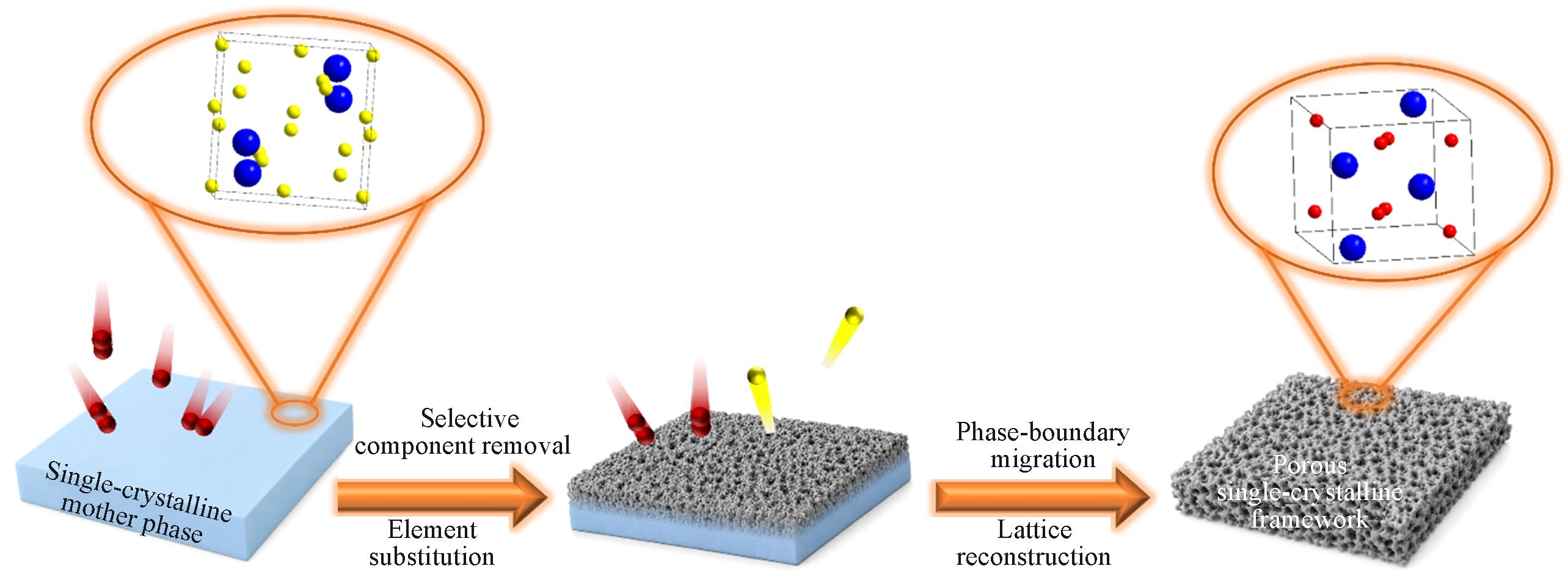
Fig.1 Schematic illustration of the formation of macroscopic porous single⁃crystalline materials via solid⁃solid phase⁃transformation⁃driven lattice reconstructionA single-crystalline mother phase undergoes selective component removal or element substitution, followed by phase-boundary migration and lattice reconstruction, ultimately forming a porous single crystal with a continuous single-crystalline skeleton and interconnected pores.
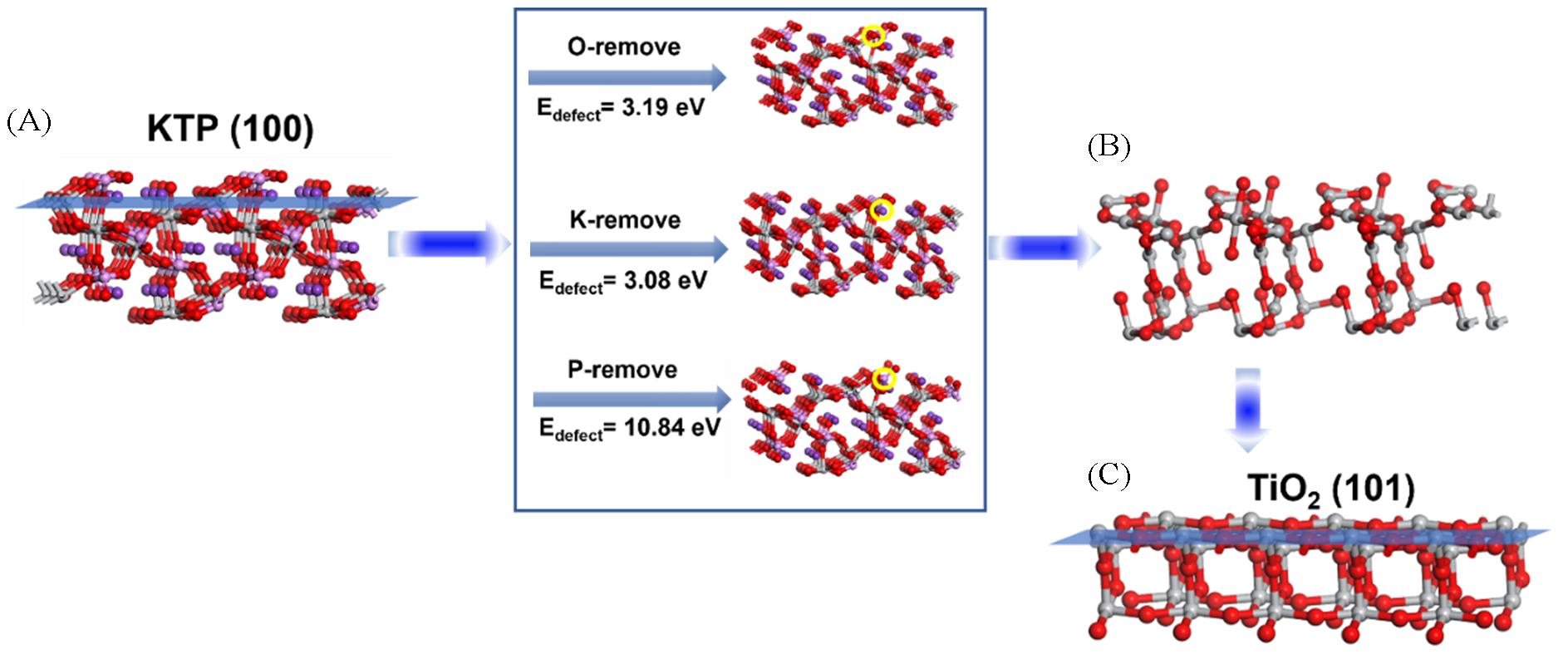
Fig.2 Calculated energies for the transformation process of KTP to PSC TiO2[14](A) Defect formation energies(Edefect) for various configurations on the pristine KTP(100) surface; (B) Ti-O framework configurations containing P, K, and O defects; (C) anatase TiO2(101) surface.Copyright 2023, Wiley-VCH GmbH.
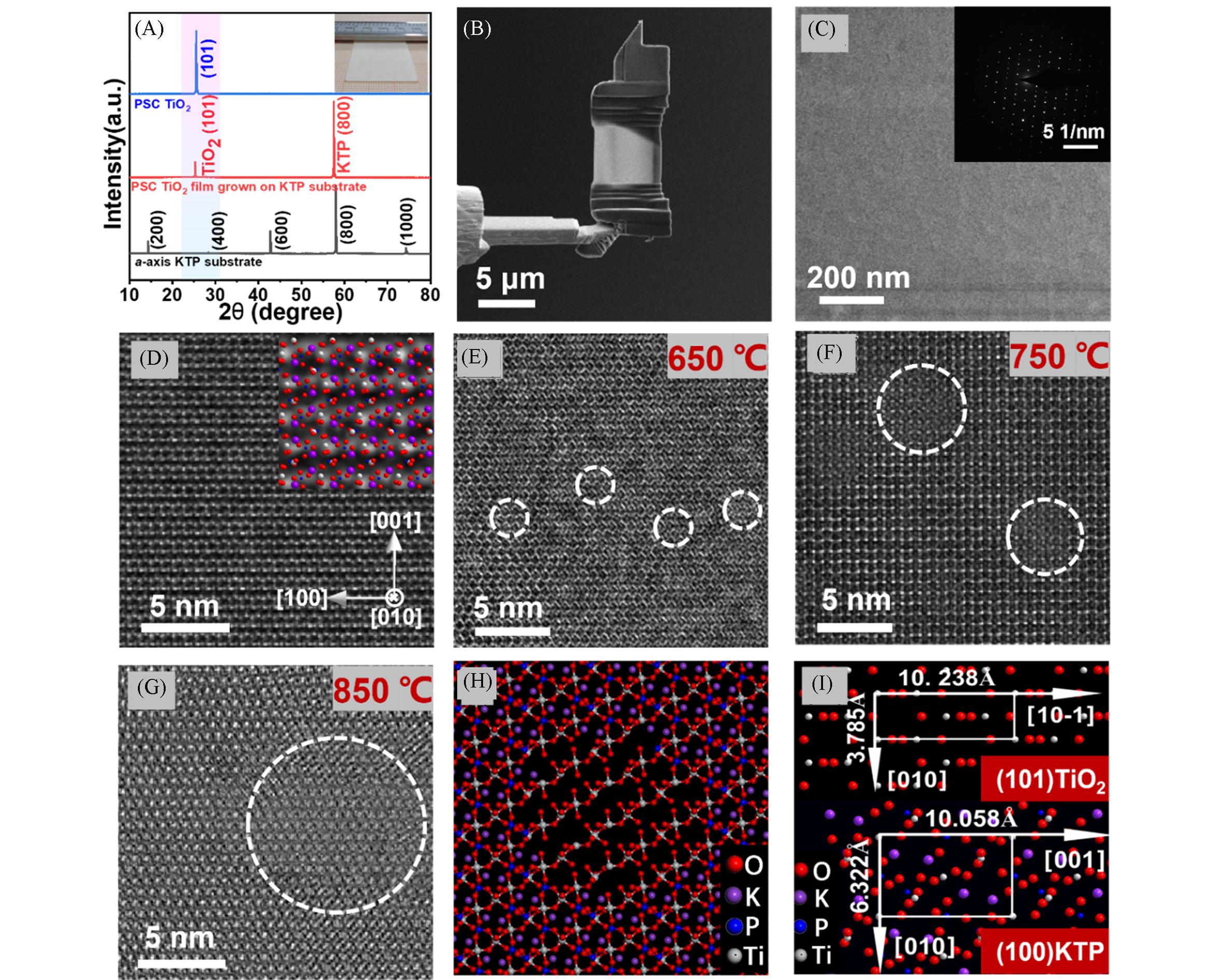
Fig.3 Structural evolution from KTP to PSC TiO2 revealed by in situ TEM, showing atomic⁃scale changes and pore formation at different temperatures[14](A) Schematic illustration of the lattice reconstruction from (11-20)-oriented CeBr3 to (200)-oriented CeO2; (B) SEM image and corresponding XRD pattern of the resulting (200)-oriented CeO2 single crystal; (C) corresponding selected-area electron diffraction (SAED) pattern; (D) schematic illustration of the lattice reconstruction from (0001)-oriented CeBr3 to (220)-oriented CeO2;(E) SEM image and corresponding XRD pattern of the resulting (220)-oriented CeO2 single crystal; (F) corresponding SAED pattern; (G) schematic illustration of the lattice reconstruction from (1-100)-oriented CeBr3 to (111)-oriented CeO2; (H) SEM image and corresponding XRD pattern of the resulting (111)-oriented CeO2 single crystal; (I) Corresponding SAED pattern.Copyright 2023, Wiley-VCH GmbH.
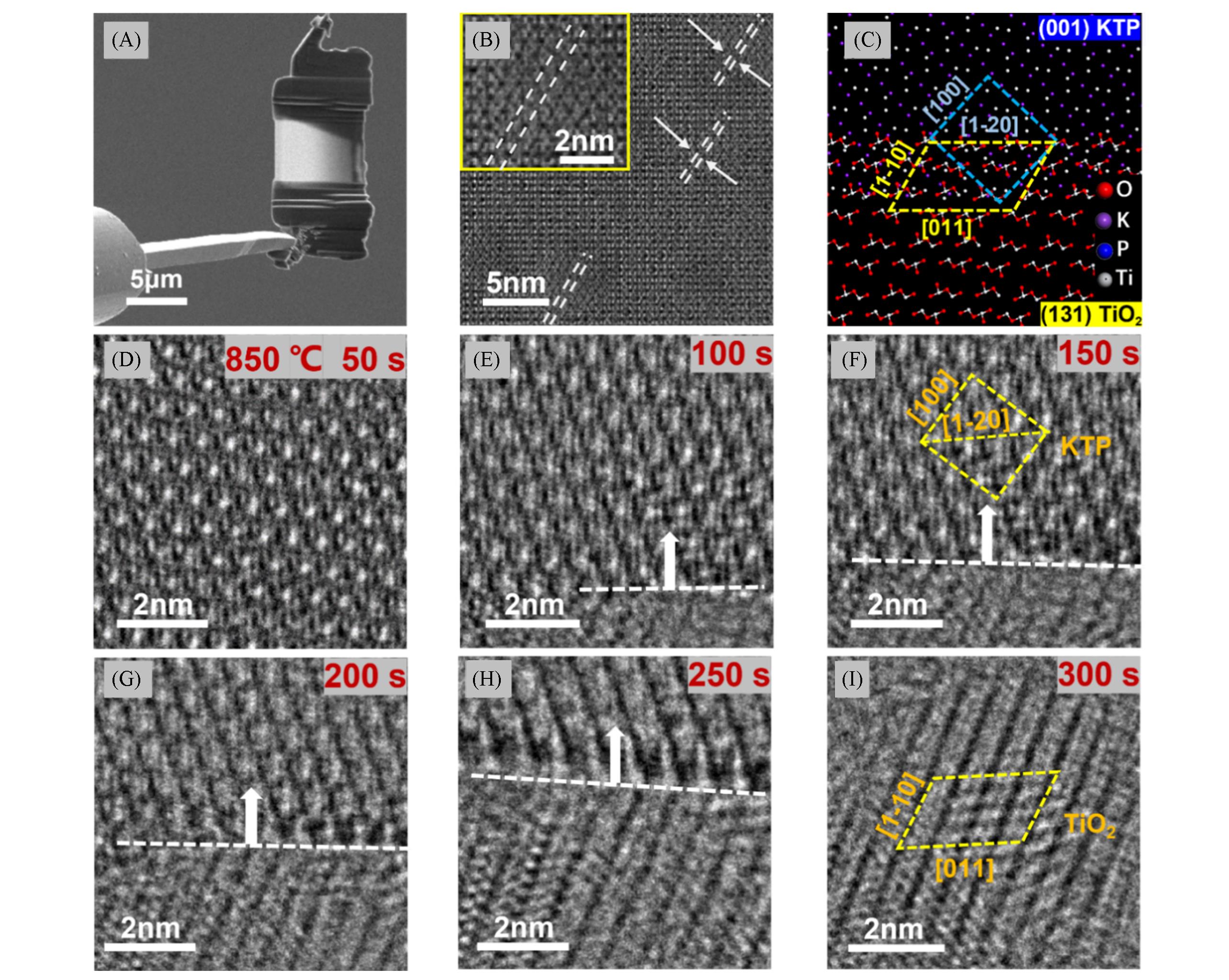
Fig.4 In situ TEM characterization of the transformation from KTP to TiO2[14](A) SEM image of the(100) KTP slice prepared for in situ TEM characterization; (B) TEM image of a TiO2 cluster evolved on the KTP lattice surface at 750 ℃; (C) Schematic illustration of the atomic arrangement and epitaxial relationship at the interface between (131) TiO2 and c-axis KTP; (D—I) In situ TEM images capturing the conversion process of KTP to TiO2 at 850 ℃ at different moments.Copyright 2023, Wiley-VCH GmbH..
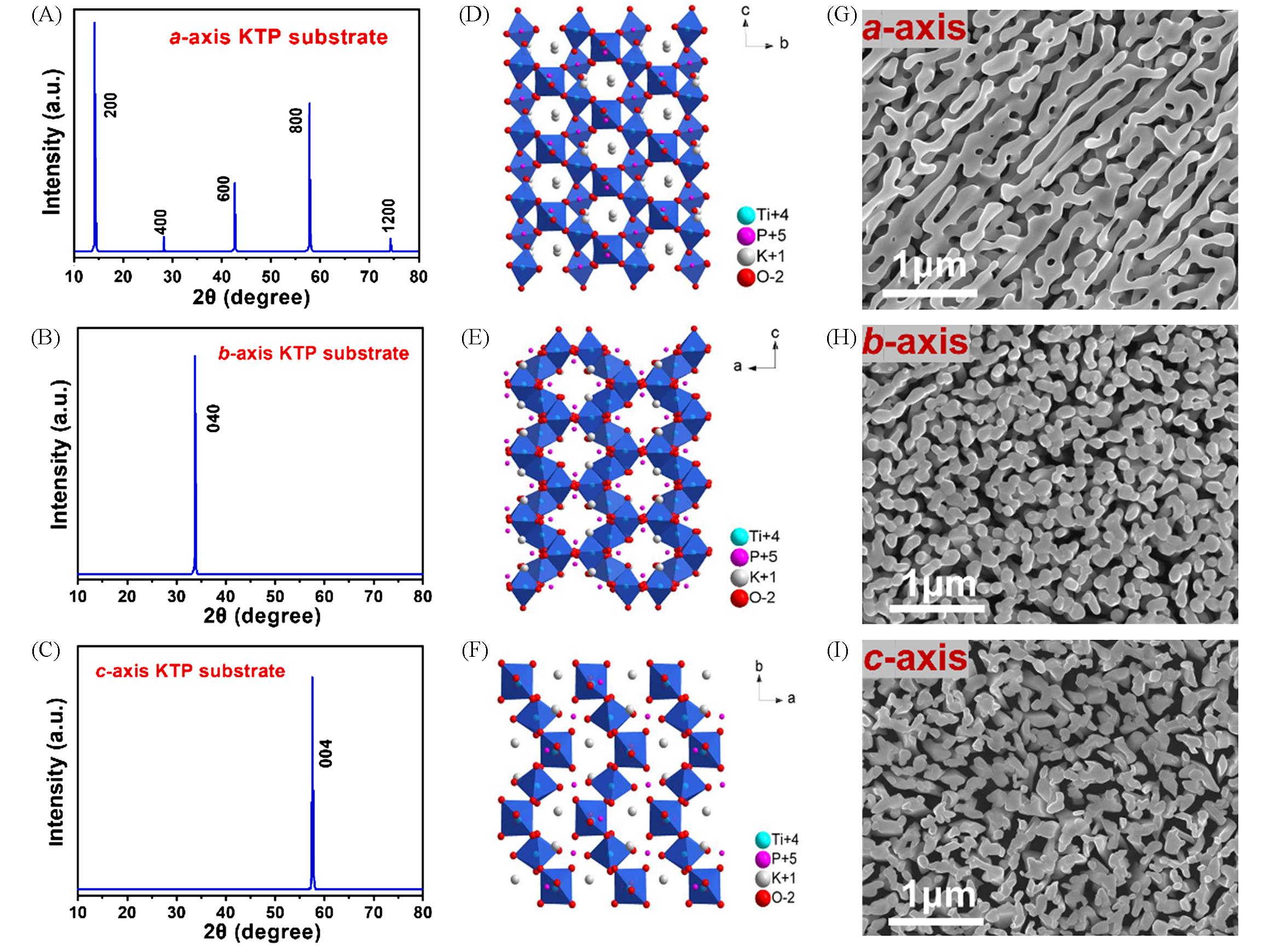
Fig.5 Structural characteristics of KTP substrates with different crystallographic orientations and the resulting morphologies of the derived PSC[15](A—C) XRD patterns of the a⁃axis, b⁃axis, and c⁃axis oriented KTP substrates, respectively.(D—F) Crystal structure models of KTP viewed along the corresponding crystallographic axis. The light blue, pink, grey, and red spheres represent Ti, P, K, and O atoms, respectively.(G—I) SEM images of the PSC grown on the a⁃axis, b⁃axis, and c⁃axis KTP substrates, respectively. Copyright 2019, Springer Nature.
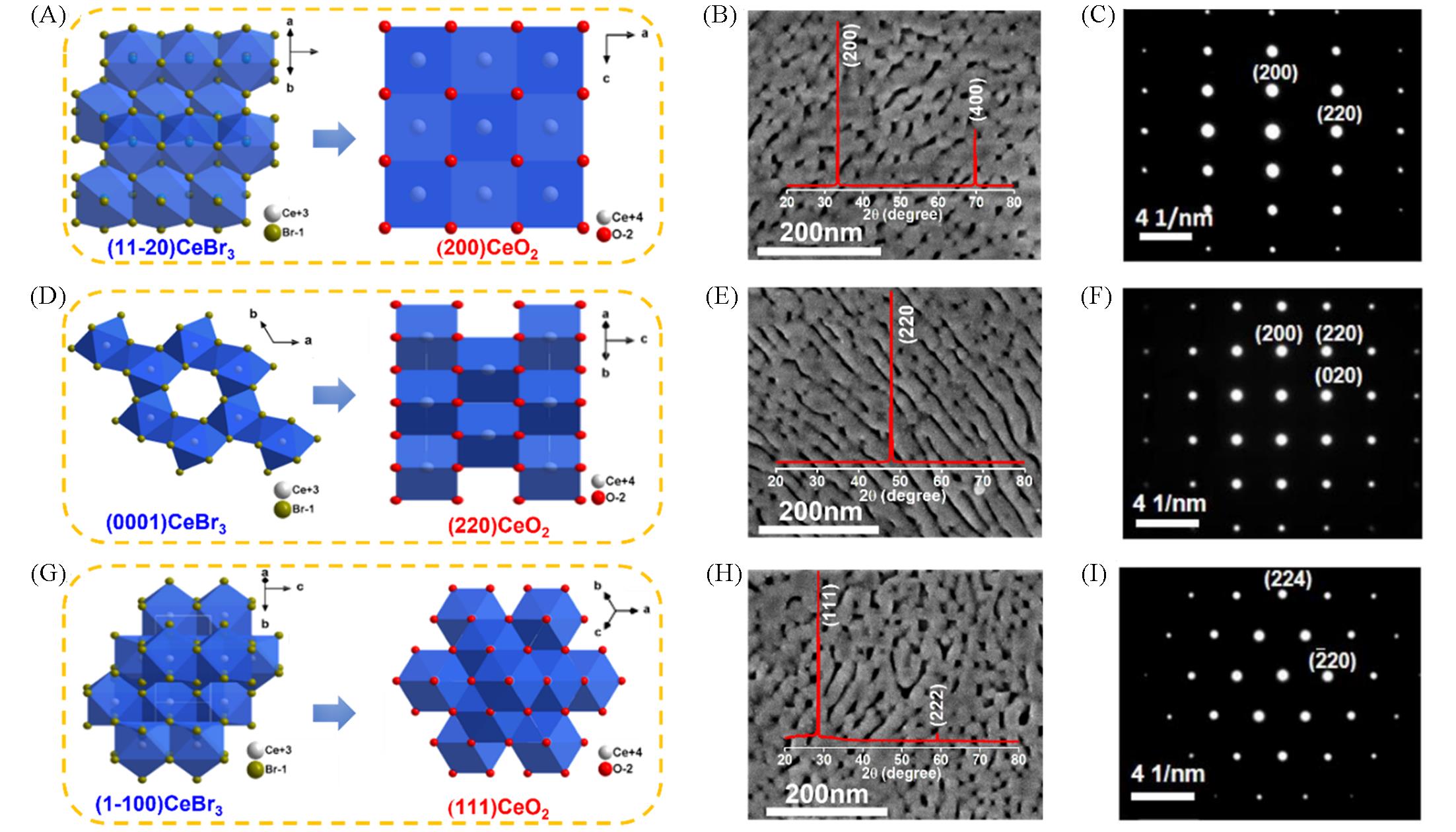
Fig.6 Growth mechanism and structural characterization of mesoporous CeO2 single crystals derived from CeBr3 substrates[41](A) Schematic illustration of the lattice reconstruction from (11-20)-oriented CeBr3 to (200)-oriented CeO2; (B) SEM image and corresponding XRD pattern of the resulting (200)-oriented CeO2 single crystal; (C) corresponding selected-area electron diffraction (SAED) pattern; (D) schematic illustration of the lattice reconstruction from (0001)-oriented CeBr3 to (220)-oriented CeO2; (E) SEM image and corresponding XRD pattern of the resulting (220)-oriented CeO2 single crystal; (F) corresponding SAED pattern; (G) schematic illustration of the lattice reconstruction from (1-100)-oriented CeBr3 to (111)-oriented CeO2; (H) SEM image and corresponding XRD pattern of the resulting (111)-oriented CeO2 single crystal; (I) corresponding SAED pattern.Copyright 2021, Wiley-VCH GmbH.
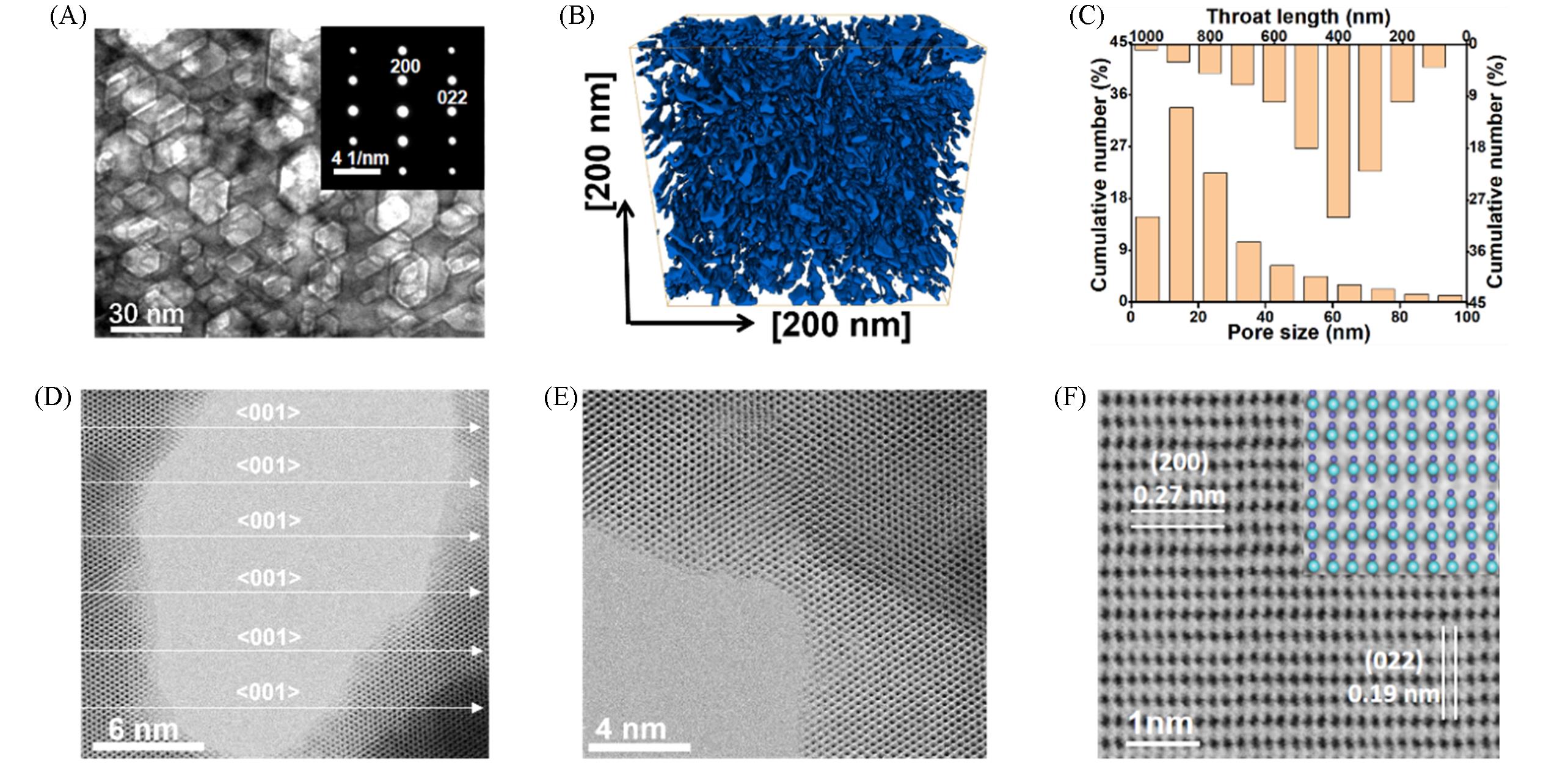
Fig.7 Microstructural and three-dimensional pore characterization of centimeter-scale mesoporous(200) CeO2 single-crystalline monoliths[41](A) TEM and SAED(inset) characterization; (B) 3D pore reconstruction; (C) pore size and throat length distribution; (D, E) enlarged HRTEM images; (F) atomic⁃scale stacking features in the STEM.Copyright 2021, Wiley-VCH GmbH.
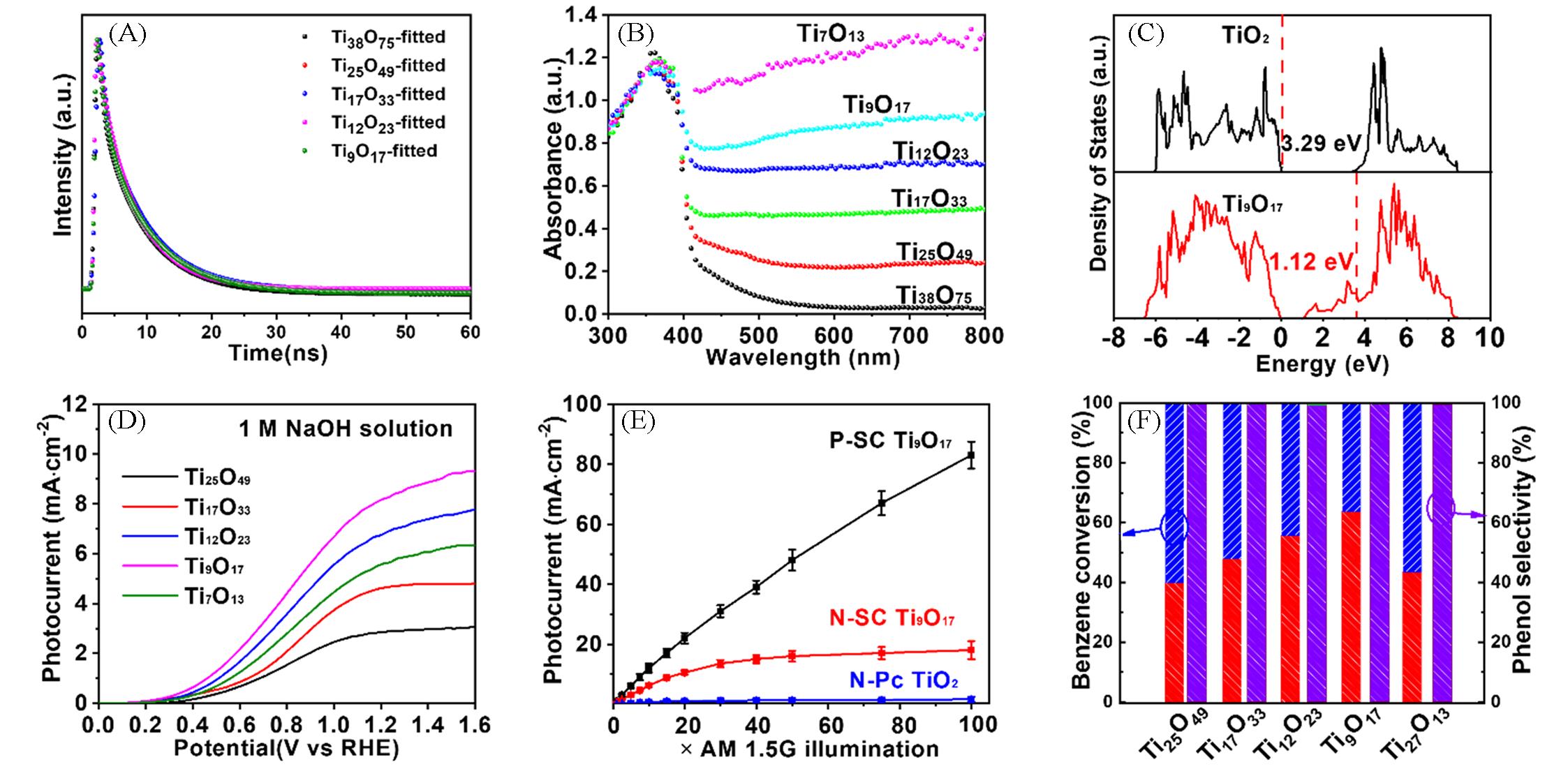
Fig.8 Physical properties and photoelectrochemical performance of the PSC Ti n O2n-1[15](A) Transient absorption decay profiles; (B) ultraviolet-visible diffuse reflectance spectra; (C) density of states for TiO2 and Ti9O17 Magnéli phase with Ti3+ interstitials. The Fermi levels are shown as vertical lines; (D) linear sweep voltammetry(LSV) curves of PSC Ti n O2n-1 photoanodes in 1 mol/L NaOH electrolyte(pH = 13.6). The three-electrode setup was utilized with Ti n O2n-1 as the working electrode, Pt as the counter electrode, and Hg/Hg2Cl2 as the reference at a scan rate of 20 mV/s; (E) photocurrent enhancement intensity: comparison of photocurrent densities at 1.23 V bias under simulated sunlight up to 50 AM 1.5G. P-SC Ti9O17 significantly outperforms nonporous single-crystalline(N-SC) Ti9O17 and nonporous polycrystalline(NPC) TiO2. Error bars denote the standard deviation from repeated measurements; (F) benzene conversion rates and phenol yields achieved using PSC Ti n O2n-1 photoanodes.Copyright 2019, Springer Nature.
| [1] | Ye J., Liu L., Oakdale J., Lefebvre J., Bhowmick S., Voisin T., Roehling J. D., Smith W. L., Cerón M. R., van Ham J., Nat. Mater., 2021, 20(11), 1498—1505 |
| [2] | Lin Q. F., Gao Z. R., Lin C., Zhang S., Chen J., Li Z., Liu X., Fan W., Li J., Chen X., Science, 2021, 374(6575), 1605—1608 |
| [3] | Bennett T. D., Coudert F. X., James S. L., Cooper A. I., Nat. Mater., 2021, 20(9), 1179—1187 |
| [4] | Aubrey M. L., Saldivar Valdes A., Filip M. R., Connor B. A., Lindquist K. P., Neaton J. B., Karunadasa H. I., Nature, 2021, 597(7876), 355—359 |
| [5] | Lei Y., Chen Y., Zhang R., Li Y., Yan Q., Lee S., Yu Y., Tsai H., Choi W., Wang K., Nature, 2020, 583(7818), 790—795 |
| [6] | Xu X., Pan Y., Liu S., Han B., Gu P., Li S., Xu W., Peng Y., Han Z., Chen J., Science, 2021, 372(6538), 195—200 |
| [7] | Wang M., Huang M., Luo D., Li Y., Choe M., Seong W. K., Kim M., Jin S., Wang M., Chatterjee S., Nature, 2021, 596(7873), 519—524 |
| [8] | Lin G., Li H., Xie K., Angew. Chem. Int. Ed., 2020, 59(38), 16440—16444 |
| [9] | Ye L., Zhang M., Huang P., Guo G., Hong M., Li C., Irvine J. T., Xie K., Nat. Commun., 2017, 8, 14785 |
| [10] | Chen C., Sun S., Chou M. M. C., Xie K., Nat. Commun., 2017, 8(1), 2178 |
| [11] | Ye L., Ma J., Zhang J., Yin W., Xia Y., Xie K., Research, 2023, 6, 0233 |
| [12] | Li X., Li W., Zhang J., Yin W., Xia Y., Xie K., Angew. Chem. Int. Ed., 2024, 63(4), e202315274 |
| [13] | Gao X., Ma G., Luo C., Xi S., Ye L., Xie K., Adv. Sci., 2025, 12(1), e2410429 |
| [14] | Cheng F., Zhang J., Xie K., Angew. Chem. Int. Ed., 2023, 62(12), e202300480 |
| [15] | Cheng F., Lin G., Hu X., Xi S., Xie K., Nat. Commun., 2019, 10(1), 3618 |
| [16] | Zhu C., Hou S., Hu X., Lu J., Chen F., Xie K., Nat. Commun., 2019, 10(1), 1173 |
| [17] | Zhang F., Xi S., Lin G., Hu X., Lou X. W., Xie K., Adv. Mater., 2019, 31(7), 1806552 |
| [18] | Ye L., Xi S., Li H., Lin G., Xie T. K., Adv. Funct. Mater., 2021, 31(7), 2008900 |
| [19] | Xi S., Lin G., Jin L., Li H., Xie K., Nat. Commun., 2019, 10(1), 4727 |
| [20] | Lin G., Su Y., Duan X., Xie K., Angew. Chem. Int. Ed., 2021, 60(17), 9311—9315 |
| [21] | Ye L., Li H., Xie K., Nat. Sustain., 2022, 5(9), 787—794 |
| [22] | Xi S., Luo C., Xie K., Adv. Mater., 2025, 37(26), e250258 |
| [23] | Guo X., Fang G., Li G., Ma H., Fan H., Yu L., Ma C., Wu X., Deng D., Wei M., Science, 2014, 344(6184), 616—619 |
| [24] | Cheng F., Duan X., Xie K., Angew. Chem. Int. Ed ., 2021, 60(34), 18792—18799 |
| [25] | Song Y., Zhang X., Xie K., Wang G., Bao X., Adv. Mater., 2019, 31(50), e1902033 |
| [26] | Wang H., Dai H., Chem. Soc. Rev., 2013, 42(7), 3088—3113 |
| [27] | Lu J. H., Zhu C. L., Pan C. C., Lin W. L., Lemmon J. P., Chen F. L., Li C. S., Xie K., Sci. Adv., 2018, 4(3), eaar5100 |
| [28] | Ye L., Duan X., Xie K., Angew. Chem. Int. Ed., 2021, 60(40), 21746—21750 |
| [29] | Zhang X., Ye L., Li H., Chen F., Xie K., ACS Catal., 2020, 10(5), 3505—3513 |
| [30] | Lin G., Li H., Xie K., CCS Chem., 2022, 4(4), 1441—1451 |
| [31] | Ye L., Xie K., J. Energy Chem., 2021, 54, 736—745 |
| [32] | Jin L., Cheng F., Li H., Xie K., Angew. Chem. Int. Ed., 2020, 59(23), 8891—8895 |
| [33] | Ye L., Shang Z., Xie K., Angew. Chem. Int. Ed., 2022, 61(32), e202207211 |
| [34] | Chu S., Majumdar A., Nature, 2012, 488(7411), 294—303 |
| [35] | Wang W., Gan L., Lemmon J. P., Chen F., Irvine J. T. S., Xie K., Nat. Commun., 2019, 10(1), 1550 |
| [36] | Fleischmann S., Mitchell J. B., Wang R., Zhan C., Jiang D. E., Presser V., Augustyn V., Chem. Rev., 2020, 120, 6738—6782 |
| [37] | Ghidiu M., Lukatskaya M. R., Zhao M. Q., Gogotsi Y., Barsoum M. W., Nature, 2014, 516(7529), 78—81 |
| [38] | Liu S., Luo C., Ye L., Xie K., J. Energy Storage, 2024, 84, 110863 |
| [39] | Zhang D. Y., Shen H. Y., Liu W., Chen W. Z., Zhang G. F., Zhang G., Zeng R., Lin W. X., Liang J. K., J. Cryst. Growth, 2000, 218(1), 98—102 |
| [40] | Angert N., Tseitlin M., Yashchin E., Roth M., J. Cryst. Growth, 1994, 137(1/2), 116—122 |
| [41] | Xiao Y., Li H., Xie K., Angew. Chem. Int. Ed., 2021, 60(10), 5240—5244 |
| [42] | Xiao Y., Xie K., Angew. Chem. Int. Ed., 2022, 61(1), e202113079 |
| [43] | Higgins W. M., Churilov A., van Loef E., Glodo J., Squillante M., Shah K., J. Cryst. Growth, 2008, 310(7—9), 2085—2089 |
| [44] | Ito T., Yokota Y., Kurosawa S., Král R., Kamada K., Pejchal J., Ohashi Y., Yoshikawa A., J. Cryst. Growth, 2016, 452, 65—68 |
| [45] | Yokota Y., Ito T., Yoshino M., Yamaji A., Ohashi Y., Kurosawa S., Kamada K., Yoshikawa A., Jpn J. Appl. Phys., 2018, 57(7), 070312 |
| [46] | Hu S., Shaner M. R., Beardslee J. A., Lichterman M., Brunschwig B. S., Lewis N. S., Science, 2014, 344(6187), 1005—1009 |
| [47] | Schrauben J. N., Hayoun R., Valdez C. N., Braten M., Fridley L., Mayer J. M., Science, 2012, 336(6086), 1298—1301 |
| [48] | Onda K., Li B., Zhao J., Jordan K. D., Yang J., Petek H., Science, 2005, 308(5725), 1154—1158 |
| [49] | Khan S. U. M., Al⁃Shahry M., Ingler Jr. W. B., Science, 2002, 297(5590), 2243—2245 |
| [50] | Chen H. Y., Ardo S., Nat. Chem., 2018, 10(1), 17—23 |
| [51] | Murdoch M., Waterhouse G. I. N., Nadeem M. A., Metson J. B., Keane M. A., Howe R. F., Llorca J., Idriss H., Nat. Chem., 2011, 3, 489—492 |
| [52] | Melián J. M. D. R., Nanomaterials, 2021, 11(3), 688 |
| [1] | 王俊杰, 王姝颖, 杜星, 赵雷, 李薇馨, 何漩, 陈辉, 王大珩, 方伟. 多孔纳米带交织结构Ir1Ru3/TiO x N y 薄膜电极的构筑及酸性析氧反应性能提升机制[J]. 高等学校化学学报, 2025, 46(12): 20250265. |
| [2] | 毛东骜, 徐林猛, 毕研峰. 铽-磺酰基杯[4]芳烃单核配合物的单晶结构转变和发光性质[J]. 高等学校化学学报, 2023, 44(11): 20230107. |
| [3] | 刘情情, 王普, 王永帅, 赵曼, 董焕丽. 新型萘/苝酰亚胺取代丁二炔衍生物的合成及拓扑聚合[J]. 高等学校化学学报, 2022, 43(6): 20220091. |
| [4] | 武亚强, 刘思明, 金顺敬, 严永情, 王朝, 陈丽华, 苏宝连. 锌掺杂NiCoP多孔双层阵列电极材料的制备及电催化产氢性能[J]. 高等学校化学学报, 2021, 42(8): 2483. |
| [5] | 张卫国, 范松华, 王宏智, 姚素薇. α-Fe2O3/石墨烯水凝胶复合材料的自组装制备及电化学性能[J]. 高等学校化学学报, 2020, 41(8): 1850. |
| [6] | 黄雨婷, 英祖萍, 郑继兴, 庄驷耕, 刘璐, 冯威. 分级多孔结构ZnO的秸秆生物模板法制备及光催化性能[J]. 高等学校化学学报, 2018, 39(9): 2031. |
| [7] | 朱磊, 韩军燕, 常海珍, 邱宇渊, 张雅楠, 彭丹妮, 胡伟, MiaoShaobin. 二胺与二酮环聚合反应的不同途径与产物[J]. 高等学校化学学报, 2018, 39(12): 2686. |
| [8] | 谭英, 肖梦武, 叶姣, 胡艾希, 曾子清, 欧晓明. (Z)-3,3-二甲基-1-(1H-1,2,4-三唑-1-基)-2-丁酮肟(5-芳基-1,3,4-噁二唑-2-基)甲基醚的合成和抑菌活性[J]. 高等学校化学学报, 2017, 38(8): 1375. |
| [9] | 韩娜, 王秀芳, 璩庭司, 钱勇强, 吕亚红. 纤维素苯甲酸酯接枝二乙二醇十六烷基醚的制备及性能[J]. 高等学校化学学报, 2017, 38(6): 1099. |
| [10] | 王栋, 韩娜, 张兴祥, 王乐军, 王宁, 李伟, 于万永, 李志南. 纤维素丙酸酯-g-二乙二醇正十六烷基醚固-固相变材料的制备及性能[J]. 高等学校化学学报, 2015, 36(6): 1221. |
| [11] | 牟思阳, 郭静, 齐善威, 张勃, 张鸿, 于跃. 丙烯腈-衣康酸共聚物接枝聚乙二醇固-固相变材料的制备及表征[J]. 高等学校化学学报, 2015, 36(12): 2557. |
| [12] | 葛凯凯, 邱文丰, 韩伟健, 叶丽, 赵爱军, 赵彤. ZrB2/SiC前驱体的制备、 表征及裂解行为[J]. 高等学校化学学报, 2014, 35(9): 2050. |
| [13] | 苗强, 傅相锴, 黄静, 李超, 陈国栋, 王国明. 新型层状晶态聚(苯乙烯-苯乙烯基膦酸)-磷酸锌铵有机聚合物-无机杂化材料的合成与表征[J]. 高等学校化学学报, 2012, 33(09): 1984. |
| [14] | 钟文文, 邸明哲, 邸友莹. 吡啶-2,6-二甲酸氢钾的合成、结构表征及热化学性质[J]. 高等学校化学学报, 2012, 33(09): 2074. |
| [15] | 高远浩 田玉鹏 杨家祥 杨风岭 李静 郑直. D-π-A型三联吡啶衍生物的合成、结构和光学特性[J]. 高等学校化学学报, 2011, 32(8): 1755. |
| 阅读次数 | ||||||
|
全文 |
|
|||||
|
摘要 |
|
|||||
