

Chem. J. Chinese Universities ›› 2026, Vol. 47 ›› Issue (10): 20260067.doi: 10.7503/cjcu20260067
• Review • Previous Articles Next Articles
FENG Jingqi1,2, FAN Chunhai3, CHEN Jing4( )
)
Received:2026-02-02
Online:2026-10-10
Published:2026-08-29
Contact:
CHEN Jing
E-mail:chenjing929@shu.edu.cn
Supported by:CLC Number:
TrendMD:
FENG Jingqi, FAN Chunhai, CHEN Jing. Synergistic Regulation of Size and Structure on the Metallicity Evolution of Gold Nanoclusters[J]. Chem. J. Chinese Universities, 2026, 47(10): 20260067.
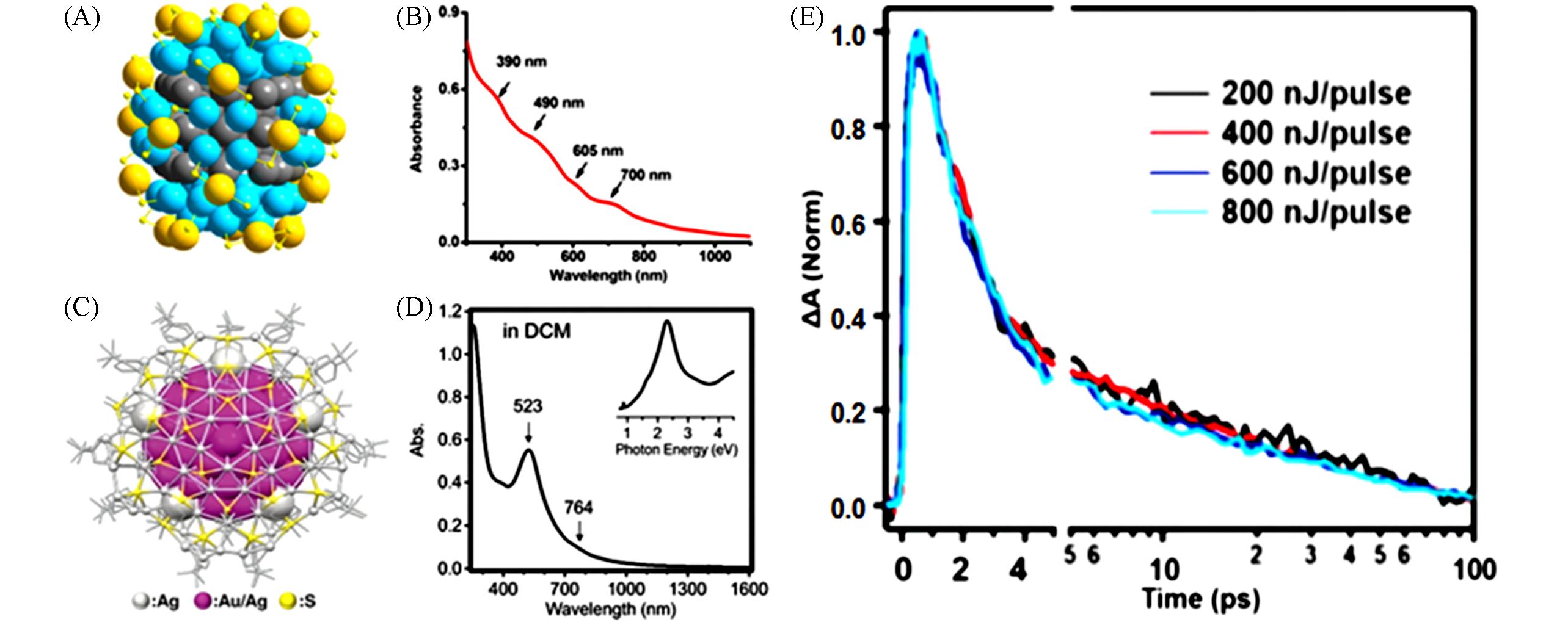
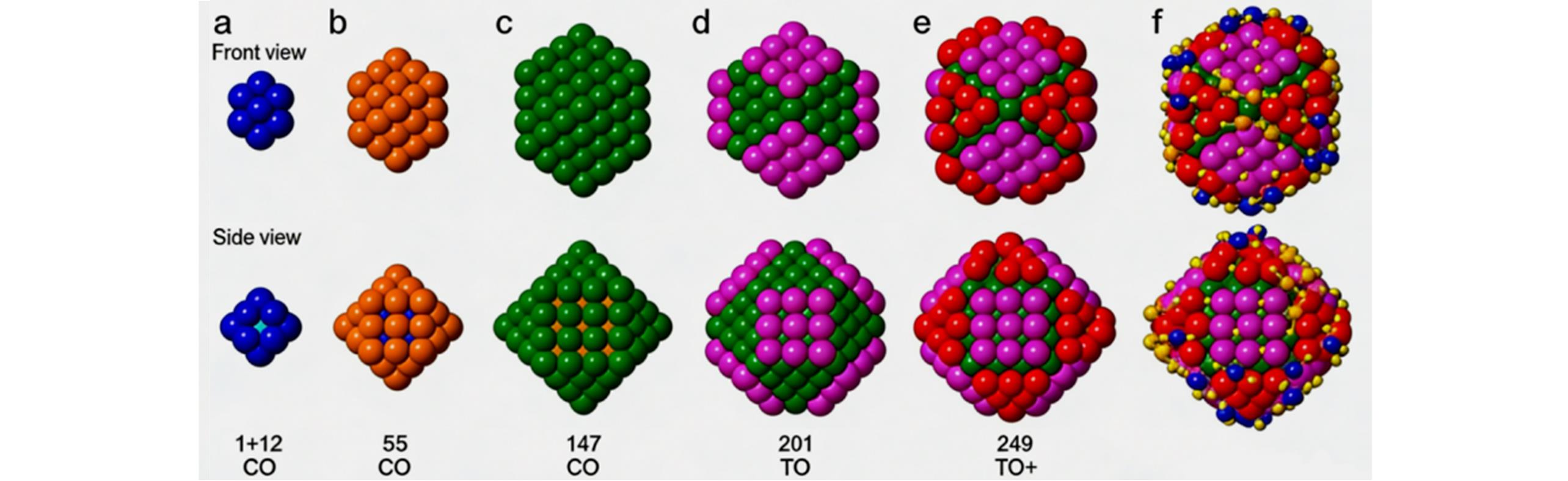
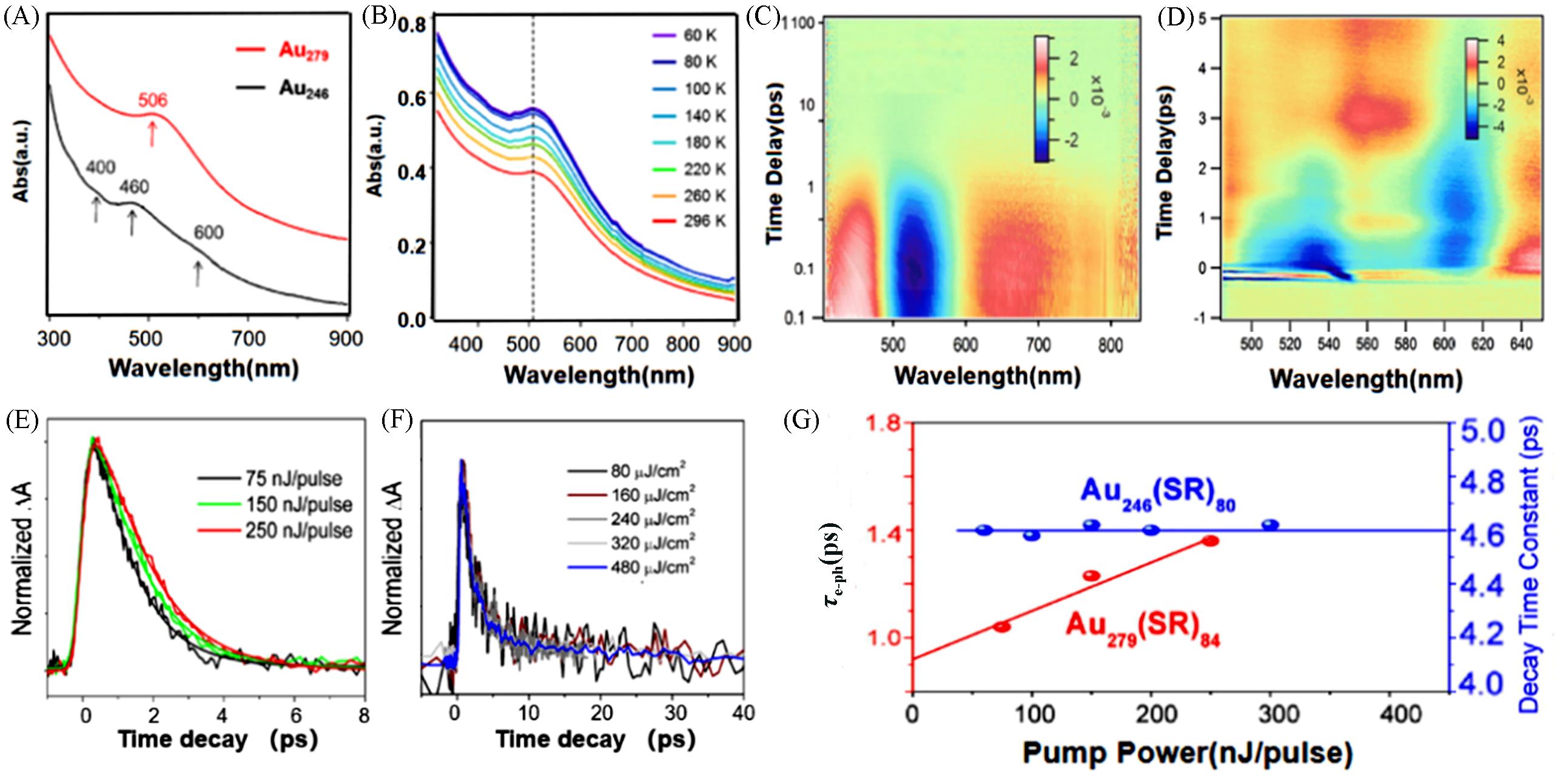
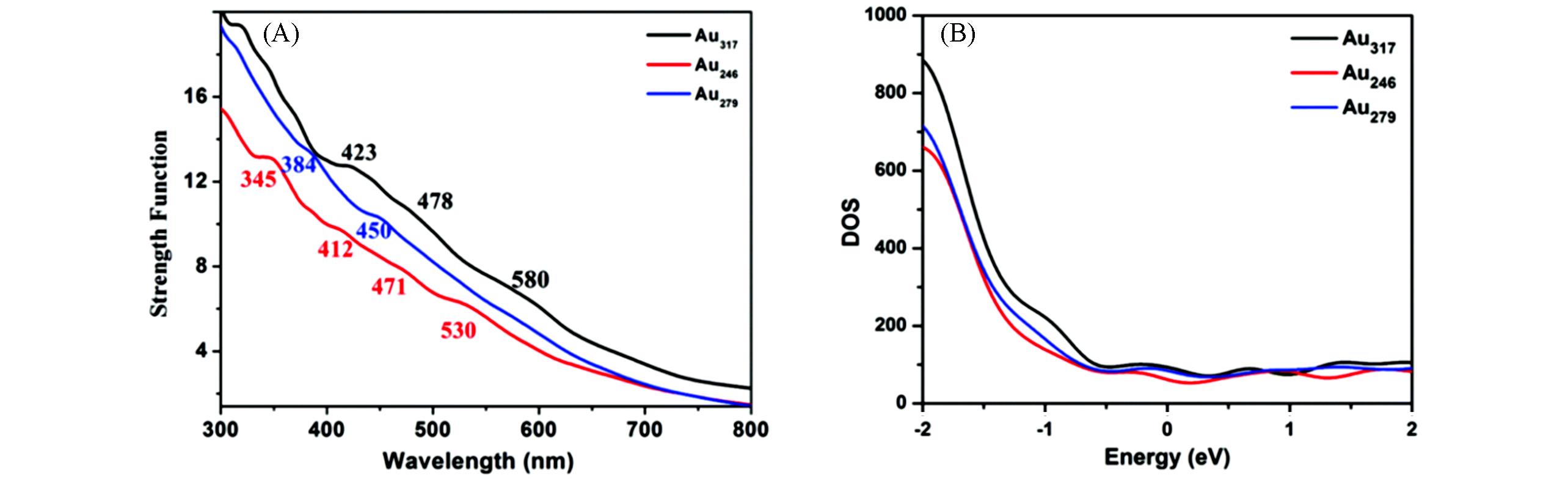
| Au NCs | Core structure | Metallicity | Determination criteria | Research methods | Ref. |
|---|---|---|---|---|---|
| Au102 | Marks decahedron | No | Exhibits multiple characteristic absorption peaks | Single⁃crystal X⁃ray diffraction(SC⁃XRD), UV⁃Vis⁃NIR absorption spectroscopy, and theoretical calculation | [ |
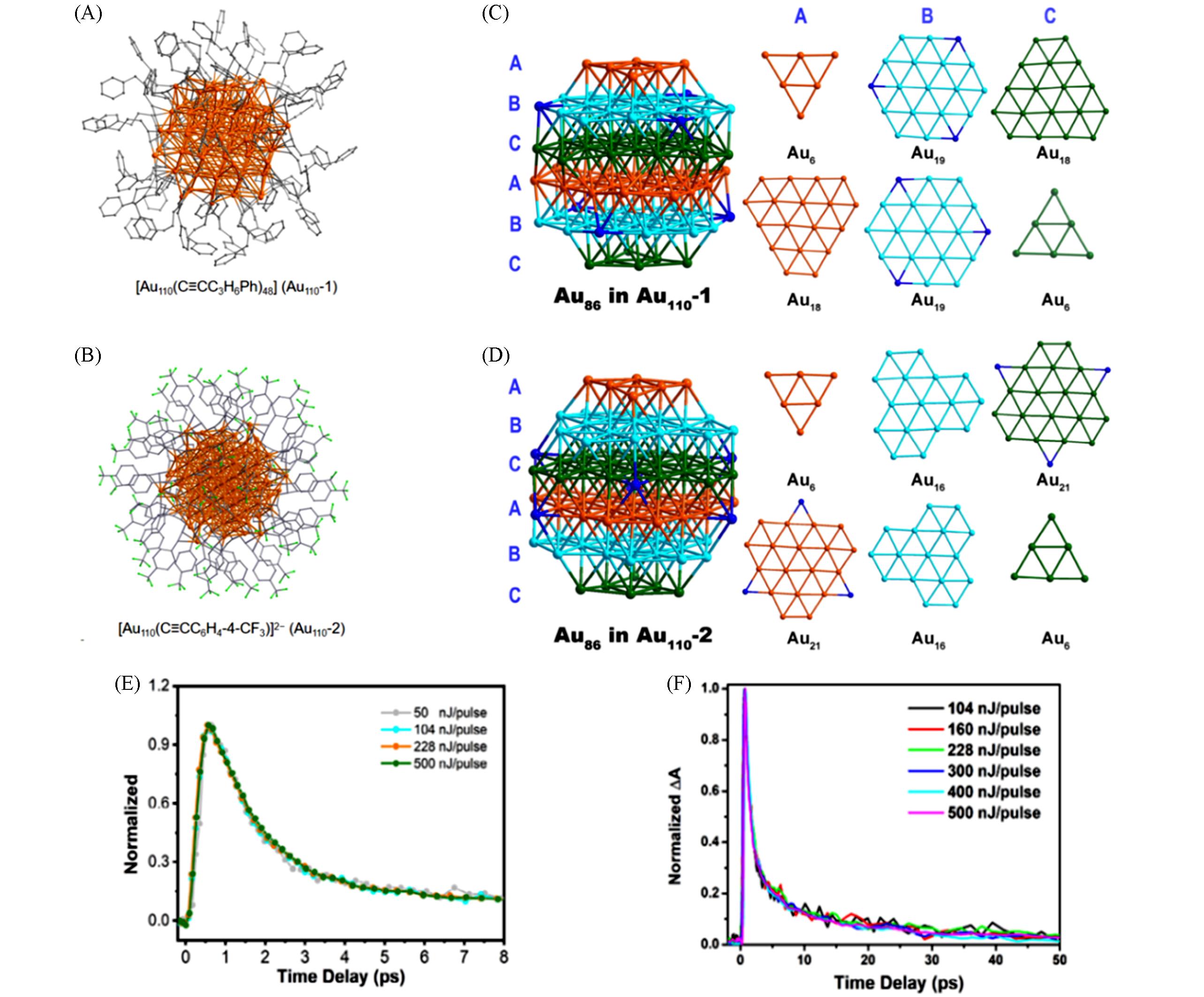
| Au110 | Face centered cubic(fcc) | No | Electron⁃phonon coupling is power⁃law dependent; no surface plasmon resonance absorption | SC⁃XRD and femtosecond absorption spectroscopy | [ |
| Au130 | Truncated decahedron | No | Exhibits multiple characteristic absorption peaks; electron⁃phonon coupling is power⁃law dependent | SC⁃XRD, scanning/transmission electron microscopy(STEM), UV⁃Vis⁃NIR absorp⁃tion spectroscopy, femtosecond absorption spectroscopy, and electrochemical characterization | [ |
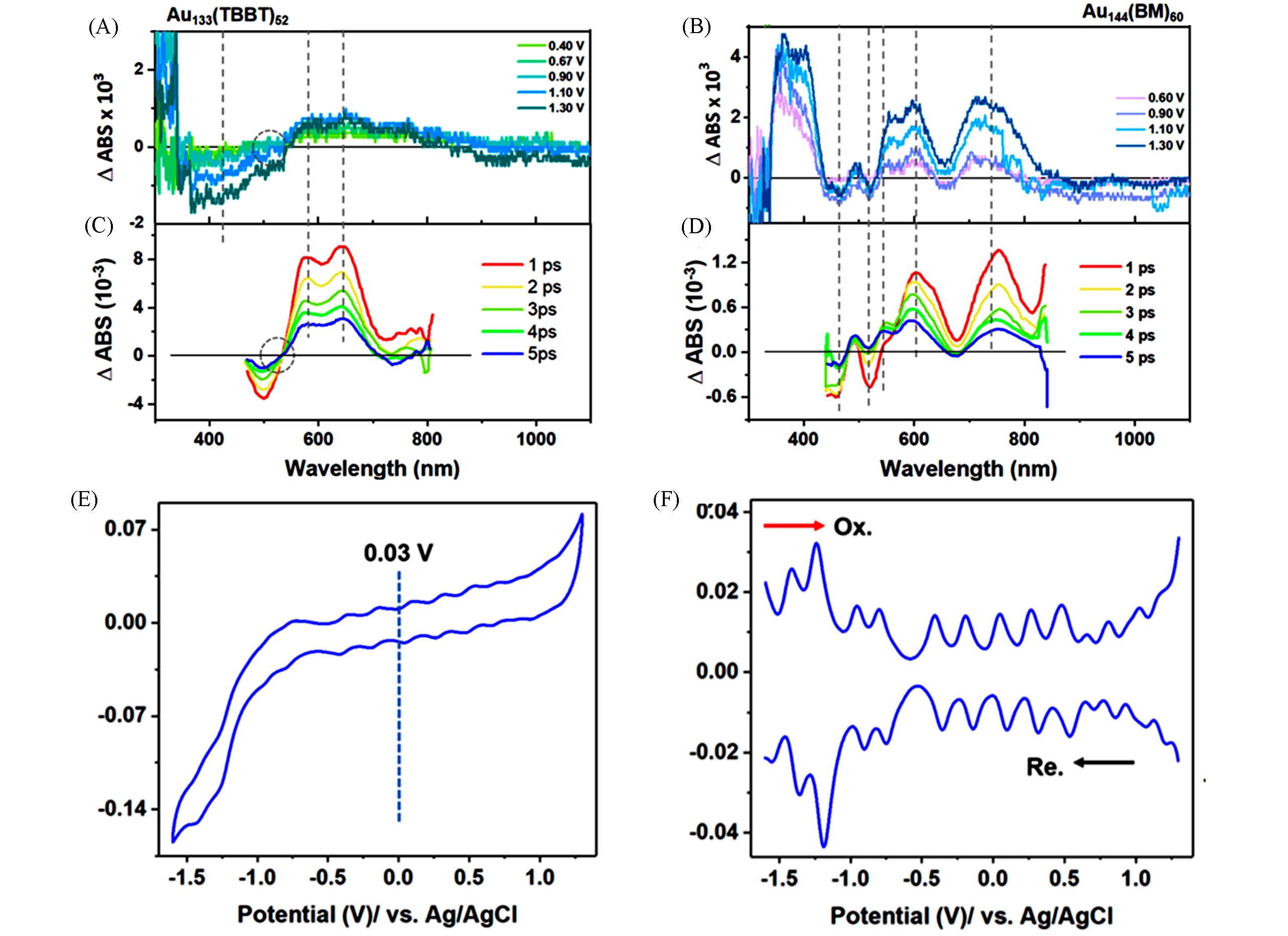
| Au133 | Icosahedron | No | Electron⁃phonon coupling is independent of power law | SC⁃XRD, high resolution electrospray ionization mass spectrometry(ESI⁃MS), femtosecond absorption spectroscopy, and electrochemical characterization | [ |
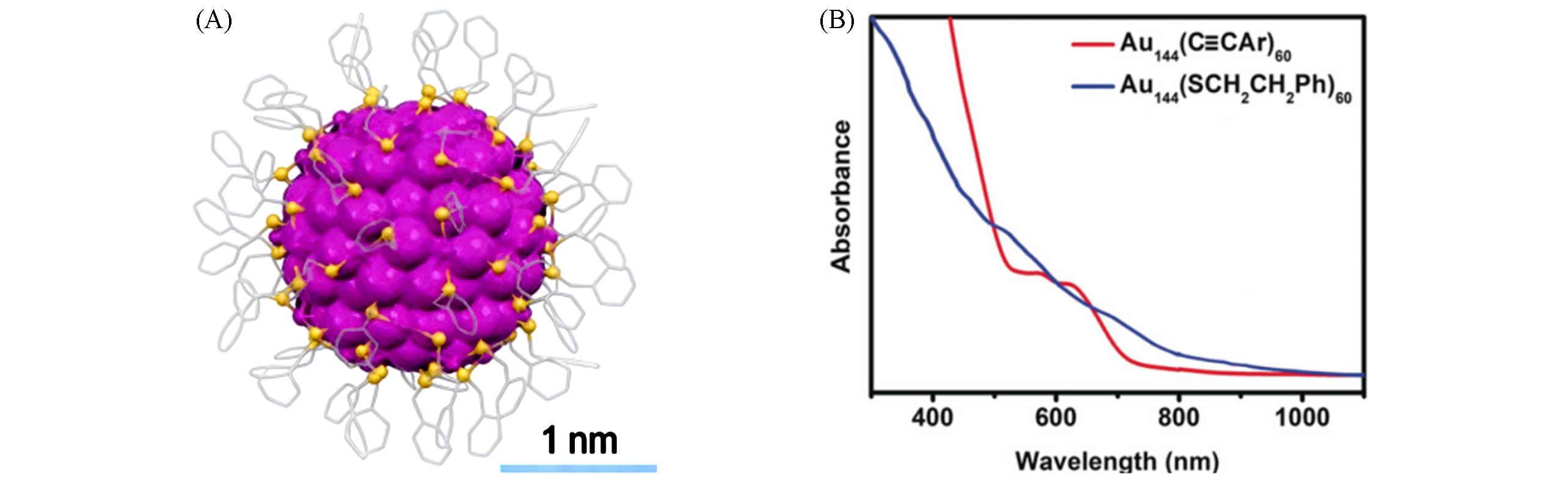
| Au144 | Cage⁃like hollow icosahedron | Critical(dual characteristics) | Electron⁃phonon coupling shows weak power⁃law dependence; multiple characteristic absorption peaks for charge carriers | SC⁃XRD, ESI⁃MS, femtosecond absorption spectroscopy, and electrochemical characterization | [ |
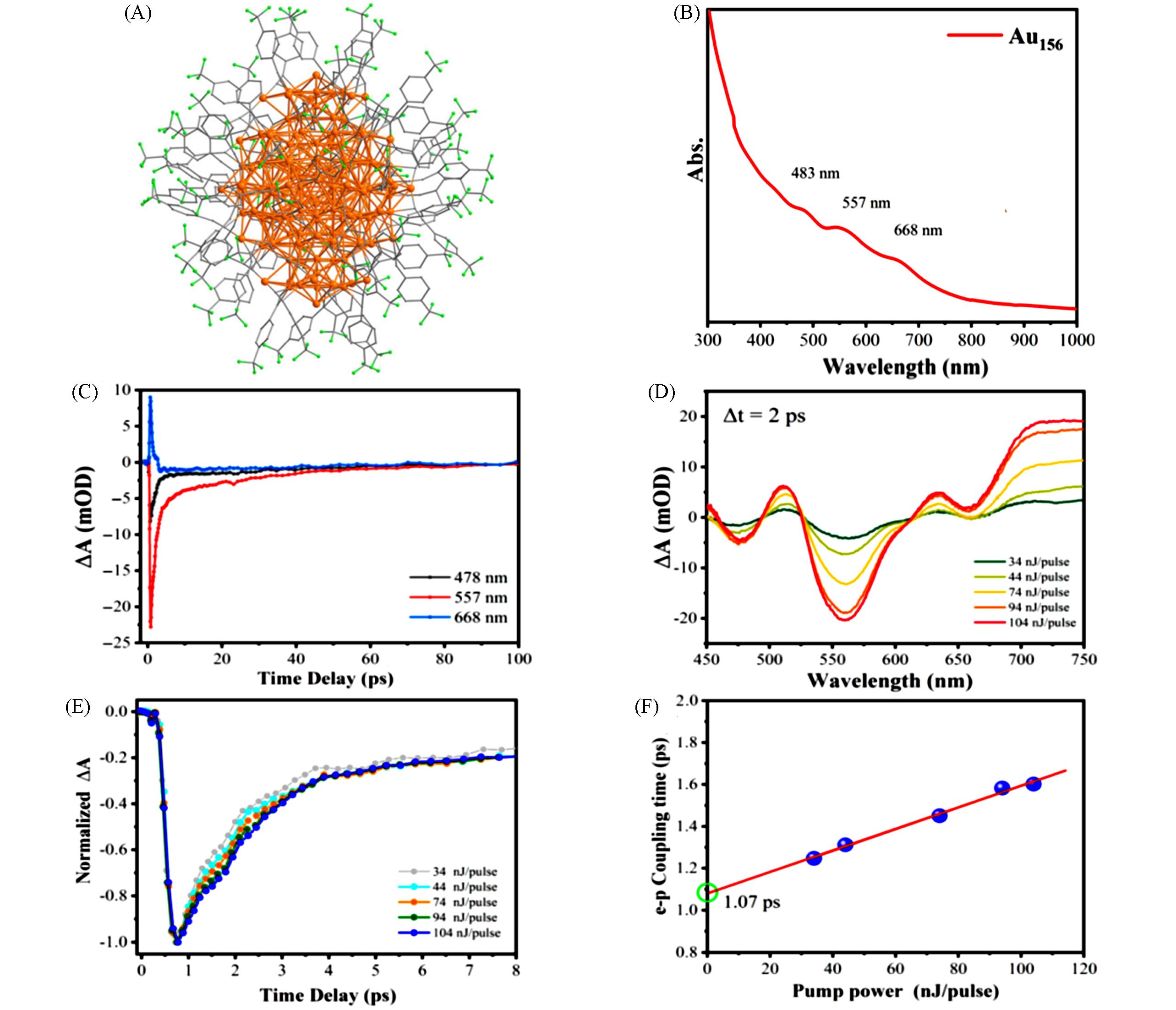
| Au156 | Rod⁃like core with homologous structure(long⁃axis short⁃axis Anisotropy) | Critical | Exhibits multiple characteristic absorption peaks; long⁃axis electron⁃phonon coupling is power⁃law dependent; short⁃axis shows distinct characteristics | SC⁃XRD, UV⁃Vis⁃NIR absorption spectroscopy, and femtosecond absorption spectroscopy | [ |
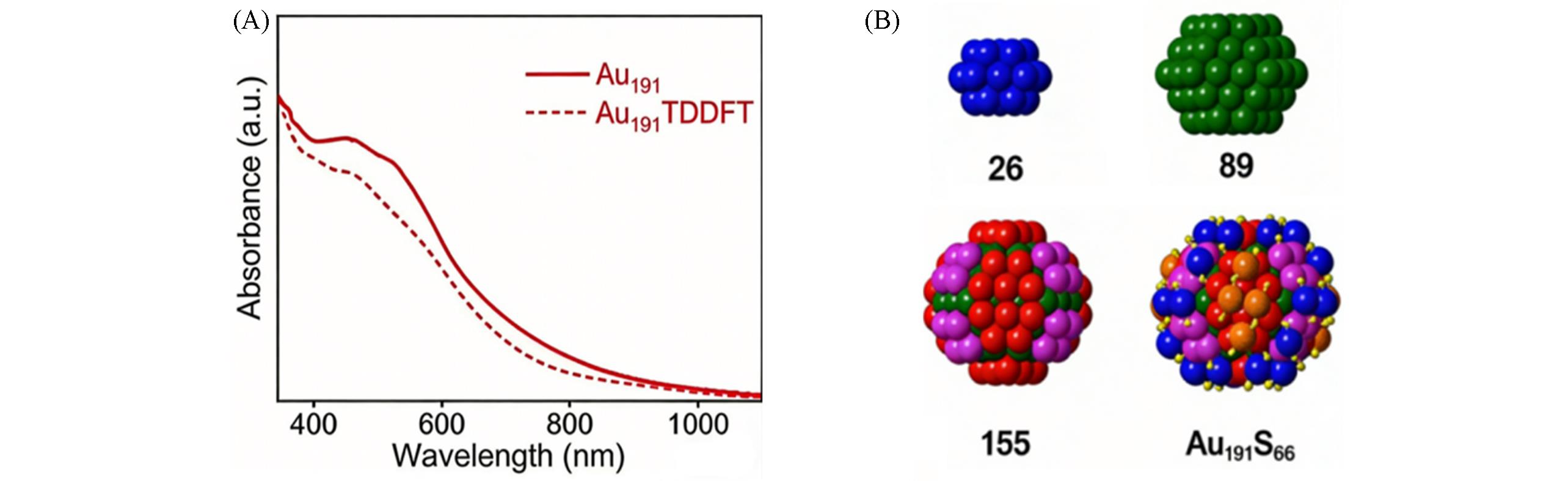
| Au191 | Monotwinned/ stacking⁃faulted fcc structure | Critical | Exhibits multiple characteristic absorption peaks; weak electron⁃phonon coupling; no plasmon resonance after ligand removal | SC⁃XRD, UV⁃Vis⁃NIR absorption spectroscopy, and theoretical calculation | [ |
| Au246 | Multiple⁃twin fivefold symmetry | No | Exhibits multiple characteristic absorption peaks; electron⁃phonon coupling is independent of power law | SC⁃XRD, UV⁃Vis⁃NIR absorption spectroscopy, and femtosecond absorption spectroscopy | [ |
| Au279 | Truncated octahedron (similar to fcc arrangement) | Yes | Ground⁃state absorption shows a single broad peak; no discrete peaks in the fluorescence spectrum; electron⁃ phonon coupling is independent of power law | SC⁃XRD, UV⁃Vis⁃NIR absorption spectroscopy, variable⁃temperature spectroscopy, and femtosecond absorption spectroscopy | [ |
| Au317 | fcc | Yes | Absorption spectrum shows a single broad peak; non⁃continuous electron state distribution near the Fermi level | Theoretical calculation | [ |
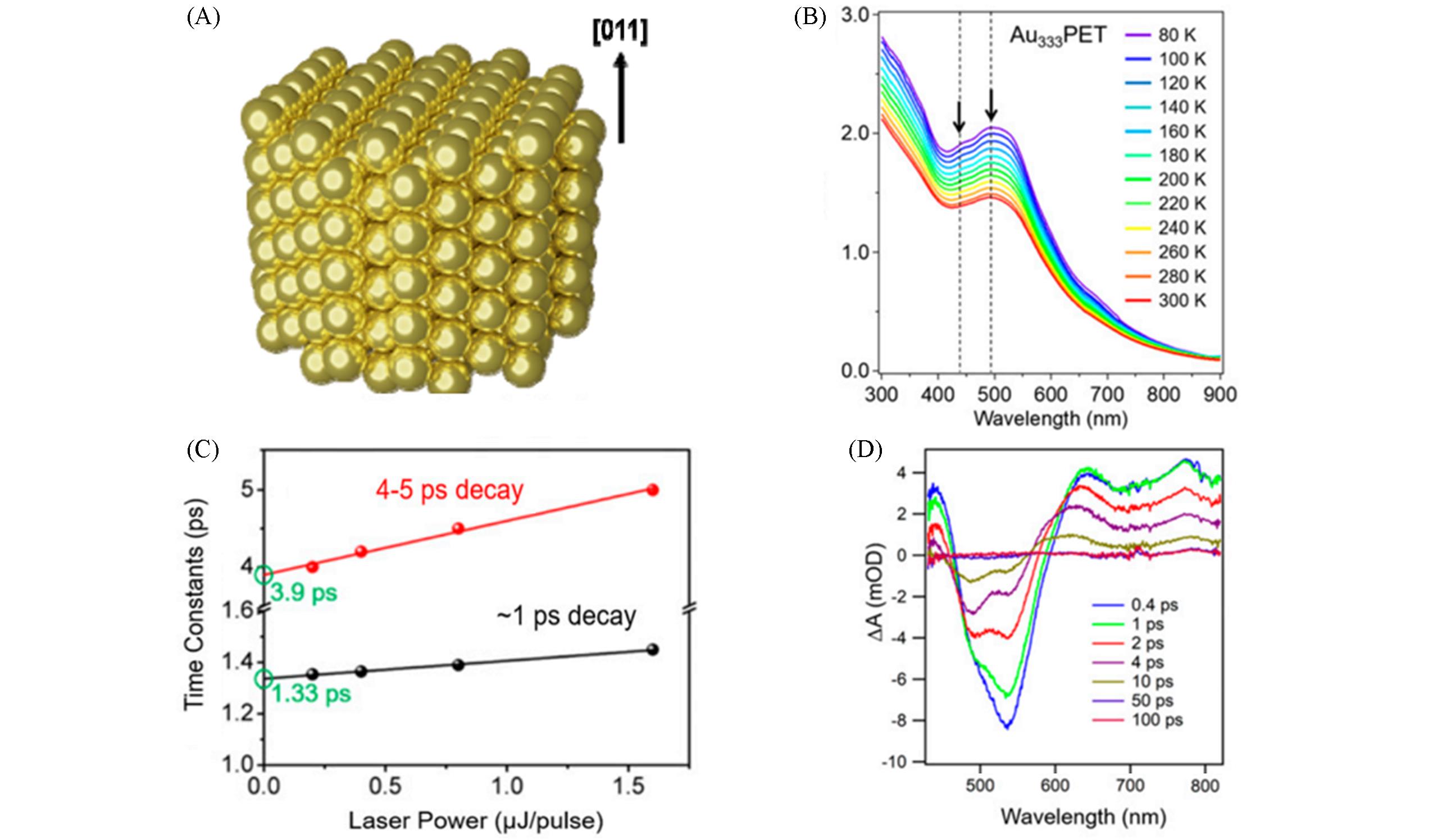
| Au333 | fcc | Yes | Absorption spectrum shows a single broad peak; prominent plasmon peak in the fluorescence spectrum; electron⁃phonon coupling is independent of power law | High⁃angle annular dark⁃field STEM(HAADF⁃STEM), UV⁃Vis⁃NIR absorption spectroscopy, femtosecond absorption spectroscopy, and variable⁃temperature spectroscopy | [ |
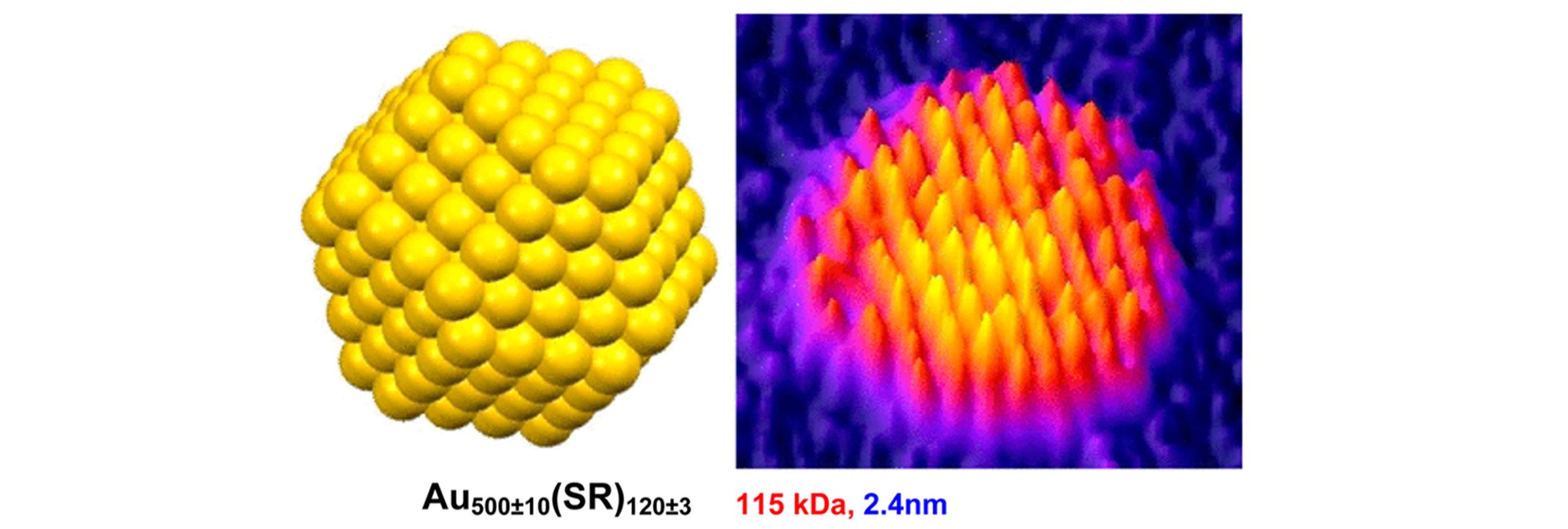
| Au~520 | fcc | Yes | Exhibits strong localized surface plasmon resonance; electronic structure is continuous | Mass spectrometry and HAADF⁃STEM | [ |
| Au~1000 | fcc | Yes | Significant surface plasmon resonance absorption | High⁃resolution transmission electron microscopy(HRTEM) and XRD | [ |
Table 1 Core structure, determination criteria and research methods of metallicity in gold nanoclusters(>100 Au atoms)
| Au NCs | Core structure | Metallicity | Determination criteria | Research methods | Ref. |
|---|---|---|---|---|---|
| Au102 | Marks decahedron | No | Exhibits multiple characteristic absorption peaks | Single⁃crystal X⁃ray diffraction(SC⁃XRD), UV⁃Vis⁃NIR absorption spectroscopy, and theoretical calculation | [ |
| Au110 | Face centered cubic(fcc) | No | Electron⁃phonon coupling is power⁃law dependent; no surface plasmon resonance absorption | SC⁃XRD and femtosecond absorption spectroscopy | [ |
| Au130 | Truncated decahedron | No | Exhibits multiple characteristic absorption peaks; electron⁃phonon coupling is power⁃law dependent | SC⁃XRD, scanning/transmission electron microscopy(STEM), UV⁃Vis⁃NIR absorp⁃tion spectroscopy, femtosecond absorption spectroscopy, and electrochemical characterization | [ |
| Au133 | Icosahedron | No | Electron⁃phonon coupling is independent of power law | SC⁃XRD, high resolution electrospray ionization mass spectrometry(ESI⁃MS), femtosecond absorption spectroscopy, and electrochemical characterization | [ |
| Au144 | Cage⁃like hollow icosahedron | Critical(dual characteristics) | Electron⁃phonon coupling shows weak power⁃law dependence; multiple characteristic absorption peaks for charge carriers | SC⁃XRD, ESI⁃MS, femtosecond absorption spectroscopy, and electrochemical characterization | [ |
| Au156 | Rod⁃like core with homologous structure(long⁃axis short⁃axis Anisotropy) | Critical | Exhibits multiple characteristic absorption peaks; long⁃axis electron⁃phonon coupling is power⁃law dependent; short⁃axis shows distinct characteristics | SC⁃XRD, UV⁃Vis⁃NIR absorption spectroscopy, and femtosecond absorption spectroscopy | [ |
| Au191 | Monotwinned/ stacking⁃faulted fcc structure | Critical | Exhibits multiple characteristic absorption peaks; weak electron⁃phonon coupling; no plasmon resonance after ligand removal | SC⁃XRD, UV⁃Vis⁃NIR absorption spectroscopy, and theoretical calculation | [ |
| Au246 | Multiple⁃twin fivefold symmetry | No | Exhibits multiple characteristic absorption peaks; electron⁃phonon coupling is independent of power law | SC⁃XRD, UV⁃Vis⁃NIR absorption spectroscopy, and femtosecond absorption spectroscopy | [ |
| Au279 | Truncated octahedron (similar to fcc arrangement) | Yes | Ground⁃state absorption shows a single broad peak; no discrete peaks in the fluorescence spectrum; electron⁃ phonon coupling is independent of power law | SC⁃XRD, UV⁃Vis⁃NIR absorption spectroscopy, variable⁃temperature spectroscopy, and femtosecond absorption spectroscopy | [ |
| Au317 | fcc | Yes | Absorption spectrum shows a single broad peak; non⁃continuous electron state distribution near the Fermi level | Theoretical calculation | [ |
| Au333 | fcc | Yes | Absorption spectrum shows a single broad peak; prominent plasmon peak in the fluorescence spectrum; electron⁃phonon coupling is independent of power law | High⁃angle annular dark⁃field STEM(HAADF⁃STEM), UV⁃Vis⁃NIR absorption spectroscopy, femtosecond absorption spectroscopy, and variable⁃temperature spectroscopy | [ |
| Au~520 | fcc | Yes | Exhibits strong localized surface plasmon resonance; electronic structure is continuous | Mass spectrometry and HAADF⁃STEM | [ |
| Au~1000 | fcc | Yes | Significant surface plasmon resonance absorption | High⁃resolution transmission electron microscopy(HRTEM) and XRD | [ |
| [1] | Jin R., Nanoscale, 2015, 7(5), 1549—1565 |
| [2] | Jin R., Zeng C., Zhou M., Chen Y., Chem. Rev., 2016, 116(18), 10346—10413 |
| [3] | Jin R., Higaki T., Comm. Chem., 2021, 4(1), 28 |
| [4] | Yau S. H., Varnavski O., Goodson T. III., Acc. Chem. Res., 2013, 46(7), 1506—1516 |
| [5] | Zhu M., Aikens C. M., Hollander F. J., Schatz G. C., Jin R., J. Am. Chem. Soc., 2008, 130(18), 5883—5885 |
| [6] | Zhou M., Higaki T., Hu G., Sfeir M. Y., Chen Y., Jiang D. E., Jin R., Science, 2019, 364(6437), 279—282 |
| [7] | Ye W. Q., Lu H., Chen W. J., Li N. J., Zhang Y., Wang L. H., Li J., Zhu Y., Li M. Q., Fan C. H., Jia S. S., Chen J., Chem. J. Chinese Universities, 2025, 46(8), 20250100 |
| 叶伟卿, 逯慧, 陈婉京, 李宁静, 张瑜, 王丽华, 李江, 诸颖, 李明强, 樊春海, 贾思思, 陈静. 高等学校化学学报, 2025, 46(8), 20250100 | |
| [8] | Stoll T., Sgrò E., Jarrett J. W., Réhault J., Oriana A., Sala L., Branchi F., Cerullo G., Knappenberger K. L. Jr., J. Am. Chem. Soc., 2016, 138(6), 1788—1791 |
| [9] | Yi C., Zheng H., Herbert P. J., Chen Y., Jin R., Knappenberger K. L. Jr., J. Phys. Chem. C, 2017, 121(44), 24894—24902 |
| [10] | Song Y., Jin S., Kang X., Xiang J., Deng H., Yu H., Zhu M., Chem. Mater., 2016, 28(8), 2609—2617 |
| [11] | Du X., Liu Z., Higaki T., Zhou M., Jin R., Chem. Sci., 2022, 13(7), 1925—1932 |
| [12] | Dass A., J. Am. Chem. Soc., 2011, 133(48), 19259—19261 |
| [13] | Hodak J. H., Henglein A., Hartland G. V., J. Chem. Phys., 2000, 112(13), 5942—5947 |
| [14] | Castañeda J., Rogers B., Sosa Y., Muñoz J. A., Bhattarai B., Martinez A. M., Phipps M. L., Morales D. P., Montoya Rush M. N., Yacaman M. J., Montaño G. A., Gibbs J. G., Martinez J. S., Small, 2025, 21(25), 2411517 |
| [15] | Bian G., Chen D., Chen Y., Zhang W., Fang L., You Q., Wang R., Gu W., Zhou Y., Yan N., Zhuang S., Ji S., Zhou M., Wang C., Liao L., Tang Q., Yang J., Wu Z., Sci. Adv., 2025, 11(15), eadu1996 |
| [16] | Ma X. H., Li J., Luo P., Hu J. H., Han Z., Dong X. Y., Xie G., Zang S. Q., Nat. Commun., 2023, 14(1), 4121 |
| [17] | Maity S., Kolay S., Chakraborty S., Devi A., Rashi, Patra A., Chem. Soc. Rev., 2025, 54(4), 1785—1844 |
| [18] | Li S., Yang N., Ma Q., Li S., Tong S., Luo J., Song X., Yang H., Anal. Chem., 2023, 95(44), 16153—16159 |
| [19] | Zhang C., Gao X., Chen W., He M., Yu Y., Gao G., Sun T., iScience, 2022, 25(10), 105022 |
| [20] | Chen Z., Yuan P., Chen C., Wang X., Wang J., Jia J., Davaasuren B., Lai Z., Khashab N. M., Huang K. W., Bakr O. M., Yin J., Salama K. N., Adv. Mater., 2024, 36(51), e2404291 |
| [21] | Sooraj B. N. S., Pradeep T., Atomically Precise Metal Nanoclusters, Elsevier, Amsterdam, 2023, 83—101 |
| [22] | Higaki T., Zhou M., Lambright K. J., Kirschbaum K., Sfeir M. Y., Jin R., J. Am. Chem. Soc., 2018, 140(17), 5691—5695 |
| [23] | Zhou M., Higaki T., Li Y., Zeng C., Li Q., Sfeir M. Y., Jin R., J. Am. Chem. Soc., 2019, 141(50), 19754—19764 |
| [24] | Knoppe S., Verbiest T., J. Am. Chem. Soc., 2017, 139(42), 14853—14856 |
| [25] | Negishi Y., Nakazaki T., Malola S., Takano S., Niihori Y., Kurashige W., Yamazoe S., Tsukuda T., Häkkinen H., J. Am. Chem. Soc., 2015, 137(3), 1206—1212 |
| [26] | Varnavski O., Ramakrishna G., Kim J., Lee D., Goodson T., J. Am. Chem. Soc., 2010, 132(1), 16—17 |
| [27] | Zhou M., Du X., Wang H., Jin R., ACS Nano, 2021, 15(9), 13980—13992 |
| [28] | Zhou M., Zeng C., Chen Y., Zhao S., Sfeir M. Y., Zhu M., Jin R., Nat. Commun., 2016, 7(1),13240 |
| [29] | Hodak J. H., Martini I., Hartland G. V., Chem. Phys. Lett., 1998, 284(1/2), 135—141 |
| [30] | Chen Y., Zeng C., Kauffman D. R., Jin R., Nano Lett., 2015, 15(5), 3603—3609 |
| [31] | Qian H., Jin R., Chem. Mater., 2011, 23(8), 2209—2217 |
| [32] | Lei Z., Zhao P., Guan Z. J., Nan Z. A., Ehara M., Wang Q. M., Chem. Eur. J., 2024, 30(42), e202401094 |
| [33] | Mukherjee S., Mandal S., Spectroscopy and Characterization of Nanomaterials and Novel Materials: Experiments, Modeling, Simulations, and Applications, Wiley-VCH, Weinheim, 2022, 187—209 |
| [34] | Jadzinsky P. D., Calero G., Ackerson C. J., Bushnell D. A., Kornberg R. D., Science, 2007, 318(5849), 430—433 |
| [35] | Hulkko E., Lopez⁃Acevedo O., Koivisto J., Levi⁃Kalisman Y., Kornberg R. D., Pettersson M., Häkkinen H., J. Am. Chem. Soc., 2011, 133(11), 3752—3755 |
| [36] | Mustalahti S., Myllyperkiö P., Malola S., Lahtinen T., Salorinne K., Koivisto J., Häkkinen H., Pettersson M., ACS Nano, 2015, 9(3), 2328—2335 |
| [37] | Wang J. Q., Shi S., He R. L., Yuan S. F., Yang G. Y., Liang G. J., Wang Q. M., J. Am. Chem. Soc., 2020, 142(42), 18086—18092 |
| [38] | Hu F., Yang G., Long Z. C., Shi W. Q., Liang G. J., Wang J. Q., Wang Q. M., Small, 2025, 21(21), 2502106 |
| [39] | Tlahuice⁃Flores A., Santiago U., Bahena D., Vinogradova E., Conroy C. V., Ahuja T., Bach S. B. H., Ponce A., Wang G., José⁃Yacamán M., Whetten R. L., J. Phys. Chem. A, 2013, 117(40), 10470—10476 |
| [40] | Du X., Zhang X., Ma H., Zhou M., Higaki T., Wang G., Wang H., Jin R., ChemElectroChem, 2024, 11(7), e202300528 |
| [41] | Chen Y., Zeng C., Liu C., Kirschbaum K., Gayathri C., Gil R. R., Rosi N. L., Jin R., J. Am. Chem. Soc., 2015, 137(32), 10076—10079 |
| [42] | Wang D., Padelford J. W., Ahuja T., Wang G., ACS Nano, 2015, 9(8), 8344—8351 |
| [43] | Padelford J. W., Zhou M., Chen Y., Jin R., Wang G., J. Phys. Chem. C, 2017, 121(39), 21217—21224 |
| [44] | Zeng C., Chen Y., Kirschbaum K., Appavoo K., Sfeir M. Y., Jin R., Sci. Adv., 2015, 1(2), e1500045 |
| [45] | Dass A., Theivendran S., Nimmala P. R., Kumara C., Jupally V. R., Fortunelli A., Sementa L., Barcaro G., Zuo X., Noll B. C., J. Am. Chem. Soc., 2015, 137(14), 4610—4613 |
| [46] | Zhang W., Kong J., Li Y., Kuang Z., Wang H., Zhou M., Chem. Sci., 2022, 13(27), 8124—8130 |
| [47] | Yi C., Tofanelli M. A., Ackerson C. J., Knappenberger K. L. Jr., J. Am. Chem. Soc., 2013, 135(48), 18222—18228 |
| [48] | Hu F., Guan Z. J., Yang G., Wang J. Q., Li J. J., Yuan S. F., Liang G. J., Wang Q. M., J. Am. Chem. Soc., 2021, 143(41), 17059—17067 |
| [49] | Sakthivel N. A., Shabaninezhad M., Sementa L., Yoon B., Stener M., Whetten R. L., Ramakrishna G., Fortunelli A., Landman U., Dass A., J. Am. Chem. Soc., 2020, 142(37), 15799—15814 |
| [50] | Zhou M., Zeng C., Song Y., Padelford J. W., Wang G., Sfeir M. Y., Higaki T., Jin R., Angew. Chem. Int. Ed., 2017, 56(51), 16257—16261 |
| [51] | Zeng C., Chen Y., Kirschbaum K., Lambright K. J., Jin R., Science, 2016, 354(6319), 1580—1584 |
| [52] | Sakthivel N. A., Stener M., Sementa L., Fortunelli A., Ramakrishna G., Dass A., J. Phys. Chem. Lett., 2018, 9(6), 1295—1300 |
| [53] | Sakthivel N. A., Theivendran S., Ganeshraj V., Oliver A. G., Dass A., J. Am. Chem. Soc., 2017, 139(43), 15450—15459 |
| [54] | Li L., Wang P., Pei Y., Nanoscale, 2022, 14(15), 5694—5700 |
| [55] | Higaki T., Zhou M., He G., House S. D., Sfeir M. Y., Yang J. C., Jin R., Proc. Natl. Acad. Sci. U.S.A., 2019, 116(27), 13215—13220 |
| [56] | Kumara C., Zuo X., Ilavsky J., Chapman K. W., Cullen D. A., Dass A., J. Am. Chem. Soc., 2014, 136(20), 7410—7417 |
| [57] | Kumara C., Zuo X., Cullen D. A., Dass A., ACS Nano, 2014, 8(6), 6431—6439 |
| [58] | Salorinne K., Malola S., Wong O. A., Rithner C. D., Chen X., Ackerson C. J., Häkkinen H., Nat. Commun., 2016, 7(1), 10401 |
| [59] | Callmann C. E., Vasher M. K., Das A., Kusmierz C. D., Mirkin C. A., Small, 2023, 19(24), 2300097 |
| [60] | Higaki T., Liu C., Morris D. J., He D. G., Luo T. Y., Sfeir M. Y., Zhang P., Rosi N. L., Jin R., Angew. Chem. Int. Ed., 2019, 58(52), 18798—18802 |
| [61] | Zhao J., Ziarati A., Bürgi T., Angew. Chem. Int. Ed., 2025, 64(26), e202504320 |
| [62] | Li S., Nagarajan A. V., Du X., Li Y., Liu Z., Kauffman D. R., Mpourmpakis G., Jin R., Angew. Chem. Int. Ed., 2022, 61(47), e202211771 |
| [63] | Seong H., Efremov V., Park G., Kim H., Yoo J. S., Lee D., Angew. Chem. Int. Ed., 2021, 60(26), 14563—14570 |
| [64] | Fang Y., Wang P., Pei Y., Xiong L., J. Phys. Chem. Lett., 2025, 16(19), 4675—4682 |
| [65] | Wang G., Lu H., Li J., Wang L., Zhu Y., Song S., Ge Z., Li Q., Chen J., Fan C., Chem. Res. Chin. Univ., 2024, 40(4), 670—674 |
| [66] | Wang P., Xiong L., Sun X., Ma Z., Pei Y., Nanoscale, 2018, 10(8), 3918—3929 |
| [67] | Wang H., Brandl D. W., Nordlander P., Halas N. J., Acc. Chem. Res., 2007, 40(1), 53—62 |
| [68] | Whetten R. L., Khoury J. T., Alvarez M. M., Murthy S., Vezmar I., Wang Z. L., Stephens P. W., Cleveland C. L., Luedtke W. D., Landman U., Adv. Mater., 1996, 8(5), 428—433 |
| [69] | Vergara S., Santiago U., Kumara C., Alducin D., Whetten R. L., Jose Yacaman M., Dass A., Ponce A., J. Phys. Chem. C, 2018, 122(46), 26733—26738 |
| [70] | Fang Y., Xiong L., Chem. Commun., 2025, 61(56), 10383—10386 |
| [71] | Yan N., Xia N., Liao L., Zhu M., Jin F., Jin R., Wu Z., Sci. Adv., 2018, 4(10), eaat7259 |
| [72] | Lei Z., Li J. J., Wan X. K., Zhang W. H., Wang Q. M., Angew. Chem. Int. Ed., 2018, 57(28), 8639—8643 |
| [73] | Chen S., Higaki T., Ma H., Zhu M., Jin R., Wang G., ACS Nano, 2020, 14(12), 16781—16790 |
| [74] | Zeng C., Chen Y., Iida K., Nobusada K., Kirschbaum K., Lambright K. J., Jin R., J. Am. Chem. Soc., 2016, 138(12), 3950—3953 |
| [75] | Sakthivel N. A., Sementa L., Yoon B., Landman U., Fortunelli A., Dass A., J. Phys. Chem. C, 2020, 124(2), 1655—1666 |
| [76] | Gao P., Xin R., Li F., Zhao M., Zhong R., Song Y., Shan W., Reaction Kinetics, Mechanisms and Catalysis, 2025, 138(6), 4305—4317 |
| [77] | Halperin W. P., Rev. Mod. Phys., 1986, 58(3), 533—606 |
| [78] | Kubo R., Ann. Rev. Mater. Sci., 1984, 14, 49—66 |
| [79] | Yu X., Pei W., Xu W. W., Zhao Y., Su Y., Zhao J., Inorg. Chem., 2023, 62(51), 20450—20457 |
| [80] | Malola S., Häkkinen H., Phys. Chem. Chem. Phys., 2018, 20(16), 10743—10750 |
| [1] | LIU Qianrong,CAI Huiwu,GUAN Ming,QIAO Juan,QI Li. Turn-off Fluorescence of Gold Nanoclusters for Sensing of Ferric Ion† [J]. Chem. J. Chinese Universities, 2019, 40(1): 55. |
| [2] | YU Xijuan, HAN Lulu, HUN Xu. Cu2+ Modified Gold Nanoclusters for Fluorescence Turn-on Detection of Dopamine† [J]. Chem. J. Chinese Universities, 2017, 38(12): 2169. |
| Viewed | ||||||
|
Full text |
|
|||||
|
Abstract |
|
|||||
