

Chem. J. Chinese Universities ›› 2026, Vol. 47 ›› Issue (7): 20250356.doi: 10.7503/cjcu20250356
• Physical Chemistry • Previous Articles Next Articles
AN Yannan, SHAO Xueguang, CAI Wensheng( )
)
Received:2025-11-24
Online:2026-07-10
Published:2026-01-24
Contact:
CAI Wensheng
E-mail:wscai@nankai.edu.cn
Supported by:CLC Number:
TrendMD:
AN Yannan, SHAO Xueguang, CAI Wensheng. Mechanism of Action of Antimicrobial Peptides Magainin and Indolicidin on Gram-negative and Gram-positive Bacterial Membranes[J]. Chem. J. Chinese Universities, 2026, 47(7): 20250356.
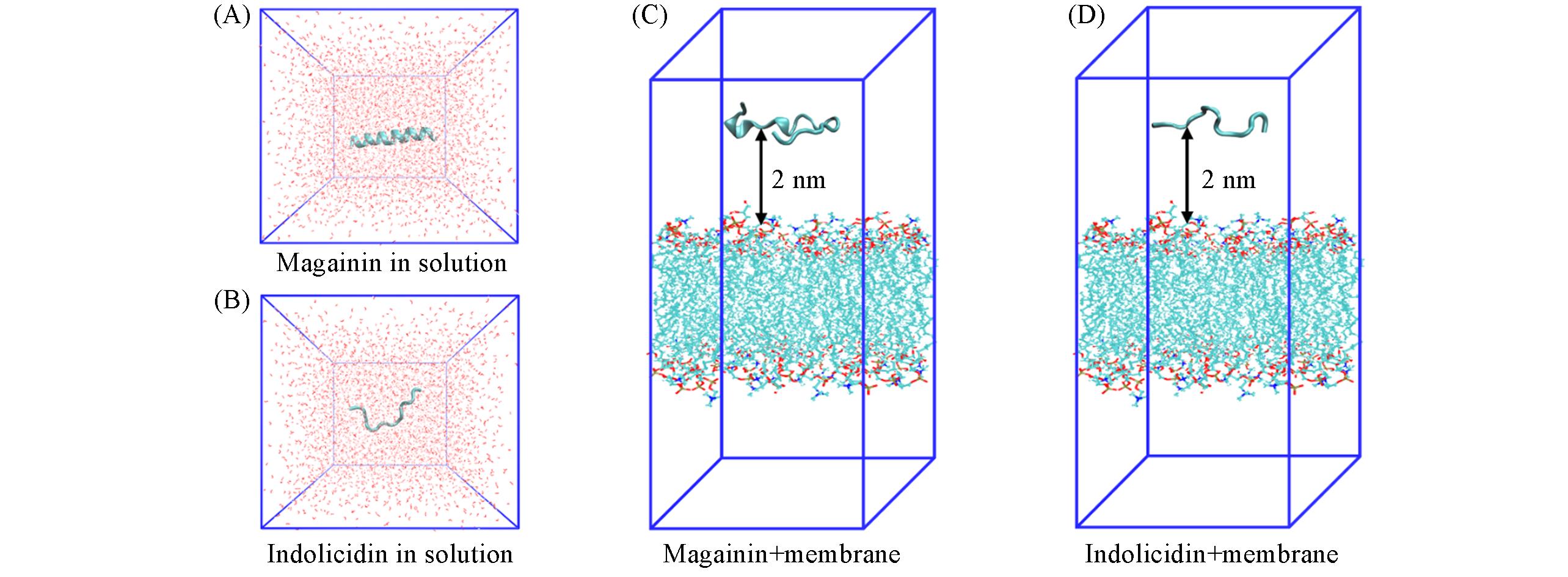
| System | AMP | Molecular assembly | Box size/nm3 | Simulation time/μs |
|---|---|---|---|---|
| 1 | Magainin | Water | 5.5×5.5×5.5 | 1 |
| 2 | Indolicidin | Water | 5.5×5.5×5.5 | 1 |
| 3 | Magainin | POPC/POPG(3∶1)⁃water | 5.5×5.5×12 | 2 |
| 4 | Magainin | POPC/POPG(5∶1)⁃water | 5.5×5.5×12 | 2 |
| 5 | Indolicidin | POPC/POPG(3∶1)⁃water | 5.5×5.5×12 | 2 |
| 6 | Indolicidin | POPC/POPG(5∶1)⁃water | 5.5×5.5×12 | 2 |
Table 1 Details of molecular assemblies investigated in this study
| System | AMP | Molecular assembly | Box size/nm3 | Simulation time/μs |
|---|---|---|---|---|
| 1 | Magainin | Water | 5.5×5.5×5.5 | 1 |
| 2 | Indolicidin | Water | 5.5×5.5×5.5 | 1 |
| 3 | Magainin | POPC/POPG(3∶1)⁃water | 5.5×5.5×12 | 2 |
| 4 | Magainin | POPC/POPG(5∶1)⁃water | 5.5×5.5×12 | 2 |
| 5 | Indolicidin | POPC/POPG(3∶1)⁃water | 5.5×5.5×12 | 2 |
| 6 | Indolicidin | POPC/POPG(5∶1)⁃water | 5.5×5.5×12 | 2 |
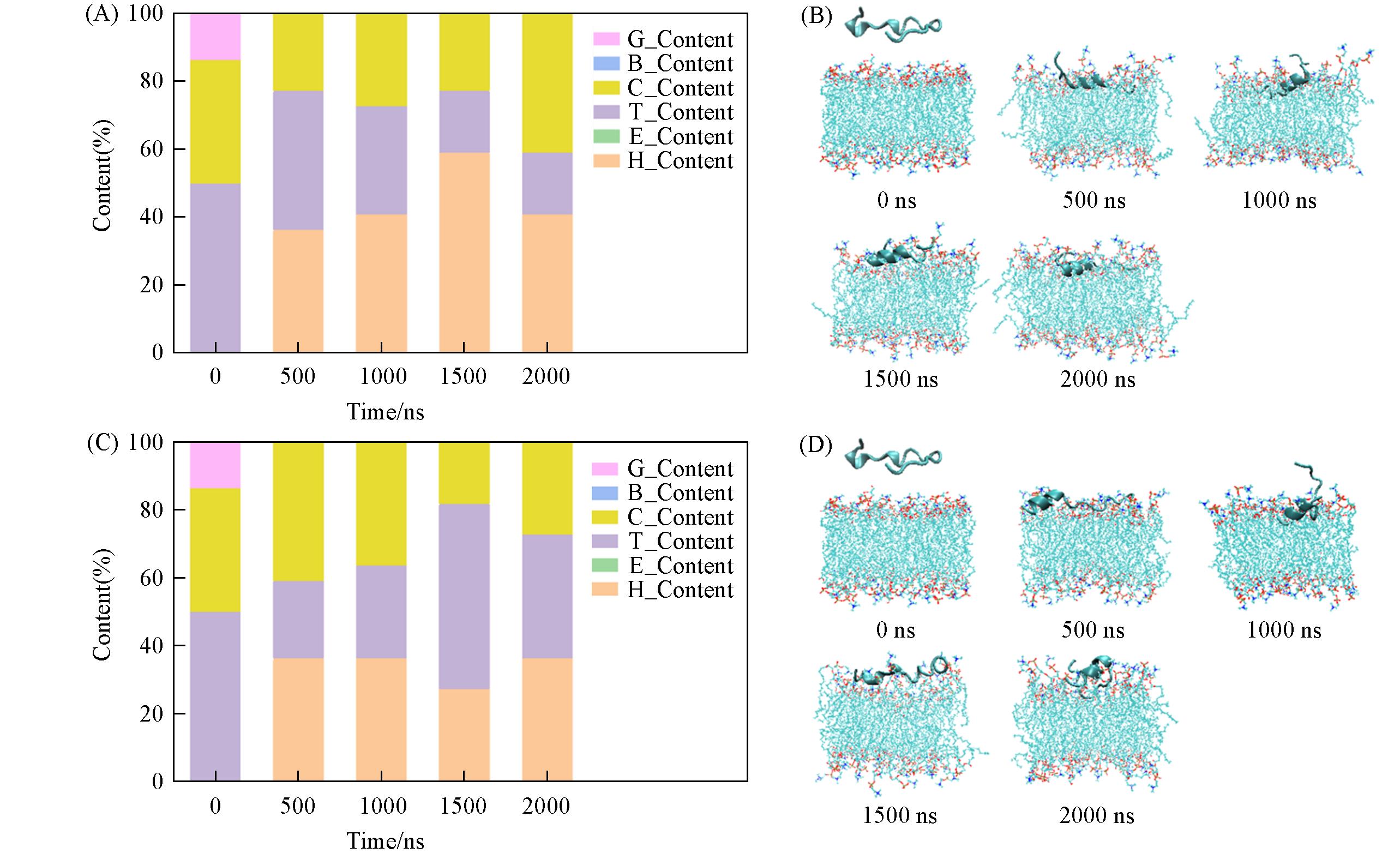
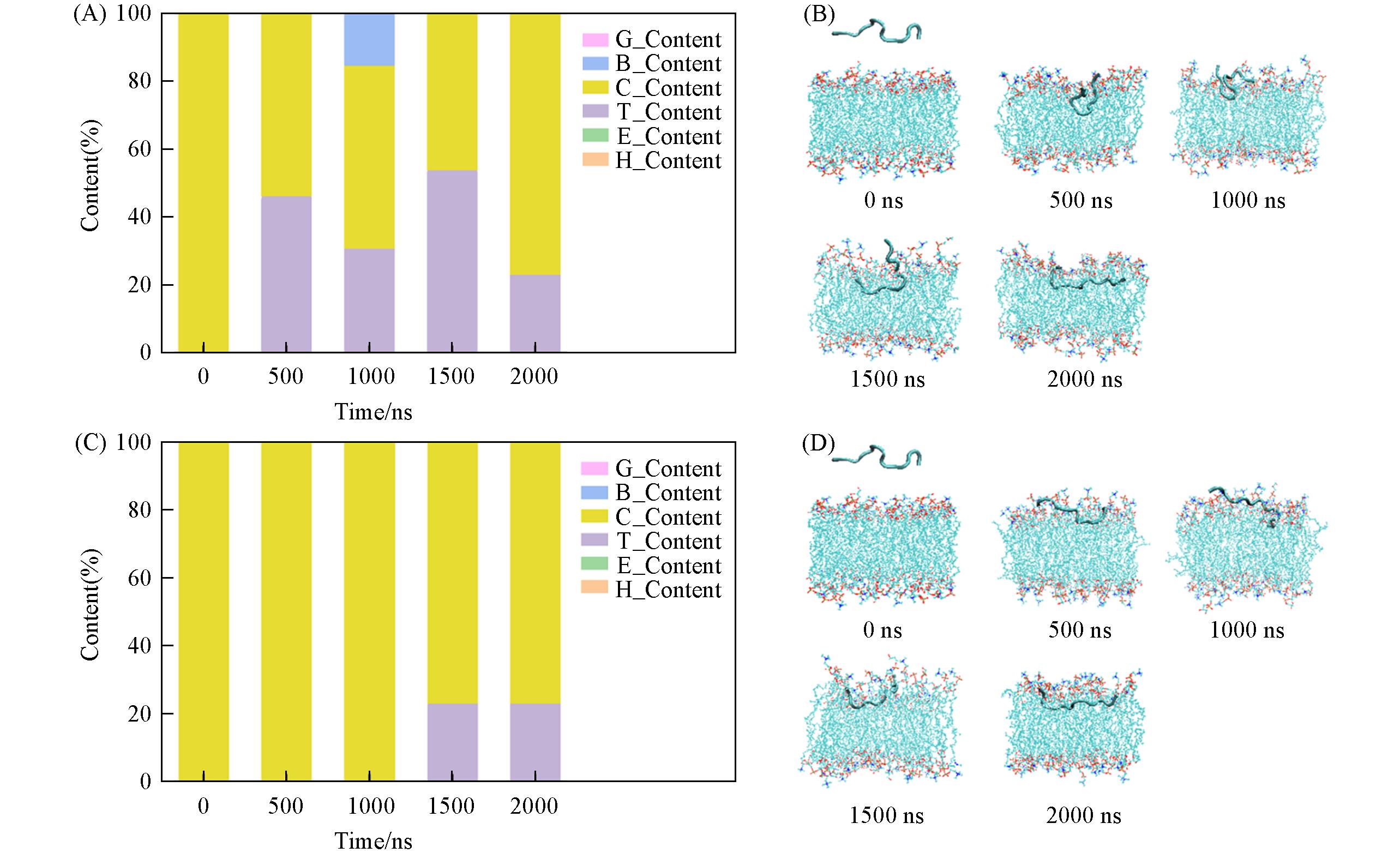
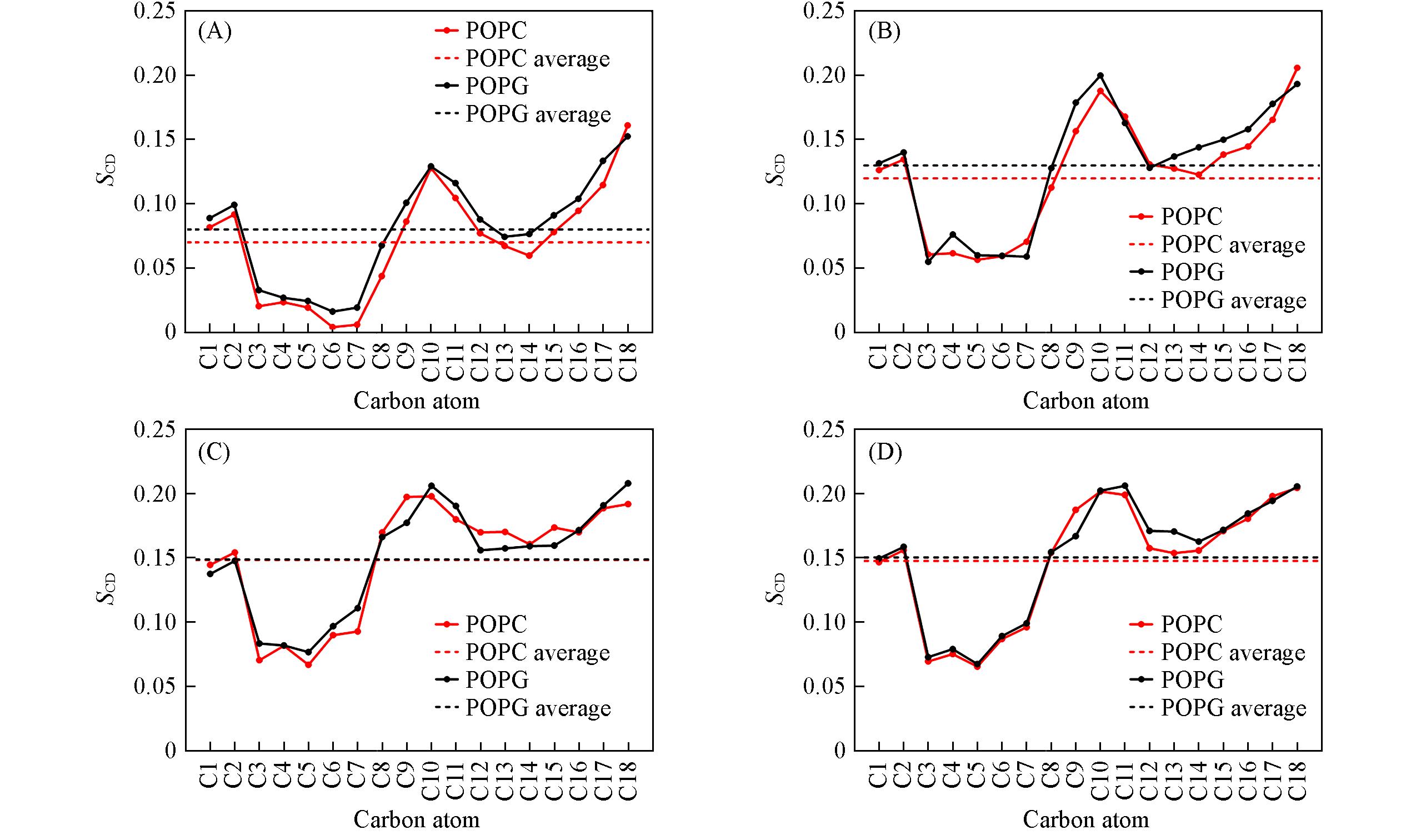
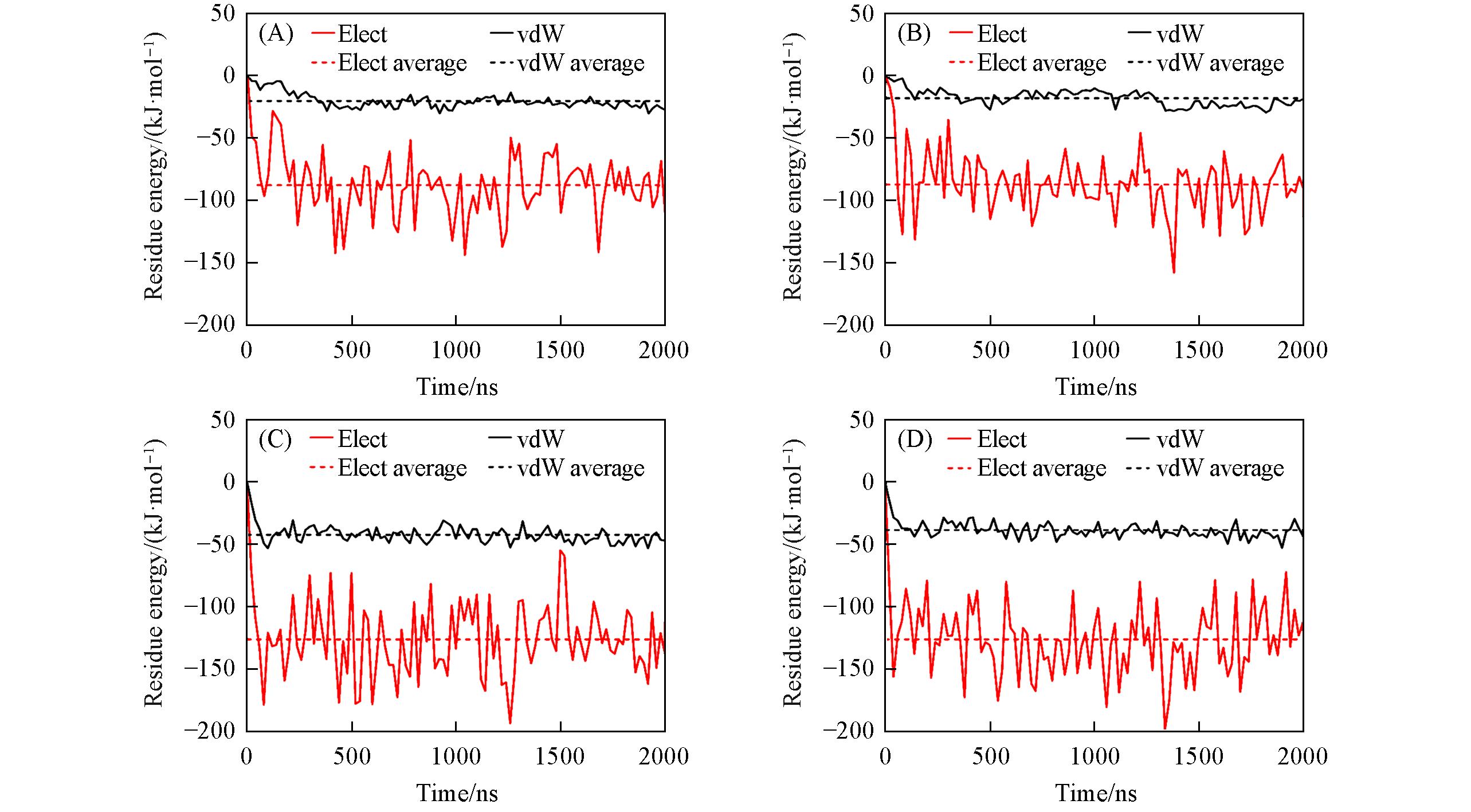
| [1] | Szymczak P., Zarzecki W., Wang J. J., Duan Y. Q., Wang J., Coelho L. P., Fuente⁃Nunez C., Szczurek E., Acc. Chem. Res., 2025, 58(12), 1831—1846 |
| [2] | He M. Y., Jiang Y. Q., Yang Y., Gong K. P., Jiang X. P., Tian Y., J. Phys. Chem. B, 2025, 129(7), 1956—1965 |
| [3] | Ahmad N. A., Ho J., J. Chem. Inf. Model., 2025, 65(1), 417—426 |
| [4] | Vega S. M., Booth V., Rowley C. N., J. Phys. Chem. B, 2022, 126(29), 5473—5480 |
| [5] | Fitz A. R., Klimov D. K., Lockhart C., J. Chem. Inf. Model., 2025, 65(17), 9251—9260 |
| [6] | Zasloff M., Nature, 2002, 415(6870), 389—395 |
| [7] | Subbalakshmi C., Sitaram N., FEMS Microbiol. Lett., 1998, 160(1), 91—96 |
| [8] | Jackel E., Lazzeri G., Covino R., J. Phys. Chem. B, 2025, 129(5), 1586—1596 |
| [9] | Benjamin A. B., Moule M. G., Didwania M. K., Hardy J., Saenkham⁃Huntsinger P., Sule P., Nielsen J. E., Lin J. S., Contag C. H., Barron A. E., Cirillo J. D., Microbiol. Spectr., 2022, 10(3), e0053422 |
| [10] | Wang H. P., Liu X. Y., Cai W. S., Shao X. G., Biomacromolecules, 2025, 26(11), 7838—7851 |
| [11] | Miao M. Y., Guo Y. C., Shao X. G., Cai W. S., Chem. J. Chinese Universities, 2021, 42(10), 3116—3124 |
| 妙孟姚, 郭一畅, 邵学广, 蔡文生. 高等学校化学学报, 2021, 42(10), 3116—3124 | |
| [12] | Cui S. L., Zhang W. J., Shao X. G., Cai W. S., Chem. J. Chinese Universities, 2022, 43(3), 20210838 |
| 崔韶丽, 张维佳, 邵学广, 蔡文生. 高等学校化学学报, 2022, 43(3), 20210838 | |
| [13] | Su L. L., Shao X. G., Cai W. S., Chem. J. Chinese Universities, 2023, 44(4), 20220745 |
| 粟李醴, 邵学广, 蔡文生. 高等学校化学学报, 2023, 44(4), 20220745 | |
| [14] | Tian C. S., Liu X. Y., Hao Y. L., Fu H. H., Shao X. G., Cai W. S., J. Phys. Chem. B, 2025, 129(5), 1453—1461 |
| [15] | Hao Y. L., Liu X. Y., Fu H. H., Shao X. G., Cai W. S., Bioinformatics, 2024, 40(8), btae497 |
| [16] | Tian C. S., Hao Y. L., Fu H. H., Shao X. G., Cai W. S., J. Chem. Inf. Model., 2025, 65(18), 9566—9575 |
| [17] | Rivel T., Biriukov D., Kabelka I., Vácha R., J. Chem. Inf. Model., 2025, 65(2), 908—920 |
| [18] | Andreev K., Martynowycz M. W., Ivankin A., Huang M. L., Kuzmenko I., Meron M., Lin B., Kirshenbaum K., Gidalevitz D., Langmuir, 2016, 32(48), 12905—12913 |
| [19] | Hayouka Z., Mortenson D. E., Kreitler D. F., Weisblum B., Forest K. T., Gellman S. H., J. Am. Chem. Soc., 2013, 135(42), 15738—15741 |
| [20] | Rozek A., Friedrich C. L., Hancock R. E., Biochemistry, 2000, 39(51), 15765—15774 |
| [21] | Jo S., Kim T., Iyer V. G., Im W., J. Comput. Chem., 2008, 29(11), 1859—1865 |
| [22] | Sharma P., Vaiwala R., Gopinath A. K., Chockalingam R., Ayappa K. G., Langmuir, 2024, 40(15), 7791—7811 |
| [23] | Yao H., Hong M., J. Am. Chem. Soc., 2014, 136(6), 2611—2624 |
| [24] | Phillips J. C., Hardy D. J., Maia J. D. C., Stone J. E., Ribeiro J. V., Bernardi R. C., Buch R., Fiorin G., Hénin J., Jiang W., McGreevy R., Melo M. C. R., Radak B. K., Skeel R. D., Singharoy A., Wang Y., Roux B., Aksimentiev A., Luthey⁃Schulten Z., Kalé L. V., Schulten K., Chipot C., Tajkhorshid E., J. Chem. Phys., 2020, 153(4), 044130 |
| [25] | Huang J., Rauscher S., Nawrocki G., Ran T., Feig M., de Groot B. L., Grubmüller H., MacKerell A. D., Nat. Methods, 2017, 14(1), 71—73 |
| [26] | Jorgensen W. L., Chandrasekhar J., Madura J. D., Impey R. W., Klein M. L., J. Chem. Phys., 1983, 79(2), 926—935 |
| [27] | Feller S. E., Zhang Y., Pastor R. W., Brooks B. R., J. Chem. Phys., 1995, 103(11), 4613—4621 |
| [28] | Ulmschneider J. P., Smith J. C., White S. H., Ulmschneider M. B., J. Am. Chem. Soc., 2011, 133(39), 15487—15495 |
| [29] | Ulmschneider M. B., Ulmschneider J. P., Schiller N., Wallace B. A., Von Heijne G., White S. H., Nat. Commun., 2014, 5, 4863 |
| [30] | Chen C. H., Starr C. G., Troendle E., Wiedman G., Wimley W. C., Ulmschneider J. P., Ulmschneider M. B., J. Am. Chem. Soc., 2019, 141(12), 4839—4848 |
| [31] | Hess B., Bekker H., Berendsen H. J. C., Fraaije J. G. E. M., J. Comput. Chem., 1997, 18(12), 1463—1472 |
| [32] | Essmann U., Perera L., Berkowitz M. L., Darden T., Lee H., Pedersen L. G., J. Chem. Phys., 1995, 103(19), 8577—8593 |
| [33] | Humphrey W., Dalke A., Schulten K., J. Mol. Graph., 1996, 14(1), 33—38 |
| [34] | Kumar A., Mishra B., Konar A. D., Mylonakis E., Basu A., J. Phys. Chem. B, 2024, 128(25), 6049—6058 |
| [35] | Volovik M. V., Batishchev O. V., Biomolecules, 2024, 14(9), 1118 |
| [36] | Fojan P., Gurevich L., Methods Mol. Biol., 2017, 1548, 201—215 |
| [37] | Liu L., Shi Z. H., Tong M. Q., Fang Y. Q., Yang D. Y., Yu J. F., Cao Z. X., J. Chem. Inf. Model., 2025, 65(5), 2623—2635 |
| [38] | Jaradat D. M. M., Saleh K. K. Y., Za'arir B. H. M., Arafat T., Alzoubi K. H., Al‑Taweel S. A., Mallah E., Haddad M. A., Haimur B. A. K., Int. J. Pept. Res. Ther., 2019, 25(3), 1095—1102 |
| [39] | Gupta S., Abhishek, Shrivastava S., Singh R. J., Gogoi P., Kumar B., Int. J. Pept. Res. Ther., 2021, 27(2), 1111—1119 |
| [40] | Vergis J., Malik S. S., Pathak R., Kumar M., Ramanjaneya S., Kurkure N. V., Barbuddhe S. B., Rawool D. B., Front. Microbiol., 2019, 10, 2723 |
| [41] | Nguyen L. T., Haney E. F., Vogel H. J., Trends Biotechnol., 2011, 29(9), 464—472 |
| [42] | Talandashti R., Mehrnejad F., Rostamipour K., Doustdar F., Lavasanifar A., J. Phys. Chem. B, 2021, 125(26), 7163—7176 |
| [43] | Ma W. D., Sun S. Q., Li W. W., Zhang Z. H., Lin Z., Xia Y., Yuan B., Yang K., Langmuir, 2020, 36(26), 7190—7199 |
| [1] | GUO Lili, HU Mengqian, HUANG Mengmei, LU Yanhua, LI Wei, ZHANG Qingyou, GUO Xiang. Prediction of Decomposition Temperature of Energetic Materials Based on Machine Learning Methods [J]. Chem. J. Chinese Universities, 2026, 47(6): 20250297. |
| [2] | FAN Xiang, LIU Zijian, JIA Mengke, AI Hongqi. Targeting Monkeypox A42R for Drug Screening and Repurposing: A Computational Study of Binding Mechanisms [J]. Chem. J. Chinese Universities, 2026, 47(6): 20250317. |
| [3] | JIAO Haili, ZHENG Xiaoyan. Progress on Theoretical Study of Organic Luminescence Enhancement Induced by Confined Environments [J]. Chem. J. Chinese Universities, 2026, 47(5): 20260060. |
| [4] | LI Xinxin, AN Guoce, SONG Xiaoming, NI Shuang, BAI Fengyang, PAN Xiumei, ZHAO Zhen. Theoretical Study on the Mechanism of Atmospheric New Particle Formation Enhanced by Formic Sulfide Anhydride in Atmosphere [J]. Chem. J. Chinese Universities, 2026, 47(3): 20250313. |
| [5] | FENG Jingqi, FAN Chunhai, CHEN Jing. Metallicity Evolution of Gold Nanoclusters [J]. Chem. J. Chinese Universities, 0, (): 20260067. |
| [6] | ZHAO Ying, YANG Haidi, CHAI Yuchun, GAO Shuaishuai, YUAN Pengfei, CHEN Xuebo. Machine Learning Descriptors for Catalytic Electron Donation: Predicting Adsorption Energies and Limiting Potentials in Nitrogen Fixation [J]. Chem. J. Chinese Universities, 2026, 47(2): 20250266. |
| [7] | LI Haojing, GE Changwei, ZHONG Qidi, YAN Hong, SUN Guohui. Theoritical Studies on the Photophysical Properties of 1,4-Dihydropyridine Derivatives [J]. Chem. J. Chinese Universities, 2026, 47(2): 20250250. |
| [8] | WEN Gehua, XUE Jingyi. One-Dimensional Uranyl Carboxyphosphonate Coordination Polymer for Highly Sensitive and Selective Detection of Fe3+ ion in Aqueous Media [J]. Chem. J. Chinese Universities, 2025, 46(12): 20250165. |
| [9] | TIAN Yang, GUO Qijing, YANG Huachun, LIU Haixia, XUE Fengfeng, YI Hao, SONG Shaoxian. Complexation Mechanism of Manganese Impurities in Hydrofluoric Acid System: DFT-based Ligand Structure and Reaction Pathway Analysis [J]. Chem. J. Chinese Universities, 2025, 46(12): 20250189. |
| [10] | ZHANG Li, HUANG Kexuan, GU Boai. Interaction Mechanism Between FXR and Its Natural Product Agonist SarmentolH [J]. Chem. J. Chinese Universities, 2025, 46(11): 20250182. |
| [11] | ZHENG Xiaohan, ZHU Jiayi, LI Xiaolei, HAO Qiang, WANG Changsheng. Extending the Polarizable Bond-dipole Model to Enable the Rapid Prediction of the Conformational Stability of Cyclic Peptides [J]. Chem. J. Chinese Universities, 2025, 46(10): 20250173. |
| [12] | LI Yongxia, CHENG Yaxuan, GUO Jinchang. Theoretical Study of the Conflicting-aromatic Ca3B8 Nanocluster Rotor [J]. Chem. J. Chinese Universities, 2025, 46(9): 20250149. |
| [13] | WEI Shiqian, LI Jiani, QIU Mei, LI Xian, CHEN Maoxia, FAN Qiang, TANG Fan, FAN Weifeng, HU Yu. Lithium/Sodium Atoms Adsorption and Migration on Silicene-Tin Disulfide Composite [J]. Chem. J. Chinese Universities, 2025, 46(8): 20250054. |
| [14] | YANG Siwei, HUANG Xuri. Theoretical Study of B, N Co-doped Fullerene C70 as Non-metal Electrocatalysts for Oxygen Reduction and Evolution [J]. Chem. J. Chinese Universities, 2025, 46(4): 20240490. |
| [15] | ZHU Jiayi, JIANG Xiaonan, ZHENG Xiaohan, HAO Qiang, WANG Changsheng. A Novel Efficient Method Based on the Bond Dipole Model for Computing Many-body Polarization Strength in Peptide-Water Systems [J]. Chem. J. Chinese Universities, 2025, 46(4): 20240518. |
| Viewed | ||||||
|
Full text |
|
|||||
|
Abstract |
|
|||||
