

Chem. J. Chinese Universities ›› 2026, Vol. 47 ›› Issue (5): 20250408.doi: 10.7503/cjcu20250408
• Review • Previous Articles Next Articles
WANG Shengjie, ZHU Zihao, ZHU Yujie, WU Chunxiao, ALIM Abdurahman( )
)
Received:2025-12-29
Online:2026-05-10
Published:2026-02-04
Contact:
ALIM Abdurahman
E-mail:alim@jlu.edu.cn
Supported by:CLC Number:
TrendMD:
WANG Shengjie, ZHU Zihao, ZHU Yujie, WU Chunxiao, ALIM Abdurahman. Advances and Challenges of Stable Organic Radicals with Luminescence in the Condensed State[J]. Chem. J. Chinese Universities, 2026, 47(5): 20250408.
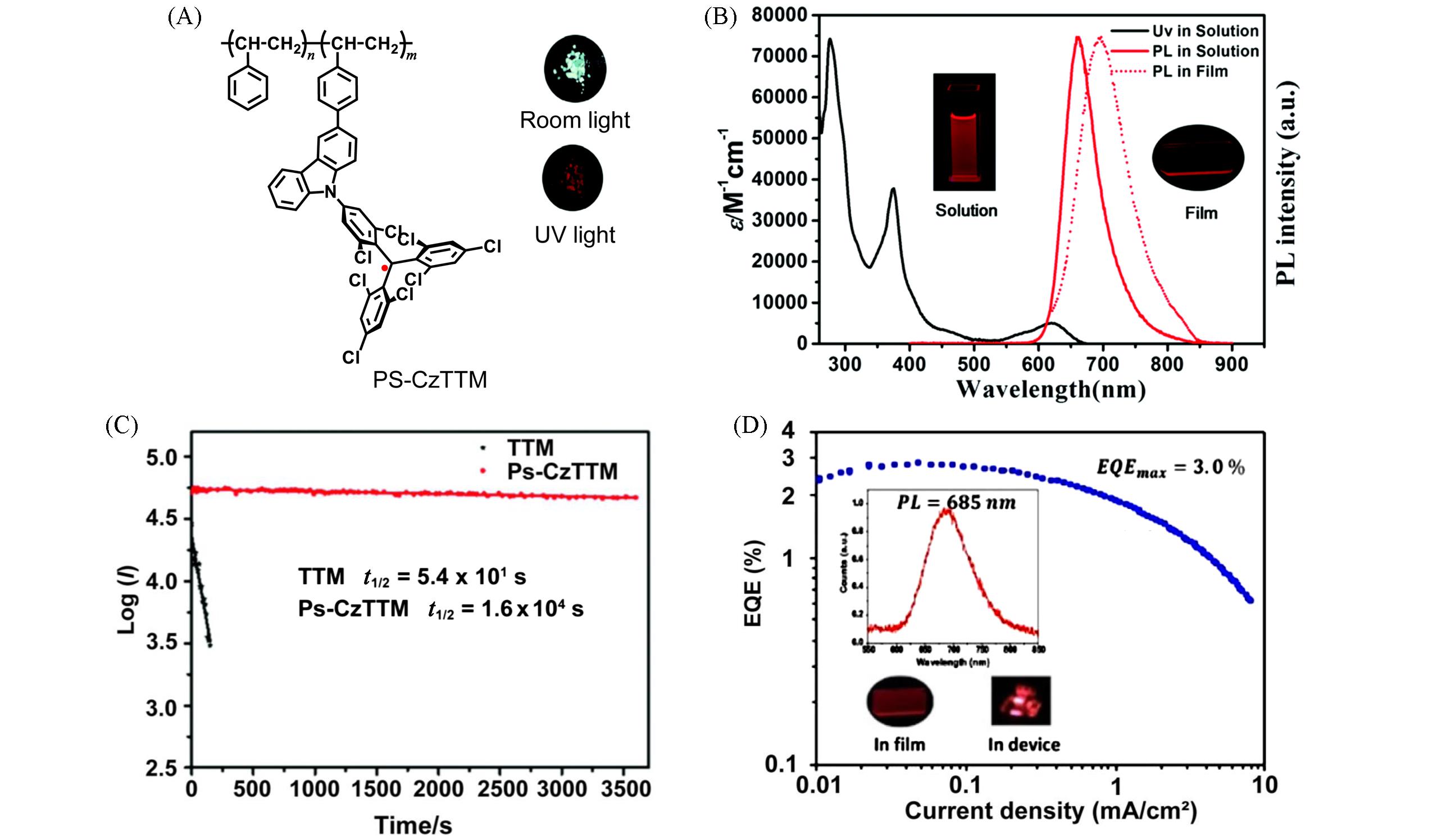
Fig.1 Photophysical and device properties of the first luminescent radical polymer PS⁃CzTTM(A) Chemical structure of PS-CzTTM and the photographs of PS-CzTTM powder under room light(up) and under UV light at 365 nm(down); (B) UV-Vis-NIR absorption spectrum(black line) and emission spectrum(red line) of PS-CzTTM in cyclohexane(1 μmol/L) and emission spectrum(red dashed line) of the PS-CzTTM in spin-coated film(100 nm, the insets); (C) comparison of the fluorescence intensity decays of TTM and PS-CzTTM in cyclohexane under irradiation with a 355 nm pulse[42]; (D) EQE of host-guest OLEDs versus current density[43]. Insets: (B) the photographs of PS-CzTTM in solution(left) and in the film state(right) under UV light(365 nm) at room temperature; (D) EL spectra of host-guest OLED at 12 V and the photographs of PS-CzTTM in the film state(left) and in the device(right).(A—C) Copyright 2019, the Royal Society of Chemistry; (D) Copyright 2020, American Chemical Society.
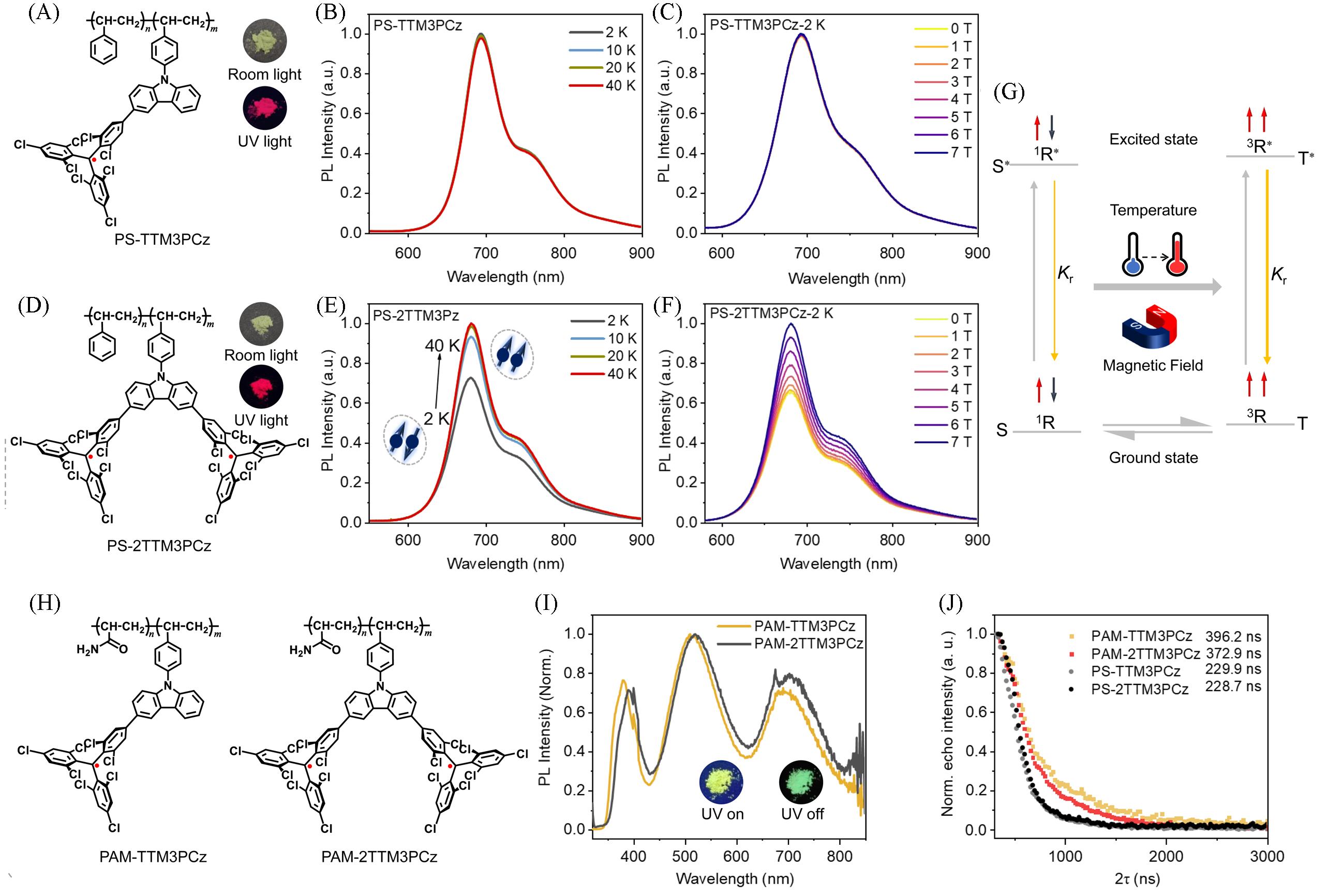
Fig.2 Chemical structures and photophysical characterizations of luminescent radical polymer PS⁃TTM3PCz, PS⁃2TTM3PCz, PAM⁃TTM3PCz, and PAM⁃2TTM3PCz
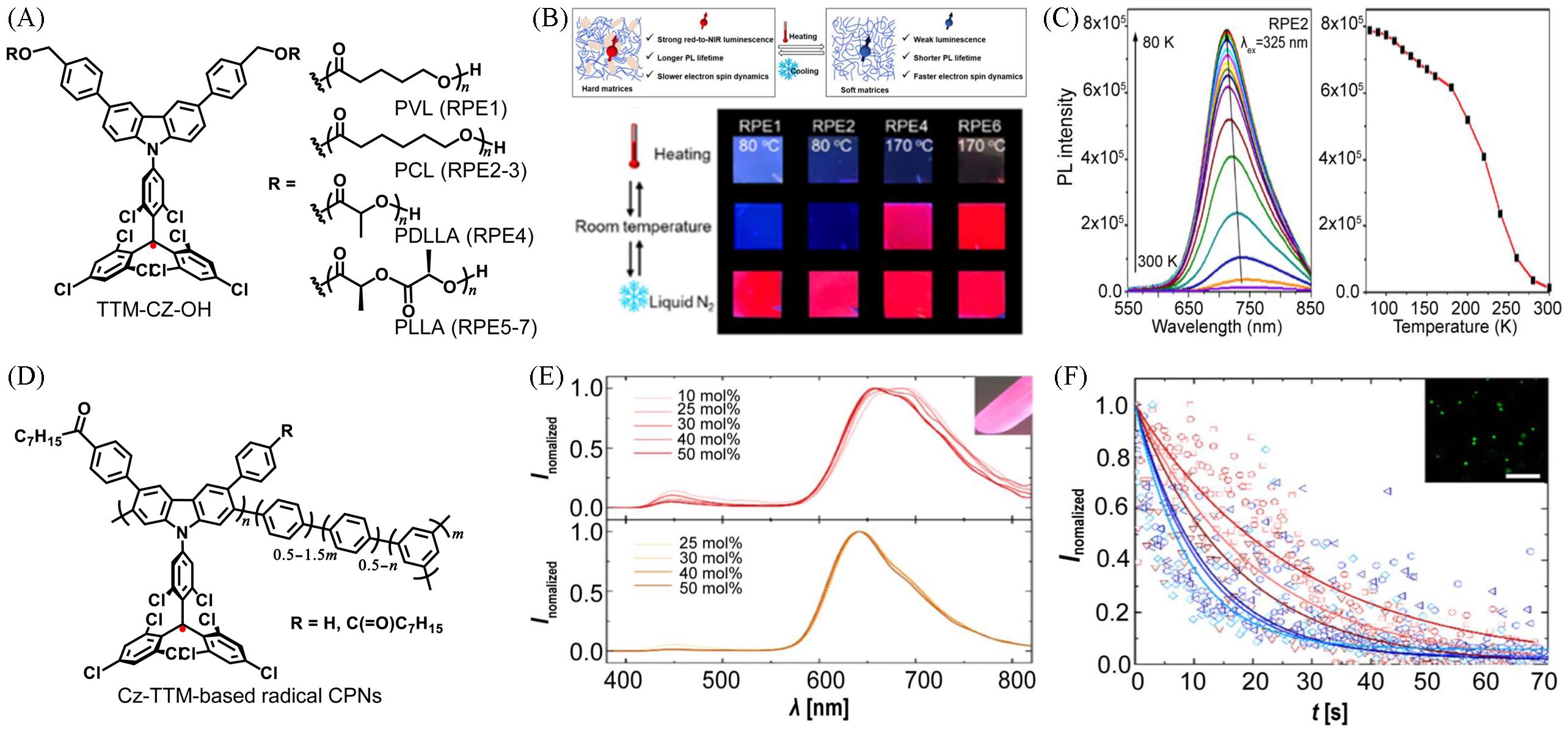
Fig.3 Luminescence properties of diverse luminescent radical⁃based polymeric materials in different conditions(A) Chemical structure of radical-centered polymers derived from TTM-CZ-OH; (B) schematic presentation to illustrate the impact of polymer rigidity on the luminescence and electron spin dynamics of the embedded radicals(up) and digital photographs of RPE1, RPE2, RPE4 and RPE6 thin films on quartz slides under UV light(365 nm, down); (C) temperature-dependent steady-state PL emission(excitation at 375 nm) spectra of the RPE2 film and the evolution of the maximal PL intensity of the RPE2 film as a function of temperature[46]; (D) chemical structure of Cz-TTM-based radical CPN; (E) PL spectra of CPN dispersions in 1-PrOH synthesized with different initial radical monomer contents of oct-CzBr2-TTM and bisoct-CzBr2-TTM in molar fraction; (F) PL intensity of radical CPNs made from 50%(molar fraction) oct-CzBr2-TTM(red) and latex reference particles loaded with commercial red dye(blue) as a function of time. Both particle dispersions are illuminated with a 5.1 mW CW-laser at 561 nm, and three distinctive particles of both batches are recorded over time; the straight lines show an exponential fit of the data, the inset shows a confocal image of the stable aqueous dispersion of the luminescent open-shell CPNs[47]. Inset of (E): photograph of a radical CPN dispersion under UV light synthesized with the same parameters as used for the kinetic study.(A—C) Copyright 2022, American Chemical Society; (D—F) Copyright 2023, the Authors. Published by American Chemical Society;
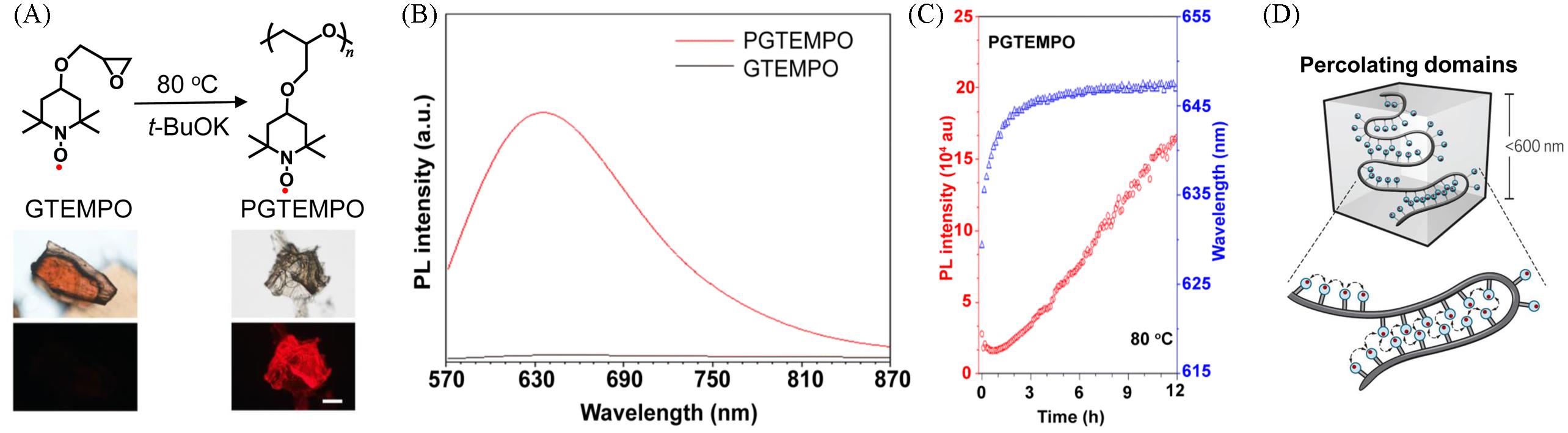
Fig.4 Synthesis and photophysical properties of radical polymer PGTEMPO(A) Synthetic route of the PGTEMPO radical polymer and its photos taken under ambient light(up) and 510—550 nm excitation(down); (B) PL spectra of PGTEMPO and GTEMPO in the solid state(excitation at 532 nm); (C) the real-time annealing of PGTEMPO at the temperature of 80 ℃ under nitrogen(excitation at 532 nm)[49]; (D) schematic of percolating domains after annealing[54].(A, B, C) Copyright 2022, the Royal Society of Chemistry; (D) Copyright 2018, the Authors, some rights reserved; exclusive licensee American Association for the Advancement of Science.
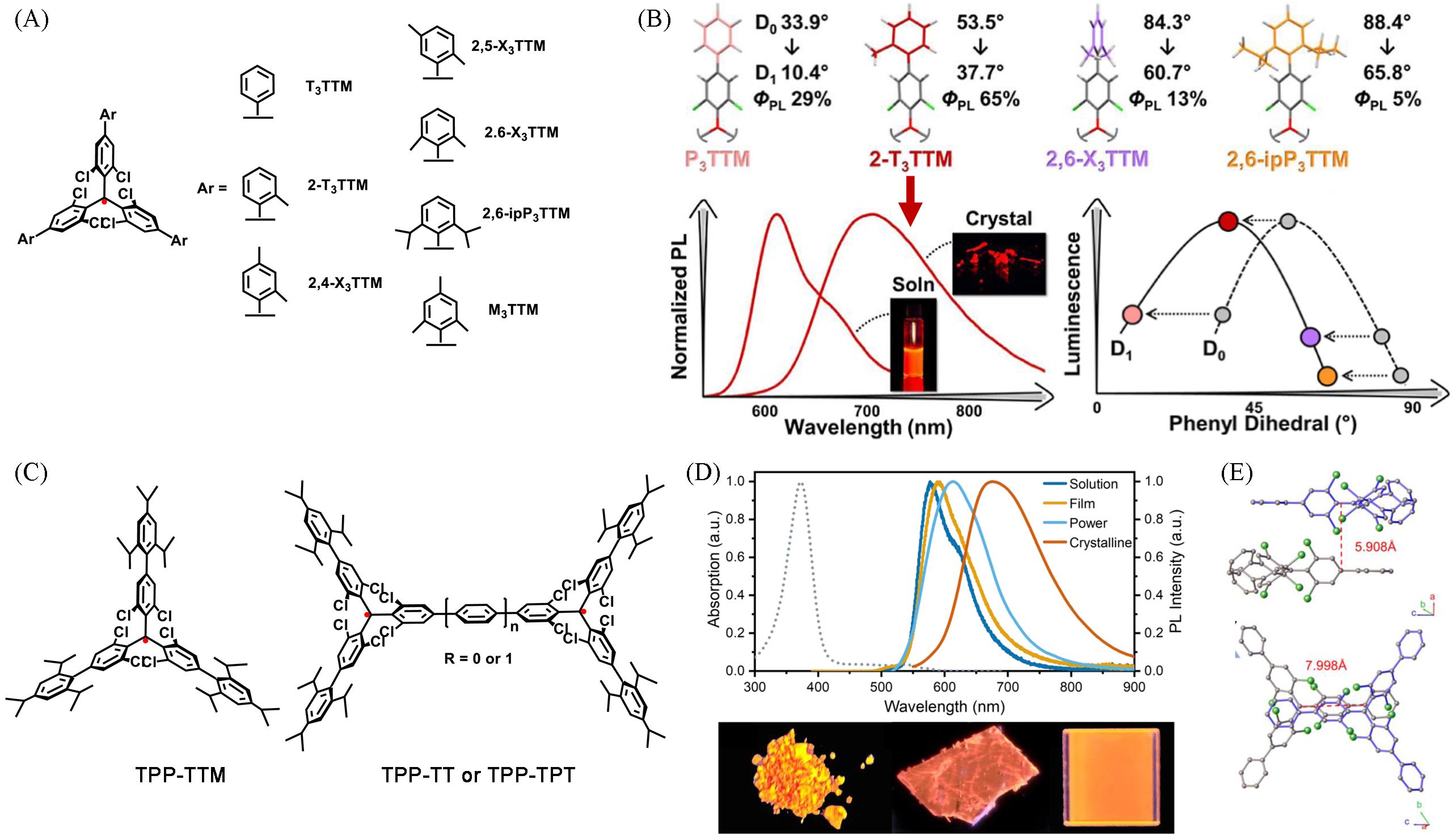
Fig.5 Luminescence of an isolated radical molecule in the condensed state(A) Chemical structures of TTM-based radicals; (B) molecular structures from X-ray crystal structures of the synthesized P3TTM, 2-T3TTM, and 2,6-X3TTM and 2,6-ipP3TTM radicals with average phenyl-phenyl dihedrals and emission spectrum of 2-T3TTM in solution and in crystal[58]; (C) chemical structure of TPP-TTM, TPP-TT and TPP-TPT; (D) normalized UV-Vis absorption and PL spectra of TPP-TTM in cyclohexane solution(1×10⁻⁵ mol/L) and aggregated states at room temperature(up); photographs of powders, a single crystal, and a spin-coated neat film of TPP-TTM under UV light(365 nm, down); (E) front(up) and top(down) view of possible intermolecular dimer of TPP-TTM in crystals[36]. Insets of (B): the photographs of 2-T3TTM in solution(left) and in the crystal(right).(A, B) Copyright 2024, the Authors, published by American Chemical Society; (C—E) Copyright 2025, Wiley-VCH.
| [1] | Mizuno A., Matsuoka R., Mibu T., Kusamoto T., Chem. Rev., 2024, 124(3), 1034—1121 |
| [2] | Abdurahman A., Peng Q. M., Chin. J. Luminesc., 2024, 45(2), 211—214 |
| [3] | Straub D., Gross M., Arnold M. E., Zolg J., Kuehne A. J. C., Beilstein J. Org. Chem., 2025, 21, 964—998 |
| [4] | Peng Q. M., Obolda A., Zhang M., Li F., Angew. Chem. Int. Ed., 2015, 54(24), 7091—7095 |
| [5] | Ai X., Evans E. W., Dong S. Z., Gillett A. J., Guo H. Q., Chen Y. X., Hele T. J. H., Friend R. H., Li F., Nature, 2018, 563, 536—540 |
| [6] | Abdurahman A., Hele T. J. H., Gu Q. Y., Zhang J. B., Peng Q. M., Zhang M., Friend R. H., Li F., Evans E. W., Nat. Mater., 2020, 19, 1224—1229 |
| [7] | Ai X., Chen Y., Feng Y., Li F., Angew. Chem. Int. Ed., 2018, 57(11), 2869—2873 |
| [8] | Qu Y. Y., Li Y. C., Tan X. L., Zhai W. X., Han G. F., Hou J. L., Liu G. Q., Song Y. G., Liu Y. P., Chem. Eur. J., 2019, 25(33), 7888—7895 |
| [9] | Zhao Y. H., Abdurahman A., Zhang Y. M., Zheng P., Zhang M., Li F., CCS Chem., 2022, 4(2), 722—731 |
| [10] | Zhou Z. B., Yang K., He L., Wang W., Lai W. M., Yang Y. H., Dong Y. G., Xie S., Yuan L., Zeng Z. B, J. Am. Chem. Soc., 2024, 146(10), 6763—6772 |
| [11] | Feng L., Tuo Y. Y., Wu Z. P., Zhang W. J., Li C. B., Yang B., Liu L. X., Gong J. Y., Jiang G. Y., Hu W., Tang B. Z., Wu L. M., Wang J. G., J. Am. Chem. Soc., 2024, 146(47), 32582—32594 |
| [12] | Chen D. J., Xu Y. X., Wang Y. T., Li X., Yin D. L., Yan L. F., ACS Appl. Mater. Interfaces, 2024, 16(44), 59907—59920 |
| [13] | Liu T., Zhu Z. H., Wang S. J., Shen L., Abdurahman A., Liu X. M., Lu G. Y., Light Sci. Appl., 2025, 14, 289 |
| [14] | Kimura S., Matsuoka R., Kimura S., Nishuhara H., Kusamoto T., J. Am. Chem. Soc., 2021, 143(15), 5610—5615 |
| [15] | Gorgon S., Ly K., Grüne J., Drummond B. H., Myers A. W. K., Londi G., Ricci G., Valverde D., Tonnellé C., Murto P., Romanov A. S., Casanova D., Dyakonov V., Sperlich A., Belionne D., Olivier Y., Li F., Friend R. H., Evans E. W., Nature, 2023, 620, 538—544 |
| [16] | Kopp S. M., Nakamura S., Phelan B. T., Poh Y. R., Tyndall S. B., Brown P. J. J., Huang Y. H., Yuen⁃Zhou J., Krzyaniak M. D., Wasielewski M. R., J. Am. Chem. Soc., 2024, 146(40), 27935—27945 |
| [17] | Poh Y. R., Morozov D., Kazmierczak N. P., Hadt R. G., Groenhof G., Yuen⁃Zhou J., J. Am. Chem. Soc., 2024, 146(22), 15549—15561 |
| [18] | Kopp S. M., Nakamura S., Poh Y. R., Peinkhofer K. W. R., Phelan B. T., Zhou J. Y., Krzyaniak M. D., Wasielewski M. R., J. Am. Chem. Soc., 2025, 147(26), 22951—22960 |
| [19] | Chowdhury R., Murto P., Panjwani N. A., Sun Y., Ghosh P., Boeije Y., Cordeiro C. D., Derkach V., Woo S., Millington O., Congrave D. G., Fu Y., Mustafa T. B. E., Monteverde A., Cerdá J., Londi G., Behrends J., Rao A., Belionne D., Chepelianskii M., Bronstein H., Friend R. H., Nat. Chem., 2025, 17, 1410—1417 |
| [20] | Schäffer D., Wischnat J., Tesi L., de Sousa J. A., Little E., McGuire J., Mas⁃Torrent M., Rovira C., Veciana J., Tuna F., Chilvers N., Van Slageren J., Adv. Mater., 2023, 35(38), 2302114 |
| [21] | Chen S. Y., Zhu Z. H., Zhou L. P., Huang H. X., Abdurahman A., Qiao X. F., Ma D. G., J. Phys. Chem. Lett., 2025, 16(36), 9401—9407 |
| [22] | Tang B. Z., Chem. J. Chinese Universities, 2019, 40(7), 1793 |
| [23] | Li L., Prindle C. R., Shi W. Z., Buckolls C., Venkataraman L., J. Am. Chem. Soc., 2023, 145(33), 18182—18204 |
| [24] | Hackney H. E., Ruchlin C., Stahle E., Perepichka D. F., Angew. Chem. Int. Ed., 2025, 64(37), e202512411 |
| [25] | Li S. Z., Zhao X. L., Shi X. L., Yang H. B., J. Am. Chem. Soc., 2025, 147(38), 34498—34507 |
| [26] | Wu C. X., Ai X., Chen Y. X., Cui Z. Y., Li F., Chem. J. Chinese Universities, 2020, 41(5), 972—980 |
| [27] | Yang Y. M., Qiu L. L., Shi X. L., Chem. Res. Chinese Universities, 2023, 39(2), 197—201 |
| [28] | Abdurahman A., Wang J. M., Zhao Y. H., Li P., Shen L., Peng Q. M., Angew. Chem. Int. Ed., 2023, 62(15), e202300772 |
| [29] | Zhu Y. J., Zhu Z. H., Wang S. X., Peng Q. M., Abdurahman A., Angew. Chem. Int. Ed., 2025, 64(10), e202423470 |
| [30] | Liu C. H., He Z. C., Ruchlin C., Che Y. X., Somers K., Perepichka D. F., J. Am. Chem. Soc., 2023, 145(29), 15702—15707 |
| [31] | Matsuoka R., Kimura S., Miura T., Ikoma T., Kusamoto T., J. Am. Chem. Soc., 2023, 145(25), 13615—13622 |
| [32] | Abdurahman A., Shen L., Wang J. M., Niu M. L, Peng Q. M., Wang J. P., Lu G. Y., Light Sci. Appl., 2023, 12, 272 |
| [33] | Mizuno A., Matsuoka R., Kimura S., Ochiai K., Kusamoto T., J. Am. Chem. Soc., 2024, 146(27), 18470—18483 |
| [34] | Wang X., Wang S. J., Ding Z. Z., Shen L., Zhu Z. H., Abdurahman A., Lu G. Y., Peng Q. M., Angew. Chem. Int. Ed., 2025, 64(40), e202515393 |
| [35] | Tong Z. K., Zhang S., Niu W. W., Yu T. X., Zhang X. F., Yao P. L., Wang J. F., Han Y. B., Li G. W., Dong S. Q., J. Am. Chem. Soc., 2025, 147(43), 39232—39246 |
| [36] | Guan J. H., Zhu Z. H., Gou Q. Q., Wang J. M., Kuang Z. Y., Zhang L. T., Zhang X. W., Ai X., Abdurahman A., Peng Q. M., Aggregate, 2025, 6(9), e70100 |
| [37] | Kimura S., Kusamoto T., Kimura S., Kato K., Teki Y., Nishihara H., Angew. Chem. Int. Ed., 2018, 57(39), 12711—12715 |
| [38] | Liu C. H., Hamzehpoor E., Otsuka Y. S., Jadhav T., Perepichka D. F., Angew. Chem. Int. Ed., 2020, 59(51), 23030—23034 |
| [39] | Zhu Z. H., Kuang Z. Y., Shen L., Wang S. J., Ai X., Abdurahman A., Peng Q. M., Angew. Chem. Int. Ed., 2024, 63(42), e202410552 |
| [40] | Wang S. J., Wang X, Zhu Z. H., Shen L, Zhu Y. J., Abdurahman A., Ma H. W., Peng Q. M., Lu G. Y., CCS Chem., 2025, e202506229 |
| [41] | Zhang Z. T., Zhang J. Y., Sun J. Z., Zhang H. K., Zhang X. H., Tang B. Z., Chem. Eur. J., 2025, 31(4), e202403493 |
| [42] | Abdurahman A., Peng Q. M., Ablikim O., Ai X., Li F., Mater. Horiz., 2019, 6, 1265—1270 |
| [43] | Gu Q. Y., Abdurahman A., Friend R. H., Li F., J. Phys. Chem. Lett., 2020, 11(14), 5638—5642 |
| [44] | Wang S. J., Wang X., Ding J. S., Zhu Z. H., Wang J. M., Shen L., Abdurahman A., Lu G. Y., Wang J. P., Peng Q. M., Macromolecules, 2024, 57(13), 6133—6139 |
| [45] | Wang S. J., Zhu Z. H., Abdurahman A., Peng Q. M., Macromolecules, 2025, 58(1), 372—378 |
| [46] | Hou L. M., Xu H. X., Zhang X. Y., Zhang Y. P., Chen R., Zhang Z. Y., Wang M. F., Macromolecules, 2022, 55(19), 8619—8628 |
| [47] | Chen L., Rudolf T., Blinder R., Suryadevara N., Dalmeida A., Welscher P. J., Lamla M., Arnold M., Herr U., Jelezko F., Ruben M., Kuehne A. J. C., Macromolecules, 2023, 56(5), 2104—2112 |
| [48] | Armet O., Veciana J., Rovira C., Riera J., Castaner J., Molins E., Rius J., Miravitlles C., Brichfeus S., J. Phys. Chem., 1987, 91(22), 5608—5616 |
| [49] | Wang Z. Y., Zou X. H., Xie Y., Zhang H. K., Hu L. R., Chan C. C. S., Zhang R. Y., Guo J., Kwok R. T. K., Lam J. W. Y., Williams I. D., Zeng Z. B., Wong K. S., Sherrill C. D., Ye R. Q., Tang B. Z., Mater. Horiz., 2022, 9, 2564—2571 |
| [50] | Chen P. Y., Zhang G. Y., Li J. G., Ma L. J., Zhou J. Y., Zhu M. G., Li S., Wang Z., Chem. Res. Chinese Universities, 2024, 40(2), 293—304 |
| [51] | Xiong J. Y., Wu M. J., Yao L. Y., Chem. Res. Chinese Universities, 2024, 40(5), 887—893 |
| [52] | Sun Z. H., Yin P. P., He S. Y., Zhang K. G., Pan X. R., Wang J. Y., Hao P. N., Zhou Z., Yang X. G., Ma L. F., Tan C. L., Chem. Res. Chinese Universities, 2025, 41(3), 519—524 |
| [53] | Joo Y., Agarkar V., Sung S. H., Savoie B. M., Boudouris B. W., Science, 2018, 359(6382), 1391—1395 |
| [54] | Lutkenhaus J., Science, 2018, 359(6382), 1334—1335 |
| [55] | Kimura S., Uejima M., Ota W., Sato T., Kusaka S., Matsuda R., Nishihara H., Kusamoto T., J. Am. Chem. Soc., 2021, 143(11), 4329—4338 |
| [56] | Kimura S., Tanushi A., Kusamoto T., Kochi S., Sato T., Nishihara H., Chem. Sci., 2018, 9, 1996—2007 |
| [57] | Matsuoka R., Kimura S., Kusamoto T., ChemPhotoChem, 2021, 5(7), 669—673 |
| [58] | Murto P., Li B., Fu Y., Walker L. E., Brown L., Bond A. D., Zeng W., Chowdhury R., Cho H. H., Yu C. P., Grey C. P., Friend R. H., Bronstein H., J. Am. Chem. Soc., 2024, 146(19) 13133—13141 |
| [59] | Murto P., Chowdhury R., Gorgon S., Guo E., Zeng W. X., Li B. W., Sun Y. Q., Francis H., Friend R. H., Bronstein H., Nat. Commun., 2023, 14, 4147 |
| [60] | Yu C. P., Chowdhury R., Fu Y., Ghosh P., Zeng W. X., Mustafa T. B. E., Grüne J., Walker L. E., Congrave D. G., Chua X. W., Murto P., Rao A., Sirringhaus H., Plasser F., Grey C. P., Friend R. H., Bronstein H., Sci. Adv., 2024, 10(30), eado3476 |
| [1] | LUO Juxiang, ZHAO Lei, XIAO Wangchuan, CHENG Deshu. Synthesis of Novel Alkoxyamine and Its Controlled Polymerization of Methyl Methacrylate [J]. Chem. J. Chinese Universities, 2025, 46(5): 20240541. |
| [2] | DENG Yakui, YUAN Yuan, CHEN Yulan. Recent Advances in the Synthesis of Multi-Mechanophore Polymers [J]. Chem. J. Chinese Universities, 2020, 41(9): 1956. |
| [3] | WANG Qianying, CUI Shuxun. Investigation of Formation Mechanism of Polydopamine by Adding Free Radical Quencher † [J]. Chem. J. Chinese Universities, 2020, 41(6): 1378. |
| [4] | WU Shanshan,WEI Chanling,ZHAO Lijuan,TIAN Yang,WANG Xia,GONG Bolin. Preparation and Enrichment Properties of Novel Magnetic Restricted Access Media-molecularly Imprinted Composites† [J]. Chem. J. Chinese Universities, 2019, 40(6): 1150. |
| [5] | ZHANG Xiaotao,WANG Yan’an,HUI Jia,SHI Yan,FU Zhifeng,YANG Wantai. Reversible-deactivation Radical Solution Polymerization of Methyl Methacrylate Catalyzed by Tetrabutylammonium Iodide† [J]. Chem. J. Chinese Universities, 2019, 40(2): 366. |
| [6] | YU Tian, XU Chengnan, YU Yuan, ZHAO Feifei, PAN Yiting, LIU Cai, HUANG Yongdong, ZHANG Rongyue. Preparation of Gigaporous Microspheres Through Atom Transfer Radical Polymerization† [J]. Chem. J. Chinese Universities, 2016, 37(9): 1740. |
| [7] | LI Weiwei, SHI Yan, YANG Wantai, FU Zhifeng. Cobalt-mediated Radical Polymerization(CMRP) of Chloroprene by CoⅡ(salen*)† [J]. Chem. J. Chinese Universities, 2016, 37(11): 2085. |
| [8] | ZHANG Lixin, WANG Jintao, YANG Yongfang, ZHAO Hanying. Novel Method of Preparation of Diblock Copolymers with Disulfide Bonds at Junction Points† [J]. Chem. J. Chinese Universities, 2016, 37(1): 161. |
| [9] | TURSON Mamat, DAWUT Gulbahar, EMIN Risalat, CHU Ganghui, JELIL Mahmutjan, TURHON Muhetar. Preparation of Quercetin Imprinted Polymer by Living Radical Polymerization and Its Application in the Composition Analysis of Zukamu Granules for Uighur Medicine† [J]. Chem. J. Chinese Universities, 2015, 36(12): 2402. |
| [10] | CHEN Youning, GAO Li, HE Maofang, WEI Yinmao. High-capacity Polyvinyltetrazole-grafted Chelating Resin for Adsorption of Heavy Metal Ions† [J]. Chem. J. Chinese Universities, 2014, 35(7): 1596. |
| [11] | SHEN Liyuan, WU Yanying, LIU Dajun, HE Xingquan. Synthesis and Third-order Nonlinear Optical Properties of Indiumphthalocyanine-functionalized Four-arm Star Polymethylmethacrylate† [J]. Chem. J. Chinese Universities, 2014, 35(2): 409. |
| [12] | WANG Jingyun, Fu Xue, BAO Yongming. Cationization of Inulin via Atom Transfer Radical Polymerization for Gene Delivery† [J]. Chem. J. Chinese Universities, 2014, 35(10): 2124. |
| [13] | ZHANG Zhili, TANG Xiaofen, MENG Jieyun, ZHANG Xingxiang, SHI Haifeng. Preparation and Characterization of Diethylene Glycol Octadecyl Ether Methacrylate and Its Polymer [J]. Chem. J. Chinese Universities, 2014, 35(1): 175. |
| [14] | REN Yuan-Lin, XIN Peng-Yue, SU Qian, CHENG Bo-Wen. Preparation and Properties of Halogen-free Fire Retardant Acrylonitrile Copolymer [J]. Chem. J. Chinese Universities, 2013, 34(9): 2216. |
| [15] | DONG Jia-Bin, WU Jian-Bo, YANG Jing, SONG Wei, DAI Xiao-Jun, YE Zheng-De, GONG Bo-Lin. Preparation of High-capacity IDA Chelating Resin and Its Adsorption Properties [J]. Chem. J. Chinese Universities, 2013, 34(3): 714. |
| Viewed | ||||||
|
Full text |
|
|||||
|
Abstract |
|
|||||
