

高等学校化学学报 ›› 2026, Vol. 47 ›› Issue (9): 20260234.doi: 10.7503/cjcu20260234
• 综合评述 • 上一篇
裴天遥1, 王永刚2( ), 岳彬彬1
收稿日期:2026-06-10
出版日期:2026-09-10
发布日期:2026-07-20
通讯作者:
王永刚
E-mail:ygw@pku.edu.cn
基金资助:
PEI Tianyao1, WANG Yonggang2(), YUE Binbin1
Received:2026-06-10
Online:2026-09-10
Published:2026-07-20
Contact:
WANG Yonggang
E-mail:ygw@pku.edu.cn
Supported by:摘要:
高压诱导的结构相变是发现新物相、 理解极端条件下物质行为的重要途径. 然而, 相变过程中的路径、 中间态和动力学长期处于“黑箱”状态, 需要原位探测技术予以揭示. 本文综合评述了高压固体化学中结构相变的原位探测技术及机理研究进展. 首先, 按信息层次分类介绍了X射线衍射、 中子衍射、 X射线吸收精细结构、 对分布函数、 拉曼光谱、 红外光谱、 紫外-可见吸收光谱、 荧光光谱及二次谐波等原位表征方法的原理与适用范围, 并讨论了超快时间分辨技术和机器学习辅助数据分析等新兴方向. 其次, 以位移型相变(SrTiO3)、 重构型相变(石墨-金刚石、 Co3P2O8)、 压致非晶化(冰)、 等结构相变(Ce)及有序-无序相变(IMMH y PbBr4)为典型案例, 展示了原位技术如何揭示压力诱导结构演化的微观机理. 最后, 总结了当前在时间分辨率和数据解释等方面面临的瓶颈, 并对多技术联用、 超快探测和机器学习等未来发展方向进行了展望.
中图分类号:
TrendMD:
裴天遥, 王永刚, 岳彬彬. 原位高压表征技术与压致相变材料研究. 高等学校化学学报, 2026, 47(9): 20260234.
PEI Tianyao, WANG Yonggang, YUE Binbin. In-Situ High-pressure Characterization Techniques and Research on Pressure-induced Phase Transition Materials. Chem. J. Chinese Universities, 2026, 47(9): 20260234.
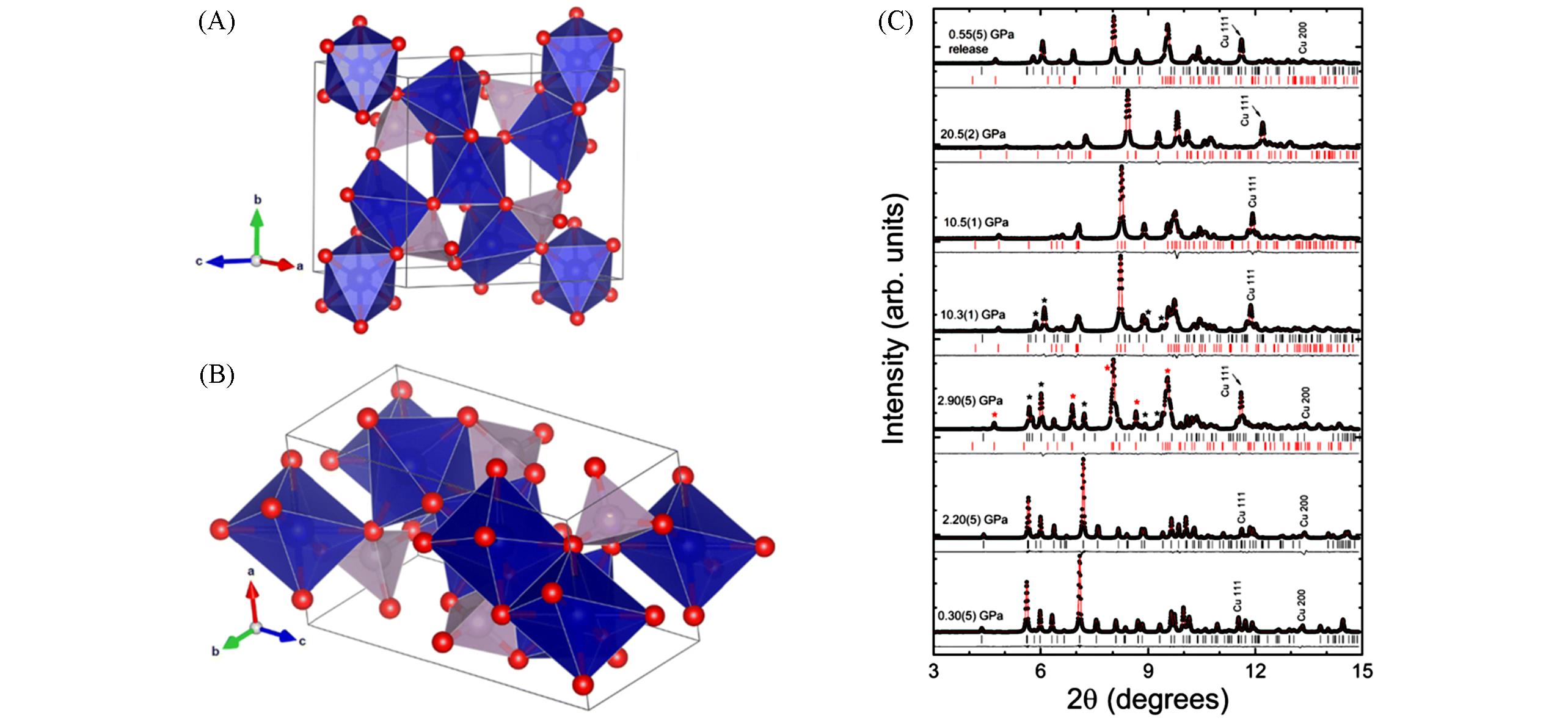
Fig.1 Determination of phase transitions during compression using high⁃pressure XRD[4](A, B) The crystal structure of the ambient-pressure phase of Co3P2O8(A), and the high-pressure phase of Co3P2O8(B). The CoO5 and CoO6 polyhedra are shown in blue and the VO4 tetrahedra are shown in grey. The red circles represent the oxygen atoms. The unit-cell is represented with black solid lines.(C) Rietveld refinement profiles of powder XRD patterns measured in Co3P2O8 at selected pressures. Pressures are given in the figure with the uncertainties given between brackets. The black circles are the experimental data, and the red(black) lines are the refinements(residuals). Vertical black(red) ticks are the calculated positions of the reflections of the low(high)-pressure phase. The Cu peaks used to measure pressure are indicated. Black(red) asterisks are the peaks of the low(high)-pressure phase discussed in the text.Copyright 2024, the Royal Society of Chemistry.

Fig.2 HB symmetrization within the natrochalcite structure at 1.6 GPa revealed by a single⁃crystal neutron diffraction experiment(A), difference Fourier map calculated using the model without the hydrogen atom H(4B) refined against neutron data at 1.6 GPa(B), bird’s eye view of the difference Fourier map(C), and structural model of natrochalcite along the Y⁃direction at 1.6 GPa with symmetric HB(D)[8](B) Hydrogen has a negative scattering factor, so the missing H atom is recognized as a negative distribution.Copyright 2025, the authors.
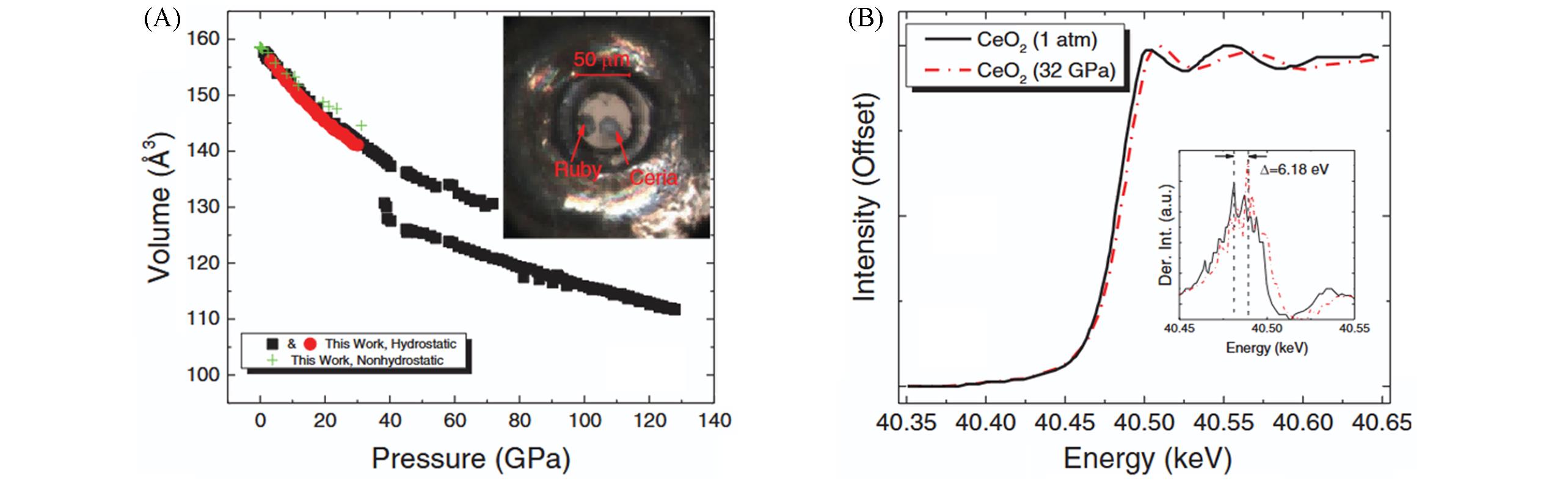
Fig.3 Pressure dependence of unit cell volume of CeO2 at ambient temperature from angle⁃dispersive XRD(A) and pressure⁃dependent K⁃edge XANES spectra of CeO2(B)[12](A) Inset: gas-loading image for the 130 GPa experiment, with ruby and sample indicated(scale bar included);(B) comparison of XANES spectra at 32 GPa and ambient pressure. Insets in both panels show the corresponding derivative curves, indicating the energy shifts of the edge features.Copyright 2016, the authors.
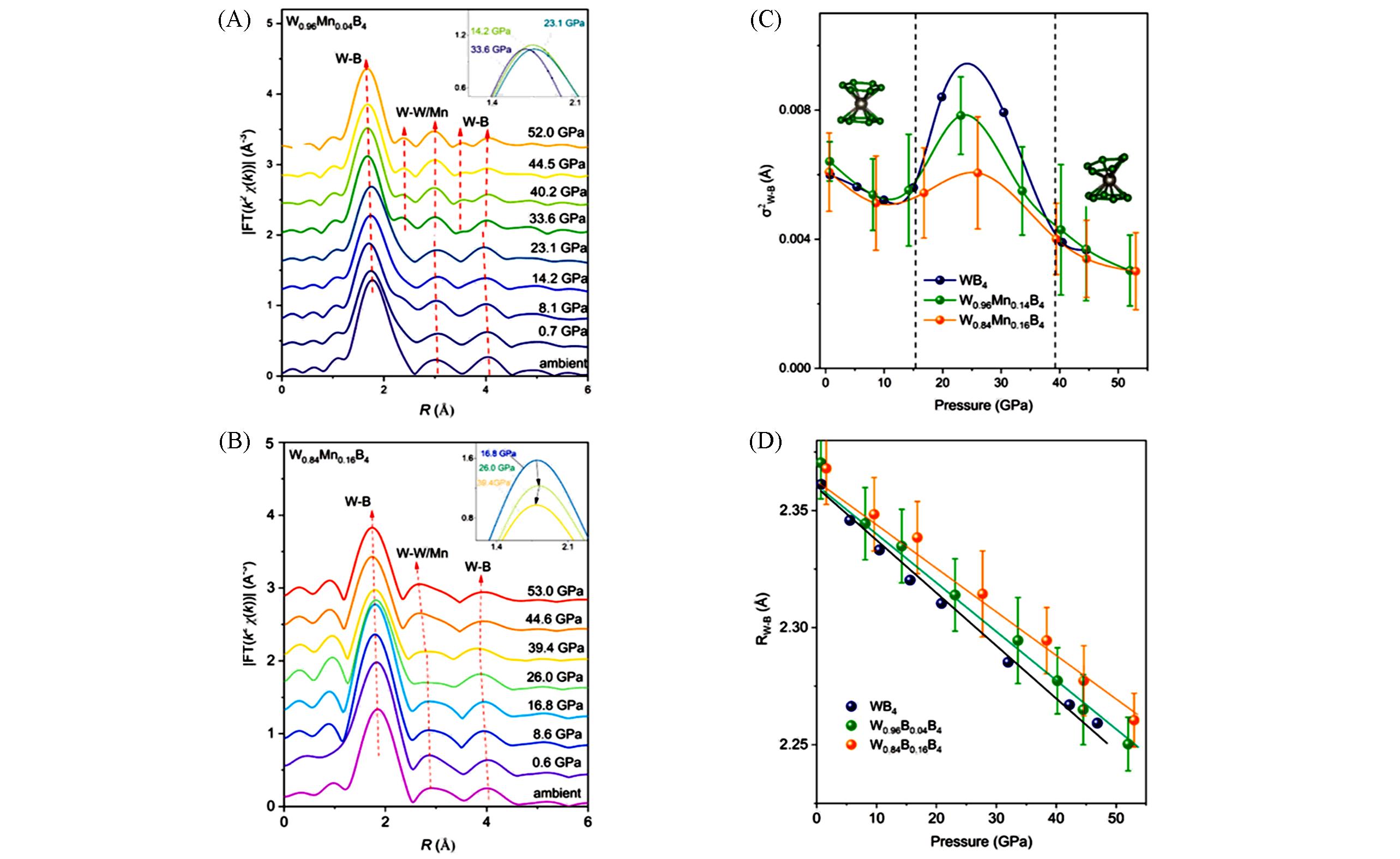
Fig.4 Structural characterizations of W1-x Mn x B4 samples by W L3⁃edge EXAFS spectroscopy under pressure[13](A, B) Fourier-transform magnitudes of the EXAFS for W0.96Mn0.04B4(A) and W0.84Mn0.16B4(B) under compression; (C) evolution of the best-fit bond disorder σW-B2; (D) W—B bond distance as a function of pressure for W0.96Mn0.04B4 and W0.84Mn0.16B4 solid solutions as compared to pure WB4.Copyright 2025, Elsevier B.V..
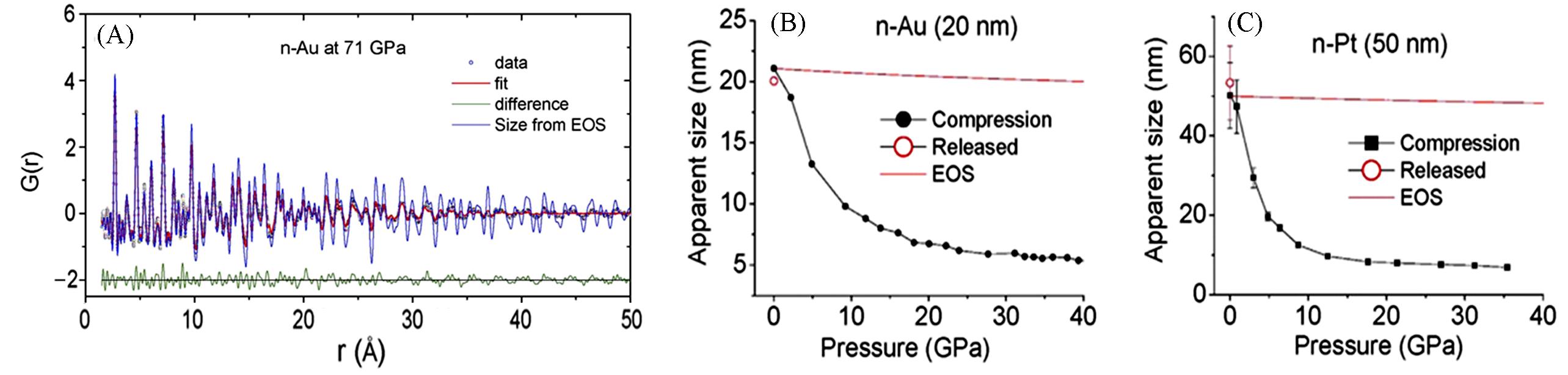
Fig.5 PDF characterization of pressure⁃induced grain size evolution in nanocrystalline Au(20 nm) and Pt(50 nm) under quasi⁃hydrostatic conditions[15](A) Red line shows the reduction in nano-particle size due to compression using the EOS for Au/Pt; (B, C) the open circles indicate data obtained on pressure release. Copyright 2016, the authors.
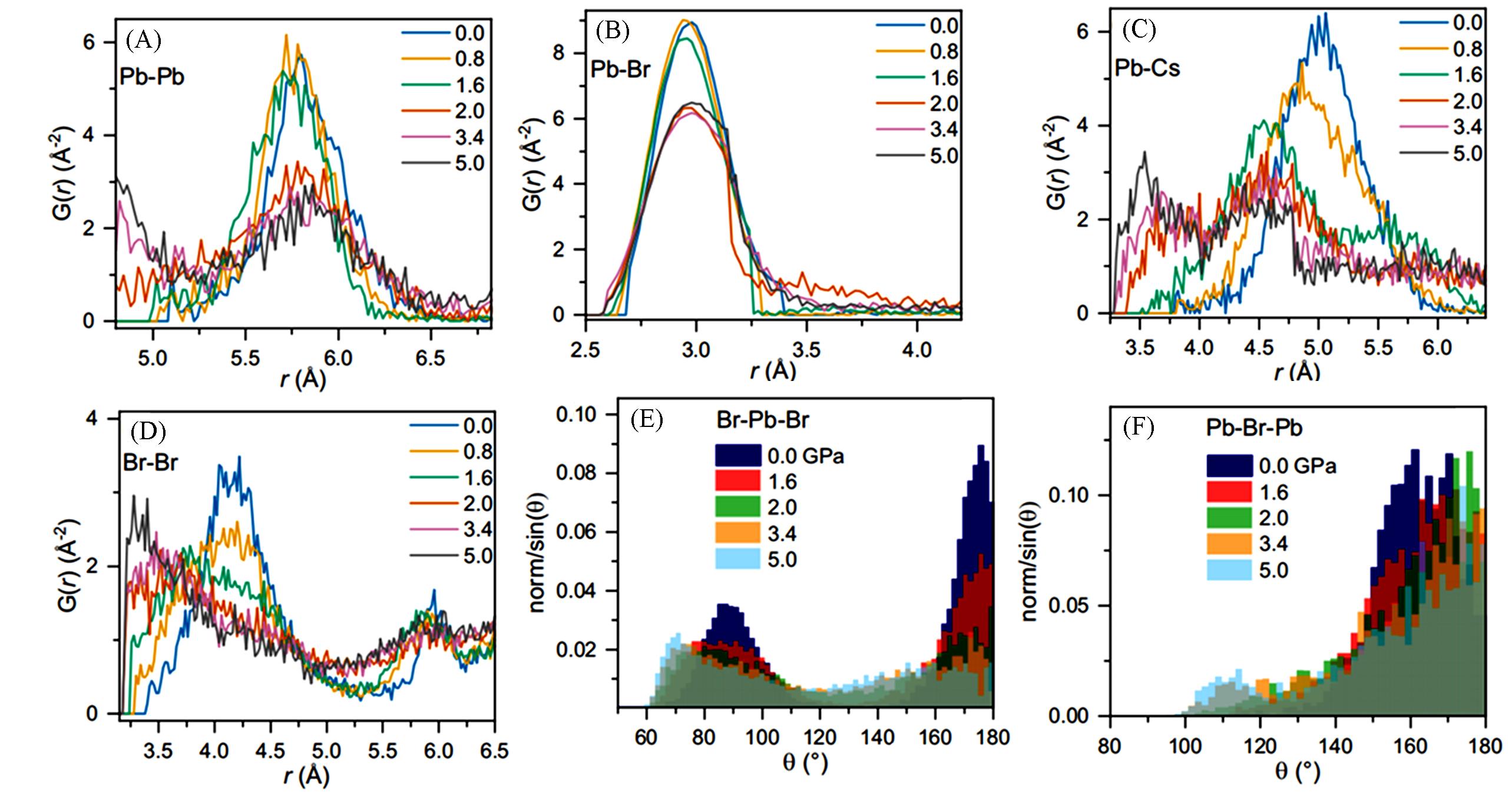
Fig.6 CsPbBr3 partial PDFs for Pb-Pb(A), Pb-Br(B), Pb-Cs(C), and Br-Br(D) atomic pairs at 0, 0.8, 1.6, 2.0, 3.4, and 5.0 GPa and angular distributions for Br-Pb-Br(E) and Pb-Br-Pb(F) bond angles at 0, 1.6, 2.0, 3.4, and 5.0 GPa[16]Data has been normalized to unit area and divided by sinθ. Copyright 2025, the authors.
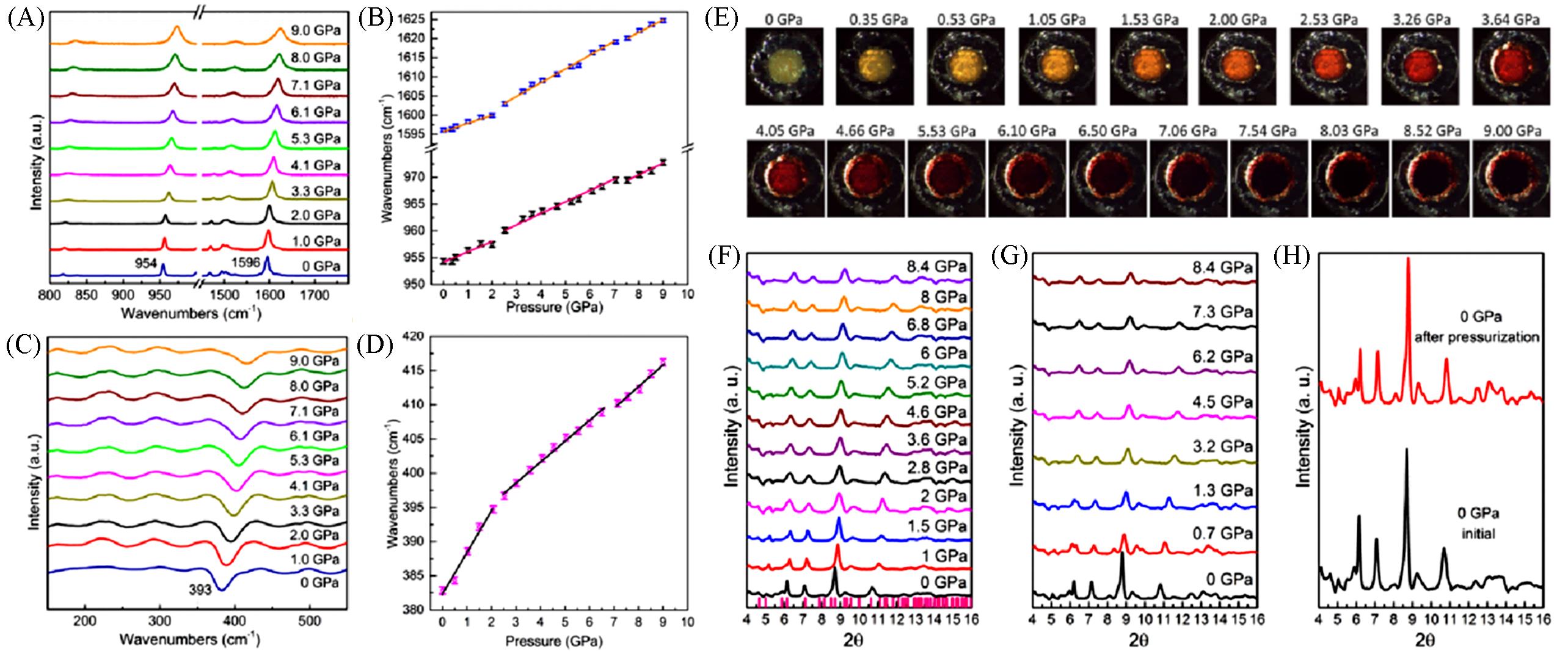
Fig.7 Various characterizations of Py⁃FeCl4[21](A) Comparison of Raman spectra;(B) analysis of observed characteristic peak shifts;(C) far-IR spectra;(D) analysis of observed characteristic peak during compression cycle from 0 to 9 GPa; (E) compression cycle of 2,4,6-triphenylpyrylium tetrachloroferrate from 0 to 9 GPa pressure range. (F—H)XRD patterns of pyrylium FeCl4:(F) during the compression cycle; vertical bars indicate peak positions of previously reported orthorhombic crystal structure of pyrylium FeCl4;(G) during the decompression step and(H) comparison of XRD spectra before and after the compression-decompression cycle from 0 to 9 GPa. Copyright 2024, the authors.
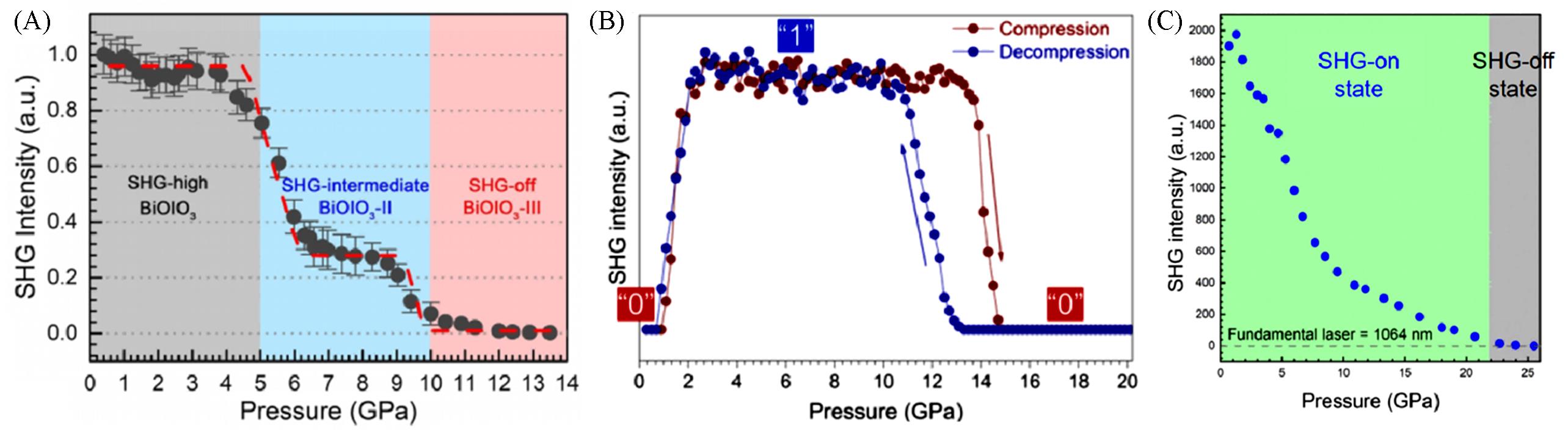
Fig.8 SHG signal reflecting changes in crystal symmetry(A) SHG intensity of BiOIO3 powders as a function of pressure[23]. (B) Pressure dependence of the SHG intensity of powder NH4Cl during compression and decompression[24]. (C) Pressure dependence of the SHG intensity of CsMoO3(IO3)[25].(A) Copyright 2021, Wiley-VCH GmbH; (B) Copyright 2024, American Chemical Society; (C) Copyright 2024, the Royal Society of Chemistry and the Chinese Chemical Society.
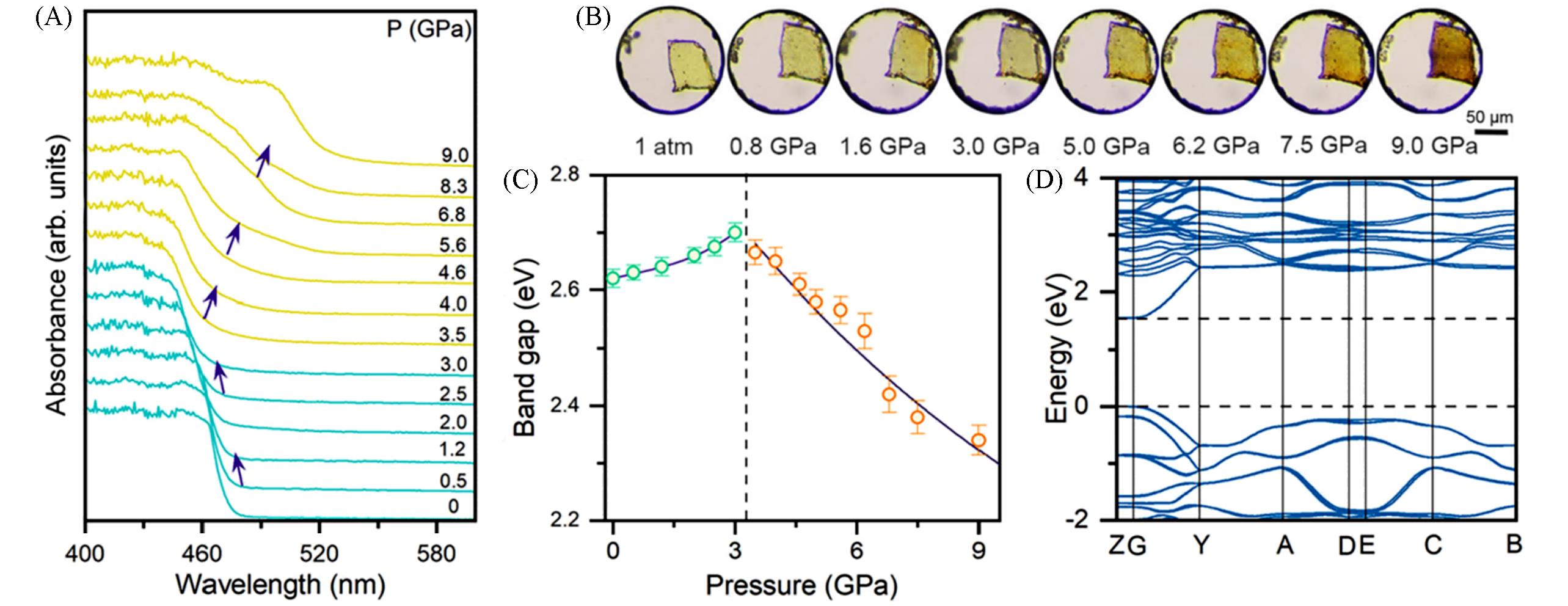
Fig.9 High⁃pressure tuning of the band gap for AgSePh crystals[30](A) Absorption spectra for AgSePh as a function of pressure. Purple arrows indicate the evolution of the absorption edge upon compression.(B) Optical micrographs of AgSePh single crystal under different pressures.(C) Pressure-dependent band gap of AgSePh. The error bars were obtained from the Tauc plot of the absorption spectra.(D) The electronic band structure for AgSePh with P21/c space group.Copyright 2025, the authors.
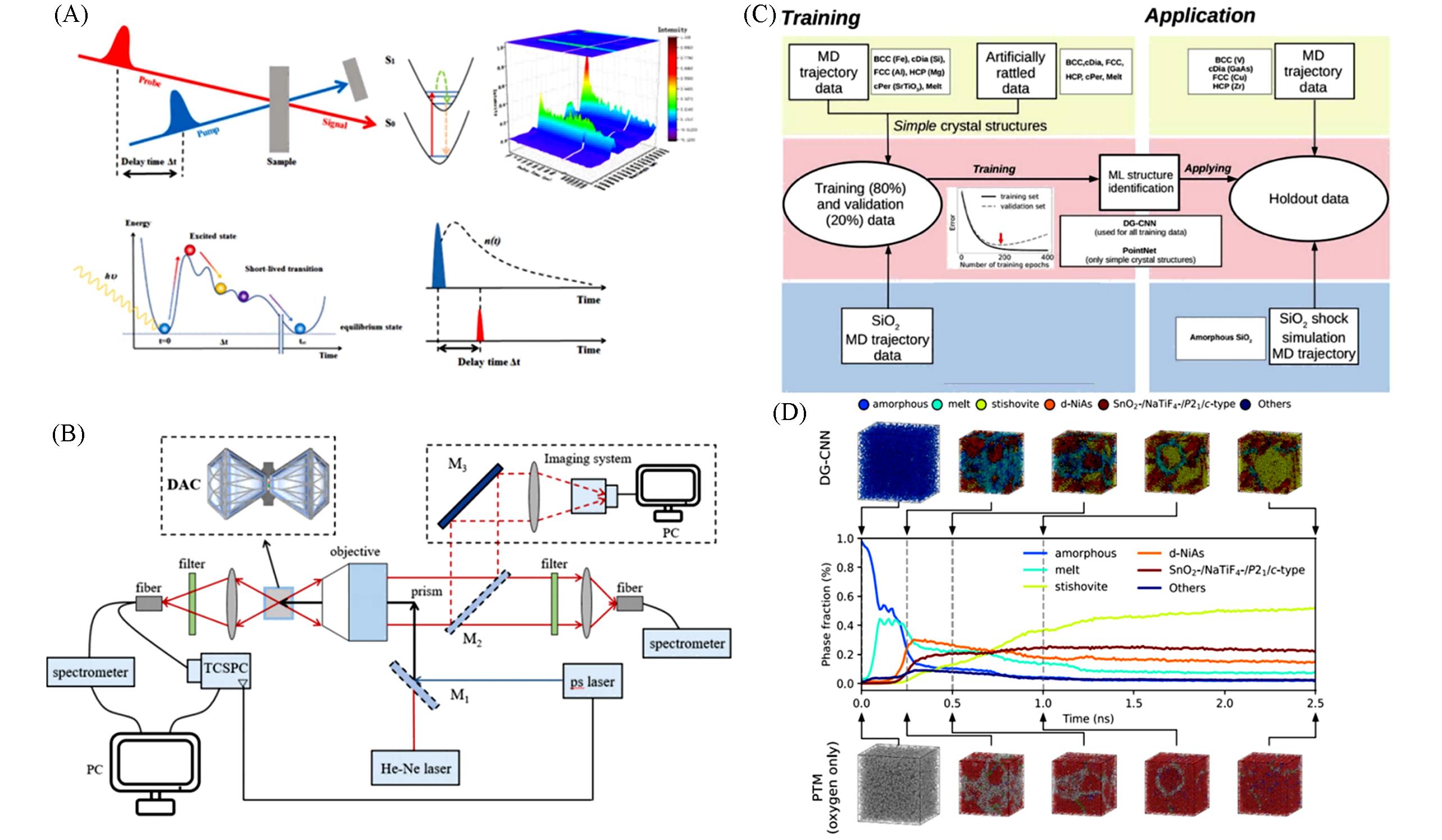
Fig.10 Ultrafast time⁃resolved techniques and machine⁃learning⁃assisted data analysis(A) Principle of pump-probe technique. (B) High pressure PL dynamics testing setup[32]. (C) An overview of the methodological procedure. Training and validation datasets are taken from molecular dynamics simulations and artificially perturbed structures (with extensive sampling for SiO2). The trained DG-CNN/PointNet models are evaluated on a holdout set. (D) Shock compression of amorphous silica. Structural evolution in an initially amorphous SiO2 sample which is subjected to shock loading. Phase fractions as a function of time show the phase fractions during this transformation. Representative snapshots show the classification of the oxygen sublattice of these structures by PTM(RMSD=0.2)[35].(A, B) Copyright 2023, IOP Publishing Ltd.; (C, D) Copyright 2024, the authors.
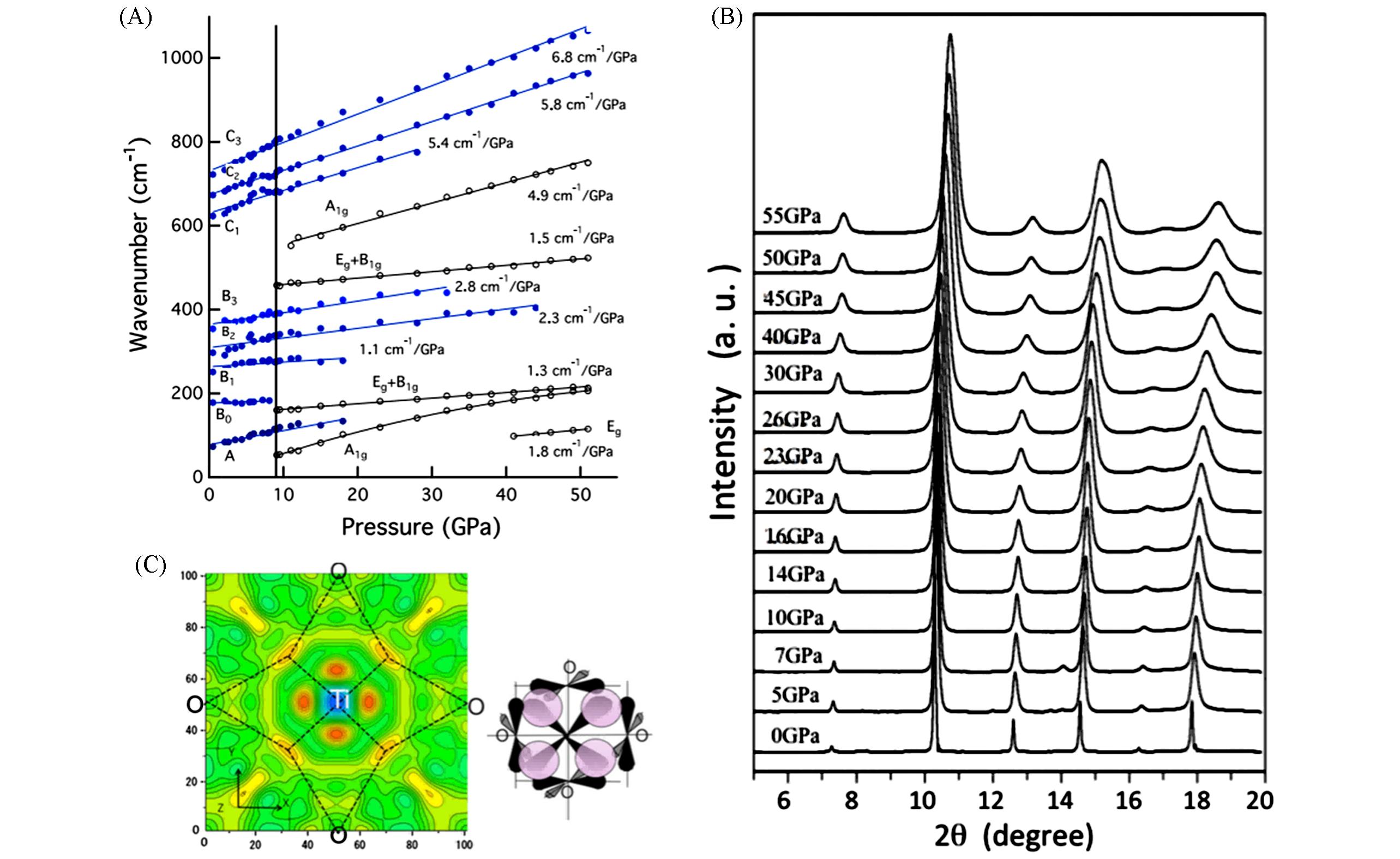
Fig.11 Investigation of displacive phase transitions using high⁃pressure characterization techniques and DFT calculations[39](A) Pressure dependencies of the SrTiO3 crystal Raman bands. (B) X-ray diffraction patterns of SrTiO3. (C) The D-F maps on the(001) plane of the TiO6 octahedron in the cubic phase at ambient conditions shows the d-p-π hybridization between t2g electron of Ti(3d) and px electron of O(2p). The octahedron has the m3m site symmetry. Dotted lines show the d-p-π hybridization. The right figure presents a schematic drawing of t2g orbit of Ti and p orbit of O. The circles indicates the d-p-π hybridization. Copyright 2018, IOP Publishing Ltd.
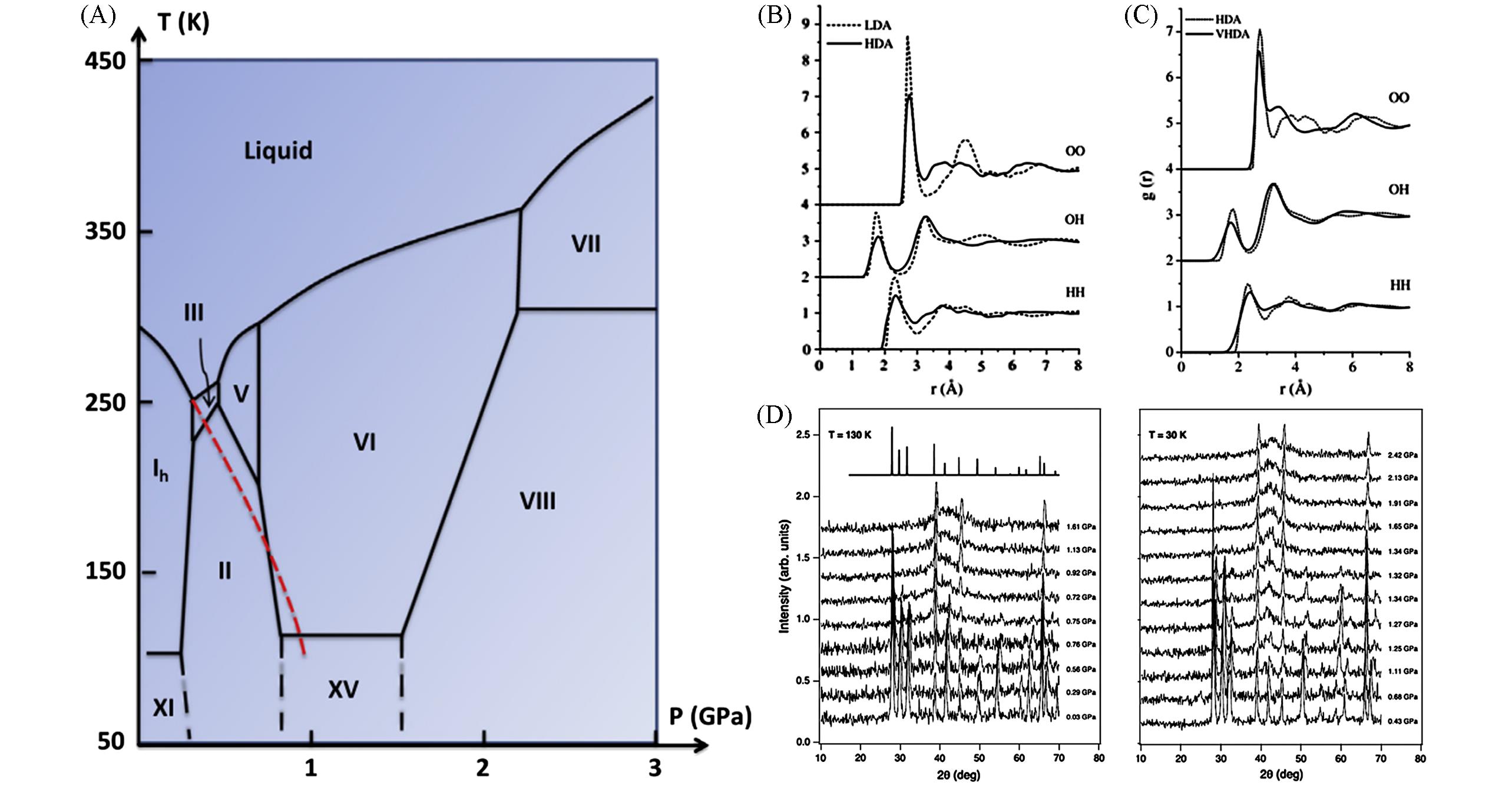
Fig.12 Investigation of pressure-induced amorphization of ice[42](A) Phase diagram showing the stable phases of the ice-water system. The dashed line represents the metastable extension of the melting line of the polymorph Ih.(B, C) Intermolecular partial radial distribution functions of HDA and LDA at 80 K(B) and of VHDA and HDA at 80 K(C).(D) Neutron diffraction patterns showing the gradual transformation from Ih to HDA with increasing pressure at T=130 K and T=30 K.Copyright 2013, Elsevier Ltd.
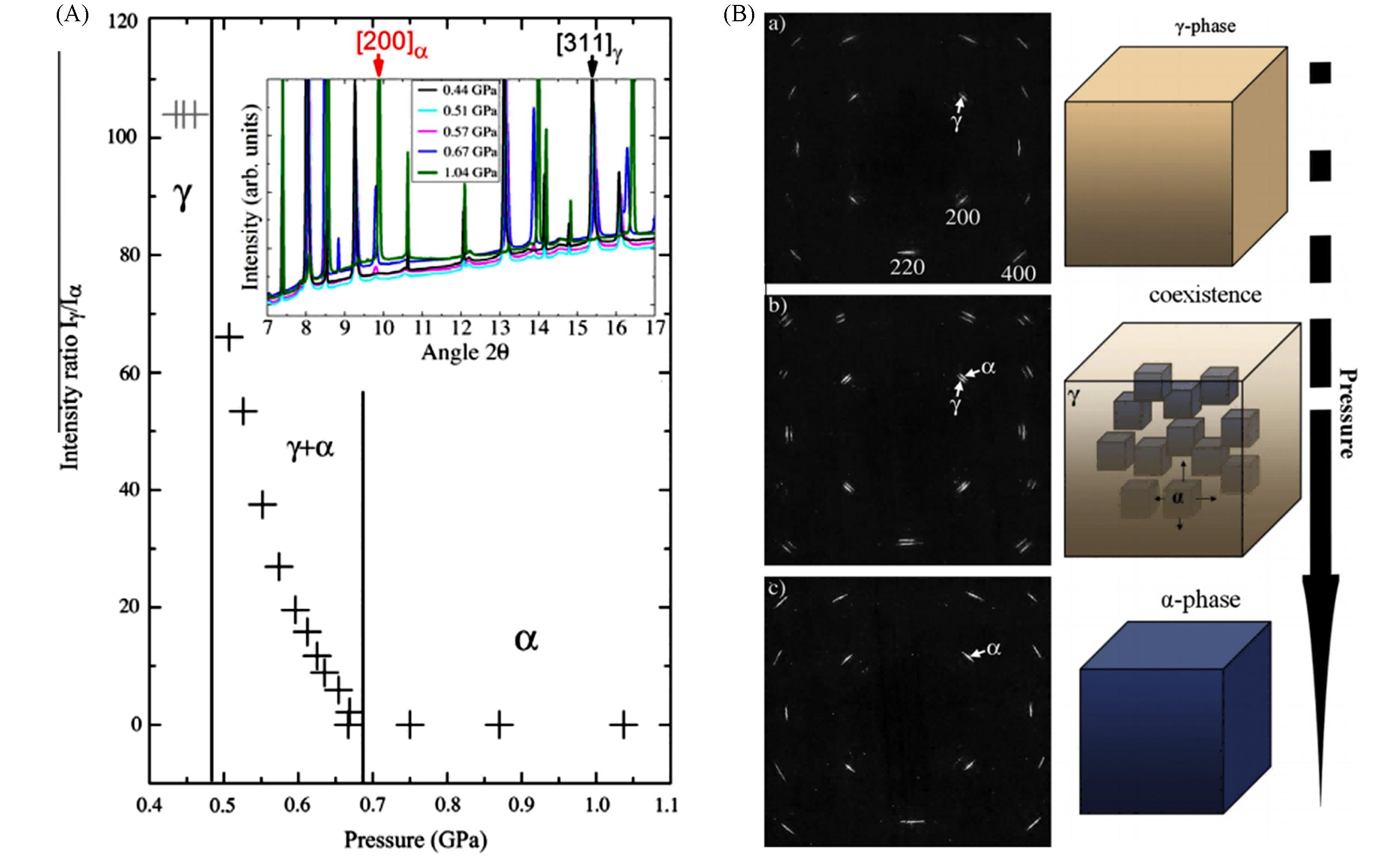
Fig.13 Isostructural phase transition of cerium[43](A) A plot of the intensity ratio between the [311] γ and [200] α reflections as a function of pressure, recorded during decompression of polycrystalline Ce metal.(B) Synchrotron radiation X-ray diffraction patterns acquired along the [001] direction of single crystalline Ce metal at 318 K. Three different pressures are shown on the left: (a) 0.32 GPa(γ-Ce), 0.61 GPa(α- and γ-Ce) and 1.19 GPa(α-Ce).Copyright 2011, Elsevier Ltd..
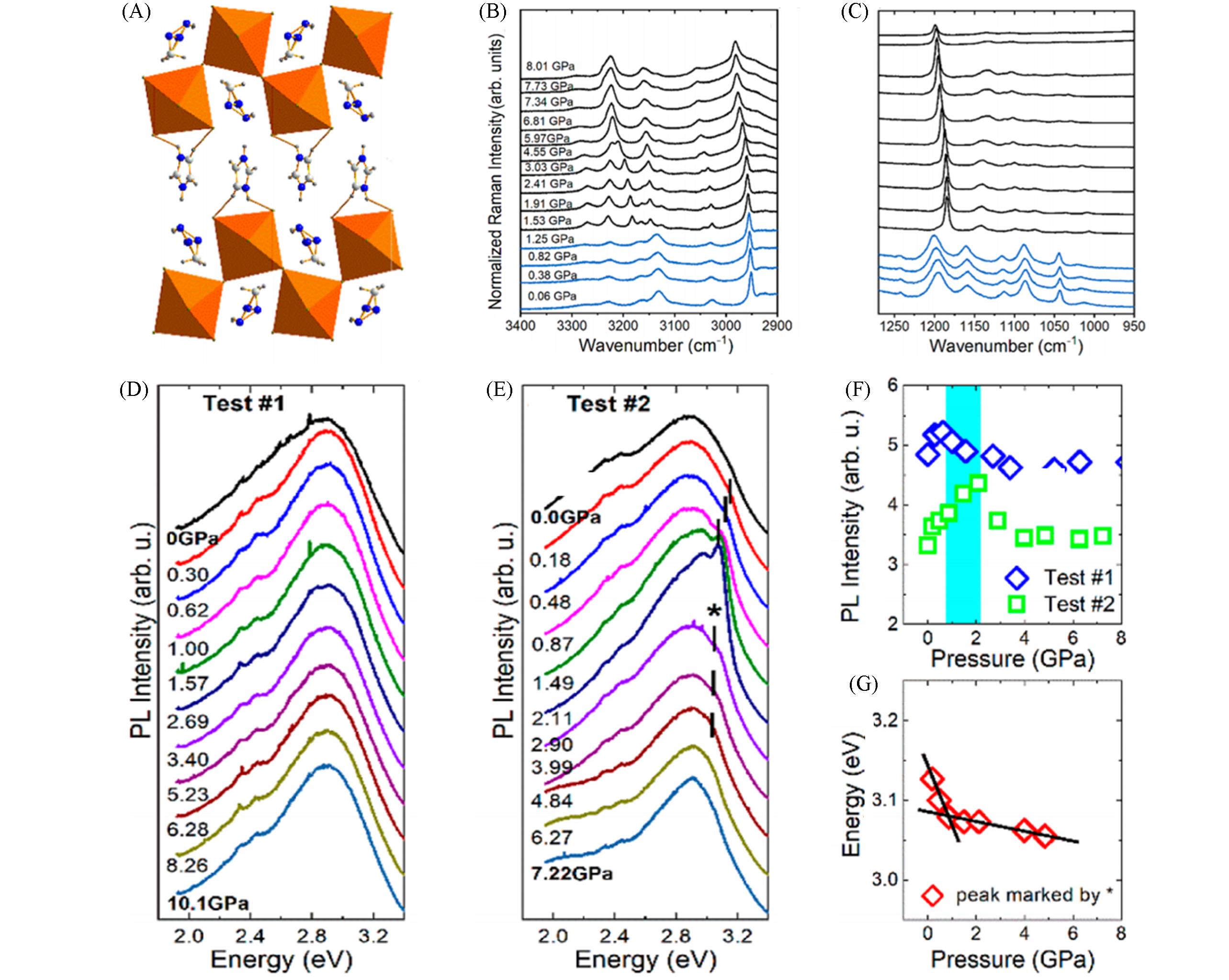
Fig.14 Order-disorder phase transition of IMMH y PbBr4[45](A) Crystal structure of IMMH y PbBr4 at 295 K showing corrugated octahedral layers, ordered IM+ cations located at interlayer space, and 3-fold disordered MH y+ cation located at intralayer sites. (B, C) Raman spectra of IMMH y PbBr4 for compression run in the 3400—2900 cm-1(B) and 1270—950 cm-1(C) wavenumber range. (D—G) Pressure dependence of PL intensity(D—F) and energy(G) for IMMH y PbBr4.Copyright 2024, The Authors.
| Technique | Probe | Length scale | Sample requirement | Ref. |
|---|---|---|---|---|
| XRD | Lattice parameters, space group, phase transition pathway | Long⁃range | Crystalline(powder/single crystal) | [ |
| Neutron diffraction | Light atom positions, magnetic structure, lattice dynamics | Long-range | Crystalline(large volume required) | [ |
| XANES | Valence state, spin state, orbital occupancy, symmetry | Electronic+local structure | Crystalline/amorphous | [ |
| EXAFS | Bond lengths, coordination numbers, disorder (Debye-Waller factor) | Local atomic configuration | Crystalline/amorphous | [ |
Atomic pair distances, bond lengths, coordination numbers, disorder | Short-to-medium range | Crystalline/amorphous/ liquid | [ | |
| Raman spectroscopy | Vibrational modes, symmetry, phase precursors (soft modes) | Lattice vibration | Crystalline/amorphous/ liquid | [ |
| IR spectroscopy | Polar bond vibration, hydrogen bonds, MIT | Lattice vibration+ electronic | Crystalline/amorphous/ liquid | [ |
| SHG | Inversion symmetry, isostructural transitions, molecular orientation | Symmetry+ electronic | Non-centrosymmetric crystals | [ |
| Photoluminescence | Defect states, exciton behavior, local electronic states | Electronic | Crystalline/amorphous | [ |
| UV-Vis absorption | Band gap, exciton features, metallization | Electronic | Crystalline/amorphous/ liquid | [ |
Table 1 Summary of in-situ high-pressure characterization techniques
| Technique | Probe | Length scale | Sample requirement | Ref. |
|---|---|---|---|---|
| XRD | Lattice parameters, space group, phase transition pathway | Long⁃range | Crystalline(powder/single crystal) | [ |
| Neutron diffraction | Light atom positions, magnetic structure, lattice dynamics | Long-range | Crystalline(large volume required) | [ |
| XANES | Valence state, spin state, orbital occupancy, symmetry | Electronic+local structure | Crystalline/amorphous | [ |
| EXAFS | Bond lengths, coordination numbers, disorder (Debye-Waller factor) | Local atomic configuration | Crystalline/amorphous | [ |
Atomic pair distances, bond lengths, coordination numbers, disorder | Short-to-medium range | Crystalline/amorphous/ liquid | [ | |
| Raman spectroscopy | Vibrational modes, symmetry, phase precursors (soft modes) | Lattice vibration | Crystalline/amorphous/ liquid | [ |
| IR spectroscopy | Polar bond vibration, hydrogen bonds, MIT | Lattice vibration+ electronic | Crystalline/amorphous/ liquid | [ |
| SHG | Inversion symmetry, isostructural transitions, molecular orientation | Symmetry+ electronic | Non-centrosymmetric crystals | [ |
| Photoluminescence | Defect states, exciton behavior, local electronic states | Electronic | Crystalline/amorphous | [ |
| UV-Vis absorption | Band gap, exciton features, metallization | Electronic | Crystalline/amorphous/ liquid | [ |
| [1] | Shen G., Mao H., Rep. Prog. Phys., 2017, 80(1), 016101 |
| [2] | Takahashi T., Mao H., Bassett W., Science, 1969, 165(3900), 1352—1353 |
| [3] | Taylor L., Mao H., Science, 1970, 170(3960), 850—851 |
| [4] | Turnbull R., Martin J., Liang A., Anichtchenko D., Popescu C., Rao K., Achary S., Munoz A., Panchal V., Errandonea D., Dalton Trans., 2024, 53(34), 14278—14288 |
| [5] | Ma S., Baxter S., Park C., Chariton S., Santos A., Molaison J., Wilkinson A., Chem. Mater., 2025, 37(4), 1657—1666 |
| [6] | Zhou J., Alonso J., Muonz A., Fernandez M., Goodenough J., Phys. Rev. Lett., 2011, 106(5), 057201 |
| [7] | Shi N., Fan L., Xu Y., Yin W., Chen H., Yuan B., Zhou C., Chen J., Small, 2024, 20(50), 2312289 |
| [8] | Rejnhardt P., Gajda R., Woinska M., Parafiniuk J., Giester G., Miletich R., Wu Y., Poręba T., Mezouar M., Sutuła S., Góral T., Dera P., Woźniak K., J. Am. Chem. Soc., 2025, 147(30), 26830—26843 |
| [9] | Ward M., Bull C., Funnell N., Warren M., Oswald I., Int. J. Pharm., 2023, 647, 123514 |
| [10] | Chen J., Hu Q., Fang L., He D., Chen X., Xie L., Chen B., Li X., Ni X., Fan C., Liang A., Rev. Sci. Instrum., 2018, 89(5), 053906 |
| [11] | Fei Y., Zhang L., Corgne A., Watson H., Ricolleau A., Meng Y., Prakapenka V., Geophys. Res. Lett., 2007, 34(17), L17307 |
| [12] | Jacobsen M., Velisavljevic N., Dattelbaum D., Chellappa R., Park C., J. Phys. Condens. Matter, 2016, 28(15), 155401 |
| [13] | Li H., He H., Guo Z., Chen D., J. Alloys Compd., 2025, 1039, 183360 |
| [14] | Grzanka E., Stel’ makh S., Gierlotka S., Zhao Y., Palosz B., Palosz W., J. Alloys Compd., 2004, 382(1/2), 133—137 |
| [15] | Hong X., Ehm L., Zhong Z., Ghose S., Duffy T., Weidner D., Sci. Rep., 2016, 6, 21434 |
| [16] | Celeste A., Girdzis S., Cladek B., Deschene C., Wolf N., Chapman K., Karunadasa H., Tucker M., Mao W., Lin Y., Nat. Commun., 2025, 16, 7631 |
| [17] | Li C., Liu K., Jiang D., Jiang Z., Wen T., Yue B., Wang Y., Inorg. Chem., 2022, 61(30), 11923—11931 |
| [18] | Yao H., Yao H., Huang H., Zhang L., Cui R., Guo X., Cheng H., Li Y., Gao X., Zhao L., Sun B., Nano Today, 2021, 37, 101079 |
| [19] | Zheng Z., Liang B., Gao J., Ren J., Liu Z., Hou X., Sun J., Mei S., Ceram. Int., 2023, 49(20), 32521—32527 |
| [20] | Yuan Y., Yinwei L., Guoyong F., Guangtao L., Cuiying P., Xin L., Haiyan Z., Ke Y., Lin W., Nat. Sci. Rev., 2019, 6(6), 524—531 |
| [21] | Canasa P., King D., Cifligu P., Sanchez A., Chen S., Han H., Malik T., Billinghurst B., Zhao J., Park C., Rossman G., Pravica., Bhowmik P., Evlyukhin E., Small Sci., 2024, 4(8), 2400106 |
| [22] | Zhang S. H., Li T., Zhang X. J., Chen Z. Q., Chin. J. High Press. Phys., 2026, 40(2), 021101 |
| 张升瀚, 李婷, 张晓军, 陈志强. 高压物理学报, 2026, 40(2), 021101 | |
| [23] | Jiang D., Song H., Wen T., Jiang Z., Li C., Liu K., Yang W., Huang H., Wang Y., Angew. Chem. Int. Ed., 2022, 61(9), e202116656 |
| [24] | Jiang D., Jiang X., Zhang X., Li C., Liu K., Ma Y., Cheng H., Pei T., Wen T., Lin Z., Li F., Wang Y., J. Am. Chem. Soc., 2024, 146(33), 23508—23516 |
| [25] | Jiang D., Li C., Wen T., Liu K., Ma Y., Chen E., Pei T.,Wang Y., Mater. Chem. Front., 2024, 8(4), 1636 |
| [26] | Liang J., Ju C., Liu Z., Li H., Karina A., Eklund T., Zheng W., Winkel K., Cai W., Wagner M., Qiu Z., Weil T., Müllen K., Angew. Chem. Int. Ed., 2025, 64(21), e202500923 |
| [27] | Ma Y., Wen T., Liu K., Jiang D., Zhao M., Lin C., Wang Y., J. Mater. Chem. C, 2023, 11(20), 6588 |
| [28] | Zhao Y., Chen K., Li N., Ma S., Wang Y., Kong Q., Baudelet F., Wang X., Yang W., Phys. Rev. Lett., 2020, 125(24), 245701 |
| [29] | Ma Y., Wen T., Liu K., Li C., Jiang D., Pei T., Lin C., Wang Y., J. Mater. Chem. C, 2024, 12(7), 2379 |
| [30] | Long Z., Li C., Jiang D., Niu G., Sui L., Yuan K., Wang Y., Nat. Commun., 2025, 16(1), 7058 |
| [31] | Polian A., J. Raman Spectrosc., 2003, 34(8), 633—637 |
| [32] | Tu H., Pan L., Qi H., Zhang S., Li F., Sun C., Wang X., Cui T., J. Phys. Condens. Matter, 2023, 35(25), 253002 |
| [33] | Huang D., Wang H., Zhao W., Dai R., Wang Z., Zhang Z., J. Phys. Chem. C, 2021, 125(40), 22354—22359 |
| [34] | Wu Y., Yin X., Hasaien J., Ding X., Zhao J., Chin. Phys. Lett., 2020, 37(4), 047801 |
| [35] | Erhard L., Utt D., Klomp A., Albe K., Model. Simul. Mater. Sci. Eng., 2024, 32(6), 065029 |
| [36] | Deng P., Hou R., Zhao Y. L., Zhu S. C., Chin. J. High Press. Phys., 2026, 40(1), 010103 |
| 邓溥, 侯瑞, 赵英亮, 朱升财. 高压物理学报, 2026, 40(1), 010103 | |
| [37] | Goodenough J., Annu. Rev. Mater. Sci., 1998, 28(1), 1—27 |
| [38] | Ishidate T., Isonuma T., Ferroelectrics, 1992, 137(1), 45—52 |
| [39] | Yamanaka T., Ahart M., Mao H., Yan H., J. Phys. Condens. Matter, 2018, 30, 265401 |
| [40] | Yagi T., Utsumi W., Phys. Rev. B, 1992, 46(10), 6031—6039 |
| [41] | Mishima O., Calvert L., Whalley E., Nature, 1984, 310(5976), 393—395 |
| [42] | Machon D., Meersman F., Wilding M., Wilson M., McMillan P., Prog. Mater. Sci., 2014, 61(4), 216—282 |
| [43] | Moore K., Belhadi L., Decremps F., Farber D., Bradley J., Cccelli F., Gauthier M., Polian A., Aracne⁃Ruddle C., Acta Mater., 2011, 59(16), 6007—6016 |
| [44] | Pei T., Tang Z., Jiang D., Li C., Ma Y., Chen E., Yue B., Wang Y., J. Phys. Chem. C, 2024, 128(37), 15718—15724 |
| [45] | Mączka M., Silva J., Gomes W., Vasconcelos D., Dybała F., Herman A., Kudrawiec R., Freire P., J. Phys. Chem. C, 2024, 128(21), 8698—8707 |
| [46] | Wang H., Zhao T. T., Li M., Li J. L., Peng S., Liu X. Q., Zhao B. H., Chen Y. L., Lin C. L., Chin. J. High Press. Phys., 2024, 38(3), 030101 |
| 王毫, 赵婷婷, 李梅, 李俊龙, 彭赏, 刘旭强, 赵博浩, 陈彦龙, 林传龙. 高压物理学报, 2024, 38(3), 030101 | |
| [47] | Chen X. H., Zhang Y., Liu L., Ye S. J., Li S. R., Jing Q. M., Gao J. J., Wang H., Lin C. L., Li J., J. Raman Spectrosc., 2024, 55(9), 989—997 |
| [1] | 钱紫钞, 黄明强, 单晓斌, 盛六四, 胡长进, 顾学军, 赵卫雄, 张为俊. 苯光氧化形成硝基酚化合物的真空紫外光电离质谱研究[J]. 高等学校化学学报, 2026, 47(7): 20250348. |
| [2] | 徐若韬, 王强, 鲍庆嘉, 王伟宇, 张志, 刘朝阳, 徐君, 邓风. γ -Al2O3颗粒溶液浸润过程的原位磁共振成像[J]. 高等学校化学学报, 2023, 44(4): 20220587. |
| [3] | 任诗杰, 谯思聪, 刘崇静, 张文华, 宋礼. 铂单原子催化剂同步辐射X射线吸收谱的研究进展[J]. 高等学校化学学报, 2022, 43(9): 20220466. |
| [4] | 汤乔伟, 蔡小青, 李江, 诸颖, 王丽华, 田阳, 樊春海, 胡钧. 同步辐射X射线成像技术在脑成像研究中的应用[J]. 高等学校化学学报, 2022, 43(12): 20220379. |
| [5] | 耿传楠, 化五星, 凌国维, 陶莹, 张辰, 杨全红. 锂硫电池中的催化作用: 材料与表征[J]. 高等学校化学学报, 2021, 42(5): 1331. |
| [6] | 唐毓婧, 门永锋. 剪切速率对等规聚丙烯的结晶和形貌的影响[J]. 高等学校化学学报, 2016, 37(2): 367. |
| [7] | 陶玲, 黄明强, 郝立庆, 张为俊, 王振亚, 孔蕊弘, 单晓斌, 刘付轶, 盛六四. 乙苯光电离的实验研究[J]. 高等学校化学学报, 2010, 31(10): 2063. |
| [8] | 汤建凯, 孙昭艳, 安立佳. P123重水溶液的物理凝胶化及凝胶结构[J]. 高等学校化学学报, 2010, 31(1): 172. |
| [9] | 林奥雷, 王凯, 赵宇, 邹勃. 高压下DPP-11超分子结构中的π-π相互作用[J]. 高等学校化学学报, 2008, 29(6): 1181. |
| [10] | 姜文海,王旭,马春雨,于书坤,叶开其,常玉春,,杜国同,. 氮杂酞菁铜aza-CuPc的合成与晶体结构[J]. 高等学校化学学报, 2006, 27(12): 2263. |
| [11] | 盛六四, 武国华, 高辉, 张允武. 对硝基甲苯的同步辐射光电离研究[J]. 高等学校化学学报, 1997, 18(12): 2041. |
| [12] | 盛六四, 齐飞, 罗志勇, 高辉, 张允武. 乙腈+氯乙烯体系的团簇产生与光电离[J]. 高等学校化学学报, 1995, 16(11): 1752. |
| [13] | 齐飞, 盛六四, 俞书勤, 张允武. 利用同步辐射测定NH3中键的离解能D0(H2N—H)及D0(H2N+-H)[J]. 高等学校化学学报, 1994, 15(8): 1228. |
| [14] | 王晋, 杨梅林, 沈家骢, 赵永年, 崔启良, 邹广田. 室温下聚四氟乙烯的压致相变[J]. 高等学校化学学报, 1992, 13(7): 994. |
| 阅读次数 | ||||||
|
全文 |
|
|||||
|
摘要 |
|
|||||
