

高等学校化学学报 ›› 2026, Vol. 47 ›› Issue (5): 20260011.doi: 10.7503/cjcu20260011
秦嘉怡1, 陈紫薇1, 曾嘉杰1, 付燕1( ), 唐本忠2, 赵祖金1()
收稿日期:2026-01-04
出版日期:2026-05-10
发布日期:2026-02-22
通讯作者:
付燕,赵祖金
E-mail:fyscut@scut.edu.cn;mszjzhao@scut.edu.cn
基金资助:
QIN Jiayi1, CHEN Ziwei1, ZENG Jiajie1, FU Yan1(), TANG Ben Zhong2, ZHAO Zujin1()
Received:2026-01-04
Online:2026-05-10
Published:2026-02-22
Contact:
FU Yan, ZHAO Zujin
E-mail:fyscut@scut.edu.cn;mszjzhao@scut.edu.cn
Supported by:摘要:
厚膜有机发光二极管(OLED)是由一层厚膜同时行使载流子传输与发光功能的器件, 在简化制备工艺和提升工作稳定性方面优势显著. 然而, 要获得高效的非掺杂厚膜OLED器件, 发光材料必须兼具平衡的双极载流子传输特性, 高固态发光效率和高激子利用率, 对发光材料的设计提出了更高的要求. 本研究选取2个代表性的双极聚集诱导延迟荧光(AIDF)材料应用于此类器件的制备. 基于这些材料制备的厚膜器件表现出优异的电致发光性能, 具有启亮电压低(约2.5 V), 外量子效率高(达19.8%), 以及高亮度下效率滚降非常低等优点. 此外, 厚膜器件的工作寿命比薄膜器件提升了2倍以上. 这些厚膜还可以敏化窄光谱多重共振发光材料来制备高效率、 高色纯度、 结构简化的厚膜超荧光OLED器件. 以上结果表明, 该双极AIDF材料是制备简易厚膜OLED器件的有潜力的候选材料. 本研究为开发高效稳定的OLED器件提供了一个新策略.
中图分类号:
TrendMD:
秦嘉怡, 陈紫薇, 曾嘉杰, 付燕, 唐本忠, 赵祖金. 基于双极聚集诱导延迟荧光材料制备高效稳定厚膜非掺杂有机发光二极管. 高等学校化学学报, 2026, 47(5): 20260011.
QIN Jiayi, CHEN Ziwei, ZENG Jiajie, FU Yan, TANG Ben Zhong, ZHAO Zujin. Efficient and Stable Thick-layer Non-doped Organic Light-emitting Diodes Based on Bipolar Aggregation-induced Delayed Fluorescence Materials. Chem. J. Chinese Universities, 2026, 47(5): 20260011.
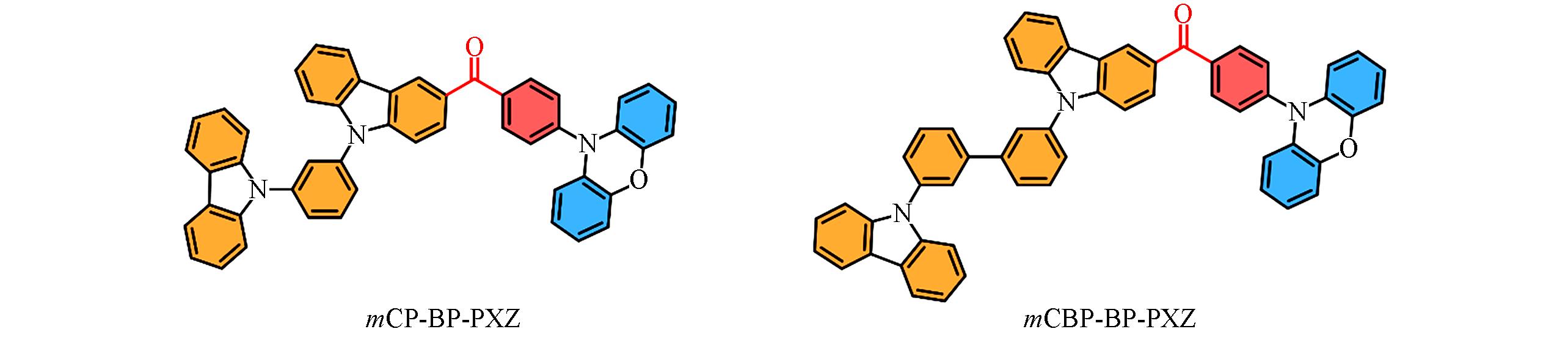
Fig.1 Molecular structures of AIDF emitters mCP⁃BP⁃PXZ and mCBP⁃BP⁃PXZ
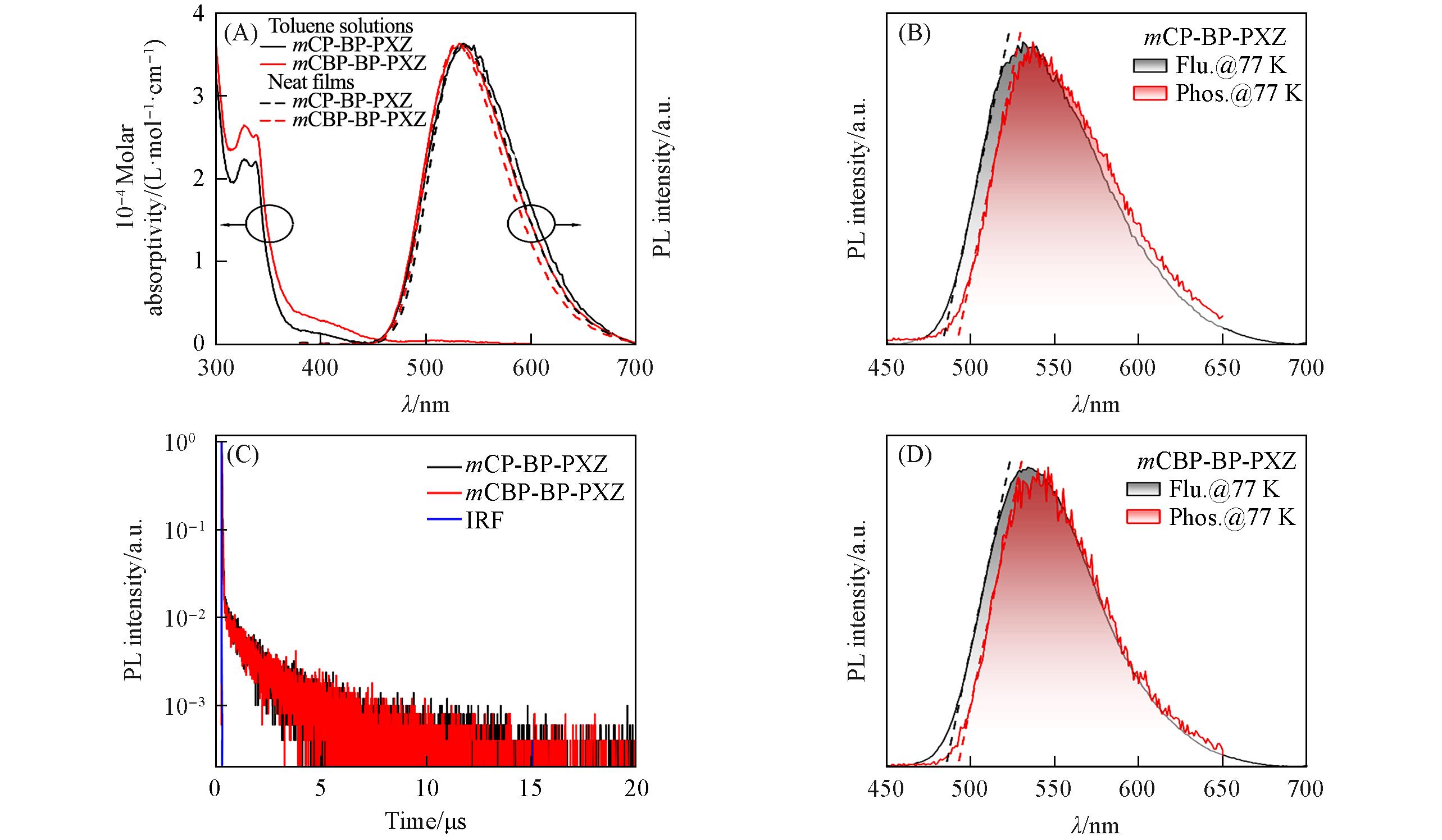
Fig.2 Absorption and PL spectra of mCP⁃BP⁃PXZ and mCBP⁃BP⁃PXZ in toluene solutions and PL spectra in neat films measured at room temperature(A), fluorescence and phosphorescence spectra of mCP⁃BP⁃PXZ(B) and mCBP⁃BP⁃PXZ(D) in neat films measured at 77 K under nitrogen, transient PL decay curves of mCP⁃BP⁃PXZ and mCBP⁃BP⁃PXZ in neat films(C) at room temperature
| Emitter | Toluene Solutions a | Neat films b | |||||||||
|---|---|---|---|---|---|---|---|---|---|---|---|
| λabsc /nm | λemd /nm | λemd /nm | ∆ESTe /eV | ΦPLf (%) | τPFg /ns | τDFg /μs | RDFh (%) | 10-7 kFi /s-1 | 10-6kRISCj /s-1 | ||
| mCP⁃BP⁃PXZ | 338 | 536 | 535 | 0.045 | 82.9 | 22.51 | 1.46 | 43.0 | 2.10 | 1.20 | |
| mCBP⁃BP⁃PXZ | 338 | 532 | 532 | 0.033 | 97.4 | 21.96 | 1.49 | 41.2 | 2.61 | 1.14 | |
Table 1 Photophysical Data of mCP-BP-PXZ and mCBP-BP-PXZ
| Emitter | Toluene Solutions a | Neat films b | |||||||||
|---|---|---|---|---|---|---|---|---|---|---|---|
| λabsc /nm | λemd /nm | λemd /nm | ∆ESTe /eV | ΦPLf (%) | τPFg /ns | τDFg /μs | RDFh (%) | 10-7 kFi /s-1 | 10-6kRISCj /s-1 | ||
| mCP⁃BP⁃PXZ | 338 | 536 | 535 | 0.045 | 82.9 | 22.51 | 1.46 | 43.0 | 2.10 | 1.20 | |
| mCBP⁃BP⁃PXZ | 338 | 532 | 532 | 0.033 | 97.4 | 21.96 | 1.49 | 41.2 | 2.61 | 1.14 | |
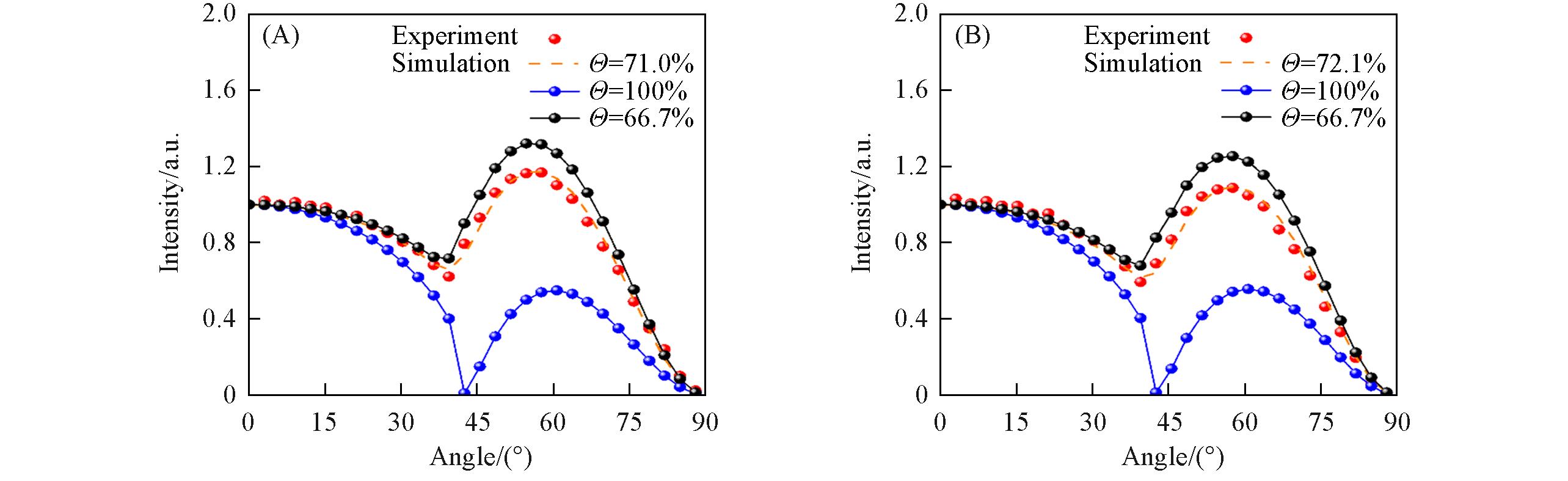
Fig.3 p⁃Polarized PL spectra of mCP⁃BP⁃PXZ(A) and mCBP⁃BP⁃PXZ(B) measured in neat films
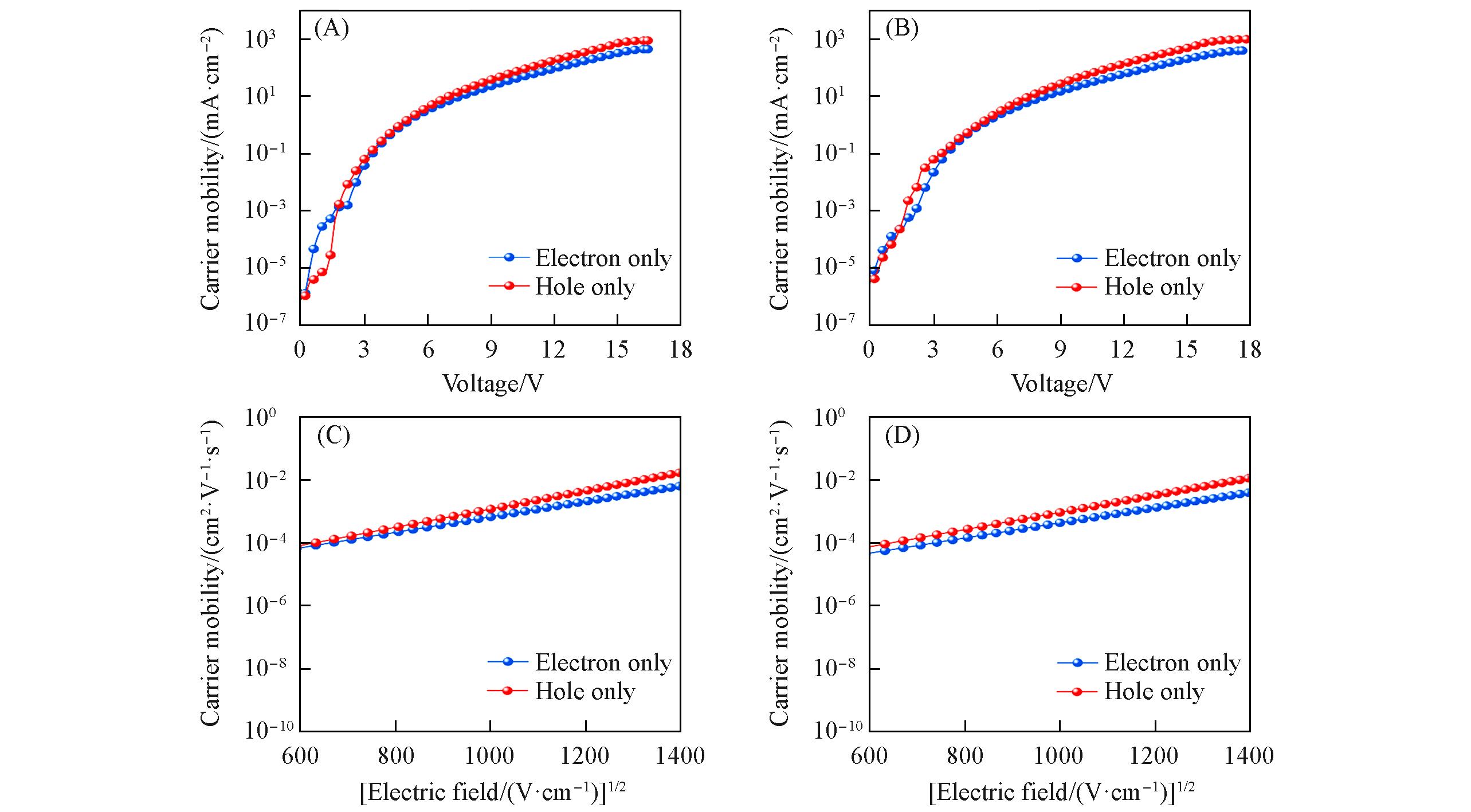
Fig.4 Plots of current density⁃voltage of single carrier devices of mCP⁃BP⁃PXZ(A) and mCBP⁃BP⁃PXZ(B) in neat films, and plots of electric field⁃dependent mobilities of mCP⁃BP⁃PXZ(C) and mCBP⁃BP⁃PXZ(D) in neat films
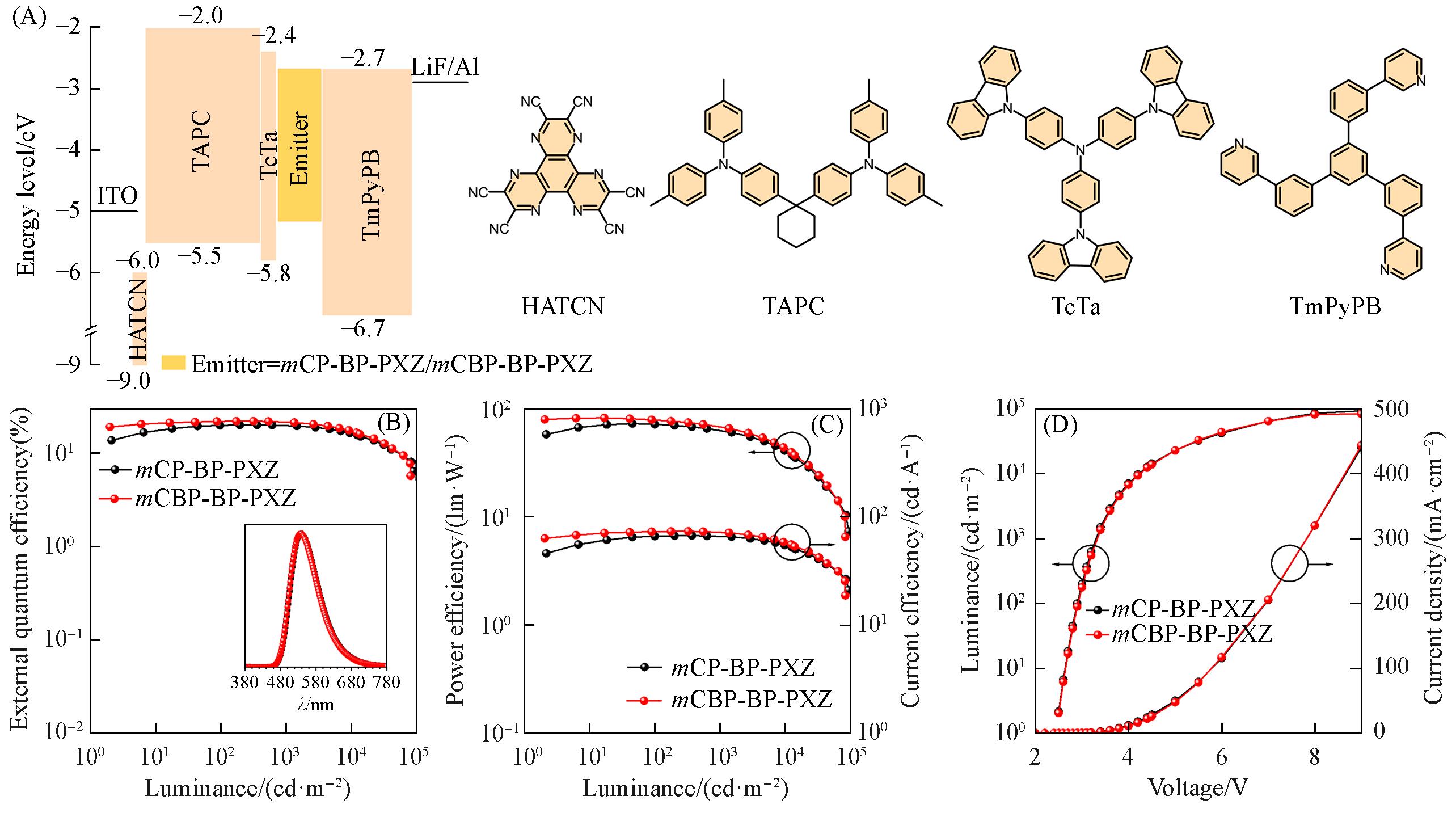
Fig.5 Configuration, energy diagram and molecular structures of the materials used in the thin⁃layer devices(A), plots of external quantum efficiency⁃luminance(B), power efficiency⁃luminance⁃current efficiency(C) and luminance⁃voltage⁃current density(D) of the non⁃doped thin⁃layer devices based on mCP⁃BP⁃PXZ and mCBP⁃BP⁃PXZ
| Emitter | Device | λEL/nm | Von/V | Lmax/ (cd∙m-2) | CIE(x, y) | CE/(cd∙A-1) | PE/(lm∙W-1) | EQE(%) | RO(%) |
|---|---|---|---|---|---|---|---|---|---|
| Maximum value/at 1000 cd∙m-2/at 10000 cd∙m-2 | |||||||||
| mCP⁃BP⁃PXZ | Thin⁃I | 540 | 2.5 | 92290 | (0.37, 0.58) | 66.8/65.9/54.7 | 72.6/62.6/40.9 | 20.1/19.7/16.4 | 2.0 |
| Thick⁃I⁃PPF(/mCBP) | 538 | 2.4 | 100800 | (0.38, 0.58) | 60.3/59.0/51.1 | 69.4/46.3/26.8 | 18.4/18.0/15.6 | 2.2 | |
| Thick⁃I⁃TSPO1 | 540 | 2.5 | 56580 | (0.38, 0.57) | 56.9/55.4/48.4 | 63.1/41.5/25.3 | 17.2/16.7/14.6 | 2.9 | |
| Thick⁃I⁃TPBi | 540 | 2.4 | 99030 | (0.38, 0.57) | 54.7/53.4/48.0 | 63.1/41.9/27.4 | 16.5/16.1/14.5 | 2.4 | |
| Thick⁃I⁃CBP | 538 | 2.4 | 96710 | (0.38, 0.58) | 55.8/54.4/47.2 | 64.4/45.0/27.0 | 17.0/16.6/14.4 | 2.4 | |
| Thick⁃I⁃mCP | 538 | 2.4 | 97750 | (0.37, 0.58) | 55.0/53.6/46.6 | 64.4/44.3/26.6 | 16.8/16.3/14.2 | 3.0 | |
| Thick⁃I⁃SimCP2 | 534 | 2.4 | 99370 | (0.37, 0.58) | 56.6/55.5/47.9 | 60.4/48.5/27.4 | 17.3/17.0/14.7 | 1.7 | |
| mCBP⁃BP⁃PXZ | Thin⁃II | 538 | 2.5 | 82870 | (0.37, 0.58) | 73.3/71.1/58.5 | 82.1/65.7/43.7 | 22.0/21.3/17.5 | 3.2 |
| Thick⁃II⁃PPF(/mCBP) | 532 | 2.5 | 74380 | (0.36, 0.58) | 62.7/61.0/51.5 | 71.6/47.9/27.0 | 19.1/18.6/15.7 | 2.6 | |
| Thick⁃II⁃TSPO1 | 534 | 2.5 | 21650 | (0.36, 0.58) | 60.1/58.1/47.4 | 69.7/40.6/21.3 | 18.3/17.7/14.5 | 3.3 | |
| Thick⁃II⁃TPBi | 532 | 2.5 | 92880 | (0.36, 0.58) | 53.4/52.3/44.7 | 59.5/43.2/25.5 | 16.3/16.0/13.7 | 1.8 | |
| Thick⁃II⁃CBP | 532 | 2.5 | 85710 | (0.36, 0.58) | 64.7/62.7/51.2 | 75.1/54.7/29.3 | 19.8/19.2/15.7 | 3.0 | |
| Thick⁃II⁃mCP | 532 | 2.5 | 76330 | (0.36, 0.58) | 60.3/59.2/48.0 | 65.3/49.0/25.2 | 18.5/18.1/14.7 | 2.2 | |
| Thick⁃II⁃SimCP2 | 532 | 2.5 | 83430 | (0.36, 0.58) | 57.0/54.7/44.9 | 65.5/40.9/21.7 | 17.4/16.7/13.8 | 4.0 | |
Table 2 EL performances of non-doped OLEDs*
| Emitter | Device | λEL/nm | Von/V | Lmax/ (cd∙m-2) | CIE(x, y) | CE/(cd∙A-1) | PE/(lm∙W-1) | EQE(%) | RO(%) |
|---|---|---|---|---|---|---|---|---|---|
| Maximum value/at 1000 cd∙m-2/at 10000 cd∙m-2 | |||||||||
| mCP⁃BP⁃PXZ | Thin⁃I | 540 | 2.5 | 92290 | (0.37, 0.58) | 66.8/65.9/54.7 | 72.6/62.6/40.9 | 20.1/19.7/16.4 | 2.0 |
| Thick⁃I⁃PPF(/mCBP) | 538 | 2.4 | 100800 | (0.38, 0.58) | 60.3/59.0/51.1 | 69.4/46.3/26.8 | 18.4/18.0/15.6 | 2.2 | |
| Thick⁃I⁃TSPO1 | 540 | 2.5 | 56580 | (0.38, 0.57) | 56.9/55.4/48.4 | 63.1/41.5/25.3 | 17.2/16.7/14.6 | 2.9 | |
| Thick⁃I⁃TPBi | 540 | 2.4 | 99030 | (0.38, 0.57) | 54.7/53.4/48.0 | 63.1/41.9/27.4 | 16.5/16.1/14.5 | 2.4 | |
| Thick⁃I⁃CBP | 538 | 2.4 | 96710 | (0.38, 0.58) | 55.8/54.4/47.2 | 64.4/45.0/27.0 | 17.0/16.6/14.4 | 2.4 | |
| Thick⁃I⁃mCP | 538 | 2.4 | 97750 | (0.37, 0.58) | 55.0/53.6/46.6 | 64.4/44.3/26.6 | 16.8/16.3/14.2 | 3.0 | |
| Thick⁃I⁃SimCP2 | 534 | 2.4 | 99370 | (0.37, 0.58) | 56.6/55.5/47.9 | 60.4/48.5/27.4 | 17.3/17.0/14.7 | 1.7 | |
| mCBP⁃BP⁃PXZ | Thin⁃II | 538 | 2.5 | 82870 | (0.37, 0.58) | 73.3/71.1/58.5 | 82.1/65.7/43.7 | 22.0/21.3/17.5 | 3.2 |
| Thick⁃II⁃PPF(/mCBP) | 532 | 2.5 | 74380 | (0.36, 0.58) | 62.7/61.0/51.5 | 71.6/47.9/27.0 | 19.1/18.6/15.7 | 2.6 | |
| Thick⁃II⁃TSPO1 | 534 | 2.5 | 21650 | (0.36, 0.58) | 60.1/58.1/47.4 | 69.7/40.6/21.3 | 18.3/17.7/14.5 | 3.3 | |
| Thick⁃II⁃TPBi | 532 | 2.5 | 92880 | (0.36, 0.58) | 53.4/52.3/44.7 | 59.5/43.2/25.5 | 16.3/16.0/13.7 | 1.8 | |
| Thick⁃II⁃CBP | 532 | 2.5 | 85710 | (0.36, 0.58) | 64.7/62.7/51.2 | 75.1/54.7/29.3 | 19.8/19.2/15.7 | 3.0 | |
| Thick⁃II⁃mCP | 532 | 2.5 | 76330 | (0.36, 0.58) | 60.3/59.2/48.0 | 65.3/49.0/25.2 | 18.5/18.1/14.7 | 2.2 | |
| Thick⁃II⁃SimCP2 | 532 | 2.5 | 83430 | (0.36, 0.58) | 57.0/54.7/44.9 | 65.5/40.9/21.7 | 17.4/16.7/13.8 | 4.0 | |
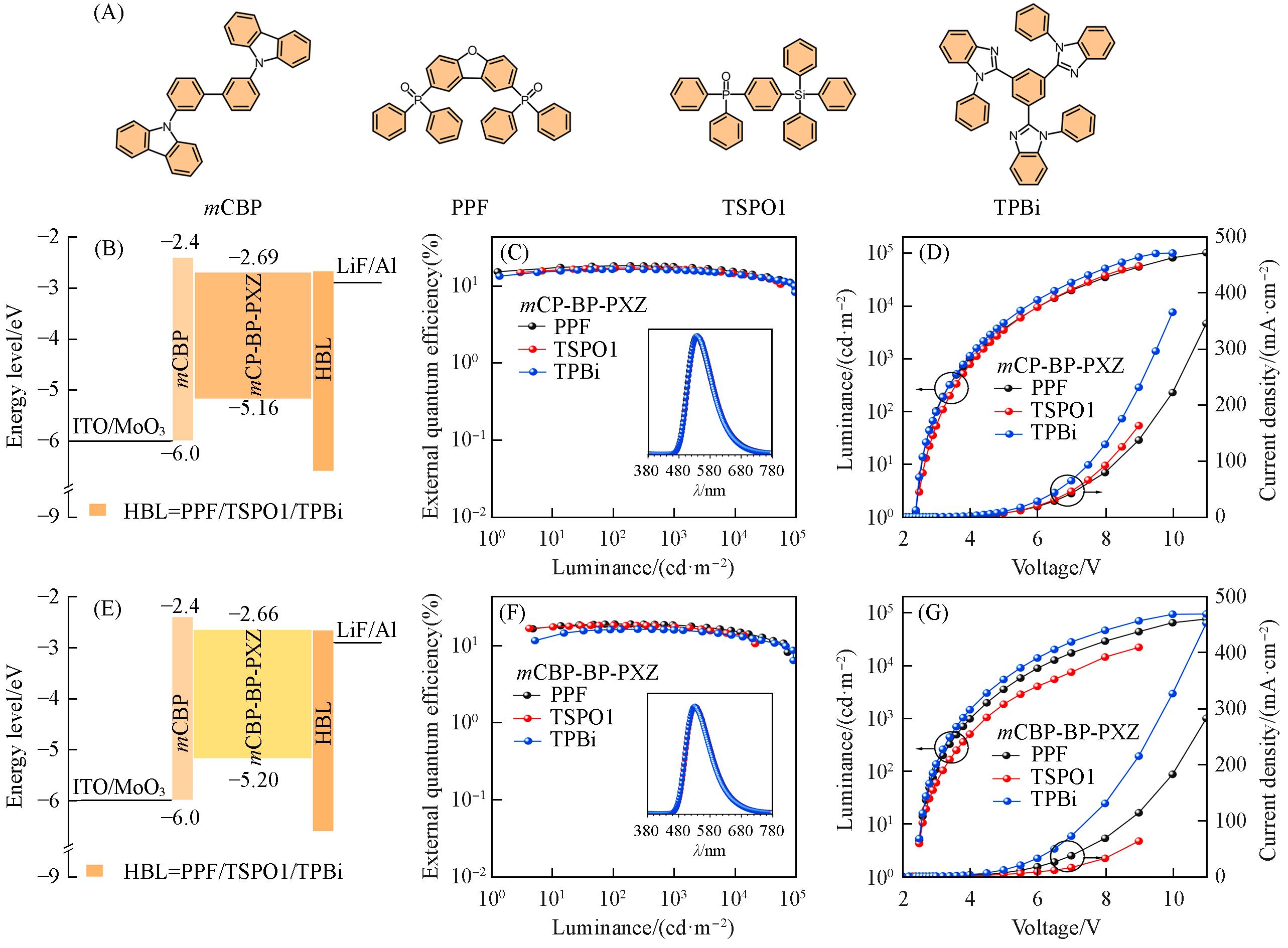
Fig.6 Molecular structures of the functional materials in the thick⁃layer non⁃doped devices with different HBL materials(A), configurations and energy level diagrams(B), plots of external quantum efficiency⁃luminance(C) and luminance⁃current density⁃voltage(D) of the mCP⁃BP⁃PXZ⁃based devices(Thick⁃I⁃HBL), configurations and energy level diagrams(E), plots of external quantum efficiency⁃luminance(F) and luminance⁃current density⁃voltage(G) of the mCBP⁃BP⁃PXZ⁃based devices(Thick⁃II⁃HBL)
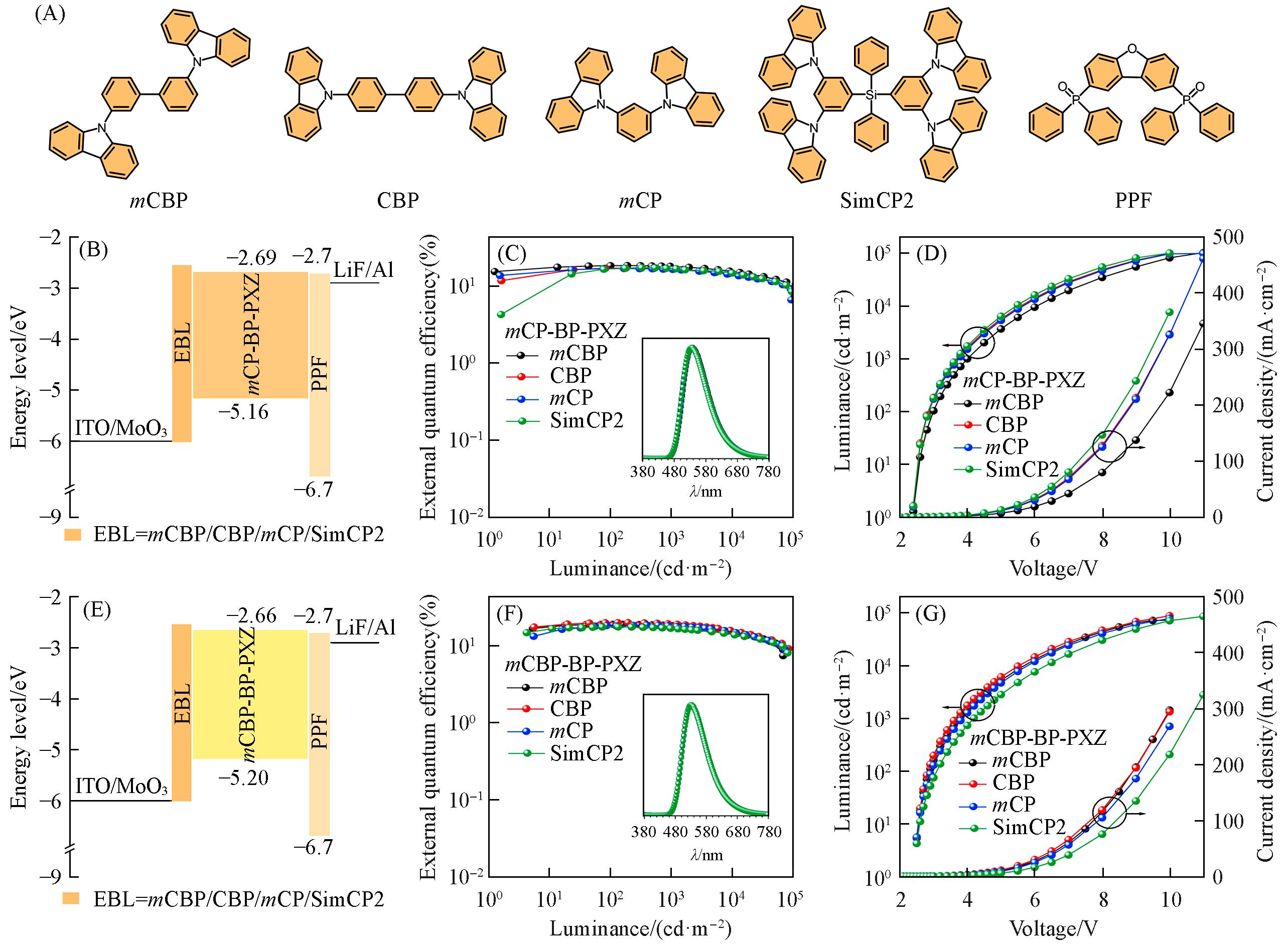
Fig.7 Molecular structures of the functional materials in the thick⁃layer non⁃doped devices with different EBL materials(A), configurations and energy level diagrams(B), plots of external quantum efficiency⁃luminance(C) and luminance⁃current density⁃voltage(D) of the mCP⁃BP⁃PXZ⁃based devices(Thick⁃I⁃EBL), configurations and energy level diagrams(E), plots of external quantum efficiency⁃luminance(F) and luminance⁃current density⁃voltage(G) of the mCBP⁃BP⁃PXZ⁃based devices(Thick⁃II⁃EBL)Insets in planes(C) and(F): EL spectra at 1000 cd/m2 of thick⁃layer devices based on mCP⁃BP⁃PXZ and mCBP⁃BP⁃PXZ, respectively.
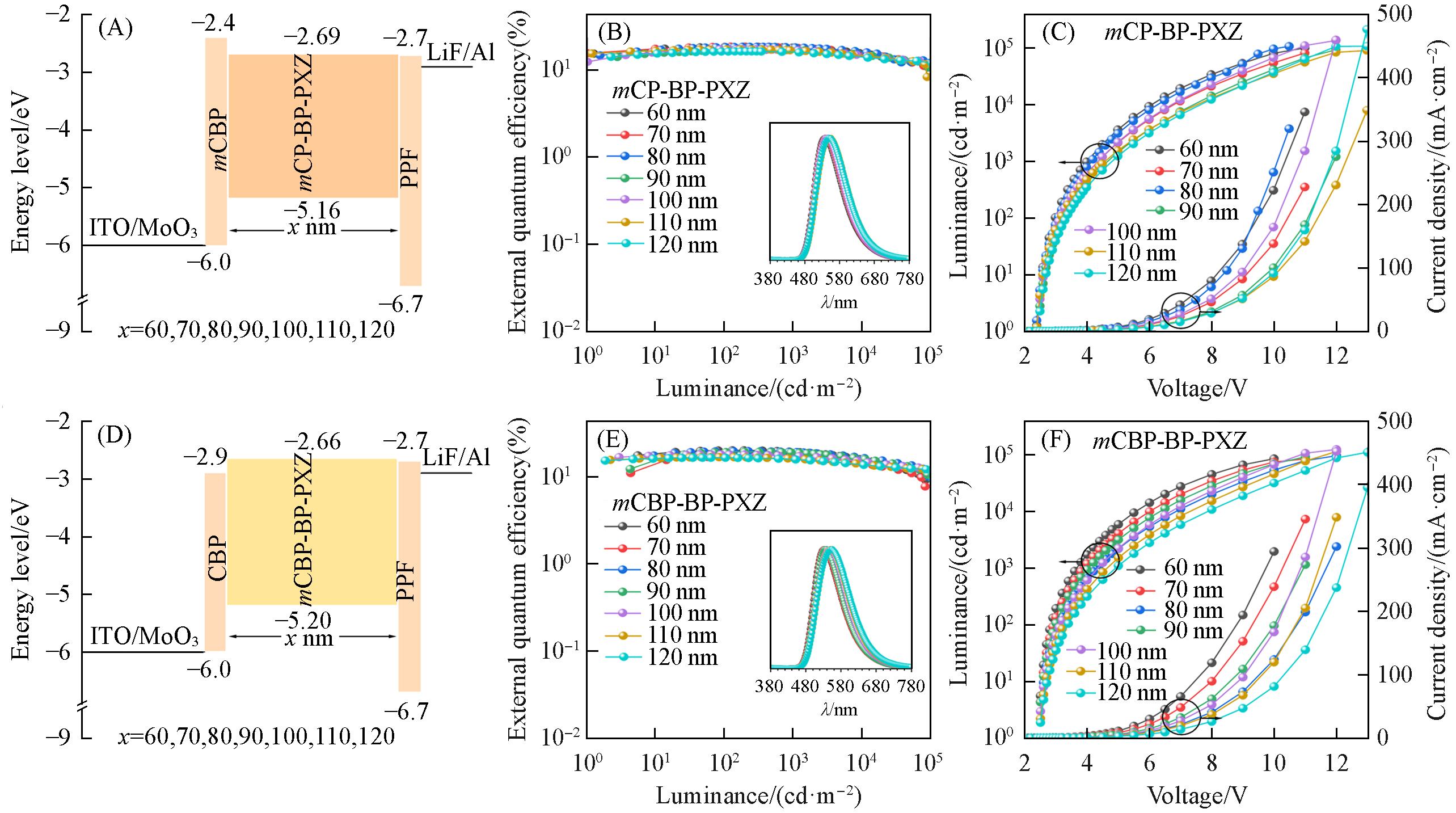
Fig.8 Configurations and energy level diagrams(A), plots of external quantum efficiency⁃luminance(B) and luminance⁃current density⁃voltage(C) of the mCP⁃BP⁃PXZ⁃based thick⁃layer devices, configurations and energy level diagrams(D), plots of external quantum efficiency⁃luminance(E) and luminance⁃ current density⁃voltage(F) of the mCBP⁃BP⁃PXZ⁃based thick⁃layer devices
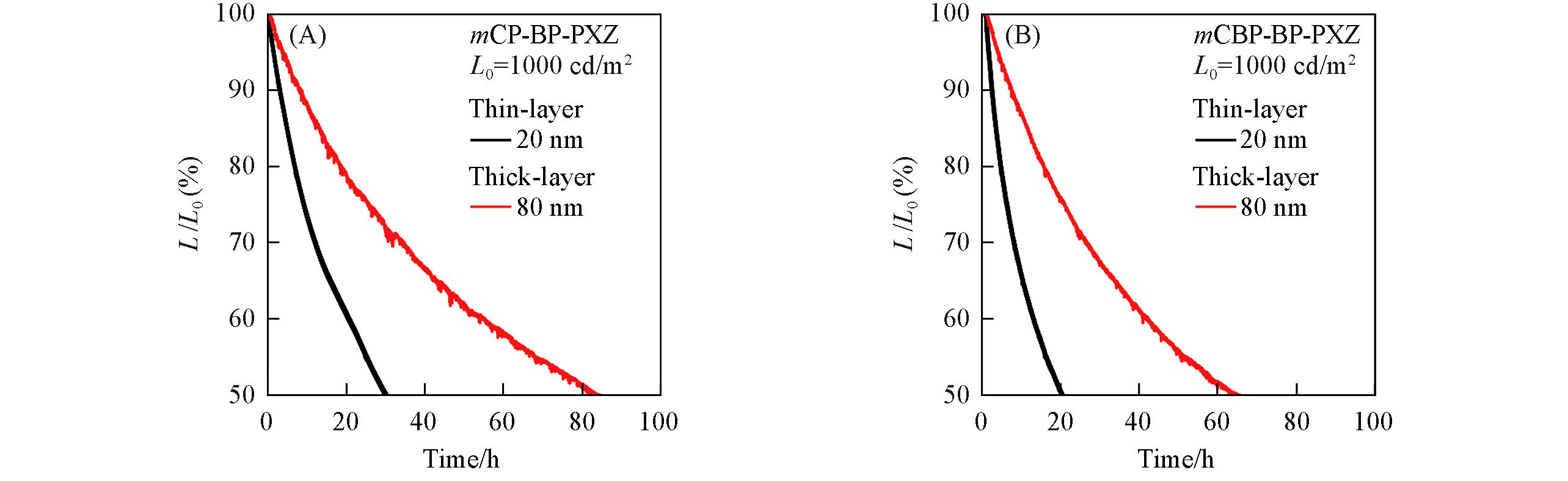
Fig.9 Operational lifetime of the non⁃doped thin⁃layer and thick⁃layer devices based on mCP⁃BP⁃PXZ(A) and mCBP⁃BP⁃PXZ(B)
| Emitter | Thicknessof EML/nm | λEL/nm | Von/V | Lmax/(cd∙m-2) | CIE(x, y) | CE/(cd∙A-1) | PE/(lm∙W-1) | EQE(%) | RO(%) |
|---|---|---|---|---|---|---|---|---|---|
| Maximum value/at 1000 cd∙m-2/at 10000 cd∙m-2 | |||||||||
| mCP⁃BP⁃PXZ | 60 | 538 | 2.4 | 100800 | (0.38, 0.58) | 60.3/59.0/51.1 | 69.4/46.3/26.8 | 18.4/18.0/15.6 | 2.2 |
| 70 | 540 | 2.4 | 81860 | (0.39, 0.57) | 60.6/58.6/49.9 | 69.4/40.9/22.4 | 18.4/17.8/15.2 | 3.3 | |
| 80 | 548 | 2.4 | 103200 | (0.40, 0.56) | 60.1/59.1/53.4 | 67.2/44.2/28.0 | 18.4/18.1/16.4 | 1.6 | |
| 90 | 550 | 2.5 | 93570 | (0.40, 0.56) | 55.2/54.7/49.1 | 59.3/38.2/22.1 | 17.0/16.9/15.2 | 0.6 | |
| 100 | 544 | 2.4 | 136900 | (0.39, 0.57) | 56.5/54.8/48.6 | 62.8/38.2/23.5 | 17.2/16.7/14.9 | 2.9 | |
| 110 | 550 | 2.4 | 91020 | (0.41, 0.55) | 54.8/53.6/47.7 | 64.6/37.4/21.4 | 17.2/16.8/15.0 | 2.3 | |
| 120 | 550 | 2.5 | 108600 | (0.41, 0.56) | 52.0/50.7/44.0 | 57.7/31.8/17.3 | 16.3/15.9/13.8 | 2.5 | |
| mCBP⁃BP⁃PXZ | 60 | 532 | 2.5 | 85710 | (0.36, 0.58) | 64.7/62.7/51.2 | 75.1/54.7/29.3 | 19.8/19.2/15.7 | 3.0 |
| 70 | 532 | 2.5 | 85060 | (0.36, 0.58) | 57.4/56.1/46.6 | 63.1/46.4/24.4 | 17.5/17.1/14.2 | 2.3 | |
| 80 | 534 | 2.6 | 96760 | (0.38, 0.57) | 64.0/62.7/53.1 | 70.3/46.9/23.8 | 19.4/19.1/16.1 | 1.5 | |
| 90 | 540 | 2.5 | 92290 | (0.37, 0.58) | 63.0/61.8/51.7 | 68.4/48.6/25.0 | 19.1/18.7/15.7 | 2.1 | |
| 100 | 550 | 2.5 | 124400 | (0.40, 0.56) | 57.7/55.1/48.5 | 67.1/38.5/23.4 | 17.8/17.0/15.0 | 4.5 | |
| 110 | 550 | 2.5 | 114400 | (0.41, 0.55) | 52.6/50.7/44.3 | 61.5/35.4/19.9 | 16.6/16.0/14.0 | 3.6 | |
| 120 | 556 | 2.5 | 111200 | (0.42, 0.55) | 51.3/48.9/42.1 | 59.6/30.7/16.5 | 16.3/15.6/13.5 | 4.3 | |
Table 3 EL performances of the thick-layer non-doped OLEDs with different thickness of EML*
| Emitter | Thicknessof EML/nm | λEL/nm | Von/V | Lmax/(cd∙m-2) | CIE(x, y) | CE/(cd∙A-1) | PE/(lm∙W-1) | EQE(%) | RO(%) |
|---|---|---|---|---|---|---|---|---|---|
| Maximum value/at 1000 cd∙m-2/at 10000 cd∙m-2 | |||||||||
| mCP⁃BP⁃PXZ | 60 | 538 | 2.4 | 100800 | (0.38, 0.58) | 60.3/59.0/51.1 | 69.4/46.3/26.8 | 18.4/18.0/15.6 | 2.2 |
| 70 | 540 | 2.4 | 81860 | (0.39, 0.57) | 60.6/58.6/49.9 | 69.4/40.9/22.4 | 18.4/17.8/15.2 | 3.3 | |
| 80 | 548 | 2.4 | 103200 | (0.40, 0.56) | 60.1/59.1/53.4 | 67.2/44.2/28.0 | 18.4/18.1/16.4 | 1.6 | |
| 90 | 550 | 2.5 | 93570 | (0.40, 0.56) | 55.2/54.7/49.1 | 59.3/38.2/22.1 | 17.0/16.9/15.2 | 0.6 | |
| 100 | 544 | 2.4 | 136900 | (0.39, 0.57) | 56.5/54.8/48.6 | 62.8/38.2/23.5 | 17.2/16.7/14.9 | 2.9 | |
| 110 | 550 | 2.4 | 91020 | (0.41, 0.55) | 54.8/53.6/47.7 | 64.6/37.4/21.4 | 17.2/16.8/15.0 | 2.3 | |
| 120 | 550 | 2.5 | 108600 | (0.41, 0.56) | 52.0/50.7/44.0 | 57.7/31.8/17.3 | 16.3/15.9/13.8 | 2.5 | |
| mCBP⁃BP⁃PXZ | 60 | 532 | 2.5 | 85710 | (0.36, 0.58) | 64.7/62.7/51.2 | 75.1/54.7/29.3 | 19.8/19.2/15.7 | 3.0 |
| 70 | 532 | 2.5 | 85060 | (0.36, 0.58) | 57.4/56.1/46.6 | 63.1/46.4/24.4 | 17.5/17.1/14.2 | 2.3 | |
| 80 | 534 | 2.6 | 96760 | (0.38, 0.57) | 64.0/62.7/53.1 | 70.3/46.9/23.8 | 19.4/19.1/16.1 | 1.5 | |
| 90 | 540 | 2.5 | 92290 | (0.37, 0.58) | 63.0/61.8/51.7 | 68.4/48.6/25.0 | 19.1/18.7/15.7 | 2.1 | |
| 100 | 550 | 2.5 | 124400 | (0.40, 0.56) | 57.7/55.1/48.5 | 67.1/38.5/23.4 | 17.8/17.0/15.0 | 4.5 | |
| 110 | 550 | 2.5 | 114400 | (0.41, 0.55) | 52.6/50.7/44.3 | 61.5/35.4/19.9 | 16.6/16.0/14.0 | 3.6 | |
| 120 | 556 | 2.5 | 111200 | (0.42, 0.55) | 51.3/48.9/42.1 | 59.6/30.7/16.5 | 16.3/15.6/13.5 | 4.3 | |
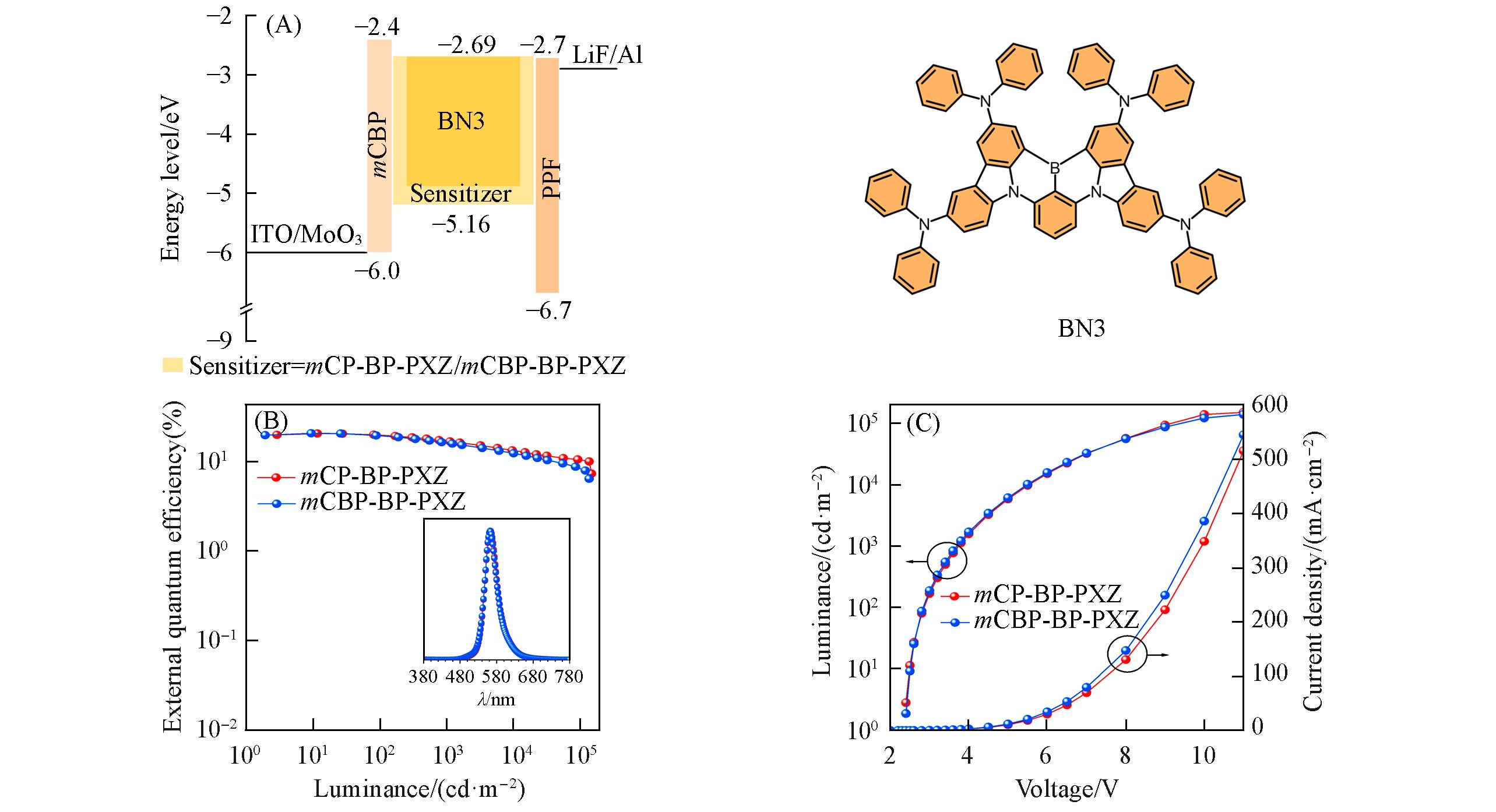
Fig.10 Configuration, energy diagram and molecular structure of the MR⁃TADF material used in the simple thick⁃layer sensitized devices(A), plots of external quantum efficiency⁃luminance(B) and luminance⁃voltage⁃current density(C) of the sensitized thick⁃layer devices
| [1] | Tang C. W., VanSlyke S. A., Appl. Phys. Lett., 1987, 51, 913—915 |
| [2] | Adachi C., Baldo M. A., Thompson M. E., Forrest S. R., J. Appl. Phys., 2001, 90, 5048—5051 |
| [3] | Uoyama H., Goushi K., Shizu K., Nomura H., Adachi C., Nature, 2012, 492, 234—238 |
| [4] | Huang T., Wang Q., Zhang H., Zhang Y., Zhan G., Zhang D., Duan L., Nat. Photon., 2024, 18, 516—523 |
| [5] | Jiang P., Miao J., Cao X., Xia H., Pan K., Hua T., Lv X., Huang Z., Zou Y., Yang C., Adv. Mater., 2022, 34, 2106954 |
| [6] | Huang T., Xu Y., Qu Y., Lu X., Ye K., Zhuang X., Wang Y., Adv. Mater., 2025, 37, 2503383 |
| [7] | Huang Z., Xie H., Miao J., Wei Y., Zou Y., Hua T., Cao X., Yang C., J. Am. Chem. Soc., 2023, 145, 12550—12560 |
| [8] | Cheng Y. C., Tang X., Wang K., Xiong X., Fan X. C., Luo S., Walia R., Xie Y., Zhang T., Zhang D., Yu J., Chen X. K., Adachi C., Zhang X. H., Nat. Commun., 2024, 15, 731 |
| [9] | Kido J., Kimura M., Nagai K., Science, 1995, 267, 1332—1334 |
| [10] | Walzer K., Maennig B., Pfeiffer M., Leo K., Chem. Rev., 2007, 107, 1233—1271 |
| [11] | Kotadiya N. B., Wetzelaer G. J. A. H., Blom P. W. M., Nat. Photon., 2019, 13, 765—769 |
| [12] | Sachnik O., Li Y., Tan X., Michels J. J., Blom P. W. M., Wetzelaer G. A. H., Adv. Mater., 2023, 35, 2300574 |
| [13] | Hudson Z. M., Wang Z., Helander M. G., Lu Z., Wang S., Adv. Mater., 2012, 24, 2922—2928 |
| [14] | Van der Zee B., Li Y., Wetzelaer G. J. A. H., Blom P. W. M., Adv. Optical Mater., 2021, 9, 2100249 |
| [15] | Li Y., Kotadiya N. B., van der Zee B., Blom P. W. M., Wetzelaer G. A. H., Adv. Optical Mater., 2021, 9, 2001812 |
| [16] | Li Y., Van der Zee B., Tan X., Zhou X., Wetzelaer G. J. A. H., Blom P. W. M., Adv. Mater., 2023, 35, 2304728 |
| [17] | Fu Y., Liu H., Tang B. Z., Zhao Z., Adv. Funct. Mater., 2024, 34, 2401434 |
| [18] | Liu Z., Guo T., Liu Z., Yang D., Ma D., Tang B. Z., Zhao Z., Adv. Funct. Mater., 2026, 36, e17758 |
| [19] | Fu Y., Liu H., Zhu X., Zeng J., Zhao Z., Tang B. Z., J. Mater. Chem. C, 2020, 8, 9549—9557 |
| [20] | Wong M. Y., Zysman‐Colman E., Adv. Mater., 2017, 29, 1605444 |
| [21] | Hao X. L., Ren A. M., Zhou L., Zhang H., J. Phys. Chem. A, 2023, 127, 9771—9780 |
| [22] | Zhao M., Li M., Li W., Du S., Chen Z., Luo M., Qiu Y., Lu X., Yang S., Wang Z., Zhang J., Su S. J., Ge Z., Angew. Chem. Int. Ed., 2022, 61, e202210687 |
| [23] | Guan J., Zhu Z., Gou Q., Wang J., Kuang Z., Zhang L., Zhang X., Ai X., Abdurahman A., Peng Q., Aggregate, 2025, 6, e70100 |
| [24] | Liu H., Guo J., Zhao Z., Tang B. Z., ChemPhotoChem, 2019, 3, 993—999 |
| [25] | Wang K., Ou X., Niu X., Wang Z., Song F., Dong X., Guo W., Peng H., Zhao Z., Lam J. W. Y., Sun J., Wu H., Yu S., Li F., Tang B. Z., Aggregate, 2025, 6, e667 |
| [26] | Ding Z., Wu B., Liu Z., Wang H., Gao F., Wei X., Zhao Z., Alam P., Qiu Z., Tang B. Z., Aggregate, 2025, 6, e70024 |
| [27] | Xu L., Li Y., Liu H., Qiu N., Chen H., Luo Y., Shi H., Zhao Z., Tang B. Z., Aggregate, 2026, 7, e70240 |
| [28] | Guo J., Zhao Z., Tang, B. Z., Adv. Optical Mater., 2018, 6, 1800264. |
| [29] | Huang J., Nie H., Zeng J., Zhuang Z., Gan S., Cai Y., Guo J., Su S., Zhao Z., Tang B. Z., Angew. Chem. Int. Ed., 2017, 56, 12971—12976 |
| [30] | Xu J., Zhu X., Guo J., Fan J., Zeng J., Chen S., Zhao Z., Tang B. Z., ACS Mater. Lett., 2019, 1, 613—619 |
| [31] | Guo J., Li X. L., Nie H., Luo W., Gan S., Hu S., Hu R., Qin A., Zhao Z., Su S. J., Tang B. Z., Adv. Funct. Mater., 2017, 27, 1606458. |
| [32] | Walia R., Xiong X., Fan X. C., Chen T. F., Wang H., Wang K., Shi Y. Z., Tang X., Bredas J. L., Adachi C., Chen X. K., Zhang X. H., Nat. Mater., 2025, 24, 1576—1583 |
| [33] | Liu H., Zeng J., Guo J., Nie H., Zhao Z., Tang B. Z., Angew. Chem. Int. Ed., 2018, 57, 9290—9294 |
| [34] | Liu Y., Li C., Ren Z., Yan S., Bryce M. R., Nat. Rev. Mater., 2018, 3, 18020 |
| [35] | Goushi K., Yoshida K., Sato K., Adachi C., Nat. Photon., 2012, 6, 253—258 |
| [36] | Zou Y., Yu M., Xu Y., Xiao Z., Song X., Hu Y., Xu Z., Zhong C., He J., Cao X., Li K., Miao J., Yang C. , Chem, 2024, 10, 1485—1501 |
| [37] | Zhang H., Huang T., Zhou J., Xu C., Zhang D., Duan L., Chem, 2025, 102685 |
| [38] | Yokoyama D., J. Mater. Chem., 2011, 21, 19187 |
| [39] | Zhao L., Komino T., Inoue M., Kim J. H., Ribierre J. C., Adachi C., Appl. Phys. Lett., 2015, 106, 063301 |
| [40] | Fu Y., Liu H., Yang D., Ma D., Zhao Z., Tang B. Z., Sci. Adv., 2021, 7, eabj2504 |
| [41] | Fan X., Wang K., Shi Y., Sun D., Chen J., Huang F., Wang H., Yu J., Lee C., Zhang X., Smart Mat., 2023, 4, e1122 |
| [42] | Mott N. F., Gurney R. W., Electronic Processes in Ionic Crystals, the Clarendon Press, Oxford, 1940 |
| [43] | Sachnik O., Ie Y., Ando N., Tan X., Blom P. W. M., Wetzelaer G. J. A. H., Adv. Mater., 2024, 36, 2311892 |
| [44] | Qi Y., Ning W., Zou Y., Cao X., Gong S., Yang C., Adv. Funct. Mater., 2021, 31, 2102017 |
| [1] | 葛书源, 冯梓浚, 程壮, 刘福通, 路萍. 基于菲并[9,10]咪唑衍生物的CIE y <0.04的深蓝光热激子材料[J]. 高等学校化学学报, 2026, 47(4): 20250403. |
| [2] | 王英杰, 潘泽晖, 陶正煜, 王妍, 童碧海, 冯敏强, 宋明星. 分子间相互作用对苯甲酮类聚集诱导延迟荧光材料性能的影响[J]. 高等学校化学学报, 2023, 44(4): 20220562. |
| [3] | 张佳玲, 吴源源, 张曼, 陶正煜, 田勇攀, 张千峰, 童碧海, 何谷峰, 孔辉. 空间接近二酰胺的多米诺类型反应及其在有机合成中的应用[J]. 高等学校化学学报, 2023, 44(2): 20220597. |
| [4] | 伍泽鑫, 朱渊杰, 王泓中, 王均安, 贺英. 甲基修饰的咔唑/二苯砜基AIE-TADF蓝光材料及其OLED器件[J]. 高等学校化学学报, 2022, 43(11): 20220371. |
| [5] | 吴小龑, 刘琳琳, 解增旗, 马於光. 金属纳米粒子增强有机光电器件性能研究进展[J]. 高等学校化学学报, 2016, 37(3): 409. |
| [6] | 韩娟, 申林, 方维海. 基于电子结构理论的能量转移速率计算[J]. 高等学校化学学报, 2012, 33(10): 2275. |
| [7] | 杨桂霞, 黄宗浩, 杨培培, 辛毅, 蒋子江, 张莲姬. 氟取代噻咯衍生物结构和光电性能的理论研究[J]. 高等学校化学学报, 2009, 30(11): 2274. |
| [8] | 杨晓晖, 印寿根, 王振家, 侯延冰, 徐叙容. 主链含电子传输型团的可溶性PPV聚合物载流子传输特性研究[J]. 高等学校化学学报, 2001, 22(5): 847. |
| 阅读次数 | ||||||
|
全文 |
|
|||||
|
摘要 |
|
|||||
