

Chem. J. Chinese Universities ›› 2026, Vol. 47 ›› Issue (6): 20260052.doi: 10.7503/cjcu20260052
• Review • Previous Articles Next Articles
LI Weixin1,4, ZENG Yulan2, PENG Zhihong1,4, CHEN Zhanfei3,4, LI Jinqiu1,4, CHEN Zhonghui1,4( ), LIN Zhenyu2()
Received:2026-01-28
Online:2026-06-10
Published:2026-03-25
Contact:
LIN Zhenyu
E-mail:zhchen@ptu.edu.cn;zylin@fzu.edu.cn
Supported by:CLC Number:
TrendMD:
LI Weixin, ZENG Yulan, PENG Zhihong, CHEN Zhanfei, LI Jinqiu, CHEN Zhonghui, LIN Zhenyu. Research Advances in Vertically-ordered Mesoporous Silica Films for Electrochemiluminescence Biosensing[J]. Chem. J. Chinese Universities, 2026, 47(6): 20260052.
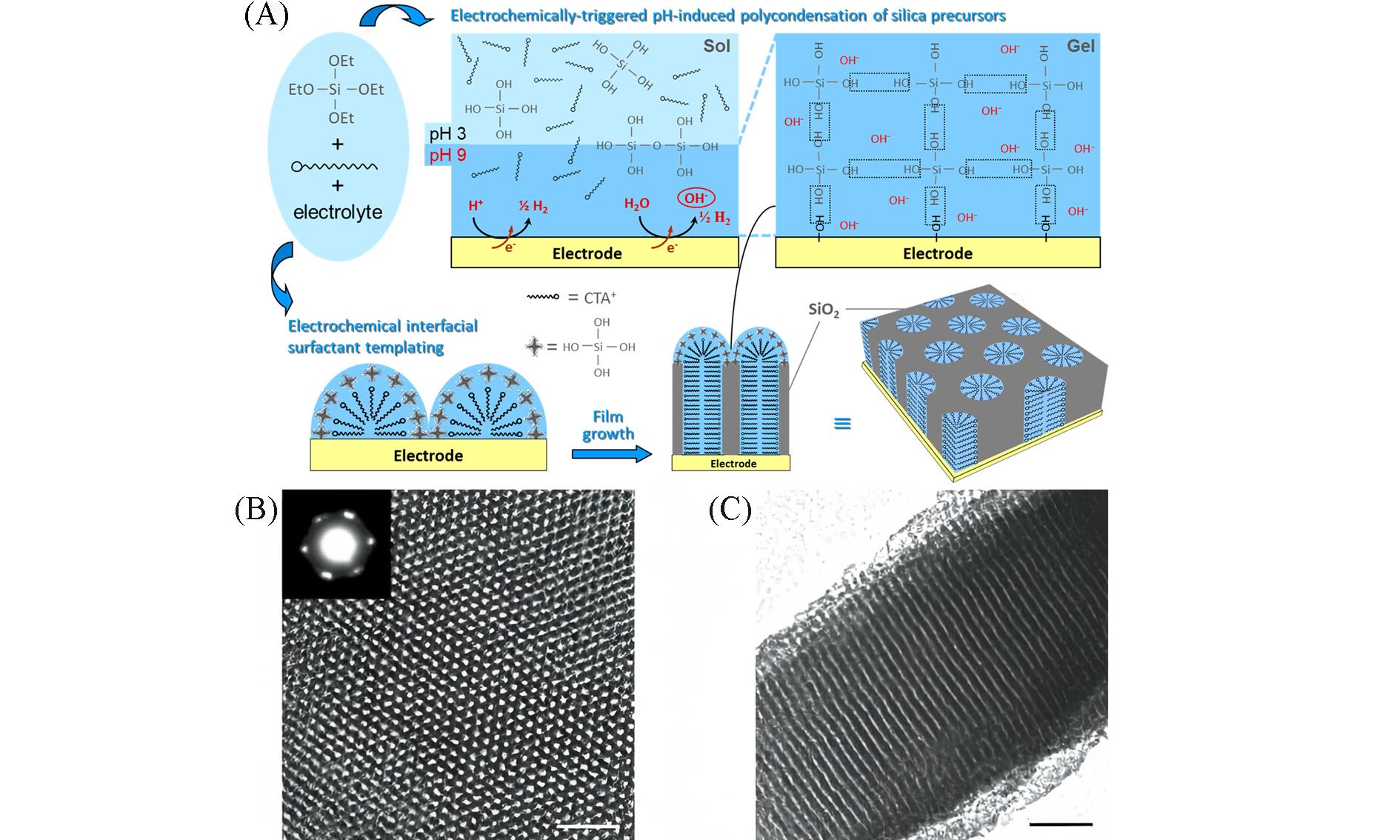
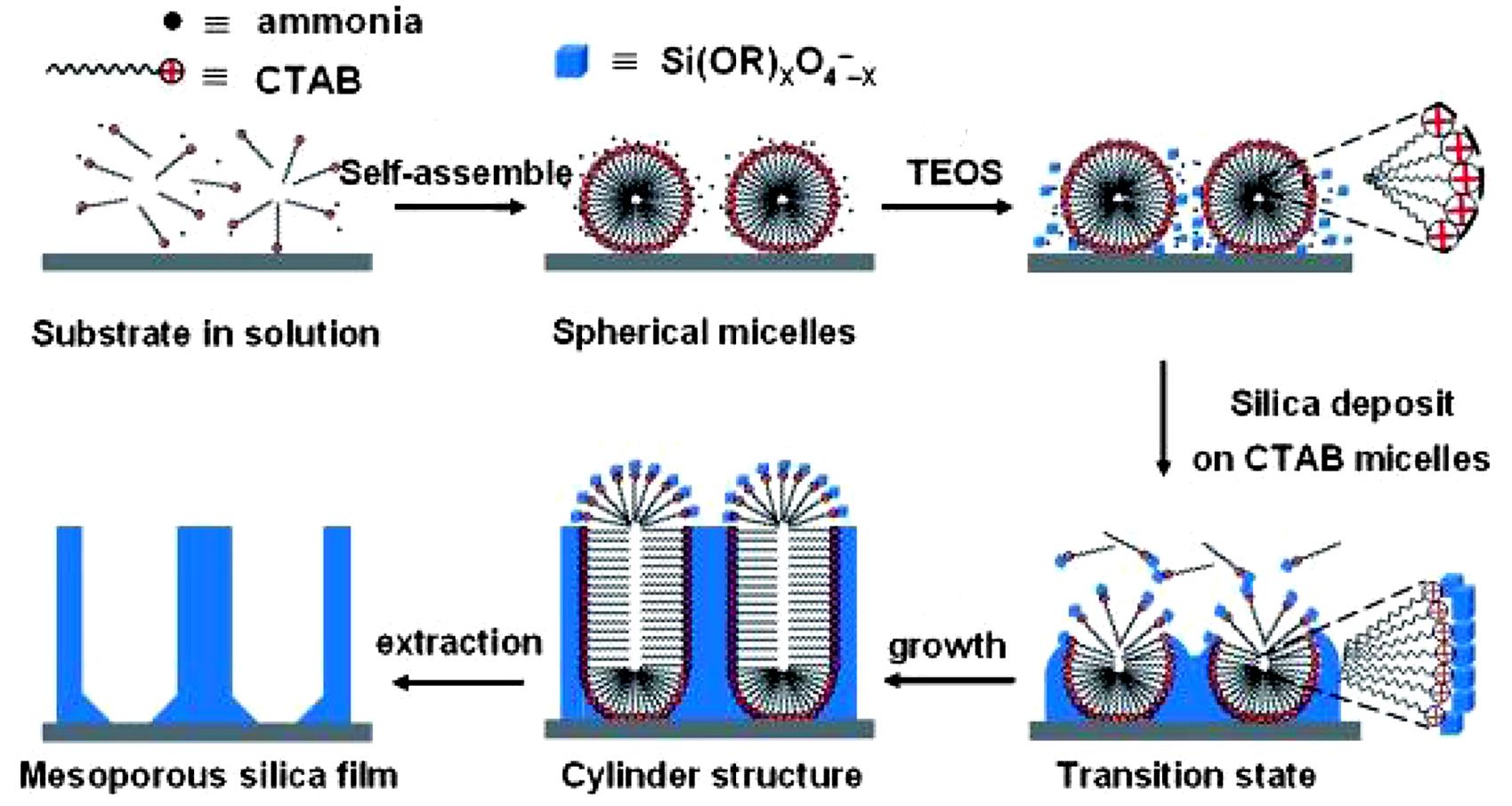
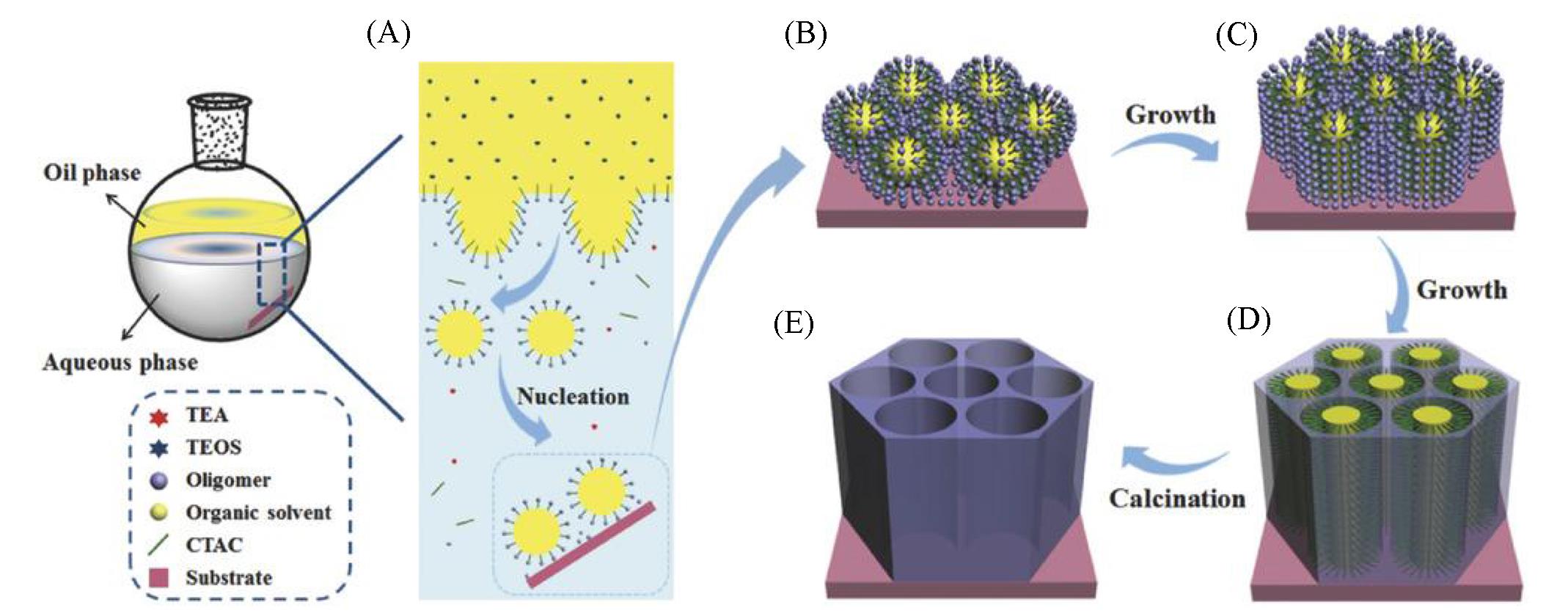
| Item | EASA Method | Stöber Solution Growth Method | Two⁃Phase Stratification Method |
|---|---|---|---|
| Core principle | Through electrochemical reactions, the interface has been rapid condensation and self⁃assembly. | Slow growth directed by template molecules in solution. | Utilizing the interface between the two phases to guide self⁃assembly. |
| Advantages | 1. Fast synthesis rate(from seconds to minutes); 2. High degree of orderliness, and with a regular and neat structure; 3. Easy process control(via potential or current); 4. Suitable for conductive substrates with complex shapes. | 1. Suitable for scalable batch production; 2. Relatively good reproducibility; 3. Applicable to non⁃conductive substrates and conductive substrates. | 1. Wide tunable pore⁃size range; 2. Capable of preparing ultrathin (ca. 50 nm) and uniform films; 3. Great potential for size⁃selective separation. |
| Disadvantages | 1. Limited to conductive substrates; 2. The control range of the film thickness is relatively narrow. | 1. Long growth period; 2. The degree of orderliness of the pore channels is relatively low. | 1. Complex process; 2. The process for large⁃scale production is not yet mature. |
| Synthesis rate | Fast | Slow | Moderate |
| Applicable scenarios | Rapid preparation in the laboratory; construction of high⁃performance electrochemical or ECL sensors. | Large⁃scale, and uniform production | Applications that require precise control of the pore size, such as large molecule separation and advanced separation membranes. |
Table 1 Comparison and summary of the three main preparation methods for VMSF
| Item | EASA Method | Stöber Solution Growth Method | Two⁃Phase Stratification Method |
|---|---|---|---|
| Core principle | Through electrochemical reactions, the interface has been rapid condensation and self⁃assembly. | Slow growth directed by template molecules in solution. | Utilizing the interface between the two phases to guide self⁃assembly. |
| Advantages | 1. Fast synthesis rate(from seconds to minutes); 2. High degree of orderliness, and with a regular and neat structure; 3. Easy process control(via potential or current); 4. Suitable for conductive substrates with complex shapes. | 1. Suitable for scalable batch production; 2. Relatively good reproducibility; 3. Applicable to non⁃conductive substrates and conductive substrates. | 1. Wide tunable pore⁃size range; 2. Capable of preparing ultrathin (ca. 50 nm) and uniform films; 3. Great potential for size⁃selective separation. |
| Disadvantages | 1. Limited to conductive substrates; 2. The control range of the film thickness is relatively narrow. | 1. Long growth period; 2. The degree of orderliness of the pore channels is relatively low. | 1. Complex process; 2. The process for large⁃scale production is not yet mature. |
| Synthesis rate | Fast | Slow | Moderate |
| Applicable scenarios | Rapid preparation in the laboratory; construction of high⁃performance electrochemical or ECL sensors. | Large⁃scale, and uniform production | Applications that require precise control of the pore size, such as large molecule separation and advanced separation membranes. |
| [1] | Hercules D. M., Science, 1964, 145(3634), 808—809 |
| [2] | Santhanam K. S. V., Bard A. J., J. Am. Chem. Soc., 1965, 87(1), 139—140 |
| [3] | Zhang R., Hu S., Ma C., Zhang T., Li H., TrAC, Trends Anal. Chem., 2024, 181, 117992 |
| [4] | Kotova A. A., Thiebaut D., Vial J., Tissot A., Serre C., Coord., Chem. Rev., 2022, 455, 214364 |
| [5] | Venga M. T., Figueiredo E. C., Anal. Chem., 2024, 96(14), 5519—5526 |
| [6] | Chen X., Zhang D., Liu Q., Liu S., Li H., Li Z., Anal. Chem., 2023, 95(18), 7354—7362 |
| [7] | Zhao M., Wang M., Zhang X., Zhu Y., Cao J., She Y., Cao Z., Li G., Wang J., Abd El⁃Aty A. M., Crit. Rev. Food Sci. Nutr., 2023, 63(21), 4942—4965 |
| [8] | Muzyka K., Saqib M., Liu Z., Zhang W., Xu G., Biosens. Bioelectron., 2017, 92, 241—258 |
| [9] | Yu J., Stankovic D., Vidic J., Sojic N., Sens. Diagn., 2024, 3, 1887—1898 |
| [10] | Meng X., Pang X., Yang J., Zhang X., Dong H., Small, 2024, 20(22), 2307701 |
| [11] | Xu X., Lu S., Zhang Z., Langmuir, 2024, 40(20), 10718—10725 |
| [12] | Liu R., Wang X., Wang S., Xie L., Zhao P., Li L., Ge S., Yu J., Anal. Chim. Acta, 2024, 1287, 342125 |
| [13] | Li H., Yang S., Wang D., Chen B., Chang Y., Li Z. X., Guo C., Coord. Chem. Rev., 2026, 546, 217080 |
| [14] | Song Y., Tao X., Liang W., Zhong X., Yuan R., Zhuo Y., Chin. Chem. Lett., 2023, 34(6), 107957 |
| [15] | Chen Q. L., Zhou X. M., Zhao M. L., Chai Y. Q., Yuan R., Zhong X., Zhuo Y., Anal. Chem., 2024, 96(28), 11383—11389 |
| [16] | Tao X. L., Pan M. C., Yang X., Yuan R., Zhuo Y., Chin. Chem. Lett., 2022, 33(11), 4803—4807 |
| [17] | He Y. T., Li H. X., Fan X. Y., Yu M. H., Zhang J. J., Chem. J. Chinese Universities, 2026, 47(3), 20250333 |
| 何雨桐, 李涵希, 范晓燕, 于美慧, 张冀杰. 高等学校化学学报, 2026, 47(3), 20250333 | |
| [18] | Zhang T., Yang L., Yan F., Wang K., Biosensors, 2023, 13(6), 628 |
| [19] | Yan F., Lin X., Su B., Analyst, 2016, 141(12), 3482—3495 |
| [20] | Fan X., Wu J., Zhang T., Liu J., ChemBioChem, 2024, 25(21), e202400320 |
| [21] | Cho J., Ishida Y., Adv. Mater., 2017, 29(25), 1605974 |
| [22] | Zheng Y., Yang J., Liu, Z., Qiao Z. A., Adv. Mater., 2025, 37(43), e10911 |
| [23] | Sabaté del Río J., Henry O. Y. F., Jolly P., Ingber D. E., Nat. Nanotechnol., 2019, 14(12), 1143—1149 |
| [24] | Walcarius A., Acc. Chem. Res., 2021, 54(18), 3563—3575 |
| [25] | Walcarius A., Sibottier E., Etienne M., Ghanbaja J., Nat. Mater., 2007, 6(8), 602—608 |
| [26] | Goux A., Etienne M., Aubert E., Lecomte C., Ghanbaja J., Walcarius A., Chem. Mater., 2009, 21(4), 731—741 |
| [27] | Teng Z., Zheng G., Dou Y., Li W., Mou C. Y., Zhang X., Asiri A. M., Zhao D., Angew. Chem. Int. Ed., 2012, 51(9), 2173—2177 |
| [28] | Liu Y., Shen D., Chen G., Elzatahry A. A., Pal M., Zhu H., Wu L., Lin J., Al Dahyan D., Li W., Zhao D. Y., Adv. Mater., 2017, 29(35), 1702274 |
| [29] | Huang J., Zhang T., Dong G., Zhu S., Yan F., Liu J., Front. Chem., 2022, 10, 900282 |
| [30] | Giordano G., Vilà N., Aubert E., Ghanbaja J., Walcarius A., Electrochim. Acta, 2017, 237, 227—236 |
| [31] | Tian X., Tang L., Zeng Y., Chen Z., Qiu B., Lin Z., Chen H., Anal. Chem., 2025, 97(46), 25888—25898 |
| [32] | He K., Wang H., Luo T., Yan F., Guo J., Front. Chem., 2024, 12, 1490940 |
| [33] | An J., Zhang C., Yan F., Ma P., Microchem. J., 2024, 206, 111413 |
| [34] | Huang J., Zhang T., Zheng Y., Liu J., Biosensors, 2023, 13(3), 317 |
| [35] | Liu J., He D., Liu Q., He X., Wang K., Yang X., Shangguan J., Tang J., Mao Y., Anal. Chem., 2016, 88(23), 11707—11713 |
| [36] | Ma N., Xu S., Wu W., Liu J., Molecules, 2023, 28(22), 7664 |
| [37] | Ma K., Zheng Y., An L., Liu J., Front. Chem., 2022, 10, 851178 |
| [38] | Gong J., Zhang T., Chen P., Yan F., Liu J., Sens. Actuators. Chem., 2022, 368, 132086 |
| [39] | Gong J., Zhang T., Luo T., Luo X., Yan F., Tang W., Liu J., Biosens. Bioelectron., 2022, 215, 114563 |
| [40] | Zhang T., Gong J., Han Q., Hu W., Yan F., Liu J., Talanta, 2024, 277, 126319 |
| [41] | Ding H., Guo W., Zhou P., Su B., Chem. Commun., 2020, 56(59), 8249—8252 |
| [42] | Lyu Z. M., Zhou X. L., Wang X. N., Li P., Xu L., Liu E. H., Sens. Actuators. Chem., 2019, 284, 437—443 |
| [43] | Zhu L., Fu W., Chen J., Li S., Xie X., Zhang Z., Liu J., Zhou L., Su B., Chen X., Sens. Actuators. Chem., 2022, 366, 131972 |
| [44] | Huang J., Zhou H., Zou Y., Liu H., Chen Q., Analyst, 2024, 149(16), 4208—4212 |
| [45] | Huang J., Xu S., Yan F., Liu J., Sens. Actuators. Chem., 2024, 402, 135119 |
| [46] | Gao J., Zhang S., Xi F., Molecules, 2025, 30(3), 746 |
| [47] | Chen H., Huang J., Zhang R., Yan F., Front. Chem., 2022, 10, 23998 |
| [48] | Chang Q., Gu X., He L., Xi F., Front. Chem., 2023, 11, 1274424 |
| [49] | Zhang H., Zhang C., Qu H., Xi F., Molecules, 2023, 28(18), 6559 |
| [50] | Yang W., Xu J., Yao Q., Xu X., Chen X., Ni J., Wang Q., Lin Z., Biosens. Bioelectron., 2024, 247, 115967 |
| [51] | Li J., Yao X., Ma J., Liu C., Hong W., Wu H., Li M., Guo L. H., Analyst, 2025, 150(6), 1048—1065 |
| [52] | Zhou Z., Guo W., Xu L., Yang Q., Su B., Anal. Chim. Acta, 2015, 886, 48—55 |
| [53] | Xiao Y., Chen S., Zhang G., Li Z., Xiao H., Chen C., He C., Zhang R., Yang X., Analyst, 2020, 145(14), 4806—4814 |
| [54] | Guo W., Lin X., Yan F., Su B., ChemElectroChem, 2016, 3(3), 480—486 |
| [55] | Rahmati S., Emili A., Cancers, 2025, 17(2), 179 |
| [56] | Ahn J. C., Teng P. C., Chen P. J., Posadas E., Tseng H. R., Lu S. C., Yang J. D., Hepatology, 2021, 73(1), 422—436 |
| [57] | Nasrollahpour H., Mahdipour M., Isildak I., Rashidi M. R., Naseri A., Khalilzadeh B., Biosens. Bioelectron., 2021, 178, 113023 |
| [58] | Zeng Z., Zhao Y., Yang L., Xi F., Su D., Front. Chem., 2023, 11(12), 22067 |
| [59] | Wu M. S., Sun X. T., Zhu M. J., Chen H. Y., Xu J. J., Chem. Commun., 2015, 51(74), 14072—14075 |
| [60] | Jafari A., Karimabadi K., Rahimi A., Rostaminasab G., Khazaei M., Rezakhani L., Jouybari T. A., Technol. Cancer Res. Treat., 2023, 22, 1—18 |
| [61] | Guo X., Yang S., Cao C., Li D., Mol. Clin. Oncol., 2025, 23(2), 71 |
| [62] | Zeng R., Tian S. H., Wang J., Chen B., Pu Y., Tan Y., Yuan Y., Lin Z. Y., Wang W., Sens. Actuators Chem., 2025, 425, 137006 |
| [63] | Xu J., Yang W. Q., Ni J., Wang Q., Lin Z., Sens. Actuators Chem., 2023, 397, 134694 |
| [1] | YANG Bifang, GUO Xiaoge, DAI Xiaohui, YANG Weiqiang, NI Jiancong. Detection of Urea by Conductivity-regulated Bipolar Electrochemiluminescence [J]. Chem. J. Chinese Universities, 2025, 46(8): 20250101. |
| [2] | JIANG Bowen, CHEN Jingxuan, CHENG Yonghua, SANG Wei, KOU Zongkui. Recent Progress of Single-atom Materials in Electrochemical Biosensing [J]. Chem. J. Chinese Universities, 2022, 43(9): 20220334. |
| [3] | LU Meiru, ZHANG Hongyu, SHI Baimei, SUN Maozhong, XU Liguang, XU Chuanlai, KUANG Hua. Chiral Nanomaterials: Bioimaging, Biosensing and Therapeutics [J]. Chem. J. Chinese Universities, 2022, 43(12): 20220683. |
| [4] | JIANG Jun, GONG Tiantian, ZHANG Chengpeng, LIU Xiaoqian, ZHAO Junwei. Synthesis and Electrochemical Biosensing Properties of Pyridine Dicarboxylic Acid Decorated Rare-earth-incorporatedTellurotungstates [J]. Chem. J. Chinese Universities, 2022, 43(1): 20210561. |
| [5] | XIN Weiwen, WEN Liping. Two-dimensional Materials for Osmotic Energy Conversion [J]. Chem. J. Chinese Universities, 2021, 42(2): 445. |
| [6] | WANG Qing, HE Yuqiu, WANG Fuan. Advances of Multifunctional Deoxyribozyme in Biomedical Analysis [J]. Chem. J. Chinese Universities, 2021, 42(11): 3334. |
| [7] | XI Jing, CHEN Na, YANG Yanbing, YUAN Quan. Recent Progress in Controlled Synthesis of Persistent Luminescence Nanomaterials for Diagnosis Applications [J]. Chem. J. Chinese Universities, 2021, 42(11): 3247. |
| [8] | LI Huiyuan, LEI Chunyang, HUANG Yan, NIE Zhou. Structural Modification of Fluorescent Proteins and Their Applications in Biosensing [J]. Chem. J. Chinese Universities, 2020, 41(11): 2324. |
| [9] | SONG Ling, ZHENG Xing-Wang*, LI Gui-Xin. Electrochemiluminescence Performances of Compositing Films of Polyluminol with Metal Ions and Its Analytical Application [J]. Chem. J. Chinese Universities, 2007, 28(10): 1869. |
| Viewed | ||||||
|
Full text |
|
|||||
|
Abstract |
|
|||||
