

Chem. J. Chinese Universities ›› 2026, Vol. 47 ›› Issue (7): 20250370.doi: 10.7503/cjcu20250370
• Environmental Chemistry • Previous Articles Next Articles
YANG Zhenmiao1, WU Yannan1, CHEN Jingfeng1, LIN Yawei1, WEI Chenjie1,2( ), LIU Lifen1,2()
Received:2025-12-04
Online:2026-07-10
Published:2025-12-19
Contact:
WEI Chenjie, LIU Lifen
E-mail:cjwei@zjut.edu.cn;lifenliu@zjut.edu.cn
Supported by:CLC Number:
TrendMD:
YANG Zhenmiao, WU Yannan, CHEN Jingfeng, LIN Yawei, WEI Chenjie, LIU Lifen. Recycling Treatment of Stainless Steel Pickling Wastewater by Combination of Diffusion Dialysis and Three-step Precipitation Processes[J]. Chem. J. Chinese Universities, 2026, 47(7): 20250370.
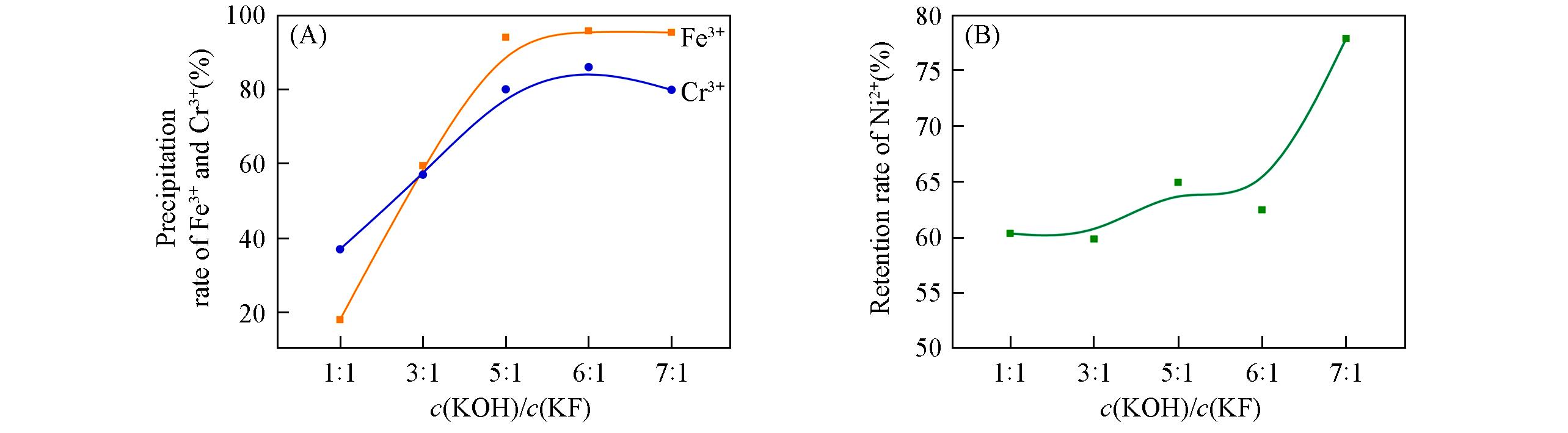
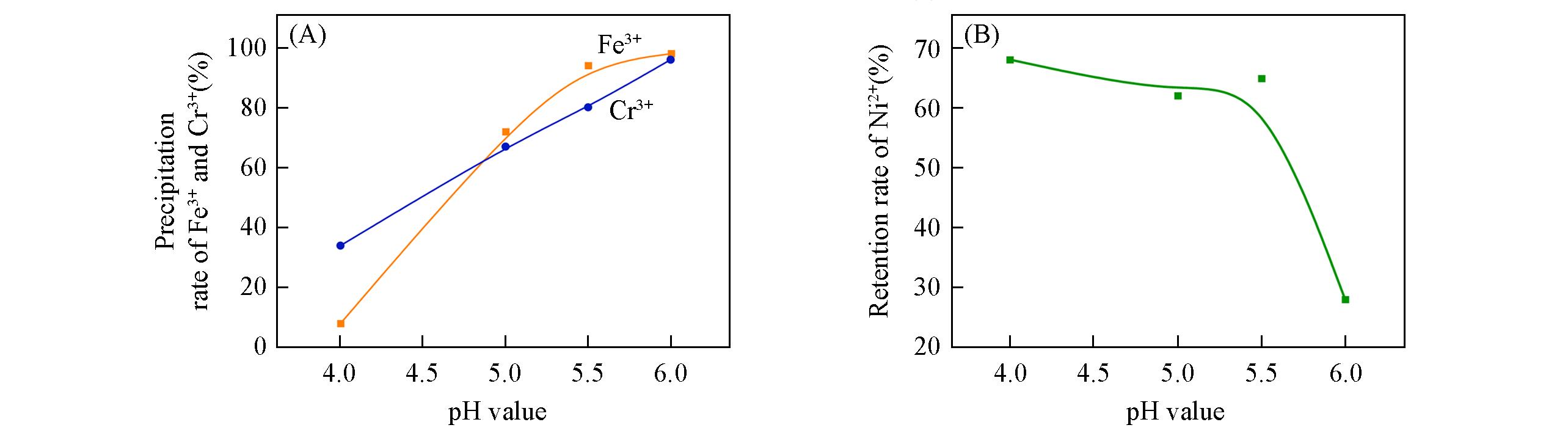
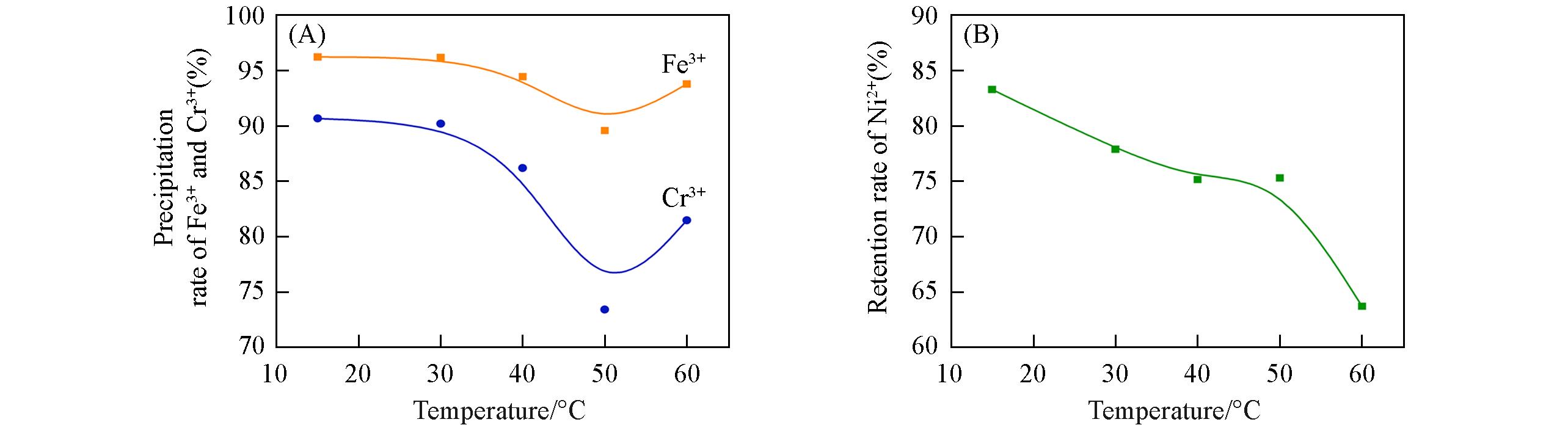
| c(HNO3)/(mol∙L-1) | c(KF)/(mol∙L-1) | Fe3+ precipitation rate (%) | Cr3+ precipitation rate (%) | Ni2+ retention rate (%) |
|---|---|---|---|---|
| 0 | 0.2 | 69.4±4.3 | 3.5±3.5 | 99.6±3.5 |
| 0 | 0.3 | 91.3±3.3 | 8.8±1.6 | 98.2±2.1 |
| 0.02 | 0.3 | 93.9±0.9 | 9.2±1.1 | 98.7±1.8 |
| 0.02 | 0.4 | 96.9±1.1 | 19.2±9.4 | 97.0±2.9 |
| 0.02 | 0.6 | 98.1±0.7 | 13.5±4.0 | 91.5±1.7 |
Table 1 Effect of HNO3 and KF concentrations on the precipitation rate of residual Fe3+ and Cr3+, and retention rate of Ni2+ in the second-step precipitation filter solution
| c(HNO3)/(mol∙L-1) | c(KF)/(mol∙L-1) | Fe3+ precipitation rate (%) | Cr3+ precipitation rate (%) | Ni2+ retention rate (%) |
|---|---|---|---|---|
| 0 | 0.2 | 69.4±4.3 | 3.5±3.5 | 99.6±3.5 |
| 0 | 0.3 | 91.3±3.3 | 8.8±1.6 | 98.2±2.1 |
| 0.02 | 0.3 | 93.9±0.9 | 9.2±1.1 | 98.7±1.8 |
| 0.02 | 0.4 | 96.9±1.1 | 19.2±9.4 | 97.0±2.9 |
| 0.02 | 0.6 | 98.1±0.7 | 13.5±4.0 | 91.5±1.7 |
| Filter solution | Precipitation condition | c(Fe3+)/ (mg∙L-1) | c(Cr3+)/ (mg∙L-1) | c(Ni2+)/ (mg∙L-1) | Mass fraction of Ni2+(%) |
|---|---|---|---|---|---|
| The first⁃step precipitation | c(KOH)∶c(KF)=7∶1, 15 ℃ | 68.5±4.0 | 28.0±1.5 | 255.0±0.2 | 72.5±1.7 |
| The second⁃step precipitation | 0.20 mol/L KF | 21.0±3.0 | 27.5±1.0 | 261.3±1.3 | 84.2±0.4 |
| 0.30 mol/L KF | 5.9±2.3 | 26.0±0.5 | 250.5±5.3 | 88.7±1.6 | |
| 0.02 mol/L HNO3+0.30 mol/L KF | 4.2±0.6 | 25.9±0.3 | 251.6±4.1 | 89.6±1.4 | |
| 0.02 mol/L HNO3+0.40 mol/L KF | 2.1±0.8 | 23.0±2.7 | 247.4±7.4 | 90.8±2.7 | |
| 0.02 mol/L HNO3+0.60 mol/L KF | 1.3±0.4 | 24.7±1.2 | 233.3±4.2 | 89.9±1.6 |
Table 2 Precipitation effect comparison of the first-step selective precipitation with the second-step precipitation
| Filter solution | Precipitation condition | c(Fe3+)/ (mg∙L-1) | c(Cr3+)/ (mg∙L-1) | c(Ni2+)/ (mg∙L-1) | Mass fraction of Ni2+(%) |
|---|---|---|---|---|---|
| The first⁃step precipitation | c(KOH)∶c(KF)=7∶1, 15 ℃ | 68.5±4.0 | 28.0±1.5 | 255.0±0.2 | 72.5±1.7 |
| The second⁃step precipitation | 0.20 mol/L KF | 21.0±3.0 | 27.5±1.0 | 261.3±1.3 | 84.2±0.4 |
| 0.30 mol/L KF | 5.9±2.3 | 26.0±0.5 | 250.5±5.3 | 88.7±1.6 | |
| 0.02 mol/L HNO3+0.30 mol/L KF | 4.2±0.6 | 25.9±0.3 | 251.6±4.1 | 89.6±1.4 | |
| 0.02 mol/L HNO3+0.40 mol/L KF | 2.1±0.8 | 23.0±2.7 | 247.4±7.4 | 90.8±2.7 | |
| 0.02 mol/L HNO3+0.60 mol/L KF | 1.3±0.4 | 24.7±1.2 | 233.3±4.2 | 89.9±1.6 |
| [1] | Zhang P. L., Du Q. J., Zhang K. X., Tian W. T., Environ. Sci., 2024, 45(11), 6336—6343 |
| 张攀路, 都沁军, 张凯旋, 田文涛. 环境科学, 2024, 45(11), 6336—6343 | |
| [2] | Li L. F., Caenen P., Daerden M., Vaes D., MeersG., Dhondt C., Celis J.P., Corros. Sci. 2005, 47(5), 1307—1324 |
| [3] | Gálvez J. L., Dufour J., Negro C., Negro F.,Mateos L., Chem. Eng. J., 2008, 136(2/3), 116—125 |
| [4] | Yang C. J., Study on the Resource Recovery Treatment Technology of Stainless Steel Pickling Wastewater, Nanjing University, Nanjing, 2012 |
| 杨才杰. 不锈钢酸洗废水资源化处理技术研究, 南京: 南京大学, 2012 | |
| [5] | Nielsen L., Møller P. M., Advanced Surface Technology: A Holistic View on the Extensive and Intertwined World of Applied Surface Engineering, 2013 |
| [6] | Agrawal A., Sahu K. K., J. Hazard. Mater., 2009, 171(1—3), 61—75 |
| [7] | Regel⁃Rosocka M., J. Hazard. Mater., 2010, 177(1—3), 57—69 |
| [8] | Yang C. J., Liu F. Q., Hou P., Li A. M., Ind. Water Treat., 2011, 31(11), 1—5 |
| 杨才杰, 刘富强, 侯鹏, 李爱民. 工业水处理, 2011, 31(11), 1—5 | |
| [9] | Kobuchi Y., Motomura H., Noma Y., Hanada F. J., J. Membr. Sci., 1986, 27, 173—179 |
| [10] | Suk J. O., Seung⁃Hyeon M., Davis T., J. Membr. Sci., 2000, 169(1), 95—105 |
| [11] | Xu T., Yang W., J. Hazard. Mater., 2004, 109(1—3), 157—164 |
| [12] | Negro C., Blanco M. A., Lopez⁃Mateos F., De Jong A. M., Sep. Sci. Technol., 2001, 36(7), 1543—1556 |
| [13] | Xu T. W., Yang W. H., Zhang Y. P., Wang Z. Z., Liu Z. M., Membr. Sci. Technol., 2002, 22(5), 46—51 |
| 徐铜文, 杨伟华, 张玉平, 王志征, 刘兆明. 膜科学与技术, 2002, 22(5), 46—51 | |
| [14] | Fu W., Environ. Pollut., 2004, 26(3), 227—228 |
| 付伟. 环境污染与防治, 2004, 26(3), 227—228 | |
| [15] | Zhao J. X., He H., Ma H. Z., Li X. M., Iron Steel Vanadium Titanium, 2010, 31(1), 84—87 |
| 赵俊学, 贺慧, 马红周, 李小明. 钢铁钒钛, 2010, 31(1), 84—87 | |
| [16] | Gerhard F., Herbert K., Wilfried S., Franz S., Process for Obtaining or Recovering Nitric Acid and Hydrofluoric Acid from Stainless Steel Pickling Solutions. EP20110718235, 2011⁃04⁃18 |
| [17] | Gerhard F., Herbert K., Wilfried S., Fabian S., Method for Obtaining or Recovering Nitric Acid and Hydrofluoric Acid from Solutions of Stainless Steel Pickling Systems, EP20110718235, 2011⁃04⁃18 |
| [18] | Li X. M., Li W. F., Wang S. J., Cui Y. R., Zhao J. X., Zeng Y., Li. F., Advanced Materials Research, 2012, 518—523, 2956—2960 |
| [19] | Zeng Y., Xi’an University of Architecture and Technology, Xi’an, 2011, 58—62 |
| 曾媛. 活性炭吸附法处理不锈钢酸洗废水研究, 西安: 西安建筑科技大学, 2011, 58—62 | |
| [20] | RöGener F., Sartor M., BáN A., Buchloh D., Reichardt T., Resour. Conserv. Recy., 2012, 60, 72—77 |
| [21] | Dufour J., Negro C., Heras F., López⁃Mateos F., ISIJ Int., 2001, 41(7), 801—806 |
| [22] | Heras F., Dufour J., Lopez⁃Delgado A., Negro C., Lopez⁃Mateos F., Environ. Eng. Sci., 2004, 21(5), 583—590 |
| [23] | Hermoso J., Dufour J., Galvez J. L., Negro C., Lopez⁃Mateos F., Ind. Eng. Chem. Res., 2005, 44(15), 5750—5756 |
| [24] | Zhou G. S., Yu G. A., Baosteel Technology, 2003, (Suppl.), 1—2 |
| 周光升, 俞国安. 宝钢技术, 2003, (增刊), 1—2 | |
| [25] | Forsberg K. M., Rasmuson Å. C., Miner. Eng., 2007, 20(9), 950—955 |
| [26] | Tjus K., Bergstrom R., Fortkamp U., Forsberg K., Rasmuson Å. R., Development of a Recovery System for Metals and Acids from Pickling Baths Using Nanofiltration and Crystallization, IVL Swedish Environmental Research Institute Ltd., 2010, 10 |
| [27] | Deng M. C., Jin W. Q., Membrane Technology Handbook(2nd Edition), Chemical Industry Press, Beijing, 2021 |
| 邓麦村, 金万勤. 膜技术手册(第二版). 北京: 化学工业出版社, 2021 | |
| [28] | Zhang X., Theoretical and Applied Reserch on Diffusion Dialysis, University of Science and Technology of China, 2014 |
| 张旭. 扩散渗析的理论与应用研究, 合肥: 中国科学技术大学, 2014 | |
| [29] | GB/T 21057⁃2007, Inorganic Chemical for Industrial Use⁃General Method for Determination of Fluorine Content⁃Ion Selective Electrode Method, Standards Press of China, Beijing, 2007 |
| GB/T 21057⁃2007, 无机化工产品中氟含量测定的通用方法 —— 离子选择性电极法, 北京: 中国标准出版社, 2007 | |
| [30] | HJ/T 345⁃2007, Water Quality⁃Determination of Iron⁃Phenanthroline Spectrophotometry, Standards Press of China, Beijing, 2007 |
| HJ/T 345⁃2007, 水质铁的测定邻菲啰啉分光光度法(试行), 北京: 中国标准出版社, 2007 | |
| [31] | GB 7466⁃87, Water Quality⁃Determination of Total Chromiun, Standards Press of China, Beijing, 1987 |
| GB 7466⁃87, 水质总铬的测定, 北京: 中国标准出版社, 1987 | |
| [32] | GB 11910⁃89, Water Quality⁃Determination of Nickel⁃Dimethylglyoxime Spectrophotometric Method, Standards Press of China, Beijing, 1989, 12 |
| GB 11910⁃89, 钢铁及合金镍含量的测定丁二酮肟分光光度法, 北京: 中国标准出版社, 1989, 12 | |
| [33] | Nie Y. G., Journal of Chuanbei College of Education, 2002, (4), 92—93 |
| 聂耀光. 川北教育学院学报, 2002, (4), 92—93 | |
| [34] | Wu Y., Wang P., Zhang G., Li X., Sep. Purif. Technol., 2017, 179, 86—93 |
| [35] | Liu Y., Deng Y. Y., Zhang Q., Liu H., Sci. Total Environ.,, 2021, 757, 143901 |
| [36] | Xiao H., Chen Q., Cheng H. R., Li X. M., Qin W. M., Chen B. S., Xiao D., Zhang W. M., J. Membr. Sci., 2017, 537, 111—118 |
| [1] | DANG Yuxin, QIN Xiaoxi, ZHANG Peng, MA Tianshu, XUE Jiayi, WANG Chao, WU Tong, ZHANG Yingying, ZHUANG Quan, LIU Jinghai. Flexible TiO2-TiSe2/Carbon Nanofiber Membrane Towards Enhancing the Rate Performance of Li/S Batteries [J]. Chem. J. Chinese Universities, 2026, 47(7): 20250340. |
| [2] | LI Xin, LV Ze, ZHONG Yi, XU Hong, MAO Zhiping, ZHANG Linping. Preparation of Ligand-functionalized MIL-101(Fe) MOFs and Their Photocatalytic Performance for CO2 Reduction [J]. Chem. J. Chinese Universities, 2026, 47(7): 20260039. |
| [3] | LIU Xu, HUANG Yuzhu, LIU Qi, CAO Hongtao. Fabrication and Refractive Index Tuning of Air Nanocolumn Array-Silica Composite Metamaterials [J]. Chem. J. Chinese Universities, 2026, 47(6): 20250338. |
| [4] | YU Kunjie, ZHANG Zhi, GAO Qilong. Research Progress on Negative Thermal Expansion Based on Machine Learning [J]. Chem. J. Chinese Universities, 2026, 47(6): 20250375. |
| [5] | WANG Xin, ZHANG Ling, ZHANG Haijun, WANG Junkai. Preparation and Hydration Resistance of Carbon Nanotubes-CaCO3 co-Coated Superhydrophobic MgO-CaO Grains [J]. Chem. J. Chinese Universities, 2026, 47(6): 20250216. |
| [6] | CHEN Junjie, XU Hankun, LI Qiang, DENG Jinxia, LIN Kun. A New Perspective on Magnetic Metal Oxides: The Challenges of Amorphization [J]. Chem. J. Chinese Universities, 0, (): 20260142. |
| [7] | WANG Ce. Microwave synthesis of anionic MOFs and effective dye and iodine capture [J]. Chem. J. Chinese Universities, 0, (): 20260124. |
| [8] | MU Rongzhen, WANG Jin, YANG Jie, ROY Tania, WANG Jie, GUO Baocheng, ZHOU Chunhui. Cl-Mediated Facet Engineering and Electronic Modulation of Fe/MgO-CaO Catalysts for Glycerol Hydrogenolysis [J]. Chem. J. Chinese Universities, 0, (): 20250394. |
| [9] | CHEN Yang, WANG Fuxiang, QIU Yiduo, HUANG Yutong, ZHAO Xiaojun, PAN Qinhe. Controlled Synthesis of Zinc Oxide Microcrystals with Distinct Morphologies via Hydrothermal Method [J]. Chem. J. Chinese Universities, 2026, 47(2): 20250208. |
| [10] | XU Haiyan, LIU Qi, MENG He, LIU Fengqi, LIU Yuxin, LI Jiawei, LI Changyan. Regulation of Macrophage Polarization by Ce-Cur Nanoenzymes [J]. Chem. J. Chinese Universities, 2025, 46(12): 20250188. |
| [11] | AN Jing, MIAO Bo, ZHAO Tongyi, SONG Jialong, ZHANG Wenyu, YUAN Bizhen, LIU Yaozu, ZHONG Tian, FANG Qianrong. A Novel Anthracene-based Two-dimensional Covalent Organic Framework Nanosheet for Rapid Singlet Oxygen Capture and Controllable Release [J]. Chem. J. Chinese Universities, 2025, 46(12): 20250117. |
| [12] | QI Wenjia, ZHAO Kaiqing, WU Gang, WUMAIER·Yasen , TONG Gangsheng. Fabrication of High-reflectance and Low-thermal-conductivity HGM@TiO₂@ZnO Core-shell-shell Material via Rotational Coating [J]. Chem. J. Chinese Universities, 2025, 46(11): 20250185. |
| [13] | LIANG Jianing, FU Kaiqi, ZHOU Rui, YE Lili, WANG Li, LIU Zhaomin, SUN Lin, DONG Yan. Construction of Thermosensitive Drug Controlled Release System for Highly Efficient Chemo-photothermal Tumor Therapy [J]. Chem. J. Chinese Universities, 2025, 46(9): 20250068. |
| [14] | ZENG Xiangchu, DING Yixuan, WU Zhe, WANG Yanping, LIU Mu. In situ Cupric Complexation Regulated Fenton-like Oxidation to Enhance the Selective Decontamination of Trace Aqueous Quinolones [J]. Chem. J. Chinese Universities, 2025, 46(3): 20240358. |
| [15] | YUE Xin, JIA Tingfang, CHEN Yao, ZHOU Yuanzhu, QU Jiafei, LI Cong, SHEN Jing. Near-infrared Light Curing of Dental Resin Composite Doped with Rare Earth Upconversion Nanoparticles [J]. Chem. J. Chinese Universities, 2025, 46(1): 20240167. |
| Viewed | ||||||
|
Full text |
|
|||||
|
Abstract |
|
|||||
