

Chem. J. Chinese Universities ›› 2026, Vol. 47 ›› Issue (6): 20250307.doi: 10.7503/cjcu20250307
• Physical Chemistry • Previous Articles Next Articles
CHENG Yaoyang1, LIN Weizhi1, LE Yu1, LI Songtao2, LI Rujin2, KANG Jincan1( )
)
Received:2025-10-21
Online:2026-06-10
Published:2025-12-11
Contact:
KANG Jincan
E-mail:kangjc@xmu.edu.cn
Supported by:CLC Number:
TrendMD:
CHENG Yaoyang, LIN Weizhi, LE Yu, LI Songtao, LI Rujin, KANG Jincan. Modified Molybdenum Disulfide Catalyst for Hydrogenation of Carbon Dioxide to Methanol[J]. Chem. J. Chinese Universities, 2026, 47(6): 20250307.
| Catalyst | CO2 conv.(%) | Selectivity(%) | |||
|---|---|---|---|---|---|
| CO | CH3OH | CH4 | Other | ||
| MoS2⁃AT | 12.3 | 9.9 | 83.7 | 6.0 | 0.4 |
| MoS2⁃ST | 7.5 | 11.3 | 84.5 | 3.9 | 0.3 |
| MoS2⁃SMT | 8.5 | 14.8 | 82.3 | 2.2 | 0.7 |
| MoS2⁃MP | 8.7 | 9.8 | 87.5 | 2.5 | 0.2 |
Table 1 Catalytic performances of MoS2 catalysts synthesized by different molybdenum and sulfur sources for CO2 hydrogenation*
| Catalyst | CO2 conv.(%) | Selectivity(%) | |||
|---|---|---|---|---|---|
| CO | CH3OH | CH4 | Other | ||
| MoS2⁃AT | 12.3 | 9.9 | 83.7 | 6.0 | 0.4 |
| MoS2⁃ST | 7.5 | 11.3 | 84.5 | 3.9 | 0.3 |
| MoS2⁃SMT | 8.5 | 14.8 | 82.3 | 2.2 | 0.7 |
| MoS2⁃MP | 8.7 | 9.8 | 87.5 | 2.5 | 0.2 |
| Catalyst | CO2 conv.(%) | Selectivity(%) | |||
|---|---|---|---|---|---|
| CO | CH3OH | CH4 | Other | ||
| MoS2⁃180 | 12.3 | 9.9 | 83.7 | 6.0 | 0.4 |
| MoS2⁃190 | 13.7 | 8.5 | 82.0 | 9.0 | 0.5 |
| MoS2⁃200 | 13.0 | 9.7 | 83.3 | 6.6 | 0.4 |
| MoS2⁃210 | 11.4 | 6.9 | 79.9 | 12.8 | 0.4 |
| MoS2⁃220 | 11.5 | 7.3 | 82.1 | 10.1 | 0.5 |
Table 2 Catalytic performances of MoS2 catalysts synthesized under different hydrothermal temperatures for CO2 hydrogenation*
| Catalyst | CO2 conv.(%) | Selectivity(%) | |||
|---|---|---|---|---|---|
| CO | CH3OH | CH4 | Other | ||
| MoS2⁃180 | 12.3 | 9.9 | 83.7 | 6.0 | 0.4 |
| MoS2⁃190 | 13.7 | 8.5 | 82.0 | 9.0 | 0.5 |
| MoS2⁃200 | 13.0 | 9.7 | 83.3 | 6.6 | 0.4 |
| MoS2⁃210 | 11.4 | 6.9 | 79.9 | 12.8 | 0.4 |
| MoS2⁃220 | 11.5 | 7.3 | 82.1 | 10.1 | 0.5 |
| Catalyst | CO2 conv.(%) | Selectivity(%) | |||
|---|---|---|---|---|---|
| CO | CH3OH | CH4 | Other | ||
| MoS2 | 13.7 | 8.5 | 82.0 | 9.0 | 0.5 |
| 1%Cu/MoS2 | 12.2 | 12.9 | 81.2 | 5.0 | 0.9 |
| 1%In/MoS2 | 12.1 | 3.9 | 90.3 | 5.5 | 0.3 |
| 1%Zn/MoS2 | 14.8 | 5.0 | 90.5 | 4.0 | 0.5 |
| 1%K/MoS2 | 14.1 | 13.2 | 80.0 | 6.4 | 0.4 |
| 1%Pt/MoS2 | 17.8 | 35.6 | 57.2 | 6.9 | 0.3 |
| 1%Ga/MoS2 | 12.9 | 3.9 | 88.9 | 6.0 | 1.2 |
| 1%Cd/MoS2 | 13.6 | 4.1 | 87.9 | 7.4 | 0.6 |
Table 3 Catalytic performances of 1%X/MoS2 catalysts for CO2 hydrogenation*
| Catalyst | CO2 conv.(%) | Selectivity(%) | |||
|---|---|---|---|---|---|
| CO | CH3OH | CH4 | Other | ||
| MoS2 | 13.7 | 8.5 | 82.0 | 9.0 | 0.5 |
| 1%Cu/MoS2 | 12.2 | 12.9 | 81.2 | 5.0 | 0.9 |
| 1%In/MoS2 | 12.1 | 3.9 | 90.3 | 5.5 | 0.3 |
| 1%Zn/MoS2 | 14.8 | 5.0 | 90.5 | 4.0 | 0.5 |
| 1%K/MoS2 | 14.1 | 13.2 | 80.0 | 6.4 | 0.4 |
| 1%Pt/MoS2 | 17.8 | 35.6 | 57.2 | 6.9 | 0.3 |
| 1%Ga/MoS2 | 12.9 | 3.9 | 88.9 | 6.0 | 1.2 |
| 1%Cd/MoS2 | 13.6 | 4.1 | 87.9 | 7.4 | 0.6 |
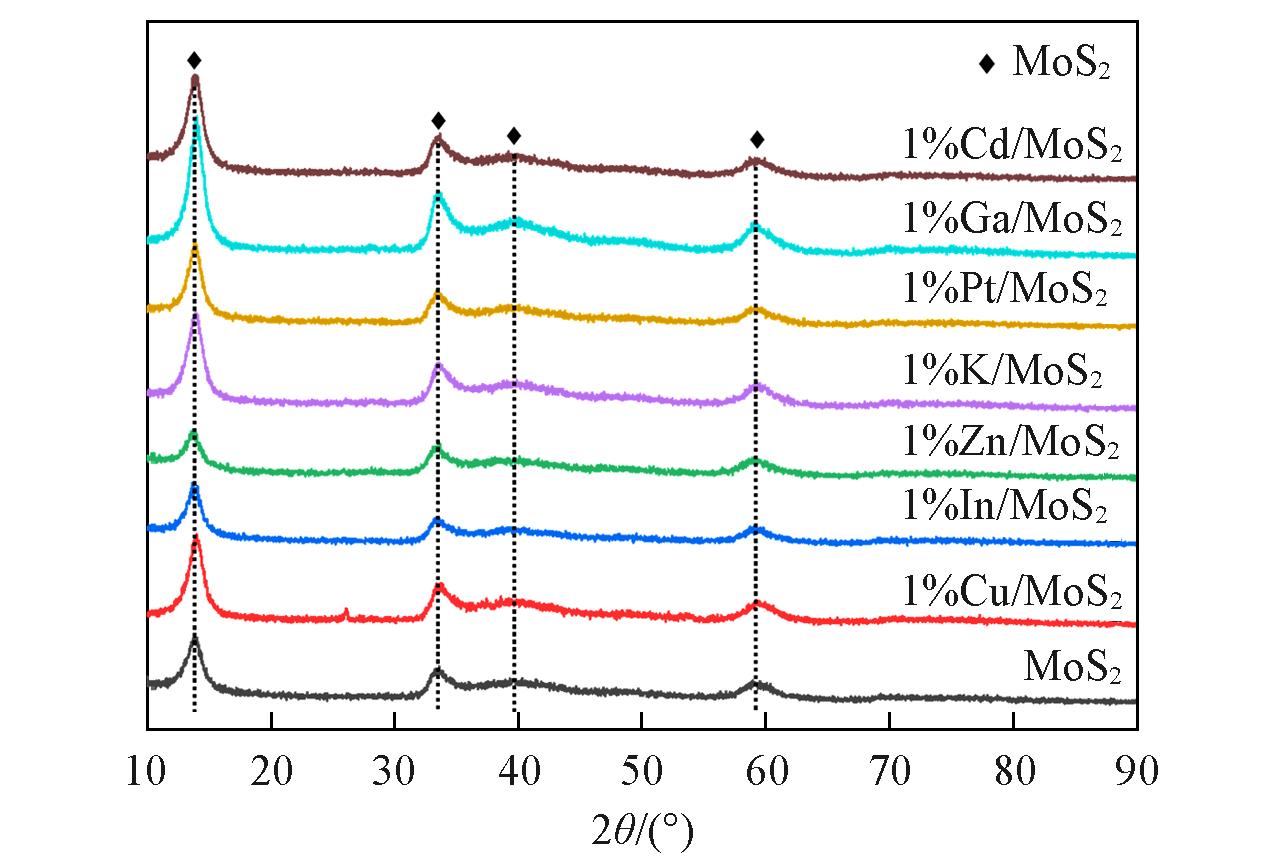
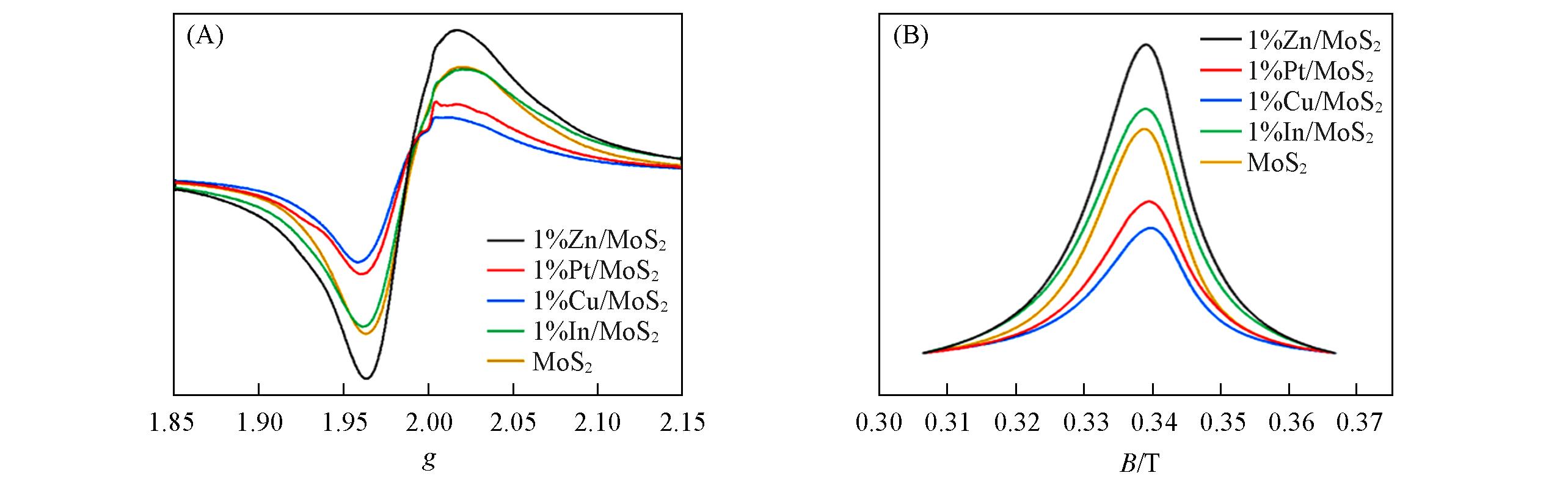
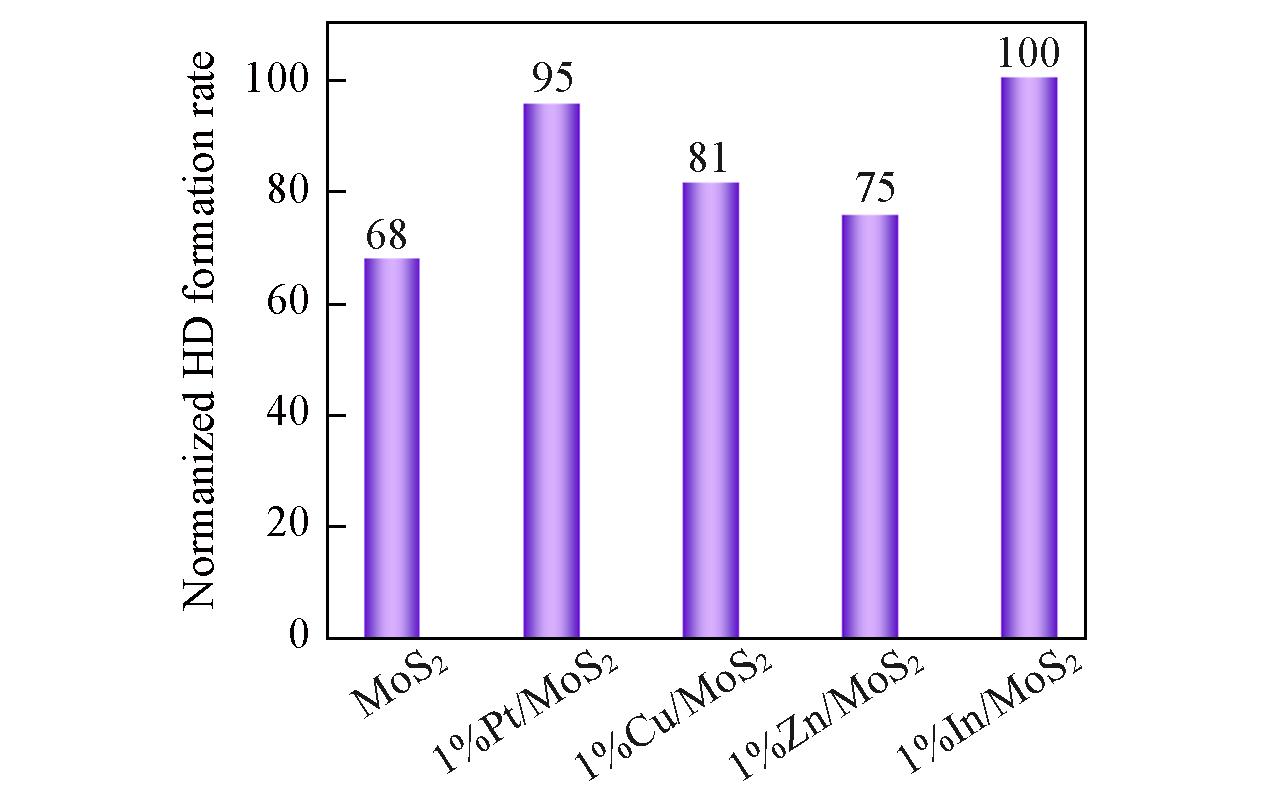
| Catalyst | CO2 conv.(%) | Selectivity(%) | |||
|---|---|---|---|---|---|
| CO | CH3OH | CH4 | Other | ||
| MoS2 | 13.7 | 8.5 | 82.0 | 9.0 | 0.5 |
| 0.5%Zn/MoS2 | 13.9 | 5.5 | 88.1 | 5.8 | 0.6 |
| 1%Zn/MoS2 | 14.8 | 5.0 | 90.5 | 4.0 | 0.5 |
| 2%Zn/MoS2 | 13.7 | 5.5 | 91.2 | 3.0 | 0.3 |
| 3%Zn/MoS2 | 12.8 | 5.1 | 89.7 | 4.8 | 0.4 |
| 4%Zn/MoS2 | 11.6 | 6.2 | 88.9 | 4.5 | 0.4 |
Table 4 Catalytic performances of xZn/MoS2 catalysts on CO2 hydrogenation*
| Catalyst | CO2 conv.(%) | Selectivity(%) | |||
|---|---|---|---|---|---|
| CO | CH3OH | CH4 | Other | ||
| MoS2 | 13.7 | 8.5 | 82.0 | 9.0 | 0.5 |
| 0.5%Zn/MoS2 | 13.9 | 5.5 | 88.1 | 5.8 | 0.6 |
| 1%Zn/MoS2 | 14.8 | 5.0 | 90.5 | 4.0 | 0.5 |
| 2%Zn/MoS2 | 13.7 | 5.5 | 91.2 | 3.0 | 0.3 |
| 3%Zn/MoS2 | 12.8 | 5.1 | 89.7 | 4.8 | 0.4 |
| 4%Zn/MoS2 | 11.6 | 6.2 | 88.9 | 4.5 | 0.4 |
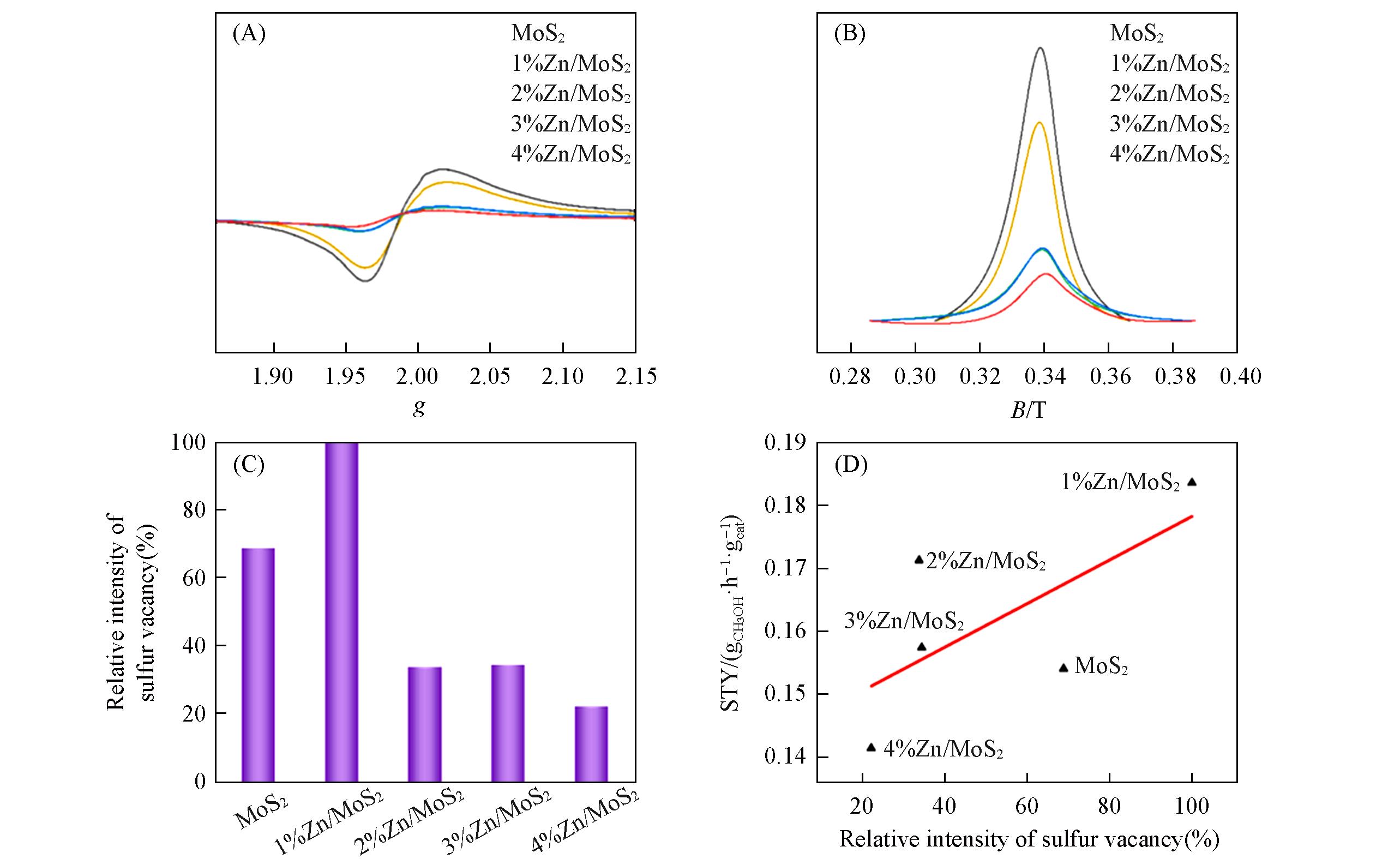
| [1] | McLaughlin H., Littlefield A. A., Menefee M., Austin K., Tobias H., Benjamin K., Morgan D., Jinsoo K., Steven G., Renew. Sustain. Energy Rev., 2023, 177, 113215 |
| [2] | Ye J., Dimitratos N., Rossi L., Thonemann N., Beale A., Wojcieszak R., Science, 2025, 387, eadn9388 |
| [3] | Behrens M., Studt F., Kasatkin I., Kühl S., Hävecker M., Abild P. F., Zander S., Girgsdies F., Kurr P., Kniep B., Tovar M., Richard W., Jens K., Robert S., Science, 2012, 336, 1219831 |
| [4] | Zhang B., Liu R., Li L., Guo W., Zhang B., Chen B., Yuan W., Li P., Zhang S., Wang J., Yang J., Luo Z., Guo Y., Nat. Commun., 2025, 16, 7847 |
| [5] | Jaroslav P., Jan B., Jirí V., Jan S., Tomas H., Jhonatan R., Milos S., React. Funct. Polym., 2025, 217, 106478 |
| [6] | Hu J., Cai Y., Xie J., Hou D., Yu L., Deng D., Chem, 2024, 10, 1084—1117 |
| [7] | Xu Z., Ying X., Lei W., Nano Res., 2024, 17, 960—981 |
| [8] | Ding S., Duan J., Chen S., EcoEnergy, 2024, 2, 45—82 |
| [9] | Wang Y., Wang L., Zhang J., Cai X., Diao J., Yang L., Liu H., EcoEnergy, 2023, 1, 207—214 |
| [10] | Shi Y., Zhang D., Miao H. F., Wu X. K., Wang Z. C., Zhan T. R., Lai J. P., Wang L., Sci. China Chem., 2022, 65, 1829—1837 |
| [11] | Xiong H., Kunwar D., Jiang D. E., García V. C., Li H., Du C., Canning G., Pereira H. X., Wan Q., Lin S. C., Purdy S. T., Miller J., Leung K. S., Chou S. H., Brongersma H., Veen R., Huang J., Guo H., Wang Y. K., Datye A., Nat. Catal., 2021, 4, 830—839 |
| [12] | Hu J., Yu L., Deng J., Wang Y., Cheng K., Ma C., Zhang Q., Wen W., Yu S., Pan Y., Yang J., Ma H., Qi F., Wang Y., Zheng Y., Chen M., Huang R., Zhang S., Zhao Z., Mao J., Meng X., Ji Q., Hou G., Han X., Bao X., Wang Y., Deng D., Nat. Catal., 2021, 4, 242—250 |
| [13] | Zhou S., Zeng H., ACS Catal., 2022, 12, 9872—9886 |
| [14] | Zhou S., Ma W., Anjum U., Kosari M., Xi S., Kozlov M. S., Zeng H., Nat. Commun., 2023, 14, 5872 |
| [15] | Li Y., Wang S., Hu Y., Zhou X., Zhang M., Jia X., Yang Y., Lin B., Chen G., J. Mater. Chem. A, 2022, 10, 5273—5279 |
| [16] | Li X., Huang J., Yuan M., Zhao Y., Li M., Du J., Li J., Wu F., You Z., Appl. Catal. B: Environ., 2026, 382, 125970 |
| [17] | Lei Y., Hou J., Wang F., Ma X., Jin Z., Xu J., Min S., Appl. Surf. Sci., 2017, 420, 456—464 |
| [18] | Yang F., Zhou W., Yang C., Zhang T., Huang Y., Acta Physico⁃Chim. Sin., 2024, 40, 2308017 |
| [19] | Jiang X., Li X., Xiong S., Liu W., Yan J., Duan X., Song S., Cheng Q., Tian Y., Li X., Carbon Capture Science Technology, 2025, 14, 100376 |
| [20] | Li H., Yin Z., He Q., Li H., Huang X., Lu G., Fam D., Tok A., Zhang Q., Zhang H., Small, 2012, 8, 63—67 |
| [21] | Halim U., Zheng C. R., Chen Y., Lin Z., Jiang S., Cheng R., Huang Y., Duan X., Nat. Commun., 2013, 4, 2213 |
| [22] | Zhu X., Su Z., Wu C., Cong H., Ai X., Yang H., Qian J., Nano Lett., 2022, 22, 2956—2963 |
| [23] | Amani M., Burke R. A., Ji X., Zhao P., Lien D., Taheri P., Ahn G., Kirya D., Ager W. J., Yablonovitch E., Kong J., Dubey M., Javey A., ACS Nano, 2016, 10, 6535—6541 |
| [24] | Garcia⁃Esparza A. T., Park S., Abroshan H., Paredes A. O., Vinson J., Abraham B., Kim R. T., Nordlund D., Gallo A., Alonso⁃Mori R., Zheng X., Sokaras D., ACS Nano, 2022, 16, 6725—6733 |
| [25] | Ye L., Xu H., Zhang D., Chen S., Mater. Res. Bull., 2014, 55, 221—228 |
| [26] | He F., Luo J., Liu S., Chem. Eng. J., 2016, 294, 362—370 |
| [27] | Marinov A. D., Bravo P. L., Shah A. R., Miller T. S., Howard C. A., Hinds G., Shearing P. R., Cullen P. L., Brett D., ACS Nano, 2023, 17, 5163—5186 |
| [28] | Niu Z., Gao X., Lou S., Wen N., Zhao J., Zhang Z., Ding Z., Yuan R., Dai W., Long J., ACS Catal., 2023, 13, 2998—3006 |
| [29] | Chen K., Wang F., Wang Y., Zhang F., Huang X., Kang J., Zhang Q., Wang Y., JACS Au, 2023, 3, 2894—2904 |
| [30] | MaY., Leng D., Zhang X., Fu J., Pi C., Zheng Y., Gao B., Li X., Li N., Chu P., Luo Y., Huo K., Small, 2022, 18, 2203173 |
| [31] | Yang S. D., Zheng Y. X., Yang L., Liu Z. H., Zhou W. J., Wang S. Y., Zhang R. J., Chen L. Y., Appl. Surf. Sci., 2017, 421, 891 |
| [32] | Hou S., Lian Y., Xu Z., Wang D., Ban C., Zhao J., Zhang H., Electrochimica Acta, 2020, 330, 135208 |
| [33] | Zhang Z., Zuo J., Luo L., Yang X., Ma Z., Jin H., Yuan Y., Qian Q., Chen Q., Luo Y., J. Catal., 2024, 436, 115621 |
| [34] | Fei H., Liu R., Wang J., Guo T., Wu Z., Wang D., Liu F., Adv. Funct. Mater., 2023, 33, 2302501 |
| [35] | Zhang S., Wang H., Joule, 2021, 5, 1038—1040 |
| [36] | Huang F., Wang S., Zhang L., Sep. Purif. Technol., 2025, 365, 132681 |
| [37] | Qin L., Gao Y., Han C., Zhu M., Wang S., J. Mater. Chem. A, 2024, 12, 20107 |
| [1] | ZHOU Zixuan, YANG Haiyan, SUN Yuhan, GAO Peng. Recent Progress in Heterogeneous Catalysts for the Hydrogenation of Carbon Dioxide to Methanol [J]. Chem. J. Chinese Universities, 2022, 43(7): 20220235. |
| [2] | ZHANG Lin, ZHANG Wei, YUE Xin, LI Pengjie, YANG Zuoyin, PU Min, LEI Ming. Theoretical Study on Mechanism of CO2 Hydrogenation to Formic Acid Catalyzed by Manganese Complex † [J]. Chem. J. Chinese Universities, 2019, 40(9): 1911. |
| [3] | LIU Rong, ZHA Fei, YANG Aimei, CHANG Yue. Synthesis of Light Olefins from CO2 Hydrogenation Catalyzed over Rare Earths Modified CuO-ZnO-ZrO2/SAPO-34† [J]. Chem. J. Chinese Universities, 2016, 37(5): 964. |
| [4] | LI Zhong*, GUO Qi-Hai, ZHANG Xiao-Bing, ZHENG Hua-Yan, FAN Hui, XIE Ke-Chang. Influence of the Precursor Phase Transition on the Catalyst Activity in Slurry Methanol Synthesis [J]. Chem. J. Chinese Universities, 2009, 30(11): 2215. |
| [5] | CAO Yong, CHEN Li-Fang, DAI Wei-Lin, FAN Kang-Nian, WU Dong, SUN Yu-Han . Preparation of High Performance Cu/ZnO/Al2O3 Catalyst for Methanol Synthesis from CO2 Hydrogenation by Coprecipitation-reduction [J]. Chem. J. Chinese Universities, 2003, 24(7): 1296. |
| [6] | FU Gang, LÜ Xin, XU Xin, WAN Hui-Lin . The UBI-QEP Study of CO2 Activation on the Metal Surfaces [J]. Chem. J. Chinese Universities, 2002, 23(8): 1570. |
| [7] | HONG Zhong-Shan, DENG Jing-Fa, FAN Kang-Nian, CAO Yong. Preparation of Methanol Synthesis Catalyst Cu/ZnO/Al2O3by Gel-network Coprecipitation Method [J]. Chem. J. Chinese Universities, 2002, 23(4): 706. |
| [8] | LI Ji-Tao, Au-Chak-Tong, CHEN Ming-Dan, ZHANG Wei-De . The Role of CO in the Synthesis of Methanol from the Hydrogenation of Carbon Dioxide [J]. Chem. J. Chinese Universities, 1998, 19(6): 926. |
| [9] | WANG Hai-You, XIA Wen-Sheng, WAN Hui-Lin, QU Zeng-Shang. Reaction Energetics for Methanol Synthesis from CO2/H2 over the Clean and the Oxygen-Modified Cu(100) Surfaces [J]. Chem. J. Chinese Universities, 1997, 18(7): 1120. |
| [10] | SUN Qi, ZHANG Yu-Long, MA Yan, DENG Jing-Fa. Comparison Studies on the Catalysis Process of Methanol Synthesis from CO2+H2 and (CO/CO2) +H2 [J]. Chem. J. Chinese Universities, 1997, 18(7): 1131. |
| [11] | SHEN Bai-Rong, HAN Ji-Hong, SUN Qi, FAN Kang-Nian, GU Chang-Xin, DENG Jing-Fa. EXAFS Studies on Cu/ZnO/MxOy Catalysts for Methanol Synthesis [J]. Chem. J. Chinese Universities, 1997, 18(12): 2038. |
| [12] | YANG Yi-Quan, LIN Zhong-Yu, CHE Chang-Zhen, YUANG You-Zhu, LIN Ren-Cun, DONG Yuan-Qun. Spectroscopic Characterization of the Active Site of NC208 Modified Copper-based Catalyst for Methanol Synthesis [J]. Chem. J. Chinese Universities, 1997, 18(1): 103. |
| [13] | XU Yong, LU Guan-Zhong, WANG Ren. Studies on the Surface Chemical State of Cu-Zn-O Catalyst for Methanol Synthesis from Carbon Dioxide with Hydrogen [J]. Chem. J. Chinese Universities, 1994, 15(4): 580. |
| [14] | ZHANG Yu-Long, WANG Huan, Deng Jing-Fa. Effect of Preparation Methods for Cu/ZnO/Al2O3 Catalyst on Methanol Synthesis from CO2+H2 [J]. Chem. J. Chinese Universities, 1994, 15(10): 1547. |
| [15] | Li Kai, Xu Zheng, Qian Zaihu . Studies on Methanol Synthesis from CO2+H2over Supported Rhenium Catalysts [J]. Chem. J. Chinese Universities, 1989, 10(2): 214. |
| Viewed | ||||||
|
Full text |
|
|||||
|
Abstract |
|
|||||
