

Chem. J. Chinese Universities ›› 2026, Vol. 47 ›› Issue (9): 20260234.doi: 10.7503/cjcu20260234
• Review • Previous Articles
PEI Tianyao1, WANG Yonggang2( ), YUE Binbin1
Received:2026-06-10
Online:2026-09-10
Published:2026-07-20
Contact:
WANG Yonggang
E-mail:ygw@pku.edu.cn
Supported by:CLC Number:
TrendMD:
PEI Tianyao, WANG Yonggang, YUE Binbin. In-Situ High-pressure Characterization Techniques and Research on Pressure-induced Phase Transition Materials[J]. Chem. J. Chinese Universities, 2026, 47(9): 20260234.

| Technique | Probe | Length scale | Sample requirement | Ref. |
|---|---|---|---|---|
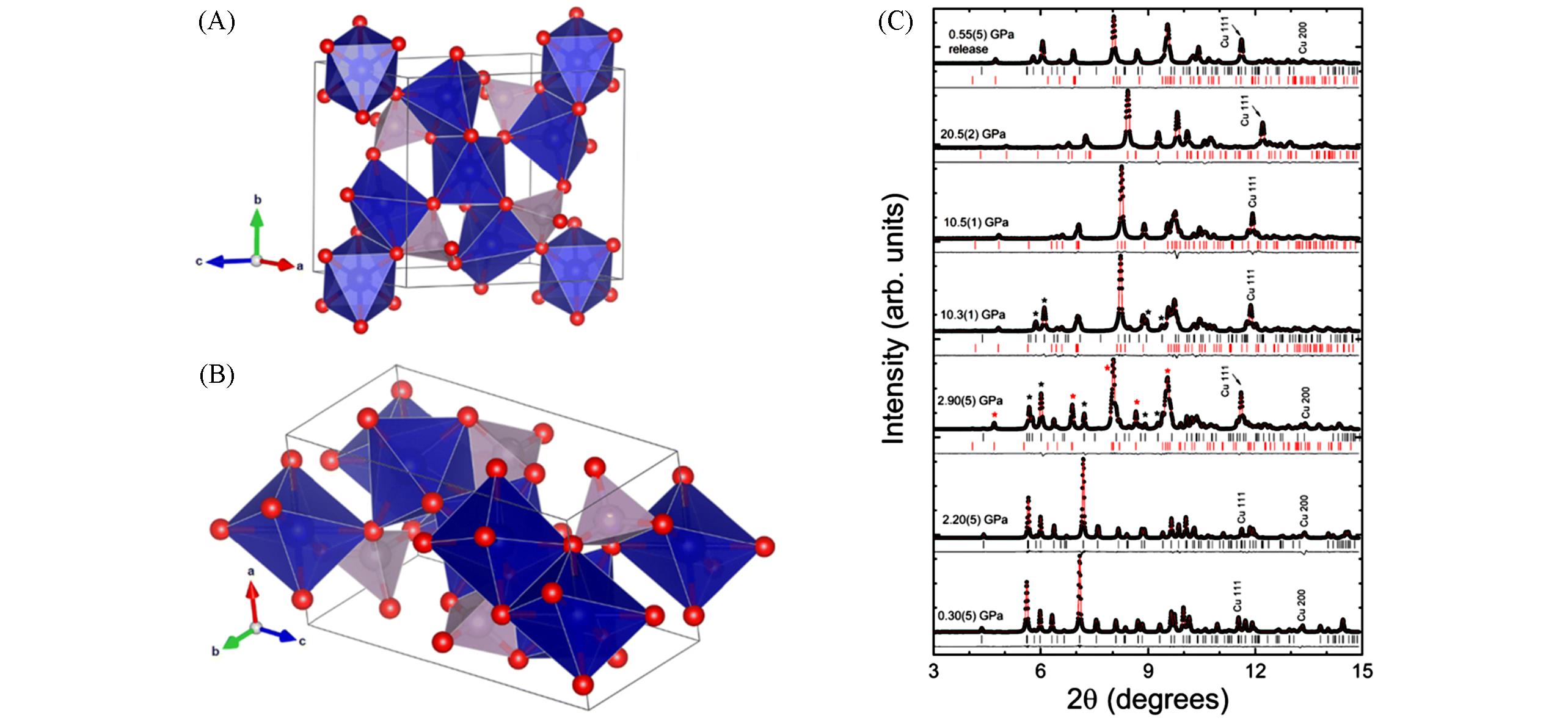
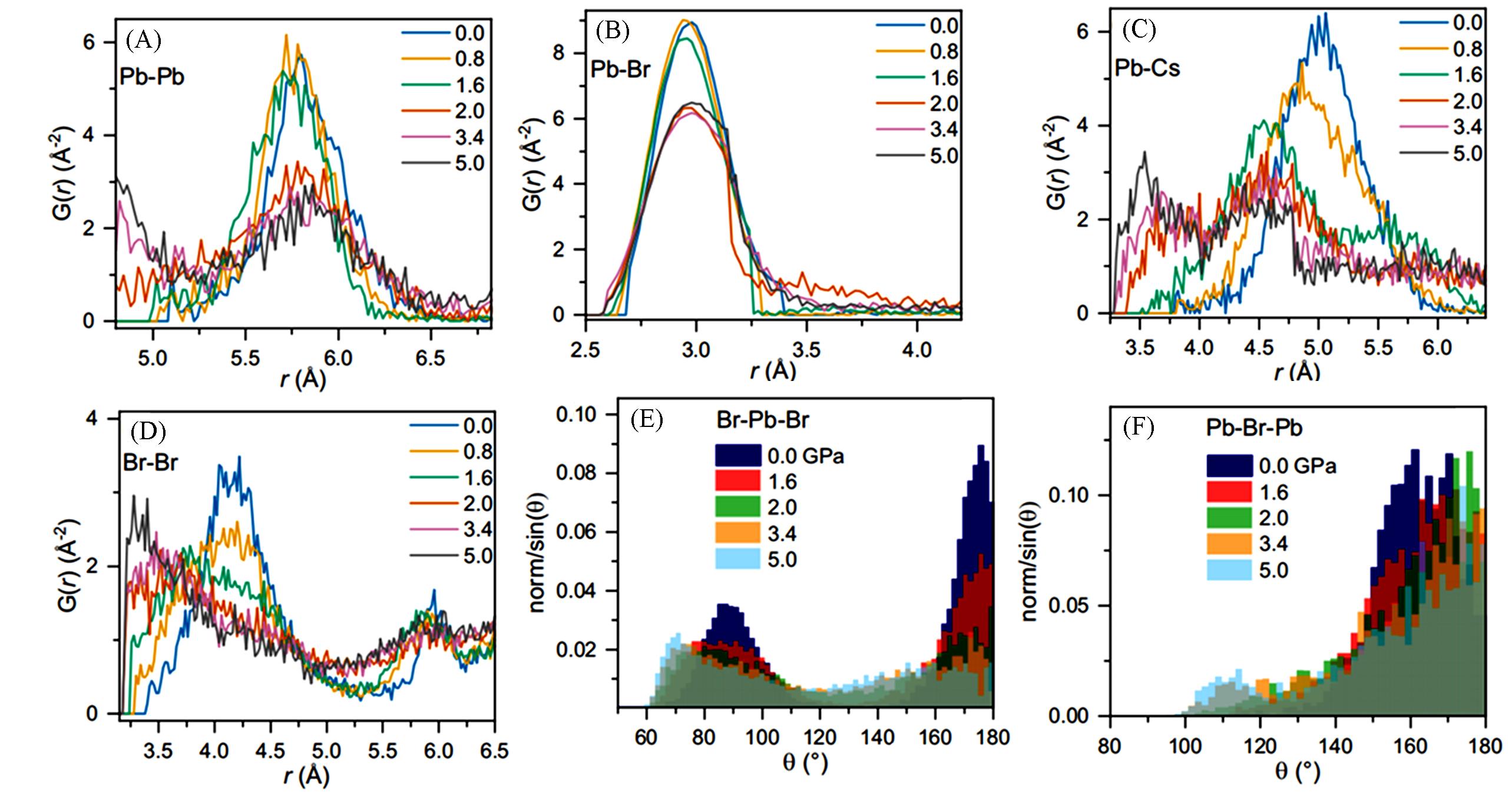
| XRD | Lattice parameters, space group, phase transition pathway | Long⁃range | Crystalline(powder/single crystal) | [ |
| Neutron diffraction | Light atom positions, magnetic structure, lattice dynamics | Long-range | Crystalline(large volume required) | [ |
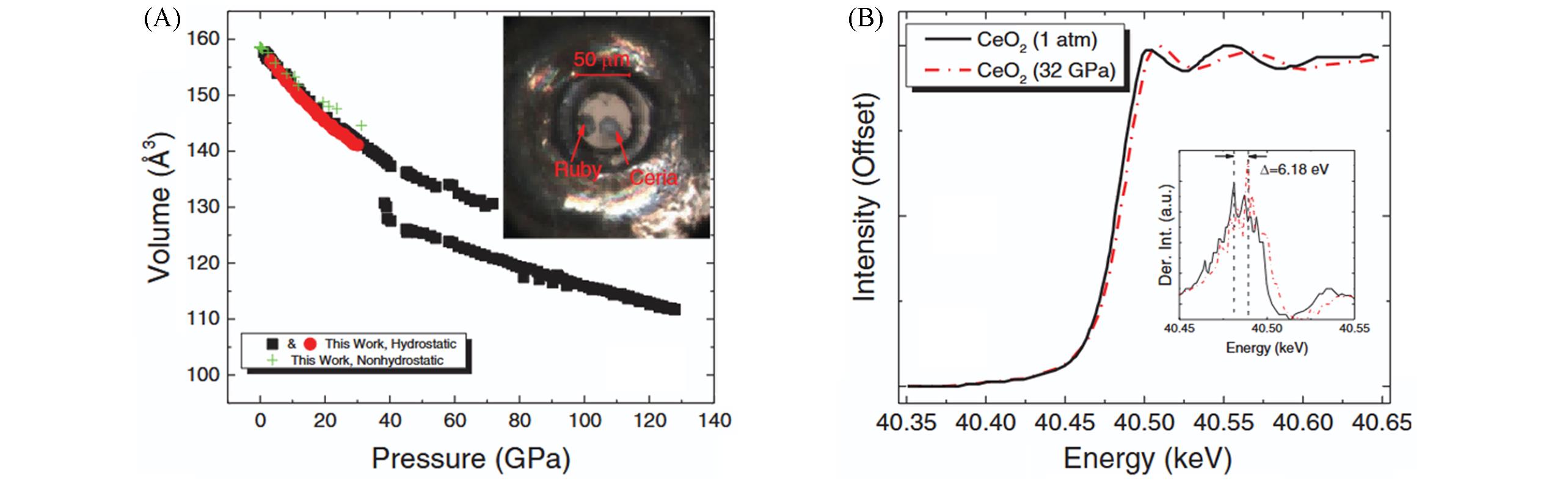
| XANES | Valence state, spin state, orbital occupancy, symmetry | Electronic+local structure | Crystalline/amorphous | [ |
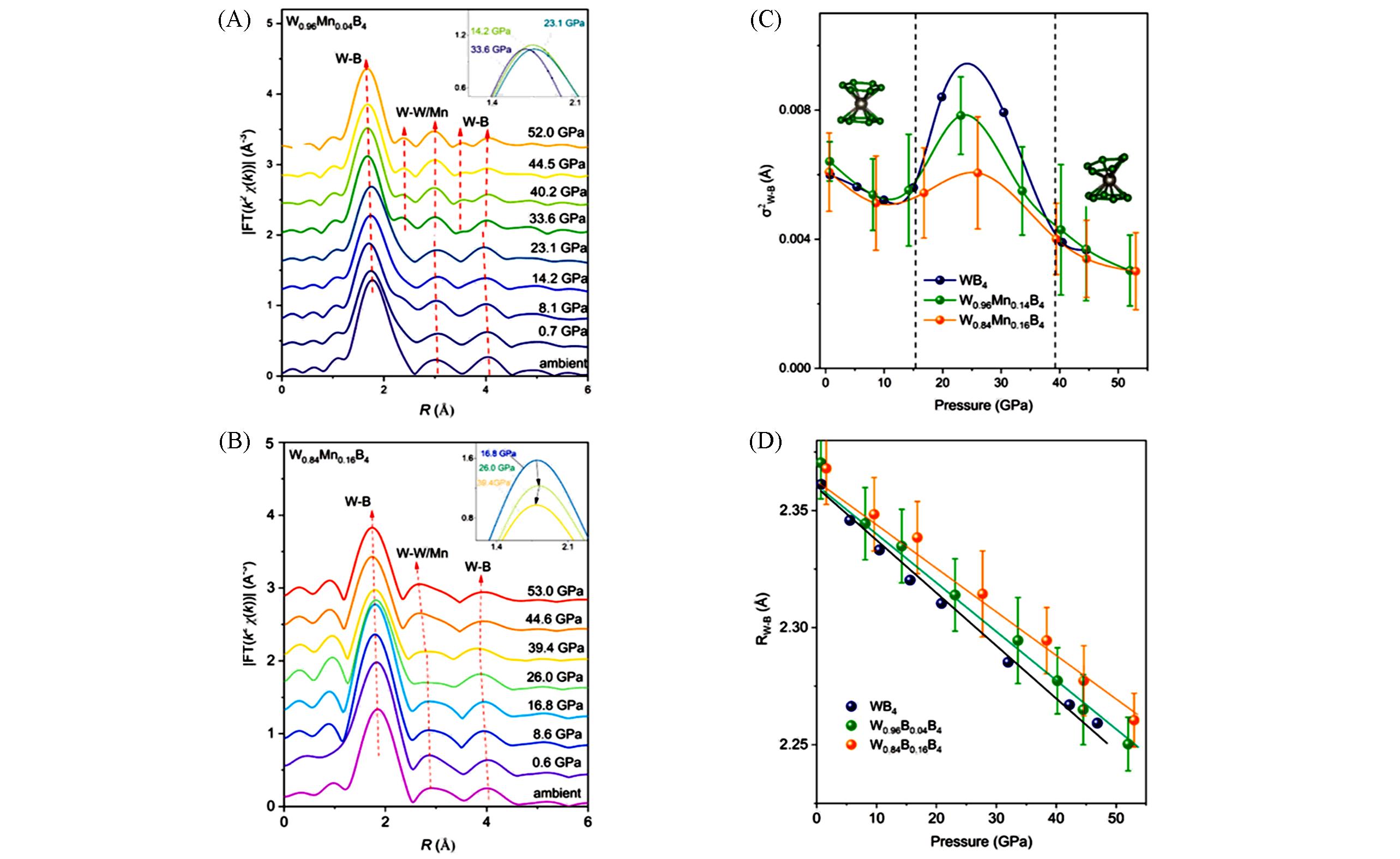
| EXAFS | Bond lengths, coordination numbers, disorder (Debye-Waller factor) | Local atomic configuration | Crystalline/amorphous | [ |
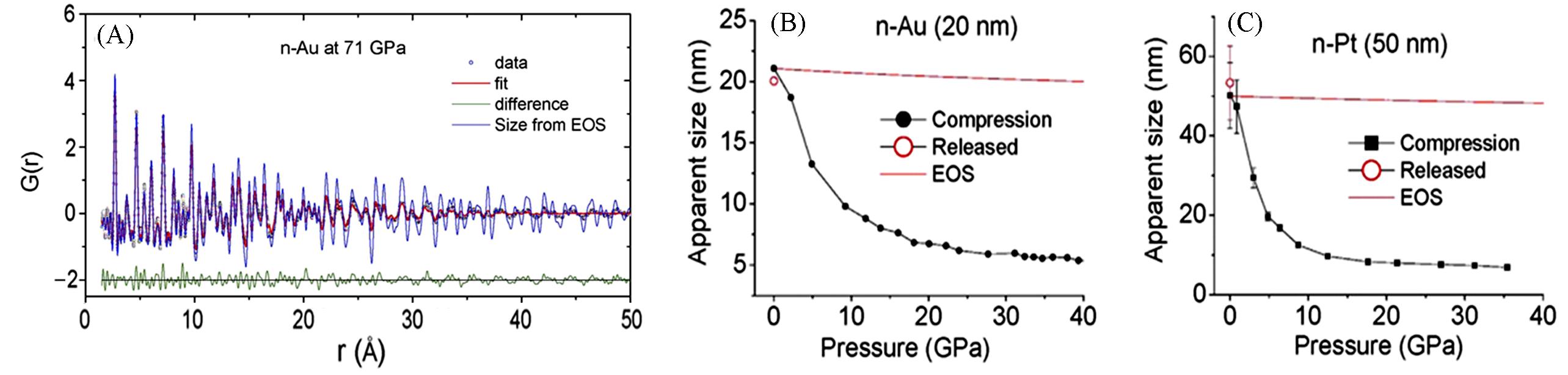
Atomic pair distances, bond lengths, coordination numbers, disorder | Short-to-medium range | Crystalline/amorphous/ liquid | [ | |
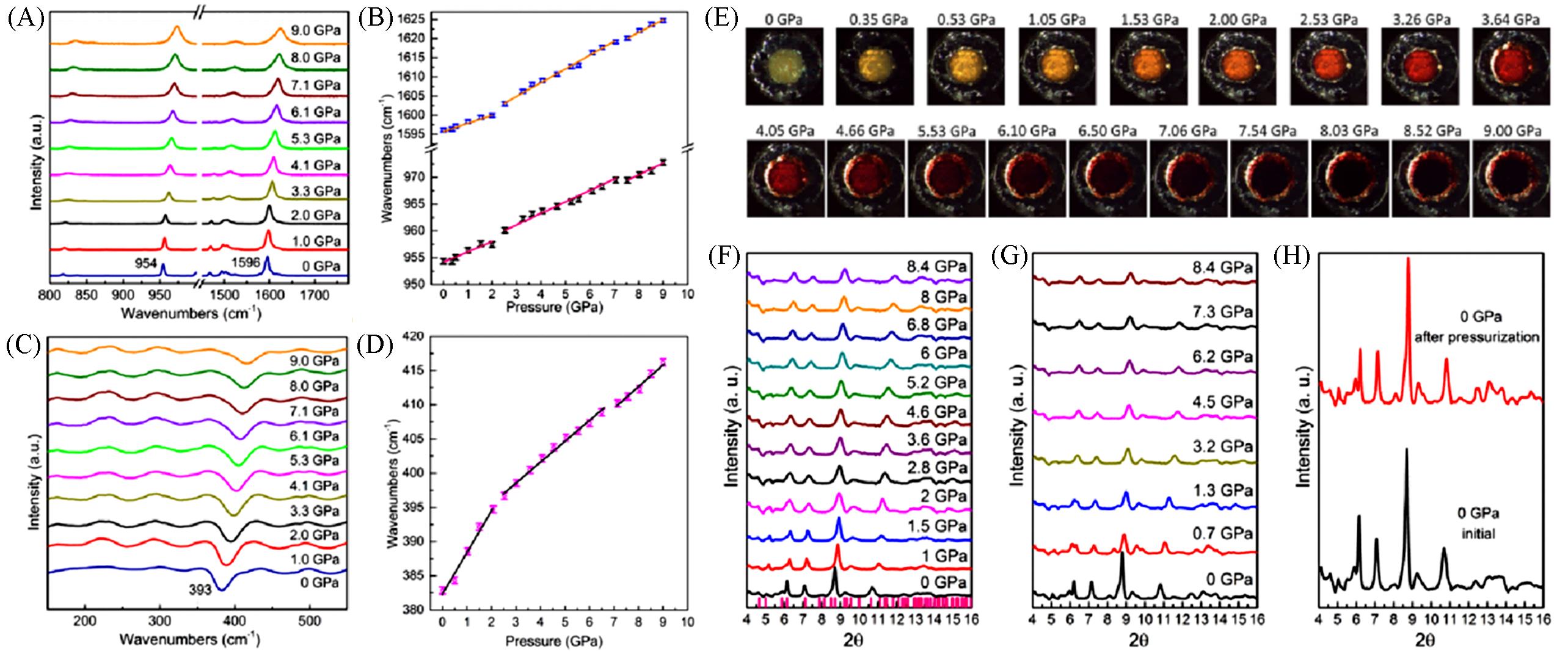
| Raman spectroscopy | Vibrational modes, symmetry, phase precursors (soft modes) | Lattice vibration | Crystalline/amorphous/ liquid | [ |
| IR spectroscopy | Polar bond vibration, hydrogen bonds, MIT | Lattice vibration+ electronic | Crystalline/amorphous/ liquid | [ |
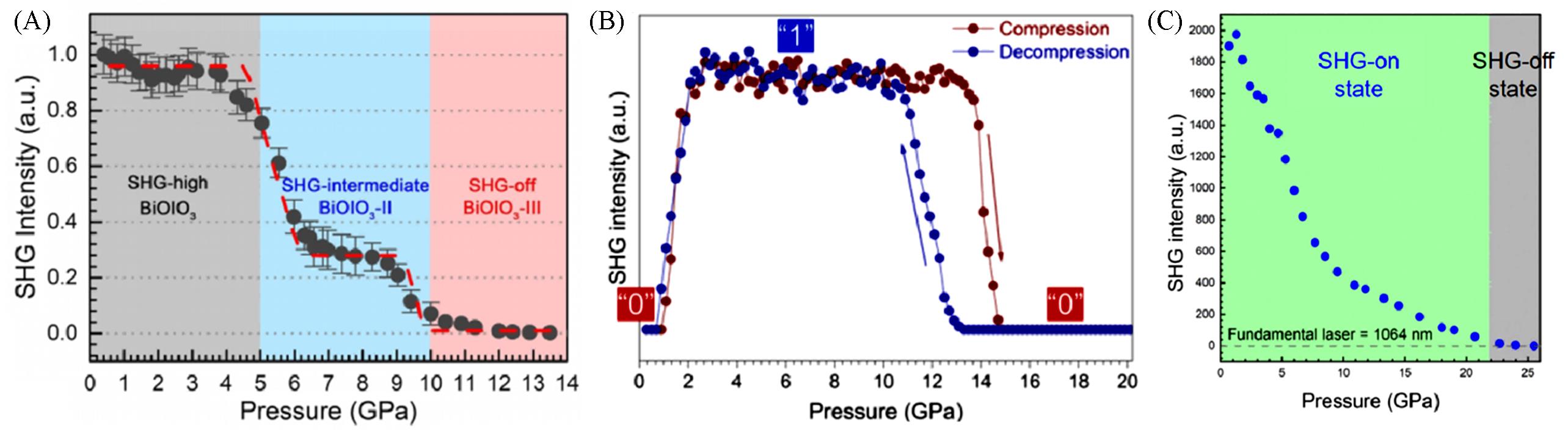
| SHG | Inversion symmetry, isostructural transitions, molecular orientation | Symmetry+ electronic | Non-centrosymmetric crystals | [ |
| Photoluminescence | Defect states, exciton behavior, local electronic states | Electronic | Crystalline/amorphous | [ |
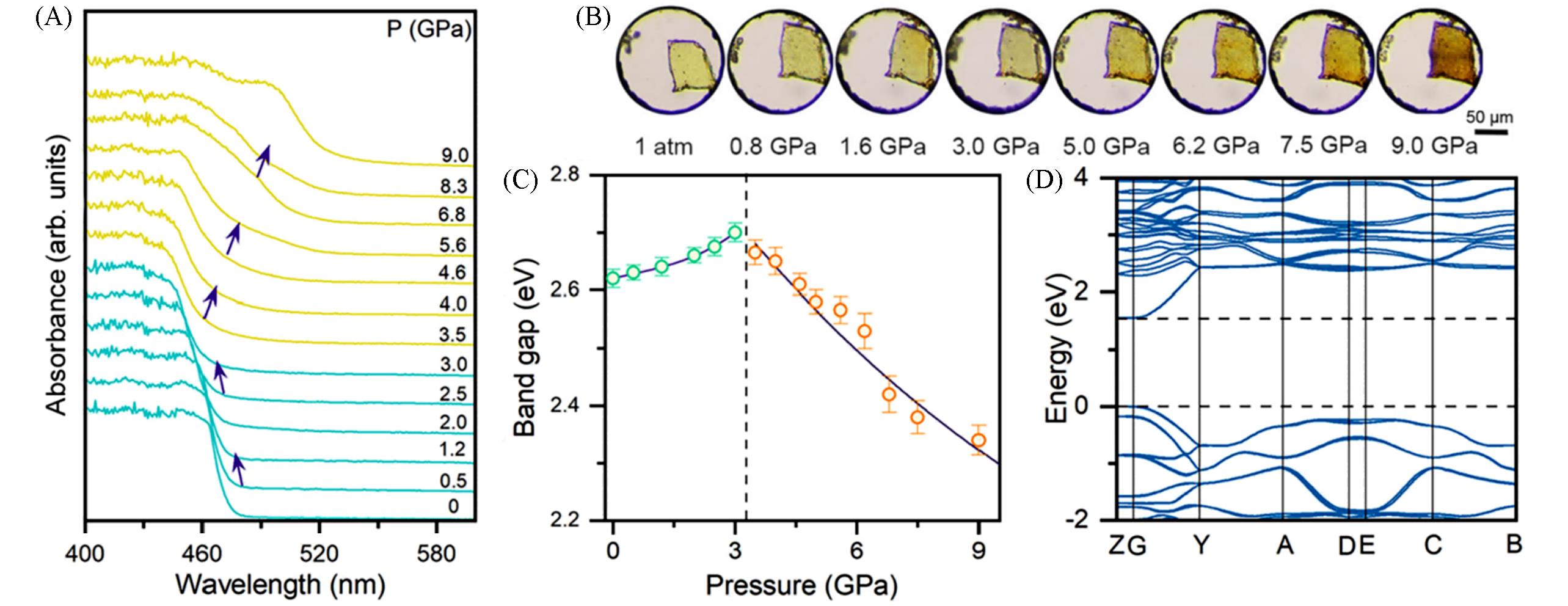
| UV-Vis absorption | Band gap, exciton features, metallization | Electronic | Crystalline/amorphous/ liquid | [ |
Table 1 Summary of in-situ high-pressure characterization techniques
| Technique | Probe | Length scale | Sample requirement | Ref. |
|---|---|---|---|---|
| XRD | Lattice parameters, space group, phase transition pathway | Long⁃range | Crystalline(powder/single crystal) | [ |
| Neutron diffraction | Light atom positions, magnetic structure, lattice dynamics | Long-range | Crystalline(large volume required) | [ |
| XANES | Valence state, spin state, orbital occupancy, symmetry | Electronic+local structure | Crystalline/amorphous | [ |
| EXAFS | Bond lengths, coordination numbers, disorder (Debye-Waller factor) | Local atomic configuration | Crystalline/amorphous | [ |
Atomic pair distances, bond lengths, coordination numbers, disorder | Short-to-medium range | Crystalline/amorphous/ liquid | [ | |
| Raman spectroscopy | Vibrational modes, symmetry, phase precursors (soft modes) | Lattice vibration | Crystalline/amorphous/ liquid | [ |
| IR spectroscopy | Polar bond vibration, hydrogen bonds, MIT | Lattice vibration+ electronic | Crystalline/amorphous/ liquid | [ |
| SHG | Inversion symmetry, isostructural transitions, molecular orientation | Symmetry+ electronic | Non-centrosymmetric crystals | [ |
| Photoluminescence | Defect states, exciton behavior, local electronic states | Electronic | Crystalline/amorphous | [ |
| UV-Vis absorption | Band gap, exciton features, metallization | Electronic | Crystalline/amorphous/ liquid | [ |
| [1] | Shen G., Mao H., Rep. Prog. Phys., 2017, 80(1), 016101 |
| [2] | Takahashi T., Mao H., Bassett W., Science, 1969, 165(3900), 1352—1353 |
| [3] | Taylor L., Mao H., Science, 1970, 170(3960), 850—851 |
| [4] | Turnbull R., Martin J., Liang A., Anichtchenko D., Popescu C., Rao K., Achary S., Munoz A., Panchal V., Errandonea D., Dalton Trans., 2024, 53(34), 14278—14288 |
| [5] | Ma S., Baxter S., Park C., Chariton S., Santos A., Molaison J., Wilkinson A., Chem. Mater., 2025, 37(4), 1657—1666 |
| [6] | Zhou J., Alonso J., Muonz A., Fernandez M., Goodenough J., Phys. Rev. Lett., 2011, 106(5), 057201 |
| [7] | Shi N., Fan L., Xu Y., Yin W., Chen H., Yuan B., Zhou C., Chen J., Small, 2024, 20(50), 2312289 |
| [8] | Rejnhardt P., Gajda R., Woinska M., Parafiniuk J., Giester G., Miletich R., Wu Y., Poręba T., Mezouar M., Sutuła S., Góral T., Dera P., Woźniak K., J. Am. Chem. Soc., 2025, 147(30), 26830—26843 |
| [9] | Ward M., Bull C., Funnell N., Warren M., Oswald I., Int. J. Pharm., 2023, 647, 123514 |
| [10] | Chen J., Hu Q., Fang L., He D., Chen X., Xie L., Chen B., Li X., Ni X., Fan C., Liang A., Rev. Sci. Instrum., 2018, 89(5), 053906 |
| [11] | Fei Y., Zhang L., Corgne A., Watson H., Ricolleau A., Meng Y., Prakapenka V., Geophys. Res. Lett., 2007, 34(17), L17307 |
| [12] | Jacobsen M., Velisavljevic N., Dattelbaum D., Chellappa R., Park C., J. Phys. Condens. Matter, 2016, 28(15), 155401 |
| [13] | Li H., He H., Guo Z., Chen D., J. Alloys Compd., 2025, 1039, 183360 |
| [14] | Grzanka E., Stel’ makh S., Gierlotka S., Zhao Y., Palosz B., Palosz W., J. Alloys Compd., 2004, 382(1/2), 133—137 |
| [15] | Hong X., Ehm L., Zhong Z., Ghose S., Duffy T., Weidner D., Sci. Rep., 2016, 6, 21434 |
| [16] | Celeste A., Girdzis S., Cladek B., Deschene C., Wolf N., Chapman K., Karunadasa H., Tucker M., Mao W., Lin Y., Nat. Commun., 2025, 16, 7631 |
| [17] | Li C., Liu K., Jiang D., Jiang Z., Wen T., Yue B., Wang Y., Inorg. Chem., 2022, 61(30), 11923—11931 |
| [18] | Yao H., Yao H., Huang H., Zhang L., Cui R., Guo X., Cheng H., Li Y., Gao X., Zhao L., Sun B., Nano Today, 2021, 37, 101079 |
| [19] | Zheng Z., Liang B., Gao J., Ren J., Liu Z., Hou X., Sun J., Mei S., Ceram. Int., 2023, 49(20), 32521—32527 |
| [20] | Yuan Y., Yinwei L., Guoyong F., Guangtao L., Cuiying P., Xin L., Haiyan Z., Ke Y., Lin W., Nat. Sci. Rev., 2019, 6(6), 524—531 |
| [21] | Canasa P., King D., Cifligu P., Sanchez A., Chen S., Han H., Malik T., Billinghurst B., Zhao J., Park C., Rossman G., Pravica., Bhowmik P., Evlyukhin E., Small Sci., 2024, 4(8), 2400106 |
| [22] | Zhang S. H., Li T., Zhang X. J., Chen Z. Q., Chin. J. High Press. Phys., 2026, 40(2), 021101 |
| 张升瀚, 李婷, 张晓军, 陈志强. 高压物理学报, 2026, 40(2), 021101 | |
| [23] | Jiang D., Song H., Wen T., Jiang Z., Li C., Liu K., Yang W., Huang H., Wang Y., Angew. Chem. Int. Ed., 2022, 61(9), e202116656 |
| [24] | Jiang D., Jiang X., Zhang X., Li C., Liu K., Ma Y., Cheng H., Pei T., Wen T., Lin Z., Li F., Wang Y., J. Am. Chem. Soc., 2024, 146(33), 23508—23516 |
| [25] | Jiang D., Li C., Wen T., Liu K., Ma Y., Chen E., Pei T.,Wang Y., Mater. Chem. Front., 2024, 8(4), 1636 |
| [26] | Liang J., Ju C., Liu Z., Li H., Karina A., Eklund T., Zheng W., Winkel K., Cai W., Wagner M., Qiu Z., Weil T., Müllen K., Angew. Chem. Int. Ed., 2025, 64(21), e202500923 |
| [27] | Ma Y., Wen T., Liu K., Jiang D., Zhao M., Lin C., Wang Y., J. Mater. Chem. C, 2023, 11(20), 6588 |
| [28] | Zhao Y., Chen K., Li N., Ma S., Wang Y., Kong Q., Baudelet F., Wang X., Yang W., Phys. Rev. Lett., 2020, 125(24), 245701 |
| [29] | Ma Y., Wen T., Liu K., Li C., Jiang D., Pei T., Lin C., Wang Y., J. Mater. Chem. C, 2024, 12(7), 2379 |
| [30] | Long Z., Li C., Jiang D., Niu G., Sui L., Yuan K., Wang Y., Nat. Commun., 2025, 16(1), 7058 |
| [31] | Polian A., J. Raman Spectrosc., 2003, 34(8), 633—637 |
| [32] | Tu H., Pan L., Qi H., Zhang S., Li F., Sun C., Wang X., Cui T., J. Phys. Condens. Matter, 2023, 35(25), 253002 |
| [33] | Huang D., Wang H., Zhao W., Dai R., Wang Z., Zhang Z., J. Phys. Chem. C, 2021, 125(40), 22354—22359 |
| [34] | Wu Y., Yin X., Hasaien J., Ding X., Zhao J., Chin. Phys. Lett., 2020, 37(4), 047801 |
| [35] | Erhard L., Utt D., Klomp A., Albe K., Model. Simul. Mater. Sci. Eng., 2024, 32(6), 065029 |
| [36] | Deng P., Hou R., Zhao Y. L., Zhu S. C., Chin. J. High Press. Phys., 2026, 40(1), 010103 |
| 邓溥, 侯瑞, 赵英亮, 朱升财. 高压物理学报, 2026, 40(1), 010103 | |
| [37] | Goodenough J., Annu. Rev. Mater. Sci., 1998, 28(1), 1—27 |
| [38] | Ishidate T., Isonuma T., Ferroelectrics, 1992, 137(1), 45—52 |
| [39] | Yamanaka T., Ahart M., Mao H., Yan H., J. Phys. Condens. Matter, 2018, 30, 265401 |
| [40] | Yagi T., Utsumi W., Phys. Rev. B, 1992, 46(10), 6031—6039 |
| [41] | Mishima O., Calvert L., Whalley E., Nature, 1984, 310(5976), 393—395 |
| [42] | Machon D., Meersman F., Wilding M., Wilson M., McMillan P., Prog. Mater. Sci., 2014, 61(4), 216—282 |
| [43] | Moore K., Belhadi L., Decremps F., Farber D., Bradley J., Cccelli F., Gauthier M., Polian A., Aracne⁃Ruddle C., Acta Mater., 2011, 59(16), 6007—6016 |
| [44] | Pei T., Tang Z., Jiang D., Li C., Ma Y., Chen E., Yue B., Wang Y., J. Phys. Chem. C, 2024, 128(37), 15718—15724 |
| [45] | Mączka M., Silva J., Gomes W., Vasconcelos D., Dybała F., Herman A., Kudrawiec R., Freire P., J. Phys. Chem. C, 2024, 128(21), 8698—8707 |
| [46] | Wang H., Zhao T. T., Li M., Li J. L., Peng S., Liu X. Q., Zhao B. H., Chen Y. L., Lin C. L., Chin. J. High Press. Phys., 2024, 38(3), 030101 |
| 王毫, 赵婷婷, 李梅, 李俊龙, 彭赏, 刘旭强, 赵博浩, 陈彦龙, 林传龙. 高压物理学报, 2024, 38(3), 030101 | |
| [47] | Chen X. H., Zhang Y., Liu L., Ye S. J., Li S. R., Jing Q. M., Gao J. J., Wang H., Lin C. L., Li J., J. Raman Spectrosc., 2024, 55(9), 989—997 |
| [1] | QIAN Zichao, HUANG Mingqiang, SHAN Xianbin, SHENG Liusi, HU Changjin, GU Xuejun, ZHAO Weixiong, Zhang Weijun. Vacuum Ultraviolet Photoionization Mass Spectrometry Study on the Formation of Nitrophenols Generated by Photooxidation of Benzene [J]. Chem. J. Chinese Universities, 2026, 47(7): 20250348. |
| [2] | REN Shijie, QIAO Sicong, LIU Chongjing, ZHANG Wenhua, SONG Li. Synchrotron Radiation X-Ray Absorption Spectroscopy Research Progress on Platinum Single-atom Catalysts [J]. Chem. J. Chinese Universities, 2022, 43(9): 20220466. |
| [3] | TANG Qiaowei, CAI Xiaoqing, LI Jiang, ZHU Ying, WANG Lihua, TIAN Yang, FAN Chunhai, HU Jun. Synchrotron-based X-ray Microscopy for Brain Imaging [J]. Chem. J. Chinese Universities, 2022, 43(12): 20220379. |
| [4] | TAO Ling, HUANG Ming-Qiang, HAO Li-Qing, ZHANG Wei-Jun*, WANG Zheng-Ya, KONG Rui-Hong, SHAN Xiao-Bin, LIU Fu-Yi, SHENG Liu-Si. Experimental Studies on Photoionization of Ethylbenzene [J]. Chem. J. Chinese Universities, 2010, 31(10): 2063. |
| [5] | TANG Jian-Kai, SUN Zhao-Yan*, AN Li-Jia. Physical Gelation and Structures of P123 in D2O Solution [J]. Chem. J. Chinese Universities, 2010, 31(1): 172. |
| [6] | LIN Ao-Lei, WANG Kai, ZHAO Yu, ZOU Bo*. π-π Interactions in DPP-11 Supramolecular Micellar Aggregates Under High-pressure [J]. Chem. J. Chinese Universities, 2008, 29(6): 1181. |
| [7] |
JIANG Wen-Hai1, WANG Xu2, MA Chun-Yu3, YU Shu-Kun1, YE Kai-Qi2, CHANG Yu-Chun1,3, DU Guo-Tong1,3 . Synthesis and Crystal Structure of Azaanalog of Copper Phthalocyanine [J]. Chem. J. Chinese Universities, 2006, 27(12): 2263. |
| [8] | SHENG Liu-Si, WU Guo-Hua, GAO Hui, ZHANG Yun-Wu . Photoionization Studies on p-Nitrotoluene with Synchrotron Radiation [J]. Chem. J. Chinese Universities, 1997, 18(12): 2041. |
| [9] | SHENG Liu-Si, QI Fei, LUO Zhi-Yong, GAO Hui, ZHANG Yun-Wu. Production and Photoionzation of Clusters for CH3CN/C2H3Cl Complex System [J]. Chem. J. Chinese Universities, 1995, 16(11): 1752. |
| [10] | QI Fei, SHENG Liu-Si, YU Shu-Qin, ZHANG Yun-Wu. Determination of the Bond Dissociation Energies of Ammonia D0(H2N H) and D(H2N+ H)by Synchrotron Radiation [J]. Chem. J. Chinese Universities, 1994, 15(8): 1228. |
| [11] | Lin Dehou, P. B?secke, H. G. Zachmann. Investigation of Crystallization of PPS by Employing Synchrotron Radiation [J]. Chem. J. Chinese Universities, 1989, 10(2): 186. |
| Viewed | ||||||
|
Full text |
|
|||||
|
Abstract |
|
|||||
