

Chem. J. Chinese Universities ›› 2026, Vol. 47 ›› Issue (4): 20250381.doi: 10.7503/cjcu20250381
• Article • Previous Articles Next Articles
ZHANG Yangdaiyi, SHAO Yan, JIANG Shimei( )
)
Received:2025-12-16
Online:2026-04-10
Published:2026-03-10
Contact:
JIANG Shimei
E-mail:smjiang@jlu.edu.cn
Supported by:CLC Number:
TrendMD:
ZHANG Yangdaiyi, SHAO Yan, JIANG Shimei. Multi-responsive Hydrogel Featuring Synergistic Regulation of AIE and Mechanical Behaviors via Dynamic Hydrogen Bonding Network[J]. Chem. J. Chinese Universities, 2026, 47(4): 20250381.
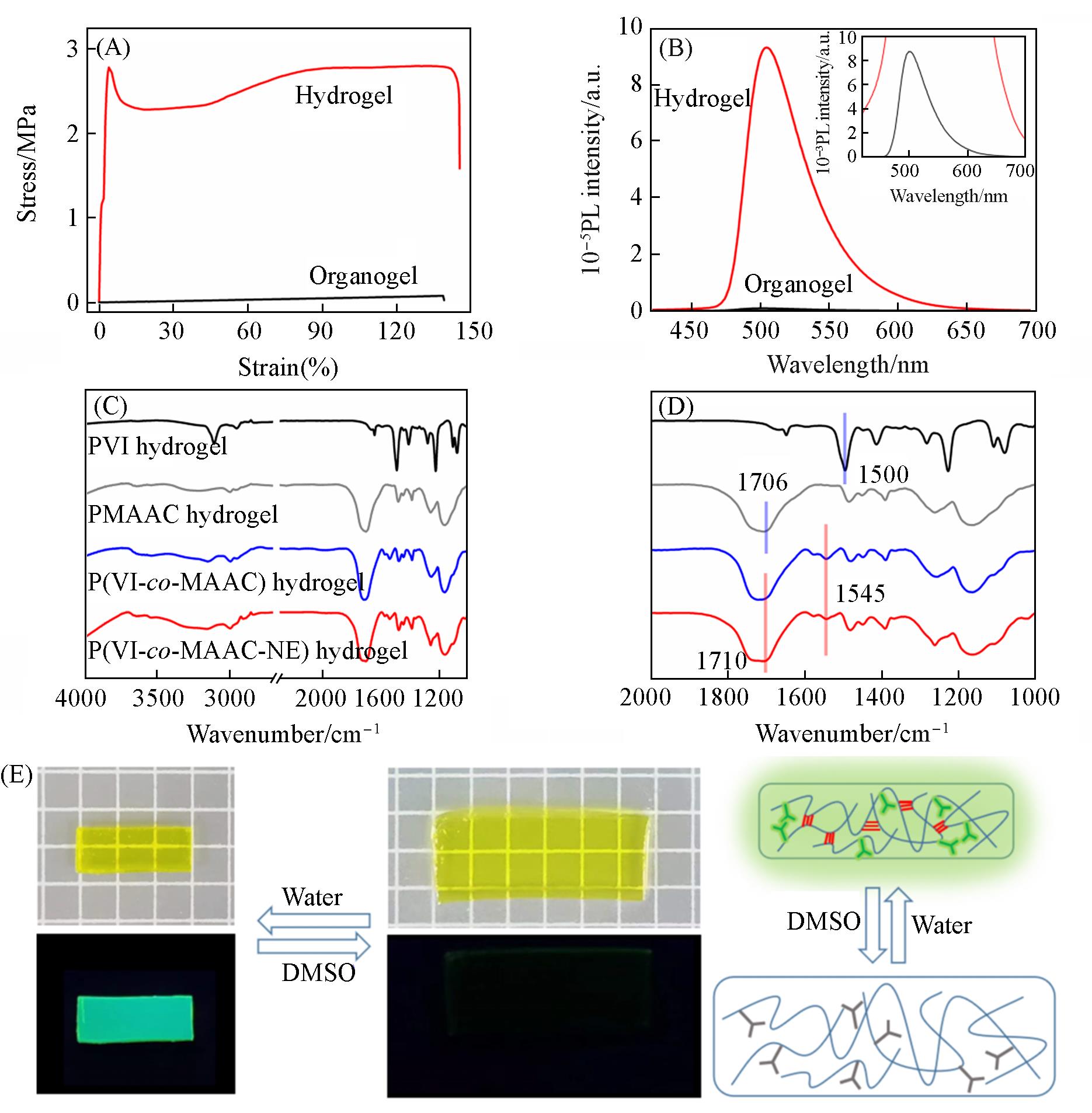
Fig.1 Stress⁃strain curves(A) and fluorescence spectra(B) of hydrogel and organogel, FTIR spectra(C, D) of PVI hydrogel, PMAAC hydrogel, P(VI⁃co⁃MAAC) hydrogel and P(VI⁃co⁃MAAC⁃NE) hydrogel, photographs of swelling behavior and fluorescence change(E) of P(VI⁃co⁃MAAC⁃NE) hydrogel in DMSO and water under natural light and UV light after reaching equilibrium, along with a schematic illus⁃tration of the internal structural change(the length of each grid is 0.5 cm)
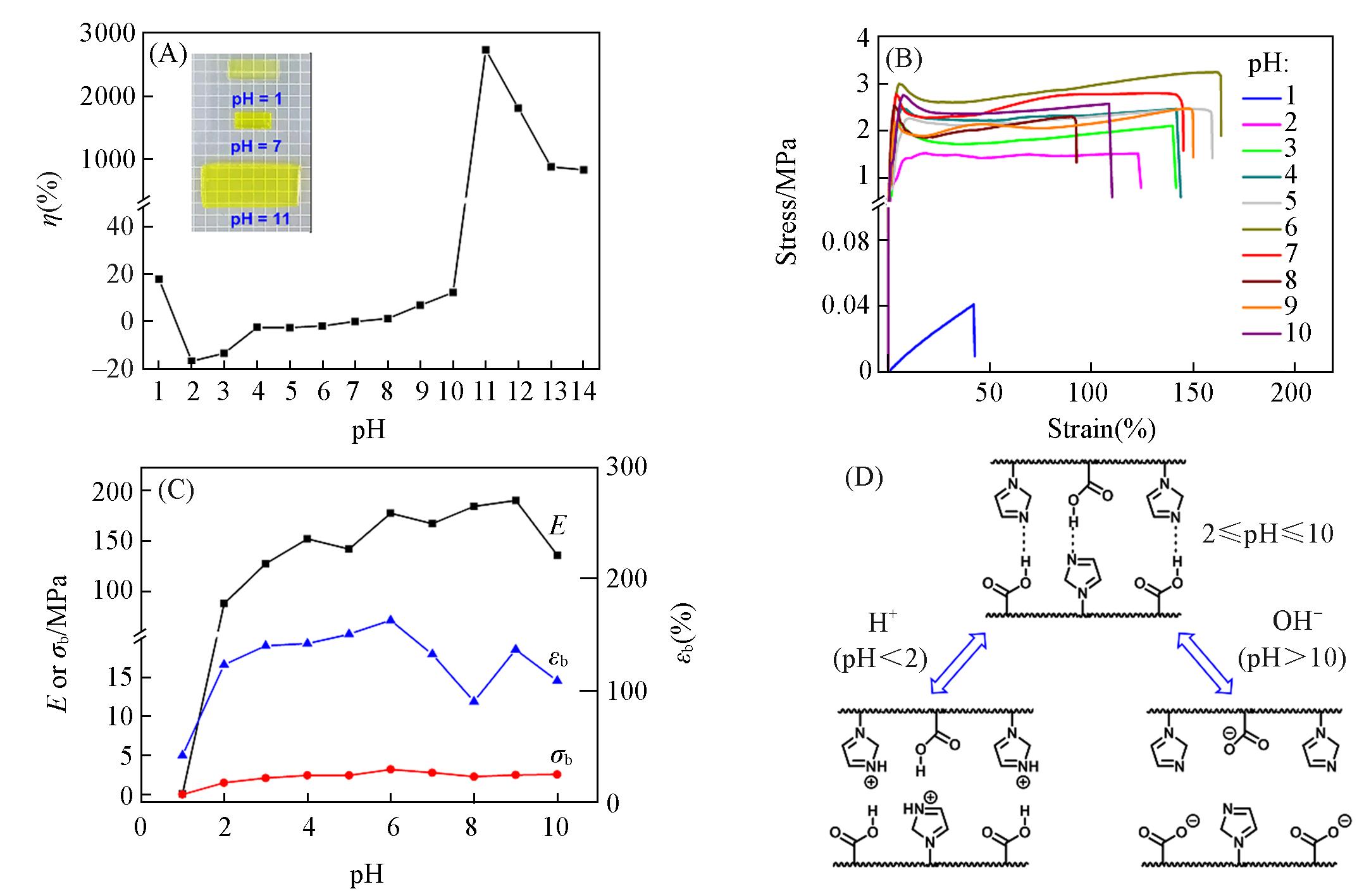
Fig.2 Swelling ratio(A), stress⁃strain curves(B) and corresponding Young’s modulus(E), breaking strain(εb), and tensile breaking stress(σb)(C) of P(VI⁃co⁃MAAC⁃NE) hydrogel at different pH values, and schematic illustration of hydrogen⁃bonding changes in P(VI⁃co⁃MAAC⁃NE) hydrogel under different pH conditions(D)
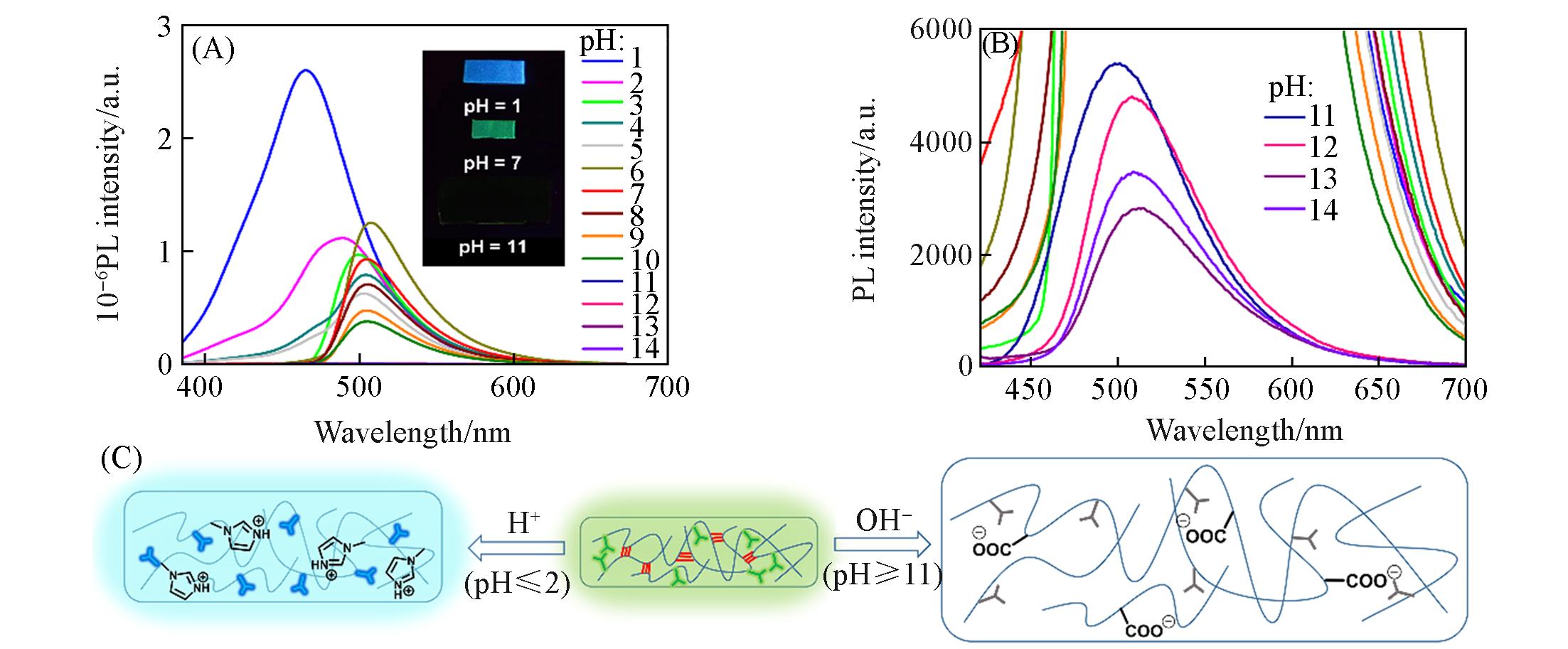
Fig.3 Fluorescence spectra(A, B) of P(VI⁃co⁃MAAC⁃NE) hydrogel measured under different pH conditions, and schematic illustration of the structural changes(C) of the hydrogel in strongly acidic(pH≤2) and strongly alkaline(pH≥11) environments
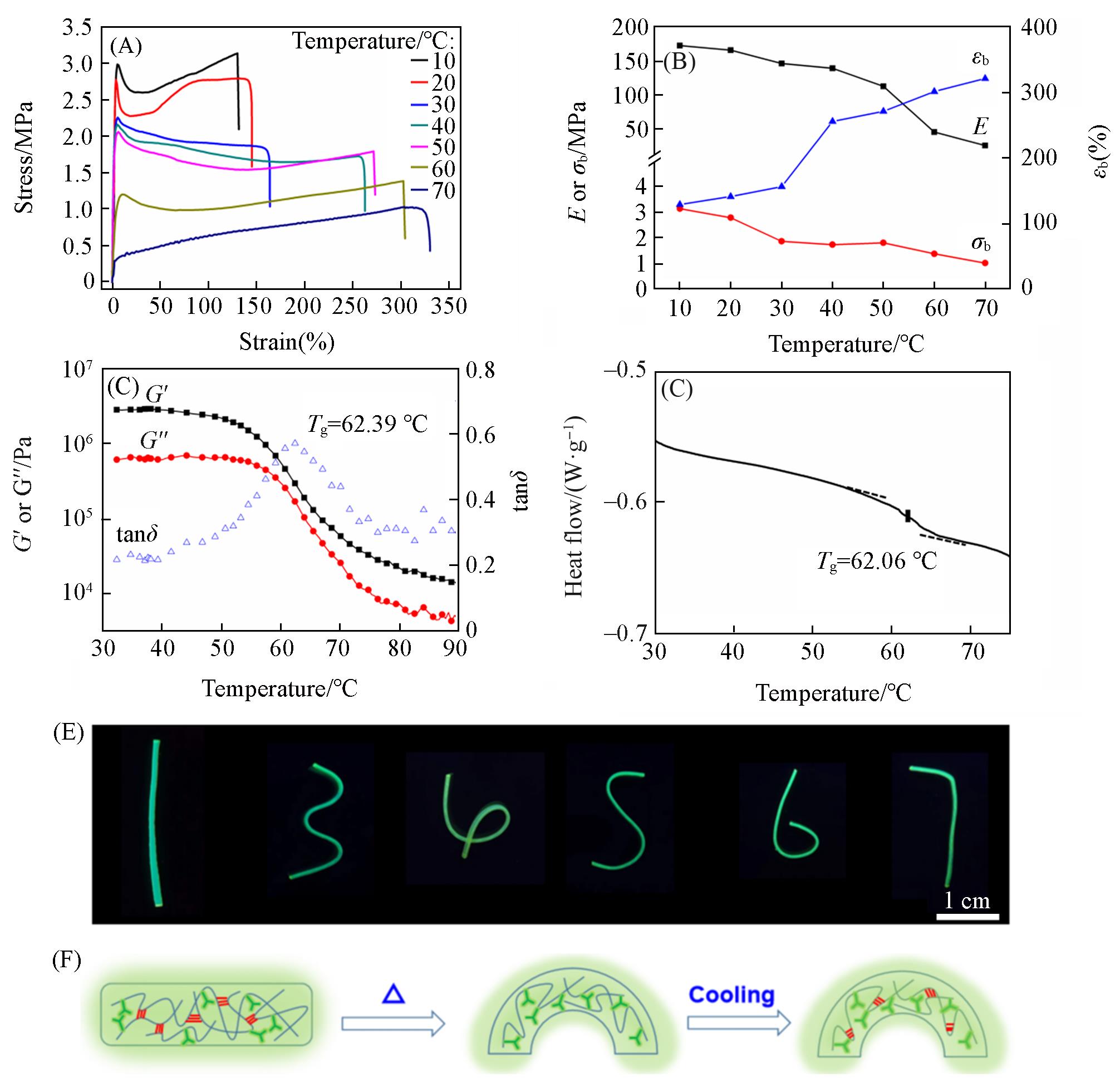
Fig.4 Stress⁃strain curves(A) and corresponding E, εb, and σb(B) of the hydrogel measured at different temperatures(tensile rate: 100 mm/min), temperature⁃sweep rheological curve from 30 ℃ to 90 ℃(frequency: 1 Hz, strain: 0.05%)(C), DSC thermogram obtained at a heating rate of 5 ℃/min(D), shape⁃memory behavior of a strip⁃shaped P(VI⁃co⁃MAAC⁃NE) hydrogel observed under UV light(the scale bar is 1 cm)(E), and schematic of the proposed shape⁃memory mechanism during heating and cooling(F)
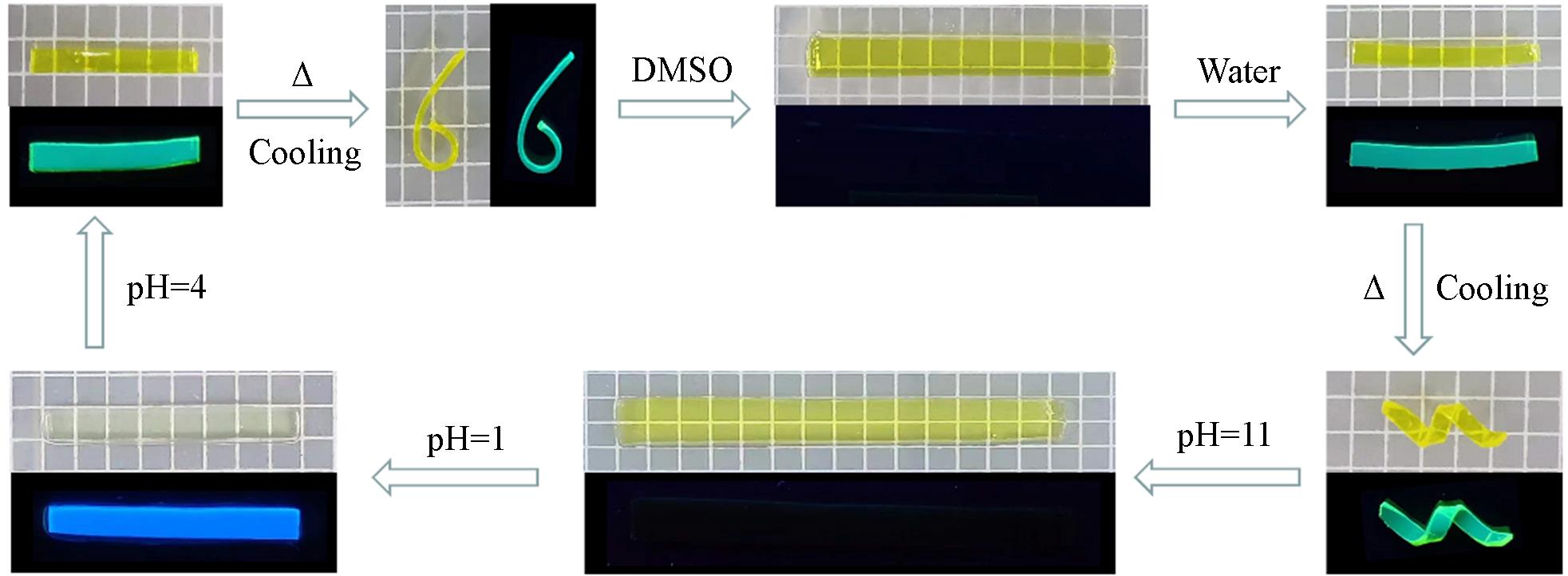
Fig.5 Programmable information encryption and erasure via multi⁃stimuli⁃responsive shape and fluorescence switching
| [1] | Merindol R., Delechiave G., Heinen L., Catalani L. H., Walther A., Nat. Commun., 2019, 10, 528 |
| [2] | Zhu Q. D., van Vliet K. V., Holten⁃Andersen N., Miserez A., Adv. Funct. Mater., 2019, 29, 1808191 |
| [3] | Kang X. H., Zhang L. P., Jia W., Yang L., Jiang C. L., Anal. Chem., 2024, 96, 20568—20577 |
| [4] | Zhang L. B., Jean S. R., Ahmed S., Aldridge P. M., Li X. Y., Fan F. J., Sargent E. H., Kelley S. O., Nat. Commun., 2017, 8, 381 |
| [5] | Wei S. X., Li Z., Lu W., Liu H., Zhang J. W., Chen T., Tang B. Z., Angew. Chem. Int. Ed., 2021, 60, 8608—8624 |
| [6] | Ghorai S., Dasgupta S., Mukherjee A., Barui A., Roymahapatra G., Ganguly J., ACS Appl. Bio Mater., 2024, 7, 5640—5650 |
| [7] | Wu S. S., Shi H. H., Lu W., Wei S. X., Shang H., Liu H., Si M. Q., Le X. X., Yin G. Q., Theato P., Chen T., Angew. Chem. Int. Ed., 2021, 60, 21890—21898 |
| [8] | Zhang Y. D. Y., Zheng T. T., Jiang S. M., Dyes Pigments, 2023, 220, 111658 |
| [9] | Lou K., Hu Z. Q., Zhang H. W., Li Q. Y., Ji X. F., Adv. Funct. Mater., 2022, 32, 2113274 |
| [10] | Sun Y., Le X. X., Zhou S. Y., Chen T., Adv. Mater., 2022, 34, 2201262 |
| [11] | Luo Q. Y., Jiang J., Dai J. G., Li D. X., Ren H. Z., Fu H. C., Tang A. H., Xu Y. T., Zeng B. R., Luo W. A., Dai L. Z., Int. J. Biol. Macromol., 2025, 320, 145897 |
| [12] | Luo Q. Y., Yuan H. M., Zhang M., Jiang P., Liu M., Xu D., Guo X., Wu Y. Q., J. Hazard. Mater., 2021, 401, 123432 |
| [13] | Shi D. W., Ji D. H., Li X., Guan Z. C., Li M. H., Bae J., ACS Nano, 2025, 19, 19578—19589 |
| [14] | Niklaus L., Tansaz S., Dakhil H., Weber K. T., Pröschel M., Lang M., Kostrzewa M., Coto P. B., Detsch R., Sonnewald U., Wierschem A., Boccaccini A. R., Costa R. D., Adv. Funct. Mater., 2017, 27, 1601792 |
| [15] | Chen H., Yang F. Y., Chen Q., Zheng J., Adv. Mater., 2017, 29, 1606900 |
| [16] | Ji X. F., Wu R. T., Long L. L., Ke X. S., Guo C. X., Ghang Y. J., Lynch V. M., Huang F. H., Sessler J. L., Adv. Mater., 2018, 30, 1705480 |
| [17] | Zhu Q. D., Zhang L. H., Van Vliet K., Miserez A., Holten⁃Andersen N., ACS Appl. Mater. Interfaces, 2018, 10, 10409—10418 |
| [18] | Bhattacharya S., Phatake R. S., Barnea S. N., Zerby N., Zhu J. J., Shikler R., Lemcoff N. G., Jelinek R., ACS Nano, 2019, 13, 1433—1442 |
| [19] | Saigusa H., Lim E. C., Acc. Chem. Res., 1996, 29, 171—178 |
| [20] | Li J., Wang J. X., Li H. X., Song N., Tang B. Z., Wang D., Chem. Soc. Rev., 2020, 49, 1144—1172 |
| [21] | Luo J. D., Xie Z. L., Lam J. W. Y., Cheng L., Chen H. Y., Qiu C. F., Kwok H. S., Zhan X. W., Liu Y. Q., Zhu D. B., Tang B. Z., Chem. Commun., 2001, (18), 1740—1741 |
| [22] | Hu R. R., Leung N. L. C., Tang B. Z., Chem. Soc. Rev., 2014, 43, 4494—4562 |
| [23] | Zhang R. B., Tian X. Q., Zuo M. Z., Zhang T., Pangannaya S., Hu X. Y., Adv. Sci., 2025, 12, 2504993 |
| [24] | He Z. K., Ke C. Q., Tang B. Z., ACS Omega, 2018, 3, 3267—3277 |
| [25] | Zhao Z., Zhang H. K., Lam J. W. Y., Tang B. Z., Angew. Chem. Int. Ed., 2020, 59, 9888—9907 |
| [26] | Yang C. X., Xiao H. X., Tang L., Luo Z. C., Luo Y., Zhou N. B., Liang E. X., Wang G. X., Tang J. X., Mater. Horiz., 2023, 10, 2496—2505 |
| [27] | Wang Q., Kang M. M., Wang D., Tang B. Z., Coord. Chem. Rev., 2026, 548, 217227 |
| [28] | Jin Q., Zeng R. P., Chen X. H., You Z., Bai W. B., Yang H. P., Dyes Pigments, 2025, 239, 112797 |
| [29] | Guo H. L., Zhu C. J., Yuan Z. H., Huang G., Liang H. S., Xiong C. X., Feng Z. Y., Wei Q., Meng G. Z., ACS Appl. Mater. Interfaces, 2023, 15, 8530—8536 |
| [30] | Yuan Z. H., Zhu C. J., Huang G., Lei B., Wu M. M., Feng Z. Y., Yang Z. Y., Wei Q., Meng G. Z., Guo H. L., ACS Appl. Polym. Mater., 2024, 6, 10467—10477 |
| [31] | Vazquez⁃Perez F. J., Gila⁃Vilchez C., Duran J. D. G., Zubarev A., Alvarez de Cienfuegos L., Rodriguez⁃Arco L., Lopez⁃Lopez M. T., Polymer, 2021, 230, 124093 |
| [32] | Li Z., Ji X. F., Xie H. L., Tang B. Z., Adv. Mater., 2021, 33, 2100021 |
| [33] | Lu W., Wei S. X., Shi H. H., Le X. X., Yin G. Q., Chen T., Aggregate, 2021, 2, e37 |
| [34] | Li Z., Liu P. C., Ji X. F., Gong J. Y., Hu Y. B., Wu W. J., Wang X. N., Peng H. Q., Kwok R. T. K., Lam J. W. Y., Lu J., Tang B. Z., Adv. Mater., 2020, 32, 1906493 |
| [35] | Zhang X. N., Wang Y. J., Sun S., Hou L., Wu P., Wu Z. L., Zheng Q., Macromolecules, 2018, 51, 8136—8146 |
| [36] | Jiao C., Zhang J. N., Liu T. Q., Peng X., Wang H. L., ACS Appl. Mater. Interfaces, 2020, 12, 44205—44214 |
| [37] | An B. K., Gierschner J., Park S. Y., Acc. Chem. Res., 2011, 44, 1570—1579 |
| [38] | Zhu C. N., Bai T. W., Wang H., Ling J., Huang F. H., Hong W., Zheng Q., Wu Z. L., Adv. Mater., 2021, 33, 2102023 |
| [39] | Ding H. Y., Zhang X. N., Zheng S. Y., Song Y. H., Wu Z. L., Zheng Q., Polymer, 2017, 131, 95—103 |
| [40] | Palakollu V., Kanvah S., New J. Chem., 2014, 38, 5736—5746 |
| [41] | Wang X. X., Ding Z. Y., Ma Y., Zhang Y. P., Shang H. X., Jiang S. M., Soft Matter, 2019, 15, 1658—1665 |
| [42] | Xu M. D., Hua L. Q., Gong L. H., Lu J. L., Wang J. H., Zhao C. Z., Sci. China Chem., 2021, 64, 1770—1777 |
| [43] | Yang C. X., Su F., Xu Y. X., Ma Y., Tang L., Zhou N. B., Liang E. X., Wang G. X., Tang J. X., ACS Macro Lett., 2022, 11, 347—353 |
| [44] | Dai C. F., Zhang X. N., Du C., Frank A., Schmidt H. W., Zheng Q., Wu Z. L., ACS Appl. Mater. Interfaces, 2020, 12, 53376—53384 |
| [45] | Wang Y. J., Zhang X. N., Song Y. H., Zhao Y. P., Chen L., Su F. M., Li L. B., Wu Z. L., Zheng Q., Chem. Mater., 2019, 31, 1430—1440 |
| [1] | LI Yuting, LUO Liang. Cutting-edge Advances in Raman Imaging Technology and Its Interdisciplinary Research with Aggregate Science [J]. Chem. J. Chinese Universities, 2026, 47(4): 20260008. |
| [2] | GAO Xin, QING Jia, HU Yichen, SHANGGUAN Zhichun, LIANG Tongling, ZHOU Yongsheng, ZHANG Guanxin, ZHANG Deqing. Novel AIE Fluorescent Probes for Ultrahigh Sensitivity and High Photostability in Lipid Droplets Imaging [J]. Chem. J. Chinese Universities, 2026, 47(4): 20250410. |
| [3] | XUE Bing, JIANG Yin-Shan, YANG Dian-Fan*, SHI Xiao-Di. Carbonization Treatment of Diatomite with High Ignition Loss and Reinforcement of Natural Rubber [J]. Chem. J. Chinese Universities, 2011, 32(7): 1617. |
| [4] | ZHANG Yong, WU Chun-Hong, FENG Zeng-Guo, LIU Feng-Xiang, ZHANG Ai-Ying, WANG Lian-Cai . Synthesis and Characterization of Poly(butylene terephthalate-co- cyclohexylene dimethylene terephthalate)-b-poly (ethylene glycol) Block Copolymers [J]. Chem. J. Chinese Universities, 2004, 25(2): 376. |
| [5] | ZHANG Yong, YE Ling, FENG Zeng-Guo, ZHANG Ai-Ying, TIAN Xiao-Juan, XU Rui-Xing . Characterization and Chain Structure of PEG/PBT Copolymer with the Constant Mass Ratio of Soft to Hard Segment [J]. Chem. J. Chinese Universities, 2002, 23(10): 1982. |
| [6] | ZHENG Hua, DU Yu-Min, YU Jia-Hui, XIAO Ling . The Properties and Preparation of Crosslinked Chitosan Films [J]. Chem. J. Chinese Universities, 2000, 21(5): 809. |
| [7] | LI Hong-Bin, ZHANG Xi, SHEN Jia-Cong . Mechanical Properties of Single Poly(acrylic acid) Chain Studied by Atomic Force Microscopy ——Single Molecule Force Spectroscopy on Poly(acrylic acid) [J]. Chem. J. Chinese Universities, 1998, 19(5): 824. |
| [8] | YANG Cheng, WU Da-Cheng. Synthesis and Characterization of Poly(ester-ether)s as Thermoplastic Liquid Crystalline Elastomers [J]. Chem. J. Chinese Universities, 1998, 19(3): 483. |
| [9] | ZHENG Si-Xun, LUO Xiao-Lie, MA De-Zhu, LIU Rui-Lin, LI Jian. Dynamic Mechanical Properties of Epoxy Resins/Poly(Ethylene Oxide) Blends Cured with Phthalic Anhydride and Aromatic Amine [J]. Chem. J. Chinese Universities, 1994, 15(3): 461. |
| [10] | LUO Xiao-Lie, LIU Jin, FAN Zhong-Dong, MA De-Zhu, ZNAO Chun-Tian, HOU Jian-An, CUI Di, XU Mao. Synthesis and Characterization of a Novel Interpenetrating Polymer Network PP/PnBA [J]. Chem. J. Chinese Universities, 1994, 15(10): 1553. |
| [11] | SONG Zheng-Zhe, WEN Jiu-Mian, XU Ji-Ping . Structures and Properties of the Copolymers from Dialkyl Fumarates [J]. Chem. J. Chinese Universities, 1993, 14(6): 886. |
| [12] | Wang Jing-yuan, Li Yu-wei, Song Hai-qing, Gao Chang-you, Tang Xin-yi . Mechanical Properties of Poly[Methyl Acrylate-2-(Dimethylamino)ethyl Methacrylate]/Epoxy Resin IPN [J]. Chem. J. Chinese Universities, 1991, 12(7): 987. |
| [13] | Huang Guang-lin, Feng Yu-ding, He Jian-ye, Lu Zhong-heng . Studies on Mechanical Properties of Cryo-Hydrogel [J]. Chem. J. Chinese Universities, 1991, 12(4): 564. |
| Viewed | ||||||
|
Full text |
|
|||||
|
Abstract |
|
|||||
