

Chem. J. Chinese Universities ›› 2026, Vol. 47 ›› Issue (5): 20260011.doi: 10.7503/cjcu20260011
• Article • Previous Articles Next Articles
QIN Jiayi1, CHEN Ziwei1, ZENG Jiajie1, FU Yan1( ), TANG Ben Zhong2, ZHAO Zujin1()
Received:2026-01-04
Online:2026-05-10
Published:2026-02-22
Contact:
FU Yan, ZHAO Zujin
E-mail:fyscut@scut.edu.cn;mszjzhao@scut.edu.cn
Supported by:CLC Number:
TrendMD:
QIN Jiayi, CHEN Ziwei, ZENG Jiajie, FU Yan, TANG Ben Zhong, ZHAO Zujin. Efficient and Stable Thick-layer Non-doped Organic Light-emitting Diodes Based on Bipolar Aggregation-induced Delayed Fluorescence Materials[J]. Chem. J. Chinese Universities, 2026, 47(5): 20260011.
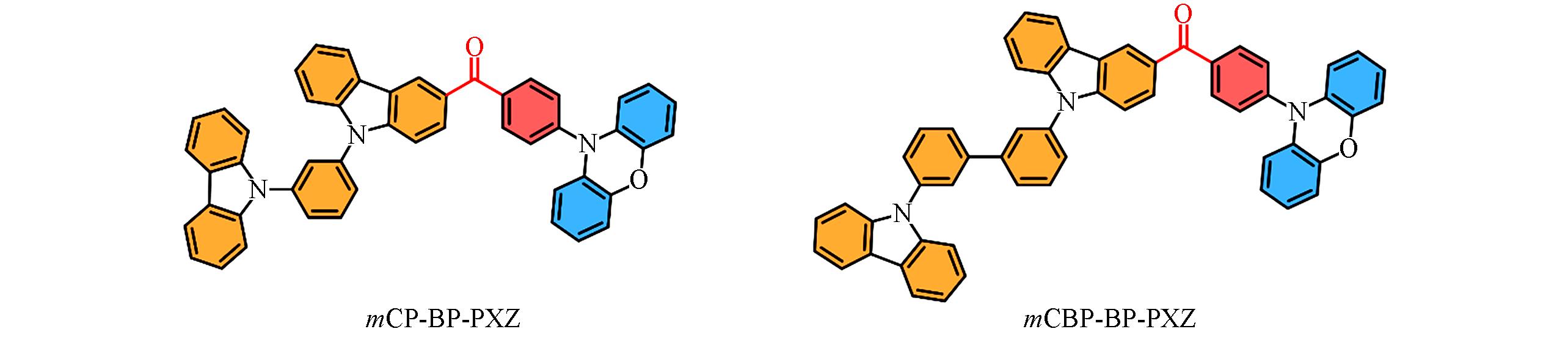
Fig.1 Molecular structures of AIDF emitters mCP⁃BP⁃PXZ and mCBP⁃BP⁃PXZ
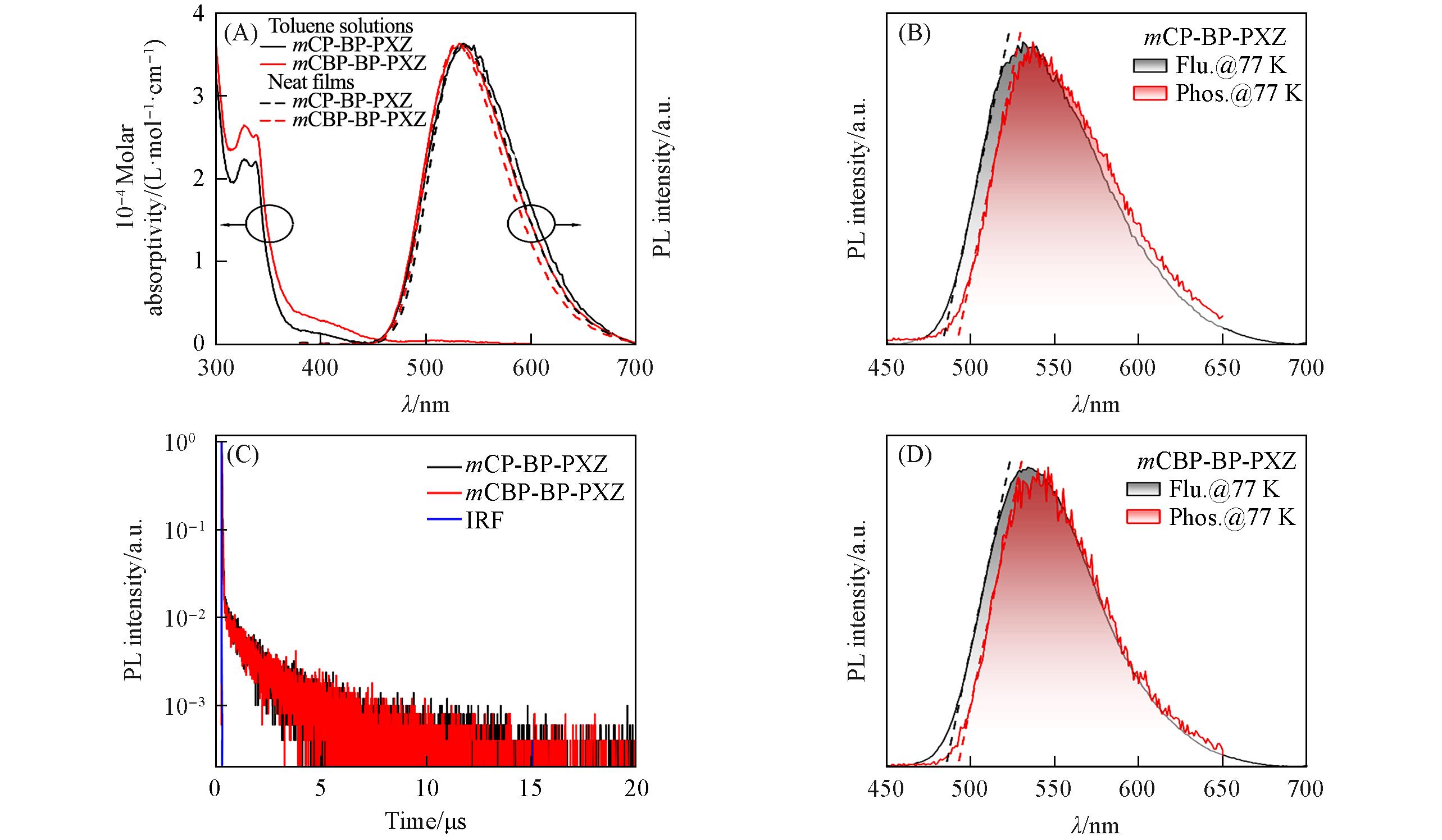
Fig.2 Absorption and PL spectra of mCP⁃BP⁃PXZ and mCBP⁃BP⁃PXZ in toluene solutions and PL spectra in neat films measured at room temperature(A), fluorescence and phosphorescence spectra of mCP⁃BP⁃PXZ(B) and mCBP⁃BP⁃PXZ(D) in neat films measured at 77 K under nitrogen, transient PL decay curves of mCP⁃BP⁃PXZ and mCBP⁃BP⁃PXZ in neat films(C) at room temperature
| Emitter | Toluene Solutions a | Neat films b | |||||||||
|---|---|---|---|---|---|---|---|---|---|---|---|
| λabsc /nm | λemd /nm | λemd /nm | ∆ESTe /eV | ΦPLf (%) | τPFg /ns | τDFg /μs | RDFh (%) | 10-7 kFi /s-1 | 10-6kRISCj /s-1 | ||
| mCP⁃BP⁃PXZ | 338 | 536 | 535 | 0.045 | 82.9 | 22.51 | 1.46 | 43.0 | 2.10 | 1.20 | |
| mCBP⁃BP⁃PXZ | 338 | 532 | 532 | 0.033 | 97.4 | 21.96 | 1.49 | 41.2 | 2.61 | 1.14 | |
Table 1 Photophysical Data of mCP-BP-PXZ and mCBP-BP-PXZ
| Emitter | Toluene Solutions a | Neat films b | |||||||||
|---|---|---|---|---|---|---|---|---|---|---|---|
| λabsc /nm | λemd /nm | λemd /nm | ∆ESTe /eV | ΦPLf (%) | τPFg /ns | τDFg /μs | RDFh (%) | 10-7 kFi /s-1 | 10-6kRISCj /s-1 | ||
| mCP⁃BP⁃PXZ | 338 | 536 | 535 | 0.045 | 82.9 | 22.51 | 1.46 | 43.0 | 2.10 | 1.20 | |
| mCBP⁃BP⁃PXZ | 338 | 532 | 532 | 0.033 | 97.4 | 21.96 | 1.49 | 41.2 | 2.61 | 1.14 | |
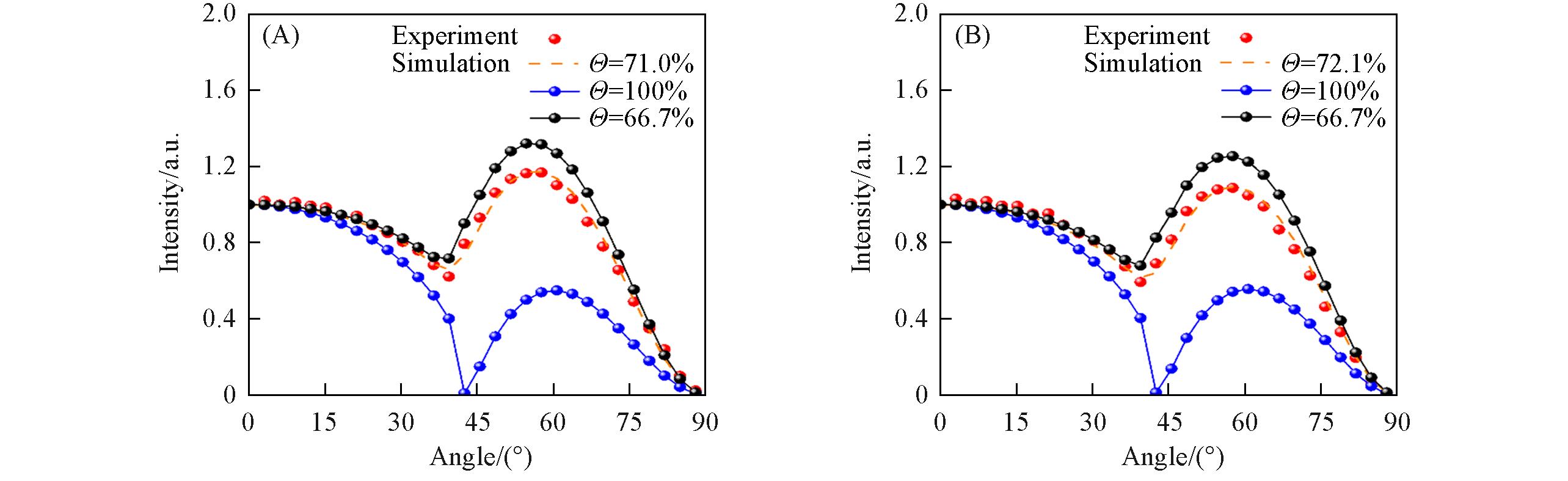
Fig.3 p⁃Polarized PL spectra of mCP⁃BP⁃PXZ(A) and mCBP⁃BP⁃PXZ(B) measured in neat films
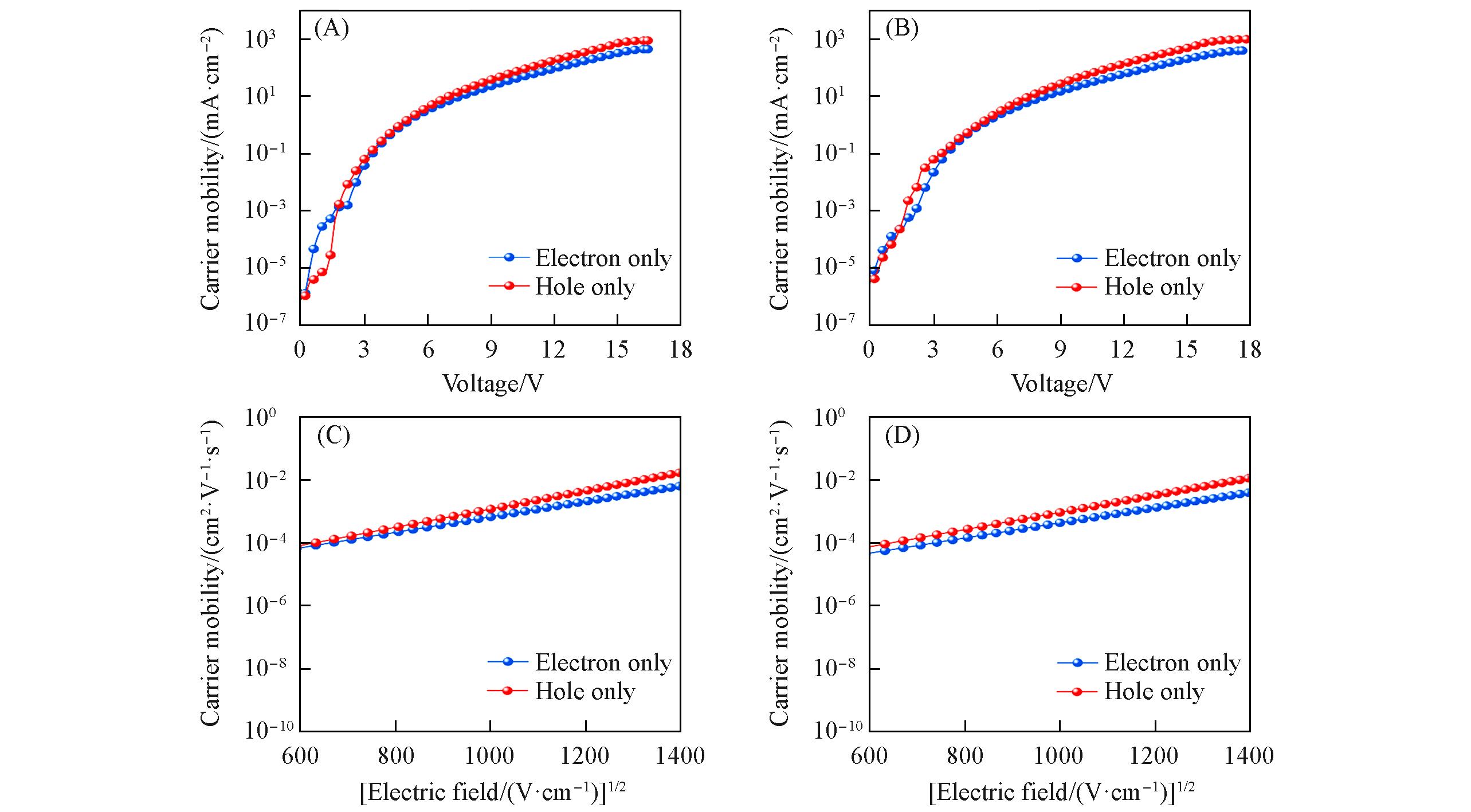
Fig.4 Plots of current density⁃voltage of single carrier devices of mCP⁃BP⁃PXZ(A) and mCBP⁃BP⁃PXZ(B) in neat films, and plots of electric field⁃dependent mobilities of mCP⁃BP⁃PXZ(C) and mCBP⁃BP⁃PXZ(D) in neat films
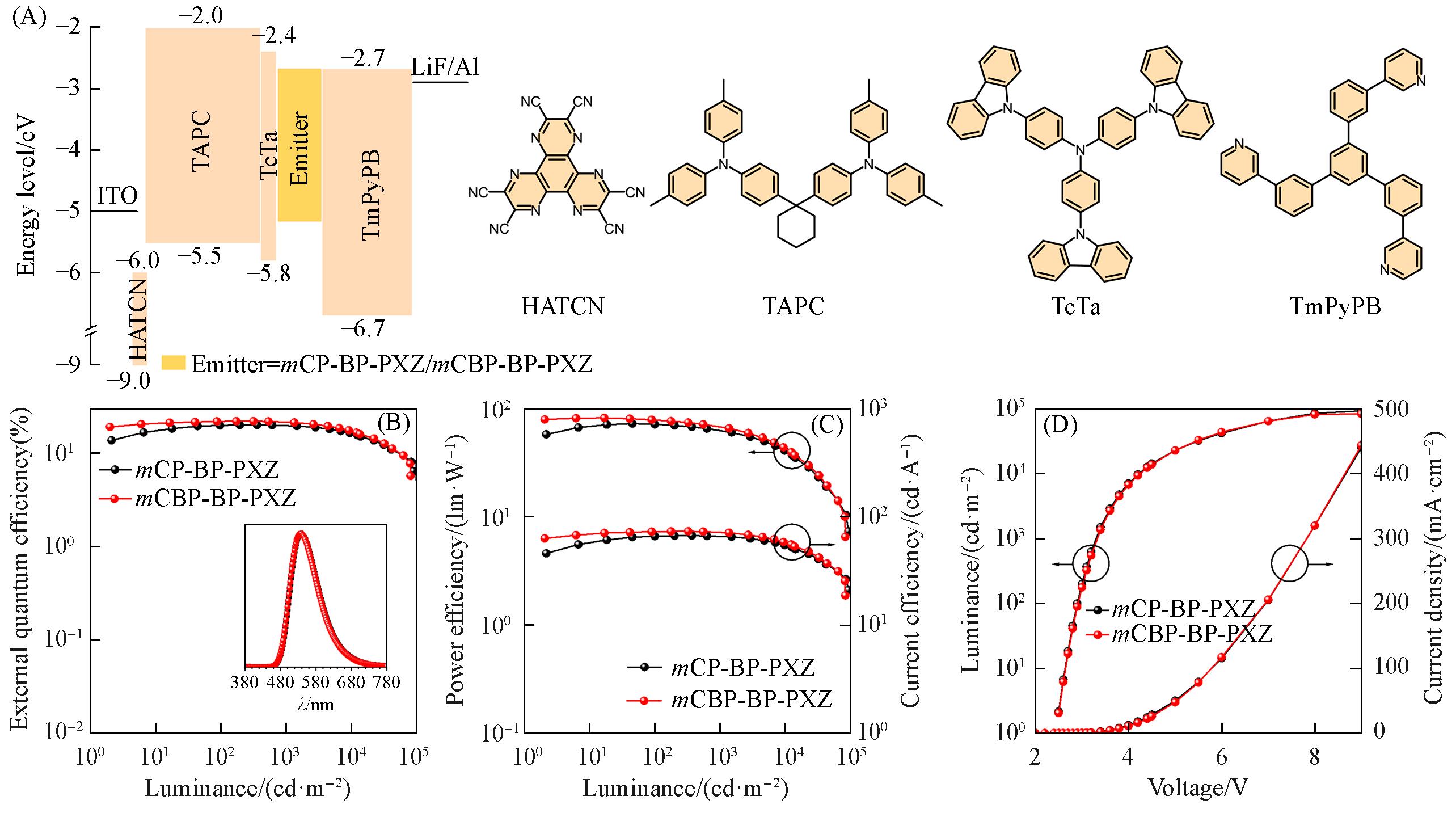
Fig.5 Configuration, energy diagram and molecular structures of the materials used in the thin⁃layer devices(A), plots of external quantum efficiency⁃luminance(B), power efficiency⁃luminance⁃current efficiency(C) and luminance⁃voltage⁃current density(D) of the non⁃doped thin⁃layer devices based on mCP⁃BP⁃PXZ and mCBP⁃BP⁃PXZ
| Emitter | Device | λEL/nm | Von/V | Lmax/ (cd∙m-2) | CIE(x, y) | CE/(cd∙A-1) | PE/(lm∙W-1) | EQE(%) | RO(%) |
|---|---|---|---|---|---|---|---|---|---|
| Maximum value/at 1000 cd∙m-2/at 10000 cd∙m-2 | |||||||||
| mCP⁃BP⁃PXZ | Thin⁃I | 540 | 2.5 | 92290 | (0.37, 0.58) | 66.8/65.9/54.7 | 72.6/62.6/40.9 | 20.1/19.7/16.4 | 2.0 |
| Thick⁃I⁃PPF(/mCBP) | 538 | 2.4 | 100800 | (0.38, 0.58) | 60.3/59.0/51.1 | 69.4/46.3/26.8 | 18.4/18.0/15.6 | 2.2 | |
| Thick⁃I⁃TSPO1 | 540 | 2.5 | 56580 | (0.38, 0.57) | 56.9/55.4/48.4 | 63.1/41.5/25.3 | 17.2/16.7/14.6 | 2.9 | |
| Thick⁃I⁃TPBi | 540 | 2.4 | 99030 | (0.38, 0.57) | 54.7/53.4/48.0 | 63.1/41.9/27.4 | 16.5/16.1/14.5 | 2.4 | |
| Thick⁃I⁃CBP | 538 | 2.4 | 96710 | (0.38, 0.58) | 55.8/54.4/47.2 | 64.4/45.0/27.0 | 17.0/16.6/14.4 | 2.4 | |
| Thick⁃I⁃mCP | 538 | 2.4 | 97750 | (0.37, 0.58) | 55.0/53.6/46.6 | 64.4/44.3/26.6 | 16.8/16.3/14.2 | 3.0 | |
| Thick⁃I⁃SimCP2 | 534 | 2.4 | 99370 | (0.37, 0.58) | 56.6/55.5/47.9 | 60.4/48.5/27.4 | 17.3/17.0/14.7 | 1.7 | |
| mCBP⁃BP⁃PXZ | Thin⁃II | 538 | 2.5 | 82870 | (0.37, 0.58) | 73.3/71.1/58.5 | 82.1/65.7/43.7 | 22.0/21.3/17.5 | 3.2 |
| Thick⁃II⁃PPF(/mCBP) | 532 | 2.5 | 74380 | (0.36, 0.58) | 62.7/61.0/51.5 | 71.6/47.9/27.0 | 19.1/18.6/15.7 | 2.6 | |
| Thick⁃II⁃TSPO1 | 534 | 2.5 | 21650 | (0.36, 0.58) | 60.1/58.1/47.4 | 69.7/40.6/21.3 | 18.3/17.7/14.5 | 3.3 | |
| Thick⁃II⁃TPBi | 532 | 2.5 | 92880 | (0.36, 0.58) | 53.4/52.3/44.7 | 59.5/43.2/25.5 | 16.3/16.0/13.7 | 1.8 | |
| Thick⁃II⁃CBP | 532 | 2.5 | 85710 | (0.36, 0.58) | 64.7/62.7/51.2 | 75.1/54.7/29.3 | 19.8/19.2/15.7 | 3.0 | |
| Thick⁃II⁃mCP | 532 | 2.5 | 76330 | (0.36, 0.58) | 60.3/59.2/48.0 | 65.3/49.0/25.2 | 18.5/18.1/14.7 | 2.2 | |
| Thick⁃II⁃SimCP2 | 532 | 2.5 | 83430 | (0.36, 0.58) | 57.0/54.7/44.9 | 65.5/40.9/21.7 | 17.4/16.7/13.8 | 4.0 | |
Table 2 EL performances of non-doped OLEDs*
| Emitter | Device | λEL/nm | Von/V | Lmax/ (cd∙m-2) | CIE(x, y) | CE/(cd∙A-1) | PE/(lm∙W-1) | EQE(%) | RO(%) |
|---|---|---|---|---|---|---|---|---|---|
| Maximum value/at 1000 cd∙m-2/at 10000 cd∙m-2 | |||||||||
| mCP⁃BP⁃PXZ | Thin⁃I | 540 | 2.5 | 92290 | (0.37, 0.58) | 66.8/65.9/54.7 | 72.6/62.6/40.9 | 20.1/19.7/16.4 | 2.0 |
| Thick⁃I⁃PPF(/mCBP) | 538 | 2.4 | 100800 | (0.38, 0.58) | 60.3/59.0/51.1 | 69.4/46.3/26.8 | 18.4/18.0/15.6 | 2.2 | |
| Thick⁃I⁃TSPO1 | 540 | 2.5 | 56580 | (0.38, 0.57) | 56.9/55.4/48.4 | 63.1/41.5/25.3 | 17.2/16.7/14.6 | 2.9 | |
| Thick⁃I⁃TPBi | 540 | 2.4 | 99030 | (0.38, 0.57) | 54.7/53.4/48.0 | 63.1/41.9/27.4 | 16.5/16.1/14.5 | 2.4 | |
| Thick⁃I⁃CBP | 538 | 2.4 | 96710 | (0.38, 0.58) | 55.8/54.4/47.2 | 64.4/45.0/27.0 | 17.0/16.6/14.4 | 2.4 | |
| Thick⁃I⁃mCP | 538 | 2.4 | 97750 | (0.37, 0.58) | 55.0/53.6/46.6 | 64.4/44.3/26.6 | 16.8/16.3/14.2 | 3.0 | |
| Thick⁃I⁃SimCP2 | 534 | 2.4 | 99370 | (0.37, 0.58) | 56.6/55.5/47.9 | 60.4/48.5/27.4 | 17.3/17.0/14.7 | 1.7 | |
| mCBP⁃BP⁃PXZ | Thin⁃II | 538 | 2.5 | 82870 | (0.37, 0.58) | 73.3/71.1/58.5 | 82.1/65.7/43.7 | 22.0/21.3/17.5 | 3.2 |
| Thick⁃II⁃PPF(/mCBP) | 532 | 2.5 | 74380 | (0.36, 0.58) | 62.7/61.0/51.5 | 71.6/47.9/27.0 | 19.1/18.6/15.7 | 2.6 | |
| Thick⁃II⁃TSPO1 | 534 | 2.5 | 21650 | (0.36, 0.58) | 60.1/58.1/47.4 | 69.7/40.6/21.3 | 18.3/17.7/14.5 | 3.3 | |
| Thick⁃II⁃TPBi | 532 | 2.5 | 92880 | (0.36, 0.58) | 53.4/52.3/44.7 | 59.5/43.2/25.5 | 16.3/16.0/13.7 | 1.8 | |
| Thick⁃II⁃CBP | 532 | 2.5 | 85710 | (0.36, 0.58) | 64.7/62.7/51.2 | 75.1/54.7/29.3 | 19.8/19.2/15.7 | 3.0 | |
| Thick⁃II⁃mCP | 532 | 2.5 | 76330 | (0.36, 0.58) | 60.3/59.2/48.0 | 65.3/49.0/25.2 | 18.5/18.1/14.7 | 2.2 | |
| Thick⁃II⁃SimCP2 | 532 | 2.5 | 83430 | (0.36, 0.58) | 57.0/54.7/44.9 | 65.5/40.9/21.7 | 17.4/16.7/13.8 | 4.0 | |
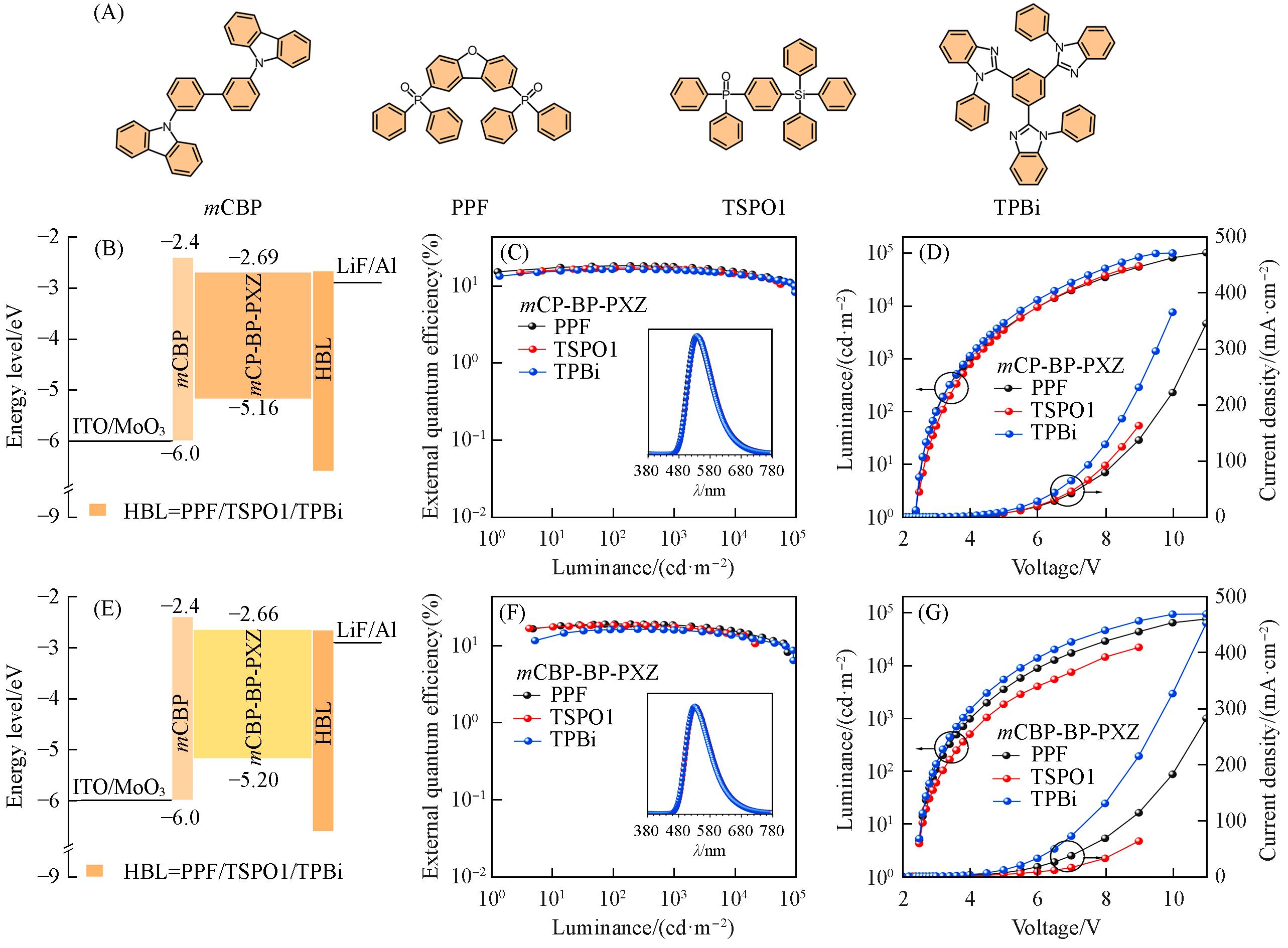
Fig.6 Molecular structures of the functional materials in the thick⁃layer non⁃doped devices with different HBL materials(A), configurations and energy level diagrams(B), plots of external quantum efficiency⁃luminance(C) and luminance⁃current density⁃voltage(D) of the mCP⁃BP⁃PXZ⁃based devices(Thick⁃I⁃HBL), configurations and energy level diagrams(E), plots of external quantum efficiency⁃luminance(F) and luminance⁃current density⁃voltage(G) of the mCBP⁃BP⁃PXZ⁃based devices(Thick⁃II⁃HBL)
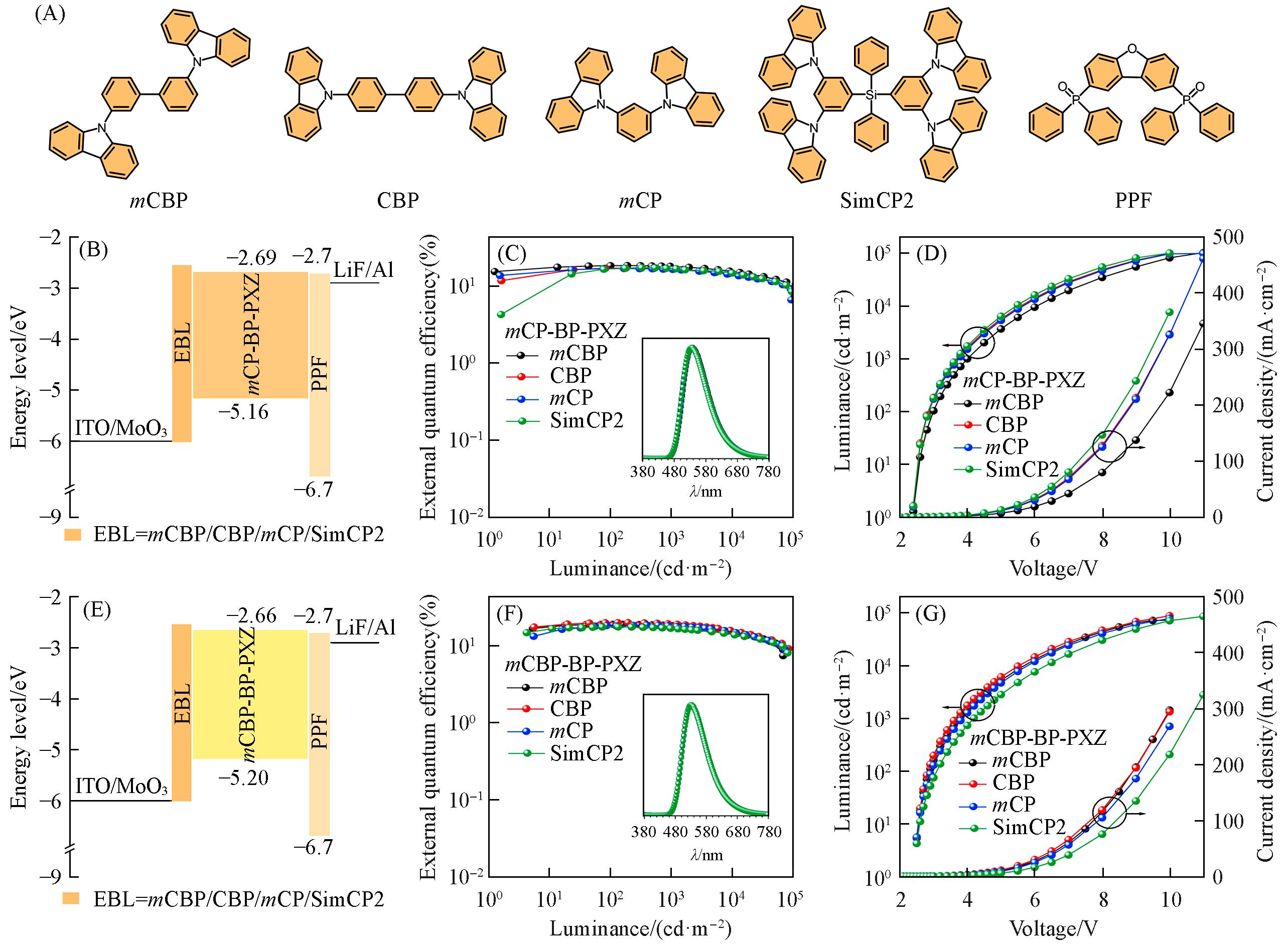
Fig.7 Molecular structures of the functional materials in the thick⁃layer non⁃doped devices with different EBL materials(A), configurations and energy level diagrams(B), plots of external quantum efficiency⁃luminance(C) and luminance⁃current density⁃voltage(D) of the mCP⁃BP⁃PXZ⁃based devices(Thick⁃I⁃EBL), configurations and energy level diagrams(E), plots of external quantum efficiency⁃luminance(F) and luminance⁃current density⁃voltage(G) of the mCBP⁃BP⁃PXZ⁃based devices(Thick⁃II⁃EBL)Insets in planes(C) and(F): EL spectra at 1000 cd/m2 of thick⁃layer devices based on mCP⁃BP⁃PXZ and mCBP⁃BP⁃PXZ, respectively.
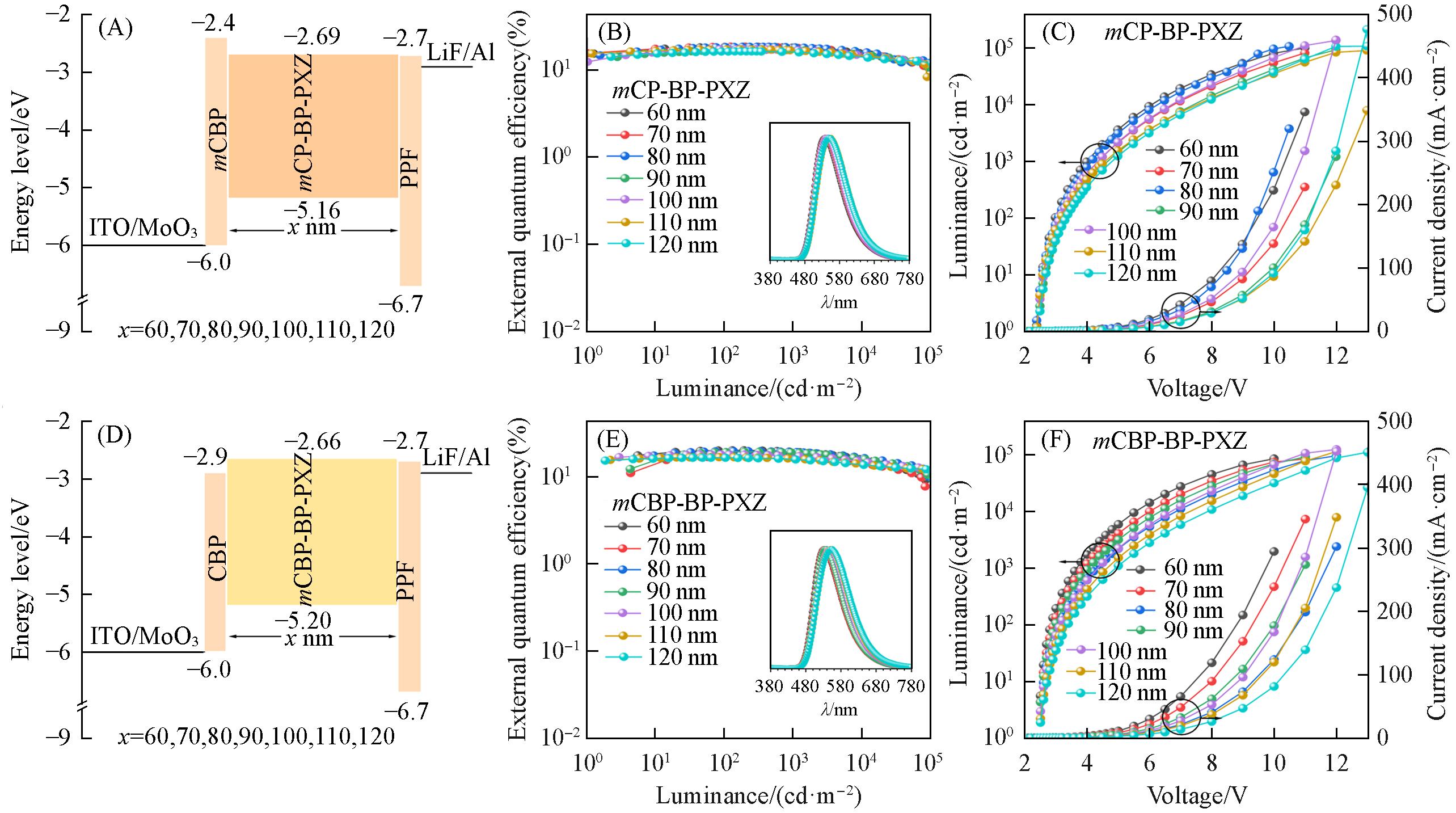
Fig.8 Configurations and energy level diagrams(A), plots of external quantum efficiency⁃luminance(B) and luminance⁃current density⁃voltage(C) of the mCP⁃BP⁃PXZ⁃based thick⁃layer devices, configurations and energy level diagrams(D), plots of external quantum efficiency⁃luminance(E) and luminance⁃ current density⁃voltage(F) of the mCBP⁃BP⁃PXZ⁃based thick⁃layer devices
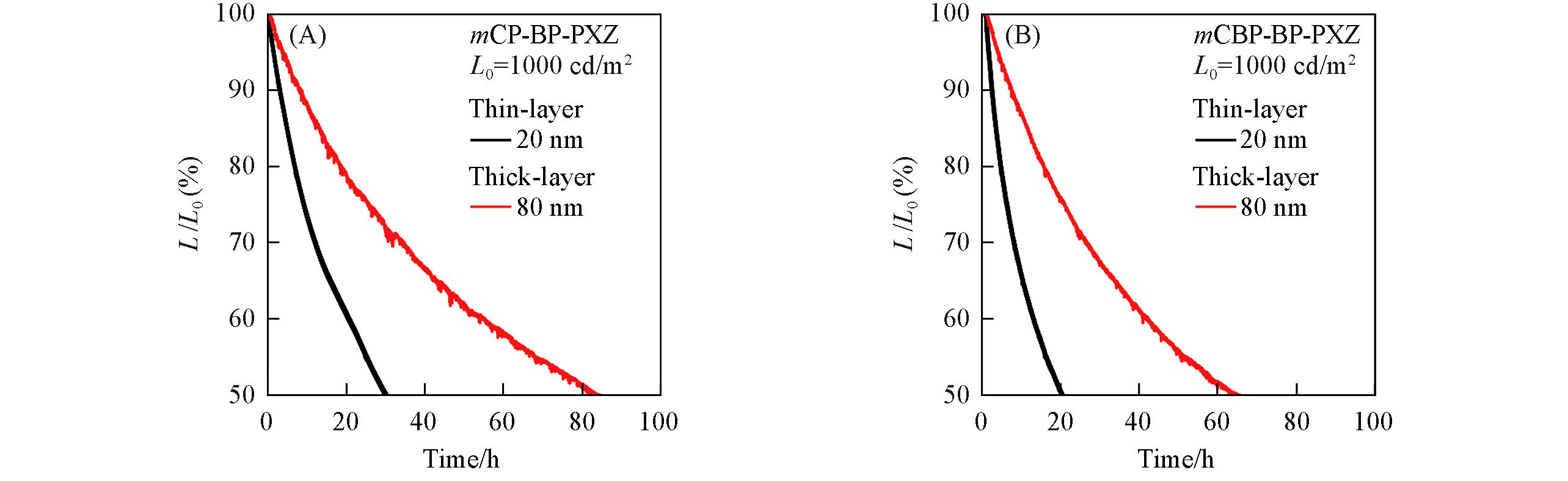
Fig.9 Operational lifetime of the non⁃doped thin⁃layer and thick⁃layer devices based on mCP⁃BP⁃PXZ(A) and mCBP⁃BP⁃PXZ(B)
| Emitter | Thicknessof EML/nm | λEL/nm | Von/V | Lmax/(cd∙m-2) | CIE(x, y) | CE/(cd∙A-1) | PE/(lm∙W-1) | EQE(%) | RO(%) |
|---|---|---|---|---|---|---|---|---|---|
| Maximum value/at 1000 cd∙m-2/at 10000 cd∙m-2 | |||||||||
| mCP⁃BP⁃PXZ | 60 | 538 | 2.4 | 100800 | (0.38, 0.58) | 60.3/59.0/51.1 | 69.4/46.3/26.8 | 18.4/18.0/15.6 | 2.2 |
| 70 | 540 | 2.4 | 81860 | (0.39, 0.57) | 60.6/58.6/49.9 | 69.4/40.9/22.4 | 18.4/17.8/15.2 | 3.3 | |
| 80 | 548 | 2.4 | 103200 | (0.40, 0.56) | 60.1/59.1/53.4 | 67.2/44.2/28.0 | 18.4/18.1/16.4 | 1.6 | |
| 90 | 550 | 2.5 | 93570 | (0.40, 0.56) | 55.2/54.7/49.1 | 59.3/38.2/22.1 | 17.0/16.9/15.2 | 0.6 | |
| 100 | 544 | 2.4 | 136900 | (0.39, 0.57) | 56.5/54.8/48.6 | 62.8/38.2/23.5 | 17.2/16.7/14.9 | 2.9 | |
| 110 | 550 | 2.4 | 91020 | (0.41, 0.55) | 54.8/53.6/47.7 | 64.6/37.4/21.4 | 17.2/16.8/15.0 | 2.3 | |
| 120 | 550 | 2.5 | 108600 | (0.41, 0.56) | 52.0/50.7/44.0 | 57.7/31.8/17.3 | 16.3/15.9/13.8 | 2.5 | |
| mCBP⁃BP⁃PXZ | 60 | 532 | 2.5 | 85710 | (0.36, 0.58) | 64.7/62.7/51.2 | 75.1/54.7/29.3 | 19.8/19.2/15.7 | 3.0 |
| 70 | 532 | 2.5 | 85060 | (0.36, 0.58) | 57.4/56.1/46.6 | 63.1/46.4/24.4 | 17.5/17.1/14.2 | 2.3 | |
| 80 | 534 | 2.6 | 96760 | (0.38, 0.57) | 64.0/62.7/53.1 | 70.3/46.9/23.8 | 19.4/19.1/16.1 | 1.5 | |
| 90 | 540 | 2.5 | 92290 | (0.37, 0.58) | 63.0/61.8/51.7 | 68.4/48.6/25.0 | 19.1/18.7/15.7 | 2.1 | |
| 100 | 550 | 2.5 | 124400 | (0.40, 0.56) | 57.7/55.1/48.5 | 67.1/38.5/23.4 | 17.8/17.0/15.0 | 4.5 | |
| 110 | 550 | 2.5 | 114400 | (0.41, 0.55) | 52.6/50.7/44.3 | 61.5/35.4/19.9 | 16.6/16.0/14.0 | 3.6 | |
| 120 | 556 | 2.5 | 111200 | (0.42, 0.55) | 51.3/48.9/42.1 | 59.6/30.7/16.5 | 16.3/15.6/13.5 | 4.3 | |
Table 3 EL performances of the thick-layer non-doped OLEDs with different thickness of EML*
| Emitter | Thicknessof EML/nm | λEL/nm | Von/V | Lmax/(cd∙m-2) | CIE(x, y) | CE/(cd∙A-1) | PE/(lm∙W-1) | EQE(%) | RO(%) |
|---|---|---|---|---|---|---|---|---|---|
| Maximum value/at 1000 cd∙m-2/at 10000 cd∙m-2 | |||||||||
| mCP⁃BP⁃PXZ | 60 | 538 | 2.4 | 100800 | (0.38, 0.58) | 60.3/59.0/51.1 | 69.4/46.3/26.8 | 18.4/18.0/15.6 | 2.2 |
| 70 | 540 | 2.4 | 81860 | (0.39, 0.57) | 60.6/58.6/49.9 | 69.4/40.9/22.4 | 18.4/17.8/15.2 | 3.3 | |
| 80 | 548 | 2.4 | 103200 | (0.40, 0.56) | 60.1/59.1/53.4 | 67.2/44.2/28.0 | 18.4/18.1/16.4 | 1.6 | |
| 90 | 550 | 2.5 | 93570 | (0.40, 0.56) | 55.2/54.7/49.1 | 59.3/38.2/22.1 | 17.0/16.9/15.2 | 0.6 | |
| 100 | 544 | 2.4 | 136900 | (0.39, 0.57) | 56.5/54.8/48.6 | 62.8/38.2/23.5 | 17.2/16.7/14.9 | 2.9 | |
| 110 | 550 | 2.4 | 91020 | (0.41, 0.55) | 54.8/53.6/47.7 | 64.6/37.4/21.4 | 17.2/16.8/15.0 | 2.3 | |
| 120 | 550 | 2.5 | 108600 | (0.41, 0.56) | 52.0/50.7/44.0 | 57.7/31.8/17.3 | 16.3/15.9/13.8 | 2.5 | |
| mCBP⁃BP⁃PXZ | 60 | 532 | 2.5 | 85710 | (0.36, 0.58) | 64.7/62.7/51.2 | 75.1/54.7/29.3 | 19.8/19.2/15.7 | 3.0 |
| 70 | 532 | 2.5 | 85060 | (0.36, 0.58) | 57.4/56.1/46.6 | 63.1/46.4/24.4 | 17.5/17.1/14.2 | 2.3 | |
| 80 | 534 | 2.6 | 96760 | (0.38, 0.57) | 64.0/62.7/53.1 | 70.3/46.9/23.8 | 19.4/19.1/16.1 | 1.5 | |
| 90 | 540 | 2.5 | 92290 | (0.37, 0.58) | 63.0/61.8/51.7 | 68.4/48.6/25.0 | 19.1/18.7/15.7 | 2.1 | |
| 100 | 550 | 2.5 | 124400 | (0.40, 0.56) | 57.7/55.1/48.5 | 67.1/38.5/23.4 | 17.8/17.0/15.0 | 4.5 | |
| 110 | 550 | 2.5 | 114400 | (0.41, 0.55) | 52.6/50.7/44.3 | 61.5/35.4/19.9 | 16.6/16.0/14.0 | 3.6 | |
| 120 | 556 | 2.5 | 111200 | (0.42, 0.55) | 51.3/48.9/42.1 | 59.6/30.7/16.5 | 16.3/15.6/13.5 | 4.3 | |
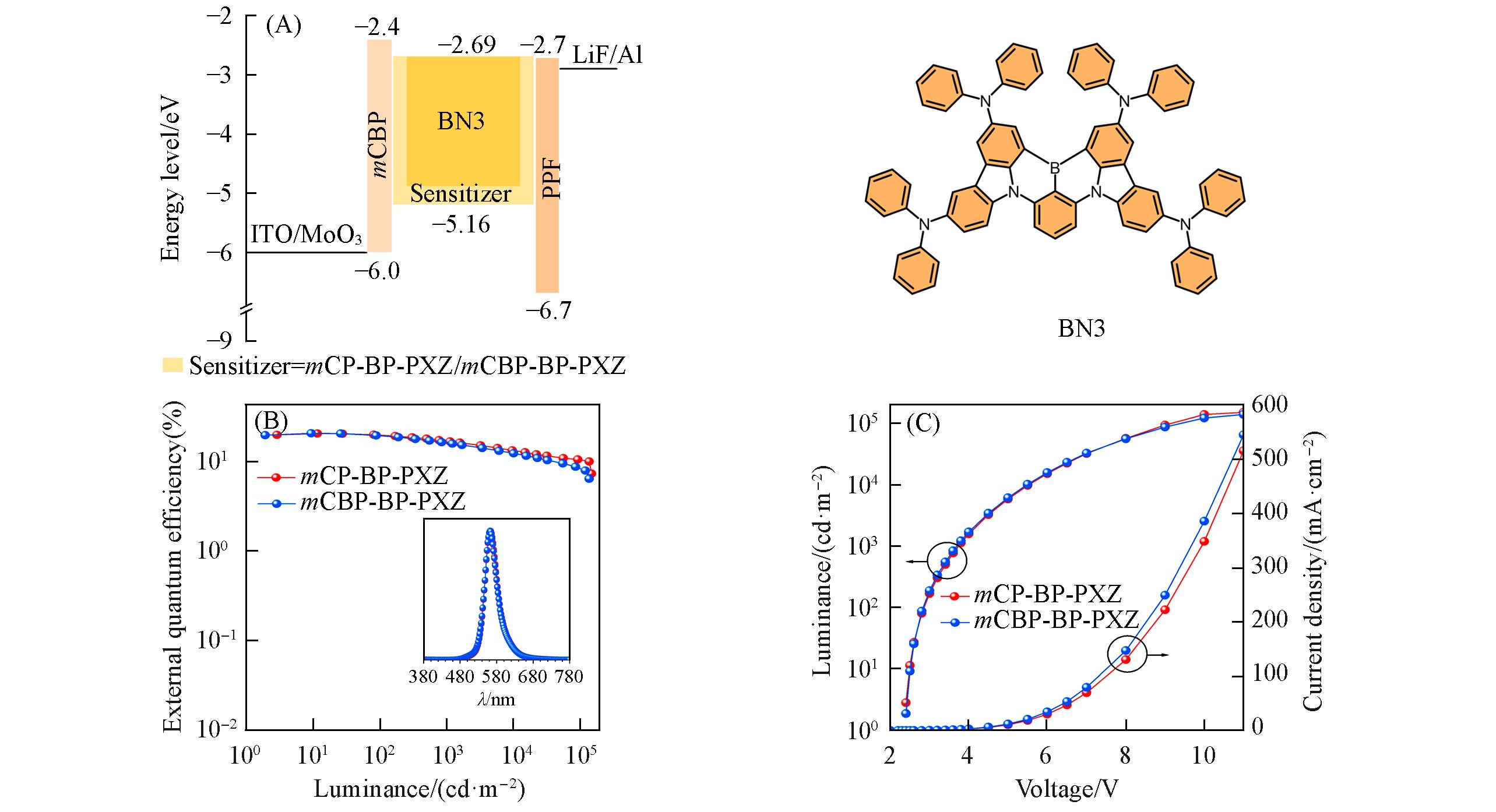
Fig.10 Configuration, energy diagram and molecular structure of the MR⁃TADF material used in the simple thick⁃layer sensitized devices(A), plots of external quantum efficiency⁃luminance(B) and luminance⁃voltage⁃current density(C) of the sensitized thick⁃layer devices
| [1] | Tang C. W., VanSlyke S. A., Appl. Phys. Lett., 1987, 51, 913—915 |
| [2] | Adachi C., Baldo M. A., Thompson M. E., Forrest S. R., J. Appl. Phys., 2001, 90, 5048—5051 |
| [3] | Uoyama H., Goushi K., Shizu K., Nomura H., Adachi C., Nature, 2012, 492, 234—238 |
| [4] | Huang T., Wang Q., Zhang H., Zhang Y., Zhan G., Zhang D., Duan L., Nat. Photon., 2024, 18, 516—523 |
| [5] | Jiang P., Miao J., Cao X., Xia H., Pan K., Hua T., Lv X., Huang Z., Zou Y., Yang C., Adv. Mater., 2022, 34, 2106954 |
| [6] | Huang T., Xu Y., Qu Y., Lu X., Ye K., Zhuang X., Wang Y., Adv. Mater., 2025, 37, 2503383 |
| [7] | Huang Z., Xie H., Miao J., Wei Y., Zou Y., Hua T., Cao X., Yang C., J. Am. Chem. Soc., 2023, 145, 12550—12560 |
| [8] | Cheng Y. C., Tang X., Wang K., Xiong X., Fan X. C., Luo S., Walia R., Xie Y., Zhang T., Zhang D., Yu J., Chen X. K., Adachi C., Zhang X. H., Nat. Commun., 2024, 15, 731 |
| [9] | Kido J., Kimura M., Nagai K., Science, 1995, 267, 1332—1334 |
| [10] | Walzer K., Maennig B., Pfeiffer M., Leo K., Chem. Rev., 2007, 107, 1233—1271 |
| [11] | Kotadiya N. B., Wetzelaer G. J. A. H., Blom P. W. M., Nat. Photon., 2019, 13, 765—769 |
| [12] | Sachnik O., Li Y., Tan X., Michels J. J., Blom P. W. M., Wetzelaer G. A. H., Adv. Mater., 2023, 35, 2300574 |
| [13] | Hudson Z. M., Wang Z., Helander M. G., Lu Z., Wang S., Adv. Mater., 2012, 24, 2922—2928 |
| [14] | Van der Zee B., Li Y., Wetzelaer G. J. A. H., Blom P. W. M., Adv. Optical Mater., 2021, 9, 2100249 |
| [15] | Li Y., Kotadiya N. B., van der Zee B., Blom P. W. M., Wetzelaer G. A. H., Adv. Optical Mater., 2021, 9, 2001812 |
| [16] | Li Y., Van der Zee B., Tan X., Zhou X., Wetzelaer G. J. A. H., Blom P. W. M., Adv. Mater., 2023, 35, 2304728 |
| [17] | Fu Y., Liu H., Tang B. Z., Zhao Z., Adv. Funct. Mater., 2024, 34, 2401434 |
| [18] | Liu Z., Guo T., Liu Z., Yang D., Ma D., Tang B. Z., Zhao Z., Adv. Funct. Mater., 2026, 36, e17758 |
| [19] | Fu Y., Liu H., Zhu X., Zeng J., Zhao Z., Tang B. Z., J. Mater. Chem. C, 2020, 8, 9549—9557 |
| [20] | Wong M. Y., Zysman‐Colman E., Adv. Mater., 2017, 29, 1605444 |
| [21] | Hao X. L., Ren A. M., Zhou L., Zhang H., J. Phys. Chem. A, 2023, 127, 9771—9780 |
| [22] | Zhao M., Li M., Li W., Du S., Chen Z., Luo M., Qiu Y., Lu X., Yang S., Wang Z., Zhang J., Su S. J., Ge Z., Angew. Chem. Int. Ed., 2022, 61, e202210687 |
| [23] | Guan J., Zhu Z., Gou Q., Wang J., Kuang Z., Zhang L., Zhang X., Ai X., Abdurahman A., Peng Q., Aggregate, 2025, 6, e70100 |
| [24] | Liu H., Guo J., Zhao Z., Tang B. Z., ChemPhotoChem, 2019, 3, 993—999 |
| [25] | Wang K., Ou X., Niu X., Wang Z., Song F., Dong X., Guo W., Peng H., Zhao Z., Lam J. W. Y., Sun J., Wu H., Yu S., Li F., Tang B. Z., Aggregate, 2025, 6, e667 |
| [26] | Ding Z., Wu B., Liu Z., Wang H., Gao F., Wei X., Zhao Z., Alam P., Qiu Z., Tang B. Z., Aggregate, 2025, 6, e70024 |
| [27] | Xu L., Li Y., Liu H., Qiu N., Chen H., Luo Y., Shi H., Zhao Z., Tang B. Z., Aggregate, 2026, 7, e70240 |
| [28] | Guo J., Zhao Z., Tang, B. Z., Adv. Optical Mater., 2018, 6, 1800264. |
| [29] | Huang J., Nie H., Zeng J., Zhuang Z., Gan S., Cai Y., Guo J., Su S., Zhao Z., Tang B. Z., Angew. Chem. Int. Ed., 2017, 56, 12971—12976 |
| [30] | Xu J., Zhu X., Guo J., Fan J., Zeng J., Chen S., Zhao Z., Tang B. Z., ACS Mater. Lett., 2019, 1, 613—619 |
| [31] | Guo J., Li X. L., Nie H., Luo W., Gan S., Hu S., Hu R., Qin A., Zhao Z., Su S. J., Tang B. Z., Adv. Funct. Mater., 2017, 27, 1606458. |
| [32] | Walia R., Xiong X., Fan X. C., Chen T. F., Wang H., Wang K., Shi Y. Z., Tang X., Bredas J. L., Adachi C., Chen X. K., Zhang X. H., Nat. Mater., 2025, 24, 1576—1583 |
| [33] | Liu H., Zeng J., Guo J., Nie H., Zhao Z., Tang B. Z., Angew. Chem. Int. Ed., 2018, 57, 9290—9294 |
| [34] | Liu Y., Li C., Ren Z., Yan S., Bryce M. R., Nat. Rev. Mater., 2018, 3, 18020 |
| [35] | Goushi K., Yoshida K., Sato K., Adachi C., Nat. Photon., 2012, 6, 253—258 |
| [36] | Zou Y., Yu M., Xu Y., Xiao Z., Song X., Hu Y., Xu Z., Zhong C., He J., Cao X., Li K., Miao J., Yang C. , Chem, 2024, 10, 1485—1501 |
| [37] | Zhang H., Huang T., Zhou J., Xu C., Zhang D., Duan L., Chem, 2025, 102685 |
| [38] | Yokoyama D., J. Mater. Chem., 2011, 21, 19187 |
| [39] | Zhao L., Komino T., Inoue M., Kim J. H., Ribierre J. C., Adachi C., Appl. Phys. Lett., 2015, 106, 063301 |
| [40] | Fu Y., Liu H., Yang D., Ma D., Zhao Z., Tang B. Z., Sci. Adv., 2021, 7, eabj2504 |
| [41] | Fan X., Wang K., Shi Y., Sun D., Chen J., Huang F., Wang H., Yu J., Lee C., Zhang X., Smart Mat., 2023, 4, e1122 |
| [42] | Mott N. F., Gurney R. W., Electronic Processes in Ionic Crystals, the Clarendon Press, Oxford, 1940 |
| [43] | Sachnik O., Ie Y., Ando N., Tan X., Blom P. W. M., Wetzelaer G. J. A. H., Adv. Mater., 2024, 36, 2311892 |
| [44] | Qi Y., Ning W., Zou Y., Cao X., Gong S., Yang C., Adv. Funct. Mater., 2021, 31, 2102017 |
| [1] | WANG Yingjie, PAN Zehui, TAO Zhengyu, WANG Yan, TONG Bihai, FUNG Mankeung, SONG Mingxing. Effect of Intermolecular Interaction on the Properties of Benzophenone-based AIDF Materials [J]. Chem. J. Chinese Universities, 2023, 44(4): 20220562. |
| [2] | ZHANG Jialing, WU Yuanyuan, ZHANG Man, TAO Zhengyu, TIAN Yongpan, ZHANG Qianfeng, TONG Bihai, HE Gufeng, KONG Hui. Dominoes Type Reaction of Spatially Close Diamides and Their Applications in Organic Synthesis [J]. Chem. J. Chinese Universities, 2023, 44(2): 20220597. |
| Viewed | ||||||
|
Full text |
|
|||||
|
Abstract |
|
|||||
