

Chem. J. Chinese Universities ›› 2026, Vol. 47 ›› Issue (5): 20250411.doi: 10.7503/cjcu20250411
• Review • Previous Articles Next Articles
WU Rui, LI Zheng, LI Qi, SHI Jiajun, ZHAO Yan, FENG Weixu, YAN Hongxia( )
)
Received:2025-12-30
Online:2026-05-10
Published:2026-02-04
Contact:
YAN Hongxia
E-mail:hongxiayan@nwpu.edu.cn
Supported by:CLC Number:
TrendMD:
WU Rui, LI Zheng, LI Qi, SHI Jiajun, ZHAO Yan, FENG Weixu, YAN Hongxia. Recent Progress on Unconventional Hyperbranched Luminescent Polymers Containing Si, P and B[J]. Chem. J. Chinese Universities, 2026, 47(5): 20250411.
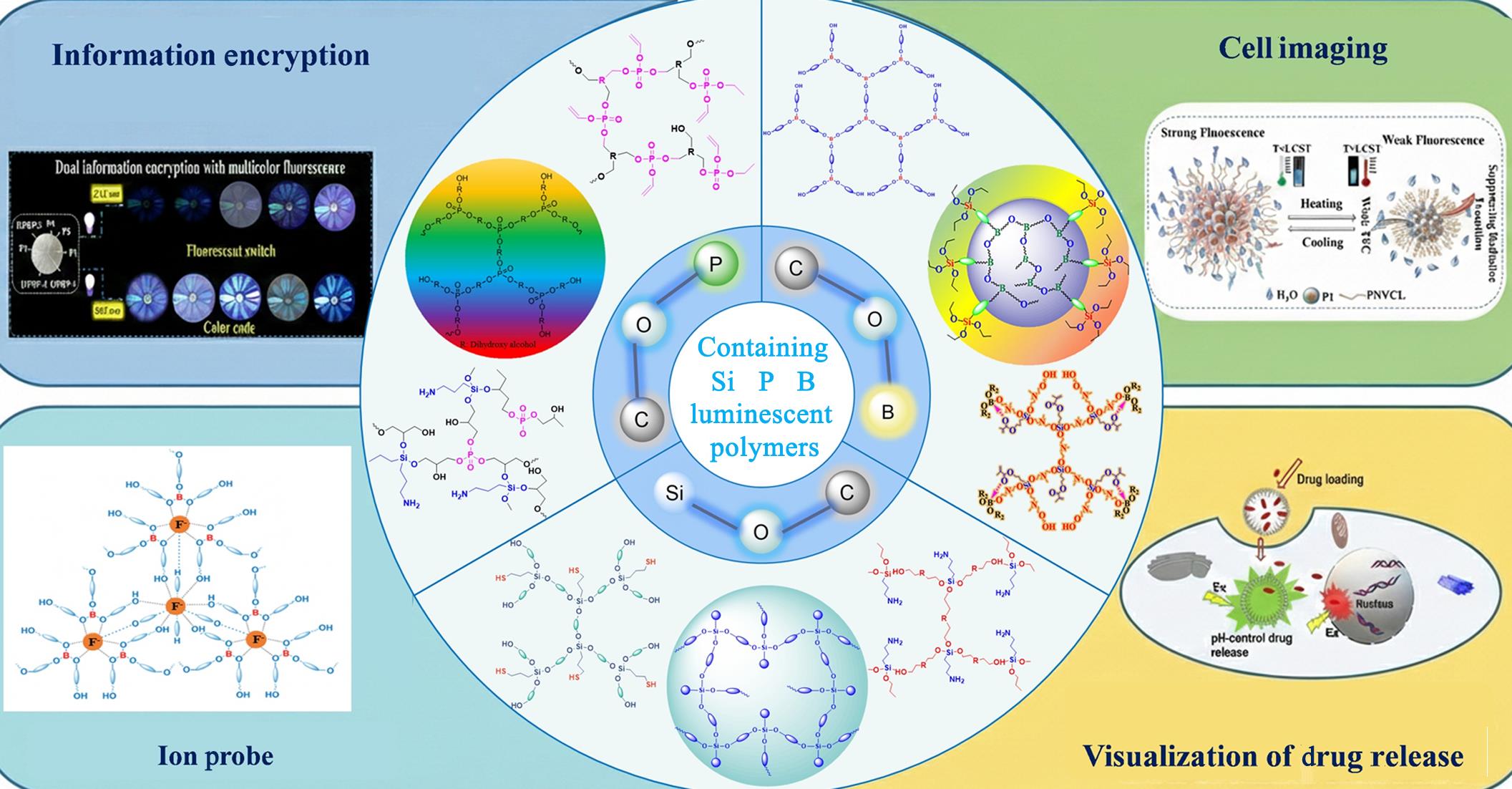
Fig.1 Schematic diagram of the structure and applications of unconventional hyperbranched luminescent polymers containing Si, P, and B
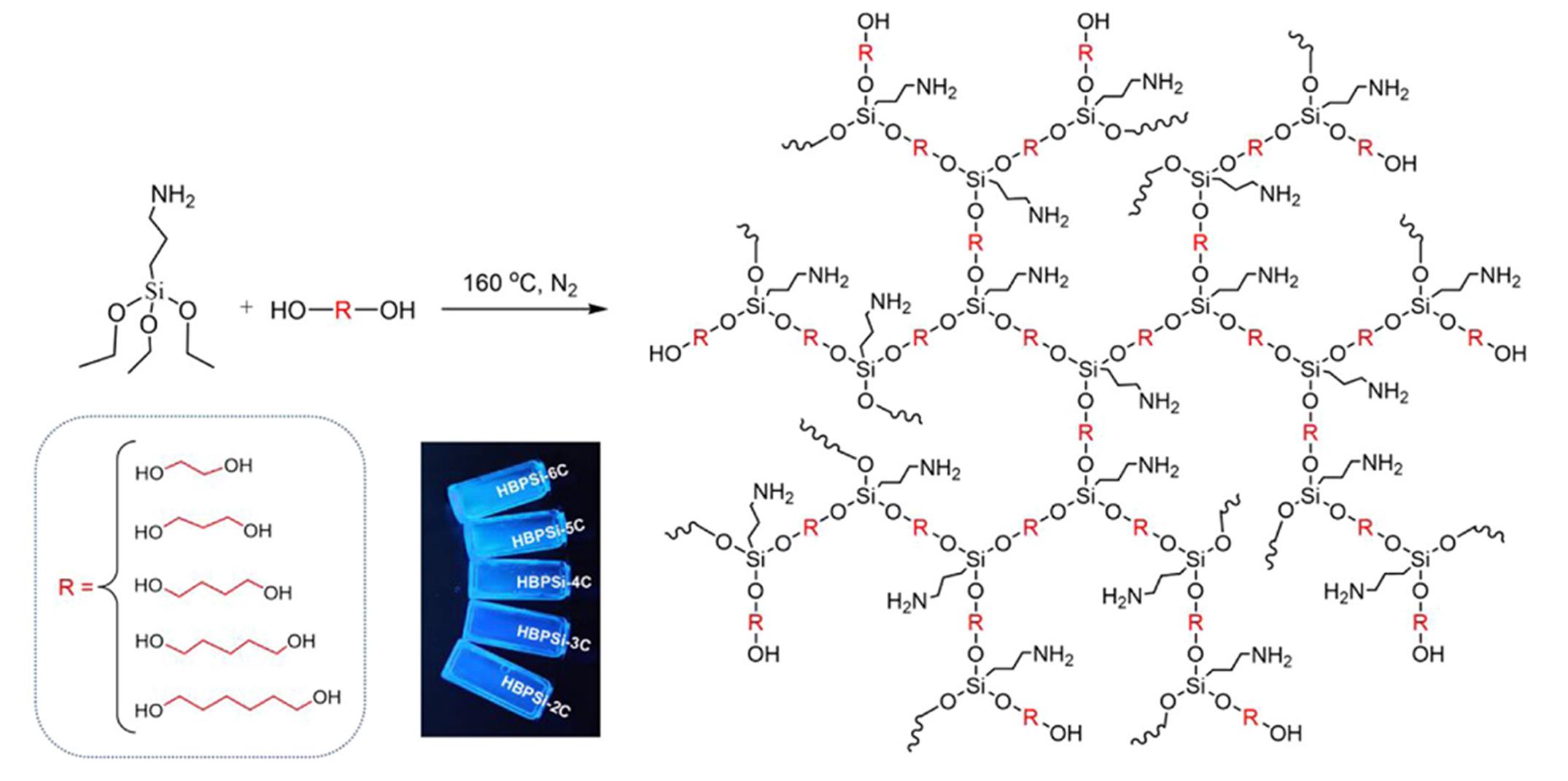
Fig.2 Synthesis route of HBPSi⁃nC[31]
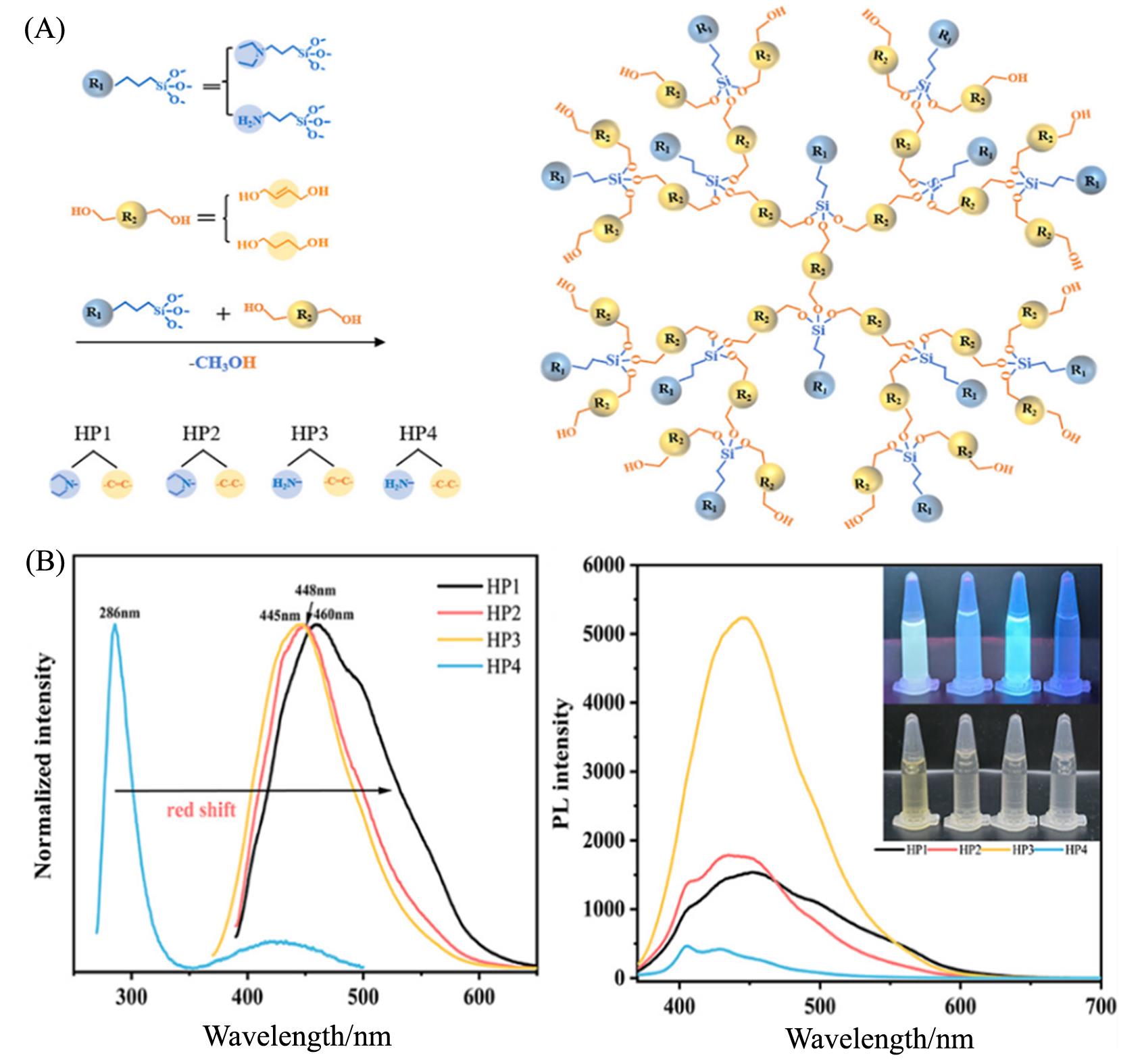
Fig.3 Synthetic route of hyperbranched HP⁃1⁃4(A) and fluorescence emission spectrum of HP⁃1⁃4(B)[37]Inset: images of HP1⁃HP4 solutions under 365 nm UV light.Copyright 2025, American Chemical Society.
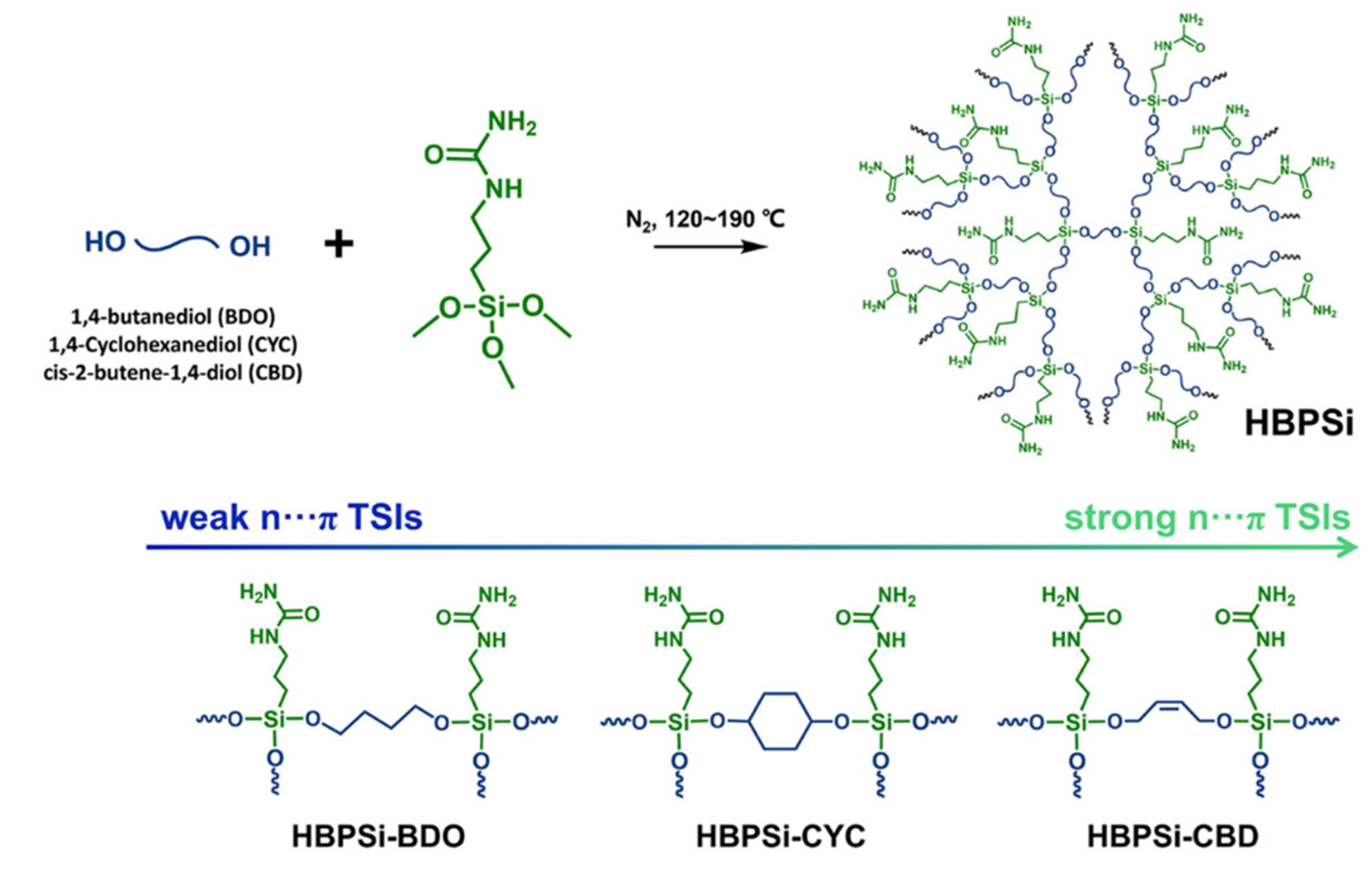
Fig.4 Synthesis routes of HBPSi⁃BDO, HBPSi⁃CY and HBPSi⁃CBD[39]
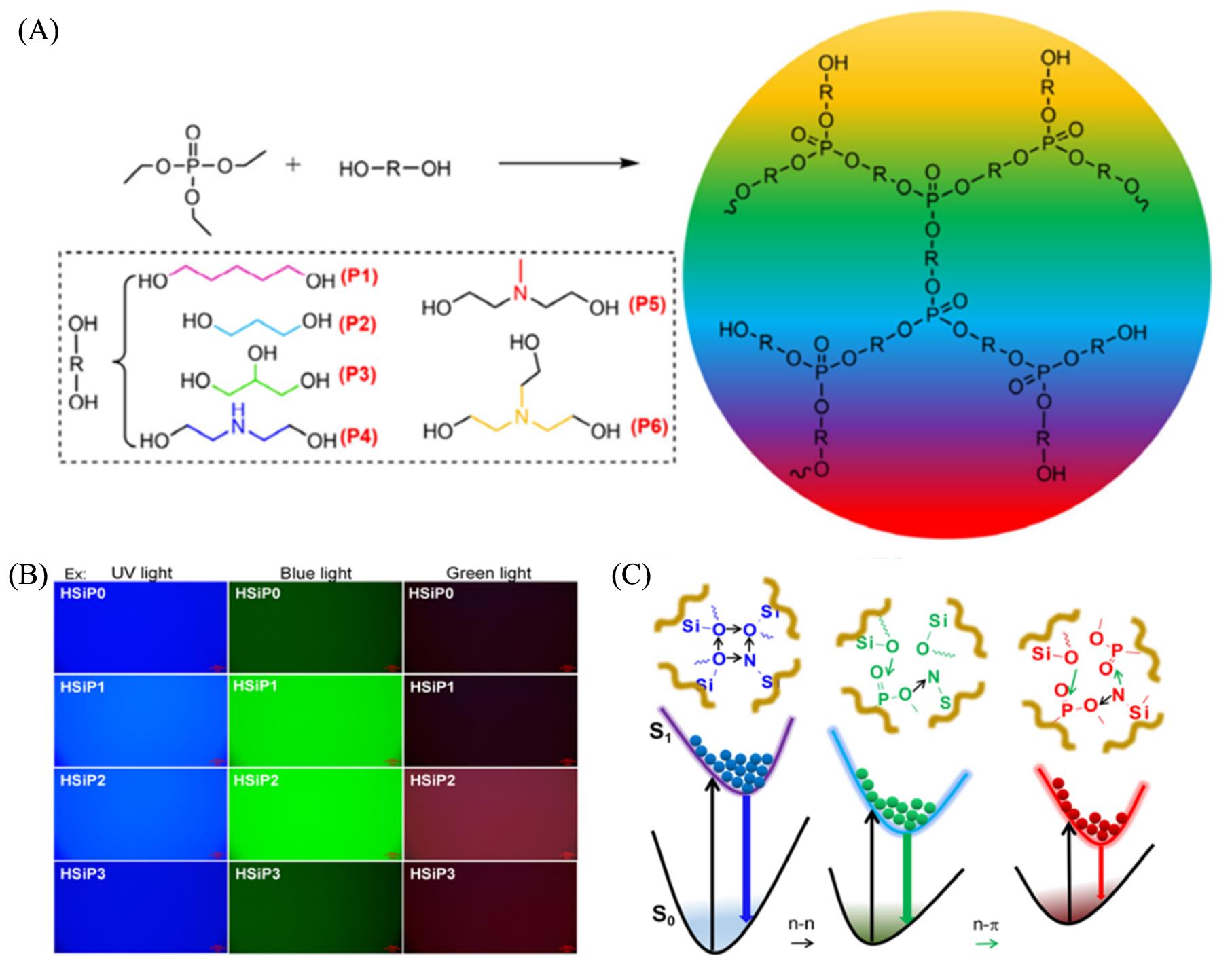
Fig.5 Synthesis route of hyperbranched polyphosphate(A)[48], multicolor emission of HSiP0, HSiP1, HSiP2, and HSiP3(B) and potential energy surfaces for the emission from the enhanced spatial electronic communication(C)[49](A) Copyright 2025, American Chemical Society; (B, C) copyright 2025, American Chemical Society.
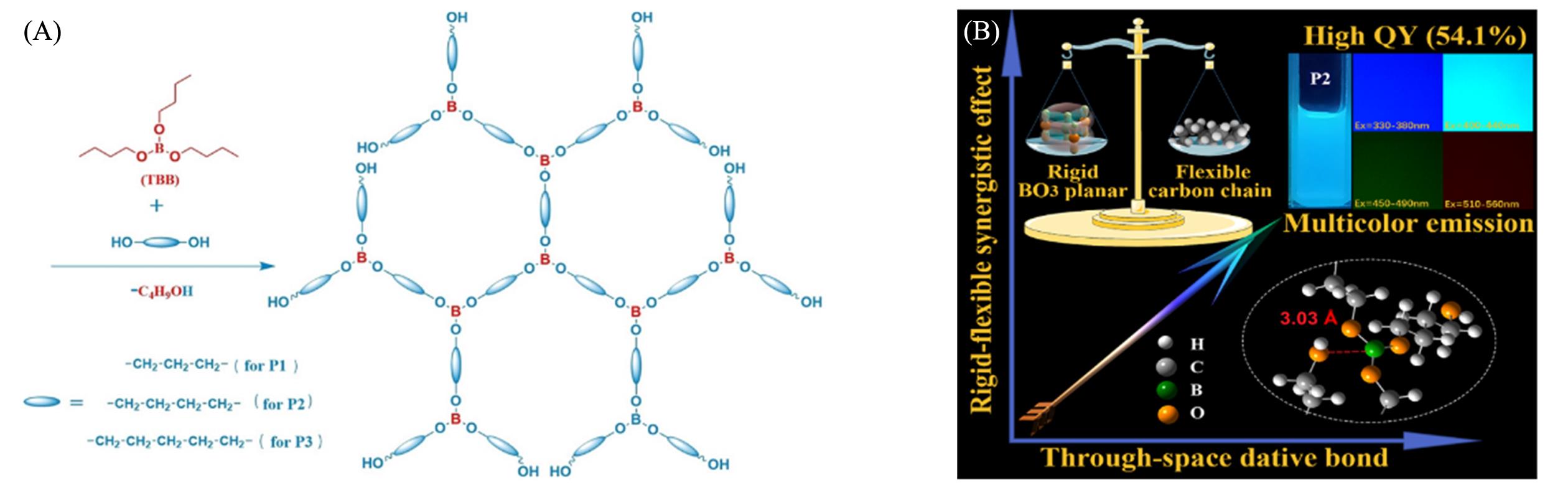
Fig.6 Synthesis routes of the HBPB⁃1—HBPB⁃3(A) and illustration of intrachain interactions for HBPB⁃2(B)[52]Copyright 2022, Wiley-VCH.
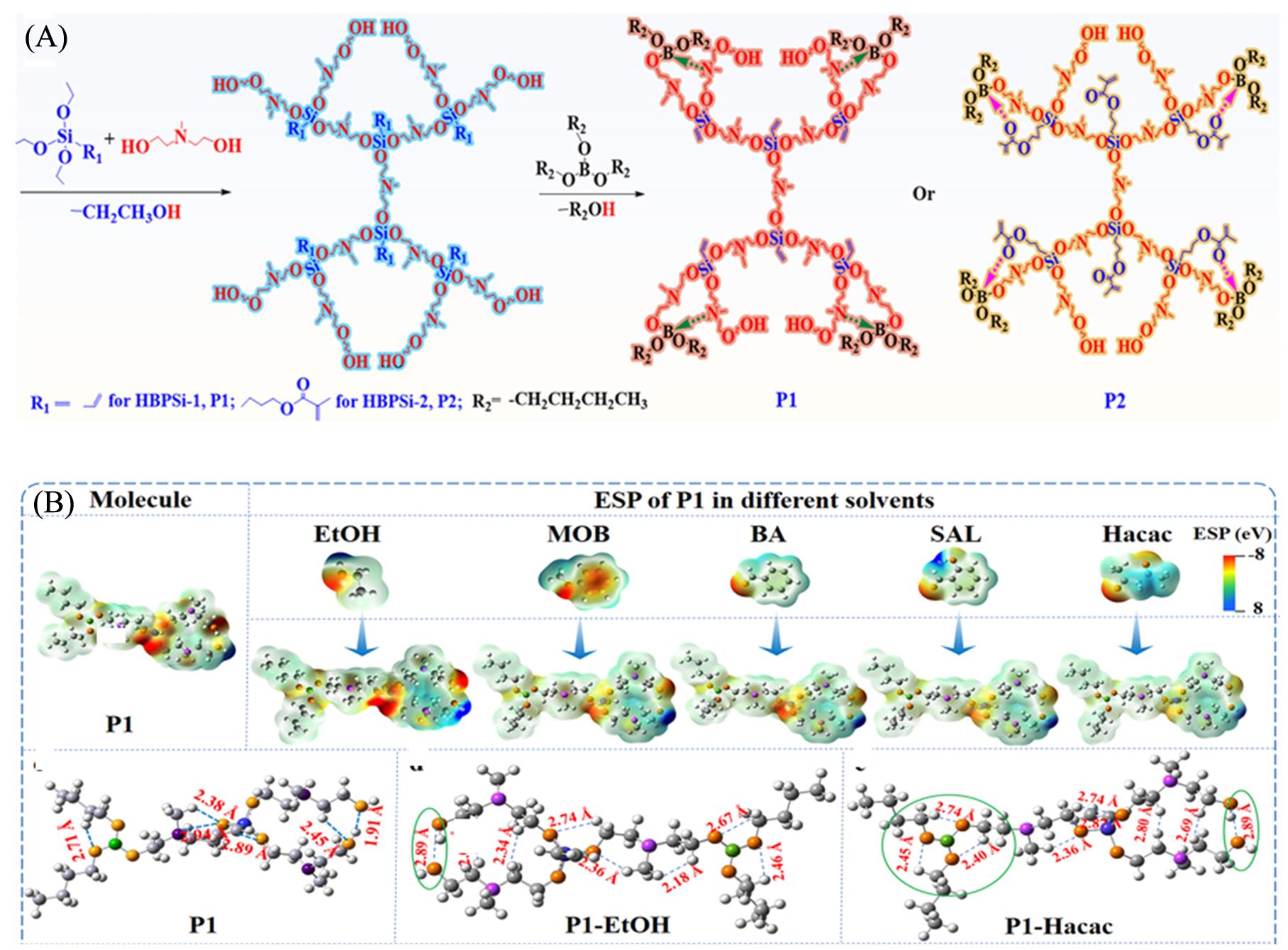
Fig.7 Synthesis routes of HBPSi⁃B⁃1 and HBPSi⁃B⁃2(A) and ESP analysis of HBPSi⁃B⁃1(B)[54]Copyright 2024, Wiley-VCH.
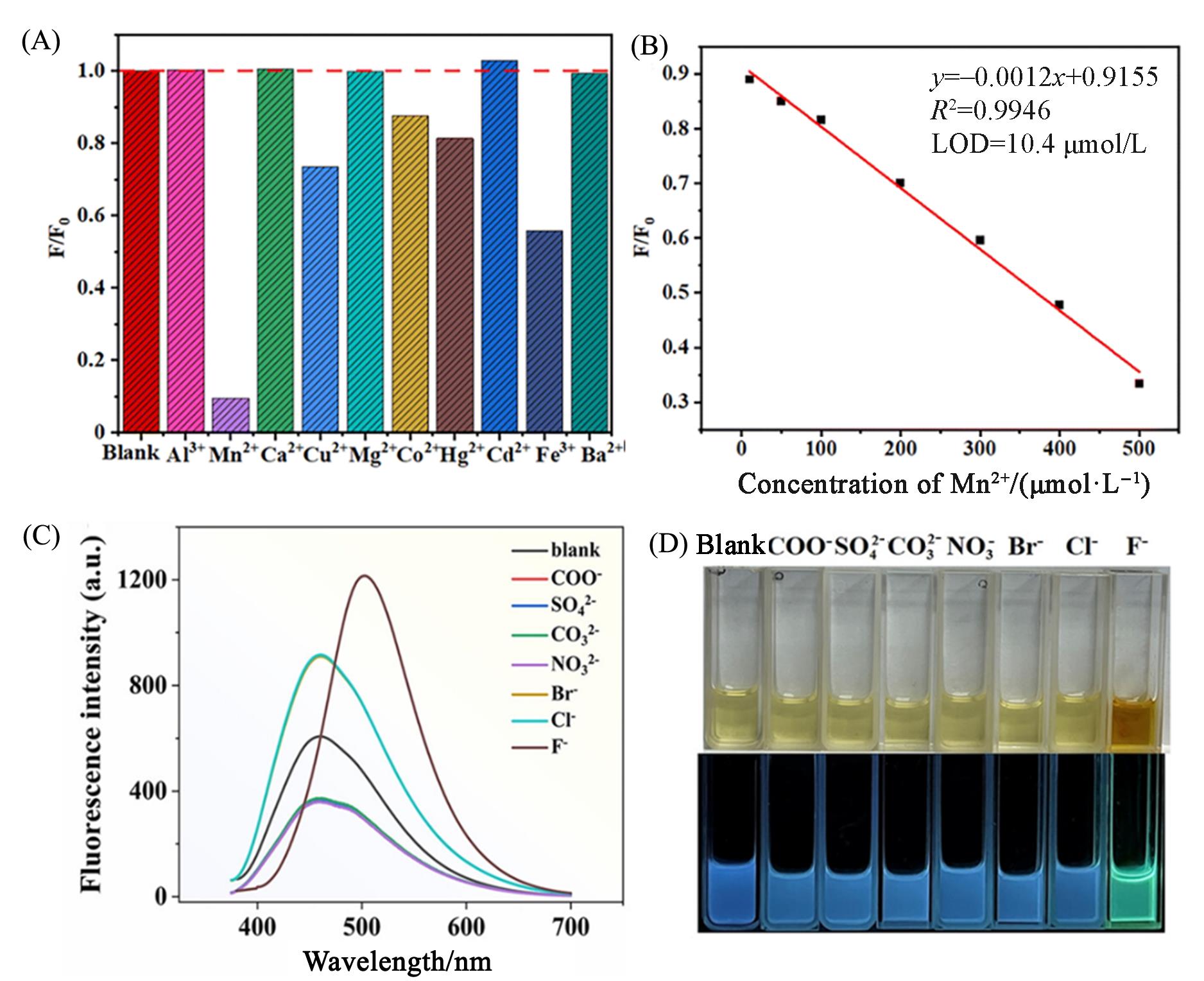
Fig.8 The influence of different metal ions on the fluorescence intensity of HBPSi⁃N ethanol solution(20 mg/mL)(A), the linear relationship between the fluorescence intensity of HBPSi⁃N ethanol solution and the concentration of Mn2+ ions(B)[41], the selectivity and anti⁃interference tests of HBPSi⁃B⁃1(C) and fluorescence photos with different anions(D)[54](A, B) Copyright 2025, the Royal Society of Chemistry; (C, D) copyright 2024, Wiley-VCH.
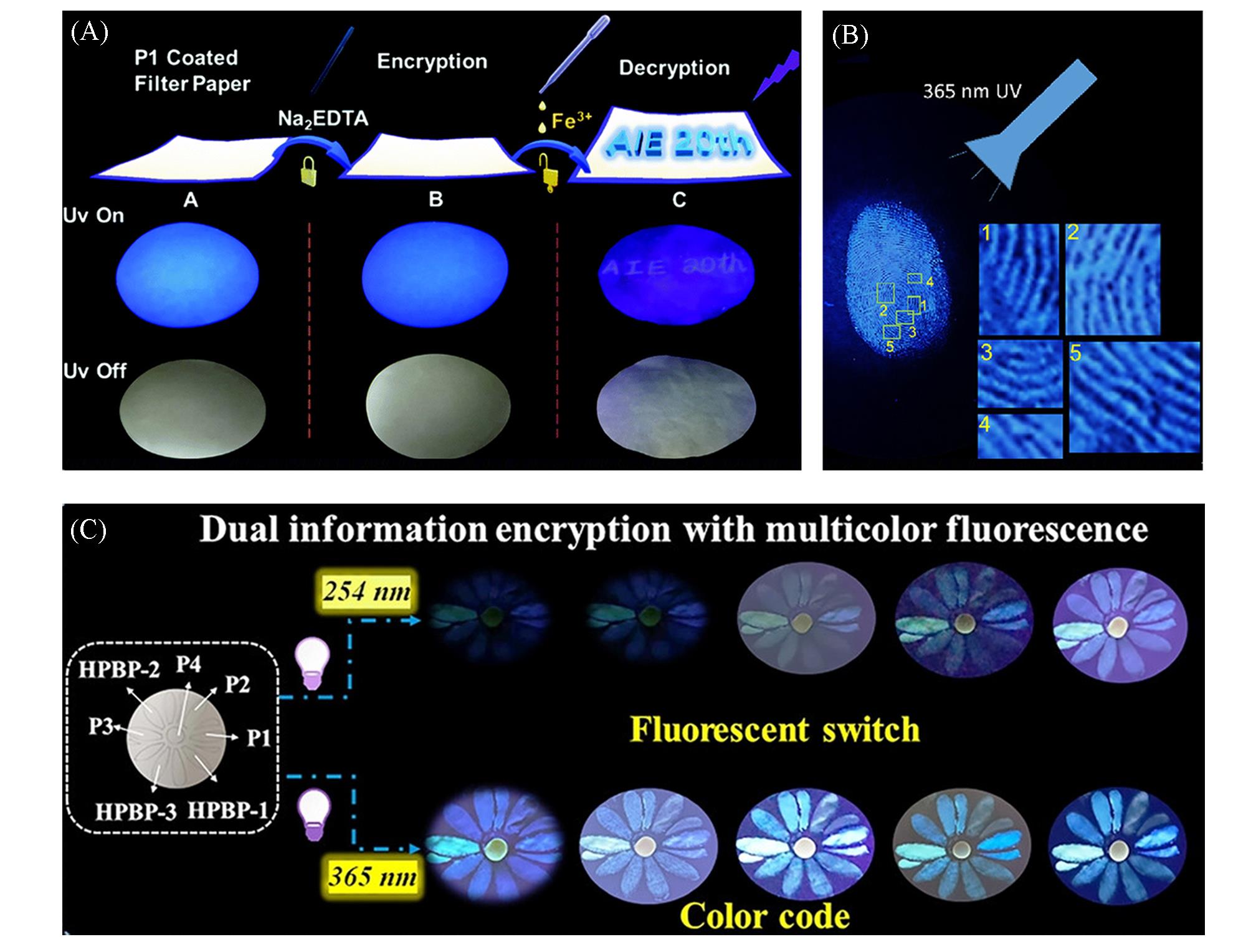
Fig.9 HBPSi⁃C for information encryption and decryption(A)[56], fluorescence imaging of a latent fingerprint(bifurcation point, end point, and center point) on qualitative filter paper under excitation of 365 nm of UV light by HBPSi⁃Tyr(B)[57], and photographs of dual information encryption(C)[53](A) Copyright 2020, the Royal Society of Chemistry; (B) copyright 2022, American Chemical Society; (C) copyright 2023, Wiley-VCH.
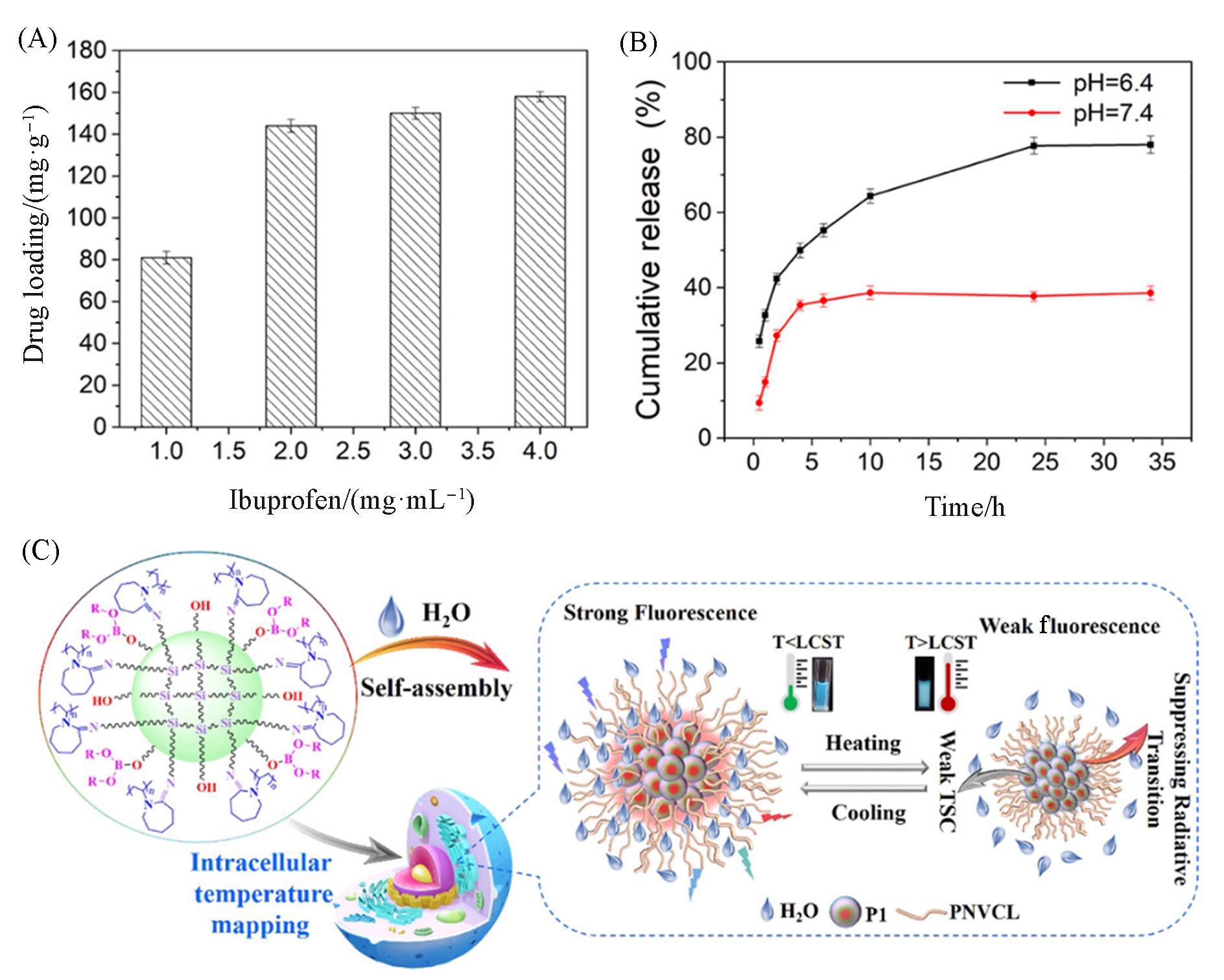
Fig.10 Drug loading(A) and release(B) of HBPSi⁃β⁃CD[43] and schematic of the mechanism for HBPSi⁃B⁃PNVCL’s temperature⁃induced fluorescence intensity decrease(C)[55](A, B) Copyright 2022, American Chemical Society; (C) copyright 2025, American Chemical Society.
| [1] | Ma F. L., Zhang S. W., Jiang J. H., Liu Y., Sun J. W., Lam J. W. Y., Zhao Z., Tang B. Z., Adv. Mater., 2024, 37, 2414188 |
| [2] | Ling Y., Liu X. J., Hao H. J., Hao X. H., Bai L. B., Wu Y. G., Chem. J. Chinese Universities, 2018, 39(6), 1319—1325 |
| [3] | Wu Z. N., Yao Q. F., Zang S. Q., Xie J. P., Natl. Sci. Rev., 2021, 8(6), nwaa208 |
| [4] | Liu Y. Y., Zhang X., Li K., Peng Q. C., Qin Y. J., Hou H. W., Zang S. Q., Tang B. Z., Angew. Chem. Int. Ed., 2021, 60(41), 22417—22423 |
| [5] | Yu M. X., Huang R. S., Guo J. J., Zhao Z. J., Tang B. Z., PhotoniX, 2 020, 1 (1), 1—32 |
| [6] | Duo Y. H., Han L., Yang Y. Q., Wang Z. F., Wang L. R., Chen J. Y., Xiang Z. Y., Yoon J. Y., Luo G. H., Tang B. Z., Chem. Rev., 2024, 124(20), 11242—11347 |
| [7] | Tu Y., Zhao Z., Lam J. W. Y., Natl. Sci. Rev., 2021, 8(6), nwaa260 |
| [8] | Hu R. R., Qin A. J., Tang B. Z., Prog. Polym. Sci., 2020, 100, 101176 |
| [9] | Zhang Z. T., Xiong Z. P., Chu B., Zhang Z. M., Xie Y., Wang L., Sun J. Z., Zhang H. K., Zhang X. H., Tang B. Z., Aggregate, 2022, 3, e278 |
| [10] | Liu X., Chu B., Xiong Z. P., Liu B., Tu W. H., Zhang Z. T., Zhang H. K., Sun J. Z., Zhang X. H., Tang B. Z., Mater. Horiz., 2024, 11, 1579—1587 |
| [11] | Wang Y. Y., Liu Z. A., Huang J. M., Wei H. L., Jiang C. J., Wei L. Z., Jiang B. L., Zou L. M., Xie H. H., Gong Y. Y., Small, 2025, 21, 2411123 |
| [12] | Tomalia D. A., Klajnert⁃Maculewicz B., Johnson K. A. M., Brinkman H. F., Janaszewska A., Hedstrand D. M., Prog. Polym. Sci., 2019, 90, 35—117 |
| [13] | Chen X., Sun Y., Yuan W. Z., Macromol. Chem. Phys., 2025, 226, 2400401 |
| [14] | Wang Z. Y., Zhang H. K., Li S. Q., Lei D. Y., Tang B. Z., Ye R. Q., Top. Curr. Chem., 2021, 379(2), 14—36 |
| [15] | Zhang J. Y., Xiong Z. P., Zhang H. K., Tang B. Z., Nat. Commun., 2025, 16(1), 3910 |
| [16] | Tang S. X., Yang T. J., Zhao Z. H., Zhu T. W., Zhang Q., Hou W. B. W., Yuan W. Z., Chem. Soc. Rev., 2021, 50(22), 12616—12655 |
| [17] | Zhang H. K., Tang B. Z., JACS Au, 2021, 1(11), 1805—1814 |
| [18] | Xu L., Coord. Chem. Rev., 2024, 519, 216094 |
| [19] | Niu S., Yan H. X., Macromol. Rapid Commun., 2015, 36(8), 739—743 |
| [20] | Niu S., Yan H. X., Chen Z. Y., Yuan L. X., Liu T. Y., Liu C., Macromol. Rapid Commun., 2016, 37, 136—142 |
| [21] | Niu S., Yan H. X., Chen Z. Y., Li S., Xu P. L., Zhi X. L., Polym. Chem., 2016, 7, 3747—3755 |
| [22] | Niu S., Yan H. X., Li S., Xu P. L., Zhi X. L., Li T. T., Macromol. Chem. Phys., 2016, 217(10), 1185—1190 |
| [23] | Niu S., Yan H. X., Chen Z. Y., Du Y. Q., Huang W., Bai L. H., Lv Q., RSC Adv., 2016, 6(108), 106742—106753 |
| [24] | Niu S., Yan H. X., Li S., Tang C., Chen Z. Y., Zhi X. L., Xu P. L., J. Mater. Chem. C, 2016, 4(28), 6881—6893 |
| [25] | Zhao Z., Li A., Yuan W. Z., Acc. Chem. Res., 2025, 58(4), 612—624 |
| [26] | Wu R., He Y. Y., Li Z., Yu Z. Y., Guo X., Yan H. X., Chem. Eur. J., 2025, 31, e202501133 |
| [27] | Buonomo J. A., Eiden C. G., Aldrich C. C., Synthesis, 2018, 50, 278—281 |
| [28] | Hamada T., Sugimoto T., Maeda T., Katsura D., Susumu M., Ohshita J., Langmuir, 2022, 38, 5829—5837 |
| [29] | Feng Y. B., Bai T., Yan H. X., Ding F., Bai L. H., Feng W. X., Macromolecules, 2019, 52(8), 3075—3082 |
| [30] | Zhao Y., He M. M., Xu L., Zhang C., Guo L. L., Feng W. X., Yan H. X., Biomacromolecules, 2023, 24(4), 1888—1900 |
| [31] | Bai L. H., Liu X., Yan H. X., Zhao S. S., Han X., Langmuir, 2023, 39(34), 12053—12062 |
| [32] | Wu R., Lian S. X., He Y. Y., Li Z., Zhao Y., Feng W. X., Yan H. X., J. Mater. Chem. B, 2024, 12(41), 10584—10592 |
| [33] | Du Y. Q., Liu Y. W., Li J. W., He Y. Y., Li Y. B., Yan H. X., Small, 2023, 19(40), 2302095 |
| [34] | Wang L., Xiong Z. P., Sun J. Z., Huang F. H., Zhang H. K., Tang B. Z., Angew. Chem. Int. Ed., 2024, 136(8), e202318245 |
| [35] | Ye S. Y., Bao Y. Y., Chem. Mater., 2024, 36(12), 5878—5896 |
| [36] | Sakhno T. V., Sakhno Y. E., Kuchmiy S. Y., Theor. Exp. Chem., 2023, 59(2), 75—106 |
| [37] | Yang Z. K., Du Y. Q., Li Q. W., Zhang J. Y., Li Q. L., Yan H. X., Macromolecules, 2025, 58(5), 2450—2458 |
| [38] | Bai T., Zhang Y. S., Wang L., Yan H. X., Zhou W. H., Aggregate, 2023, 4, e267 |
| [39] | Zhao Y., Xu L., Feng Z. X., Yin S., Feng W. X., Yan H. X., Biomacromolecules, 2024, 25(4), 2635—2644 |
| [40] | Zhao Y., Feng Z. X., He M. M., Wang X. Y., Feng W. X., Tian W., Yan H. X., Chem. Sci., 2025, 16, 11077 |
| [41] | Li Q., Qiao Y. J., Li Z., Wu R., Zhang Y. K., Zhao Y., Tian W., Wang R. M., Feng W. X., Yan H. X., J. Mater. Chem. B, 2025, 13(37), 11687—11695 |
| [42] | Bai L. H., Li H. Y., Gao J. Y., Ma X. T., Liu X. R., Yan H. X., Zhao S. S., Yu C. X., Li J. M., Chem. Eng. J., 2024, 499, 156253 |
| [43] | Bai L. H., Yang P. F., Guo L. L., Liu S. S., Yan H. X., Biomacromolecules, 2022, 23(3), 1041—1051 |
| [44] | Bai L. H., Yan H. X., Guo L. L., He M. M., Bai T., Yang P. F., Macromol. Chem. Phys., 2021, 222(23), 2100283 |
| [45] | Todorova Z., Tumurbaatar O., Todorova J., Ugrinova I., Koseva N., Eur. Polym. J., 2021, 142, 110151 |
| [46] | Guo L. L., Yan H. X., Wang L. L., Yang P. F., Yan L. R., Zhao Y., Mater. Adv., 2021, 2(23), 7701—7708 |
| [47] | Bai L., Liu X. R., Yan H. X., Zhao S. S., Polym. Chem., 2023, 14(30), 3501—3511 |
| [48] | Bai L. H., Ge X. Q., Zhao S. S., Yang H., Li J. M., Yan H. X., Liu X. R., Macromolecules, 2025, 58(15), 8458—8467 |
| [49] | Bai L. H., Ge X. Q., Zhao S. S., Yang H., Li J. M., Yan H. X., Liu X. R., Macromolecules, 2025, 58(2), 1038—1047 |
| [50] | Kwok R. T. K., Leung C. W. T., Lam J. W. Y., Tang B. Z., Chem. Soc. Rev., 2015, 44(13), 4228—4238 |
| [51] | Grams R. J., Santos W. L., Scorei I. R., Abad⁃García A., Rosenblum C. A., Bita A., Cerecetto H., Viñas C., Soriano⁃Ursúa M. A., Chem. Rev., 2024, 124, 2441—2511 |
| [52] | Guo L. L., Yan L. R., He Y. Y., Feng W. X., Zhao Y., Tang B. Z., Yan H. X., Angew. Chem. Int. Ed., 2022, 61(29), e202204383 |
| [53] | He Y. Y., Feng W. X., Qiao Y. J., Tian Z. X. Tang B. Z., Yan H. X., Angew. Chem. Int. Ed., 2023, 62(48), e202312571 |
| [54] | He Y. Y., Qiao Y. J., Li Z., Feng W. X., Zhao Y., Tian W., Tang B. Z., Yan H. X., Angew. Chem. Int. Ed., 2024, 63, e202413425 |
| [55] | He Y. Y., Wu R., Li Z., Zhang Y. K., Liu W. Y., Feng W. X., Yan H. X., Biomacromolecules, 2025, 26(5), 3011—3020 |
| [56] | Feng Y. B., Yan H. X., Ding F., Bai T., Nie Y. F., Zhao Y., Feng W. X., Tang B. Z., Mater. Chem. Front., 2020, 4, 1375—1382 |
| [57] | Bai L. H., Zhang Y. Z., Yan H. X., Liu X. R., Biomacromolecules, 2022, 23(11), 4617—4628 |
| [1] | ZHANG Ruiqing, YIN Kuo, CHEN Yanjie, GU Fan, LIU Jian, MA Xiang. In situ Multiple Optical Monitoring of Bulk Polymerization [J]. Chem. J. Chinese Universities, 2026, 47(5): 20260051. |
| [2] | YIN Shiqi, ZHENG Zhigang, HE Xintong, WANG Shimin, GU Xinggui, WANG Erjing. From Protogenesis to Functionalization: Luminescence, Modification and Application of AIE⁃active Natural Products [J]. Chem. J. Chinese Universities, 2026, 47(5): 20260042. |
| [3] | JIAO Haili, ZHENG Xiaoyan. Progress on Theoretical Study of Organic Luminescence Enhancement Induced by Confined Environments [J]. Chem. J. Chinese Universities, 2026, 47(5): 20260060. |
| [4] | ZENG Xianping, QIN Yi, WANG Dong. Aggregation-induced Emission Probes for Imaging-guided Surgery [J]. Chem. J. Chinese Universities, 2026, 47(5): 20260066. |
| [5] | ZHAI Zhe, LIU Leijing, TIAN Wenjing. Molecular Design of Aggregation-induced Emission Probes and Their Applications in Organelle Imaging [J]. Chem. J. Chinese Universities, 2026, 47(5): 20260078. |
| [6] | LI Weijian, XU Xiaoqin, WANG Wei, YANG Haibo. Recent Advances in AIE-active Dendrimers [J]. Chem. J. Chinese Universities, 2026, 47(5): 20260003. |
| [7] | ZHANG Kaiwei, QIN Anjun. Lanthanide Complexes with Aggregation-induced Emission [J]. Chem. J. Chinese Universities, 2026, 47(5): 20260013. |
| [8] | WU Yuqian, XIA Yang, LI Wanhui, WANG Xiaoye. Achiral-polymer-based Co-assembled Circularly Polarized Luminescent Materials [J]. Chem. J. Chinese Universities, 2026, 47(5): 20260006. |
| [9] | WANG Shengjie, ZHU Zihao, ZHU Yujie, WU Chunxiao, ALIM Abdurahman. Advances and Challenges of Stable Organic Radicals with Luminescence in the Condensed State [J]. Chem. J. Chinese Universities, 2026, 47(5): 20250408. |
| [10] | YUAN Letian, GUO Jiachen, WU Tongyue, GAO Shuitao, HUANG Jianbin, YAN Yun. Template for Delayed Fluorescence Based on Clusteroluminescence [J]. Chem. J. Chinese Universities, 2026, 47(5): 20260075. |
| [11] | ZHU Gaohua, SHU Ju, GENG Jiangtao, MA Fulong, XIONG Linghong, HE Xuewen. In situ Activating NIR-II AIE Probe for Highly Sensitive Hydrogen Peroxide Imaging in Tumor [J]. Chem. J. Chinese Universities, 2026, 47(5): 20260058. |
| [12] | PAN Jingke, QI Xin, ZHANG Lulu, WANG Beibei, LU Chao. Synthesis and Application of Aggregation-induced Emission Supramolecular Polymers Constructed by Host-guest Interaction [J]. Chem. J. Chinese Universities, 2026, 47(5): 20260130. |
| [13] | LIU Miaomiao, FU Mengran, GAO Die, ZHANG Wanpeng, LIANG Ying, HE Yuanyuan, ZHAO Qiaoqiao, ZHAO Tingxing, LI Hongbo, DING Zicheng, HAN Yanchun. Side-chain Engineering of “Bridging” Polymer Acceptors with Donor/Acceptor Dual Similarity for High-performance Ternary Organic Solar Cells [J]. Chem. J. Chinese Universities, 2026, 47(4): 20250324. |
| [14] | CHENG Jianshuo, YE Wenyan, ZHOU Lulu, LIU Mouwei, LI Zhongyu, TANG Ziran, YU Wanting, ZHU Liangliang. Photoexcitation-induced Biomacromolecular Self-assembly [J]. Chem. J. Chinese Universities, 2026, 47(4): 20250398. |
| [15] | GAO Xin, QING Jia, HU Yichen, SHANGGUAN Zhichun, LIANG Tongling, ZHOU Yongsheng, ZHANG Guanxin, ZHANG Deqing. Novel AIE Fluorescent Probes for Ultrahigh Sensitivity and High Photostability in Lipid Droplets Imaging [J]. Chem. J. Chinese Universities, 2026, 47(4): 20250410. |
| Viewed | ||||||
|
Full text |
|
|||||
|
Abstract |
|
|||||
