

Chem. J. Chinese Universities ›› 2026, Vol. 47 ›› Issue (8): 20260004.doi: 10.7503/cjcu20260004
• Physical Chemistry • Previous Articles Next Articles
LI Shiqing1, WANG Zhuo2, ZHANG Bin1, ZENG Bingfang3, RUAN Xianghui1( ), LYU Menglan1()
Received:2026-01-01
Online:2026-08-10
Published:2026-05-14
Contact:
RUAN Xianghui, LYU Menglan
E-mail:xhruan@gzu.edu.cn;mllv@gzu.edu.cn
Supported by:CLC Number:
TrendMD:
LI Shiqing, WANG Zhuo, ZHANG Bin, ZENG Bingfang, RUAN Xianghui, LYU Menglan. Pseudo Lotus Leaf Layered Design to Enhance the Surface Hydrophobicity and CO2 Adsorption Capability of 13X Molecular Sieve[J]. Chem. J. Chinese Universities, 2026, 47(8): 20260004.
| Temperatur/℃ | Langmuir adsorption model | Freundlich adsorption model | |||||
|---|---|---|---|---|---|---|---|
| qm | k | R2 | k | 1/n | R2 | ||
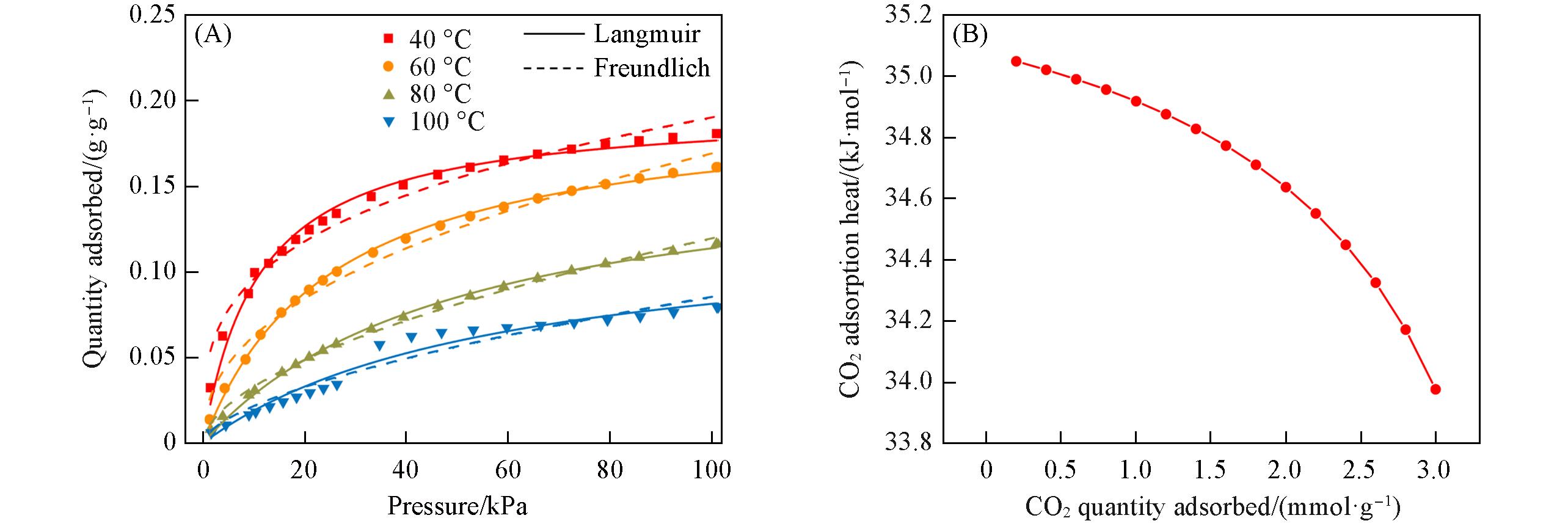
| 40 | 0.195 | 0.091 | 0.988 | 0.048 | 0.297 | 0.967 | |
| 60 | 0.198 | 0.039 | 0.998 | 0.023 | 0.431 | 0.981 | |
| 80 | 0.171 | 0.019 | 0.997 | 0.009 | 0.559 | 0.995 | |
| 100 | 0.128 | 0.017 | 0.968 | 0.005 | 0.595 | 0.943 | |
Table 1 Langmuir and Freundlich adsorption isotherm fitting parameters of PS-PMMA0.05/13X molecular sieve
| Temperatur/℃ | Langmuir adsorption model | Freundlich adsorption model | |||||
|---|---|---|---|---|---|---|---|
| qm | k | R2 | k | 1/n | R2 | ||
| 40 | 0.195 | 0.091 | 0.988 | 0.048 | 0.297 | 0.967 | |
| 60 | 0.198 | 0.039 | 0.998 | 0.023 | 0.431 | 0.981 | |
| 80 | 0.171 | 0.019 | 0.997 | 0.009 | 0.559 | 0.995 | |
| 100 | 0.128 | 0.017 | 0.968 | 0.005 | 0.595 | 0.943 | |
| Molecular sieve | Hydrophobic modification | Adsorption conditions | Adsorption capacity/(g∙g-1) | Ref. | ||
|---|---|---|---|---|---|---|
| Temperature/℃ | CO2 volume fraction(%) | RH(%) | ||||
| MOR | Dealumination | 25 | 9 | 75 | 0.0298 | [ |
| NaX | Silanization | 50 | 14 | 5 | 0.0150 | [ |
| NaX | Polyacrylate hydrophobic layer | 40 | 10 | 11 | 0.0563 | [ |
| β | Benzylamine functionalization | 40 | 10.5 | 5 | 0.0382 | [ |
| 13X | Carbon coating | 25 | 13.6 | 4.5 | 0.0460 | [ |
| A Type | Imidazolate⁃based hydrophobic layer | 25 | 15 | 90 | 0.1174 | [ |
| ZSM⁃5 | All⁃silica MFI hydrophobic layer | 40 | 15 | 100 | 0.0132 | [ |
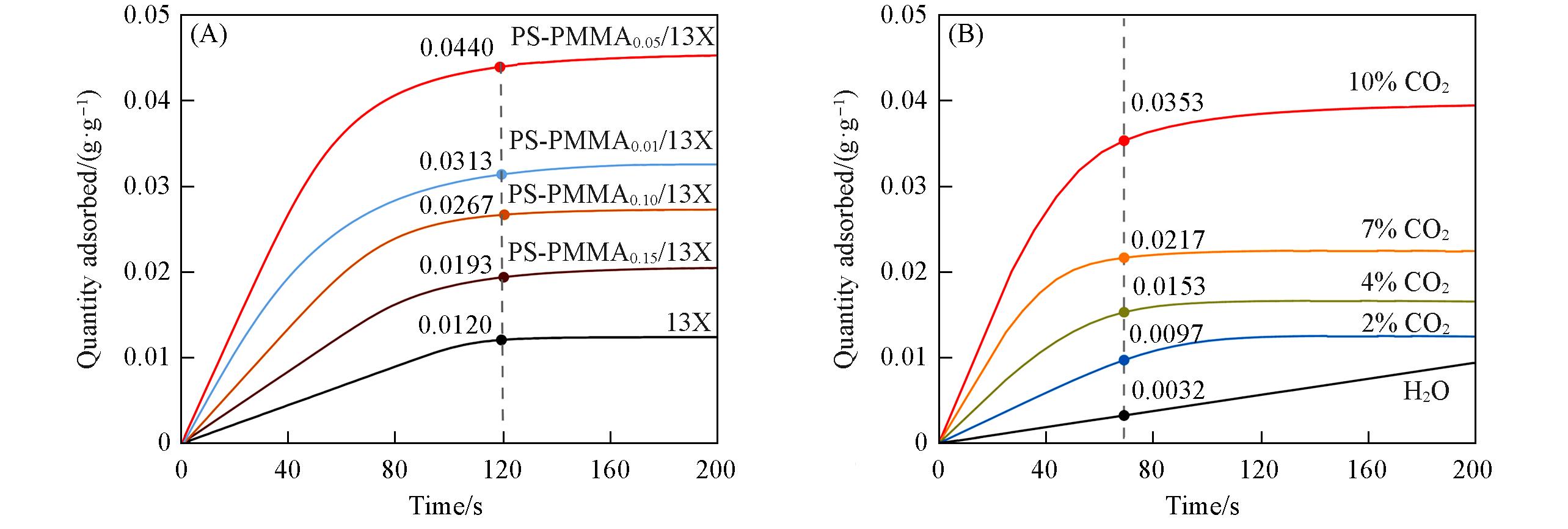
| PS⁃PMMA0.05/13X | PS⁃PMMA hydrophobic particle layer | 50 | 15 | 15 | 0.0440 | This work |
Table 2 Comparison of CO2 adsorption performance of hydrophobically modified molecular sieve under different conditions
| Molecular sieve | Hydrophobic modification | Adsorption conditions | Adsorption capacity/(g∙g-1) | Ref. | ||
|---|---|---|---|---|---|---|
| Temperature/℃ | CO2 volume fraction(%) | RH(%) | ||||
| MOR | Dealumination | 25 | 9 | 75 | 0.0298 | [ |
| NaX | Silanization | 50 | 14 | 5 | 0.0150 | [ |
| NaX | Polyacrylate hydrophobic layer | 40 | 10 | 11 | 0.0563 | [ |
| β | Benzylamine functionalization | 40 | 10.5 | 5 | 0.0382 | [ |
| 13X | Carbon coating | 25 | 13.6 | 4.5 | 0.0460 | [ |
| A Type | Imidazolate⁃based hydrophobic layer | 25 | 15 | 90 | 0.1174 | [ |
| ZSM⁃5 | All⁃silica MFI hydrophobic layer | 40 | 15 | 100 | 0.0132 | [ |
| PS⁃PMMA0.05/13X | PS⁃PMMA hydrophobic particle layer | 50 | 15 | 15 | 0.0440 | This work |
| [1] | Bashir A., Ali M., Patil S., Aljawad M. S., Mahmoud M., Al⁃Shehri D., Hoteit H., Kamal M. S., Earth⁃Sci. Rev., 2024, 249, 104672 |
| [2] | Mirziyoyeva Z., Salahodjaev R., Front. Energy Res., 2023, 11, 1123269 |
| [3] | Zhang X., Li K., Ma Q., Fan J. L., Chin. J. Popul. Resour., 2021, 31(9), 29—33 |
| 张贤, 李凯, 马乔, 樊静丽. 中国人口·资源与环境, 2021, 31(9), 29—33 | |
| [4] | Zhang L. Y., Song Y. F., Shi J., Shen Q., Hu D., Gao Q., Chen W., Kow K. W., Pang C. H., Sun N. N., Adv. Atmos. Sci., 2022, 39(8), 1252—1270 |
| [5] | Hong W. Y., Carbon Capture Sci. T., 2022, 3, 100044 |
| [6] | Qi G. G., Meng X. J., Chem. J. Chinese Universities, 2023, 44(10), 9—18 |
| 戚刚刚, 孟祥举. 高等学校化学学报, 2023, 44(10), 9—18 | |
| [7] | Najafi A. M., Soltanali S., Khorashe F., Ghassabzadeh H., Chemosphere, 2023, 324, 138275 |
| [8] | Yin Y. K., Wu J. L., Wang X. Y., Ma K., Zhai W. J., Wu Z. J., Zhang J. B., Chem. Eng. Sci., 2024, 288, 119838 |
| [9] | Wang Z. P., Yu J. H., Xu R. R., Chem. Soc. Rev., 2012, 41(5), 1729—1741 |
| [10] | Huang W. W., Ren J. W., Fang Q. R., Valtchev V., Chem. J. Chinese Universities, 2018, 39(6), 1127—1131 |
| 黄薇薇, 任家旺, 方千荣, Valtchev V. 高等学校化学学报, 2018, 39(6), 1127—1131 | |
| [11] | Yang X. D., Wang Q. S., Chen J., Liu H. B., Xu L. P., Rao M. J., Processes, 2024, 12(8), 1547 |
| [12] | Lu J. H., Tang J. J., Li J. M., Wang S. L., Appl. Therm. Eng., 2022, 213, 118746 |
| [13] | Mi Z. R., Lu T. T., Zhang J. N., Xu R. R., Yan W. F., Chem. Res. Chinese Universities, 2022, 38(1), 9—17 |
| [14] | Wang B. H., Zhu Y., Qin Q. Y., Liu H. X., Zhu J., Appl. Catal. A: Gen., 2021, 611, 117952 |
| [15] | Cao B. N., Jia Q., Li G. Q., Cui H. T., Li F., Peng B., Li L., Chem. Commun., 2025, 61(83), 16274—16277 |
| [16] | Lu X. X., Hu H. L., Lv X. J., Zhang Y. X., Zhang J., Mod. Chem. Ind., 2023, 43(10), 105—110 |
| 卢欣欣, 胡华雷, 吕晓静, 张业新, 张建. 现代化工, 2023, 43(10), 105—110 | |
| [17] | Babić V., Koneti S., Moldovan S., Debost M., Gilson J. P., Valtchev V., Micropor. Mesopor. Mat., 2022, 329, 111513 |
| [18] | Pliekhov O., Pliekhova O., Arčon I., Bondino F., Magnano E., Mali G., Logar N. Z., Micropor. Mesopor. Mat., 2020, 302, 110208 |
| [19] | Yin T., Meng X., Jin L. P., Yang C., Liu N. W., Shi L., Micropor. Mesopor. Mat., 2020, 305, 110327 |
| [20] | He X. R., Xue B., Wei R. X., Liao K. L, Li G. Y., Zhao T. B., Energ. Convers. Manage., 2024, 313, 118612 |
| [21] | Jovellana J. A. K. P., Pajarito B. B., Key Eng. Mater., 2019, 801, 179—184 |
| [22] | Li Y. X., Shen J. X., Peng S. S., Zhang J. K., Wu J., Liu X. Q., Sun L. B., Nat. Commun., 2020, 11(1), 3206 |
| [23] | Liu M., Jiang L., Adv. Funct. Mater., 2010, 20(21), 3753—3764 |
| [24] | Dumbre D., Ayoub E., Dawaymeh F., Abbas Y., Elmhamdi A., Matouk Z., Alazzam A., Khaleel M., Alamoodi N., Eur. Polym. J., 2024, 218, 113365 |
| [25] | Nalawade S. P., Picchioni F., Marsman J. H., Janssen L. P. B. M., J. Supercrit. Fluids, 2006, 36(3), 236—244 |
| [26] | Zhang K., He G. Y., Wang N., Dong Z. Y., Ma Y. H., Xu J., Mei D. H., Sun Q. M., Yu J. H., J. Am. Chem. Soc., 2025, 147(30), 26277—26285 |
| [27] | Liu J. B., Sun X. Z., Li N., Tan T. T., Zhang F., Sun M., Liu Q., Env. Pollut. Bioavail., 2024, 36(1), 2387683 |
| [28] | Xu Q., Lu J. Y., Zhou Z. Y., Jin Y. J., Sep. Purif. Technol., 2025, 369, 133147 |
| [29] | Sun Y. B., Tang J. F., Li G. Y., Hua Y. H., Li H., Hu S. Y., ACS Omega, 2022, 7(22), 18542—18551 |
| [30] | He W. Y., Wang J., Li Y. X., Ye W. H., Jing C., Lv M. H., Huang H. M., Fu M. L., Wu J. L., Hu Y., Ye D. Q., Acta Sci. Circ., 2022, 42(3), 373—383 |
| 何文宇, 王婧, 李艳霞, 叶文桦, 井察, 吕明慧, 黄皓旻, 付名利, 吴军良, 胡芸, 叶代启. 环境科学学报, 2022, 42(3), 373—383 | |
| [31] | Yan X. H., Li P., Yuan H., Huang W., Hu Z., Yang R. T., Sep Purif. Technol., 2025, 354, 129304 |
| [32] | Krishnan M. R., Aldawsari Y. F., Alsharaeh E. H., J. Appl. Polym. Sci., 2021, 138(9), 49942 |
| [33] | Cheng X. Y., Wu C. L., Wu X., Li H. X., Coal Convers., 2021, 44(3), 76—82 |
| 程晓莹, 武成利, 吴祥, 李寒旭. 煤炭转化, 2021, 44(3), 76—82 | |
| [34] | Si Y. C., Wu T., Multipurpose Util. Miner. Resour., 2022, 43(4), 157—161 |
| 司玉成, 吴涛. 矿产综合利用, 2022, 43(4), 157—161 | |
| [35] | Aldosari M. A., Alsaud K. B. B., Othman A., Al⁃Hindawi M., Faisal N. H., Ahmed R., Michael F. M., Krishnan M. R., Asharaeh E., Polymers, 2020, 12(5), 1155 |
| [36] | Dai R. J., Zhao Y. Q., Zhai Q. C., Wang S. Y., Li H., Chen X. X., Yu J. L., Dou J. X., Colloid Surface A., 2025, 716, 136716 |
| [37] | Krishnan M. R., Alshabib R. M., Alsharaeh E. H., Polymers, 2025, 17(14), 1970 |
| [38] | Madhu J., Santhanam A., Natarajan M., Velauthapillai D., RSC Adv., 2022, 12(36), 23221—23239 |
| [39] | Ren W. R., Zhou G. L., Li R. H., Jiang W. L., Wang Z. R., Li J. C., Xuan S. G., Cui Y. X., Pet. Process. Pet., 2024, 55(12), 13—21 |
| 任文瑞, 周广林, 李汝晗, 姜伟丽, 王仲戎, 李继聪, 宣守国, 崔玉鑫. 石油炼制与化工, 2024, 55(12), 13—21 | |
| [40] | Mi Z. R., Li S. J., Liu W., Wang J., Deng D. H., Liu P. S., Tian P., Liu C., Yan W. F., Zhu K. K., J. Am. Chem. Soc., 2025, 147(20), 16922—16934 |
| [41] | Xu Z. C., Yu Z. D., Wu H. F., Wu P. W., Wu H. X., Chao Y. H., Zhu W. S., Liu Z. C., Xu C. M., CIESC J., 2025, 76(5), 2198—2208 |
| 徐智超, 俞镇东, 吴昊峰, 吴沛文, 武洪翔, 巢艳红, 朱文帅, 刘植昌, 徐春明. 化工学报, 2025, 76(5), 2198—2208 | |
| [42] | Zhan F., Gao W. N., Zhao F., Qin P., Sun X. L., Sun C. K., Tang S. S., Wang L., Soft Matter, 2022, 18(11), 2123—2128 |
| [43] | Shen Y., Yang X. W., Zheng J. Y., Liang Y. H., Zhao X. X., Ying Z. Y., Zhao J. K., Ye J. X., Zhang S. H., Sep. Purif. Technol., 2025, 373, 133488 |
| [44] | Olushola S. B., Bocus K. M. A., Devnath B., Reza M. T., Pahinkar D. G., Surf. Interf., 2026, 83, 108554 |
| [45] | Hu M. H., Qie Z. P., Liu Z. B., Lu X. P., Bai S. Y., Lv L, Wang Z. P., Xiang H. Z., Ou X. X., Zhuang Y. Y., Micropor. Mesopor. Mat., 2025, 384, 113465 |
| [46] | Han C. H., Teng Y., Zhang K., Acta Sci. Circ., 2026, 46(1), 310—320 |
| 韩晨浩, 滕阳, 张锴. 环境科学学报, 2026, 46(1), 310—320 | |
| [47] | Zhou A. G., Yang C. R., Xue M., Xue B., Zheng J. L., Li X. C., Nie F., Zhao X. L., Mi J. G., Sep. Purif. Technol., 2025, 355, 129689 |
| [48] | Kwon D. I., Kim J. C., Lee H., Lee W., Jo C., Chem. Eng. J., 2022, 427, 131461 |
| [49] | Zhao T., Wei Y. J., Wang J. W., Wang Q., Chen Y. L., Liu X. Z., Zhao Y. F., Sep. Purif. Technol., 2023, 317, 123762 |
| [50] | Gao F., Li Y. K., Bian Z. J., Hu J., Liu H. L., J. Mater. Chem. A., 2015, 3(15), 8091—8097 |
| [51] | Miyamoto M., Ono S., Kusukami K., Oumi Y., Uemiya S., ChemSusChem, 2018, 11(11), 1756—1760 |
| [1] | LIANG Luxian, SONG Anqi, ZHOU Yang, SUN Ping, WANG Deqiang, WEI Jie. Piezoelectric Effect of Polyether Ether Ketone Fibers Loaded with Bismuth Oxide Stimulating Osteogenic Differentiation [J]. Chem. J. Chinese Universities, 2024, 45(7): 20240169. |
| [2] | ZHAO Sheng, HUO Zhipeng, ZHONG Guoqiang, ZHANG Hong, HU Liqun. Preparation of Modified Gadolinium/Boron/Polyethylene Nanocomposite and Its Radiation Shielding Performance for Neutron and Gamma-ray [J]. Chem. J. Chinese Universities, 2022, 43(6): 20220039. |
| [3] | SHI Ying, HU Guangjian, WU Minjie, LI Feng. Applications of Low Temperature Plasma for the Materials in Li-ion Batteries [J]. Chem. J. Chinese Universities, 2021, 42(5): 1315. |
| [4] | JI Shaobo, CHEN Xiaodong. Surface and Interface Chemistry in Flexible Electronics [J]. Chem. J. Chinese Universities, 2021, 42(4): 1074. |
| [5] | YAN Fanyong, SUN Zhonghui, PANG Jiping, JIANG Yingxia, CHEN Yuan. Functionalized Carbon Dots of Benzothiazine Derivatives for Detection of Quercetin in Ginkgo Biloba Tea [J]. Chem. J. Chinese Universities, 2020, 41(8): 1768. |
| [6] | PENG Xinyan, LIU Yunhong, LI Jiawen, FENG Yilong, WANG Hanchun. Preparation and Characterization of Tannin/Zwitterionic Modified Oil-water Separation Membrane † [J]. Chem. J. Chinese Universities, 2020, 41(6): 1337. |
| [7] | CHEN Liangdan,ZOU Wei,WU Liang,XIA Fanjie,HU Zhiyi,LI Yu,SU Baolian. Nano-Al2O3 Coated Li-rich Cathode Material Li1. 2Ni0.13Co0.13Mn0.54O2 for Highly Improved Lithium-ion Batteries † [J]. Chem. J. Chinese Universities, 2020, 41(6): 1329. |
| [8] | LIU Shuaizhuo,ZHANG Qian,LIU Ning,XIAO Wenyan,FAN Leiyi,ZHOU Ying. One-step Synergistic Hydrophobic Modification of Melamine Sponge and Its Application † [J]. Chem. J. Chinese Universities, 2020, 41(3): 521. |
| [9] | ZHANG Xinyu, WANG Hong, FANG Yun, FAN Ye. Stimuli-responsive Fe3O4 Nanoparticle Modified by Conjugated Linoleic Acid [J]. Chem. J. Chinese Universities, 2020, 41(11): 2519. |
| [10] | MAO Long, LIU Yuejun, FAN Shuhong. Preparation and Properties of Polypyrrole Modified Layered Clay/poly(ε-caprolactone) Antibacterial Nanocomposites [J]. Chem. J. Chinese Universities, 2019, 40(8): 1726. |
| [11] | SUI Jiayang, LIU Xiaoyang, QIAN Miaomiao, ZHU Yanchao, XUE Beichen, FENG Yi, TIAN Yumei, WANG Xiaofeng. Surface Modification of Silica/carbon Black Derived from Rice Husks and Its Influence on Natural Rubber Composites† [J]. Chem. J. Chinese Universities, 2019, 40(7): 1561. |
| [12] | LIU Zile, ZENG Zequan, YANG Jieyang, CUI Yan, WU Ailian, LI Zhe, HUANG Zhanggen. Degradation of Phenol with Persulfate Activated by Surface Modified Activated Carbon† [J]. Chem. J. Chinese Universities, 2017, 38(7): 1241. |
| [13] | MA Zichuan, LI Junshu, XING Shengtao. Facile Cyclohexane-mediated Hydrothermal Synthesis of Modified δ-MnO2 with Enhanced Fenton-like Catalytic Activity† [J]. Chem. J. Chinese Universities, 2017, 38(4): 636. |
| [14] | SUN Hui, YU Qingsong, YANG Biao, XU Guozhi. Surface Hydrophilic Modification of Poly(ether ether ketone) and Immobilization of Collagen† [J]. Chem. J. Chinese Universities, 2016, 37(6): 1154. |
| [15] | CAO Xiaolu, WANG Longlong, WANG Yajun, XU Qunjie, LI Qiaoxia. Facile Preparation of Amino-modified Pd/TiO2/C Nanocatalyst and Its Electrocatalytic Performance for Ethanol Oxidation in Alkaline Solution† [J]. Chem. J. Chinese Universities, 2015, 36(6): 1187. |
| Viewed | ||||||
|
Full text |
|
|||||
|
Abstract |
|
|||||
